The beginning of the end? Is the middle-class evaporating or did it ever exist?
I remember when we got our first color television. It was 1973. My parents purchased the house two years prior, and that television was a refurbished Zenith console model.
I was the remote control.
From his favorite chair, my father would bark at me: “Turn to Channel 13! I want to see Walter Cronkite.”
Growing up in that house of Franklin Street in Saco with my sister and our dog, Kelly, I was positive we were a middle class family.
My father was a teacher. My mom worked part-time at Canal Bank. I was a Cub Scout and took clarinet lessons. My sister took ballet and tap lessons. We ate dinner at the table, and put on our good clothes for church on Sunday.
Shit, I was an altar boy. Life was good. Right?
Maybe, but it was certainly more a perception of reality than a hard fact.
What is the middle class? Who can define it? Is it disappearing or was it always a myth?
Defenders of the Myth
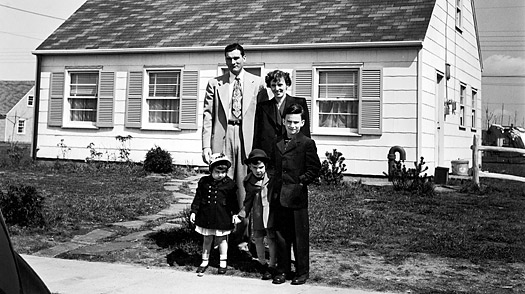
Politicians, pundits and just about everyone else loves to “stand up” for the middle class, but what are they defending?
Few politicians dare define the middle class because they fear what will happen if the economy tanks, and more people feel left out of the so-called American Dream.
Just look at Mitt Romney’s blunder when he attempted to define the middle class (“Those earning $200,000 to $250,000 and less’)
According to an April 14 story in USA Today: “President Obama mentioned the middle class a half-dozen times in his State of the Union address this year, and House Speaker John Boehner told Obama to “stand up for middle-class jobs.”
Google says [the middle class] has been called the “backbone of the country” at least 2.3 million times.
From gridlocked Washington to cities and town everywhere, the middle class is far and away America’s favorite socioeconomic group.
Yet no one can agree on what, exactly, the middle class is.
Economists and sociologists say that’s a big deal. Decisions are made, laws are written and elections are won or lost based on people’s beliefs about the middle class and what it means to the country. A nation that so values the middle class, they say, really should be better at defining it.”
Perception or reality?
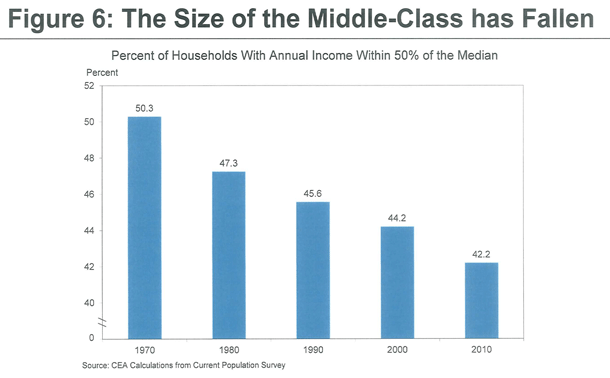
According to numerous polls, most Americans define themselves as “middle-class,” despite ample statistical evidence to the contrary. It would appear that we prefer the middle. A short drive on the Maine Turnpike will back-up my anecdotal observation, watching drivers hug the center lane.
By definition, the “middle” is wedged halfway between lower and upper, between large and small, equidistant between left and right.
Go to the grocery store and try to buy “small” eggs. You can’t. The smallest eggs you can buy are “medium-sized” Try to buy a small soft drink at McDonald’s. You can’t. The cashier will offer you a medium. It’s ridiculous how we play these games of perception that have no basis in logic.
We don’t like to talk about the lower-class, the lower rungs of our socio-economic ladder. Nor are most people comfortable contemplating the rungs above.
Politically, we tend to generalize and demonize both the lower and upper class. Poor people have made bad choices and are inherently lazy. Rich people are greedy bastards who only care about themselves.
We puff ourselves full of self-righteous indignation, armed with little more than anecdotal evidence.
What is middle class? Are you middle class?
It appears that few things are more subjective than determining where you fit on America’s socio-economic scale. But let’s look at some data.
Using 2012 data from the U.S. Census Bureau, it’s easy to see that median annual household income in the United States is $51,371. The median is halfway between the top figure and the bottom figure (not an average). This means that half of all households in the U.S. earn less than $51, 371 per year; and that half of all households earn more than $51, 371.
Now let’s look at the state of Maine, where the median household income is lower, estimated at $46,709 per year. Remember, this includes all income from everyone in your household, regardless of whether they are related to you.
So what should be the margin for determining middle income in Maine? For argument’s sake, let’s say +/- 10 points, so now we have determined the middle household income range based on data ($42,000 -$51,380).
Are you still in the middle class?
In fairness, middle class is more than just income. There are numerous other factors: home ownership, profession, level of education, marital status, etc.
But what about debt load? Even with a good income, those with high debt loads may be struggling and not feeling like the middle class.
Feelings are not facts
How we feel about our situation makes up a large part of our subjective analysis regarding whether we are middle class or not middle class.
A friend of mine recently stated that the middle class is evaporating. He bemoaned the good ol’ days of his youth and the opportunities his father had in the booming years following World War II.
Let’s think about that for a minute. In fact, I challenge you to get up from your computer and take a quick walk around your home. Is your standard of living higher now than when you grew up?
I’ll share my own observations.
I started by stepping outside for a cigarette break. I have a snowblower. My parents had shovels. I have a boat, a camper. Not my parents. My truck was purchased brand-new; my wife’s car is fully loaded with tinted windows and a retractable moon-roof. My parents bought used cars.
Our houses are somewhat similar except my parents’ home had one bath. Mine? Two bathrooms and enough space for a home office. My parents didn’t have a cell-phone bill. They did not pay for internet. If you had blue-tooth, you needed to see the dentist. There were no home theater systems, no stainless-steel appliances and no one could imagine having a “personal” computer.
My father was able to finish college not thanks to a federal student loan but because my mother worked third-shift, painting little lines on resistors and capacitors at Components. We washed dishes by hand. We never needed a new printer. We had three television channels. No one in my neighborhood had granite countertops. No one had a Jacuzzi in their bathroom. We didn’t have microwaves.
The more I think about it, the more it feels like I am George Jetson, son of Fred Flintstone.
We have moved the bar on “living comfortably.” We have raised the standard of living to keep up with the Joneses.
A few weeks ago I decided to try a social media experiment.
Given that many of my Facebook friends are fellow political junkies who cross the full spectrum of political affiliation, and given that discussions about “income equality” and minimum wage standards are becoming more frequent, I decided to sample my friends’ opinions in an amateur poll.
But this poll would be different. It would be completely transparent, meaning that respondents would be able to see responses from other respondents and that all responses could be viewed publicly. This poll would also allow respondents to self-select regarding their participation.
Before I proceed any further, I want to thank each of the respondents for their willingness to participate. For the most part, I don’t personally know most of those who responded. And that is the beauty of social media: the ability to connect and share ideas with others who are sometimes far outside our more traditional circle of friends and acquaintances. Each of these respondents, unlike those who participate in a traditional poll, were willing to share and “own” their opinions and answers publicly.
Though I was hoping for 50 participants, I decided to wrap up data collection after three days (December 8 – December 11, 2013) with 42 participants, including my own answers. The pool of respondents reflects about 5 percent of my 736 Facebook friends.
Now before anyone starts hyperventilating about this poll, its accuracy or its methodology, let’s clear up a few things:
1.) This is an amateur poll; a social media experiment. 2.) It was not paid for nor authorized by anyone; 3.) It is not intended to represent anything other than informal sampling of people I am connected to on social media. 4.) We must also assume that respondents were honest with their responses and did not alter their responses after the data was analyzed.
With all of that out of the way, let’s now look at the data. Clearly, the poll was weighted by male responses, but was nearly evenly split by political affiliations. Among the 42 respondents, there were 17 Democrats; 12 Republicans; and 13 Independents or un-enrolled. Thirty-one men and 11 women participated in the poll (Figure 1.1)
Figure 1.1
The poll was limited to three questions. The original Facebook post, along with the various replies and comments, can be viewed here.
Asked and answered
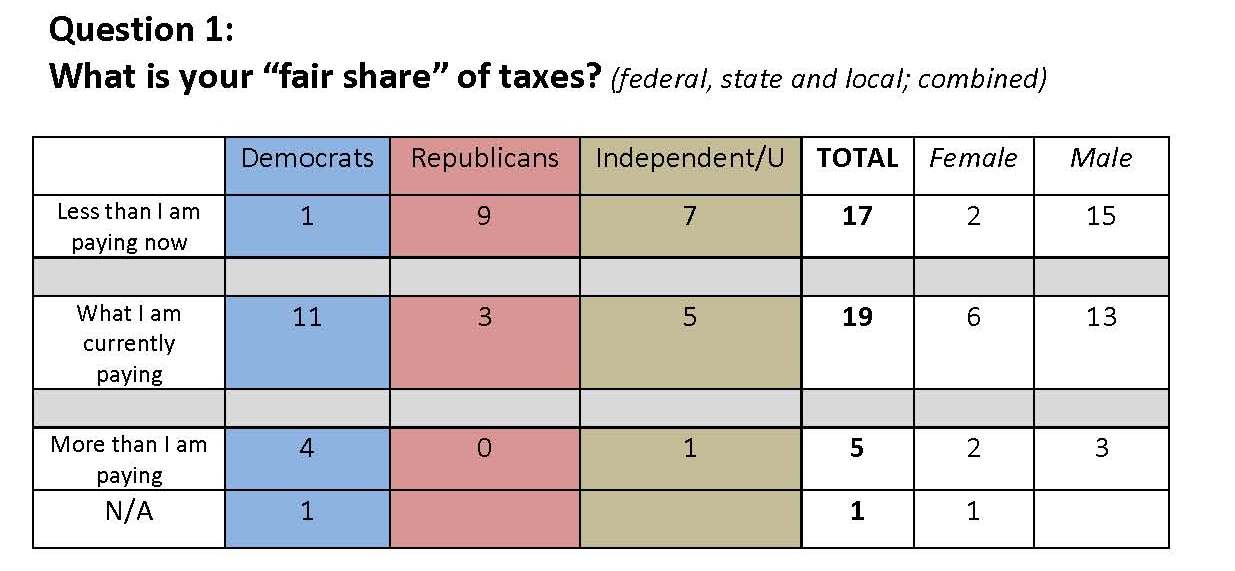
Question 1 asked respondents: What is your “fair share” of taxes (combined fed, state, local)?
Several respondents and others expressed disdain for my use of the word “fair” in the question. I responded that the word “fair” is certainly a subjective term, but the responses would also be subjective. Respondents were given three responses to choose from: A.) Less than you are now paying? B.) What you are currently paying? or C.) More than you are now paying? One respondent declined to answer the question.
Figure 2.1
There were no big surprises here. I was expecting to see a sharp divide between Democrats and Republicans, assuming Republicans would almost universally answer that they are already overtaxed and paying more than their “fair share.” What is interesting? Three Republicans (25 percent of Republican respondents) said they think their current tax obligation is “fair.” Both Democrats and Republicans, however, expressed frustration about local taxes rather than state or federal tax rates. See the chart (Figure 2.2) below for the breakdown of responses.
Figure 2.2
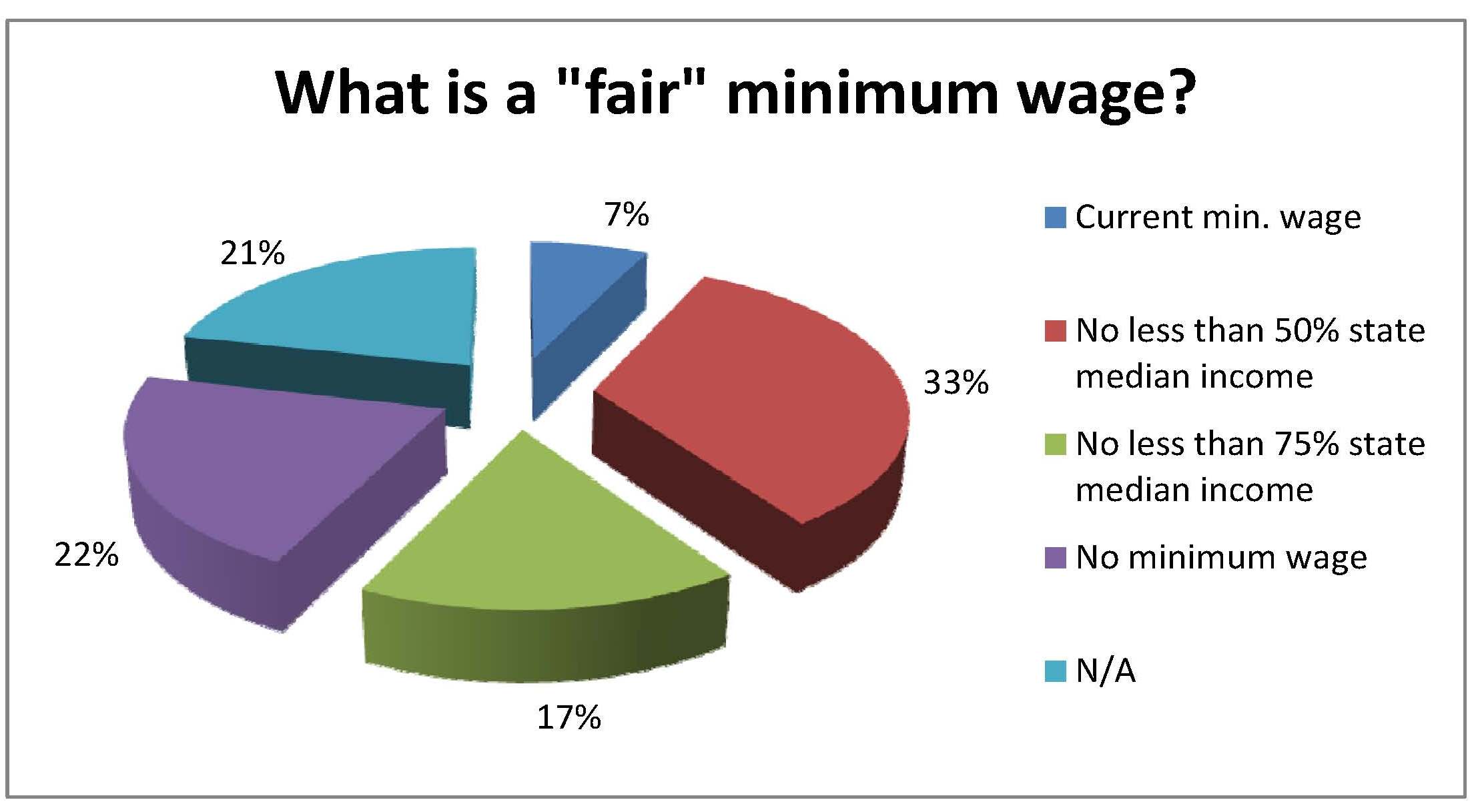
Question 2 asked respondents what they considered to be a “fair” minimum wage, providing four responses: A) Current minimum wage ($7.25/hour) B.) No less than 50% of the state’s median income. C.) No less than 75% of the state’s median income; or D.) There should not be a minimum wage.
Nearly 30 percent of respondents expressed confusion regarding responses that were tied to the state’s “median wage,” saying they did not know the current median wage or that it was a poor alternative for determining a state’s minimum wage requirement.
My theory is that minimum wage should be required by the federal government but not set to a national standard, other than as a percentage of a particular state’s median income.
My reasoning? Someone earning $7.25 per hour in Maine has less economic capacity than someone earning $7.25/hour in Tennessee, which has lower cost of living expenses. This disparity becomes more apparent in large urban areas, such as New York City or Chicago, creating an unlevel playing field.
For further clarification, it’s important to understand the difference between a “median” income and an “average” income. Median is simply the half-way point when looking at all recordable wages in a specified group. while it is common to discuss “household” median income, I used this chart from the University of New Mexico to compare median personal incomes among the 50 states. Maine ranks 28th with a median personal income of $39,481. This means 50 percent of income workers in Maine make less than $39,400/year.
If a Maine adult is working 40 hours at minimum wage, that person would be earning a gross income of $15,080 (assuming working 52 weeks per year). If we changed the state’s minimum wage to be no less than 50 percent of median income, that same person would now earn: $19,700 annually, considering an hourly wage of $9.47/hour. Lets see what my friends said:
Figure 3.1
As we can see in the above chart (Figure 3.1), there is an almost even split between those who favor the current minimum wage or the idea of having no minimum wage (43 percent); and those who would like to see some level of increase (50 percent). Seven percent of respondents declined to pick one of the offered choices (as explained above).
Figure 3.2
The poll’s final question asked respondents if there should be a “maximum wage.” This question received the most universal agreement. 95 percent of respondents said there should NOT be a maximum wage, however, it should be noted that more than 40 percent of those indicated that they would like to see increased tax brackets for high wage earners. Only two Democrats (one male, one female) answered in the affirmative.
Figure 4.1
Of course, I have some opinions about this data, and some other thoughts sparked by this conversation; but I will pause here and allow you to reflect on the responses to develop your own analysis.
Again, my deepest appreciation to all those who participated!
Source: City Clerk’s office; 2004 data not available
I was speaking with a friend yesterday about the recent municipal elections in Biddeford.
“I bet you’re glad it’s over,” he said.
“Over?” I responded. “It’s hardly over. Already candidates are lining up for local legislative races that will be decided next November. There’s always another election around the corner.”
He shook his head and smiled. “Who cares about who we send to Augusta,” he said. “It’s not like it matters.”
It’s understandable that most people feel a bit burned out by the political process.
Only a few weeks after arguing and ranting about Mitt Romney and Barack Obama, political junkies turned their attention to controversial referendum questions pending in South Portland and Portland. While local candidates were seeking city council and mayoral seats, Congressman Mike Michaud, the likely Democratic nominee for the Blaine House, announced that he was gay and thus strategically overshadowed Republican Gov. Paul LePage’s announcement about his own official re-election campaign this week.
I almost expected Independent Eliot Cutler to announce that he was bi-sexual, pledging allegiance to neither heterosexual nor homosexual preferences; a true Independent — just like Maine — in a desperate attempt for some much needed press during a tough news cycle.
It’s no wonder that voters have become a bit apathetic and cynical about politics.
For the record, I could not care less about a candidate’s sexual orientation. I also don’t care about their favorite color or whether they like their chicken original or extra crispy. I want the candidates and the media to focus on the issues that are affecting every day people who are struggling under the weight of a difficult economy. I want to hear new ideas. I want to hear each candidate describe their vision.
Although I am pleased that an overwhelming majority of voters in my hometown chose vision over fear, positive over negative; I also expect those who won their seats to get real busy, real quick and to focus with laser-precision on economic development, creating streamlined efficiencies and encouraging private investment.
Voter turnout in Biddeford this year hit a 10-year low. Fewer than one-third of the city’s voters bothered to cast a ballot. Sure, there were no sexy referendum issues like a casino or marriage equality driving people to the polls; but the decisions we made yesterday impact every part of our lives: our roads, our schools, public safety, our sewers and yes . . . our tax bills. The people chosen on Tuesday will be responsible for making decisions that could have long-lasting impacts.
So why was voter turnout so pathetic? The weather was beautiful. There were no long lines at the polling places. What gives?
It’s always difficult to gauge voter sentiment, but there are a few likely reasons:
a.) Voters are content with the way Biddeford is being managed. They sensed Alan Casavant had a commanding lead and, therefore, their vote was unnecessary;
b.) Voters are upset with the way Biddeford is being managed and feel disenfranchised. You can’t fight City Hall;
Or c.) the most likely reason: voters just didn’t care. Period.
If you belong to any of the above three groups, you are an idiot.
Members of Group A risked a potential loss and a step backward for the city. Members of Group B missed a real opportunity to send a powerful message about their discontent; and members of Group C ought to be required to take a remedial civics lesson.
Voting is important. You are an equal shareholder in this community. Your voice matters. Imagine how different the election would have been if only 20 percent more of the city’s register voters had bothered to participate?
Of course, it’s too late to speculate. And those who did vote sent a pretty clear message. They want a fiscally responsible council. They want a positive and professional mayor leading the city. They are not afraid of making long-term investments in their community (all five state bond questions passed easily).
Sure, it’s more fun to get wound up about a particular, controversial issue, but if you can’t be bothered to exercise your civic duty, then be prepared to accept whatever comes down your path.
Voters tend to turn out for things they want; things they support.
Throughout this last election cycle, many of Casavant’s loudest critics failed to articulate who they supported. They were against someone, but for no one. A sure-fire prescription for voter apathy and a stunning loss at the polls.
Sure, Casavant’s opponents split their opposition, but looking at the results tells an even stronger story. Even if you add the total votes of each opponent, Casavant’s numbers were still higher. Fifty-seven percent is a clear victory. Winning each of the city’s seven wards reaffirms the voters’ decision.
If the opponents are struggling to accept the results, maybe they ought to spend a little less time bitching and a bit more time convincing their friends and neighbors to get to the polls two years from now.
I said it before, and I will say it again: Campaign signs do NOT win elections; Facebook or other social media tools do NOT win elections; debates or endorsements do NOT win elections. What wins elections? It’s about how many people you get to the polls. Game over.
Which Hollywood film better describes the city of Biddeford’s ongoing struggle with issues such as “the creative economy,” “cultural diversity” and elitism: Mr. Holland’s Opus or Mad Max: Beyond Thunderdome?
In Thunderdome, a community barely surviving in a post-apocalyptic world is wary of strangers and outsiders. To avoid another global war, all disputes are settled by a bizarre cage match contest in which “two men enter and one man leaves,” a fight to the death.
By contrast, the 1995 film Mr. Holland’s Opus examines the career of a musician who reluctantly becomes a high school music teacher. Mr. Holland becomes passionate about exposing his students to the value of music and arts, but a political reality sets in near the end of the film.
The school board is struggling with its budget. A decision is made to eliminate the arts and music programs in order to preserve the “more important” functions of teaching reading and writing. Mr. Holland tries to fight back. “if you keep cutting arts and music, pretty soon these kids will have nothing to write or read about,” he quips on the day he receives his pink slip.
Take me to the other side
Sarah Beanland is a Massachusetts resident who summers in Biddeford Pool. I met her and her husband last week on Main Street. They had just purchased a couple of paintings.
Renee and Jim O’Neil: Stop complaining and get involved.
She was puzzled and dismayed to learn that some community members have reacted negatively to a recent push for the creation of a creative economy in the downtown area. Although she quickly conceded that she did not have the benefit of a local, historical perspective, she was forceful in her opinion about the benefits of a creative economy and how it can elevate any community.
“Arts and education are the great equalizers,” she said. “But we must make sure that everyone has access to those things. Access to both arts and education is the key.”
Renee O’Neil, a lifelong resident, has been a leading downtown advocate for more than two decades. O’Neil championed and led the efforts to restore and renovate City Theater, a historic Opera House on Main Street.
“I don’t get why anyone would feel offended in any way by efforts to build a creative economy here,” she said, conceding that there has been a historical resentment about the perceptions of class warfare in Biddeford.
Renee said a lot of people told her she would never be able to generate enough community interest to successfully renovate City Theater. She proved those detractors wrong, and today the facility serves a broad array of community functions, ranging from theatrical functions to a venue for community meetings and events.
Renee recalls growing up in a working-class family and says community concerns about elitism are becoming a distant part of Biddeford’s past. “There was a time and a place when that all may have been true, but not now,” she said. “I guess I don’t see the social boundaries because I have always crossed them. My dad would talk to everyone. There was never this idea that we weren’t all part of the same community.”
Renee’s husband, Jim agrees. “All this talk about elitism seems strange,” he said. “People were not happy with the fact that nothing much was happening [in downtown,]” he said. “Now something positive is happening, and these very same people are upset. Go figure.”
For many years, Renee and Jim operated a small and popular convenience store near the western border of the city. They said they learned much from that experience, including how initial impressions are often inaccurate and that all people share much more in common than the things that seem to divide them.
“People would come into the store, and when we took the time to know them, we found ourselves connecting on a personal level,” Renee said. “Too many people don’t seem to take the time to listen or consider things beyond their own comfort level.”
The Rubberband Man
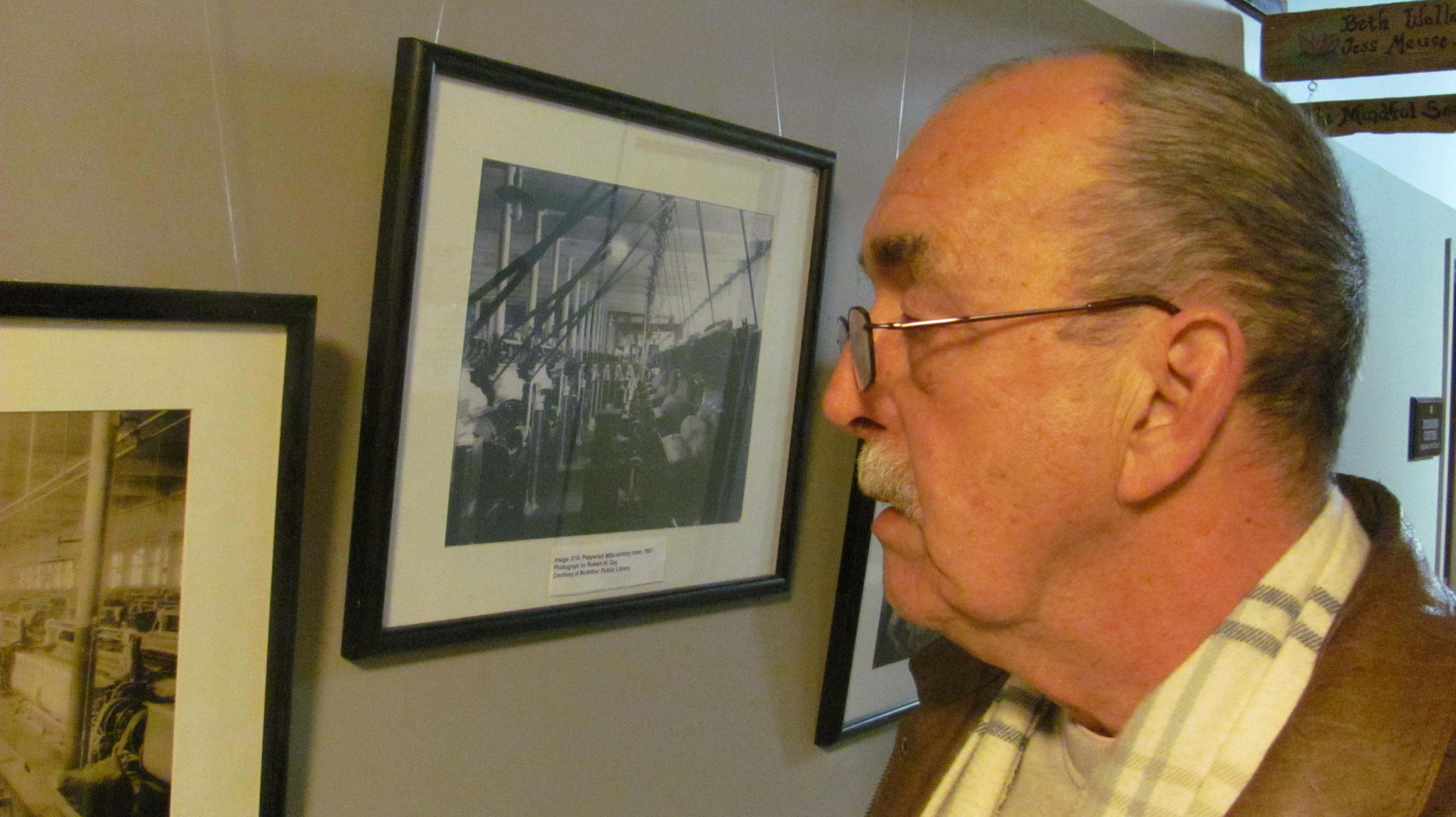
Pete Lamontagne examines a historical photo of mill workers who toiled in the same buildings where he and his father worked.
If any one person is revered as the spokesman of Biddeford’s working class population, it is George “Pete” Lamontagne, a former city councilor, mill worker and former president of the labor union that represented the city’s mill workers back when the mills were producing blankets and other textiles.
Today, those same mill buildings that once drove Biddeford’s economy and provided steady employment for generations of immigrants are being renovated and converted into numerous uses, from up-scale housing units to a small business incubator that features dozens of small businesses.
There is even talk of a hotel, a conference center and many other exciting opportunities for a community that has struggled to move beyond its mill town heritage.
As the renovation and reinvigoration of the formerly dormant mill complex continues, a new tension has been created. That renovation process is primarily being led by “people from away,” the folks I describe as Biddeford’s most recent immigrants.
“Oh yes, there is elitism in Biddeford,” Lamontagne said in his usual soft-spoken style. “But it goes both ways and it’s more often about perception than reality.”
Lamontagne serves as a self-appointed emissary between the two sides of this latest clash of personalities and opinions in Biddeford. He was co-curator of a photo exhibit that was displayed at the Engine Gallery on Main Street. That exhibit, The Way We Were, focused on Biddeford’s cultural history.
The mostly black and white images from The Way We Were exhibit were collected from a variety of sources, mostly from individual community members who were eager to share their memories and heritage.
But not everyone appreciated Lamontagne’s efforts to bridge the gap between old and new ideas for Biddeford’s future and its identity.
“A lot of people questioned why I was getting involved,” he recalled. “A lot of people said, ‘Pete, how can someone like you spend so much time with those people.'”
Lamontagne says he understands the mistrust and suspicion raised by some of his peers. He agrees with my assertion that the passionate push for developing a creative economy in downtown Biddeford sometimes seems too aggressive without fully understanding the city’s history.
Together, Lamontagne and I recant a long litany of real elitism and class warfare in Biddeford: Attempts by coastal neighborhoods to secede from the city in the 1990s; a move to ban public use of the beaches at Biddeford Pool and Fortunes Rocks in the 1970s, and of course, the long history of enduring the weight of criticisms from those who live across the river in Saco.
But we also talked about more recent examples, including the tensions and controversy created by the opening of Fatboys Saloon and the 800-pound gorilla issue that created an even deeper divide in the community: a plan in 2011 to open a casino-resort complex on the outskirts of the city.
“No doubt, the casino issue left a bad taste in a lot of mouths,” Lamontagne said. “On one side were supporters, many of whom saw the casino as a way to create much-needed blue-collar jobs and put Biddeford back on the map. On the other side were people who worried about the image of a casino, about how it would impact our quality of place.”
Lamontagne, like most Biddeford voters, supported the idea of opening a casino. But Maine voters rejected the city’s proposal, despite narrowly approving a similar facility in Oxford the year before.
“A lot of people were upset and are still upset about that,” Lamontagne said. “We’ve lost a lot of our traditional jobs, and people are worried. Many of them don’t see how art exhibits and music performances will help us get back to where we were.”
City Councilor Roch Angers agrees with Lamontagne. Angers grew up in a working-class neighborhood on South Street, where his family operated a small grocery store.
“You know what I hate?” Angers said. “The word Biddo. That’s not the name of our community. We have three consonants in the name of our city. Deal with it and show some respect for our heritage.”
Fatboy Slim
David Bourque: A man and his bar
Biddeford City Councilor David Bourque found himself at the center of a storming controversy earlier this year.
His plan to open Fatboys Saloon on Main Street erupted into a full-scale public policy nightmare that once again raised concerns about elitism and a lingering sense of class warfare.
When the Heart of Biddeford, a non-profit downtown business organization, raised their concerns during a city council meeting, former Biddeford mayor Joanne Twomey came off the ropes swinging in defense of Bourque and his proposed establishment. Local newspapers seized on the story.
Heart of Biddeford representatives said they only asked the council whether downtown was the appropriate location for a “biker bar” and whether it met the vision of a Downtown Master Plan that was developed two years prior and included input from a broad array of stakeholders. They worried about noise and impacts to nearby downtown residents and plans to build a hotel nearby.
But Twomey wasn’t buying what the Heart of Biddeford was selling. She described the organization and some of its members as “elitists.” She was full of sound and fury, outraged that a working class community would look down their noses at a bar marketed toward working class citizens.
The liquor license was approved and almost four months have passed since. Twomey has taken out nomination papers and apparently is planning another run at the seat she lost two years ago.
Although the dust may have settled in the Fatboys debate, Bourque said he was taken aback by the reaction to his business.
“I don’t get it,” he told me during a telephone interview. “It came out of nowhere. It was like I was guilty until I could prove myself innocent.”
While Heart of Biddeford members said Bourque should have approached them before aggressively promoting the pending opening of Fatboys, Bourque says no one from the Heart of Biddeford approached him to learn about his vision or plans.
“It was an unprecedented attack on my reputation,” Bourque said. “People should know who I am. I have been on the city council for four years, and I’ve been doing business in this city for more than 30 years.”
Bourque was an outspoken supporter of the casino. Many Heart of Biddeford members opposed the idea of a casino. Was this payback, I asked.
“I don’t think so,” Bourque responded. “I think people just jumped to conclusions. I believe in what the Heart of Biddeford is doing. They deserve a lot of kudos for what they are doing and trying to get done in Biddeford.”
Bourque defended the pre-opening promotion of Fatboys, including a controversial Facebook page that displayed young women in tight-fitting clothes and marketing geared toward bikers. “Sure, we wanted to create a buzz,: he said. “It’s alcohol and female bartenders. What’s wrong with that?”
But some say Bourque simply poked a tiger with a stick by being as provocative as possible during the pre-opening promotion. He should not be surprised that the tiger snarled.
Bourque said he has moved beyond the controversy. He also says he is planning to join the Heart of Biddeford and run for another term on the city council. “I was so humbled during that process,” he said. “I heard from so many people who supported me…people I have not seen or heard from in years. It was very encouraging.”
The mayor weighs in
Mayor Alan Casavant (Sun Chronicle photo)
Before his retirement in 2010, Mayor Alan Casavant spent 35 years teaching American Studies and Psychology at Biddeford High School.
He describes this conversation about elitism, cultural diversity and the creative economy as “fascinating stuff that has always intrigued me.”
“I think we can all be somewhat elitist at times,” he said. “But it’s sort of like racism in that it’s not an easy or comfortable topic for a lot of people.”
Throughout his first term as Biddeford’s mayor, Casavant has consistently pushed for Biddeford to move beyond its own negativity and self-imposed inferiority complex. “Yes, we were a mill town,” he says. “But we are no longer a mill town and we simply must acknowledge that new reality as we all work toward repositioning ourselves for the future.”
Casavant said cultural identity is important, but it should not become a wedge that prevents collaboration between those with different perspectives. “There’s room for everyone in Biddeford,” he says. “We all have a role to play. The question becomes who among us is willing to step up? You can’t just sit back and complain. We all need to look for solutions.”
But Casavant acknowledges that his vision is difficult for some people to embrace. “We are all — to varying degrees — uncomfortable with change, but change is the only constant thing in our lives.”
The mayor understands and empathizes with those who are upset that there is push to transform LaKermesse, the city’s annual Franco American festival, into a celebration of multi-cultural diversity.
Casavant has also heard elitism used as a weapon in other policy debates, including ongoing debate about the city’s municipal airport and accusations that it’s nothing more than “an exclusive country club for rich out-of-towners.”
“I think both sides get too defensive when we attempt to discuss these issues,” Casavant said. “I think we would all be well-served by committing even further to understanding and appreciating different points of view.”
Perception or reality?
Has a sense of cultural elitism taken hold in downtown Biddeford, where a push for creative economy is brushing up against those hoping for more traditional economic development?
Vassie Fowler, a downtown business owner, does not hesitate with her answer. “You betcha.”
In addition to owning and operating Union House Pub and Pizza with her husband Jack, Vassie also runs a catering service that has worked closely with the Heart of Biddeford and the Engine gallery. She was raised by a family of second-generation immigrants from Greece: the Ladakakos family, best known for their outstanding, downtown Italian sandwich shop, George’s Sandwich Shop.
Union House is one of the many small businesses thriving in the renovated North Dam mill building that was redeveloped by Doug Sanford.
Vassie says she is happy that her business can simultaneously be part of Biddeford’s new and old narrative. A pizza pub located in a renovated mill building, a business name that pays homage to the city’s past.
But she also says tension between those pushing for a creative economy and those who want more traditional development is real.
“It feels like you have to be loyal to just one side, and that’s just ridiculous,” she responded in an e-mail. “You can be embraced but then shunned. Like you’re either with us or against us; you’re either part of the clique and follow our rules or you’re not. Give me a break.”
Fowler says there is certainly room for a creative economy in Biddeford, but it should not be the sole focus.
“Biddeford will never improve or grow unless we are honest with who or what we are,” she added. “Flower pots and a fresh coat of paint can not change who we are as a community: the good, the bad and the ugly.”
Much has been said about Maine’s quality of place, a subject that hit me like a brick this weekend as I once again travel the roads of rural Maine.
But what is the value of a quality place without a quality life?
GrowSmart Maine describes quality of place as:
“. . . our majestic mountains, unbroken forests, open fields, wild rivers, pristine lakes, widely-celebrated coast, picturesque downtowns, lively arts and culture, authentic historic buildings, and exceptional recreational opportunities. It is our principal advantage in today’s global economic competition. Quality of place will help us keep and attract skilled workers and entrepreneurs to fill Maine’s declining workforce population.”
Sounds good, right?
Sure, right up until you drive along Rte. 4 past Livermore Falls and into the town of Jay on your way to someplace pretty.
The policy wonks, pundits and environmental do-gooders slap themselves on the back with self-congratulation over drinks at the Senator Inn in Augusta after passing some piece of legislation designed to protect Maine’s “quality of place,” but I wonder if they have ever strolled along Water Street, less than a mile away or driven past the dilapidated tenement triple-deckers that line Rte. 8 on the way toward the Civic Center.
Try telling someone in that neighborhood about quality of place.
Better yet, visit the Wal-Mart in Calais, Skowhegan, Newport or Sanford. Tell the single-mom buying generic-labeled cereal about “quality of place.”
Drive past the gutted factories and the ghost towns that were once homes to thriving industries like shoe shops, paper mills and textile manufacturing. Pull over and tell the people who are barely living there about quality of place.
Drive north, east or west from Portland. Get off the main roads and count the number of blue tarps that serve as substitute roofs on ramshackle homes. Pause and tell those people about “quality of place.”
There are no easy answers, but I never see the pundits or the lobbyists shopping for pre-paid cell phones, making an installment payment at Rent-A-Center or drying their clothes at the Laund-O-Matic on a sweltering July afternoon.
These people —the not-so-pretty and the not-so-fortunate ones —- are largely forgotten, discounted and mostly ignored. They routinely buy lottery tickets. Many of them smoke, and they keep their heads above the surface like prison inmates. One fucking day at a time.
It’s easy to judge them. To think we know better about how they should live or how Maine should be managed, but few of us know — really know— that if this is quality of place . . . That if this is as good as it gets…..
What is the value of having an abundance of natural resources if you cannot feed your children? What is the value of open space if you don’t have a car to get there?
How do we achieve the balance between protecting the things we cherish in our backyard without forgetting or discounting the people who live there?
Just moments ago, Mitt Romney did what he does best. He chose the safe bet and once again fumbled the ball in his quest to be the next president of the United States. Mitt ended all speculation by announcing his choice of Paul Ryan as his running mate.
Of course, the right is thumping its chest, joyously proclaiming that President Obama will no longer be able to ignore our country’s miserable economy during an especially malicious campaign.
GOP Nominee Mitt Romney
Meanwhile, the left is busy buying bottles of champagne, prematurely celebrating their victory while putting together a slew of campaign ads that pronounce Ryan as the guy who wanted to kill Medicare. For the record, check what Politifact has to say about the left’s Medicare innuendo.
My prediction? Obama wins by 3 points when he should lose.
Yes, I just said President Obama should lose the election.
Yes, I just said that President Obama will win a second term.
With just one sentence, I have managed to piss off loyalists on both sides of the aisle. So now that I have your attention, allow me to explain my rationale.
Why Obama will win
Romney’s selection of Ryan as a running mate only serves two purposes: 1. it forces Obama back into the debate about the economy, and 2.) it spikes the temperature on the right. But just like four years ago, the GOP has done absolutely nothing with this pick to take from the political center…That is why Obama will squeak out a narrow victory. Palin gave McCain an early bump, but it came up far short on drawing critical votes from the political center.
Why Obama should lose
President Obama screwed up royally even before he was sworn into office for his first term. He set the bar for his presidency far too high. In short, he over promised and under delivered.
That alone is reason enough to justify my decision not to renew his employment contract.
Ask yourself this: Why would such an allegedly smart guy promise so much so soon?
It’s simple. Obama’s “Hope and Change” was a tactic born of grandiose arrogance and fueled by a troubling naiveté of how the world works.
Remember four years ago? This president was going to be so much different. He was going to change Washington. No more business as usual. No more cozying with lobbyists. Superior transparency and political accountability would be the new norm. He was going to fix the economy, end our wars, give us universal health care and stick it to the rich.
“Yes, we can!” he proclaimed without deference to the stark reality that surrounded him.
I was there on that cold, January day when the nation was about to be forever transformed into something so much better. I did not vote for him, but I was genuinely excited to be part of that historic moment when our 44th president was sworn into office.
The crowd on the Capitol Mall was like nothing I had ever experienced. There was an electric excitement in the air. I am a big guy, but I could not secure my footing. When that massive crowd lurched, I lurched…I was literally moved by those throngs of joyous and expectant celebrants.
It was hard not to believe that we were witnessing something much bigger than a new president taking office. Like Chris Matthews,I also experienced a tingling sensation running down my leg… (in retrospect, that may have been the result of really cold temperatures and a lack of restrooms).
But did Obama really overpromise and under-deliver, or am I just a frustrated cynic?
To answer those questions, I offer some analysis and opinion from a broad spectrum of news and media outlets, including: The Huffington Post, Politico, ABC News and Fox.
Let’s now examine the reality of our president’s 2008 campaign promises:
Healthcare: To his credit, Obama tackled one of our nation’s most complex and dysfunctional systems. The result? The government got in bed with huge corporations by using its force of law to require everyone to purchase health care insurance. In exchange, the corporations agreed to change practices including rescission of policy coverage and extending the term of dependent care. If you’re excited about this, you have very low expectations.
Ending the wars and closing Guantanamo Bay: Instead of troops in Iraq, we now have private contractors quietly cleaning things up in the name of democracy and capitalism. Foreign civilians are still being killed by drone strikes and US foreign policy has changed little, especially when considering that we were happy to celebrate and credit this president for crossing into a sovereign nation without permission and executing a criminal without trial. Yay, us! Guantanamo Bay? Still open for business.
Increase Transparency in government: Not so much, at least according to Politico:
“Open-government advocates say some administration practices are actually undercutting Obama’s goal. Among their complaints:
• Administration lawyers are aggressively fighting FOIA requests at the agency level and in court — sometimes on Obama’s direct orders. They’ve also wielded anti-transparency arguments even bolder than those asserted by the Bush administration.
• The administration has embarked on an unprecedented wave of prosecutions of whistleblowers and alleged leakers — an effort many journalists believe is aimed at blocking national security-related stories. “There just seems to be a disconnect here. You want aggressive journalism abroad; you just don’t want it in the United States,” ABC News correspondent Jake Tapper told White House press secretary Jay Carney at a recent briefing for reporters”
Swamped by outside Republican groups in fundraising so far, Obama belatedly decided to give his blessing to so-called super PACs, which can accept unlimited donations from corporations, labor unions and wealthy individuals. Both Obama’s campaign and the White House maintain that the president does not support today’s rules but realized belatedly he must play by them to give himself a competitive chance at a second term.
“He’s not saying that the system is healthy or good,” said Obama spokesman Jay Carney, who was pressed repeatedly about whether Obama’s move was hypocrisy. “He is making the decision, his campaign is making the decision, that the rules are what they are. And they cannot play by a different set of rules than Republicans are playing.”
That’s not consistent with what Obama has said about the groups, though. And now, by putting strategy above all else, Obama opened himself to criticism that he had compromised on principle and succumbed to the rules of the same Washington game he pledged to change.”
Jobs and the Economy: Epic fail and the starkest example of overpromise and under-delivering.
Business Insider: ” . . . the Obama administration drastically underestimated how bad the economy was and drastically overestimated its ability to do something about it.
As a result of this, President Obama over-promised and under-delivered on the single most important challenge of his Presidency: Jobs.”
Huffington Post: “. . . A slew of weak data has led economists in recent weeks to ratchet back their expectations for U.S. economic growth. A Reuters poll published on Wednesday found economists expect the nation’s Gross Domestic Product to expand at only a 2 percent annual rate in the second quarter.
Projections for hiring also have been cut. According to the poll, the economy is likely to add an average of 147,000 jobs a month between now and October, too few to make much of a dent in the nation’s 8.2 percent jobless rate.
As the economic recovery threatens to stall for the third summer in a row, voters are registering deep doubts about Obama’s leadership, according to a Reuters/Ipsos poll released on Tuesday. More now believe Romney would be stronger than Obama in dealing with the economy and creating jobs. . .”
How is the world better today than it was four years ago? How much has Washington changed? Are you better off than you were in 2008?
Can Mitt Romney do any better? Probably not.
Thus, I am a cynic. Meet the new boss. Same as the old boss.
Anyone with a pulse and an IQ exceeding room temperature can likely agree that our nation’s health care system is seriously flawed.
But that’s generally where the agreement stops.
That’s why I was impressed when Biddeford Mayor Alan Casavant posed a series of observations about Maine’s own raging health care debate on his Facebook page.
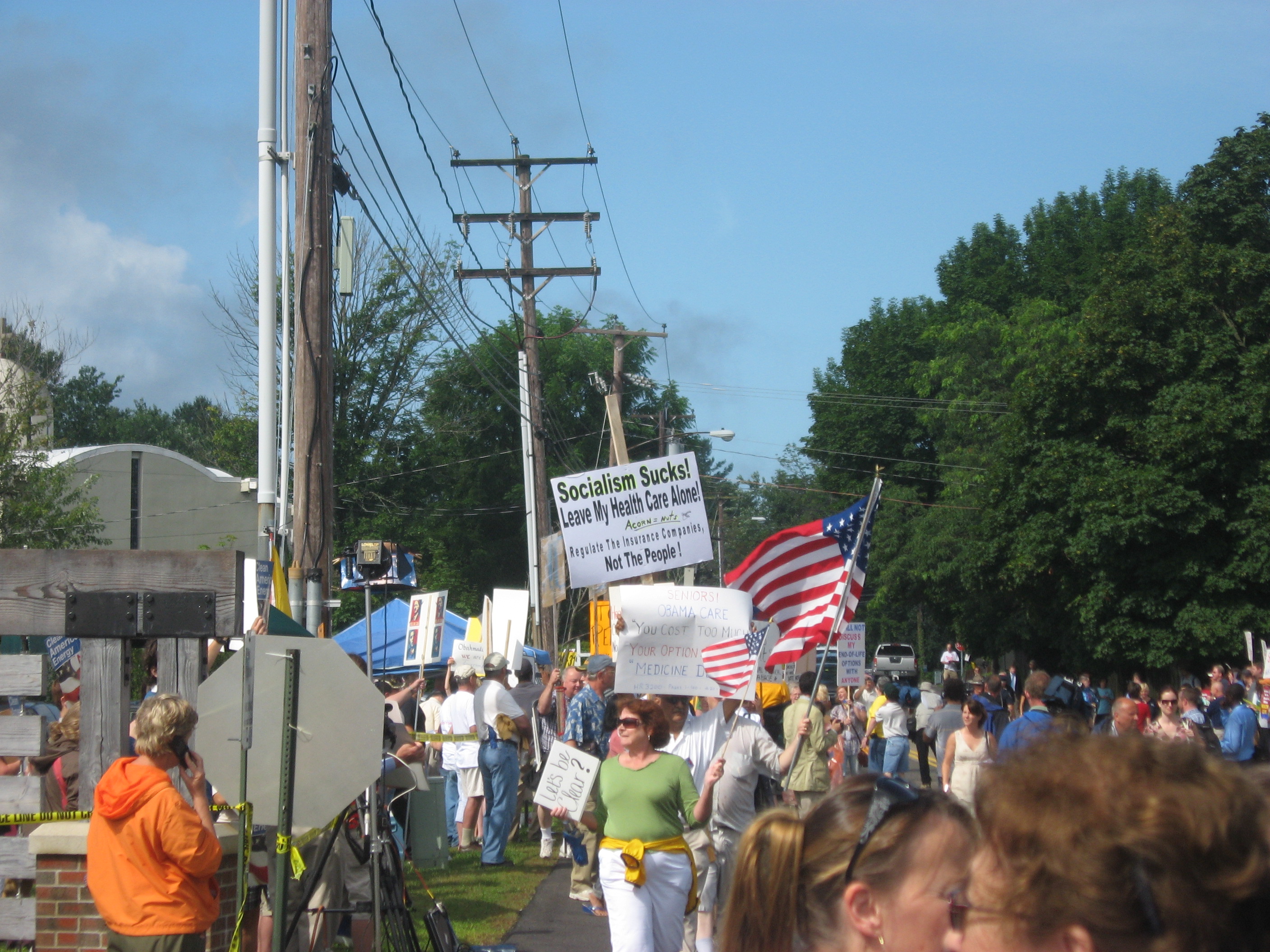
August 2009: Large crowds in Portsmouth, NH, protest outside a high school where President Obama speaks about the need for health care reform.
Casavant is also a member of the Maine House of Representatives, and his comments were based on his observations during a legislative hearing about how best to address rising health care costs.
“Clearly, resentment [of] the Obama plan drives a lot of these bills,” Casavant noted, referring to the federal Patient Protection and Affordable Care Act of 2009.
“For some, the costs of treatment and medicine exceed their ability to pay,” he said. “So the moral question is: What should a society do in such situations? What should government do? Do we act, or do we allow the laws of Darwin to supersede our compassion, integrity and our humanity? The system is broken. . .”
I applaud Casavant for raising the topic, but submit that our health care system is NOT broken, it is fixed . . . meaning it is rigged.
Our current system is either outdated and ineffective, at best ; or it is favorably geared toward an ever shrinking pool of those who can afford to keep up with skyrocketing costs.
Are you with me, so far? Good; because this is where the debate gets tricky.
Before we proceed any further, we must agree to at least one basic fact, regardless of our individual political/cultural/socio-economic viewpoints.
Health “care” and health “insurance” are completely different topics that are too often linked at the hip.
Let’s start with health insurance.
If you drive a vehicle in Maine, you are required by law to have a minimum-liability insurance policy. This law exists to protect drivers who are harmed by another driver’s neglect or carelessness.
Driving, as the state of Maine tells all new drivers, is a privilege, not a right.
I will take that a step further and say that health “insurance” is also not a right.
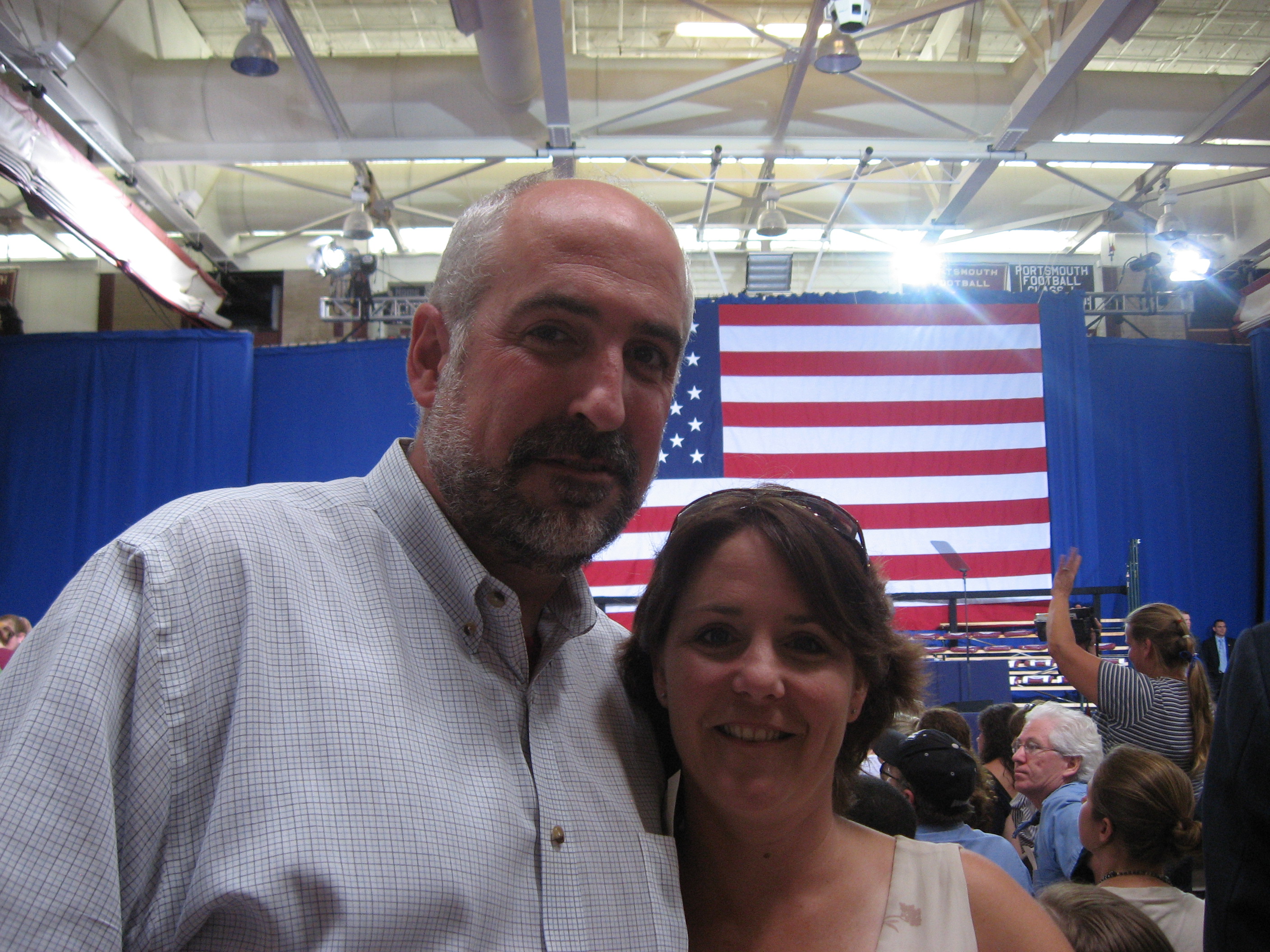
Laura and I scored tickets to see President Obama speak about the need for health care reform in 2009. Then, just as it is now, we both had reservations about the president’s plan. Laura tried to ask a question, but she and many others did not get picked.
The argument about whether health care is a right remains a bit more ambiguous, but let’s remember we’re now discussing health “insurance,” not health “care.”
The discussion about rights and expectations have only been muddied by the nation’s new health care law, which mandates individuals to purchase health insurance in the private marketplace.
The so-called “individual mandate” is one of the more controversial aspects of the health care reform law signed by President Obama. That issue is scheduled to be deliberated by the U.S. Supreme Court this year.
Interestingly, critics of the individual mandate can be found from both the left and right side of the political spectrum.
Conservatives argue that the individual mandate further erodes personal liberty and crosses the sacrosanct line between personal choice and government mandates.
On the other hand, more progressive Democrats — especially those who pined for a public option or a single-payer system of healthcare reform — describe the individual mandate as nothing more than a very big gift for evil insurance companies that stand to gain millions of new customers.
But all that debate and Constitutional introspection pales in comparison to the more fiery rhetoric associated with the subject of health insurance profits.
Left-leaning groups, such as ACORN and HCAN (Health Care for America Now) say that corporate, for-profit health insurance profits are skyrocketing and have quadrupled over the past few years.
It’s a favorite talking point of progressive Democrats and very handy when whipping up grassroots mobilization to support the president, but it’s not entirely accurate — although rated as “mostly true” by PolitiFact, a Pulitzer Prize-winning organization established by the Tampa Bay Times to fact check political rhetoric.
Meanwhile, the health insurance industry is crying poverty, saying their profit margins are among the lowest of any industry in the United States — ranging between two and four percent.
So, which one is right?
Unfortunately, the inconvenient truth is that both groups are a little bit right, and a lot wrong.
And that is bad news for those of us trying to navigate the turbulent waters of this complex debate.
But simply blaming “greedy” insurance companies conveniently ignores too many other factors that drive health care costs. Moreover, such rhetoric is debatable, at best; and intentionally misleading at worst,
Rick Newman, chief business correspondent for US News & World Report, makes a compelling case about why health insurance companies make lousy villains, pointing out that profits are hardly the root of a much larger and complex problem.
“Overall, the profit margin for health insurance companies was a modest 3.4 percent over the past year, according to data provided by Morningstar. That ranks 87th out of 215 industries and slightly above the median of 2.2 percent,” Newman reports.
Despite my right-leaning, free-market beliefs, I admit to being somewhat conflicted on this issue, and that’s probably because my household is knee-deep in our own health-insurance nightmare.
My wife, Laura, was diagnosed with multiple sclerosis just three days after Christmas in 2008. Her disease is never going to go away. It is never going into remission. It takes a little piece of her each day, even when we don’t notice it.
Laura does a good job of managing her illness, but there is no escaping that MS is a progressive illness that will never go away and only get worse over time.
Neither of us asked for our respective illness. We both work full-time. We pay our taxes, but we are also a health insurance company’s worst nightmare…we take out a lot more than we put in to the system.
If you’re a conservative, Tea-Party Republican, you are advised now to reach for the duct tape because otherwise your head may explode when I offer up this next tidbit:
You are paying a portion of our health insurance.
Laura is a state employee and thus, we are more than lucky to have an outstanding health insurance plan that is offered to all state employees and their immediate family members.
But even if Laura lost her job, and we relied upon a more traditional (and much more expensive) private health insurance plan, you would still be paying for our health insurance.
Why? Because in our current system, healthy Americans subsidize the costs of treatment for the ill. That is the fundamental core of the individual mandate: we need more young, healthy people in the system to offset the cost of treating older and sicker Americans.
I am not a big fan of the individual mandate – beyond the Constitutional arguments, I think the system unfairly penalizes healthy people and will do little to drive down the costs of health care.
There is a lot more to cover, but I will end this installment here and borrow Casavant’s closing observation from his Facebook post: Stalemate [on this issue] is unacceptable.
Don’t you just hate the 1 percent? You know . . . all those fat cats who have way more than they need. Meanwhile, the rest of us…the 99 percent…are struggling for survival and getting screwed by the system.
Sound familiar? It’s the anthem of the Occupy Movement, a mantra that can be traced back through civilization, but was not talked about much before the US economy tanked in 2008.
Take from the rich and give to the poor. It’s the stuff of fairy tales, fables and it makes for easy and convenient talking points, centered upon a powerful emotional message of righteous indignation.
But do you really loathe or even hate the 1 percent?
Well, maybe you should look in the mirror because you are part of the 1 percent.
Make no mistake, millions of Americans remain unemployed, and they are genuinely struggling to put food on the table and to stay warm in their homes during these difficult economic times.
But a bit of perspective is in order, especially when considering that the United States remains as one of the wealthiest countries in the world.
I hate to tell you this, but we – you and me—are the 1 percent.
Ask a 12-year-old boy in Tanzania about poverty. But before you do, give him some data about how we define poverty here in the United States. Each year, the U.S. Census Bureau reports that as many as 40 million Americans live in poverty.
The Census Bureau calculates the poverty level each year. In 2009, a typical family of four with a household income of $22,000 was considered living in poverty.
Meanwhile, the United Nations reported that more than 925 million people in the world are hungry. Roughly 2 percent of them live in developed nations such as the United States, Japan, Canada, Britain, France, etc.
More disturbing are findings of the Heritage Foundation’s research report that used data from U.S. Government reports and surveys, including those by the U.S. Energy Department and the U.S. Department of Agriculture.
For example, in 2005, the typical U.S. household defined as poor had a car and air conditioning. For entertainment, the household had two color televisions, cable or satellite TV, a DVD player, and a VCR. If there were children, especially boys, in the home, the family had a game system, such as an Xbox or a PlayStation. In the kitchen, the household had a refrigerator, an oven and stove, and a microwave. Other household conveniences included a washing machine, clothes dryer, ceiling fans, a cordless phone, and a coffee maker.
I am not attempting to diminish the struggles of those who live in poverty, rather I am hoping to illustrate that we too often ignore or dismiss how very fortunate we are in the United States. Even the poorest among us is far wealthier than most of the world.
If you or someone you know thinks you are poor, ask yourself the following questions:
Do you own or have access to a computer?
Do you have a cell phone? A refrigerator? Indoor plumbing? A change of clothes? A television? A stereo? A car or truck? A microwave oven? An air conditioner?
Despite the current bump in the economy, the vast and overwhelming majority of Americans are living in greater prosperity than has any other generation before.
It was like nothing I could ever imagine. It was 5:25 a.m. on the day after Thanksgiving, and I was in a parking lot with more than 1,800 people, waiting in the blackness of a pre-dawn sky for the fluorescent monster to open its mouth and swallow us whole.
Welcome to the jungle—
We got everything you want —
There was an edge of excitement in the air; a certain camaraderie that permeated the long and winding line of bleary eyed men, women and children who were sipping coffee from styrofoam cups and chatting nervously about why they were there.
I couldn’t help myself. I wanted to be disgusted. I wanted to be shocked. I wanted to be sad, but all that would have to wait. So instead, I patted my rear pants pocket, making sure that I had remembered my wallet.
Welcome to the jungle — If you got the money, honey — We got your disease—
The rain had yet to begin falling, but the air was cold and damp. The drones, me included, didn’t seem to mind, however. We were on a mission, fueled by adrenaline, caffeine and the hopes of finding what we wanted.
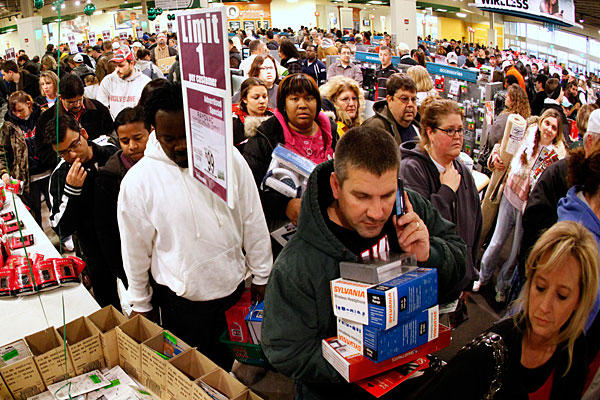
Finally, the magical hour arrived and the line lurched forward. It was6 a.m.and still dark. We shuffled forth like lemmings toward the sea. Deaf, dumb, blind and ready to swipe our plastic cards through an electronic machine so that we could buy more stuff, we inched closer toward the Nirvana of mass consumerism.
As I shuffled closer toward the store, I wondered how many of these people own storage sheds. You know — the place where you keep all the stuff that you can no longer fit in your house.
The shopping carts were snatched up quickly. There were no punches thrown, but some angry glares were traded as the mob raced through the double-glass doors. The elderly greeter seemed overwhelmed. Wearing his trademark blue vest, I imagine that he gave up trying to greet each shopper individually after the first 250 people squeezed through.
By the time I got there, only a handful of shopping carts were left. The greeter resigned himself to simply nodding at the onslaught of shoppers.
It was 6:09 a.m.There were lines of shoppers at more than 28 open cash registers. The greeter seemed ready for a coffee break and the $30 DVD players were nowhere to be found; an entire pallet of the electronic devices, stacked more than seven-feet-high, had been snatched up.
Everywhere I looked, shoppers of all ages were pushing carts with televisions, bicycles and computer systems wedged inside. I tried to interview people and take pictures of the scene.
One woman, who recently lost her job at Biddeford Blankets, was pulling two carts behind her and yelling at her husband to keep up.
I saw another man who has publicly condemned Biddeford’s downtown waste incinerator. He was one of the lucky ones. He got three of those DVD players. “What happens if they break?” I asked.
“At this price, who cares,” he replied, weaving his cart through an obstacle course of dazed shoppers toward the toy aisle.
I started to feel guilty about being there. But later in the day, I talked to a woman who has two young children. She and her husband both work hard, but they are forced to stretch every dollar they earn. Children need heat, electricity, medicine and food just as much as they need the new Gameboy machine under the Christmas tree, she said. “I have to buy it where it’s cheapest,” she added.
“I don’t feel good about it,” she said of buying presents at the big box store. “But that’s just the way it is.”
We waved flags in the weeks and months followingSept. 11, 2001. We talked about national pride. Well, this is it, folks. Welcome to capitalism, where the strongest survive and the little guys become convenient nostalgia. This is who we are. Sometimes, it’s not pretty, but it is real.
I brought home a television that was made inMalaysia. I wondered about who made that television. What kind of a country was I supporting with my unnecessary purchase?
According to several sources, including the World Fact Book, 8.3 percent of people inMalaysia are living below the poverty line. Sound bad?
In the United States, 12.3 percent of our nation is living below the poverty line.
Malaysia spends an estimated 2.03 percent of its gross domestic product for its military. In contrast, we spend roughly 3.2 percent of our GDP on the military. Malaysia is operating in debt with revenues of $2.03 billion and expenditures of $27.2 billion. We live in debt also, producing $1.946 trillion in revenues versus $2.052 trillion in expenditures.
Malaysia is a country that has transformed its economic picture during the last 30 years, becoming a major exporter of electronic items. TheUnited States leads the way in buying Malaysian goods, accounting for more than 22 percent of that country’s exports.
None of this made me feel any better about my purchase. I just wanted to know. The box and the styrofoam packaging were taken off my front lawn a few hours later by a trash truck. And I took a shower before going to work for the day.
Welcome to the jungle, baby.
Originally published in the Dec. 4, 2004 Biddeford-Saco-OOB Courier
James Simpson was released from prison in May 2001, but in many ways, he feels as if he still behind bars.
At the advice of his attorney, Simpson, 41, plead guilty to gross sexual assault in February 1998. Superior Court Justice Paul Fritzsche sentenced Simpson to 11 years in jail with all but four years suspended and an additional six years of probation.
While Simpson maintains that he is innocent, he also says that a new state law, which requires sex offenders to be listed on an Internet registry, has made his life a living hell.
The case against Simpson began in November 1997, when he befriended a female acquaintance and eventually allowed her to live with him at his Saco apartment. Three days later, the woman told police that Simpson raped her.
The Courier is withholding the victim’s name, but did verify that she was an adult when the crime was committed.
Released early for good behavior from the Maine Correctional Center in Windham, Simpson said he has been trying to put his life back on track. The problem, he says, is that Maine’s Sex Offender Registry has made it all but impossible to do that.
“Everywhere I go, people are treating me like some kind of monster,” he said. “I’m not a pedophile, but people don’t know that. They just see my name on the same list with people who hurt little kids.”
Simpson’s complaint about the mandatory registry is not the first of its kind, and law enforcement agencies admit the system is far less than perfect.
Saco Police Chief Brad Paul said the 1999 law puts his department and other law enforcement agencies in a difficult position.
“It’s a hell of a quandary,” Paul said. “The law was developed with good intentions, and it does help us do our primary job of keeping the community safe. At the same time, we try to evaluate each incident on a case-by-case basis.”
Like many other communities in Maine, Saco maintains its own website of sex offenders who now live in the city. The Saco list contains the names of 12 men, ranging in age from 27 to 74. The offenders’ addresses range from a transient who stays at area campgrounds to a downtown apartment building and the Ferry Road.
According to Paul, sex offenders must routinely “check-in” with police to update their status, including their address and place of employment.
Since the Maine registry was first published on the internet earlier this month, Simpson said he lost his job at a South Portland fast-food restaurant. He is also no longer allowed to pick up his children from their daycare center.
Simpson, a 1981 graduate of Biddeford High School, has moved back to his hometown of Biddeford, where he stays with a former girlfriend who is the mother of his one-year-old son. He is still looking for work and a new place to live.
“This thing makes it impossible for me to live,” Simpson said of the required registry. “Everywhere I go, people treat me like a monster.”
About the registry
Maine’s sex offender registry website can be found here. From there, offenders can be searched by name or the municipality in which they live.
The city of Biddeford has the highest number of registered sex offenders in the tri-community area, listing the names of 30 men and women who are required to register and live in the city. According to the state’s website, the neighboring city of Saco has 11 registered sex offenders living there; and Old Orchard Beach has 10 registered sex offenders.
Each municipality offers direct links to the state’s sex offender registry from their respective homepages.
The state’s registry is maintained by the Maine State Police and is intended to provide the public information concerning the location of registered offenders currently living in Maine. But not every person listed on the site is a convicted child molester.
Instead, many of those listed have committed crimes against adults and have never been arrested for crimes against children.
On the other hand, the registry does not contain information on all individuals that have been convicted of a sex crime. Information is only provided for those individuals that are required to register under the 1999 state registry law. Registration is also limited to those who were sentenced after June 30, 1992.
Until three weeks ago, Maine was one of only a handful of states that did not provide an Internet listing database of its residing sex offenders. According to the U. S. Justice Department, only six states — Hawaii, Missouri, Montana, Nevada, Rhode Island and Washington — do not have a sex offender database available on the Internet.
Questions raised
Angela Thibodeau, a Biddeford attorney, said she was considering a challenge to the state’s 1999 sex offender registry law. One of her clients was convicted of unlawful sexual contact during a child custody dispute in Georgia, but now lives in Maine.
“I have my own misgivings about the law,” Thibodeau said. “But I’m not so sure that any kind of challenge would be too successful. It’s something that still needs to be studied more closely.”
Thibodeau says the registry tends to “victimize the offenders” by not allowing them to move forward with their lives as other criminals who did not commit sex crimes can after serving their sentences.
“Right now, the registry is not classified by level of risk,” Thibodeau said. “I think that’s something which should be considered.”
Saco attorney Eric Cote agrees with Thibodeau. Cote served as Simpson’s attorney five years ago. He says the law is too broad and as a result, counterproductive.
“There is a substantial difference between a crime committed against a child and a crime committed against an adult,” Cote said. “This thing sort of lumps them all in together. It should be broken down into different categories.”
But Michael Cantara, Maine’s Public Safety Commissioner, said it’s important to remember that the law was drafted and passed by the Legislature after many hours of public hearings in Augusta.
A former York County District Attorney and native of Biddeford, Cantara said the registry provides nothing different than what was already public record, available for newspapers and other media outlets.
“It’s important to remember that this law reflects legislative direction that was also filtered through several federal court decisions,” Cantara said. “It’s just another tool that is meant to inform, not to alarm the public.”
While both criminal court clerks and child protective workers with Maine’s Department of Human Services report a significant increase in calls regarding potential child molesters during the last few weeks, Cantara says the public has a responsibility to check all of the facts before jumping to conclusions about someone who is listed on the site.
“It is incumbent of citizens to act properly before rushing to judgment,” Cantara said, pointing to a law that prohibits harassment or threatening of sex offenders. “While the basic information about an offender is quickly available, it does take time to find more information, which is just as available for the general public.”
For each person listed on the registry, the state supplies the offender’s name, address, photograph and physical characteristics. The offender’s birthdate and place of employment is also listed, along with the date, place and docket number of their conviction.
“It would be a mistake for anyone to see the list as their only source of information,” Cantara said. “We all share responsibility for keeping ourselves safe, but we must do that with diligence and within the parameters of the law.”
Despite his concerns about the new law, Cote said the registry can be a valuable tool. “I would want to know if a child molester lived next door to me,” he said.

 Politicians, pundits and just about everyone else loves to “stand up” for the middle class, but what are they defending?
 According to numerous polls, most Americans define themselves as “middle-class,” despite ample statistical evidence to the contrary. It would appear that we prefer the middle. A short drive on the Maine Turnpike will back-up my anecdotal observation, watching drivers hug the center lane.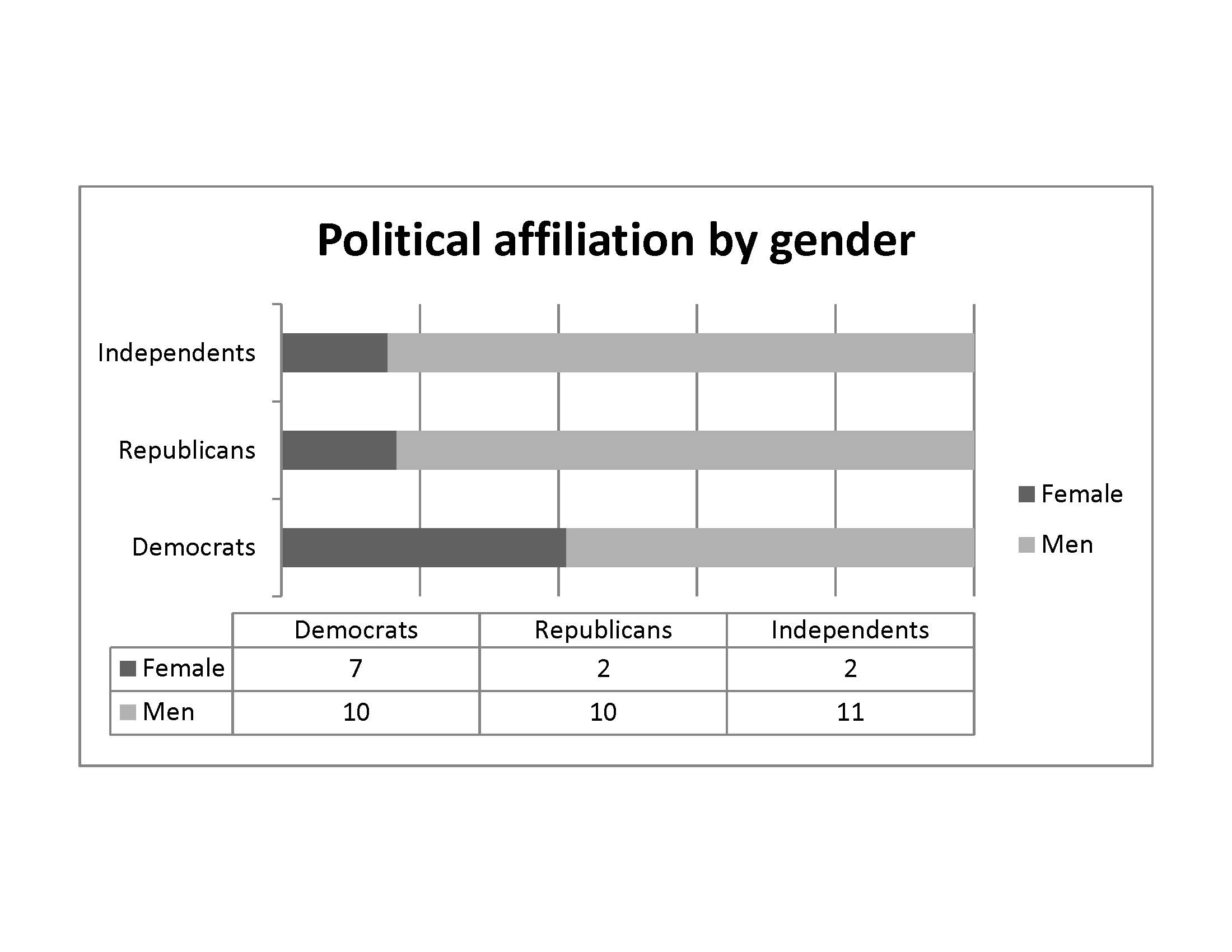








 LESSONS IN MEDIOCRITY