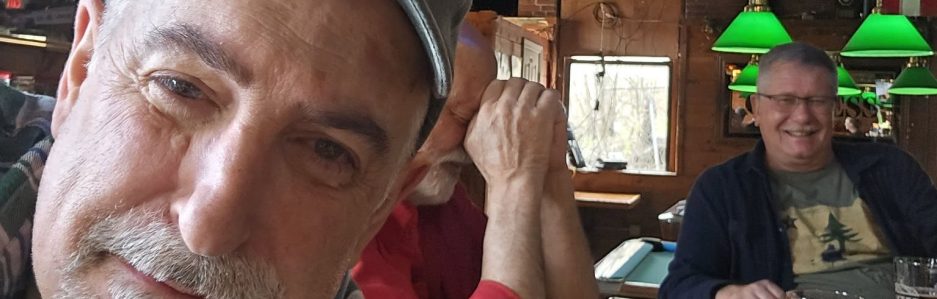
So proud of my wife

Running for elected office is not easy; not by a long shot.

But I am so proud of my wife; proud of her courage, her determination and her fiercely independent spirit.

It’s the two-week stretch, and no matter the outcome, I have enjoyed watching Laura grow and face her challenges head-on. She’ll make one hell of a city councilor.

Teacher, teacher

They say if you stand in one place long enough, the entire world will pass you by.

That’s how if feels at the Fryeburg Fair, where every single night I run into someone I know or someone I used to know.

Such was the case last night when I almost literally bumped into Peter Scontras and his wife at the fair.

Mr. Scontras was my eighth-grade English teacher at Saco Middle School, and despite my often asinine behavior in his class, he had a profound effect on my life that lingers to this very day.

Whatever failing can be found in my written words, it is certainly not the fault of Mr. Scontras. It’s more than likely that I was not paying close enough attention when he was talking about gerunds, split infinitives and serial commas.

Today, Mr. Scontras is happily retired, and he owns and operates one of the most interesting businesses in this area: The Way Way Store on Rte. 112 in Saco. If you have not been to the Way-Way store, you are missing out on adventure, a magical journey back in time.

I was surprised that Mr. Scontras would remember me.  I was even more surprised when he told me that he was a regular reader of this blog.

“You have a gift,” he said.

Words simply cannot describe how it felt to hear those words. (Example of a split infinitive).

A couple of nights ago, I posted on Facebook that I may have missed my calling. I speculated that I would enjoy teaching because I love interacting with kids at the fair.

Mr. Scontras replied to that post, reminding me that we are all teachers, and we all have lessons to share.

I come from a long line of teachers, and their students often tell me warm and fuzzy stories about the people I know as family.

My father was a teacher. He taught severely disabled students at the Cerebral Palsy Center. My grandfather was a teacher, teaching English and history at Biddeford High School. My grandmother was an elementary school teacher in Saco. Her former students invariably talk about Charlotte’s Web and E.B. White.

Today, my sister is a teacher, and she is married to a teacher. Thus, I am the proverbial black sheep in my family. I am not a teacher. But Mr. Scontras would argue that point. (Starting a sentence with a conjunction is a no-no, but is becoming common practice.)

Just the other day, one of my favorite teachers — Mrs. Loughlin (third-grade) — wrote on my Facebook page, telling me she was proud of me and my previous blog post. Her late husband, Tim Loughlin, was one of only two math teachers that I enjoyed. He had a special knack in connecting with students. Math was always tough for me, and his patience was limitless.

My late uncle, Leonard, was the director of student teaching at the University of Maine in Farmington.

He always told his students that you only need to two things to be a great teacher: 10 percent common sense, and 90 percent love of kids.

My uncle taught me more in one day than I learned during an entire year of high school. He did not teach me geometry, chemistry or how to memorize Whitman.

He taught me about hard work, honesty, compassion and generosity. Life lessons.

Sometimes I fail at those lessons, but the trick is to remain open to the learning process.

If you bump into a teacher, please do me a favor: say thank you.

My apologies in advance to Mr. Scontras for butchering the English language on a regular basis.

Every breath you take

coupleWhen my boys were younger, I drilled into their heads one constant message: Everything is a choice, and every choice comes with either consequences or rewards.

Some people will argue that not every thing is a choice: a flat tire, the death of a loved one or the loss of a job. While those things may be beyond your control, you do have a choice about how you respond to any of those situations; to any situation that arises in your life.

As poet William Earnest Henley wrote more than 100 years ago: “I am the master of my fate: I am the captain of my soul.”

Regular readers of this blog know that some very negative energy has tried to consume and overpower my family over the last six months.

My first and gut reaction is to fight this negativity; to engage in a war of words; to take this fight to the streets and to conquer it publicly.

Too often, I am a foot soldier, not a strategist. I run directly into battle with little thought of the consequences. Most people understand this instinct. In fact, many of my friends cheer me on as I wage each successive battle with this negativity, and I feel self-righteous — on the side of the angels.

The reputations of my wife and my children have been smeared in the public arena. Many friends have asked why my reaction has not been stronger.

A few days ago, this negative energy was revived after a three-week hiatus. Again, my family and I have become the focal point of contempt, rage and obsession. So yesterday, I began stockpiling my ammunition. I geared myself to once again respond to the negativity with brute force.

But last night I had an epiphany of sorts. I thought back to the lessons I taught my boys: I have a choice.

I can perpetuate this negative energy. I can feed this beast of darkness; or I can take pity on it. I can walk away. I can be better than the negativity. I can starve the negativity.

Sure, there is nobility in being a foot soldier, especially when defending your family. But shouldn’t I be putting more energy into supporting my family, to raising them up, rather than going to war?

War always comes with the consequence of casualties. Negativity begets negativity. Darkness begets darkness. There is absolutely no need for that in my life.

For whatever reason, my family and I have become the focal point of one man’s rage and obsession. So how am I going to respond?

I am going to pray for this man; I am going to beseech the God I believe in to help heal this man and his wounds. I am going to walk away and focus all my energy on my family, my job and my friends.

I cannot imagine the pain that this man must be feeling. I wonder if he is simply envious that I have so many people in my life who love and support me. I will pray that he can experience more of what I experience on a daily basis. I am going to forgive him.

I have a beautiful and loving wife. I have two amazing sons. I have many friends, a good job and a warm bed to sleep in tonight. I am more blessed than I should be.

For the better part of the last 20 years, I have been a semi-public figure in my community. There have always been people who have been somewhat offended by both my opinions and my actions. But never before have I experienced such visceral rage.

So while my response of prayer may seem counter-intuitive,  it is the best way I know to move forward. It is the best way to put my focus back where it belongs.

You and I are going to die. It is not a matter of if, it is only a matter of when. What will be your legacy?

With every breath you take, you have a choice. No matter how far down the scale you may have fallen, you still have a choice. If today is the day that I draw my last breath, then I want to leave this world thankful for my blessings, not bitter about a man who must be lonely, frightened and confused.

Today is a good day. It is a day I will focus on the things that really matter.

Pretty Persuasion

boehner-resignDo you argue about politics on social media? Do you find yourself getting angry and often one step away from “unfriending” someone or blocking them?

And what happens when you argue about politics with someone right in front of you? Are you able to keep calm or do you feel your blood begin to boil?

I have an interesting mix of Facebook “friends,” and follow an eclectic mix of folks on Twitter.

Most of these people are relatively outspoken about their political views, and many of them are political junkies just like me. Hence, we are connected via social media.  My social media contacts are pretty much equally divided between the two dominant political parties, but most of them could be described as political moderates.

Lately, however, I am seeing an increasing number of my friends becoming more extremist, whether they sit on the left or right side of the political aisle. I’m not a big fan of the word “extremist,” I prefer to describe these particular friends as passionate.

Passion, however, does not equal reason or even common sense. You can be passionate about something, but if you’re leading with your heart or your gut instead of your brain, you are bound to cross paths with someone who has a polar opposite point of view.

Witnessing those interactions is like watching a train wreck. Nothing good comes from it.

Passionate folks often decry the role of moderates. They say we lack convictions, courage and principles. I would counter that passionate people rarely pause to use their brains when trying to make a political point.

So there, I just lost the art of political persuasion.

Define winning

We live in a culture of winners and losers. We love to root for our teams, and politics has always been a blood-sport.

We have cliches such as “elections have consequences,” a modern adaptation of “to the victor go the spoils.”

But what is the point of winning a political argument? If you win, does it really help your candidate or cause?

What is more important: your PRIDE or your GREED?

Pride is defined as your way of doing things, your personal view of yourself and tactics. Greed is defined as your goals, the object of your desire.

So, first ask yourself: am I arguing to beat someone or am I arguing to help them better see my point?

Instead of bashing a candidate or cause, why not vest your energy into making a more compelling argument for your candidate or cause?

Why are you arguing? To thump your chest, to make a point or maybe to win someone over?

Last week, Speaker of the House John Boehner abruptly announced he would be leaving his post at the end of October. That announcement drew cheers from many of my friends on both sides of the aisle.

I don’t think Republicans understand fully how much Boehner helped his party. He was a fundraising machine and held together one of the most challenging caucuses in recent memory.

I also don’t think many of my friends on the left appreciate Boehner’s dedication to his country, his willingness to compromise and the leadership he offered in the House.

If it is to be all out war between the two political parties, then the casualties will be counted in losses for our nation.

So let’s all take a stab at better approach to arguing. Let’s persuade instead of attack.

Persuasion is much more difficult, but it is far more rewarding.

And it will likely help keep your blood pressure in check.

For a complete style guide about how to really win a political argument, check this link from New York Magazine.

No Good Deed

CourierThey say that no good deed goes unpunished, and if you don’t believe that just ask Biddeford City Councilor Robert “Bobby” Quattrone.

A couple of weeks ago, Quattrone and other members of the city council received an e-mail from Vicky Edgerly, the city’s welfare director.

In her e-mail, Edgerly asked if any of the councilors knew someone who would be willing to donate a walker for an indigent client.

Quattrone immediately stepped up to the task. “It really hit home with me,” he said. “My grandmother had MS (multiple sclerosis), and I know how hard it can be when you can’t move around on your own.”

Quattrone, who is also a member of the city’s Social Services Committee, took to social media in his quest to find a walker. He posted several updates on his Facebook page, relentlessly prodding his friends if they or someone they knew might be able to donate a walker.

The good news? According to Quattrone, Pris Paul of Biddeford donated a walker.

But the story does not end there. Quattrone said he did not know the woman who donated the walker. He did not have her telephone number or an e-mail address.

So, Quattrone decided to thank the donor publicly via a letter to the editor in the Biddeford-Saco-OOB Courier.

So far, so good. Right? Wrong.

Because it’s election season and because Quattrone is running for re-election, the weekly newspaper’s editor, Molly Lovell-Keely, rejected Quattrone’s letter.

“She (Lovell-Keely) told me it would not be fair to print my letter because it could be construed as political,” Quattrone said. “I accepted that explanation until I saw the next edition of the Courier.”

In the Sept. 24 issue of the Courier is a letter to the editor by Terry Belanger. Not coincidentally, Mr. Belanger is running against Quattrone for the Ward Four city council seat.

“I was sort of taken aback, especially after I read Mr. Belanger’s letter,” Quattrone said.

The letter carried the following headline: ‘Candidate says city mayor is shortsighted’

Belanger’s letter harshly criticizes Mayor Alan Casavant and members of the city council. Belanger’s tirade closes with the following: “I want to be part of that change and be able to stand up for you. That’s why I’m running for Ward 4.”

Maybe it’s just me, but a letter like that sounds a tad political, eh?

Quattrone said he called Lovell-Keely to complain.

“She said she was sorry,” he said. “She said it was an oversight.”

Pretty big oversight in my book, but what do I know?

During my tenure as the Courier’s editor (1999-2006) we always accepted one letter from each candidate and we accepted multiple letters from regular people supporting various candidates up until two weeks before the election.

Lovell-Keely has plainly demonstrated on several occasions that she is biased against Mayor Alan Casavant. Her husband, Brian Keely, an amateur blogger, foams at the mouth at every given opportunity to bash Casavant and his supporters.

I’ll bet dollars to donuts that a letter critical of Casavant’s opponent in the upcoming election would never see the light of day.

The good news is that a needy person got a much-needed walker. More good news: a city councilor helped facilitate the donation. The better news is that someone was generous enough to donate a walker for a good cause.

The bad news? I’ll leave that for the Courier to cover. Unless, of course, the editor has another oversight.


It’s been a slow turning

Laura Seaver
Laura Seaver

I have come full circle.

When I first met Laura, she was running for one of two seats on the Old Orchard Beach School Board. I was the editor of a local newspaper, and generally wrote endorsements for various candidates in five different communities.

In that particular race, I endorsed the incumbent, mistakenly thinking there was only one seat up for grabs.

I got an e-mail from Laura Kidman the next day. Part of what she wrote: “If I were a newspaper editor, I would get my facts straight. There are two open seats and three candidates.”

Ouch.

I was feeling defensive and returned her e-mail with a curt response, a half-hearted apology and also told her: “If I were going to write to the editor of a newspaper, I would be sure to spell the name of the newspaper correctly.”

This is how our relationship began.

Later in the day, I was complaining about the e-mail exchange to a reporter from another newspaper. That reporter empathized and added that Laura was really cute . . . and single. She offered to show me a campaign photo.

I was smitten, and I immediately returned to my office to write another e-mail to Laura. A response came into my inbox only moments later.

And that’s how it went for the next several days: a series of e-mails that became increasingly flirtatious, leading up to Election Day.

During our e-mail exchange, I made Laura an offer: If she won the election, I would actually bother to cover a meeting of the Old Orchard Beach School Board.  But if she lost the election, I would buy her a cup of coffee.

We had still not met in person.

On Election Day, my gut felt as if it were filled with shards of broken glass. I could not concentrate. I was planning to go to Old Orchard Beach and check the polls, knowing that Laura would likely be there, greeting voters as they entered the high school.

I saw her standing against a wall with other candidates, and my heart sunk. I knew instantly that she was way out of my league.

I shook her hand briefly, and then moved along quickly, trying to look important . . . as if I cared about the other races in Old Orchard Beach, and then left quickly without saying goodbye.

I drove away from the high school that night, cursing myself for believing that I might actually have a chance with this woman.

Long story short: Laura lost that election, and e-mailed me the next day to remind me that I owed her a cup of coffee. She provided me three different phone numbers to contact her.

There were more e-mails, and then a first date, a second date and so on . . .

Bottom line, it’s very unlikely that we would be married today if Laura had won that election.

Sometimes a loss is a big win.

What goes around comes around

After being married only a few years, Laura won other elections; serving two terms on the Biddeford School Committee. And today, she is a candidate for the Biddeford City Council.

This is where it gets tricky. I often get paid to work on political campaigns, but what do I do when my wife is a candidate?

I struggle with wanting to run her campaign, and she pushes back, saying she is going to do things her own way.

Make no mistake, she appreciates my support and advice, but at the end of the day this particular campaign is hers, not mine.

I am personally vested in seeing her win, but I am also reminded that even a loss could be a good thing.

Laura really cares about the city of Biddeford. She has a lot of good ideas about how our city can move forward.

My job is to sit back, and let her do her job; to help her when she asks, but otherwise keep my opinions to myself. And if you know me, you know that is a tall order.

Laura’s campaign won’t really start until Tuesday, and there are seven weeks to go before Election Day.

It just strikes me that if I didn’t make that mistake during my newspaper days, my life would be completely different today.

So, there are two lessons here:

Mistakes can turn out really well, and losses can be very big wins.

Meet your candidates

Mayor Alan Casavant (Sun Chronicle photo)
Mayor Alan Casavant
(Sun Chronicle photo)

Hear ye, hear ye . . .

I have just returned from Biddeford City Hall with the official list of mayoral and city council candidates.

The deadline for filing nomination papers has come and gone; and these are the names you will find on your November 3 ballot.

Let’s start at the top . . .

The Mayor’s Race:

Mayor Alan Casavant is being challenged for a third-term bid by Daniel Parenteau.

Parenteau ran two years ago as one of six candidates for the two at-large council seats. He finished in last place with a little more than 600 votes. He’s gonna need to step up his game if he wants to win this time.

City Council, At-Large:

Laura Seaver
Laura Seaver

There are five candidates running for the two at-large seats on the city council. This could be an epic battle. Finally: Seaver vs. Twomey!

Sorry for the distraction, here are the candidates: Councilor Marc Lessard is hoping to keep his seat. Councilor Clement Fleurent has decided to retire and will not be seeking re-election. The other four candidates (in alphabetical order) are:

Melissa “the Wolverine” Bednarowski. She served one term on the council (2011-2013) and is an outspoken critic of almost everything, but especially hates Alan Casavant.

Doris McCauliffe: if you don’t recognize the name, just think of the lady who screams when addressing the council at public meetings.

Laura Seaver: She’s smart, she’s sexy, she’s funny and super motivated. Did I mention she is a super hottie? (My personal favorite)

And, Joanne Twomey. Yes, Joanne Twomey will be battling a Seaver for a council seat. Epic! Twomey has lost her last three bids for public office, including twice being beaten by Casavant for mayor and losing the Democratic nomination for the District 135 Legislative seat in 2012.

Ward One:

Councilor Michael Swanton is being challenged by political newcomer Kathy Russell.

Ward Two:

John McCurry
John McCurry

Councilor John McCurry is the only candidate running unopposed.

Ward Three:

Councilor Stephen St. Cyr is being challenged by Richard Rhames. St. Cyr was appointed to the council earlier this year, and now wants to earn the seat. Rhames has a strong following in that ward (actually in all wards) and will be a strong contender.

Ward Four:

Councilor Robert “Bobby” Quattrone is hoping for a second term but he is being challenged by political newcomer Terry Belanger.

Ward Five:

Hang on to your seats, boys and girls. There are six candidates vying for the Ward Five seat. That’s right, I said SIX candidates.

Councilor Bobby Mills really wants to hold onto his seat for a fourth term, but is being challenged by (let me catch my breath) : Nathan Bean, Perry Aberle, Milton Truman, Carol Boisjoly and Karl Reed, Jr. (who runs a web site named best in your girl)

Ward Six:

Councilor Roger Hurtubise is retiring from political life. His seat is being sought by former city councilor Rick Laverriere and political newcomer Debbie Croteau Lauzon, the mother of Matt Lauzon. Matt Lauzon has played a critical role in shaping this year’s political landscape by keeping the heat on city officials regarding alleged sexual abuse by two former police officers.

Ward Seven:

Councilor Michael Ready is being challenged by former Charter Commission member Ben Neveaux.

And there you have it! Your slate of candidates for the city council.

I’ll post the school committee candidates later, but right now I have a birthday party to attend.

Good luck to all the candidates. On behalf of all Biddeford residents, thank you for stepping forward to serve your community.

No easy answers

Joining other mental health advocates in discussing stigma

In the wake of yet another senseless crime — this one, which struck close to home in Saco — there is a renewed debate about what to do with people who suffer from a mental illness.

Earlier this month, Connor MacCalister allegedly slit the throat of an unsuspecting grandmother, Wendy Boudreau, in a Shaw’s supermarket.

According to a story about the incident in the Portland Press Herald, “[h]orrific crimes like this, committed by individuals with profound mental illness, are rare in Maine, yet each time they occur, the same question arises: How could someone like that be out on the street, in a position to commit such a brutal crime?”

Though I consider myself a self-appointed advocate of mentally ill people, I struggle with the question because it hits home for me.

As mentioned several times throughout this blog, I suffer from a mental illness, with a range of diagnoses.

As of this writing, there are more than 67 reader comments on the Portland Press Herald story. Those comments run the gamut of reactions. Some say we need better access to outpatient mental health services. Others say mental illness is nothing more than a ploy to escape responsibility for a crime. Still others say, patients should be forced to take their medications, while others say we should go back in time and warehouse individuals with mental illness in institutions like AMHI (The Augusta Mental Health Institute).

Admittedly, it’s pretty damn hard to argue for the civil liberties of the mentally ill, especially in the wake of a horrific murder. Where are the advocates for Wendy Boudreau’s civil rights?

Ms. Boudreau’s only mistake was to go to a supermarket to buy ice cream. She had done nothing wrong other than being in the wrong place at the wrong time.

Stigma on a slippery slope

On the other hand, we tread a slippery slope when we generalize mental illness.

For example, how exactly do we define a “profound” mental illness, as the Press Herald story did? How do we know in advance that a mentally ill person is going to commit such a heinous crime?

In fact, violent acts committed by people with serious mental illness comprise an exceptionally small proportion of the overall violent crime rate in the U.S.

Mentally ill persons are far more likely to be the victims of violence, not its perpetrators, according to the National Association of Social Workers (NASW)

In its March 2011 article, “Budgets Balanced at Expense of Mentally Ill,” the NASW newsletter also mentions a new report by the U.S. Substance Abuse and Mental Health Services Administration that documents a nationwide decline in behavioral health care spending as a share of all health care spending, from 9.3 percent in 1986 to just 7.3 percent, or $135 billion out of $1.85 trillion, in 2005.

According to the Centers for Disease Control, one in five Americans suffers from some sort of mental illness. Of course, the statistics include depression, anxiety and treatable bipolar disorders. Put me in that category.

But what do we do with people who suffer from more extreme cases of these symptoms and other issues including paranoid-schizophrenia.

There have been times when I have been in that category, too.

Should the government force me to take medications? Should I be confined to the Riverview Psychiatric Institute?

Every day, I get up, take a shower, get dressed and go to work. Just like you.

I pay my taxes, enjoy the company of my friends and take care of my home and pets. Just like you.

I have been married to the love of my life for nearly 13 years. I successfully raised two stepsons. I give back and volunteer in my community. How do I do all that if I have a moderating mental illness?

First, I take a wide range of medications every day. Two, I see a therapist every two weeks; and third — perhaps most importantly — I have a support network of caring family members and friends, not to mention safe and stable housing.

These things are unfortunately out of reach for many people with a mental illness.

A broken system

I have relatively good and comprehensive health insurance, but even so it took me weeks to get connected to a psychiatrist after my last hospitalization, some two years ago. There is a profound lack of psychiatric beds in the state of Maine.

There are budget constraints to consider. Many mentally ill people — especially those with more profound illnesses — do not have access to premium health insurance. They live on the edge, relying on the minimum benefits of Medicaid (Maine Care). Still other insurance plans offer minimal coverage for mental health services, both for outpatient and inpatient care. For example many plans will pay for only 12 sessions of outpatient therapy (capped).

Supposedly, after three months, you are cured and ready to hit the streets.

Mental health providers do not choose their occupation to “get rich,” as suggested in the reader comments of the Press Herald Story. Social workers salaries are among the lowest of college-educated professionals. A manager of a fast-food restaurant typically makes more than a social worker.

Social workers do not choose their occupation as a way to get rich quick off the back of taxpayers.

Psychotropic medications are some of the most expensive on the market. Patient records are confidential, and sharing them between providers is a complex, burdensome task.

So what do we do? How do we fix a broken system?

Is it a matter of more money? Do we round up everyone we think might have a mental illness and lock them away? Do we criminally charge people for crimes they may commit in the future?

I do not know the answers to those questions. I do not know if Wendy Boudreau would still be alive today if we had better community-based mental health services. I do not know if her murder was preventable.

But I do know that Wendy Boudreau’s death was utterly senseless, and she did not deserve what happened to her on that hot August day in a supermarket.


#Black Lives Matter

Seattle Times photo
The Rev. Dr. Martin Luther King: Seattle Times photo

I had a little bit of an epiphany yesterday during an especially long drive home.

To prevent road boredom, I was a listening to talk radio, and a news segment about the Black Lives Matter movement caught my attention.

Before we proceed, a bit of disclosure: I am a white, middle-aged man.

Up until yesterday, I generally had a reflexive, knee-jerk reaction to the synergy building in the Black Lives Matter campaign: I would generally mutter: “All lives matter,” and while I still believe that is intellectually true, what is so wrong with acknowledging that Black Lives do, in fact, matter?

I began wondering, can’t we say Black Lives Matter without assuming that it is an automatic dismissal of other lives, races or ethnic backgrounds?

Why can’t we simply acknowledge that Black Lives Matter without feeling defensive and the impulsive need to correct those who deliver that message?

Like most white people, I want to believe that racism in the United States is a topic best left for the history books. I generally ignore it, or once in a while give it a passing nod as a present day and legitimate problem. I wrote about my own battles with racism previously.

But how can we ignore the rising tensions in black communities without actually sticking our heads in the sand?

I know and expect that I am going to get push-back for this blog post, but before you respond I would ask you to consider the following analogy.

Close your eyes and imagine that you and I are close friends. I have just been through a painful ordeal, one in which justice and fairness evaded me.

I say to you, “My Life Matters.”

Do you feel compelled to say, “Well, my life matters, too. Stop feeling sorry for yourself.”

Or could you say, “Yeah, your life matters. I’m sorry you are going through a difficult time.”

I really think it’s okay to acknowledge someone’s pain, sorrow or grief without lecturing them about what a politically correct response should be.

It is 2015, why is not okay for some people to hear the phrase that Black Lives Matter?

Why does that make so many people uncomfortable? No one is saying that white lives do not matter or that Hispanic lives do not matter.

A growing number of people in America are standing up, acknowledging reality and asserting that Black Lives Matter.

And they do.

#BlackLivesMatter


The Island of Misfit Toys

August 15, 2015

It’s not even Labor Day. Sweet Jesus take me now.

Already the political machinations are beginning in Biddeford, a city that treats their biennial municipal elections like the Super Bowl.

It’s not like this in the neighboring city of Saco, but on the south side of the river — local politics is a blood sport that rivals rugby or a Stanley Cup playoff game.

I should not complain. For years, I have been a season-ticket holder to these gladiator games. From time to time, I have even wandered onto the field, working as defensive coordinator for various candidates.

Casavant and I celebrate his second mayoral win in 2013

In 2008, for example, I was hired professionally to help defeat a referendum that would have closed the airport. The result? 86 percent of voters went our way.

Three years later, someone called me and asked if I could head up Alan Casavant’s effort to oust former mayor Joanne Twomey from office. I agreed to help, and we won that campaign with 68 percent of the vote. Not too shabby, especially since we were taking on a two-term incumbent.

Two years later, in 2013, Casavant once again asked for my help in his campaign. We won. By big numbers. Again.

I am a political junkie and a professional communications consultant. It’s fantastic when your hobby and your occupation collide. I was hired in 2012 by Casella Waste Systems to help ensure a successful city council vote that would ensure the MERC trash incinerator was no longer a part of the city’s skyline. The result? The Biddeford City Council voted 8-1 to purchase the MERC property and begin a new curbside recycling program.

Three years later, a private developer is undertaking a $50 million redevelopment of a property that abuts the former incinerator’s parcel. That investment would never have happened if MERC were still there.

In addition to those campaigns, I worked professionally on the Oxford Casino campaign. The result? Oxford became the first casino in Maine, despite many failed attempts by others in previous years.

Last year, I worked to help preserve Maine’s traditional bear hunting practices. We won.

But when you work on campaigns, you don’t always win.

In 2008, I was subcontracted by the Hillary Clinton campaign in an effort to sway Maine’s super delegates. By then, Senator Barack Obama had too much momentum heading into the nomination.

But there was an upside to working on the Clinton campaign. I got to be part of a conference call with Harold M. Ickes, a legend in campaign circles. There I was sitting on a bench swing in my backyard, listening to Ickes talk about strategy. It was a memorable moment and a highlight of my career.

With that bit of disclosure out of the way, allow me to finally get to the point of this blog post.

Alan Casavant and I are friends. —- Friends.

The Karl Rove of Biddeford?

Apparently, some people in Biddeford have delusions of grandeur. They think a run for the mayor’s seat is the equivalent of running for president.

Over the last few days, there has been much speculation that Alan Casavant is little more than my puppet; that I am somehow the man behind the curtain, keeping the residents of Oz in line.

These people are generally rabidly opposed to Casavant winning a third term. Somehow, they think that linking me to Casavant will further ensure his defeat in November.

Some of these malcontents from the Island of Misfit Toys think that when Alan Casavant farts it’s because Randy Seaver ate beans.

On social media, they keep a steady drumbeat, raising questions about Casavant’s recent press releases about a serious and troubling problem in the city.

“This has all the hallmarks of Randy Seaver’s political spin,” wrote Ryan Gavin on Casavant’s Facebook page, when the mayor announced that he had written a letter to the United States Attorney General.

Joshua Bodwell complained to the mayor that it seemed as if it is actually me who is writing Casavant’s press releases.

And Brian Keely has routinely blogged that I am essentially Casavant’s attack dog. Christ, even Joanne Twomey described me as “the devil.”

Note: If Joanne Twomey ever calls you the devil, you know you’re doing something right.

So let’s set the record straight. I am not helping Alan Casavant with his campaign. I am also not writing his press releases or shooting his videos. With the exception of suggesting which tie he should wear, I am not providing him any strategic advice.

Alan Casavant has close to 4,000 friends on Facebook, any one of them may or may not be giving him advice. How to hell do you get 4,000 Facebook friends? Must be a popular guy.

It’s easy to understand why the malcontents and some others from the Island of Misfit Toys would think that I am helping Casavant. I have helped him before, but I am not helping him now.

Why?

1.) I am far too busy at work to devote any time to the tedium of Biddeford’s political struggles. Today my clients stretch from the Bangor area all the way to Sierra Vista, Arizona.

2.) Casavant can’t afford to pay my billable rate, so my primary focus must remain on clients who pay me.

3.) I have some fairly serious health concerns that render me pretty much useless after 8:30 p.m. (more about that in a moment)

4.) I am enjoying a new-found and civil relationship with Matt Lauzon, the man at the center of troubling sex abuse allegations in Biddeford. Both Matt and I have gone through a lot in the last few months and it was simply too stressful to think about getting back into Biddeford’s political theater as anything other than a spectator.

I will most likely vote for Casavant in November. I will let him put a sign on my lawn. I will cheer him on from the sidelines, but I cannot afford (financially, physically or mentally) to be any more involved in his campaign. That is the God’s honest truth.

A true story

In closing, I’d like to tell you a quick story about Alan Casavant.

This story, I think, sums up Alan’s character, integrity and his loyalty to his friends.

Sometimes, just before bedtime, I become confused and disoriented. It usually means I need to take my medications and get to bed. But on this particular cold October night I wandered from my home. Laura was fast asleep. She did not know that I had wandered off.

I became increasingly confused, and I found myself near some woods and on the verge of tears. I was lost and frightened. Fortunately, I had my cell phone. I managed to punch the contacts list and hit the first number. It was Alan Casavant’s cell phone, but I did not know it.

He was already in bed. I told him I was lost and confused. He got up, got dressed, jumped in his car and went looking for me. I was only a 1/4 mile from my home, and he found me rather quickly near the intersection of May and South streets.

He brought me home and came inside to make sure Laura knew what was happening.

That, ladies and gentlemen, is what you call friendship.

In a few weeks, Laura and I are planning to join Alan and his wife, Patti, for dinner in Portland. If I give him any advice, it will be written on a napkin and passed under the table.