The city of Biddeford is a lot of things; among them it is a college town that is home to the University of New England, a liberal arts college nestled along the banks of the Saco River.
In numerous conversations this evening with city election clerks and poll workers, I heard repeated stories about record voter turnout and incredible same-day voter registration statistics among UNE students.
It’s nice to see our nation’s young people get involved in politics, I only wish they actually cared a bit more about the community that serves as their temporary home.
Why do I say this? Why am I so callous?
Well, maybe it’s because I think college students, especially, ought to be a bit more “educated” on issues of national, state and local importance. Our nation’s college students represent our future. They are the up and coming leaders of tomorrow, but apparently can’t be bothered to invest a small measure of time in their host community.
Even with a perfunctory review of the numbers, it becomes quickly apparent that the students cared about only two issues: the presidential election and a statewide referendum question regarding marriage equality.
UNE is located in Biddeford’s Ward One, the predominantly coastal and more affluent section of the city.
In Ward One, 1,445 voters cast ballots regarding Marriage Equality, not including 59 blank ballots.
In Ward One, 1,496 voters cast ballots to choose the next president, not including 8 blanks.
But what happened when these voters were asked about who should be their state representative in the Maine Legislature?
Hmmm…. there were 97 blank ballots
How about the Maine Senate? 173 blanks
How about Local Bond Questions regarding road pavements? 228 blanks
How about the local school budget? 138 blanks.
Ok, so maybe most voters don’t drill down that far…but let’s compare the number of blanks on those election issues against some other neighborhoods in the same city, like my neighborhood…
State Senate: 72 blanks (a difference of 99 fewer blank votes compared to Ward One)
Paving Bond: 143 blanks (a difference of 85 fewer blank votes)
Local School Budget: 69 blanks (a difference of 99 fewer blank votes)
Across the board, Ward One had a higher number of blank ballots than any of the city’s other six voting wards (both in actual numbers and as a percent of totals)
For better or worse, Biddeford Mayor Alan Casavant is also serving as a representative in the Maine House of Representatives. He is a Democrat. He lost by a margin of just 8 votes to his Republican challenger. Wow…what if just a few more students had cast a vote in that race???
Many of the students, including a young woman from the neighboring town of Kennebunk, used only their UNE student ID as a means of proving residency in Biddeford. But they did have to swear an oath to certify that they had not voted anywhere else.
Out of curiosity, how is it that college students who can wait in line 36 hours for the latest I-Phone or score coveted Dave Matthews concert tickets months before a scheduled concert not be able to register for voting until the actual day of the election?
Nah, it couldn’t be they want to wait until the last possible minute in order to avoid scrutiny. They really do care what’s happening in the world. They just forgot that Election Day was creeping up on them.
Maybe we should require you to register to vote when you buy an I-Phone or some concert tickets. Wouldn’t that be convenient? Then they would not have to rent so many passenger vans to vote. Then they would not have to put such a strain on our strapped city resources. Then, maybe these educated kids might be able to fill out the entire ballot.
You may call me a dreamer, but I’m not the only one.
Just moments ago, Mitt Romney did what he does best. He chose the safe bet and once again fumbled the ball in his quest to be the next president of the United States. Mitt ended all speculation by announcing his choice of Paul Ryan as his running mate.
Of course, the right is thumping its chest, joyously proclaiming that President Obama will no longer be able to ignore our country’s miserable economy during an especially malicious campaign.
GOP Nominee Mitt Romney
Meanwhile, the left is busy buying bottles of champagne, prematurely celebrating their victory while putting together a slew of campaign ads that pronounce Ryan as the guy who wanted to kill Medicare. For the record, check what Politifact has to say about the left’s Medicare innuendo.
My prediction? Obama wins by 3 points when he should lose.
Yes, I just said President Obama should lose the election.
Yes, I just said that President Obama will win a second term.
With just one sentence, I have managed to piss off loyalists on both sides of the aisle. So now that I have your attention, allow me to explain my rationale.
Why Obama will win
Romney’s selection of Ryan as a running mate only serves two purposes: 1. it forces Obama back into the debate about the economy, and 2.) it spikes the temperature on the right. But just like four years ago, the GOP has done absolutely nothing with this pick to take from the political center…That is why Obama will squeak out a narrow victory. Palin gave McCain an early bump, but it came up far short on drawing critical votes from the political center.
Why Obama should lose
President Obama screwed up royally even before he was sworn into office for his first term. He set the bar for his presidency far too high. In short, he over promised and under delivered.
That alone is reason enough to justify my decision not to renew his employment contract.
Ask yourself this: Why would such an allegedly smart guy promise so much so soon?
It’s simple. Obama’s “Hope and Change” was a tactic born of grandiose arrogance and fueled by a troubling naiveté of how the world works.
Remember four years ago? This president was going to be so much different. He was going to change Washington. No more business as usual. No more cozying with lobbyists. Superior transparency and political accountability would be the new norm. He was going to fix the economy, end our wars, give us universal health care and stick it to the rich.
“Yes, we can!” he proclaimed without deference to the stark reality that surrounded him.
I was there on that cold, January day when the nation was about to be forever transformed into something so much better. I did not vote for him, but I was genuinely excited to be part of that historic moment when our 44th president was sworn into office.
The crowd on the Capitol Mall was like nothing I had ever experienced. There was an electric excitement in the air. I am a big guy, but I could not secure my footing. When that massive crowd lurched, I lurched…I was literally moved by those throngs of joyous and expectant celebrants.
It was hard not to believe that we were witnessing something much bigger than a new president taking office. Like Chris Matthews,I also experienced a tingling sensation running down my leg… (in retrospect, that may have been the result of really cold temperatures and a lack of restrooms).
But did Obama really overpromise and under-deliver, or am I just a frustrated cynic?
To answer those questions, I offer some analysis and opinion from a broad spectrum of news and media outlets, including: The Huffington Post, Politico, ABC News and Fox.
Let’s now examine the reality of our president’s 2008 campaign promises:
Healthcare: To his credit, Obama tackled one of our nation’s most complex and dysfunctional systems. The result? The government got in bed with huge corporations by using its force of law to require everyone to purchase health care insurance. In exchange, the corporations agreed to change practices including rescission of policy coverage and extending the term of dependent care. If you’re excited about this, you have very low expectations.
Ending the wars and closing Guantanamo Bay: Instead of troops in Iraq, we now have private contractors quietly cleaning things up in the name of democracy and capitalism. Foreign civilians are still being killed by drone strikes and US foreign policy has changed little, especially when considering that we were happy to celebrate and credit this president for crossing into a sovereign nation without permission and executing a criminal without trial. Yay, us! Guantanamo Bay? Still open for business.
Increase Transparency in government: Not so much, at least according to Politico:
“Open-government advocates say some administration practices are actually undercutting Obama’s goal. Among their complaints:
• Administration lawyers are aggressively fighting FOIA requests at the agency level and in court — sometimes on Obama’s direct orders. They’ve also wielded anti-transparency arguments even bolder than those asserted by the Bush administration.
• The administration has embarked on an unprecedented wave of prosecutions of whistleblowers and alleged leakers — an effort many journalists believe is aimed at blocking national security-related stories. “There just seems to be a disconnect here. You want aggressive journalism abroad; you just don’t want it in the United States,” ABC News correspondent Jake Tapper told White House press secretary Jay Carney at a recent briefing for reporters”
Swamped by outside Republican groups in fundraising so far, Obama belatedly decided to give his blessing to so-called super PACs, which can accept unlimited donations from corporations, labor unions and wealthy individuals. Both Obama’s campaign and the White House maintain that the president does not support today’s rules but realized belatedly he must play by them to give himself a competitive chance at a second term.
“He’s not saying that the system is healthy or good,” said Obama spokesman Jay Carney, who was pressed repeatedly about whether Obama’s move was hypocrisy. “He is making the decision, his campaign is making the decision, that the rules are what they are. And they cannot play by a different set of rules than Republicans are playing.”
That’s not consistent with what Obama has said about the groups, though. And now, by putting strategy above all else, Obama opened himself to criticism that he had compromised on principle and succumbed to the rules of the same Washington game he pledged to change.”
Jobs and the Economy: Epic fail and the starkest example of overpromise and under-delivering.
Business Insider: ” . . . the Obama administration drastically underestimated how bad the economy was and drastically overestimated its ability to do something about it.
As a result of this, President Obama over-promised and under-delivered on the single most important challenge of his Presidency: Jobs.”
Huffington Post: “. . . A slew of weak data has led economists in recent weeks to ratchet back their expectations for U.S. economic growth. A Reuters poll published on Wednesday found economists expect the nation’s Gross Domestic Product to expand at only a 2 percent annual rate in the second quarter.
Projections for hiring also have been cut. According to the poll, the economy is likely to add an average of 147,000 jobs a month between now and October, too few to make much of a dent in the nation’s 8.2 percent jobless rate.
As the economic recovery threatens to stall for the third summer in a row, voters are registering deep doubts about Obama’s leadership, according to a Reuters/Ipsos poll released on Tuesday. More now believe Romney would be stronger than Obama in dealing with the economy and creating jobs. . .”
How is the world better today than it was four years ago? How much has Washington changed? Are you better off than you were in 2008?
Can Mitt Romney do any better? Probably not.
Thus, I am a cynic. Meet the new boss. Same as the old boss.
Predictably, in the days following a massacre in an Aurora, Colo. movie theater, there has once again been a rallying cry for tighter gun control laws.
Sadly, this knee-jerk reaction fails to address the much larger issue: No sane person would willingly open fire on an unarmed group of civilians. It’s not about guns. It’s about our appetite for violence and our reluctance to address mental health issues.
But that is a more complex issue, and it is much harder to contemplate a solution for a problem that extends well beyond our nation’s borders, including a July 2011 massacre in Oslo, Norway or last month’s shooting spree in Toronto, Canada, where gun control laws are about as tight as they can be.
Not far from Aurora, lies the smaller town of Littleton, Colo., where two students opened fire on their classmates and teachers at the Columbine High School in 1999.
In response, the U.S. Secret Service, in conjunction with the National Education Association, undertook a study of school violence and published their report three years later, in 2002
The Secret Service Report concluded that schools were taking false hope in physical security, when they should be paying more attention to the pre-attack behaviors of students.
But behavior is a tricky subject matter, and not nearly as sexy or convenient for sound bites as AK-47s or Glocks.
No matter, we still happily and blindly toss around words such as “sicko,” “whack-job” and “nut case” to describe the people who commit these horrific, unimaginable criminal acts.
As someone who struggles daily with a mental illness, I am reminded again why I penned an op-ed that was published in the Portland Press Herald only a few days after the Jan. 2011 shootings in Tucson.
If you haven’t read it, take a gander…and let’s finally have that conversation.
President Barack Obama is on a roll. After nearly four years of “evolving” on the issue of gay marriage, he finally caught up to former Vice President Dick Cheney.
As expected, there has been much media hoopla about Mr. Obama’s sudden profile of “courage” regarding this very controversial social issue.
But is all the praise deserved?
Not quite, . . . at least according to some observers who say that Obama is still dancing around the issue.
For starters, The Atlantic reminds us of what Cheney said in 2009 on the issue of gay marriage:
“Well, I think that freedom means freedom for everyone,” Cheney said. “. . . I think people ought to be free to enter into any kind of union they wish. Any kind of arrangement they wish. The question of whether or not there ought to be a federal statute that governs this, I don’t support . . . It has always been a state issue, and I think that’s the way it ought to be handled today, that is on a state-by-state basis.”
So why exactly did Mr. Obama wait three years to say the very same things that Dick Cheney said in a July 2009 interview?
Is he worried about his upcoming election? Did he have an epiphany? Was it the result of a recent referendum in North Carolina?
Not exactly.
Obama got put into a box by his No. 2.
A few days ago, Vice President Joe Biden had a stunning moment of clarity that apparently caused lots of hand wringing in the Oval Office.
Biden made it abundantly clear that he supports gay marriage. For nearly 48 hours, the media was talking more about Biden than Obama.
That will just not do.
So, the prez called his buddies at ABC and cautiously waded into the pool, offering some rather tepid remarks about an issue that should be at the forefront of his party’s platform.
” . . .[Obama] now believes that gay couples should be able to marry. He doesn’t believe they have a right to do so. This is like saying that black children and white children ought to attend the same schools, but if the people of Alabama reject that notion—what are you gonna do?”
Gawker correctly reminds us why the president’s words were so lame and pathetic:
” . . . before Roe v. Wade, abortion was a state-by-state issue, too. So was slavery. There are 44 states in which gay men and women are currently barred from marrying one another. Obama’s position is that, while he would have voted the other way, those 44 states are perfectly within their rights to arbitrarily restrict the access of certain individuals to marriage rights based solely on their sexual orientation.”
If our president had real courage or anything remotely resembling integrity, here is what he should have said:
“Gay people have the right to get married just the same as atheists, heterosexuals or any other consenting adult. Marriage is a deeply personal issue, and our government should acknowledge and respect the decisions of all marriages without deference to religion, gender, sexual orientation or race.
“I will make it a central point of my second term to ensure that every gay person has the same rights as every other American. I will take this message to each and every one of our 50 states and sell it door-to-door if I have to. It is just the right thing to do, and anyone who values liberty and personal freedom ought to be standing proudly with me on this issue. Period.”
Well, we can hope for change, right?
Yeah, don’t hold your breath looking for real leadership from either Mr. Obama or Mr. Romney on this issue.
Oh yeah, one more thing: Which president signed the Defense of Marriage Act and deployed Don’t Ask, Don’t Tell?
Did you enjoy your summer? I hope so, because now we return you to your regularly scheduled weather for late March in southern Maine.
There was rampant speculation about last week’s freakish heat wave, an anomaly that shattered local meteorological records and sent scores of disappointed people to Old Orchard Beach in search of Pier Fries.
Some folks opined that increasing solar flares from the sun were to blame. Others said fiery rhetoric from presidential hopeful Rick Santorum was dramatically increasing gaseous emissions and further eroding our fragile ozone.
And, of course, global-warming alarmist were out in full force, smugly announcing that the much-anticipated end of the world is now in full swing.
But leave it to those crazy Brits to get to the meat of the story.
Apparently, the earth has a long track record of warming and then cooling. It’s a cycle that’s been going on for centuries, long before rednecks like me were driving F-150s to suburban shopping malls in pursuit of consumer electronics and plastic bags.
If you don’t believe me, check this story in London’s Daily Mail newspaper, which reported a new study that throws a monkey wrench into the global climate change debate.
According to the story, a team of scientists led by geochemist Zunli Lu from Syracuse University found that contrary to the ‘consensus’, the ‘Medieval Warm Period’ approximately 500 to 1,000 years ago wasn’t just confined to Europe — it extended to Antarctica.
Now there’s an inconvenient truth that ought to be as easy to understood as a trip to Peaks Island.
We had an Ice Age long before we had SUVs. Peaks and all the other islands in Casco Bay were created long ago when southerly flowing glaciers carved out the island masses.
Even in Greenville, Maine — arguably the state’s greenest community, there is evidence of historical global warming: it’s called Moosehead Lake.
Moosehead Lake, Maine
We have a moral obligation to be good stewards of our natural resources; and none of this should justify industrial pollution or irresponsible human behavior.
It’s just that you should remember that there is an agenda to the global warming hysteria. It’s a belief that individuals should not get to choose how much energy they use. Other people want to tell you how you should heat your home, what kind of car you should drive and what type of lightbulbs you can use.
Look, if it helps you sleep at night by driving a Prius… knock yourself out. If you want mercury-laced, curly lightbulbs in your kids’ playroom — have at it.
But don’t think that any of that is going to fundamentally change the planet’s natural evolution.
Earth’s climate has been changing since the beginning of time. To think that you can save the planet is the height of arrogance. The planet will change with or without you.
If you want credibility, then lead by example: ditch your car, buy a bicycle and get off Facebook….computers are made of petroleum-based products and they consume gobs of electricity.
If only the Neanderthals had Twitter, maybe they could have stopped those damned glaciers.
But then, where would I drive my boat?
Global warming has been good to me—even if only to give my furnace and my wallet a much-needed break during the final days of winter.
The most vocal supporters of President Obama’s push to reform our nation’s health care system will invariably say that health care is a “fundamental right.”
The so-called “right to affordable health care” has become the mantra and favorite talking point for those who say health care in the United States ought to look a lot more like it does in other countries, including Canada, Norway, Sweden or Denmark.
These folks generally support a single-payer system of health care, which resembles the current Medicaid program and effectively eliminates the need for private insurance.
But is health care — or even access to health care — a right?
In our first installment (Money for Nothing), we followed up on questions posed by Biddeford Mayor Alan Casavant on his Facebook page:
“So the moral question is: What should a society do in such situations? What should government do? Do we act, or do we allow the laws of Darwin to supersede our compassion, integrity and our humanity? The system is broken. . .”
Although we previously discussed the difference between health “insurance” and health “care,” Casavant’s questions also beg a discussion about where morality and government should — or should not — intersect.
Casavant’s questions also prompt a more focused pondering of how our nation defines “rights.”
The second paragraph of the Declaration of Independence is probably a good place to start when examining the concept, definition and limitations of “rights” held by the American people:
We hold these truths to be self-evident, that all men are created equal, that they are endowed by their Creator with certain unalienable Rights, that among these are Life, Liberty and the pursuit of Happiness.
Reading that sentence it becomes crystal clear our nation’s Founders understood basic rights come from a higher power than government. And this is a fundamental point.
Government cannot bestow rights; otherwise government can take away rights.
Your rights are yours, with or without a government.
The government’s limited role, as defined by both the Declaration and the ensuing Constitution, is to secure and defend your individual rights as part of a much larger group.
But the Declaration of Independence also opens the door for a legitimate discussion and debate about other “rights” beyond Life, Liberty and the Pursuit of Happiness, which are described as being “among” other, non-specified rights.
The argument for health care as a right gained further legitimacy when our Founders drafted the Constitution. It is within this document that our Founders more fully explored the concept of government’s appropriate role in promoting the “general welfare.”
Although the subject of health care is not discussed in either the Declaration or the Constitution, it could be reasonably construed as much of a “right” as public education — another topic not specifically discussed in those documents.
During our nation’s formative years, there was no such thing as public education. Education was reserved for the privileged few who could afford it.
Today, however, most people generally agree that our nation is better off when our citizens have — at minimum — a certain level of education.
Although our nation continues to grapple and debate public education funding, those costs and the ensuing delivery system is much easier to control than the cost and delivery of health care.
And here’s where it gets really tricky.
If we declare health care as a “right,” how does that impact your other rights as an individual?
If the government provides your healthcare from cradle to grave, then does it not follow that the government can dictate your health choices and even many of your lifestyle choices?
If we allow government to take care of us, are we not abdicating our individual pursuit of happiness?
I moved out of my parents’ home because I was ready to enjoy my adult freedoms. I wanted to come and go as I pleased. I wanted to make my own choices about what I eat, when and where I sleep and all the other benefits of freedom.
If my pursuit of happiness includes a poor diet that includes a daily regimen of Big Macs and French Fries, are you responsible to help pay the cost of my inevitable need for a heart transplant?
We have established standards and limitations for public education.
We accept the fact that not every child will be able to attend Harvard or Yale. Of course, you have the “right” to apply, but those universities also have the right to reject your application.
If you want to make the moral case for public health care, what happens when your health care contradicts your neighbors rights to his/her religious beliefs?
During the Vietnam war, even our military made accommodations for drafted citizens to be conscientious objectors. If you are Catholic, should you be required to help pay for abortions and contraceptives?
Where do your rights as an individual end — or start — in a society that provides you with health care?
How much of your liberty are you willing to sacrifice for your safety?
One of the most ardent opponents of smoking was Adolph Hitler, a man who envisioned a nation of supreme and physically fit citizens. Mentioning Hitler in this debate is intended to be inflammatory, only if to give us pause.
If you have the right to health care, does that mean that other people should financially support that right? If so, are there any limitations to how much health care any one individual wants or needs?
These are legitimate questions and not very convenient for either side of the debate.
If we propose that health care is a right, then we will need to completely reconstruct our health care system. We would have public doctors and nurses, whose employment contracts and salaries are negotiated by the government — just like teachers.
We would also have public health care clinics that are less desirable than their private counterparts.
In the end, those with money would have better access to service than those without money.
Sound familiar?
The hypocrisy found in these arguments is overwhelming.
We want our choices. We want our freedom, but we would prefer that the consequences of our individual choices are funded — at least in part — by other people.
Maybe it’s just time to move back in with mom and dad.
If you would like to further explore the arguments for and against the concept of health care as a right, you may want to visit this website.
Anyone with a pulse and an IQ exceeding room temperature can likely agree that our nation’s health care system is seriously flawed.
But that’s generally where the agreement stops.
That’s why I was impressed when Biddeford Mayor Alan Casavant posed a series of observations about Maine’s own raging health care debate on his Facebook page.
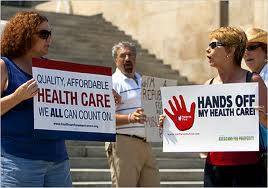
August 2009: Large crowds in Portsmouth, NH, protest outside a high school where President Obama speaks about the need for health care reform.
Casavant is also a member of the Maine House of Representatives, and his comments were based on his observations during a legislative hearing about how best to address rising health care costs.
“Clearly, resentment [of] the Obama plan drives a lot of these bills,” Casavant noted, referring to the federal Patient Protection and Affordable Care Act of 2009.
“For some, the costs of treatment and medicine exceed their ability to pay,” he said. “So the moral question is: What should a society do in such situations? What should government do? Do we act, or do we allow the laws of Darwin to supersede our compassion, integrity and our humanity? The system is broken. . .”
I applaud Casavant for raising the topic, but submit that our health care system is NOT broken, it is fixed . . . meaning it is rigged.
Our current system is either outdated and ineffective, at best ; or it is favorably geared toward an ever shrinking pool of those who can afford to keep up with skyrocketing costs.
Are you with me, so far? Good; because this is where the debate gets tricky.
Before we proceed any further, we must agree to at least one basic fact, regardless of our individual political/cultural/socio-economic viewpoints.
Health “care” and health “insurance” are completely different topics that are too often linked at the hip.
Let’s start with health insurance.
If you drive a vehicle in Maine, you are required by law to have a minimum-liability insurance policy. This law exists to protect drivers who are harmed by another driver’s neglect or carelessness.
Driving, as the state of Maine tells all new drivers, is a privilege, not a right.
I will take that a step further and say that health “insurance” is also not a right.
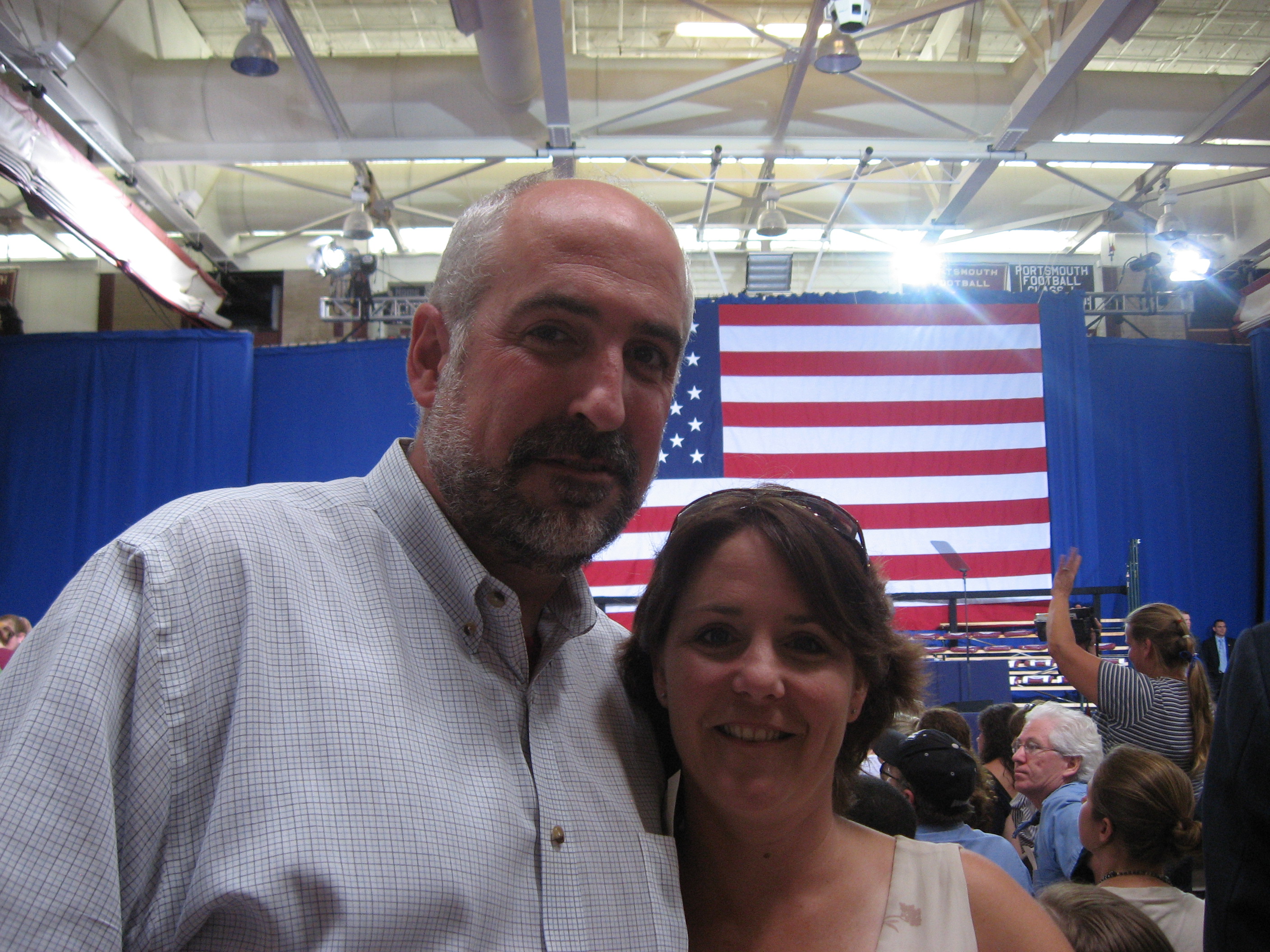
Laura and I scored tickets to see President Obama speak about the need for health care reform in 2009. Then, just as it is now, we both had reservations about the president’s plan. Laura tried to ask a question, but she and many others did not get picked.
The argument about whether health care is a right remains a bit more ambiguous, but let’s remember we’re now discussing health “insurance,” not health “care.”
The discussion about rights and expectations have only been muddied by the nation’s new health care law, which mandates individuals to purchase health insurance in the private marketplace.
The so-called “individual mandate” is one of the more controversial aspects of the health care reform law signed by President Obama. That issue is scheduled to be deliberated by the U.S. Supreme Court this year.
Interestingly, critics of the individual mandate can be found from both the left and right side of the political spectrum.
Conservatives argue that the individual mandate further erodes personal liberty and crosses the sacrosanct line between personal choice and government mandates.
On the other hand, more progressive Democrats — especially those who pined for a public option or a single-payer system of healthcare reform — describe the individual mandate as nothing more than a very big gift for evil insurance companies that stand to gain millions of new customers.
But all that debate and Constitutional introspection pales in comparison to the more fiery rhetoric associated with the subject of health insurance profits.
Left-leaning groups, such as ACORN and HCAN (Health Care for America Now) say that corporate, for-profit health insurance profits are skyrocketing and have quadrupled over the past few years.
It’s a favorite talking point of progressive Democrats and very handy when whipping up grassroots mobilization to support the president, but it’s not entirely accurate — although rated as “mostly true” by PolitiFact, a Pulitzer Prize-winning organization established by the Tampa Bay Times to fact check political rhetoric.
Meanwhile, the health insurance industry is crying poverty, saying their profit margins are among the lowest of any industry in the United States — ranging between two and four percent.
So, which one is right?
Unfortunately, the inconvenient truth is that both groups are a little bit right, and a lot wrong.
And that is bad news for those of us trying to navigate the turbulent waters of this complex debate.
But simply blaming “greedy” insurance companies conveniently ignores too many other factors that drive health care costs. Moreover, such rhetoric is debatable, at best; and intentionally misleading at worst,
Rick Newman, chief business correspondent for US News & World Report, makes a compelling case about why health insurance companies make lousy villains, pointing out that profits are hardly the root of a much larger and complex problem.
“Overall, the profit margin for health insurance companies was a modest 3.4 percent over the past year, according to data provided by Morningstar. That ranks 87th out of 215 industries and slightly above the median of 2.2 percent,” Newman reports.
Despite my right-leaning, free-market beliefs, I admit to being somewhat conflicted on this issue, and that’s probably because my household is knee-deep in our own health-insurance nightmare.
My wife, Laura, was diagnosed with multiple sclerosis just three days after Christmas in 2008. Her disease is never going to go away. It is never going into remission. It takes a little piece of her each day, even when we don’t notice it.
Laura does a good job of managing her illness, but there is no escaping that MS is a progressive illness that will never go away and only get worse over time.
Neither of us asked for our respective illness. We both work full-time. We pay our taxes, but we are also a health insurance company’s worst nightmare…we take out a lot more than we put in to the system.
If you’re a conservative, Tea-Party Republican, you are advised now to reach for the duct tape because otherwise your head may explode when I offer up this next tidbit:
You are paying a portion of our health insurance.
Laura is a state employee and thus, we are more than lucky to have an outstanding health insurance plan that is offered to all state employees and their immediate family members.
But even if Laura lost her job, and we relied upon a more traditional (and much more expensive) private health insurance plan, you would still be paying for our health insurance.
Why? Because in our current system, healthy Americans subsidize the costs of treatment for the ill. That is the fundamental core of the individual mandate: we need more young, healthy people in the system to offset the cost of treating older and sicker Americans.
I am not a big fan of the individual mandate – beyond the Constitutional arguments, I think the system unfairly penalizes healthy people and will do little to drive down the costs of health care.
There is a lot more to cover, but I will end this installment here and borrow Casavant’s closing observation from his Facebook post: Stalemate [on this issue] is unacceptable.
You know a political nerve has been pinched when Rush Limbaugh apologizes for comments he made on his national radio show.
Rush’s outrageous comments about Sandra Fluke ignited a deafening outcry from women’s groups and reproductive rights advocates this week, and several of his advertisers are now distancing themselves.
Because this is a presidential election year; and because Rush is an unabashedly conservative pundit, his comments are being used by Democrats to underscore the notion that Republicans are waging a war against women.
Nothing like a bit of hypocrisy just a few days before Super Tuesday.
Check the cheering and applause that HBO talk show host Bill Maher received when he described Sarah Palin as a “dumb twat.”
A few nervous giggles, but applause nonetheless…
So, if a Republican commentator demeans women with vitriolic commentary we gather the pitchforks and demand his head on a stick.
But if a liberal commentator does the same thing, we laugh or just look the other way. Is that how it works?
Make no mistake, both Rush Limbaugh and Bill Maher are pigs, and their outrageous comments should be condemned by everyone with a pulse, regardless of political affiliation.
California Governor Jerry Brown, a former presidential candidate, apologized for comments that were attributed to him and/or his staff, describing Republican opponent Meg Whitman as a whore during the gubernatorial campaign.
From my perspective, an apology doesn’t cut it.
George Will got it right when he said the word “inappropriate” is far too tame for describing Rush Limbaugh’s comments.
“Inappropriate is when you use your salad fork for your entrée,” Will quipped on ABC’s Good Morning America, saying Republicans are too tepid in their response and afraid of Limbaugh and his massive audience.
Violence against women begins when we give ourselves permission to demean them with our discourse.
As the father of two young men, I have an inherent obligation to speak out about the pervasive nature of gender violence and misogyny.
As an amateur pundit, I just wonder why it’s somehow funny when Bill Maher calls a woman a twat, yet outrageous when Rush Limbaugh infers that a woman is a slut.
Dean Scontras, the Republican who challenged Chellie Pingree in the 2010 First District Congressional race, is also bothered by the crystal-clear hypocrisy.
On his Facebook page, Scontras said that until those who sympathize with the left express equal outrage over Maher’s remarks about Palin, they should remain silent about Rush Limbaugh’s comments.
I disagree.
Although I despise the hypocrisy, remaining silent about Rush Limbaugh’s vile commentary just because Bill Maher was equally (or arguably more) offensive, only serves to amplify and allow a very real war against women to fester – – if only beneath the surface.
Although I am confident that people who know me understand the context of my satirical commentary, my words were immediately thrust onto the stage of public discourse via the power of the internet.
A very wise woman once told me that words are like toothpaste. Once you squeeze them out, it is virtually impossible to put them back in their container.
So, I will not edit or delete that post. I will leave it where it remains as a constant reminder of my own hypocrisy.
And, hopefully, my willingness to at least acknowledge my own boorish behavior will serve as an example for how not to behave.
Some people say that our national political discourse is out of control and filled, more than ever before, with the rancor and tension of partisan politics that threatens to destroy the fabric of our united nation.
“If Sen. Olympia Snowe is really retiring from the U.S. Senate because she can’t stand the poisonous partisanship in Congress – and we have no reason to doubt her word on that score – then Maine is paying a terrible price for the rancor that has become business as usual in Washington, D.C.”
We only need look just beyond Maine’s borders to find moderate Republicans, such as Senator Kelly Ayotte of New Hampshire or Senator Scott Brown of Massachusetts.
Not to mention that no one could reasonably say Lamar Alexander of Tennessee, Utah’s Orrin Hatch or John McCain are anywhere near Tea Party favorites.
Hatch was a close personal friend of the liberal lion, the late Senator Ted Kennedy, and they worked closely on several pieces of legislation.
Former Maine Senator Edmund Muskie
If anything, there is far too much moderation in the Senate and not enough people to stand up and cry foul when necessary. But the media won’t tell you that.
Why? Well, have you ever watched C-SPAN? It’s more boring than watching paint dry.
More than 99.9 percent of the time, both parties in Congress are working cooperatively and doing a super-duper, stand-up job of figuring out how to further screw the people they supposedly represent.
The system is not broken. It’s fixed.
But the media likes to focus on the Rand Paul’s of the world, or the banality of Rep Joe Wilson (R-SC) who shouted, “You lie!” during a State of the Union Address by President Obama.
That kind of partisan hype makes for better Facebook updates and newspaper headlines than the recent bipartisan push to reauthorize the Defense Spending Act; or last month’s transferring of budget line-item veto power to the president, a scary proposition for all of us, depending on who is sitting in the Oval Office.
Did you see that in the newspaper or on your favorite blog?
That nugget seemed especially important for Snowe to mention during last month’s Republican caucuses in Maine, where she was facing primary challenges from more conservative candidates.
Reportedly, Snowe votes along party lines nearly 75 percent of the time. Good for her! She’s a Republican, what do you expect? But does breaking ranks one out of four times make you a moderate? Please.
We have become a nation of sheep, bleating for civility and warm, fuzzy sentiment.
But what about Nancy Pelosi’s statements when the House was finally able to pass the controversial health care reform bill? We won…deal with it. Should Democrats be a bit more moderate and side more often with Republicans?
We conveniently forget the rancor that dominated the Continental Congress, the Burr-Hamilton duel, the partisanship that led to the Civil War, the impeachment of President Andrew Johnson, the communists-hunting era of Joe McCarthy or the vitriol expressed by Barry Goldwater, not to mention the more recent call for President Clinton’s impeachment.
Maine people, especially, should be mindful of those lessons and our place in history.
Look at how the GOP slung mud at Ed Muskie; or consider the wisdom of Margaret Chase Smith as she chastised McCarthy: “Have you no shame, sir?”
Instead of heeding the mindless, perfunctory analysis of media pundits, maybe we all should crack a history book every once in a while.
For a fun, yet historically accurate, reminder about our nation’s political discourse and the angry words used by our founding fathers, check out this video.
On the heels of a public uproar regarding the sanctity of the internet, there is growing evidence that it’s a good idea to do your own fact checking and think through things that are posted by your friends on Facebook or circulated by groups with an agenda.
Subject at hand: a graphic chart that supposedly shows President Obama has had little impact on the national debt, especially when compared to his Republican predecessors.

 The city of Biddeford is a lot of things; among them it is a college town that is home to the University of New England, a liberal arts college nestled along the banks of the Saco River.











 LESSONS IN MEDIOCRITY | OUTLAW JOURNALIST