Bridge over troubled water

Chris Christie (AP Photo)

By comparison, guys like Gary Hart and Bill Clinton had it easy.

Sex scandal? No big deal. Traffic jam in New Jersey? Now that’s how you infuriate people.

It remains to be seen exactly how the controversy surrounding “bridge-gate” will impact Christie’s dreams of a 2016 presidential bid, but watching the news this morning it appeared that the world was about to slip off its axis. The talking heads were beside themselves, questioning whether Christie’s political clout could endure the scandal.

Within moments of the fateful e-mail surfacing, DNC activists were all over the blogosphere, questioning the New Jersey governor’s credibility and his ability to lead.

“Is this the guy we want in the White House?,” wrote one woman on Facebook, mocking Christie for “not knowing” about every e-mail his staff had sent or received.

Strangely, it was only a few months ago when Democrats were eager to point to Christie as a welcome voice of sanity in the GOP. They praised his bipartisan nature because he was willing (gasp) to meet with President Obama in the aftermath of Hurricane Sandy, only days before the 2012 election.

Republicans, on the other hand, were infuriated, stopping just short of accusing Christie of orchestrating the hurricane disaster as a way to help Obama beat Romney. Sorry, but my cocker spaniel could have helped Obama beat Romney.

Back then, my friends on the left side of the political aisle celebrated Christie. They praised him as a rare Republican. They called him a moderate. They said he was a “common sense leader.”

They used to say the same things about John McCain: a maverick . . . a man of principle. Democrats felt good about being able to heap praise on someone from the other side of the aisle, right up until he won the GOP nomination.

The same dynamic began happening to Christie last year, despite his willingness to parody himself on the Jimmy Fallon Show. Because Hillary is the heir apparent for the Oval Office, and because Christie was holding his own in polling against her, he began to fall out of favor, especially with my friends on the left.

Christie, however, adamantly and repeatedly denies having any interest in the 2016 presidential race. Strangely, he sent a lot of Christmas cards to elected officials in Iowa a few weeks ago. Who knows? Maybe he just likes Iowa.

I don’t know how this crisis will impact Christie’s political future, but I do know this: I was lukewarm about him as a presidential candidate until this afternoon.

Christie did something today that is rare in today’s political world. He took responsibility. He said, “I own this.” He apologized. He held his subordinates responsible. He expressed regret. He answered every question the media threw at him . . . and then some. He talked, and talked and talked . . . and talked.

He did not run away from the problem. He faced it head on. He accepted the responsibility that comes with leadership. “The buck stops with me,” he said.

How refreshing. He didn’t blame his political opponents. He didn’t blame the media. He didn’t blame Congress. He owned the problem and pledged to fix it.

That’s leadership, but don’t hold your breath waiting for the left to give him any praise or even the benefit of the doubt.

Because today was the best day that Hillary Clinton has had in a long, long time.

Just like a prayer

Bobby Mills
Bobby Mills

Biddeford City Councilor Bobby Mills has a lesson for all of us who use social media.

It doesn’t matter much if the NSA has tapped your phone or if Google is using your online data to create a psychological profile, you have a responsibility to be careful about what you share on social media outlets.

Mills, an elected official, is upset that he was contacted by a local newspaper regarding a potential conflict of interest issue. According to Mills, the newspaper received an anonymous tip regarding something he posted online.

I’ll let Mills tell the story . . .

Interesting enough I just got a phone call interview from the Courier. Someone made an “anonymous” complaint about the unsuccessful Go Fund Me page I set up back in October/November for assistance in our down payment for our lease to own home. Since this page was only created for my family and friends on Facebook I’m simply amazed.
“The complaint was about public officials creating pages seeking donations and conflicts of interests that it may generate.  Seriously.  My family doesn’t live here and any friendships in Biddeford would never be in a situation to assist us if they could. Nonetheless conflicts of interests? Amazing.
 Everytime I’m reelected,  there’s always some “anonymous” nonsense. Hey. Why don’t you call me? 207[redacted].  Your welcome to come and visit as well. Obviously you know where I live”

Bobby Mills and I have not always seen eye to eye. In fact, I’ve often been one of his loudest critics. But in this story, I feel some of his pain.

Please note: I said some.

Mills and every other adult who uses social media ought to understand how those platforms work. Social media is a power tool in the realm of mass communication, and like any other power tool, you can expect really bad results if you don’t follow some basic guidelines.

Mills said he posted his personal request for the benefit of his family and friends. He didn’t expect criticism or harsh comments about his financial situation from outside his circle of family and friends.

While I sympathize with Mr. Mills’ situation, his defense is extremely weak. He wanted to raise a lot of money (thousands) to help secure a down-payment for a home. You don’t post something online if you don’t want a lot of people to see it.

Rule No. 1 of social media: Never post or tweet anything that you wouldn’t want to see on the front page of tomorrow’s newspaper.

Bobby Mills likes to use social media. In fact, he’s set up a Facebook page for a second run at becoming Maine’s next governor. Criticize him for that, if you want (and I will . . . later), but don’t knock the guy for being in a tight financial spot and then attack his character because of that fact.

Times are tough for a lot of people. There’s nothing wrong with asking family and friends for help. It’s a tough situation. If you haven’t experienced it, thank your lucky stars.

Raising questions about whether Mills’ original fundraising post constitutes a potential conflict of interest is a bit of a stretch.

By all accounts, Bobby Mills is a good husband and father who loves his kids. He holds several jobs and works hard. He gives a lot back to his community. His only crime here is being a bit naïve about how social media works.

However, if Mills still serves as a member of the Biddeford Housing Authority, and if the home’s sale is connected in any way to that agency, then Mills needs to put some distance between his personal objective and his role as a city official.

Elected officials are treated differently by the media for good reason. When you run for office you have to expect that.

And when you post something on Facebook, you should expect that a lot of people will see what you may not want them to see.

UPDATED: Bobby Mills is NOT a member of the Biddeford Housing Authority.

Take the money and run

Stack Of CashLike a lot of other people, President Barack Obama has a New Year’s resolution.

This week Obama pledge to return his focus to the subject of “income inequality.”

According to a story in the Washington Post, the president was a bit short on specifics about how he might achieve his long-sought economic goals. Instead, the speech — coming at the end of a difficult and politically damaging year — was designed to help define a populist argument that he and other Democrats can carry into upcoming legislative battles and into next year’s midterm elections.”

While most everyone can agree that a widening gap between the haves and the have-nots presents serious problems for the country, the real battles will come as various factions argue about how to narrow the gap between the poor and rich. You can expect these battles to line up in perfect symmetry between the two major political parties.

This is the year that I will turn 50. This year is also the 50th anniversary of President Lyndon Johnson’s declaration of a “war on poverty.”

This is where it gets tricky for Democrats. Five years into Obama’s presidency, and 50 years after our nation declared a so-called war on poverty, there is ample evidence that the war is failing and President Obama’s economic recovery measures are falling short. The poor are still getting poorer and the rich are getting richer.  This is why today’s political battles are about extending unemployment benefits, expanding Medicaid, etc.

An Inconvenient Truth

Republicans will have their own challenges in this debate.

They will be labeled, generalized and demonized as rich, fat cats. No one will talk about John Kerry, the Kennedys or the Roosevelt Family. We will ignore Nancy Pelosi’s wealth. This, as always, will be about politics . . . not about solutions. It will be about Republicans trying to beat Democrats by pointing to failures; and about Democrats blaming Republicans.

It’s just too easy for most Americans to get behind the Robin Hood concept of taking from the rich and giving to the poor without realizing that you are simply relocating wealth by force.

Since both parties have challenges in this mid-term election year, you can expect a lot of talk about the “top 1 percent.” But here is an inconvenient truth that I stumbled across on Twitter:

According to the non-partisan Congressional Budget Office (CBO),  the top 1% of wage earners make 14.9 percent of all pre-tax income in the United States, yet pay 24.2 percent of all federal taxes.This is a conversation we must have. We should focus on making poor people richer, not on making rich people poorer.

The best way to achieve that goal is to 1.) Focus on educating the nation’s workforce. 2.) Stabilize family units 3.) Drive down health care costs and stop focusing on expanding insurance (make health care more affordable, efficient)

Since U.S. poverty rates continue to climb, maybe it’s time to admit we’ve lost the war on poverty. Maybe we need a new strategy and a little less politicking. But don’t bank on it.

If you would like to read or download the CBO report, you can find it here

Middle of the road

middle_class
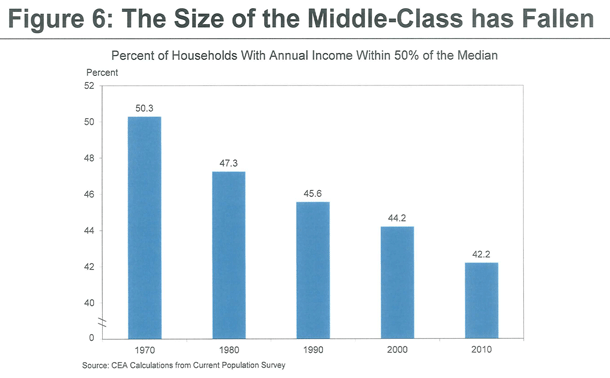
The beginning of the end? Is the middle-class evaporating or did it ever exist?

I remember when we got our first color television. It was 1973.  My parents purchased the house two years prior, and that television was a refurbished Zenith console model.

I was the remote control.

From his favorite chair, my father would bark at me: “Turn to Channel 13! I want to see Walter Cronkite.”

Growing up in that house of Franklin Street in Saco with my sister and our dog, Kelly, I was positive we were a middle class family.

My father was a teacher. My mom worked part-time at Canal Bank. I was a Cub Scout and took clarinet lessons. My sister took ballet and tap lessons. We ate dinner at the table, and put on our good clothes for church on Sunday.

Shit, I was an altar boy. Life was good. Right?

Maybe, but it was certainly more a perception of reality than a hard fact.

What is the middle class? Who can define it? Is it disappearing or was it always a myth?

Defenders of the Myth

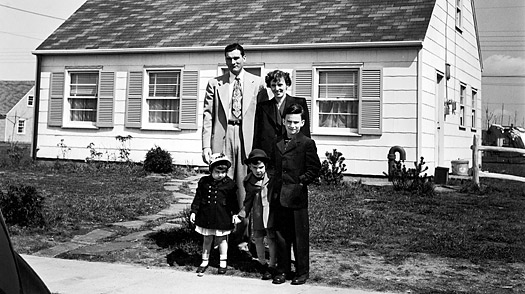
suburban-familyPoliticians, pundits and just about everyone else loves to “stand up” for the middle class, but what are they defending?

Few politicians dare define the middle class because they fear what will happen if the economy tanks, and more people feel left out of the so-called American Dream.

Just look at Mitt Romney’s blunder when he attempted to define the middle class (“Those earning $200,000 to $250,000 and less’)

According to an April 14 story in USA Today“President Obama mentioned the middle class a half-dozen times in his State of the Union address this year, and House Speaker John Boehner told Obama to “stand up for middle-class jobs.”

Google says [the middle class] has been called the “backbone of the country” at least 2.3 million times.

From gridlocked Washington to cities and town everywhere, the middle class is far and away America’s favorite socioeconomic group.

Yet no one can agree on what, exactly, the middle class is.

Economists and sociologists say that’s a big deal. Decisions are made, laws are written and elections are won or lost based on people’s beliefs about the middle class and what it means to the country. A nation that so values the middle class, they say, really should be better at defining it.”

Perception or reality?

middle_classAccording to numerous polls, most Americans define themselves as “middle-class,” despite ample statistical evidence to the contrary. It would appear that we prefer the middle. A short drive on the Maine Turnpike will back-up my anecdotal observation, watching drivers hug the center lane.

By definition, the “middle” is wedged halfway between lower and upper, between large and small, equidistant between left and right.

Go to the grocery store and try to buy “small” eggs. You can’t. The smallest eggs you can buy are “medium-sized” Try to buy a small soft drink at McDonald’s. You can’t. The cashier will offer you a medium. It’s ridiculous how we play these games of perception that have no basis in logic.

We don’t like to talk about the lower-class, the lower rungs of our socio-economic ladder. Nor are most people comfortable contemplating the rungs above.

Politically, we tend to generalize and demonize both the lower and upper class. Poor people have made bad choices and are inherently lazy. Rich people are greedy bastards who only care about themselves.

We puff ourselves full of self-righteous indignation, armed with little more than anecdotal evidence.

What is middle class? Are you middle class?

It appears that few things are more subjective than determining where you fit on America’s socio-economic scale. But let’s look at some data.

Using 2012 data from the U.S. Census Bureau, it’s easy to see that median annual household income in the United States is $51,371. The median is halfway between the top figure and the bottom figure (not an average). This means that half of all households in the U.S. earn less than $51, 371 per year; and that half of all households earn more than $51, 371.

Now let’s look at the state of Maine, where the median household income is lower, estimated at $46,709 per year. Remember, this includes all income from everyone in your household, regardless of whether they are related to you.

So what should be the margin for determining middle income in Maine? For argument’s sake, let’s say +/- 10 points, so now we have determined the middle household income range based on data ($42,000 -$51,380).

Are you still in the middle class?

In fairness, middle class is more than just income. There are numerous other factors: home ownership, profession, level of education, marital status, etc.

But what about debt load? Even with a good income, those with high debt loads may be struggling and not feeling like the middle class.

Feelings are not facts

How we feel about our situation makes up a large part of our subjective analysis regarding whether we are middle class or not middle class.

A friend of mine recently stated that the middle class is evaporating. He bemoaned the good ol’ days of his youth and the opportunities his father had in the booming years following World War II.

Let’s think about that for a minute. In fact, I challenge you to get up from your computer and take a quick walk around your home. Is your standard of living higher now than when you grew up?

I’ll share my own observations.

I started by stepping outside for a cigarette break. I have a snowblower. My parents had shovels. I have a boat, a camper. Not my parents. My truck was purchased brand-new; my wife’s car is fully loaded with tinted windows and a retractable moon-roof. My parents bought used cars.

Our houses are somewhat similar except my parents’ home had one bath. Mine? Two bathrooms and enough space for a home office. My parents didn’t have a cell-phone bill. They did not pay for internet. If you had blue-tooth, you needed to see the dentist. There were no home theater systems, no stainless-steel appliances and no one could imagine having a “personal” computer.

My father was able to finish college not thanks to a federal student loan but because my mother worked third-shift, painting little lines on resistors and capacitors at Components. We washed dishes by hand. We never needed a new printer. We had three television channels. No one in  my neighborhood had granite countertops. No one had a Jacuzzi in their bathroom. We didn’t have microwaves.

The more I think about it, the more it feels like I am George Jetson, son of Fred Flintstone.

We have moved the bar on “living comfortably.” We have raised the standard of living to keep up with the Joneses.

The (not so) usual suspects

David Flood
David Flood

Another Biddeford politician has thrown his hat into the ring to replace State Rep. Paulette Beaudoin in the Maine Legislature.

While some observers were thinking that newcomer Ryan Fecteau has all but clinched the June 2014 Democratic primary for the District 11 seat, it looks like voters could have several choices.

Former Biddeford city councilor and one-time mayoral candidate David Flood announced this week that he also will be running for Beaudoin’s seat, and he’s already received her endorsement.

Flood is best known in the city as the founder and publisher of the Biddeford-Saco-OOB Courier and five other weekly newspapers that he and his wife sold in 2007, only months before he won an at-large seat on the city council. In 2009, Flood lost his bid to oust Mayor Joanne Twomey, but two years later voters returned him to the city council.

Flood and Fecteau both have some advantages and challenges.

Fecteau, 21, is certainly eager and appears to have built a decent foundation for his campaign. In an unprecedented move, he publicly announced his candidacy last year.

Previously, Fecteau served on the city’s Charter Review Commission and as chair of the city’s Democratic Committee.  He has already set up a web site, social media pages and did what no other state representative candidate from Biddeford has done before: he coordinated a fundraiser and campaign event for himself in Washington, D.C., where he is a student at Catholic University of America.

Fecteau posted some photos from that Washington D.C. event and sent press releases to local newspapers. The photos show a bright-eyed kid with big dreams, holding a microphone and rallying a group of his peers who would be hard-pressed to find Biddeford on a map, never mind being able to vote for him.

Flood, 58, said he believes his experience as a successful business owner, entrepreneur and father makes him a strong candidate who understands the challenges of a struggling state economy and the real-life, day-to-day issues that impact voters. “This is an important time in our state’s history,” Flood said. “We need someone who knows what it’s like to pay taxes, to meet a payroll, to raise a family and deal with the complexities of life.”

 Flood also has Paulette Beaudoin’s endorsement, saying she called him and asked if he would consider running for the seat she now holds.

Flood is the founder of the Heart of Biddeford, a non-profit group that is working to revitalize the city’s downtown area. He also owns commercial properties on Main Street, including a previously empty building that he co-purchased and developed with Biddeford architect Caleb Johnson. Today, 265 Main Street houses Elements Cafe and other tenants, including Engine, a non-profit arts center. Earlier this year, he launched a new magazine, Innovation Maine.

Ryan Fecteau
Ryan Fecteau

“I think of myself as a newspaper guy,” Flood said. “Carolyn and I opened the Biddeford-Saco-OOB Courier on July 13, 1989. I had just turned 34, and our two sons were eight and five years old. We know what it’s like to start a business and work as hard as you can to make it work.”

By the time the Floods sold the company, it had increased to six newspapers with 28 full-time and a dozen part-time employees.

“I do not want local governments to have to raise property taxes because the state isn’t doing its job,” Flood said.  “This is an exciting time in Biddeford’s history – this is a way I can help.”

But Flood does have some challenges. Only weeks after winning his last election, he abruptly announced that he would be resigning his seat from the city council to return to the newspaper business. “It would have been a huge conflict of interest if I remained on the council,” he explained in 2011. “That opportunity came along right after the election, it’s not something I planned to do while campaigning.”

Flood’s return to the newspaper business was also short-lived, and he said he has no problems talking about that turn of events with voters.

Other Democrats who may be considering the seat include former Biddeford Mayor Joanne Twomey, who lost her primary challenge against Beaudoin two years ago; former city councilor Roch Angers and (because the district’s boundaries have changed) former State Sen. Nancy Sullivan.
 
Republican Perry Aberle is also considering another run for the seat. Aberle was trounced in his first bid for the seat by Beaudoin in 2012. A year later, in November, Aberle finished a distant third in a three-way race to be Biddeford’s next mayor.
 
District 11 was formerly known as District 135. Beaudoin held the seat for eight years and is being forced out because of term limits.
 

With a little help from my friends

A few weeks ago I decided to try a social media experiment.

Given that many of my Facebook friends are fellow political junkies who cross the full spectrum of political affiliation, and given that discussions about “income equality” and minimum wage standards are becoming more frequent, I decided to sample my friends’ opinions in an amateur poll.

But this poll would be different. It would be completely transparent, meaning that respondents would be able to see responses from other respondents and that all responses could be viewed publicly. This poll would also allow respondents to self-select regarding their participation.

Before I proceed any further, I want to thank each of the respondents for their willingness to participate. For the most part, I don’t personally know most of those who responded. And that is the beauty of social media: the ability to connect and share ideas with others who are sometimes far outside our more traditional circle of friends and acquaintances. Each of these respondents, unlike those who participate in a traditional poll, were willing to share and “own” their opinions and answers publicly.

Though I was hoping for 50 participants, I decided to wrap up data collection after three days (December 8 – December 11, 2013) with 42 participants, including my own answers. The pool of respondents reflects about 5 percent of my 736 Facebook friends.

Now before anyone starts hyperventilating about this poll, its accuracy or its methodology, let’s clear up a few things:

1.) This is an amateur poll; a social media experiment. 2.) It was not paid for nor authorized by anyone; 3.) It is not intended to represent anything other than informal sampling of people I am connected to on social media. 4.) We must also assume that respondents were honest with their responses and did not alter their responses after the data was analyzed.

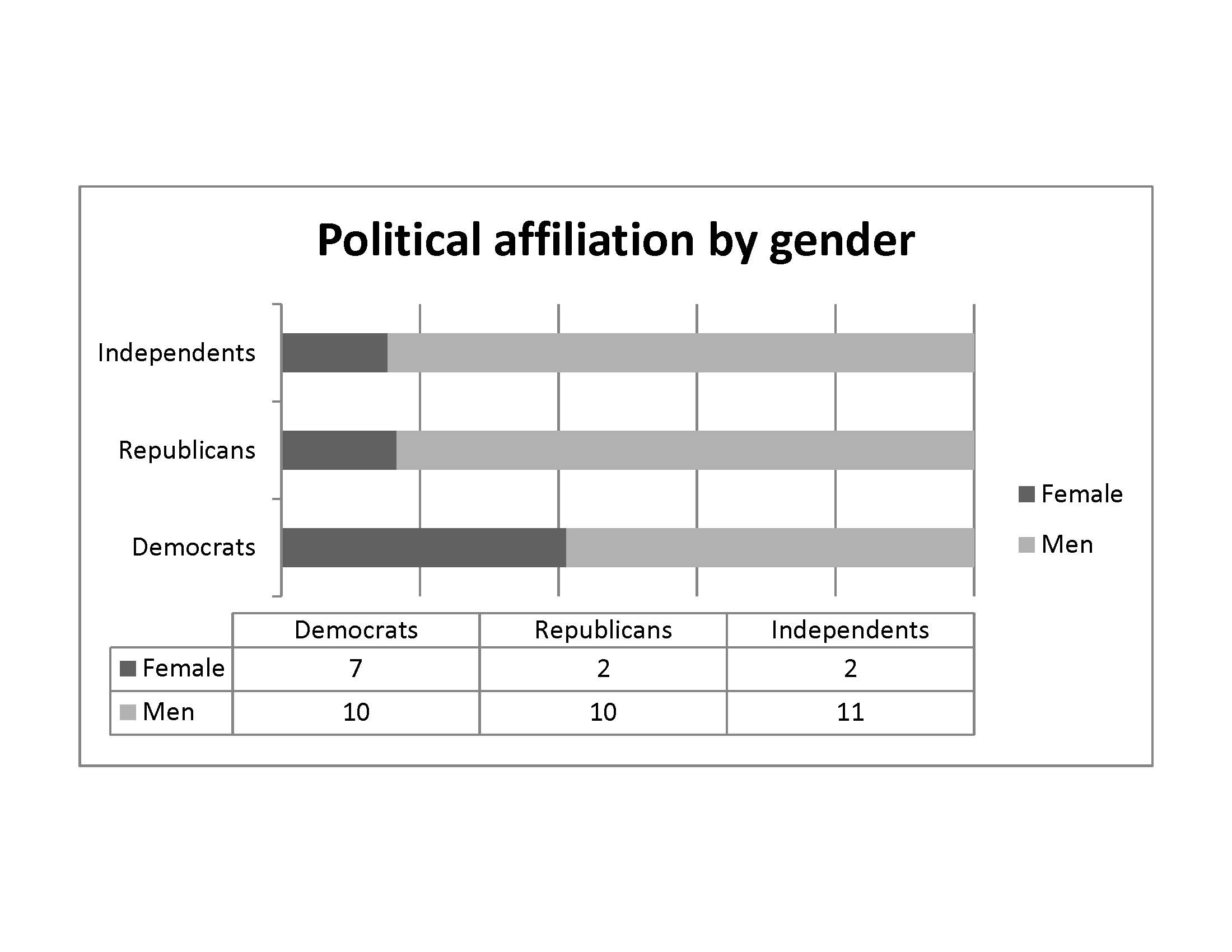
With all of that out of the way, let’s now look at the data. Clearly, the poll was weighted by male responses, but was nearly evenly split by political affiliations. Among the 42 respondents, there were 17 Democrats; 12 Republicans; and 13 Independents or un-enrolled. Thirty-one men and 11 women participated in the poll (Figure 1.1)

Figure 1.1
Figure 1.1

The poll was limited to three questions. The original Facebook post, along with the various replies and comments, can be viewed here.

Asked and answered

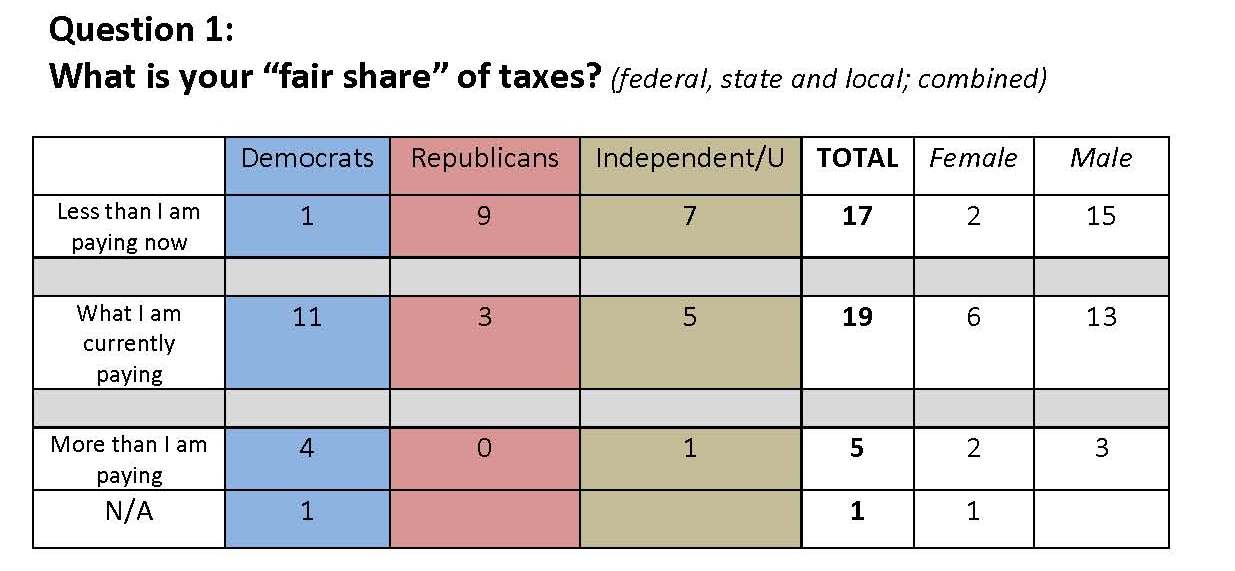
Question 1 asked respondents: What is your “fair share” of taxes (combined fed, state, local)?

Several respondents and others expressed disdain for my use of the word “fair” in the question. I responded that the word “fair” is certainly a subjective term, but the responses would also be subjective. Respondents were given three responses to choose from: A.) Less than you are now paying? B.) What you are currently paying? or C.) More than you are now paying? One respondent declined to answer the question.

Figure 2.1
Figure 2.1

There were no big surprises here. I was expecting to see a sharp divide between Democrats and Republicans, assuming Republicans would almost universally answer that they are already overtaxed and paying more than their “fair share.” What is interesting? Three Republicans (25 percent of Republican respondents) said they think their current tax obligation is “fair.” Both Democrats and Republicans, however, expressed frustration about local taxes rather than state or federal tax rates. See the chart (Figure 2.2) below for the breakdown of responses.

Figure 2.2
Figure 2.2

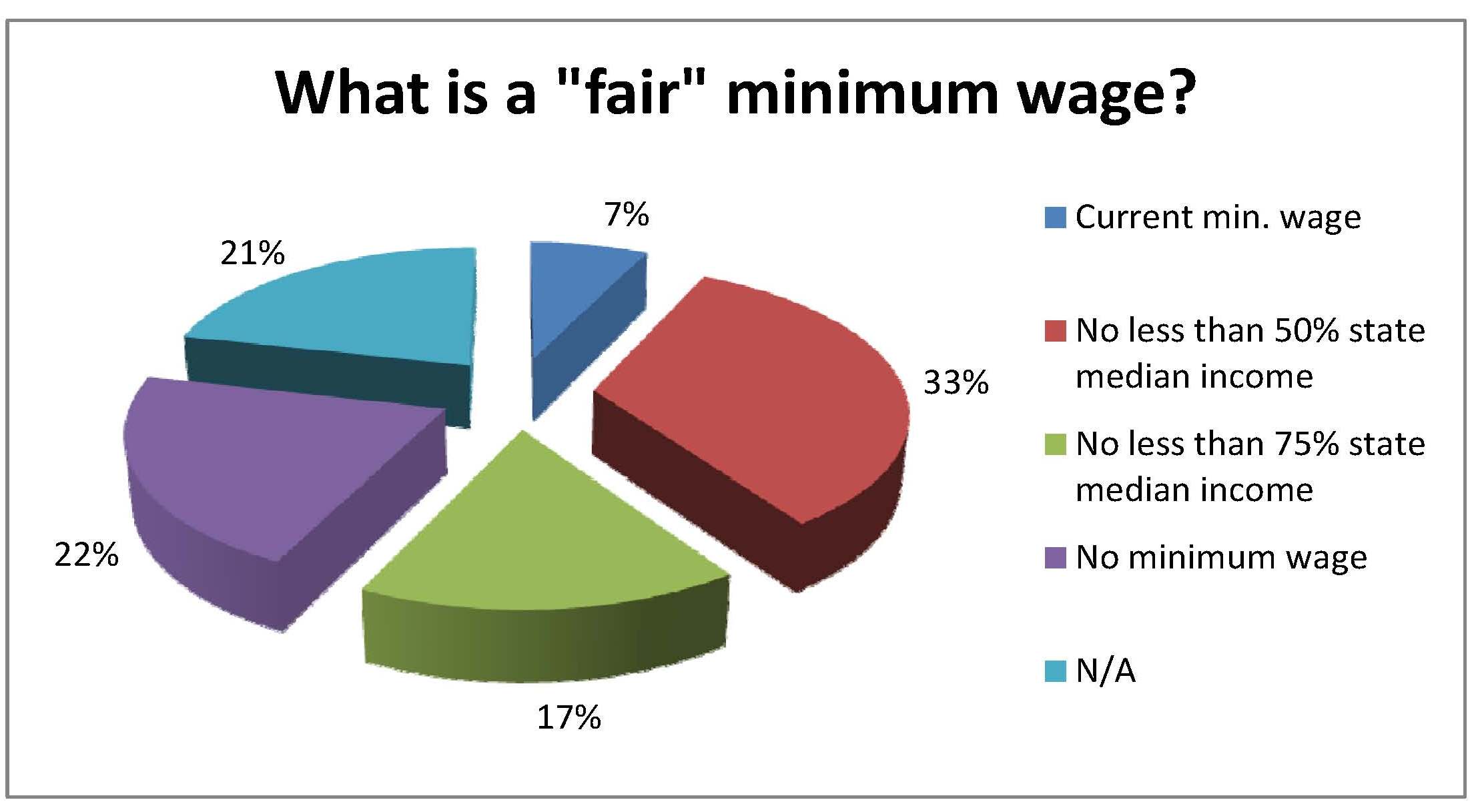
Question 2 asked respondents what they considered to be a “fair” minimum wage, providing four responses: A) Current minimum wage ($7.25/hour) B.) No less than 50% of the state’s median income. C.) No less than 75% of the state’s median income; or D.) There should not be a minimum wage.

 Nearly 30 percent of respondents expressed confusion regarding responses that were tied to the state’s “median wage,” saying they did not know the current median wage or that it was a poor alternative for determining a state’s minimum wage requirement.

My theory is that minimum wage should be required by the federal government but not set to a national standard, other than as a percentage of a particular state’s median income.

My reasoning? Someone earning $7.25 per hour in Maine has less economic capacity than someone earning $7.25/hour in Tennessee, which has lower cost of living expenses. This disparity becomes more apparent in large urban areas, such as New York City or Chicago, creating an unlevel playing field.

For further clarification, it’s important to understand the difference between a “median” income and an “average” income.  Median is simply the half-way point when looking at all recordable wages in a specified group. while it is common to discuss “household” median income, I used this chart from the University of New Mexico to compare median personal incomes among the 50 states. Maine ranks 28th with a median personal income of $39,481. This means 50 percent of income workers in Maine make less than $39,400/year.

If a Maine adult is working 40 hours at minimum wage, that person would be earning a gross income of $15,080 (assuming working 52 weeks per year). If we changed the state’s minimum wage to be no less than 50 percent of median income, that same person would now earn: $19,700 annually, considering an hourly wage of $9.47/hour. Lets see what my friends said:

Figure 3.1
Figure 3.1

As we can see in the above chart (Figure 3.1), there is an almost even split between those who favor the current minimum wage or the idea of having no minimum wage (43 percent); and those who would like to see  some level of increase (50 percent). Seven percent of respondents declined to pick one of the offered choices (as explained above).

Figure 3.2
Figure 3.2

The poll’s final question asked respondents if there should be a “maximum wage.” This question received the most universal agreement. 95 percent of respondents said there should NOT be a maximum wage, however, it should be noted that more than 40 percent of those indicated that they would like to see increased tax brackets for high wage earners. Only two Democrats (one male, one female) answered in the affirmative.

Figure 4.1
Figure 4.1

Of course, I have some opinions about this data, and some other thoughts sparked by this conversation; but I will pause here and allow you to reflect on the responses to develop your own analysis.

Again, my deepest appreciation to all those who participated!

Let’s stick together

1277122_10200627116743607_506355194_oI have some dueling feelings, and would like to know what you are doing today?

Are you headed to the Maine Mall for some holiday shopping? Putting up your Christmas tree? Football game?  Browse social media and offer your political opinions?

How are you making the world around you a better place?

I am not trying to shame you because any of those activities above could dominate a big part of my own day. I just want to offer my observations of the last 24 hours; a mixture of blessings and loss.

Earlier this week, our community lost a tremendous leader; a man who embodied community spirit. I only met him a couple of times, only briefly. I did not know him as well as I should have. I didn’t even know he died until I saw the obituary that his daughter posted on her Facebook timeline.

Richard “Dick” Potvin was the embodiment of living in community. He was from the tail end of that “greatest generation:” men and women who didn’t talk about community service or brag about it. They just did it. And Mr. Potvin did that better than most people.

He was an ordinary man who lived an extraordinary life.

His obituary tells an amazing story of a working-class man who left behind an amazing legacy.

He was a standout athlete in high school and held the Amateur Maine State Golden Glove Welterweight Championship, undefeated  until he was drafted into the U.S. Army during the Korean War.  He served as a forward observer for an artillery unit and sustained a bullet wound to the head by a sniper. He was awarded a Purple Heart and honorably discharged.

That would be more than enough “service” for most people. But not for Dick.

He came home to Biddeford and worked for York Bottling Company and  married Doris Cote at St. Andre’s Church. After changing jobs, he and his wife moved several times over the next two decades before becoming the Public Works Director in Biddeford.  A couple of years later, the couple opened Potvin’s Market in Old Orchard Beach.

For a couple raising three children, you would think their plates were full. Running a convenience store does not offer much in the way of “down time.”

But Dick kept serving his community, serving nine terms on the city council and was appointed to serve on numerous city committees. He was also  a stalwart of the Maine Democratic Party, and according to his obituary, was invited to the White House for breakfast as a thank you for his support of President Jimmy Carter. He and his wife hosted Walter Mondale in their home during Mondale’s 1984  presidential campaign.

Enough, right? Wrong.

Dick was appointed as Maine State Athletic Commissioner and served under two governors, and was a member of the Elks, Knights of Columbus, AMVETS, VFW, and Fraternal Order of Eagles.

But wait. There’s more. Beyond his own three children, Dick was a mentor, coach and a steadying influence to countless children in Biddeford. Facing retirement, he founded the Southern Maine Boxing Club with the mission to promote positive youth activity through the art of boxing. His son, Jay, continues to successfully run the club.

Speaking of his children, Laura and I have the privilege and honor of knowing his daughter, Renee and her husband Jim, counting them among our friends.

Renee and her brothers are following their father’s footsteps in community service. Renee serves with Laura on the City Council’s Policy Committee. Renee also, stubbornly and nearly single-handedly led the effort to restore the city’s historical downtown opera house, City Theater.

This morning, I cannot fathom the emptiness that Renee and her family are experiencing. When men like Dick leave us behind, the void is huge, almost unimaginable.

So while we remember them in our prayers and thoughts, I want to do better. I want to be more like Dick Potvin. I want to be more like Renee O’Neil. I want to spend less time fretting about my own little problems and focus more on the world around me. I want to be more like the next person I am going to mention.

Never enough

Heroes are not reserved for comic books. They walk amongst us everyday. And I am so lucky to know so many of them by name.

One of our community’s shining heroes is actually a heroine. Over the last several years, Vassie Fowler has redefined the words “personal sacrifice in her efforts to make the world a brighter place for those among us who are less fortunate.

If you know Vassie and her husband, Jack, then consider yourself lucky. They are the owners of Union House Pub and Pizza in Biddeford. Every Thanksgiving, Vassie coordinates an epic turkey drive to help provide holiday meals to more than 100 less fortunate families.

Last night, Vassie and Jack hosted their fifth annual Toys for Tots fundraiser and dinner. The event started modestly, a small affair at their own business, attended by only a handful of guests. Last night, the conference facility at the Ramada Inn was packed with people opening their wallets and their hearts for children.

Vassie is a relentless giver. She gives, gives and then gives some more. She invests hundreds of hours every year making life better for other people. She works her fingers to the bone and pulls off grand events on shoestring budgets because of a work ethic that is beyond words.

It’s hard to match Vassie’s commitment to her community, but it can be done. Take, for example, another one of the people I am honored to call my friend, Pam Payeur.

Pam is the executive director of the Wounded Heroes Program of Southern Maine.

Every day, Pam can be found working in our community, raising awareness about the plight of our nation’s wounded heroes. Her work, dedication and passion for helping veterans is off the charts. Not just on Veteran’s Day or helping coordinate the annual Wreaths Across America event, but on a hot August day when a local veteran needs a ride to a medical appointment; or in September when she seeks volunteers to help move a veteran and his belongings to a new residential facility.

She is on the front-lines every day. Based on her Facebook wall, I strongly suspect she never sleeps. There is always something more that needs to be done. Always another opportunity to help a charity, raise awareness and champion the forgotten and discarded.

So allow me to ask you this. How is it that people like me get to live in a world among heroes like these? What are we going to do today to make our world a better place?

I don’t think you have to receive a Purple Heart, have breakfast at the White House or collect 200 turkeys for the less fortunate. But maybe we could just try to treat one another with little more kindness, a little more respect.

Maybe we can just carve out five minutes of each day or an hour each week dedicated to something beyond our own world. Maybe that is enough. Maybe not, but it seems like a good place to start.

Meet the ‘new’ boss

In about 24 hours, I will have the privilege and honor of being the first to introduce members of my community to the new members of the Biddeford City Council.

I will be the master of ceremonies at the inauguration of Mayor Alan Casavant, the nine members of the city council and the seven members of the school committee.

Many of these “new” councilors have previously served on the council, but some of them have been out of the public eye for a few years.

So, what can we expect from this new council?

For starters, I think Biddeford voters knew exactly what they were doing when they chose Clement Fleurent, Roger Hurtubise, John McCurry and Marc Lessard for a return to the council.

Each of these men are proven commodities. Each cares deeply about their community. We will all benefit from their previous service, their years of experience and their own, unique connections to the city we call home.

They are fiscally conservative and generally politically conservative. McCurry and Lessard have both previously served as council president; and both men made unsuccessful bids for the mayor’s seat (McCurry in 2007; Lessard in 2003).

While McCurry and Lessard have much in common and often see eye-to-eye on major policy issues, there is a not-so-subtle difference between the two men, at least based on my observations of their past civic performance.

McCurry is a stickler for process and he makes no bones about his priorities during annual budget battles. What you see is what you get. McCurry can be outspoken, but not for the sake of being outspoken. He has strong opinions, but he’s also a good listener. He can be stubborn, like a dog with a bone, once he has made up his mind.

McCurry is secure and confident without being arrogant. If he tells you he is going to vote for Plan A, he is going to vote for Plan A, not use his prior statement as either a political tool of manipulation; nor subject his opinion to the ranging barometer of public opinion.

But Lessard was a much different character on the council. I honestly hope that his brutal loss for the mayor’s seat a decade ago forced him to take an extra dose of humility. I will opt for optimism. It’s been 10 years. We’ve all grown and matured over the past decade.

Lessard is a political animal. Taken under the wing of former Mayor James Grattelo many years ago, Lessard often mistook his public service role as some sort of baseball game, complete with strategy, secret signals, orchestrated deals and plenty of red meat rhetoric for the spectators to gnaw upon.

He loved to quote articles from USA Today, demonstrating his vast knowledge of the nation’s economy and why Biddeford should be thankful to just be alive. He delighted in being coy and mischievous. He grinned slyly when he won; but his temper was rarely hidden on those rare occasions when he lost.

He once told me: “Randy, you could say a zebra is black with white stripes; or white with black stripes,” as a way to defend one of his positions.

I wasn’t buying it. “No,” I responded. “A zebra is just a zebra.”

Marc had a tendency to exaggerate and was no doubt frustrated that I routinely called him out about those distortions during my newspaper days.

But my newspaper days are over.

Marc and I were never best friends, but I have admiration for his zeal, his passion and his belief in his own ideas. He has never been anything less than polite and cordial with me. He is a hardworking man. By all accounts, he is a good husband and father and plays a mean game of baseball.

Conventional wisdom holds that a leopard cannot change his spots, but I still believe in Marc Lessard’s potential as a city leader. I think the people of Biddeford can be well-served by his firebrand style and his fiscally conservative approach. I think he can provide a good counterweight to some of Mayor Casavant’s idealistic leanings.

I strongly suspect that Marc has not given up on his dream of being the city’s mayor. If he asked me for my political advice, I would urge him to be a lot more like his friend John McCurry and a lot less like that guy who finished third in a three-way race 10 years ago.

Can a leopard change his spots? Let’s hope so because this council has the potential to be the best city council Biddeford has seen in a long, long time.

Thanksgiving 2013

What I am thankful for this year . . .

Dangerous Type

Richard Rhames
Richard Rhames

During the last official meeting of the 2011-2013 Biddeford City Council, Mayor Alan Casavant said, ” . . . history will look favorably upon this council.”

I think he was right, but that may be a hard pill to swallow for the four councilors who lost their re-election bids: Roch Angers, David Bourque, Rick Laverriere and Richard Rhames.

Similar to what Dorothy said to the scarecrow just before waking from her dream, I think I will miss Councilor Richard Rhames the most.

You may be shaking your head, especially since I did not encourage people to vote for Rhames in the last election; and because I have previously (and rigorously) criticized his positions on a variety of policy issues.

But it should be noted that I also previously described Richard as “the city council’s conscience.”

Roughly two years ago, I ranked Rhames as ninth of the 25 most influential public policy masters in Biddeford-Saco politics.

From that previous post: Rhames began his political career by driving a grassroots effort to stop a planned expansion of the Biddeford Airport in the late 1970s. He then became one of the most outspoken opponents of the Maine Energy Recovery Company. Even his most ardent detractors concede that Richard is extraordinarily intelligent and that he commands a core following of people with similar political persuasions. He despises pragmatism and often rails against a “political class” that seems way too cozy with business interests. He is an unapologetic FDR Democrat, who believes the power of government should be reserved for those who are otherwise powerless.

Richard’s strength is his ability to point out the hypocrisy and greased skids tactics of the politically well-connected. He does not want to “get along” simply for the sake of “getting along.” His frequent and long-winded monologues follow predictable themes: opposing corporate influence, raising awareness about labor issues and the sorry-state of media (local, national and global).

Richard is the real deal. An authentic rabble rouser, who is arguably one of the best known people in Biddeford.

During my stint as the editor of the Biddeford-Saco Courier, I often poked fun at Richard in my weekly opinion column. Admittedly, I often crossed the lines of good taste and always cringe when I recall those rants about his “pony-tail politics.” Richard, however, was fair game, despite my sophomoric criticisms. He consistently injects himself — without hesitation — into the city’s political arena, and he could never be accused of being a shrinking violet. He also knows a thing or two about taking swipes.

But over the last 15 years of closely observing Biddeford’s political theater, I have developed a genuine respect for Rhames.

Although I am sometimes vexed by his approach and still disagree with some of his positions, he consistently (although indirectly) forced me to pause and question my own political bent. I admire his honesty and his consistency. There are no games with Richard. He is who he is. He says what he means and means what he says. Unfortunately, that makes him a rare breed among elected officials.

Rhames has always been an outspoken champion for the poor and the powerless. Yes, he can be snarky, condescending and sometimes hypocritical but he never pretended to be anything more than a flawed individual who was at least willing to speak up, even when he knows doing so is not in his own best interest.

Jimmy Carter may not have been a good president, but I am hard pressed to think of a more decent and honest man.

I agree with Mayor Casavant. I think history will look favorably upon this outgoing council, but I think it will look especially favorably upon Councilor Rhames.