
When things go right

American_Airlines_logoRegular readers of this blog know that I believe strongly in the power of social media.

Social media has been used to topple governments, connect people globally around a common cause and to highlight awareness of issues that may otherwise go unnoticed.

You can also use the awesome power of social media to put pressure on companies or businesses that fail to deliver on their promises.

But today, I want to highlight a company that responded to the pressure of social media in a productive and meaningful way.

Some of you may recall that I was fairly harsh with American Airlines regarding the treatment I received on a March 21 flight from West Palm Beach to Portland, Maine. You can read all the gory details here: Automatic For The People.

I used Facebook and Twitter to express my dissatisfaction with the airline. I waged a relentless battle while the airline repeatedly asked for my patience. It took nearly two months to get a response.

That said, the response I received was meaningful and sincere. The airline explained why the situation happened, detailed the corrective steps that they were taking and agreed with me that they had short-changed me on my compensation for an over-booked flight. It was a lengthy and detailed response. It showed empathy and reinforced the airline’s commitment to customer service.

Since I was particularly tough on the airline, I thought I should share their response publicly. The text of their e-mail is posted below: (Personal information has been redacted)

***************

May 14, 2015

Dear Mr. Seaver:

I’m sorry you weren’t able to board your scheduled flight to Portland and I understand your frustration. You have every right to expect to be boarded on the flights you have reserved. As you may know, airlines overbook to help plan for customers who are re-booked at the last minute or do not show up for their flights. An empty seat on a flight means a loss of revenue, which in turn means higher ticket prices. I realize this explanation doesn’t change what happened, but I wanted to let you know some of the reasoning behind this process.

At American Airlines we are committed to providing a truly enjoyable travel experience, and a warm, courteous attitude on the part of our employees is the key. That is why your email is so disheartening. We did not afford you with friendly customer service at the gate and the Passenger Assistance Counter, and we apologize. Your comments are important and serve as a significant tool in helping to maintain our standards of excellence. I have shared your feedback with the Philadelphia Station Manager to be addressed directly with the personnel on duty at these positions.

Per our Customer Service Plan and in accordance with the regulations of the US Department of Transportation, when a passenger has been subjected to involuntary denied boarding on a domestic flight, the passenger is entitled to one of the following forms of compensation:

* If the passenger’s arrival at his or her final destination is greater than one hour but less than two hours past their original scheduled arrival, involuntary compensation is 200 percent of the sum of the values of the remaining flight coupons of the ticket to the next stopover, but not to exceed $650.

* If the passenger’s arrival at their final destination is two hours or more past their original scheduled arrival, involuntary compensation is 400 percent of the sum of the values of the remaining flight coupons of the ticket to the next stopover, but not to exceed $1300.

Based on the circumstances surrounding your flight, you should have received a check for $[redacted], and we apologize that the check you were given did not meet this amount. I have issued an additional check for $[redacted], the difference between the correct value and what you received at the airport.

Mr. Seaver, I truly appreciate the time you took to share your experience with us. It is always our pleasure to have an opportunity to serve you and hope you will look to the new American Airlines for your future travel needs.

Sincerely,

[Redacted]

******************

We all screw up sometimes, but it is heartening to know that simply acknowledging your mistakes and taking corrective actions can restore faith and trust in your relationships, whether they are personal or professional.

Kudos to American Airlines for stepping up to do the right thing.

Ship of fools

VGThere’s a right way and a wrong way to handle social media, and in the city of Biddeford, orange can now step aside because Facebook is the new black.

Biddeford’s political machinations have always been colorful and somewhat interesting.

But lately, our city’s colorful political landscape has gone from an interesting mix of pastels to a nightmarish blend of bright acrylics that looks like something from a Van Gogh nightmare.

Just four hours after Mayor Alan Casavant announced on Facebook that he will be seeking a third term, an anonymous Facebook identity popped up and started sending out “friend” requests.

“Joe Biddeford” says he (she?) wants to keep his/her identity anonymous “to keep trolls from attacking me as opposed to contributing to the important dialogue on local issues.”

Since I routinely blog about Biddeford politics and often play in political circles, I was curious about what this “dialogue” would be. So I sent Joe a friend request. As of this writing, Joe has not accepted my request.  I am heartbroken by this.

Many of my friends have received friend requests from Joe Biddeford, but not me.

Joe Biddeford’s Facebook page is public, and last I checked he had 10 friends. Wow! 10 friends.

But wait, it gets better. Only two people have posted anything on Joe Biddeford’s Facebook timeline. One of them is my friend Fred Staples, a former city councilor who has 407 Facebook friends.

The other person is Paul Pelletier, a familiar enough surname in a community with a Franco heritage.

But get this: Paul Pelletier has zero Facebook friends. Zip. Zero. Nada.

Paul Pelletier seems to be a ghost raised from the dead just a few weeks ago, according to his/her Facebook profile, which is also public. Unlike Joe Biddeford, “Paul” says he/she does not want friends. (All the makings of a sociopath)

In the “About” section of his Facebook page, “Paul” dazzles us with this brilliance: “I don’t wish to share information over Facebook. I use it for informational purposes and to engage in political conversations.”

Someone needs to tell Paul that he should not be on Facebook if he doesn’t want to share information on Facebook.

He says he uses Facebook for “informational purposes.” That’s generally what  all stalkers say.

“Gee, officer, I know I followed her through the mall and into the parking lot, but I was just gathering information about shopping trends.”

I’ve got some news for “Joe Biddeford” and “Paul Pelletier:” There are several places where you can go to engage in social media conversations about Biddeford or its politics.

On Facebook, there is Biddeford Today, a page that features news about the city and profiles of its residents. There is a nostalgia page called You Know You’re From Biddeford If . . . There is a Facebook Page for the for the city’s dog park, and even this blog has its own Facebook page.

Heck, once upon a time there were two other blogs about Biddeford Politics: Game Over: The Premier Blog of Biddeford; and “Biddeford’s Best Blog: B3. Both of those blogs (critical of Mayor  Casavant) went radio silent shortly after Casavant won his last election in 2013.

The point is: there are plenty of places to go on the internet to talk with Biddeford residents.

The power of the internet

Let’s face it, the internet is an extremely powerful tool that enables instant, global communication. And social media has been used to topple governments, win presidential elections and showcase cute kitten videos.

Sometimes, if you use it properly, social media can bring attention to things that might otherwise go ignored. Social media can be used for noble purposes (crowd funding) and for bad purposes (child pornography).

If you want to be “social” on the internet, social media outlets are a great place to start. It’s also a great place to stop because an increasing number of people are reporting being addicted to social media.

Sometimes, the best way to be social is to turn off your computer, pick up your phone and call a real friend. Go for a walk, have a cup of coffee. You don’t have to be anonymous or play silly little games.

If you really need to connect, try stepping away from the keyboard and breathe some fresh air.

[Edited: “Joe Biddeford” accepted my friend request. Yippee! Now I can finally take part in the “important dialogue about local issues.”]

Lido Shuffle

The experiment is over, and it was a bittersweet experience letting it go.

As it is with so many things in life, it occurs to me that my endeavor to create a diverse group to debate differing political ideas with civility was both a phenomenal success and an utter failure. We called this group “Thinking Politics” and its membership quickly swelled beyond my expectations.

WP_20140906_18_48_58_ProLast night, I had the pleasure of participating in the phenomenal success part; but it was the utter failure part that led me to let go of the reins, end the “experiment” and let the group go wherever it wants; allow the other members of this “secret” social media group to experience true self-determination.

I started the group, and until last night served as its primary moderator. Admittedly, I tried to control the group: to maintain a balance between liberal and conservative thought.

My bigger mistake, however, was trying to appease all members of the group, and that caused a lot of anger and dissension.

A few months ago there was a schism of sorts. Roughly 20 percent of the members left the group after I announced that we would leave religion out of our political conversations.

I was angry that these departing members hijacked my group’s name and started a similar group entitled Thinking Politics/Free Speech, as if free speech has no limits.

But the bulk of the original group’s members remained, yet still the dynamic I envisioned never really materialized in a substantive way.

I wanted to see if there would be more intellectual curiosity; if members would be willing to re-examine and challenge their own political pre-conceptions and beliefs.

One of the problems is that the group quickly became dominated by one side of the political aisle. Those in the minority felt frustrated and stopped participating.

In a recent Facebook post, Robert Reich, former Labor Secretary under President Clinton, spoke of the value of having his ideas challenged by a good friend during a monthly lunch meeting.

Perhaps that is why last night was such a stunning success.

About 30 members of Thinking Politics convened for an impromptu dinner in Portland. All members, regardless of political affiliation, were invited. It was an awesome experience, full of laughter, shared experiences, good food and plenty of libation.

That experience reminded me of the Political Beer Summits I once organized with friends who often disagreed about political issues. Those summits inspired the creation of Thinking Politics.

When you’re sitting at a table, directly across from your adversary, it becomes instantly clear that you have much more in common than not. We all have funny stories, fond memories, shared experiences, including loss, fear, hope and dreams.

It’s almost impossible to establish that kind of intimacy on the internet. When you are separated by a keyboard and a monitor, it’s much easier to belittle your opponent, to say things you would never say if you were sharing a meal with them.

So, part of me thinks I failed; but as I looked around at the group last night, I also felt a certain sense of pride. The conversations were real, the friendships were plainly evident.

It was a good time for me to say goodbye, to let go of my moderator status and turn over the keys to six others.

Where Thinking Politics goes from here is unknown. What is known, however, is that I will no longer be at the helm of that ship.

My experiment is over, and I regret nothing.

A good friend from Rhode Island accompanied us to the dinner. Her observation meant a lot to me. “Look at all these people, they came from Texas, Illinois and all over, and they really want to be here and meet the other members in person. You started that, Randy, and that’s impressive.”

So, in the end, maybe my time at the helm of Thinking Politics was a stunning success; and thus, it was the perfect time to walk away and let others steer that ship.

Talking in your sleep

Angry-Computer-GuyOftentimes, it’s not so much what you say but rather how you say it.

It’s an important lesson for all of us, but especially important for those who aspire to be our leaders. Think: “Social Security is Welfare

Earlier today, I was interviewed for a locally produced talk show in my community. I was pitched for this idea several weeks ago, and my first instinct was to decline the invitation. But the host was persistent, and he wanted to talk about a subject near and dear to my heart: strategic communication.

As I prepared for the 25-minute taping, I paused to think about some words that I routinely take for granted.  After all, I am a strategic communications consultant; my job makes sense to me but I wondered if it made sense to anyone else.

stra-te-gic \strƏ-tē-jik\ adj 1. of, relating to, or marked by strategy. 2. necessary to or important in the initiation, conduct or completion of a strategic plan.

com-mu-ni-ca-tions\ kә-myὕ-nә-kā-shәns\ n. 1. an act or instance of transmitting; 2. process by which information is exchanged between individuals.

con-sul-tant \kәn-sәlt-nt\ n. 1. one who gives professional advice or services: expert

Thinking more deeply about those words led me to a basic conclusion: Despite the rapid and sometimes overwhelming advance of technology, the basic fundamentals of good communication skills haven’t changed much.

In fact, I quickly recalled a lesson that my late uncle drilled into my head during my teenage years: God gave you two ears and one mouth. Use them proportionately.

Human beings have always had the need and desire to communicate. Our ancestors used hieroglyphics (an earlier version of SnapChat) before sharing stories around campfires and passing those tales and lessons from one generation to the next. From there, we moved on to the invention of the printing press, the telegraph, telephone, television  – – all the way into our brave new world of Pinterest, Facebook and Twitter.

But as the speed of our communication increases exponentially, it becomes increasingly important to remember my uncle’s Golden Rule of Communication: take the time to listen and think before you speak, post or tweet.

If you want to learn a little bit more about my professional life (how I feed my family): check out this relatively short video clip.

In the meantime, remember that social media tools are power tools and require caution and a firm understanding of the consequences of making one wrong move that can happen in an instant without warning.

As always, I encourage your feedback. You can contact me by clicking this link.


How not to use social media in a campaign

camplogo3There is a right way to use social media in a campaign.

And there is a wrong way to use social media in a campaign.

The following could be forgiven if it came from a political novice, but not when it comes from the governor’s re-election team.

Here’s a game you can play at home. Find the three glaring strategic mistakes that Team LePage 2014 uses in their recent Facebook post.

https://www.facebook.com/#!/mainesgov/posts/10152803304354676?stream_ref=10

1.) The post urges us to “please search for the LePage 2014 website on your computer.”

Oh, I’m not supposed to search under the table or between the seat cushions?

How about this? How about posting a link to your site? You can do that on Facebook.

Instead, the governor’s social media gurus are worried about unintended “filters” that could accompany an embedded link. So, instead they strongly suggest that you use your computer, hunt down the link and then donate.

In fact, donating must be important because they ask you to donate twice in the same paragraph, which almost looks like one giant sentence, considering the absence of punctuation.

2.) The campaign’s post is horrendously long.

Facebook is not Twitter, which requires abbreviated posts. That said, you should not use Facebook to “cut and paste” an entire speech.

A better strategy would be to hook your social media audience into your website. Use social media to tease your message and direct readers back to your website.

3.) If you must go long, give your post some space.

If you insist on your using Facebook like a blog, at least be considerate and allow readers a visual experience that doesn’t look like a bucket of spilled nails.

Insert a line space between paragraphs. Remember, if you want more people reading your posts, make your posts easier to read.

So here’s a primer for Governor LePage and his re-election team:

If you want to see Governor LePage re-elected go here and donate.

See how easy that was? Social media is supposed to be easy.

I’m not sure who is handling the governor’s social media, but from the looks of things there is plenty of room for improvement.

Social media and Maine’s gubernatorial campaign

camplogo3Despite all the hoopla about the power of social media tools in political campaigns, what metrics can we use to determine if those tools are effective?

While just about anyone can set up a Twitter account or create a Facebook page, social media tools are only as effective as those who are using them.  Although it is widely accepted that social media tools played a big part in President Obama’s 2008 campaign, that type of success is not guaranteed by simply using social media as part of a campaign strategy.

When it comes to Maine’s 2014 gubernatorial race, which of the campaigns is best using social media? More importantly, how do we set aside our individual biases and evaluate the campaigns based solely upon their social media metrics?

At the Brookings Institute’s Center for Technology Innovation, Darrell West offers a mixed review regarding social media and campaign engagement and the awkward transition to actual governance.

Social media are the ultimate in disruptive technology. They change information delivery, business organization, online content, news coverage, and the manner in which individuals process new developments. As shown during the 2008 campaign, these digital tools represented a textbook example of voter mobilization and electoral impact. They were, in the words of Engage Partner Mindy Finn, the “central nervous system” of campaign organizations.

Using social networking outreach tools such as Facebook, MySpace, YouTube, and Twitter, a number of Democratic and Republican candidates raised money, identified supporters, built electoral coalitions, and brought people in closer touch with the electoral process.

You may recall a somewhat silly and lighthearted piece about Maine’s gubernatorial campaigns that I posted a couple of months ago. Then, I jokingly said we should dispense with the standard election process and use social media metrics to determine the winner. I examined each of the campaign’s current metrics.

Twitter FollowersToday, I have decided to track those metrics on a regular basis and to blog frequently about those campaigns and their use of social media.

Over the last 60 days, each of the Maine gubernatorial campaigns has been active on various social media platforms. But before we begin, it’s important to note that Democrat Mike Michaud is the latest entrant to this race. Both Governor LePage and Eliot Cutler carried over their respective social media support from the 2010 campaign.

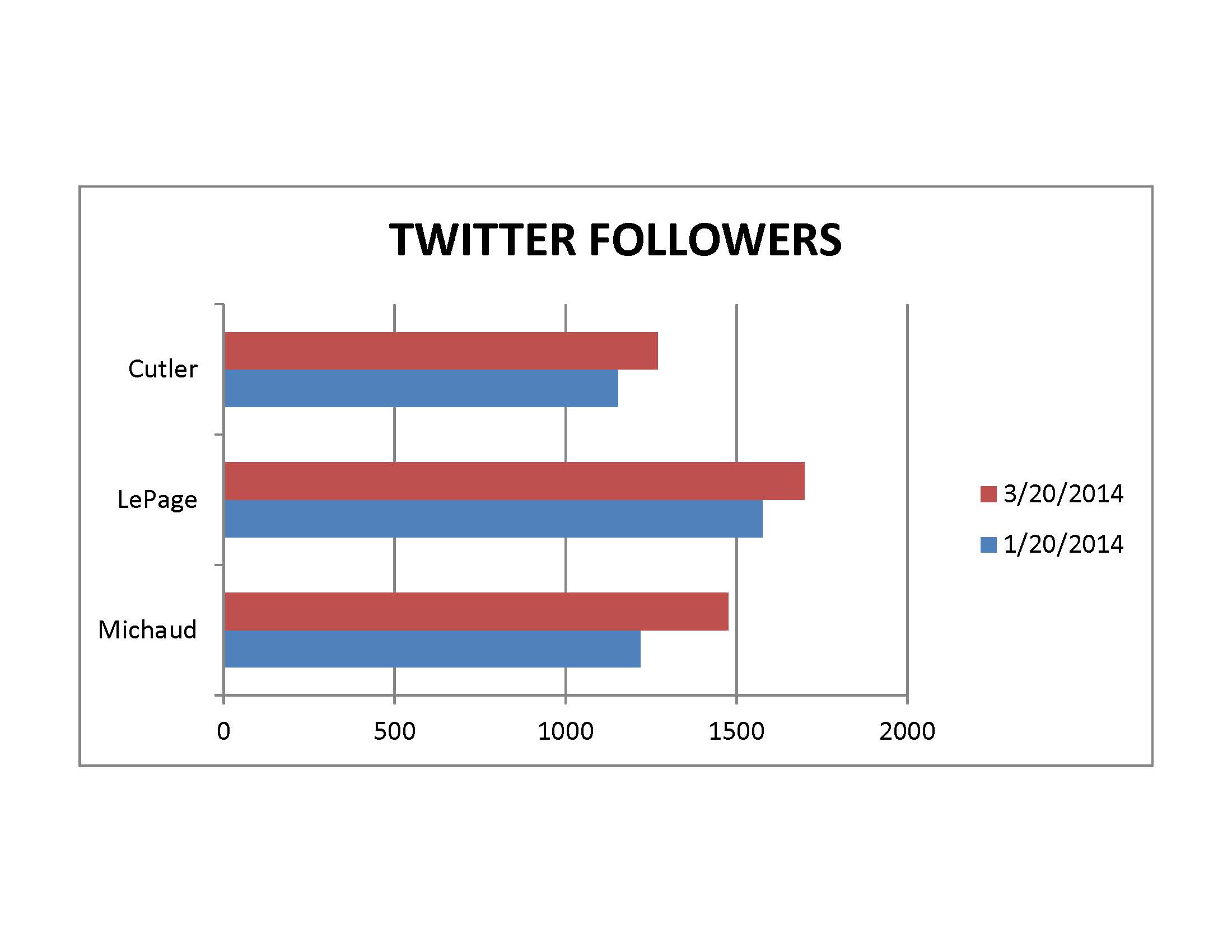
Nonetheless, Michaud has seen the greatest increase in social media traffic, earning a 21 percent increase in the number of Twitter followers @Michaud2014, moving from 1,219 Twitter followers on January 20 to 1,475 followers as of March 20, 2014.

Although Governor LePage (@lepage2014) has the greatest number of Twitter followers (1,698) his metrics have increased only 8 percent during the same time period.

Eliot Cutler (@EliotCutler) saw a 10 percent increase in Twitter followers, from 1, 153 to 1,269 followers during the same period.

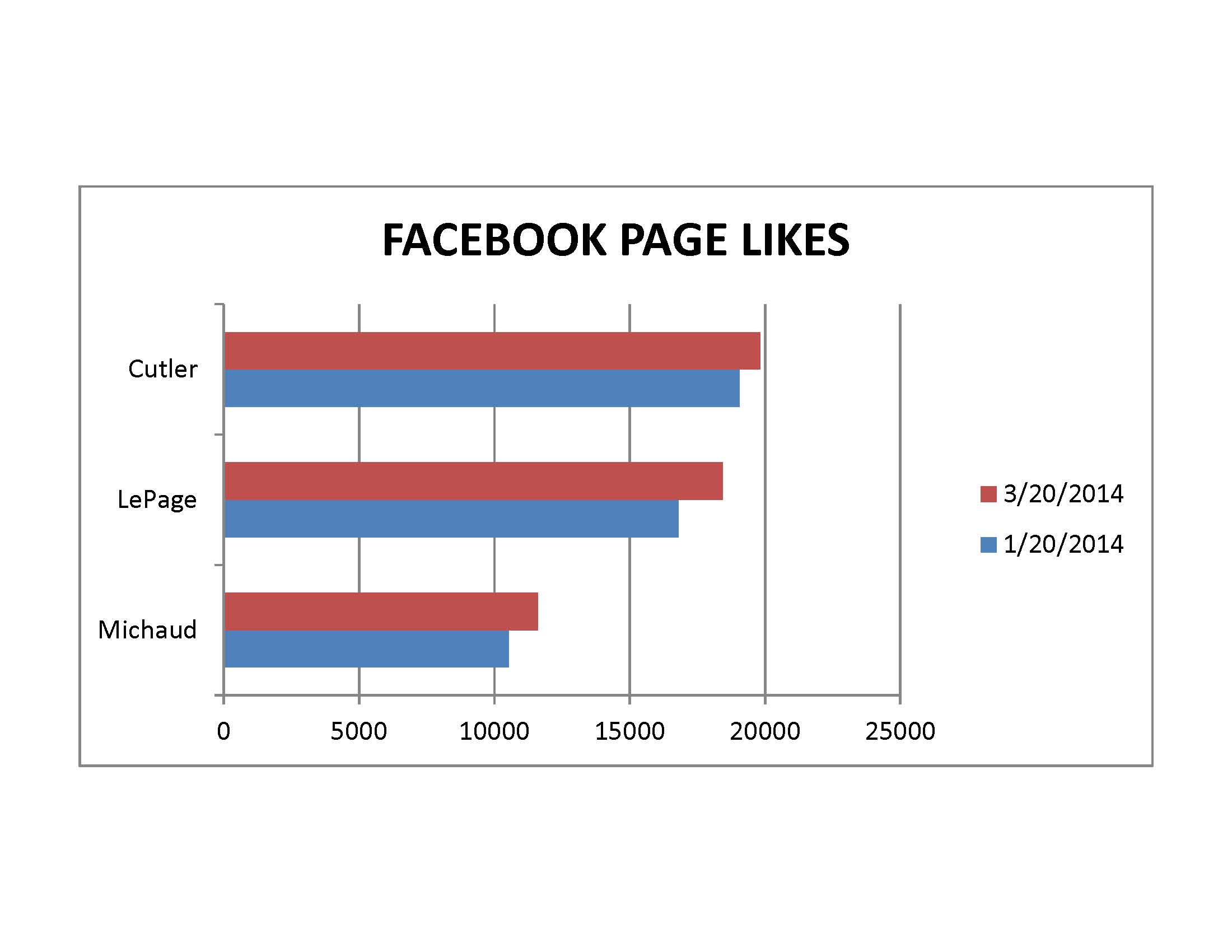
Facebook LikesOn Facebook, Cutler still dominates in the total number of Likes for his campaign page (19,824) but saw only a 4 percent increase over the last 60 days, while both Michaud and LePage experienced increases of 10 percent.

LePage’s Facebook page had 18,438 fans on March 20, compared to 16,791 fans on January 20, 2014.

Michaud’s Facebook page had 11,600 fans on March 20, compared to 10,529 fans on January 20, 2014.

When viewed overall, it would appear that Team Cutler has the steepest hill to climb, so far.

Note: Though it’s generally common knowledge, it must be noted that Twitter followers and Facebook fans do not translate directly to the number of supporters for a political candidate. As an example, I follow all three campaigns on Twitter, but will only be voting for one candidate.

Thinking Politics

A few weeks ago, I decided to try an experiment.

Political Beer Summit Participants

As Maine Goes (AMG), one of Maine’s most popular and controversial political websites, had gone dark after a 16-year run that allowed verified members to post and comment on a wide range of political issues. Admittedly, AMG was a conservative site, but it was well-moderated, and liberal posters would sometimes wade into those waters to offer their perspectives and to push-back on what they perceived to be an echo-chamber of conservative thought.

AMG’s membership, although decidedly right-leaning, was rather diverse: single mothers, retired folks, business owners, students, academics and every-day working people spent hour upon hour debating ideas, posting insights and frequently arguing about a wide range of subject matters.

Journalists would monitor the site, observing political trends and gleaning intelligence from campaign operatives who would lurk on AMG’s pages.

Profanity was forbidden, but the jousting was real. It was not a place for those easily offended. If you couldn’t take the heat, if you didn’t like being challenged, well…you could always just sit back and watch the big dogs get off the porch.

So it was, in the post-AMG abyss, that I decided to try my own social media experiment. Lacking the dedication and commitment that Scott Fish gave to AMG, I instead set up a Facebook group called “Thinking Politics

It remains a closed, secret group (new members must be invited by existing members to participate). I started the group with fourteen people: six who generally lean left, six others who generally lean right and two people I perceived to be in the middle of the political road. (This was all very subjective and was calculated while drinking generous doses of a favorite Merlot).

The mission statement of the group is rather simple: Thinking Politics is a place for those who enjoy political discourse that includes rigorous debate but not personal attacks. Members are seeking an elevated level of political discourse and pledge to be as committed to hearing as they are to speaking.

I wanted to see how these selected friends would do in a controlled environment.  I invited no one else, despite the urge not to offend other friends. I tried to just sit back and watch. That was almost five weeks ago.

Can you hear me?

Today, there are nearly 120 members in the Thinking Politics group. Members pick and start the conversation points or join other ongoing discussions.

At least one person dropped out of the group. She was reportedly frustrated that she could not see comments being made by another member because he had “blocked” her from his own Facebook profile.

The group quickly veered left. Why? Simply put, my left-leaning friends outflanked their counterparts on the right by inviting others of similar thought as reinforcements.

Obviously, this dynamic frustrated my friends on the right. They were feeling outnumbered, outmatched and felt it was a waste of time to participate if they were just going to be outshouted. They retreated a bit.

But here’s where it gets strange. Some of those on the left actually began bemoaning the fact that the page was becoming little more than a “political echo chamber,” chock full of progressive thought with little or no input from the political right.

Just when I thought my experiment had failed, something happened. The conservatives found some heavy-hitters to join their ranks, including State Rep. Jonathan McKane (R-Newcastle) and Beth O’Connor, a former state representative and vice chair of Maine Taxpayers United. Other unapologetic Republicans followed.

So now the page was a bit more balanced, but was it more productive?

It remains to be seen. A majority of the members seem genuinely committed to the process: to stand firmly on ground and debate with civility. But I wanted (hoped) to see something else. I wanted to see if people would begin asking questions. I wanted to see if there was a natural curiosity out there. Would people pause and consider alternative viewpoints? More importantly, would they proactively seek out those other views?

You can guess the answer.

I’m right, you’re wrong

Even in a semi-controlled environment, my friends seemed more focused on being right rather than considering an alternative viewpoint. I get it. That’s how I roll 99 percent of the time.

Last week, I participated in an event that some friends organize every once in a while: a Political Beer Summit. Now, face to face and with the assistance of great beer and delicious pizza, the political debate was just as passionate but it was a lot less heated.

Sitting across the table from one another, the Democrats saw the Republicans as reflections of themselves with the exception of different viewpoint. The Republicans were not afraid that the Democrats were going  to stiff them with the check. It was fierce, but friendly. No one changed their mind, but every one was willing to listen.

Why can’t that dynamic happen more often? Why are we so fiercely competitive?

Recently, I stumbled across an article in the Washington Post that explains this increasingly  fierce dynamic of political competition.

Nearly every recent election has held out the possibility of a shift in party control of one institution or another, writes Francis Lee in his Monkey Cage blog.

Lee continues: Competition fuels party conflict by raising the political stakes of every policy dispute. When control of national institutions hangs in the balance, no party wants to grant political legitimacy to its opposition by voting for the measures it champions. After all, how can a party wage an effective campaign after supporting or collaborating with its opposition on public policy?

Lee’s analysis of political competition helps explain the dynamics I witnessed in my experiment. Today’s political discourse has taken on the tenor and tone of an all-out war, a battlefield of fighting to the death and an unwillingness to compromise.

Last night I posed a question on my Facebook timeline: Is it possible to debate politics without animosity; is it possible to fight a war without hating your enemy?

Matt Jacobson, a Facebook friend who was one of several Maine people seeking the Republican nomination for governor in 2010, offered a brilliant response: “Too many don’t understand the difference between an opponent and an enemy,” he wrote.

I am fascinated by the psychology of politics, and I earn my living as a policy/political consultant. It still amazes me that so few candidates understand the vital importance of reaching toward the middle for additional supporters. If we want the fence sitters to join our side, how do we get them off the fence and into the game?

I think it’s a worthy question, and I invite your feedback. And if you want to join the Thinking Politics group just send an e-mail to randy@randyseaver.com

To be continued . . .

Just like a prayer

Bobby Mills
Bobby Mills

Biddeford City Councilor Bobby Mills has a lesson for all of us who use social media.

It doesn’t matter much if the NSA has tapped your phone or if Google is using your online data to create a psychological profile, you have a responsibility to be careful about what you share on social media outlets.

Mills, an elected official, is upset that he was contacted by a local newspaper regarding a potential conflict of interest issue. According to Mills, the newspaper received an anonymous tip regarding something he posted online.

I’ll let Mills tell the story . . .

Interesting enough I just got a phone call interview from the Courier. Someone made an “anonymous” complaint about the unsuccessful Go Fund Me page I set up back in October/November for assistance in our down payment for our lease to own home. Since this page was only created for my family and friends on Facebook I’m simply amazed.
“The complaint was about public officials creating pages seeking donations and conflicts of interests that it may generate.  Seriously.  My family doesn’t live here and any friendships in Biddeford would never be in a situation to assist us if they could. Nonetheless conflicts of interests? Amazing.
 Everytime I’m reelected,  there’s always some “anonymous” nonsense. Hey. Why don’t you call me? 207[redacted].  Your welcome to come and visit as well. Obviously you know where I live”

Bobby Mills and I have not always seen eye to eye. In fact, I’ve often been one of his loudest critics. But in this story, I feel some of his pain.

Please note: I said some.

Mills and every other adult who uses social media ought to understand how those platforms work. Social media is a power tool in the realm of mass communication, and like any other power tool, you can expect really bad results if you don’t follow some basic guidelines.

Mills said he posted his personal request for the benefit of his family and friends. He didn’t expect criticism or harsh comments about his financial situation from outside his circle of family and friends.

While I sympathize with Mr. Mills’ situation, his defense is extremely weak. He wanted to raise a lot of money (thousands) to help secure a down-payment for a home. You don’t post something online if you don’t want a lot of people to see it.

Rule No. 1 of social media: Never post or tweet anything that you wouldn’t want to see on the front page of tomorrow’s newspaper.

Bobby Mills likes to use social media. In fact, he’s set up a Facebook page for a second run at becoming Maine’s next governor. Criticize him for that, if you want (and I will . . . later), but don’t knock the guy for being in a tight financial spot and then attack his character because of that fact.

Times are tough for a lot of people. There’s nothing wrong with asking family and friends for help. It’s a tough situation. If you haven’t experienced it, thank your lucky stars.

Raising questions about whether Mills’ original fundraising post constitutes a potential conflict of interest is a bit of a stretch.

By all accounts, Bobby Mills is a good husband and father who loves his kids. He holds several jobs and works hard. He gives a lot back to his community. His only crime here is being a bit naïve about how social media works.

However, if Mills still serves as a member of the Biddeford Housing Authority, and if the home’s sale is connected in any way to that agency, then Mills needs to put some distance between his personal objective and his role as a city official.

Elected officials are treated differently by the media for good reason. When you run for office you have to expect that.

And when you post something on Facebook, you should expect that a lot of people will see what you may not want them to see.

UPDATED: Bobby Mills is NOT a member of the Biddeford Housing Authority.

Dead letter office

Source: City Clerk's office; 2004 data not available
Source: City Clerk’s office; 2004 data not available

I was speaking with a friend yesterday  about the recent municipal elections in Biddeford.

“I bet you’re glad it’s over,” he said.

“Over?” I responded. “It’s hardly over. Already candidates are lining up for local legislative races that will be decided next November. There’s always another election around the corner.”

He shook his head and smiled. “Who cares about who we send to Augusta,” he said. “It’s not like it matters.”

It’s understandable that most people feel a bit burned out by the political process.

Only a few weeks after arguing and ranting about Mitt Romney and Barack Obama, political junkies turned their attention to controversial referendum questions pending in South Portland and Portland. While local candidates were seeking city council and mayoral seats, Congressman Mike Michaud, the likely Democratic nominee for the Blaine House, announced that he was gay and thus strategically overshadowed Republican Gov. Paul LePage’s announcement about his own official re-election campaign this week.

I almost expected Independent Eliot Cutler to announce that he was bi-sexual, pledging allegiance to neither heterosexual nor homosexual preferences; a true Independent — just like Maine —  in a desperate attempt for some much needed press during a tough news cycle.

It’s no wonder that voters have become a bit apathetic and cynical about politics.

For the record, I could not care less about a candidate’s sexual orientation. I also don’t care about their favorite color or whether they like their chicken original or extra crispy. I want the candidates and the media to focus on the issues that are affecting every day people who are struggling under the weight of a difficult economy. I want to hear new ideas. I want to hear each candidate describe their vision.

Although I am pleased that an overwhelming majority of voters in my hometown chose vision over fear, positive over negative; I also expect those who won their seats to get real busy, real quick and to focus with laser-precision on economic development, creating streamlined efficiencies and encouraging private investment.

Voter turnout in Biddeford this year hit a 10-year low. Fewer than one-third of the city’s voters bothered to cast a ballot. Sure, there were no sexy referendum issues like a casino or marriage equality driving people to the polls; but the decisions we made yesterday impact every part of our lives: our roads, our schools, public safety, our sewers and yes . . . our tax bills. The people chosen on Tuesday will be responsible for making decisions that could have long-lasting impacts.

So why was voter turnout so pathetic? The weather was beautiful. There were no long lines at the polling places. What gives?

It’s always difficult to gauge voter sentiment, but there are a few likely reasons:

a.) Voters are content with the way Biddeford is being managed. They sensed Alan Casavant had a commanding lead and, therefore, their vote was unnecessary;

b.) Voters are upset with the way Biddeford is being managed and feel disenfranchised. You can’t fight City Hall;

Or c.) the most likely reason: voters just didn’t care. Period.

If you belong to any of the above three groups, you are an idiot.

Members of Group A risked a potential loss and a step backward for the city. Members of Group B missed a real opportunity to send a powerful message about their discontent; and members of Group C ought to be required to take a remedial civics lesson.

Voting is important. You are an equal shareholder in this community. Your voice matters. Imagine how different the election would have been if only 20 percent more of the city’s register voters had bothered to participate?

Of course, it’s too late to speculate. And those who did vote sent a pretty clear message. They want a fiscally responsible council. They want a positive and professional mayor leading the city. They are not afraid of making long-term investments in their community (all five state bond questions passed easily).

Sure, it’s more fun to get wound up about a particular, controversial issue, but if you can’t be bothered to exercise your civic duty, then be prepared to accept whatever comes down your path.

Voters tend to turn out for things they want; things they support.

Throughout this last election cycle, many of Casavant’s loudest critics failed to articulate who they supported. They were against someone, but for no one. A sure-fire prescription for voter apathy and a stunning loss at the polls.

Sure, Casavant’s opponents split their opposition, but looking at the results tells an even stronger story. Even if you add the total votes of each opponent, Casavant’s numbers were still higher. Fifty-seven percent is a clear victory. Winning each of the city’s seven wards reaffirms the voters’ decision.

If the opponents are struggling to accept the results, maybe they ought to spend a little less time bitching and a bit more time convincing their friends and neighbors to get to the polls two years from now.

I said it before, and I will say it again: Campaign signs do NOT win elections; Facebook or other social media tools do NOT win elections; debates or endorsements do NOT win elections. What wins elections? It’s about how many people you get to the polls. Game over.

Too big to fail?

I never expected it to happen so quickly.

Almost every day I am deep in the trenches of public opinion, helping a wide variety of clients navigate the perilous waters of brand reputation management, crisis communications and message development designed to garner strong public support.

But last night it got a bit personal, and I tried a social media experiment.

urlI had an issue with my mobile phone provider, AT&T, one of the nation’s largest corporations. I spent more than an hour on the phone with their customer service representatives, haggling over a bill that was grossly out of balance. You can find the details here.

The company failed on several fronts. First, they did not live up to the promises they made during prior calls about the same issue. Secondly, perhaps more importantly, they let me off the phone without asking me if I was satisfied.

I waited 24 hours and then launched an all-out social media battle with the company. I dragged their competitors into the fray. I hounded their Facebook page and chased them on Twitter. But it all ended rather abruptly.

I never had the chance to execute the second phase of my PR battle because they smartly surrendered and resolved the issue to my satisfaction.

I am just one person, but I used my social media connections to leverage my message. The results were clear. It took fewer than 24 hours for them to surrender to my one-man war on the blogosphere.

This was all preventable. AT&T spent far more than the $1,000 they claimed I owed. They also suffered as others jumped on my bandwagon, further diminishing the company’s brand and reputation.

There are lessons here.

1.) No company is too big to fail.

2.) Do not underestimate the power of social media.

3.) Your brand and reputation are your most important assets and must be guarded.

AT&T ought to take a lesson from companies like AVIS, which authorizes its front-counter rental agents to do whatever it takes to resolve customer complaints; or LL Bean, a company that built a reputation for the quality of its products by honoring their replacement for any reason whatsoever. Or, GWI, a locally owned Biddeford-based ISP and telecommunications provider that always goes the extra mile to make customer satisfaction a top priority.

Fletcher Kittredge of Biddeford started GWI with vision and commitment, but he also had to endure many, many battles with larger telecomm giants. Fletcher proved that you can compete with anyone by focusing on the quality or your product and developing strong relationships with your customers.

AT&T, by comparison, is a multi-billion dollar corporation. Why is it so hard for such a large company to understand or appreciate the value of customer satisfaction and loyalty?