You probably heard that CVS, one of the nation’s largest drugstore chains, made news by announcing it will no longer sell cigarettes.
While a majority of pundits and health advocates were quick to heap praise upon the retail giant for its “bold and principled” move, some lingering questions remain about the decision and its fallout.
Depending on your perspective, one of the following things precipitated Wednesday’s announcement:
A: the CVS board of directors decided that their good conscience should prevail: selling tobacco products is in direct conflict with their company’s core value of promoting healthy lifestyles, and they made a “principled” decision; or
B: the CVS board of directors violated several regulations of the Securities Exchange Commission by willingly turning away an estimated $2 billion in annual revenue generated from the sale of cigarettes at its stores, and was thereby willing to accept a loss in profits for its shareholders because of principles; or
C: the CVS board of directors knew exactly what they were doing, and this was little more than a calculated and strategic move that would 1.) attract new customers; 2.) provide a significant public relations and marketing boost to a company that is constantly battling with fierce competitors; and 3.) most importantly, open up new sources of revenue and cost discounts with the chain’s affiliated vendors and health partners, including health insurance companies.
Which of those scenarios do you think is most plausible?
If you chose A, you are what people in my profession call completely gullible. If you chose B, you should probably get back to promoting your own grassy-knoll theory.
The right answer, of course, is C.
Allow me to explain. There is no defense for smoking cigarettes. It’s a terrible and nasty habit. But CVS is relying upon a questionable talking point here, especially when considering all the other products that are stocked on its shelves.
The last I heard, the United States is dealing with an obesity epidemic that is costing taxpayers and insurance ratepayers billions and billions of dollars each year. Yet, CVS, the self-proclaimed bastion of good health and righteous moral principles, has yet to announce that it will no longer sell soda, potato chips or candy at any of its stores. Why?
Every once in a while, I enjoy a cold beer, a nice glass of wine or a soothing shot of bourbon. Alcohol, however, is a known toxic. Many people are unable to consume alcohol responsibly. Alcohol related deaths are skyrocketing. Alcohol abuse can be found at the root of many social problems, including crimes that range from inxtoxicated driving and domestic violence to robberies and assault. Loss in workplace productivity related to alcohol consumption is staggering. The impacts of alcohol on our nation’s health care system is extraordinary.
Will CVS sell wine or beer at any of its stores?
I am a free-market capitalist. I am tickled pink that CVS made its own decision. The government did not pressure the company. The market did. That’s the way it should work.
But for CVS to single out just one of several products its sells for profit earns them my Hypocrite of the Year Award.
And for health advocates to call this a “move of principle” is a joke because they conveniently (for now) ignore some much larger issues.
Today, it’s the smokers. And eventually, smoking will be eliminated. But then what?
Do you really think it will stop there? Do you really think that they won’t come after your food, your beverages, or any of your choices?
Attempting to create a physically fit, morally upright citizenry has been attempted before. Maybe some day, we will get it right.
This blog is on equal footing with the New York Times.
No, I am not having a Richard Sherman moment. I am simply stating a fact. A fact that should give all of us pause as we contemplate the marvels of technology
What I write on these pages is instantly available to billions of people, anyone connected to the world-wide web. By virtue of nothing more than my registered domain, my silly and perfunctory blog is just as accessible as any other online media source.
The internet, virtually free of government regulation (at least in the United States), is the great equalizer, and it has fundamentally shifted the way we live our lives. Today, we can do things that would have seemed impossible or the stuff of science fiction just 20 years ago.
Medical records can be transmitted at lightning speed, sometimes helping doctors save a life; you can now renew your driver’s license while wearing only boxer shorts at 3 a.m. from the comfort of your own home; 12-year-old boys no longer have to suffer the humiliation of sneaking a peek at a Playboy magazine perched on the top shelf at the local drug store. There are millions of funny cat videos to watch; and you can argue politics with absolute strangers (today they are called Facebook “friends” or “followers”) 24 hours a day.
I think we can all agree that the internet is pretty cool. Thank you, Al Gore!
I write this because of a recent court decision that is considered by some as a victory for free markets and by others as a threat to humanity.
The issue is known as “network neutrality,” a terrifying concept with a very appealing name. Thank you, public relations professionals! (You’re welcome)
Those who favor net neutrality say they want to “save the internet.” Those who oppose net neutrality say they want to “save the internet.”
Enter the District of Columbia U.S. Court of Appeals, which sided with Verizon and other telecom giants over the schizophrenic rulemaking proposed by the FCC.
According to Reuters, the Court rejected federal rules that required Internet providers to treat all web traffic equally, a decision that could allow mobile carriers and other broadband providers to charge content providers for faster access to websites and services.
The Federal Communications Commission’s open Internet rules, also known as net neutrality, required Internet service providers to give consumers equal access to all lawful content without restrictions or tiered charges.
Which side of the net neutrality debate is right?
The sad fact is that both sides are a little bit right, and we can all agree that the internet should continue being cool and delivering porn or funny cat videos at blazing fast speeds, right?
Unfortunately, that’s not really the issue at hand. Let’s pause for a moment and watch a video:
Clash of the Titans
At the center of the net neutrality debate is a sad truth. This is not some humanistic battle on the wild frontier of technology. This is a race to the bank by two sets of very large corporations.
On one side, you have internet service providers like Verizon, Comcast and AT&T. On the other side are huge internet users like Netflix, Google, Amazon, Microsoft and YouTube.
The late Senator Ted Stevens (R-AK) was roundly chastised for describing the internet as a “series of tubes,” but he was not that far off the mark.
The bottom line? It costs money to make the internet work. It requires infrastructure that is in constant need of upgrades and repairs to meet the challenges of an exploding market and skyrocketing volume demands. The world has a big appetite for cat videos and pornography.
Netflix, Amazon and others want to use the internet just like you and me. Equal access for all, they scream.
But does that make sense? Net neutrality opponents argue that the internet is a public domain and should thus have equal access for all users. Let’s think about that.
Can we apply that logic to other public domains? How about the post office? Should it cost as much to mail a post card as it does an air conditioner? Is that discrimination?
Or how about the Turnpike, a quasi-public piece of infrastructure subsidized by tax dollars? Tractor trailer trucks have to pay a bigger toll than someone driving a Prius. And that is fair because the truck creates more wear and tear on the road.
Proponents of net neutrality say that consumers may have to pay more for faster services or special tiered packages. Oh my!
Their rallying cry, as demonstrated by a recent op-ed in the New York Times by Susan Crawford is that the internet could end up being like (gasp) pay TV.
I don’t know about Susan Crawford, but television when I was growing up sucked. We had three channels, and I was my father’s remote control. Television today is much better. I have a huge TV and about a zillion channels that all show the same seven movies over and over. I pay through the teeth for that kick-ass, high-definition, Dolby surround-sound, 60-inch, power sucking thing of beauty, and I can pause live television. Imagine telling that to someone watching Archie Bunker in 1972.
Net neutrality is a solution desperately in search of a problem. Your internet today is better than it was five years ago. I guarantee it will be even better five years from now, . . . unless, the “Save the Internet” crowd opts for a second bite at the apple.
As Maine Goes (AMG), one of Maine’s most popular and controversial political websites, had gone dark after a 16-year run that allowed verified members to post and comment on a wide range of political issues. Admittedly, AMG was a conservative site, but it was well-moderated, and liberal posters would sometimes wade into those waters to offer their perspectives and to push-back on what they perceived to be an echo-chamber of conservative thought.
AMG’s membership, although decidedly right-leaning, was rather diverse: single mothers, retired folks, business owners, students, academics and every-day working people spent hour upon hour debating ideas, posting insights and frequently arguing about a wide range of subject matters.
Journalists would monitor the site, observing political trends and gleaning intelligence from campaign operatives who would lurk on AMG’s pages.
Profanity was forbidden, but the jousting was real. It was not a place for those easily offended. If you couldn’t take the heat, if you didn’t like being challenged, well…you could always just sit back and watch the big dogs get off the porch.
So it was, in the post-AMG abyss, that I decided to try my own social media experiment. Lacking the dedication and commitment that Scott Fish gave to AMG, I instead set up a Facebook group called “Thinking Politics”
It remains a closed, secret group (new members must be invited by existing members to participate). I started the group with fourteen people: six who generally lean left, six others who generally lean right and two people I perceived to be in the middle of the political road. (This was all very subjective and was calculated while drinking generous doses of a favorite Merlot).
The mission statement of the group is rather simple: Thinking Politics is a place for those who enjoy political discourse that includes rigorous debate but not personal attacks. Members are seeking an elevated level of political discourse and pledge to be as committed to hearing as they are to speaking.
I wanted to see how these selected friends would do in a controlled environment. I invited no one else, despite the urge not to offend other friends. I tried to just sit back and watch. That was almost five weeks ago.
Can you hear me?
Today, there are nearly 120 members in the Thinking Politics group. Members pick and start the conversation points or join other ongoing discussions.
At least one person dropped out of the group. She was reportedly frustrated that she could not see comments being made by another member because he had “blocked” her from his own Facebook profile.
The group quickly veered left. Why? Simply put, my left-leaning friends outflanked their counterparts on the right by inviting others of similar thought as reinforcements.
Obviously, this dynamic frustrated my friends on the right. They were feeling outnumbered, outmatched and felt it was a waste of time to participate if they were just going to be outshouted. They retreated a bit.
But here’s where it gets strange. Some of those on the left actually began bemoaning the fact that the page was becoming little more than a “political echo chamber,” chock full of progressive thought with little or no input from the political right.
Just when I thought my experiment had failed, something happened. The conservatives found some heavy-hitters to join their ranks, including State Rep. Jonathan McKane (R-Newcastle) and Beth O’Connor, a former state representative and vice chair of Maine Taxpayers United. Other unapologetic Republicans followed.
So now the page was a bit more balanced, but was it more productive?
It remains to be seen. A majority of the members seem genuinely committed to the process: to stand firmly on ground and debate with civility. But I wanted (hoped) to see something else. I wanted to see if people would begin asking questions. I wanted to see if there was a natural curiosity out there. Would people pause and consider alternative viewpoints? More importantly, would they proactively seek out those other views?
You can guess the answer.
I’m right, you’re wrong
Even in a semi-controlled environment, my friends seemed more focused on being right rather than considering an alternative viewpoint. I get it. That’s how I roll 99 percent of the time.
Last week, I participated in an event that some friends organize every once in a while: a Political Beer Summit. Now, face to face and with the assistance of great beer and delicious pizza, the political debate was just as passionate but it was a lot less heated.
Sitting across the table from one another, the Democrats saw the Republicans as reflections of themselves with the exception of different viewpoint. The Republicans were not afraid that the Democrats were going to stiff them with the check. It was fierce, but friendly. No one changed their mind, but every one was willing to listen.
Why can’t that dynamic happen more often? Why are we so fiercely competitive?
Recently, I stumbled across an article in the Washington Post that explains this increasingly fierce dynamic of political competition.
Nearly every recent election has held out the possibility of a shift in party control of one institution or another, writes Francis Lee in his Monkey Cage blog.
Lee continues: Competition fuels party conflict by raising the political stakes of every policy dispute. When control of national institutions hangs in the balance, no party wants to grant political legitimacy to its opposition by voting for the measures it champions. After all, how can a party wage an effective campaign after supporting or collaborating with its opposition on public policy?
Lee’s analysis of political competition helps explain the dynamics I witnessed in my experiment. Today’s political discourse has taken on the tenor and tone of an all-out war, a battlefield of fighting to the death and an unwillingness to compromise.
Last night I posed a question on my Facebook timeline: Is it possible to debate politics without animosity; is it possible to fight a war without hating your enemy?
Matt Jacobson, a Facebook friend who was one of several Maine people seeking the Republican nomination for governor in 2010, offered a brilliant response: “Too many don’t understand the difference between an opponent and an enemy,” he wrote.
I am fascinated by the psychology of politics, and I earn my living as a policy/political consultant. It still amazes me that so few candidates understand the vital importance of reaching toward the middle for additional supporters. If we want the fence sitters to join our side, how do we get them off the fence and into the game?
I think it’s a worthy question, and I invite your feedback. And if you want to join the Thinking Politics group just send an e-mail to randy@randyseaver.com
By comparison, guys like Gary Hart and Bill Clinton had it easy.
Sex scandal? No big deal. Traffic jam in New Jersey? Now that’s how you infuriate people.
It remains to be seen exactly how the controversy surrounding “bridge-gate” will impact Christie’s dreams of a 2016 presidential bid, but watching the news this morning it appeared that the world was about to slip off its axis. The talking heads were beside themselves, questioning whether Christie’s political clout could endure the scandal.
Within moments of the fateful e-mail surfacing, DNC activists were all over the blogosphere, questioning the New Jersey governor’s credibility and his ability to lead.
“Is this the guy we want in the White House?,” wrote one woman on Facebook, mocking Christie for “not knowing” about every e-mail his staff had sent or received.
Strangely, it was only a few months ago when Democrats were eager to point to Christie as a welcome voice of sanity in the GOP. They praised his bipartisan nature because he was willing (gasp) to meet with President Obama in the aftermath of Hurricane Sandy, only days before the 2012 election.
Republicans, on the other hand, were infuriated, stopping just short of accusing Christie of orchestrating the hurricane disaster as a way to help Obama beat Romney. Sorry, but my cocker spaniel could have helped Obama beat Romney.
Back then, my friends on the left side of the political aisle celebrated Christie. They praised him as a rare Republican. They called him a moderate. They said he was a “common sense leader.”
They used to say the same things about John McCain: a maverick . . . a man of principle. Democrats felt good about being able to heap praise on someone from the other side of the aisle, right up until he won the GOP nomination.
The same dynamic began happening to Christie last year, despite his willingness to parody himself on the Jimmy Fallon Show. Because Hillary is the heir apparent for the Oval Office, and because Christie was holding his own in polling against her, he began to fall out of favor, especially with my friends on the left.
Christie, however, adamantly and repeatedly denies having any interest in the 2016 presidential race. Strangely, he sent a lot of Christmas cards to elected officials in Iowa a few weeks ago. Who knows? Maybe he just likes Iowa.
I don’t know how this crisis will impact Christie’s political future, but I do know this: I was lukewarm about him as a presidential candidate until this afternoon.
Christie did something today that is rare in today’s political world. He took responsibility. He said, “I own this.” He apologized. He held his subordinates responsible. He expressed regret. He answered every question the media threw at him . . . and then some. He talked, and talked and talked . . . and talked.
He did not run away from the problem. He faced it head on. He accepted the responsibility that comes with leadership. “The buck stops with me,” he said.
How refreshing. He didn’t blame his political opponents. He didn’t blame the media. He didn’t blame Congress. He owned the problem and pledged to fix it.
That’s leadership, but don’t hold your breath waiting for the left to give him any praise or even the benefit of the doubt.
Because today was the best day that Hillary Clinton has had in a long, long time.
Like a lot of other people, President Barack Obama has a New Year’s resolution.
This week Obama pledge to return his focus to the subject of “income inequality.”
According to a story in the Washington Post, the president was a bit short on specifics about how he might achieve his long-sought economic goals. Instead, the speech — coming at the end of a difficult and politically damaging year — was designed to help define a populist argument that he and other Democrats can carry into upcoming legislative battles and into next year’s midterm elections.”
While most everyone can agree that a widening gap between the haves and the have-nots presents serious problems for the country, the real battles will come as various factions argue about how to narrow the gap between the poor and rich. You can expect these battles to line up in perfect symmetry between the two major political parties.
This is the year that I will turn 50. This year is also the 50th anniversary of President Lyndon Johnson’s declaration of a “war on poverty.”
This is where it gets tricky for Democrats. Five years into Obama’s presidency, and 50 years after our nation declared a so-called war on poverty, there is ample evidence that the war is failing and President Obama’s economic recovery measures are falling short. The poor are still getting poorer and the rich are getting richer. This is why today’s political battles are about extending unemployment benefits, expanding Medicaid, etc.
An Inconvenient Truth
Republicans will have their own challenges in this debate.
They will be labeled, generalized and demonized as rich, fat cats. No one will talk about John Kerry, the Kennedys or the Roosevelt Family. We will ignore Nancy Pelosi’s wealth. This, as always, will be about politics . . . not about solutions. It will be about Republicans trying to beat Democrats by pointing to failures; and about Democrats blaming Republicans.
It’s just too easy for most Americans to get behind the Robin Hood concept of taking from the rich and giving to the poor without realizing that you are simply relocating wealth by force.
Since both parties have challenges in this mid-term election year, you can expect a lot of talk about the “top 1 percent.” But here is an inconvenient truth that I stumbled across on Twitter:
According to the non-partisan Congressional Budget Office (CBO), the top 1% of wage earners make 14.9 percent of all pre-tax income in the United States, yet pay 24.2 percent of all federal taxes.This is a conversation we must have. We should focus on making poor people richer, not on making rich people poorer.
The best way to achieve that goal is to 1.) Focus on educating the nation’s workforce. 2.) Stabilize family units 3.) Drive down health care costs and stop focusing on expanding insurance (make health care more affordable, efficient)
Since U.S. poverty rates continue to climb, maybe it’s time to admit we’ve lost the war on poverty. Maybe we need a new strategy and a little less politicking. But don’t bank on it.
If you would like to read or download the CBO report, you can find it here
A few weeks ago I decided to try a social media experiment.
Given that many of my Facebook friends are fellow political junkies who cross the full spectrum of political affiliation, and given that discussions about “income equality” and minimum wage standards are becoming more frequent, I decided to sample my friends’ opinions in an amateur poll.
But this poll would be different. It would be completely transparent, meaning that respondents would be able to see responses from other respondents and that all responses could be viewed publicly. This poll would also allow respondents to self-select regarding their participation.
Before I proceed any further, I want to thank each of the respondents for their willingness to participate. For the most part, I don’t personally know most of those who responded. And that is the beauty of social media: the ability to connect and share ideas with others who are sometimes far outside our more traditional circle of friends and acquaintances. Each of these respondents, unlike those who participate in a traditional poll, were willing to share and “own” their opinions and answers publicly.
Though I was hoping for 50 participants, I decided to wrap up data collection after three days (December 8 – December 11, 2013) with 42 participants, including my own answers. The pool of respondents reflects about 5 percent of my 736 Facebook friends.
Now before anyone starts hyperventilating about this poll, its accuracy or its methodology, let’s clear up a few things:
1.) This is an amateur poll; a social media experiment. 2.) It was not paid for nor authorized by anyone; 3.) It is not intended to represent anything other than informal sampling of people I am connected to on social media. 4.) We must also assume that respondents were honest with their responses and did not alter their responses after the data was analyzed.
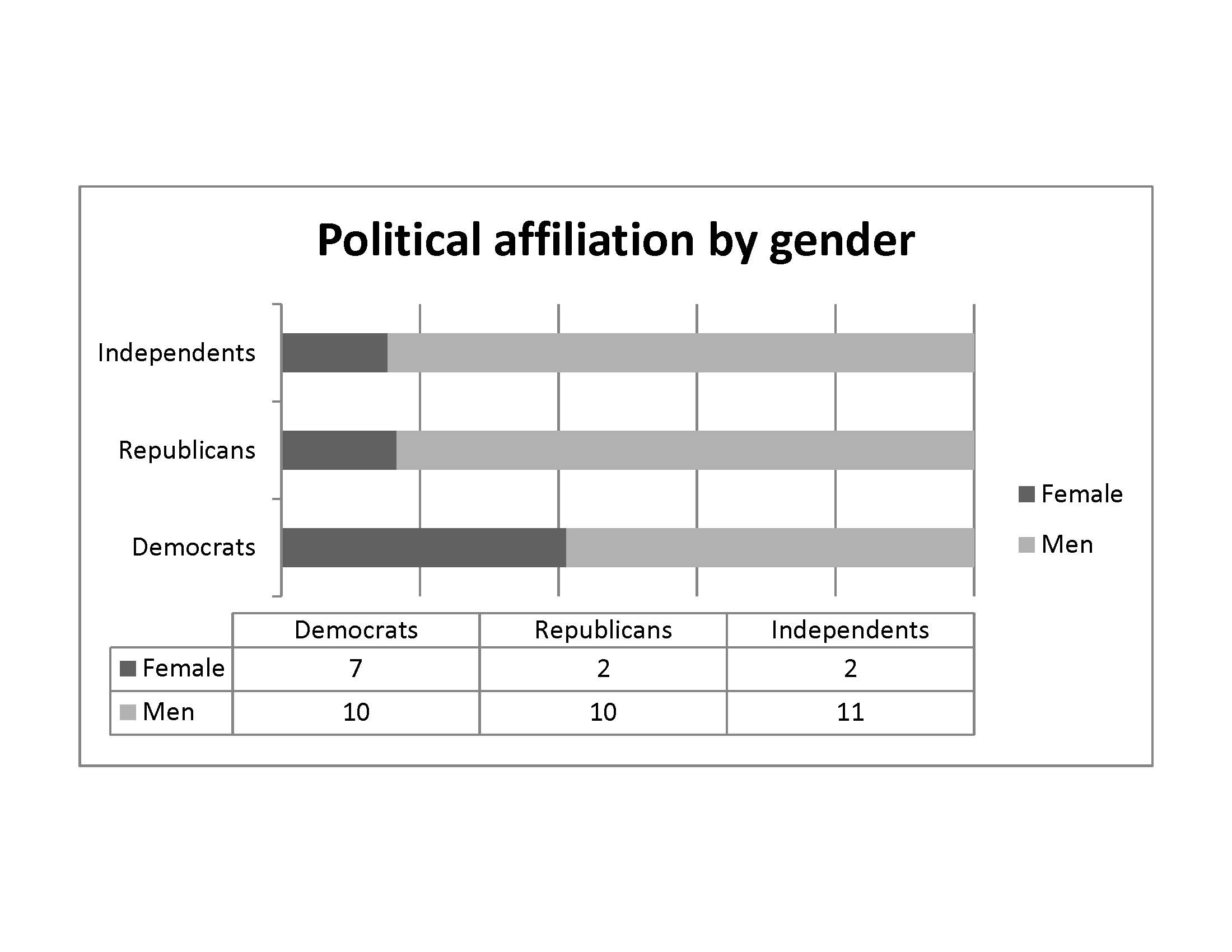
With all of that out of the way, let’s now look at the data. Clearly, the poll was weighted by male responses, but was nearly evenly split by political affiliations. Among the 42 respondents, there were 17 Democrats; 12 Republicans; and 13 Independents or un-enrolled. Thirty-one men and 11 women participated in the poll (Figure 1.1)
Figure 1.1
The poll was limited to three questions. The original Facebook post, along with the various replies and comments, can be viewed here.
Asked and answered
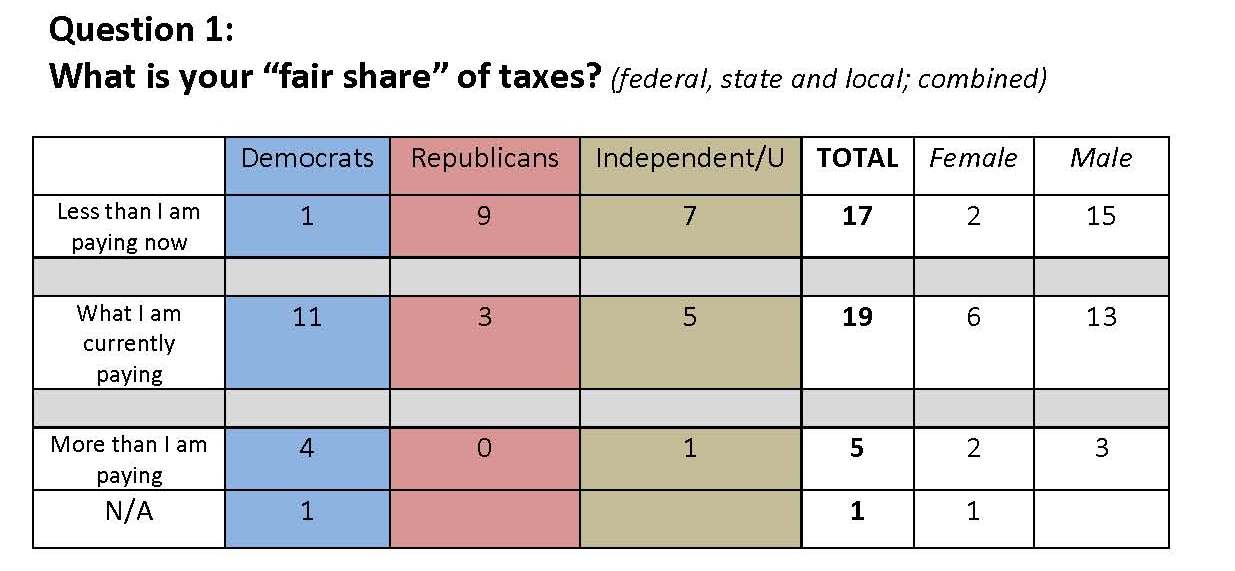
Question 1 asked respondents: What is your “fair share” of taxes (combined fed, state, local)?
Several respondents and others expressed disdain for my use of the word “fair” in the question. I responded that the word “fair” is certainly a subjective term, but the responses would also be subjective. Respondents were given three responses to choose from: A.) Less than you are now paying? B.) What you are currently paying? or C.) More than you are now paying? One respondent declined to answer the question.
Figure 2.1
There were no big surprises here. I was expecting to see a sharp divide between Democrats and Republicans, assuming Republicans would almost universally answer that they are already overtaxed and paying more than their “fair share.” What is interesting? Three Republicans (25 percent of Republican respondents) said they think their current tax obligation is “fair.” Both Democrats and Republicans, however, expressed frustration about local taxes rather than state or federal tax rates. See the chart (Figure 2.2) below for the breakdown of responses.
Figure 2.2
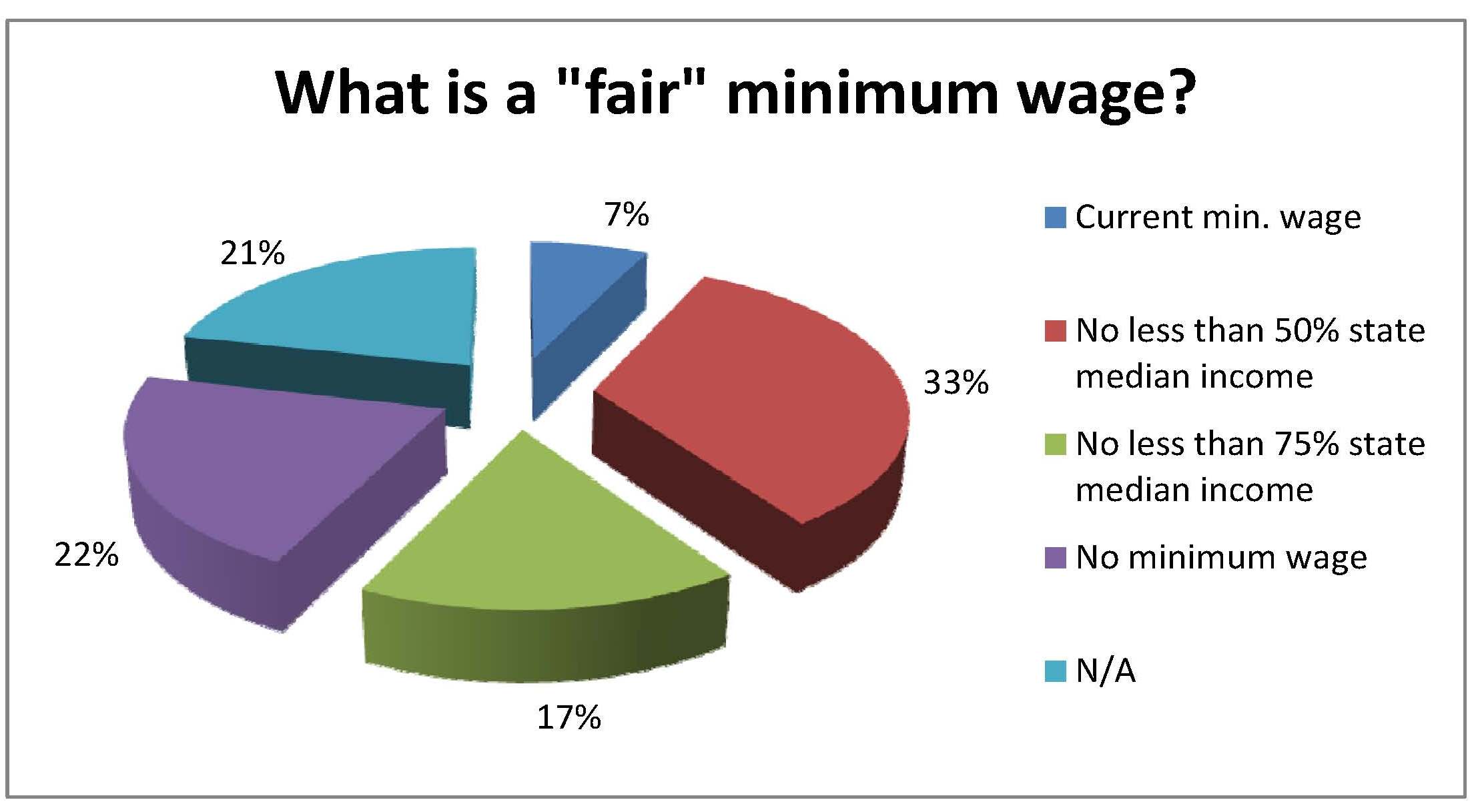
Question 2 asked respondents what they considered to be a “fair” minimum wage, providing four responses: A) Current minimum wage ($7.25/hour) B.) No less than 50% of the state’s median income. C.) No less than 75% of the state’s median income; or D.) There should not be a minimum wage.
Nearly 30 percent of respondents expressed confusion regarding responses that were tied to the state’s “median wage,” saying they did not know the current median wage or that it was a poor alternative for determining a state’s minimum wage requirement.
My theory is that minimum wage should be required by the federal government but not set to a national standard, other than as a percentage of a particular state’s median income.
My reasoning? Someone earning $7.25 per hour in Maine has less economic capacity than someone earning $7.25/hour in Tennessee, which has lower cost of living expenses. This disparity becomes more apparent in large urban areas, such as New York City or Chicago, creating an unlevel playing field.
For further clarification, it’s important to understand the difference between a “median” income and an “average” income. Median is simply the half-way point when looking at all recordable wages in a specified group. while it is common to discuss “household” median income, I used this chart from the University of New Mexico to compare median personal incomes among the 50 states. Maine ranks 28th with a median personal income of $39,481. This means 50 percent of income workers in Maine make less than $39,400/year.
If a Maine adult is working 40 hours at minimum wage, that person would be earning a gross income of $15,080 (assuming working 52 weeks per year). If we changed the state’s minimum wage to be no less than 50 percent of median income, that same person would now earn: $19,700 annually, considering an hourly wage of $9.47/hour. Lets see what my friends said:
Figure 3.1
As we can see in the above chart (Figure 3.1), there is an almost even split between those who favor the current minimum wage or the idea of having no minimum wage (43 percent); and those who would like to see some level of increase (50 percent). Seven percent of respondents declined to pick one of the offered choices (as explained above).
Figure 3.2
The poll’s final question asked respondents if there should be a “maximum wage.” This question received the most universal agreement. 95 percent of respondents said there should NOT be a maximum wage, however, it should be noted that more than 40 percent of those indicated that they would like to see increased tax brackets for high wage earners. Only two Democrats (one male, one female) answered in the affirmative.
Figure 4.1
Of course, I have some opinions about this data, and some other thoughts sparked by this conversation; but I will pause here and allow you to reflect on the responses to develop your own analysis.
Again, my deepest appreciation to all those who participated!
The Maine Chamber of Commerce held its annual dinner and awards ceremony Friday and landed U.S. Senator Angus King as its keynote speaker.
Thus, the event’s theme was Mr. Smith Goes to Washington.
You probably remember the 1939 movie that made actor Jimmy Stewart a star, especially the famous filibuster scene that portrays the young and somewhat naïve Sen. Smith as an adorable champion of integrity, truth, justice and the American Way.
As the movie began production in 1937, Stewart was only 28 years old, two years shy of the minimum age requirement to be a U.S. Senator. Angus King, on the other hand, will soon celebrate his 70th birthday.
In the movie, a young, ambitious and principled man from an unnamed western state is reluctantly chosen by a somewhat corrupt governor to replace a deceased senator.
Back here in Real-ville, King’s trip to Washington D.C. happened much differently. He launched his campaign only days after Olympia Snowe abruptly announced that she would not seek another term in the senate.
King, a very popular, former two-term governor, instantly crushed the hopes of more than a dozen political hopefuls who all dreamed of sugar-plum fairies and huge PAC donations. He adroitly skipped the banality of the primary process by pulling his worn and tattered “Independent” card from his breast pocket.
He quickly raised $3 million, half of which probably came from the sale of a decked-out RV that he purchased to “tour the country with my family” after leaving the Blaine House.
Maine Democrats hung their heads in shame because they knew that they’d been beat. The state GOP, full of pride after taking back the Blaine House and the Legislature a year prior, hoisted up no fewer than four candidates, including three members of Gov. LePage’s cabinet.
Cynthia Dill, a far-left Democratic state senator from Cape Elizabeth — virtually unknown outside the three-mile perimeter that surrounds her home — bravely accepted her party’s nomination for Snowe’s seat and walked dutifully — with her head held high — toward a political slaughter.
Meanwhile, King coyly teased the Maine press corps, saying he wasn’t sure which party he would caucus with if he were elected. The gag order had been issued. The emperor had no clothes, but no one seemed brave enough to say: wait a second . . . dude is a Democrat! Instead, we lathered ourselves in the premise that Governor King would be “independent” and fix all that was broken in DC.
In essence, King won his election approximately 38 seconds after he called Congresswoman Chellie Pingree to tell her what was what.
Mr. Smith? Hardly.
One hit to the body
So, there we were on a Friday night: various members of Maine’s business community, mingling near the cash bar, sampling local foods and waiting to hear from Maine’s junior senator.
Regardless of how you feel about King’s political positions, no one can deny that he is an incredibly smart guy and a skilled politician. He exudes warmth and confidence. He is likable, smart and often — sometimes painfully so — very human; revealing an unabridged and honest insight of “how cool and fun it is” to be a U.S. Senator.
King is also an exceptional public speaker and usually a diligent student of history.
While working as a reporter, I had the pleasure of interviewing Angus King. I spent nearly 45 minutes with him, one-on-one; and it was damn hard to walk away unimpressed from that conversation. In the years that followed, I also greatly enjoyed hearing King speak at numerous public events.
Therefore, I was surprised on Friday when King — for the first time ever — didn’t mention his favorite historical figure: Civil War hero and Maine native Joshua Chamberlain. Instead, King ran through a laundry list of frustrations about the current dysfunction in Washington. And who could blame him?
Currently, public opinion polling of Congress as a whole is running just three points ahead of Osama Bin Laden’s popularity rating.
King led off his assessment of beltway politics – – quite surprisingly — by delivering a pointed jab to President Barack Obama and his signature legislation: the Affordable Care Act. It’s not like Obama needs another critic these days. The President’s own approval numbers are hovering perilously close to George W. Bush numbers.
As we feasted on our salads, King relayed an anecdote about a text message he sent to his chief-of-staff a few weeks ago, when the healthcare.gov site was rolled out.
“If you want to know what the Soviet Union was like in the 1970s, go to this website because nothing works like it should,” King said. There were a few nervous laughs in the room as people turned to one another with puzzled expressions.
“I’m a supporter of the Affordable Care Act, but boy, have they screwed up the implementation,” King went on to say. “It’s really frustrating that they can’t even do a website right.”
Someone just got themselves removed from the President’s Christmas card list.
Shiny, happy people
King continued his rather populist bashing of DC’s political climate, focusing most of his energy into the sometimes stunning changes of a hyper-partisan Congress.
He bemoaned a lack of civility and expressed frustration about his colleagues who are genuinely worried about re-election in 2014 because of an ever-increasing gap of political polarization on both the left and right ends of the political spectrum.
He relayed a story about his interaction with another member of his incoming senate class, Republican Ted Cruz, by saying he found the conversation “interesting and productive” but drew a laugh when revealing that his wife witnessed them talking on C-SPAN and immediately castigated him with a call to his cell phone. “She wanted to know, why are you talking to Ted Cruz?”
It’s easy to be a populist and a centrist, but King’s story revealed that it’s a lot easier to talk the talk than walk the walk. King seems sincere about his willingness and eagerness to find bi-partisan solutions to our nation’s problems, but his own wife went ballistic when he spent just a few moments chatting with someone from the other side of the aisle — albeit someone from way over on the other side.
King also shared insights about some fellow members of the senate, revealing the human side that is often missed by MSNBC, FOX or CNN. For example, King said he learned that Senator Orrin Hatch, a patriarch of the GOP, grew up literally dirt poor in Pennsylvania. Hatch’s family lived in a home with dirt floors and one wall in their home was erected from a salvaged billboard that Hatch’s father was able to drag home.
Of course, King spent a fair amount of time Friday evening rigorously patting himself on the back, portraying himself as the great white hope in the U.S. Senate. He’s a politician, so it’s to be expected; but he conveniently skipped over some remarks he made just a few weeks ago during the government shutdown.
King, who doesn’t hesitate to show his annoyance, told a reporter earlier this year that Republicans who were stalling implementation of the ACA are “guilty of murder.”
Apparently, King’s pleas for a more civil discourse are reserved for those who disagree with him. It’s also surprising, given his penchant for history, that King buys into the half-cocked notion that our Congress is more hyper-partisan now than ever before.
King didn’t win his landslide election because of money or better television ads. Maine voters are smarter than that, especially when they speak so loudly and clearly.
Maine’s voters sent Angus King to Washington simply because they knew he was the right guy for the job. Even King acknowledges that he has difficult shoes to fill, pointing out the state’s legacy in sending remarkable people to Washington: Margaret Chase Smith, Edmund Muskie, George Mitchell and Bill Cohen.
Maine’s voters know that Angus King is stubborn, especially once he buys into an idea. They know who he is, and they respect his feisty temperament and keen intellect. They also know he’s a politician and will sometimes disappoint but rarely back down. King has a long road ahead. He’s not Jimmy Stewart.
King is a real person, complete with all the quirks and inconveniences associated with being human. He proudly led the charge to integrate technology into public classrooms, but yet goes old school with markers and an easel board to make his points. It’s damn hard not to like or respect the guy.
He’s human, and thus, flawed. And if you ask him, he will gladly tell you that being a member of the U.S. Senate is pretty damn “cool.”
Mr. King is not Mr. Smith, but if he wants another term in the U.S. Senate, all he has to do is call Chellie Pingree and tell her to wait another six years.
I found it in the most unlikely of places. It was written by the most unlikely of authors. It intrigued me, and its aftermath terrified me.
It was a column headlined: “Let’s talk limits,” a well-written and balanced piece about the hype and rhetoric that surrounds our nation’s gun control debate.
It was published in Guns & Ammo, which describes itself as “the world’s most widely read firearms magazine.”
It was written by Dick Metcalf, a staunch Second Amendment supporter, who had the temerity to opine that reasonable gun regulations do not necessarily constitute an infringement on civil liberties.
“Way too many gun owners still seem to believe that any regulation of the right to keep and bear arms is an infringement,” Metcalf wrote in the December issue
“The fact is, all constitutional rights are regulated, always have been, and need to be.”
Gun advocates went ballistic. They felt betrayed by one of their own.
Jim Bequette, the magazine’s editor immediately apologized to readers for his goal of generating “a healthy exchange of ideas on gun rights.”
But that did not calm the storm. Metcalf was fired, and Bequette resigned his post a month earlier than he planned.
Apparently, too many of those who so staunchly support the Second Amendment have little use for the First Amendment.
If gun advocates feel as is if they are being discounted by the so-called mainstream media as “unreasonable,” perhaps they should try listening to other points of view and refrain from shooting any messenger with a set of talking points that don’t align perfectly with their own script, especially when that message comes from one of their own.
And so it was — amidst all this talk of a government shut down, an “unfair” system of health care delivery and a skyrocketing national debt — that my youngest son was assigned to read Animal Farm.
As so many of us learned in high school, George Orwell wrote Animal Farm as an allegorical reference to the Russian Revolution in 1917.
Matthew finished reading the final chapter last night, and now it appears that our government is about to end yet another temporary shutdown.
Which political party will be blamed for this fiasco remains to be seen. We’ll likely have to wait a little more than a year for that answer.
Allow me to pause here for a moment to ask you a question. Are you surprised that our elected leaders have behaved so foolishly over the past several days? Really?
Maybe we shouldn’t be blaming Congress. Maybe we should be blaming ourselves.
Consider this. Americans elected a man (Republican) who believes that wind turbines “slow down” the wind. We also elected another man (Democrat) who believes that the island of Guam could actually “tip over.”
We have elected members of Congress who enjoy taking pictures of their own genitals and then sending those pictures to porn stars. We have elected members of Congress who believe the internet is little more than “a series of tubes.”
Take these people, put them together in a room with broad Constitutional powers and tell me that is not a recipe for disaster.
But a penchant for stupidity does not end at the DC Beltway. It extends into every nook and cranny of our great nation.
Despite all the rapid advances in technology, we humans have changed very little over the last 2,000 years.
The popularity of Wikipedia should have been a wake-up call. But still, so many of us keep doing the same things and yet expect different results.
We all want a chicken in every pot and repeatedly fail to understand the consequences of actually believing political candidates who make such promises.
All politics is local
In my hometown we will soon be asked to choose a mayor and new city councilors.
The lawn signs have begun popping up all over town. The candidates are working their campaigns and making their promises.
This is where it starts. This is where the numbing process begins.
One of our mayoral candidates is promising “lower taxes” and “more jobs.” Although he is short on specifics, I’m almost certain that he also likes puppies, French fries and cold beer. Why wouldn’t you vote for that guy? Sounds good, right?
Most of us are too busy to peel back the layers of such a perfunctory campaign. We have jobs, families and the Red Sox are playing.
Some local folks are upset about property taxes. They are planning to take out their frustration on an incumbent candidate who is seeking re-election.
Sounds smart, right? Toss the bum out. Vote for one of his opponents.
There’s just a few things you should consider. The incumbent has only been the mayor for two years, and the city council decides the budget.
Why is this important? Four years ago, under the leadership of a different mayor, the city’s voters overwhelmingly voted to approve a $35 million bond in order to finally complete a long overdue renovation at the high school. I supported that bond question but sometimes it feels like I am one of the few people who read the fine print on the ballot.
Yeah, taxes went up because we borrowed $35 million to finally fix a project we ignored for decades. Duh!
When I purchased my truck, I drove it off the lot with no money down. A few weeks later, the bank had the nerve to start asking for payments. How arrogant of them! I am going to get a new bank!
Voters are not blaming the former mayor for the tax increase. In fact, the former mayor is today hoping to get her old job back, a prospect made much easier by blaming the current mayor for a situation that happened on her watch.
Our city has several infrastructure problems that need to be addressed. For decades we have ignored and stalled many of these projects to keep taxes low.
The front stairs of our high school were literally crumbling and the gymnasium roof was leaking before we were willing to invest a dime. Stalling those repairs did not make them less expensive. In fact, we stalled right past the deadline to qualify for some state funding for those repairs.
But hey, let’s blame the guy who has been in the mayor’s office for 22 months. It’s all his fault, right?
For 30 years, our city bitched and moaned about a controversial trash-to-energy incinerator that was located in the center of our downtown area. The stench of burning trash became a humiliating calling card for our community. Merchants and businesses complained. Economic development was thwarted and diminished.
The city spent decades in court, racking up huge legal fees in fighting against the facility’s former owner. Every mayor in the last 20 years pledged to get rid of the facility. It was politically popular rhetoric.
Then, after 30 years of complaining and wringing our hands, our current mayor (the new guy) led a team that was able to negotiate the closure of the facility. The problem is now gone. No more wasted time, energy and resources will be spent on that particular problem.
Results matter. Talk is cheap and empty promises are politically convenient.
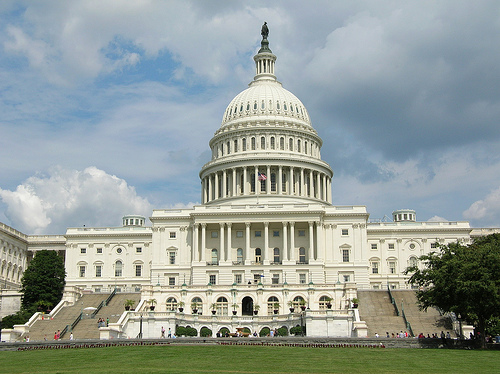
We have a responsibility to pay attention. Otherwise, the wind may begin to slow and islands could start tipping over.
The days are getting shorter, the economy remains anemic and political rhetoric is intensifying in the face of a so-called government “shutdown.”
Just in the last seven days, our nation has witnessed some stunning and bizarre examples of citizen unrest.
On Thursday, a woman suffering from depression attempted to crash the White House barriers. She had her infant daughter in her car. She then headed to the Capitol, where she was eventually shot to death by police. Fewer than 24 hours later, a man set himself on fire near the National Mall.
Of course, two weeks earlier, Aaron Alexis went on a killing rampage that left 12 people dead at the DC Navy Yard.
Despite those horrific incidents, the nation remains bitterly, stubbornly focused on an intensely partisan battle that is still raging on Capitol Hill. These other incidents were mere blips on the radar screen, generally ignored like those blips that signaled the advance of Japanese fighter planes approaching Oahu on December 7, 1941.
It is mind-numbing stuff; stuff that is too difficult to even think about, much less the sort of stuff that we are willing to discuss in the sphere of public policy.
We avoid this stuff because it’s much harder to point fingers and assign blame. It’s not as convenient or simple as arguing about Obamacare. It’s stuff that we generally want to avoid.
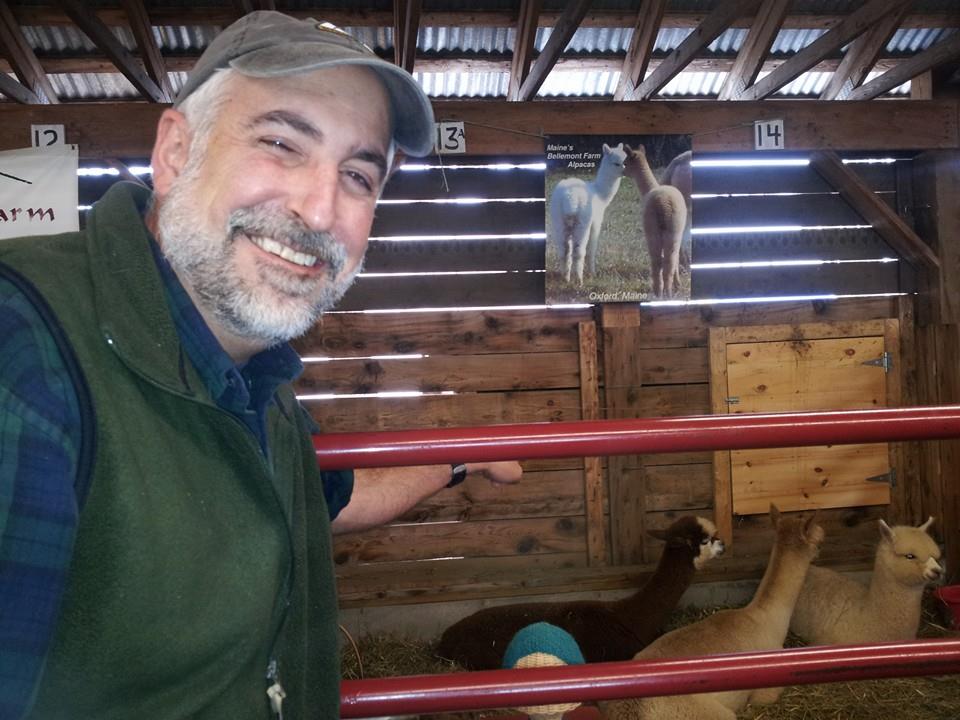
What does this have to do with alpacas?
As a so-called “consumer” of mental health services, I have a wide range of my own diversionary tactics, a boat-load of coping tools I can deploy to ignore the obvious and the overwhelming.
I am also a semi-professional pundit, not to mention a professional consultant who spends the bulk of his time crafting public policy messages and strategies to help clients achieve their goals.
When those two worlds intersect, I need a distraction as much as anyone else. So, I began focusing on alpacas.
Go ahead and laugh. I will wait.
This week is also the week of the annual Fryeburg Fair. For many years, I have represented various clients at that fair, staffing booths in the Natural Resources building and thus unable to enjoy the fair like most people with my family.
Of all the animals on display at the fair, I have always had a soft-spot (literally) for alpacas. I have long fantasized about how cool it would be to have a pet alpaca.
It’s just a fantasy; it’s not the real thing
This year I did not have to work at the fair. Laura and I decided that we would go on Saturday. Our youngest son, Matthew wanted to join us and bring along his girlfriend. We began planning this day almost three weeks ago.
This year, we had other things to consider about attending the fair. Laura’s MS has been progressing. On Monday, the neurosurgeon ordered her to stay home from work. For the first time, I had to get serious about wheelchairs and their cost, function. Maybe I would not need it this year. But it is part of our family’s new reality.
Earlier in the week, I once again dreamed about how great it would be to own an alpaca. The little kid in me got very excited about this prospect. Matthew, in fact, suggested that we would name our alpaca Cameron.
I am terrified thinking about my wife’s MS. I want things to stay the same. The future looks so uncertain. This is the Fryeburg Fair, dammit. I just want an apple crisp, wager on a few races, smell maple syrup and hear reports about the Red Sox and their progress in the ALCS.
What happens if Laura can’t go back to work? What happens to our health insurance? How will we be impacted by Obamacare? What if . . .?
I went to bed early on Tuesday evening in a mix of anticipation about seeing the alpacas at the fair and worrying about my wife’s health. I wept like I have not wept in years.
I really wanted an alpaca. I researched alpacas, and the adult that also lives in me tried to be as gentle as possible. But reality won on Tuesday. Our yard is too small. Alpacas live in herds. We have no business, whatsoever, in even considering the purchase of an alpaca.
It was the clashing of reality and fantasy. This tool of distraction would soon need to be replaced. What do I do now?
Sometimes a fantasy is all you need
We had so much fun on Saturday. Despite the heavy traffic, the difficulty in finding a parking spot, we all laughed so much. People of all stripes, sizes and colors packed the fairgrounds. Yes, we saw the alpacas, and we even found Cameron.
The alpacas, goats, sheep and cattle all seemed somewhat oblivious to the incessant buzz of human activity that surrounded them. They were content to gnaw on hay, to root in piles of sawdust.
For several hours, I did not hear one word about John Boehner or President Obama. I did hear that the Sox scored another run in the bottom of the fourth. The air became cooler all around us, the night sky settled in quickly.
And then it dawned on me. There is a thin line that separates reality from fantasy, dreams from nightmares.
We spend so much energy fretting about the unknown.
Sometimes all you need is some hot apple crisp, a home run by the Red Sox, the company of those you love and the experience of petting an alpaca. That way, the buzz of human activity that surrounds you becomes little more than just another day at the fair.

 You probably heard that CVS, one of the nation’s largest drugstore chains, made news by announcing it will no longer sell cigarettes.
 Will CVS sell wine or beer at any of its stores?





 LESSONS IN MEDIOCRITY | OUTLAW JOURNALIST