
The deputy national security advisor commits suicide only a few hours before his widowed mother is brutally murdered on a small island off the coast of Maine. These events set the stage for a political thriller that ultimately leads three very different people on a journey of personal discovery and a quest for the truth.
Category: BLOG POSTS
Commentary that has not been published elsewhere.
‘Let’s Go Camping’
This is a story about our very first camping trip as a family in 2002. This, unfortunately, is a true story.
It was supposed to be a relaxing weekend of camping. I should know better than to include the word “relaxing” when talking about a camping trip with the kids and Laura, who — by the way — requires a minimum of 47 hours of sleep between Friday and Sunday.
This camping trip was a spur-of-the-moment decision Laura made while I was busy wrapping up some Saturday morning errands. Since we are planning a longer camping trip later this month at Rangely State Park, Laura suggested we should take a trial run at camping in order to check out the “equipment.”

So, I spend the next two hours packing up the Jeep, which includes taking down the kids’ tent that I put up in the yard. Laura makes a “quick” run to her parents’ house so that we can borrow a lantern.
I am alone with the boys, who are very excited and very eager to help pack, and they offer plenty of suggestions about what we need to bring. I load the sleeping bags, the tents, the bug spray, the lawn chairs, the tarp, the kids’ water toys and a cooler that weighs roughly 300 pounds, not including the ice we still have to buy.
As a finishing touch, I strap the canoe on the roof rack and squeeze the paddles over the pillows, blankets and cookware. And we’re off. Two vehicles, two kids and more “stuff” than the Allied Forces needed in Germany.
An ominous sign
While driving to the campground, my eyes catch a glimpse of gathering clouds on the horizon. If there is ever a drought, simply ask Randy Seaver to plan a camping trip. There’s no better way to ensure a steady downpour.
We arrive at our site at approximately 3:30 p.m. “Let’s set up camp,” Laura proclaims. Unpacking moves a little more quickly until we realize that we don’t have enough stakes to set up the “main tent.”
Matthew begins to cry. We forgot to bring a “floatie.” Tim meets a friend at the campground. He wants to know if he can visit her family’s site so that he can watch a video.
Fortunately, we picked a local campground relatively close to home for our ‘test run,” so I offer to drive back to the house, get the “floatie.” Roughly 90 minutes later, I return to the site. Matthew doesn’t want to go into the water now.
Laura wonders what we will have for dinner. We planned on steaks but there is no grate for the fire. So, we have approximately 250 pounds of snacks and salad stuff, but nothing for dinner. I still have yet to eat lunch. “Kentucky Fried Chicken sounds good,” Laura suggests.
I’m back in the Jeep with Matthew. Remember, Tim is busy watching a video. I tell Laura to keep an eye on the raging inferno that I built as a campfire. The mosquitoes seem to enjoy our brand of bug repellent.
The line at Kentucky Fried Chicken circles around the parking lot. We wait 35 minutes only to be told, upon finally reaching the counter, they are out of extra crispy chicken. “I don’t care, just fry something and put in a bucket,” I bark.
A “quick” stop at Hannaford for some “adult beverages” consumes another 22 minutes as I wait in the “express” line behind a woman who wants to cash a check from Neptune with no identification.
Summer traffic on Rte. One is a nightmare. Bumper-to-bumper and Matt tells me he needs a bathroom. “I have to go real bad,” he says, grimacing in the backseat.
Evening descends
I return to the campsite at 7:50 p.m. It’s getting dark. Tim tells me he is hungry. Apparently, watching a video in a neighbor’s R.V. is a physically draining experience. Laura notes that we forgot the marshmallows and graham crackers. The kids fight over who gets to use a particular stick. I trek a half-mile to the convenient camp store, where I use a strained Visa card to buy a dusty bag of marshmallows.
Finally, the kids are asleep. Peace and quiet and the great outdoors. I crack open a bottle, and Laura yawns from the comfort of her camp chair. “Goodnight,” she says, kissing me on the forehead. The fire needs to be extinguished by 10:30 p.m. The flames are three feet high. I look around and spot an empty, 16-ounce Mountain Dew bottle. Our lantern doesn’t work.
It takes me only 38 trips back and forth to the campground’s water spigot (located 350 yards from our site) to put out the fire. I finally enter our tent and lie down, exhausted. It is so quiet and peaceful that I can clearly make out the sound of air slowly seeping from the air mattress. I decide to ignore this latest development. And then, the rain starts and a clasp of thunder wakes the boys.
“Welcome to Maine,” I sigh. “The way life should be.”
New England Fisheries
The Gulf of Maine is a unique natural resource that has fueled New England’s economy for nearly three centuries. Today, that resource and the traditions of New England’s commercial fishing fleet are at a crossroads as government regulators, scientists, environmentalists and fishermen continue a struggle to find common ground in how best to protect and enjoy this resource.
I was honored to be part of the ongoing process during my tenure as a collaborative research reporter for the Northwest Atlantic Marine Alliance (NAMA), a non-profit organization with a mission to restore and enhance an enduring marine system that supports a healthy diversity and an abundance of marine life and human uses through a self-organizing and self-governing organization.

One of NAMA’s core missions is to support and promote collaborative research efforts in the Gulf of Maine that partners commercial fishermen with scientists and policy researchers.
Bringing together fishermen, scientists and regulators is not easy, but it is incredibly valuable and rewarding. You can find below a few of articles I wrote about collaborative research projects in the Gulf of Maine in 2002.
Those projects and my reporting were funded by the Northeast Consortium, a group of academic institutions throughout New England.
The Effect of Herring on Lobsters
It’s estimated that more than 73,000 metric tons of herring are dumped each year along the coast of Maine for lobster bait, but how does the use of herring bait affect the lobsters that are being harvested in the Gulf of Maine?
That is the question Dr. Phil Yund and other scientists are hoping to answer this year as part of their collaborative research project entitled “Are we using herring to farm lobsters? Effect of herring bait on lobster growth, and fate of discarded bait in benthic communities.”
The project was funded last year by a $111,972 grant from the Northeast Consortium, and its objectives are simple and straightforward.
Yund, along with Jon Grabowski and Erika Clesceri of the Gulf of Maine Research Institute, will use their research to determine the proportion of lobster diet and tissue derived from bait; assess the impact of a bait-augmented diet on lobster growth and population density; quantify the initial fate of discarded herring bait in the benthic community, and conduct an economic assessment of lobster production versus herring cost.
The project is scheduled to get underway in May and it should be finished in November, according to Yund. The study will focus on two specific areas, comparing data collected from the area surrounding Monehegan Island in Maine and the waters near Grand Manan Island in New Brunswick.
“Basically, we want to find out what’s really happening with all of the herring we dump as bait,” Yund said. “For instance, what other species are eating it, besides the lobsters?”
According to Yund, approximately 25,000 metric tons of lobster is harvested each year. The scientists are now wondering whether those lobsters are being affected, in terms of size and location, by the use of herring bait.
“What [lobsters] feed on during the summer is what makes them grow,” Yund said, explaining why the project will be conducted during the summer months.
In order to make their project work, the scientists needed the help of some lobstermen who know the geographic study area. Carl Wilson of the Maine Department of Marine Resources served as a liaison for the project and enlisted the help of some local lobstermen, including Matt Webber (F/V Griffin) from Monehegan Island.
A need to participate
Webber, 25, is relatively young, but says he has a lot invested in the lobstering industry. Thus, he says, it made sense to participate in a collaborative research project that could have long-term impacts upon his livelihood.
“I work in a six-month fishery (Dec.- May),” Webber said. “Because of the closures, I end up with a lot of time on my hands At least this way, I’m able to be out on my boat, but I’ll also get to be a part of the process and I think that’s a good thing.”
Although Webber said he is interested in the research aspect of the project, he also expressed concerns about increased regulations, including trap limits and net change requirements.
“I think the more you know about a species, the better you can actually forecast what may take place in the future,” he said. “I’m young, and I want to be doing this for the rest of my life.”
Like many other fishermen who participate in collaborative research projects, Webber said he is expecting to face some challenges and minor difficulties by agreeing to work on the project.
“Sure, I’ll incur some costs. . . like increasing my insurance and picking up some extra survival gear, but I would still say it’s worth it,” he said. “This is my life and I want to be a part of it.”
The project’s goals
According to the project’s summary, recent lobster landings have been higher than traditionally thought to be sustainable. The thousands of tons of herring that are dumped into coastal waters each year are believed to be contributing to this production, and likely are having additional consequences for the near-shore benthic environment.
Three complementary methods will be used to assess the relative contribution of herring to lobster diet and growth in areas with and without bait.
Lobster gut contents will be examined to assess dietary impact. Secondly, nitrogen stable isotope ratios will be used to compare longer term effects of herring bait on lobster biomass production. Finally, single-season growth rates will be compared to determine whether the presence of herring bait increases short-term growth. By addressing these issues, this project will begin to assess how different fisheries are interconnected by fishing practices of lobster production versus herring cost.
Fishing for Answers
[Rockport, Mass.] Bill Lee happily mutters to himself as he cleans the deck of his boat. Like hundreds of other fishermen throughout New England, Lee has been hit hard by recent changes in federal ground fishing rules, but unlike many of his colleagues he has found an innovative way to soften the blow.
As he works to remove debris from the renovations he recently made to the wheelhouse of his 43-foot trawler (F/V Ocean Reporter), Lee says U.S. District Court Judge Gladys Kessler most likely had no idea about how her April 26 decision would affect the fishing industry.
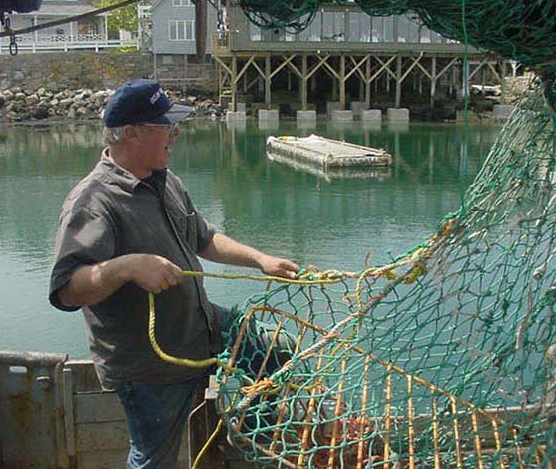
But on this otherwise perfect day — with clear skies and calm seas — Lee’s biggest complaint is about the lack of available parking spaces on Rockport’s main pier.
“Tourist season hasn’t even started, and it’s already hard to find a spot down here,” he smiles, shrugging his shoulders and carrying a barrel of trash along the dock. “A lot of these guys don’t have anything to do, so they all hang out over at that café [Flav’s] all day.”
Even before Kessler decided to vacate her order and lighten some of her restrictions late last month, Lee was keeping himself steadily optimistic by participating in a process known as collaborative research.
So instead of rigging his nets for flounder or cod, Lee is installing an underwater camera frame in the net at the stern of his vessel. It’s just another way the 54-year-old fisherman has learned to adapt, and that — he says — is what keeps him going.
“I’ve always been a big believer in the collaborative process,” Lee says. “If you think about it, that’s the way it should be.”
In the past few years, Lee has earned an enviable reputation in collaborative research circles.
“If you ask me, Bill epitomizes the beauty of cooperative research,” said Dr. Earl Meredith of the National Marine Fisheries Science Center in Gloucester. Meredith, a marine biologist, is a member of the New England Fisheries Management Council’s Research Steering Committee.
“Bill is one of those guys who you always love to talk with,” Meredith continued. “He’s always pumped up about an ongoing project or a new idea. He approaches the process with a lot of enthusiasm.”
For his part, Lee says the enthusiasm is just part of a natural evolution that starts when you participate in the collaborative process. He is nonchalant, now focusing his attention on a series of video wires in the wheelhouse of his boat.
There’s something unique about the video gear that Lee uses: it’s all been built in his basement. For example, one of the camera frames he built includes an automobile tire. That way, Lee explains, the underwater camera mounted inside the tire is left undamaged as its housing bounces harmlessly in the net.
Despite the mass of video cables and connectors, Lee is organized about the process of his underwater videotaping. Each camera is designated as either color or black and white, depending on the color of the flange that is mounted to the camera frame. Generally, Lee uses three cameras but he can operate as many as eight.
“Personally, I think this is the way to go,” he says, checking each of the wire connections as we prepare to leave the dock. “When you catch the fish on videotape, you’re not killing them in order to understand their behavior.”
Of principles and practicality —
Bill Lee describes himself as a fisherman, not as a scientist. At the same time, he has converted one entire room of his Rockport home into a well-equipped video production facility. And his basement, although similar to many other do-it-yourselfers’ basements — featuring a drill press and an entire wall of hanging tools — also houses a vast array of high-tech video cable and underwater camera building equipment.
But Lee didn’t start his collaborative research career by producing underwater home videos. Instead, it was a chance encounter with an independent marine biologist that got Lee involved in collaborative research.
Dr. Allan Michael first met Bill Lee some 13 years ago, when the city of Gloucester put out bids for water quality samples. According to Michael, there wasn’t an instant chemistry between the two men — each of whom was accustomed to working independently.
“Bill is certainly full of energy,” Michael says. “Talk about catching a tiger by the tail. I’m just a quiet scientist, but Bill is always on the go, ready to tackle a dozen things all at once. I guess you could say that I’m the steadying influence in our partnership.”
The partnership and acceptance of each other’s differences has served both men well. By working together — a quiet scientist and an ambitious fisherman — Lee and Michael have been able to share their resources on a number of collaborative research projects.
Last year, Lee and Michael were awarded a $35,000 grant from the Northeast Consortium for a project in which they set out to test the effectiveness of a Nordmore-style grate by using underwater videotaping. The grate is placed in the cod end of a trawl net in order to reduce bycatch of non-targeted fish species.
While a typical Nordmore-style grate features vertical bars that are spaced approximately one inch apart, Lee’s grate featured horizontal bars that are spaced three inches apart. The modifications, he says, are based upon fish behavior — behavior that he was able to videotape in a video he produced for the Northeast Consortium.
In the video, which Lee narrates, flounders are shown swimming with a tendency to swim downward, while cod — much stronger swimmers — escape the specially designed net by swimming upward.
Despite the effectiveness of Lee’s underwater video equipment, he keeps a close eye on the cost of the equipment, working to build things that any other fisherman could do easily and without a lot of money.
“You see the radius on this camera frame?” Lee asks as he moves toward the stern of his boat. “That’s the same radius as a standard 5-gallon pail. Show me a fisherman who doesn’t have a 5-gallon pail on his boat. Things don’t need to be expensive in order to be effective”
As an example, Lee’s scientific partner talks about a time early in their relationship when Lee demonstrated his most practical side.
“I was once looking at purchasing a piece of equipment that cost roughly $12,000,” Michael said. “I showed it to Bill, and he built it for me for about $20. He’s very innovative and incredibly motivated.”
In fact, Lee built the 43-foot F/V Ocean Reporter from the keel onward in 1986. “I knew what I wanted and I just decided to build it myself,” he says with a shrug. He learned welding while serving in the U.S. Navy Seabees during the Vietnam War, but he admits that he has always liked to “tinker with things to figure out how they work.”
Lee’s curiosity and ingenuity is displayed in the video he produced for the Northeast Consortium. As he narrates through the video images, he meticulously describes every detail of the research project, showing the gear that was used and how the cameras and lighting equipment were placed into the water.
“A lot of it has to be done by trial and error,” he says. “You just have to keep trying different things.” In the first few minutes of the tape, Lee tells his viewers that attempts to use color film underwater was complicated by underwater plant species that provided too much camouflage for the fish he hoped to capture on tape. He also details the problems he and Michael encountered when they attempted to use reflective lights during the filming process.
Lee is also not a big believer in proprietary information when it comes to doing collaborative research. Instead, he says the information from his research should be shared with as many people as possible.
“Everything we’re doing out there is being funded by the federal government,” he says. “That’s why I believe in being accountable for everything. There should be no secrets.”
For all of his seriousness about collaborative research, Lee also has a well-developed sense of humor, which is best demonstrated by his strong Yankee heritage and his passion of videotape production. For instance, at the end of his baited underwater video, Lee narrates a story about Billy “The Bully” Lobster. During the short segment, shot entirely on location underwater in Ipswich Bay, viewers are treated to images of a lobster that tends to “bully” some nearby crabs.
The crabs exact their revenge by tricking Billy and luring him into a nearby lobster trap by telling him “There’s plenty of food over there.”
Lee’s colleagues and friends describe him as friendly, outgoing and a modern-day Renaissance man; someone who can tackle a myriad of complicated tasks with relative ease and enthusiasm.
“He has to be one of the most dynamic and fascinating guys I know,” Meredith said.
In 1996, Lee was given a Public Service Commendation from the U.S. Coast Guard for his role in the rescue of Harbor Pilot Capt. Bill Chambers of Gloucester, who had fallen from a ladder and into the ocean in the pre-dawn hours of Jan. 21, 1996. Lee was commended for his quick thinking and response while working as the operator of the pilot boat that was dispatched to retrieve Capt. Chambers from the Danish M/V Fresca.
“You do the things you need to do when you need to do them,” Lee says of the incident.
Today, Lee is excited about some upcoming projects he is planning. In just a few weeks, a marine biologist from New Zealand will be visiting the Gloucester area to discuss conducting a research project similar to the one Lee and Michael recently completed for the Northeast Consortium.
“I think it’s pretty exciting that someone from New Zealand can recognize the benefits of what we’re trying to do right here in New England,” Lee said.
Additionally, Lee has placed an advertisement in local trade publications, seeking the assistance of other New England fishermen. He wants to work more on studying fish behavior and designing bycatch reduction techniques that rely primarily on videotape rather than traditional net studies.
“Why kill the fish in order to figure out how not to kill the fish?” he asks.
“Sometimes I think I’m just a dumb fisherman,” Lee says. “But if someone like me can do this kind of stuff, there’s no reason that other guys can’t get involved, too.”
A Day That Never Ends
Jesus, it has now been more than 40 years, but it seems like just yesterday.
August 10, 1983: a date I will never forget and a date that has shaped my life more than any other since my birth.
It was a Wednesday and it was hot. Hot and incredibly humid. Dog Day Afternoon hot.
I was 19 years old and about to experience something I would never forget.

I was also an in-patient on the psychiatric unit of the Maine Medical Center in Portland. Less than 24 hours earlier my mother visited me and explained that I could not come home once I was discharged. My behavior, she explained, was unacceptable. My illness was manifesting itself in fits of uncontrolled rage, belligerent behavior and sheer arrogance.
This was my second hospitalization in less than one year. I was floundering and out of control. I remember being angry during that meeting with my mother, my doctor and a social worker. But my anger was much more about fear than anything else.
Where would I go? How would I survive?
I did not have a job. I had only the clothes on my back and 55 cents in my pocket. I not only know it was exactly 55 cents, I also know that it was one quarter and three dimes. I awoke the next morning and stared out the window of my hospital room. From the sixth floor, it looked as if the city of Portland was snarling at me, ready to swallow me whole.
You may find yourself in another part of the world. . .
I was discharged at about 11 a.m. and began my walk down Congress Street, past the fire department, the statue of Longfellow and the porno theaters that have since disappeared.
By the time I hit the intersection of Oak Street, I was drenched in sweat. I stopped at the McDonald’s restaurant and asked to speak with the manager.
I was told the manager was busy. They were gearing up for a lunch rush. I asked when I could come back just before a man tapped me on the shoulder. “What do you need?” he asked.
I will never forget that man. His name was George Lydick. He lived in Falmouth, and he owned three McDonald’s restaurants in the area. He invited me to sit down and grabbed an employment application.
I can’t remember if I filled out the application. I do remember that he gave me a Big Mac and a chocolate shake. He asked if I could start immediately because he needed a third-shift utility worker, a janitor who would clean the bathrooms, change the oil in the fryolators, empty the garbage, break down and sanitize the shake machine and mop the floors.
He was willing to take a gamble on me, but only when the restaurant was closed and there were no customers around. I had told him that I was just discharged from P-6, after all.
I had a job. I would earn $4.25 an hour, and George agreed to comp me two meals a day until I got my first paycheck. I shook his hand. Thanked him profusely and left in search of place to live.
Roughly 30 minutes later, I found myself with dozens of other people in the basement level of Portland City Hall. My name was called, and I met with a caseworker. I showed her my discharge papers and told her I just got a job at McDonald’s but had no place to live. The shame of being there was crushing.
The city, she explained, had limited resources, but if I could find an apartment that would take city vouchers, they could pay my rent until I got my first paycheck. They could not, however, help with any security deposits. She also gave me $17 worth of emergency food stamps and sent me on my way, looking for an apartment with a list of potential places and an eligibility form that the landlord would have to complete.
I struck pay-dirt on my first try, the emphasis on dirt. The apartment was a one-room efficiency on the fourth floor of a building that smelled of cat urine and featured peeling paint, torn carpeting in the hallways and lots of loud music. The rent was $50 a week. It included all utilities.
The room was tiny and had two windows, both of which could not be opened because of the swelling wood and lack of maintenance. The view featured the brick wall of an adjacent building. There was a stained mattress, a two-burner cook top and a micro fridge.
You may find yourself living in a shotgun shack.
It was 2:30 p.m. I had been on my own for a little more than three hours. I had a job and a place to live.
I was terrified and would begin my new job in less than eight hours.
Despite my accomplishments, I did make a very big mistake that day. I decided to use the toilet in my new apartment. It did not occur to me until it was much too late that I did not have toilet paper, a shower curtain, soap or even a towel.
My theory is if that ever happens to you, it only happens once. In the 40 years since, I’ve never had less than 28 rolls of toilet paper in my home at any given time.
I struck pay-dirt on my first try,
the emphasis on dirt.
I remember being stunned that I had to actually pay for things like towels, salt, soap and toilet paper. Those things should be free, I reasoned.
Welcome to being an adult.
My mother and a friend of hers visited me three days later. They brought with them several bags of groceries: cans of tuna fish and soup, fresh vegetables, peanut butter, bread and cereal.
Flash forward 40 years later. I am sitting at my desk this morning, finishing up some work and thinking about where I might have lunch. Maybe I’ll take a drive to the beach instead of updating my blog. I am overlooking my gardens, and I am impressed with my lawn and its lack of brown spots. All my windows can be opened, and we have three air conditioners and stainless-steel appliances in our kitchen.
I am looking forward to our next camping trip in a couple of weeks. We will be towing our 22-foot camper to the shores of Moosehead Lake. That 2020 camper is much nicer than that efficiency apartment on Oak Street could ever hope to be.
You may find yourself with a beautiful wife and a beautiful house . . .
My, God. . . how did I get here?
I say all this because the taxpayers (you) made an investment in me. Four decades ago, you gave me $117 in rent and groceries. For the next two years, you subsidized my medications and loaned me money to go to college.
Was it a wise investment? I like to think so, especially when I look at how much I pay in taxes; the money I donate to charity and the lessons I try to pass on to my two stepsons.
Yes, I have stumbled many times since. I have been hospitalized for psychiatric care (both voluntary and involuntary) more than 20 times. The last time was in 2018, and I began regular ECT (Electro-Convulsive Therapy) treatments. Over the last 40 years, there have been lots of mistakes, many lessons learned.
Sure, it doesn’t always work out this way. And who knows, maybe I will crash and burn tomorrow, but sometimes the investment in those who are living on the edges of society works out nicely.
Regardless, I will never forget that day.
It was my worst day, and it was my best day.
The Lincoln Tour
[This is based on a true story, some of the names have been changed, for obvious reasons]
To truly appreciate the origin of this story, and why we actually thought we would be guests on the David Letterman Show, it is important to understand exactly how drunk we were on that late September evening.
We are talking about some serious alcohol, boys and girls.

We were hammered. We were plowed. We were shitfaced, stone-cold, blathering, barely-could-walk drunk.
It was 1986, and I had just discovered the literary genius of Hunter S. Thompson. I was a quarter century behind, so I had some serious catching up to do.
Jackson wasn’t in much better shape. We weaved our way along Spring Street in Portland through the pre-dawn darkness, headed toward our rat-hole apartment on the lunatic edge of the West End.
If memory serves, we giggled as we staggered along, kicking trash cans in the days long before recycling bins.
It had been a long day. Jackson and I were roommates, and we worked at the same Old Port restaurant. He was a flamboyant homosexual, so naturally he was a waiter.
I was a down-on-my-luck college drop-out, so naturally, I worked in the kitchen. The odds of either of us sleeping with a woman anytime in the near future were beyond comprehension.
“Shit!” Jackson blurted quite suddenly, pausing on the sidewalk and looking like he was about to do something really stupid.
I found my balance and attempted a turn so I could face him. “What?” I asked, thinking I might vomit at any given moment.
“We missed Letterman,” he said, his jaw slackening as the color rushed from his already pale face. “Dammit, I hate when that happens.”
“It’s okay,” I replied. “I’ve seen enough stupid pet tricks to last a lifetime.”
Jackson was seriously annoyed, and he stared forlornly at his feet. I turned back toward my wayward march home but something caught my eye and made me freeze in my tracks.
It was draped over an aluminum trash can, and its grotesque beauty was highlighted by a flickering street lamp. It was a black velvet painting of Abraham Lincoln, perhaps the tackiest thing I had come across in my 22 years on planet Earth.
“Look at this,” I said, pointing at my discovery.
Jackson’s face brightened. He temporarily forgot all about David Letterman, at least for the next 48 seconds or so. “It’s perfect, he said, rushing over to examine the canvass more closely. “It’s perfect for the dining room!”
Did I mention Jackson was a flamboyant homosexual?
We immediately seized our new treasure and continued our trek toward Neal Street, laughing about all the things we could do with this discarded and stained piece of magic debris.
We contemplated a very early breakfast at the Denny’s on outer Congress Street, but we barely had the energy or aptitude to make it to our apartment. And driving was certainly out of the question.
So instead, Jackson brewed a pot of coffee as I sat on the couch, staring into the black velvet eyes of America’s sixteenth president.
If you ask Jackson, he will swear it was his idea. But it’s my story, and I prefer to remember that it was an alcohol-induced epiphany of my own making.
He was still puttering in our tiny kitchen when I shared my idea. “We should take pictures of this thing all over town,” I hollered toward the kitchen.
Jackson walked into the living room with the pot of coffee. “No, we should take it on a cross-country trip and submit the photos to David Letterman,” he said.
Maybe it was the Seagram’s talking. Maybe it was because I could not imagine my life getting much worse, but whatever the reason, my imagination raced. “Yeah,” I said, sitting forward on the couch. “We’ll visit really lame tourist traps all over the country and ask people we meet to pose with Abe.”
We were still too wasted to consider the consequences of our conversation.
“We’ll call it the Lincoln Tour,” Jackson pronounced.
I said what any other penniless, 22-year-old man would say. “Let’s do it!”
The Adventure Begins
Neither of us had any money, but unlike me — Jackson had convinced Key Bank to give him a credit card some three months before. He had also just made his final payment on a 1980 Mercury Zephyr station wagon. The car was fire-truck red with a chrome roof rack.

We had crappy jobs and shared a crappy apartment. He didn’t have a boyfriend, and I didn’t have a girlfriend. The way we saw it, there was nothing to lose.
We loaded the Zephyr with our prized possessions before quitting our respective jobs. It was Sunday afternoon, and we called a few friends to meet us for brunch. We could not wait to tell them about our plans.
There was only one glitch. We would have to sedate Jackson’s 13-year-old cat, Moses. Otherwise, we didn’t know how we could get the cat to his sister’s house in Gloucester, Mass.
We didn’t need maps. We figured it would be easy enough to get to L.A. by just following road signs. We each borrowed some money from friends. It went without saying that those loans would never be repaid. We sold or abandoned whatever possessions that could not fit into the car.
It was now almost 5 p.m., and the sun was already fading as our collective hangovers switched into high gear.
On Day One, we barely made it to Gloucester. Moses did not enjoy the ride. He escaped from his box and scratched everything in sight, including my limbs and neck.
Undaunted, we soldiered on, and dropped our first postcard to David Letterman on Monday morning at the Gloucester Post Office.
Back then, Letterman was still with NBC, so our plan was simple: we would build mystery and excitement by sending periodic teasers to 30 Rockefeller Plaza. Each postcard or dining room placemat would read: Look for the Lincoln Tour: Coming to a town near you very soon!
We had only 2,918 miles to go, and we were excited to begin our traveling documentary. We bought six cartridges of film for my Kodak Instamatic camera, a giant bag of Fritos and new sunglasses for Jackson.
We talked excitedly about what we would say as guests on the David Letterman Show and set our sights on Philadelphia for the first real day of driving.
The Journey
I could share all sorts of details about those first few days, but this is supposed to be a short story. So, I will skip details about the big fight we had in Manassas, Virginia, when I missed the exit three times. Nor will I discuss the 12 days we spent with Jackson’s friend, Fat Sam, in Knoxville, Tennessee, or details about another fight while camping along the south rim of the Grand Canyon.

Jackson was upset that I did buy into his theory of how eating salsa would help keep you warm when it’s very cold outside.
Instead, suffice it to say that we took lots and lots of photos. In each picture, Abe Lincoln was prominently featured. We conned people into posing for the pictures by telling them that we were crew members from the Letterman Show.
A Kentucky tourist who was vacationing with his family in Gettysburg grew a bit suspicious about our story. “How do I know you’re really with the Letterman show? “ he inquired, squinting at me like a Border Patrol agent in Nogales, Arizona.
“It’s okay, honey,” his chubby wife replied, pointing at our car. “They have Maine license plates. It must be for real.”
Jackson and I were both stunned by the collective gullibility of the American people. Their intense desire to perhaps have their photo selected for a national television show immediately vanquished any doubts about our credibility or the purpose of our mission.

We photographed tourists at the Lincoln Memorial, the Natural Bridge in Virginia and at Dollywood in Pigeon Forge, Tennessee. We took photos of the young and the old, the rich and the poor.

We got a picture of a Maryland State Trooper holding the black velvet portrait of Lincoln; there was a cute waitress at the Lincoln Diner in Gettysburg that I still cannot forget.
A lady in Oklahoma wanted to know why I was using such a shitty camera.
I didn’t flinch. “It needs to look authentic,” I explained. “These are supposed to look like any other typical family vacation pictures. It’s what Dave wants.”
Her boyfriend was not convinced. “Why don’t you have a release form or something?” he asked.
I let my annoyance show. “Look,” I barked. “You wanna be on the fucking show or not?”
He shrugged and grabbed Abe, waiting for me to frame the shot.

And that’s how it went for the next 15 days.
Jackson did most of the driving since I didn’t have a valid driver’s license. We asked everyone we met to send a note to the Letterman show, telling them about seeing the Lincoln Tour. Most everyone eagerly agreed. A few of them even offered to personally call the NBC studios in New York.

We took more photos. A homeless man in Santa Fe; a group of college kids in Albuquerque and an art dealer in Little Rock.
We never made it to L.A. We ran out of money in Tucson, Arizona. I got a job bussing tables at the Red Robin restaurant at the Tucson Mall. Jackson got a job as a waiter at a much nicer restaurant.
Of course, we called NBC to see when they would like to meet with us. We got bounced to an intern in the assistant producer’s office. “We’re the guys from the Lincoln Tour,” Jackson announced as I watched him pace with the telephone.

The intern seemed less than pleased. “What the hell is the Lincoln Tour? Our mail room has been flooded with stuff about the Lincoln Tour.”
Jackson patiently explained our saga. The intern promised to call us back.
That was 1986.
I’m still waiting for that phone call from David Letterman.
PLAUSIBLE DENIABILITY
A powerful, Boston-based law firm runs a secret operation to recruit highly-functioning psychiatric patients for clandestine work, including political assassinations.
Plausible Deniability: Chapter One
It was late afternoon on August 10, 1865 when Cornell Weston and Hugh Jeffries greeted one another on the sidewalk near the entrance of the Eagle Nest Publican House on Boylston Street, just a stone’s throw from the southwest corner of Boston Common and less than one mile from the city’s burgeoning financial district. The city’s cobblestone streets were drenched with humidity and the sun was hanging low in the sky.
Carpenters working on the final phases of Boston’s City Hall on School Street were beginning their long trek home, through the Common toward Dorchester or somewhere else in South Boston. Many of the sweat-stained workers wandered into the Eagle Nest for a well-deserved pint after a long day of labor. Although horse carriages lined both sides of Boylston, the workers could rarely afford the fares after consuming several pints of bitter.
Weston and Jefferies were regulars at the working-class pub, and they spent many long hours at their favorite corner table near the back of the tavern. Here, they debated politics, interpreted philosophy and romanticized about the prospects of their career paths as newly minted members of the Commonwealth Bar. For them, mingling with the commoners added to their sense of superiority among their fellow man.
“After you,” Jeffries told Weston, holding back the oak door of the pub’s entrance, and tipping his felt Bowler hat to his colleague.
“Delighted by your grace,” Weston replied with a sly grin and returning the gesture.
“Always the consummate gentleman,” Jeffries said as he followed his friend inside the tavern.
Cornell Weston was 25 years old. He was lanky with wavy brown hair and deep-set eyes. A native of Portsmouth, New Hampshire, Weston’s family had amassed a small fortune in the export business that loaded seafaring vessels with textile goods while also investing in shipbuilding endeavors. Cornell was the first member of his family to attend post-graduate school. His father, an accountant, was determined that his son would attend both Boston Latin and Harvard.
Cornell was hired after graduation by Fidelity Reserve, one of the nation’s largest import-export companies. Fidelity operated offices in four states, including Virginia, Pennsylvania, Massachusetts and New York. Cornell was a brash and opinionated man who was less than satisfied with his current position as deputy general counsel at Fidelity Reserve. He believed himself to be ready for the bench or some other more noble cause. He feared that his legal talents were being fettered away as he spent his days revising and reviewing shipping and manifest contracts.
The bright spot in his career was this: Frazier Randolph, general counsel at Fidelity Reserve, was a portly man, 52 years of age and generally in poor health with an incessant cough. When Randolph died, which Cornell assumed would be any day now, Cornell’s pay would triple and he would have the title of General Counsel.
Hugh Jeffries was much shorter than his best friend, and his girth suggested that he rarely waved away fine cheeses or breads. His curly blond hair and piercing blue eyes belied the true man that he was, giving him an outwardly impish appearance.
Unlike Weston, Jeffries came from old money, and he still lived with his parents at their Central Square mansion in Cambridge. Upon graduation, Jeffries immediately accepted a position at Stewart, Kindley & Smythe, one of Boston’s most prestigious law firms. He worked in the firm’s Real Estate & Trust Bureau, and he fully expected to become a partner in less than two years’ time.
Being one of the most popular publican houses in Back Bay, the long wooden tables at the Eagles Nest were being quickly filled by thirsty men, seeking some small measure of relief on such a hot and humid day.
For the most part, Weston and Jeffries ignored the other men in the tavern. They spent several minutes chatting about current events, their respective careers and Laura Whittermore, the woman Weston had fancied for more than three months. Despite his intense feelings for Miss Whittemore, and her seemingly in-kind inclinations, Weston had uttered no more than four phrases to her, usually in passing on the way home to his Dartmouth Street apartment.
The two men were now near halfway through their second round when Jeffries could sense that Weston was troubled, watching in puzzlement as his best friend remained silent, staring forlornly toward the window overlooking the busy street.
“Why so glum? Has Miss Whittemore become engaged?” Jeffries laughed.
Weston barely acknowledged the question, toying gently with the stein in front of him. After a moment of pause, he turned from his stare out the window and looked directly into his friend’s eyes.
“Do you ever feel as if we our idling our time away?” he asked.
Jeffries was taken aback. “Heavens, man. Our lives are before us, the streets paved with marble for our bare feet. It’s been a little more than a year since graduation. What possible regrets could you have now?”
“This is hardly what I envisioned,” Weston said, ignoring the growing throng of customers and returning his gaze toward the window.
“Well, what do you envision then?” Jeffries asked with a mixture of curiosity and dread, almost afraid of the answer and its implications for his own dreams.
“I envision us to be captains of industry, masters of our destiny,” said Weston, a bit more clearly, as he finally took a swig of his ale.
“Well, we are certainly on our way,” Jeffries replied, somewhat heartened that his friend was regaining his normal composure and bluster.
“At a damn snail’s pace,” Weston almost barked. If not for the size of the crowd and the din of happy drinkers, Weston’s tone and tenure may have caused a curious glance. Instead, his remarks were lost deep within the conversations of other boisterous men.
“Am I to assume that you have a proposal to adjust our fates?” Jeffries asked with a grin. “Some grand scheme, perhaps?”
Weston’s eyes narrowed, and he leaned over the table, setting his elbows firmly in place as he stared again at his friend. “How many times over the course of these last few months have we discussed the death of our president?” Weston asked.
Jeffries shrugged. “I dare say countless times,” he responded.
“And where would the Union be today if Booth’s master plan had manifested itself more completely?”
“We can only thank the Lord that the Union was preserved,” Jeffries said, wishing the conversation would take a more pleasant tone; perhaps arguing about Adams’ defense of the British troops during the Boston Massacre or opining about the works of Ralph Waldo Emerson. After all, they were Harvard men, required to engage in deep thought and question, but certainly not to ponder the demise of the nation.
“Are you then content to be a clerk?” Weston snapped.
Now it was Jeffries who could feel his face redden. “I am hardly a clerk, sir! Need I remind you that I am poised to become a partner in one of the nation’s most prestigious law firms in less than two years hence?”
“Would you bank your parents’ money on that?” Weston asked, leaning back in his chair, satisfied that he had the full attention of his friend.
Jeffries took another swig of ale, motioning the barmaid to bring another round, though he could feel his fists clenching. He turned sideways to his friend, while raising his arm to the barmaid. “You’ve never held my family’s good fortune against me before. Why now?”
“I ask it only as a rhetorical question, my friend,” Weston said before draining his stein. “I am simply asking you to think about the possibilities – about the future.”
Jeffries was puzzled, and he paused while the barmaid filled their steins. “The future?”
“Yes, my good friend. The future. It is on precipitous ground.”
“Nonsense,” Jeffries replied. “The rebellion was crushed. The war is over. The men gathered in this tavern are nearly complete in building a new City Hall. Within a manner of weeks, the Massachusetts Institute of Technology will be opening its doors on the other side of the Charles, only blocks from where I live. The Pacific Railroad is nearly complete and will connect our two coastlines. America’s future has never been brighter.”
“But our president was taken; and who is to say that another rebellion is no just around the corner?”
“Perhaps it is the ale that impairs my judgment,” Jeffries replied. “But I dare say you are taking the pessimist’s view of our current state of affairs.”
“My good friend, it is not the ale, nor the rantings of a madman,” Weston said, fully animated now. “We are Harvard men. We have a God-given obligation to our fellow man. We must see the opportunities before us even before they have clarity. We must seize on these opportunities.”
“I confess that I am complexed,” said Jeffries. “On the one hand, you speak of doom and gloom. In the very next breath, you are speaking of opportunities to be seized. Perhaps you could enlighten me as to the basis of your logic.”
“It’s really quite elementary,” Weston exclaimed, throwing up his arms for dramatic effect. “There are countless firms, individuals and organizations around the globe, most of them rattled by the war and its associated discontent; its air of unpredictability. We can help those clients hedge against the potential of another upheaval in these United States.”
“And, my friend, how do we do this?” Jeffries asked, waving his forefinger at his own chest and toward Weston.
Weston slapped his hands on the table so hard that the two steins of beer shook. “We start our own law firm. A firm dedicated to the principles of preserving the Union forever more. You and I shall be partners.”
Jeffries chortled. “Partners? In our own firm?”
“Yes,” Weston said without flinching. We become partners. We pool our resources and chart our own destiny. Imagine not having to pore over wills and trusts? After all, within two years hence, you may as well be drafting your own will and testament because Stewart, Kindley & Smythe will be surely the death of you.”
“I would require time to contemplate such a proposal,” Jeffries said, unable to face his friend and staring down at the table.
Weston ignored the obvious doubt in his friend’s tone. “Splendid,” he said. “We shall meet here again on Friday. I will bring along someone I have to come to respect at Fidelity. His name is Donald Kendall. He’s British, an Oxford man who studied at the London School of Economics. We will need a third man, someone with international expertise because we cannot limit our future to the borders of our own nation.”
“Very well,” Jeffries replied. “Bring this Kendall fellow, and I promise to give your proposal serious consideration.”
“Splendid,” Weston said, standing from the table and reaching over to shake his friend’s hand.
Jeffries paused. “We’re not shaking on a deal.”
“Of course not,” Weston beamed. “We are simply setting the stage for a future conversation; one which I assure you will forever change the world.”
_______________
The small corner table was barely able to accommodate the three men and their steins. Donald Kendall silently wondered why Weston and Jeffries would frequent such a roughhouse. He glanced at the stairs behind the table, wondering where those steps led. To what devices were those second floor rooms used?
Mr. Kendall desperately wanted to wash his hands.
Weston, however, was brimming with excitement. “Lads, we are looking down the barrel of a golden opportunity,” he said taking a long swallow of ale to punctuate his words.
“I might agree with the looking down the barrel part of your sentence,” Jeffries said, trading nervous glances with Kendall and feeling more and more ill at ease.
“My dear, chap,” Kendall said. “I am only here this eve because you promised me two free pints.”
Weston ignored both men. “It will be an equal partnership,” he proclaimed. We need each to invest no more than $500. I already have an office flat picked out on Tremont Street, a prestigious address for a prestigious firm.”
“Do I still get my two free pints?” Kendall smirked.
But Jeffries was close to being livid with his friend. “You are already choosing office space and have yet to hear our consent,” Jeffries said, refusing to hide his incredulity.
“Our purpose is more noble and grand than our own selfish interests,” Weston replied, darting his eyes back and forth at the two men. “The way I see things, Mr. Kendall, is that you will promptly return to London to open our offices there. Hire two or three associates and offer them handsome salaries. We will then have offices in Boston and London – an international firm — and our clients will soon be flocking for our services rendered.”
Jeffries and Kendall traded glances, both men filled with doubt and hardy moved by Weston’s enthusiasm.
“You would have me leave the colonies, after being here less than a year?” Kendall asked. “And you want me to resign a job of means based on nothing more than a handshake in a brothel?”
Weston flinched in his seat. “Two points, Mr. Kendall. Firstly, these are no longer colonies. Britain lost the war.”
“Great Britain,” Kendall interrupted.
“Yes, yes,” Weston said, annoyed and shaking his head in frustration. “And secondly – perhaps most importantly – The Eagle Nest is a fine establishment and beyond your poorly conceived ideas about its purpose.”
The minutes turned to hours and it was now well past midnight. Weston knew that both Jeffries and Kendall shared his insatiable ambition, if not for money then for prestige. Weston’s calculation paid off as other two men allowed their imaginations to roam over several pints of bitter ale. Within an hour more, Kendall and Jeffries were weakened. Their ambition, coupled with Weston’s fiery rhetoric, finally subdued all their protests.
Thus, the foundation of Boston’s newest law firm was laid. Each of the men would deliver to their respective employers a thirty-day notice of employment termination. All three knew that they would be dismissed immediately. After much haggling and ample discussion, they drafted a copy of their new firm’s Intent & Purpose:
To serve the nation and the people of the United States, and to all those who have interests therein, whether they be foreign or domestic, in a manner that demands the highest standards of integrity, trust and discretion. And above all else: an unparalleled measure of loyalty amongst ourselves to – through force of law — quell insurrection and to dislodge tyrants in all their forms.
Both Weston and Kendall were required to secure individual lines of credit, along with loans of $200 apiece from their respective families.
Jeffries, however, had his own means through an inheritance he received from his late grandfather.
Over the next fifteen years and with the recruitment of several Harvard classmates, the firm of Jeffries, Weston & Kendall flourished. They had established offices in Boston, Philadelphia, Washington DC, London and Paris.
Their practice areas focused on political consulting, risk analysis and financial management.
Although the firm started small — recruiting local candidates for the Boston City Council, the Massachusetts Assembly and other local races — they became trusted advisors to members of Congress in 12 states, including six members of the U.S. Senate. On the international front, Donald Kendall provided advice and counsel to firms that were planning investments in the states, including imports and exports and advising the British Parliament about tariff policies and the expected reaction in the States.
The firm soon found itself investing its clients’ resources in private security firms and providing insurance for sailing vessels and railroads. But the centerpiece of Jeffries, Weston & Kendall was solidly rooted in their ability to provide political stability with carefully, handpicked candidates who would provide the firm’s clients with a certain measure of predictability.
The ambition of the firm’s partners was insatiable, and there was no predicting their limitations.
But on a rainy evening in early July 1881, the firm was about to face its first real test of power and influence.
President James Garfield was assassinated by Charles J. Guiteau, a drifter with a troubled past and a history of erratic behavior.
Hugh Jeffries offered to attend the trial. He was nervous about the political implications. A second assassination of a United States president did not bode well for the firm or its partners. Clearly, the financial markets would be rattled. Was the United States stable enough to attract greater investment from around the world?
The trial began on November 14 in Washington, D.C, and Jeffries had arranged for himself a prominent seat in the court galley and a room only three blocks from the courthouse. During each day of the trial, Jeffries took copious notes and then dutifully mailed them each evening to his partner in Boston.
But Jeffries’ had an epiphany of sorts a little more than two weeks into the trial.
It was an especially cold night in Washington, and Jeffries dined with some other attorneys at the end of the day. He tried to put on a show of confidence as he sipped Cognac and smoked cigars, but inwardly he was reeling.
By the time, he returned to the inn, his stomach was in knots. The embers burning in the fireplace of his suite gave the ample room a soft glow. Jeffries reached to the nightstand for another swig of his Irish whiskey in an attempt to calm his racing mind and remove the chill of the night air.
He pulled another woolen blanket over himself, speculating which way the trial would go. If Guiteau escaped the force of law by reason of insanity, then the work he and his partners had executed would be foiled. The young nation would again be viewed as unstable and unable to control its population.
That outcome, of course, was troubling, meaning that any wretch with a pistol could throw the nation into chaos and disrupt the normal course of events, including multitudes of commerce.
Sleep seemed impossible, and Hugh Jeffries was as restless as he could ever remember. But there was another gnawing thought upon his brain as he lay awake on that damp evening in late November. At first, the idea lacked clarity but did not take long to cement itself, and he seized upon it with force.
If it were true that any wretch – especially one so malleable – could disrupt the nation and its associated activities of commerce, who was the real tyrant? Who deserved to die? Depending on one’s perspective, there were two sides of this particular coin.
Perhaps, Jeffries thought, this trial was much more an opportunity than a setback for Jeffries, Weston & Kendall. With the slightest bit of manipulation, the central question of this trial could well become who was the tyrant: Garfield or Guiteau? The answer would seem obvious to most men, but Hugh Jeffries was not most men. His firm was prospering beyond all expectations and yet his ambition continued to consume him.
Could someone daring and bold enough hold such a coin and give equal consideration to both sides?
If Garfield was a threat to the nation, then should there not be a more expedient way of removing him from office rather than the drawn-out process of impeachment. But who would decide? Who would judge the tyrant?
If Jeffries, Weston and Kendall was proficient in placing men of high caliber into positions of power and influence, should it not retain the means to remove those same men if it became necessary? Perhaps not with a pistol, especially since Jeffries abhorred violence, but there were many other methods of dealing with tyrants.
Jeffries was able to rationalize his epiphany with one simple sentence. Stability and the greater good of the nation must be preserved, and it is incumbent upon men of good will to ensure that the government would not undo the greater good for which it was created.
Now, Jeffries could hardly wait for his return to Boston so that he could confer his ideas with Weston. Such thoughts, he reasoned, should never be committed to parchment. He would abandon the trial and leave for Boston on the morning train.
What Jeffries could not imagine that night was how his single coin theory would forever change the course of human events, and make his growing law firm one of the most powerful and influential in the world.
He drifted off to a deep sleep with a smile on his face, thinking not of his bride or young children but rather the delight in meeting again with his partner and best friend, Cornell Weston.
There was much to discuss and contemplate. And the dreams came quickly.
c. 2017/Randy Seaver
Plausible Deniability: Prologue
When John Wilkes Booth shot and killed President Abraham Lincoln on April 14, 1865, he did so with clarity, determination and purpose. Booth was clear about his motives. He was dedicated to the cause and willing to accept the consequences of his actions. More importantly, he was of sound mind and body.
In the more than 150 years since Lincoln’s assassination, few assassinations or assassination attempts have been executed with such planning, precision and purpose.
While Booth was hoping to execute a coup d’état for the Confederacy, other assassinations and assassination attempts seem – through a historical lens – much more random and significantly more bizarre. A common theme emerged over the course of time: assassinations or assassination attempts against a United States president are often blamed on the assailant’s mental defect rather than his or her political motivations.
In 1881, defense lawyers for Charles Guiteau, the man who fatally shot President James Garfield, unsuccessfully argued that their client was clinically insane.
In fact, Guiteau’s trial was one of the first high-profile cases in the United States where the insanity defense was considered. Guiteau vehemently insisted that while he had been legally insane at the time of the shooting, he was not really medically insane, causing infighting between him and his court-appointed attorneys.
During the trial, Dr. Edward Charles Spitzka, a leading alienist — the term then used for psychiatrists because the insane were thought to be “alien” to their peers — testified that it was clear “Guiteau is not only now insane, but that he was never anything else.” [Charles Rosenberg, 1968. The Trial of the Assassin Guiteau: Psychiatry and the Law in the Gilded Age. Chicago: University of Chicago Press.]
The prosecution vehemently dismissed the insanity defense, and Guiteau was found guilty and executed.
Two decades later, Leon Czlgosz, a 25-year-old anarchist, shot and fatally wounded President William McKinley in a crowded setting on the grounds of the Pan-American Exposition in Buffalo.
After firing his gun twice at point blank range, Czolgosz was immediately attacked and disarmed by the large crowd that surrounded the president. He was indicted on first-degree murder, and though he reportedly spoke freely with his guards, he refused to speak with his court-appointed lawyers or with the psychiatrist who was ordered to evaluate his mental competence.
As a result, his attorneys argued at the trial that Czolgosz could not be found guilty for the murder of the president because he was insane at the time of the shooting.
The jury was sympathetic to the defense’s case that Czolgosz was insane because “no sane man would have shot and killed the president in such a public and blatant manner in which he knew he would be caught.” But the insanity defense ultimately failed and Czolgosz was later executed in the electric chair.
And then there is the case of Lee Harvey Oswald, an obviously troubled man who allegedly served as the sole assassin of President John F. Kennedy.
When he was 13 years old, Oswald was briefly placed at the Youth House in New York City because of truancy issues and the fact that his mother was having an increasingly harder time controlling her son’s violent outbursts. Lee then, as he was later in life, was described as an anti-social loner. In his psychiatric assessment of Oswald, Dr. Renatus Hartogs found no profound mental defect in the 13-year-old Oswald, but diagnosed him as suffering from a “personality pattern disturbance with schizoid features and passive – aggressive tendencies.”
After his attempted defection to Moscow failed, Lee made a superficial suicide attempt by slicing his wrists. He was held in a Russian psychiatric institution and later allowed to remain in the USSR.
By all accounts, Oswald was a loner in search of belonging and meaning and often bragged about working as a spy for the Central Intelligence Agency. If anyone could be easily discredited, Lee Harvey Oswald fit that pattern perfectly.
In 1974, Samuel Byck hijacked a commercial airliner at Baltimore Washington Airport with the intent of having it flown into the White House and killing President Richard Nixon. Two years earlier, Byck began to suffer from severe bouts of depression after his wife divorced him and after experiencing many job failures. Due to his depression, he admitted himself to a psychiatric ward where he stayed for two months. He was shot by police before the plane ever left the ground.
A year later, Lynette “Squeaky” Fromme, an ardent follower of Charles Manson and member of the “Manson Family,” attempted to assassinate President Gerald Ford in Sacramento, California. She pointed an unloaded Colt .45 caliber pistol at the president. Earlier that year, she unsuccessfully tried to contact Led Zeppelin guitarist Jimmy Page. She told the band’s manager that she wanted to warn the musician about “bad energy.”
In 1979, Raymond Lee Harvey, an unemployed American drifter, was arrested by the Secret Service after being found carrying a starter pistol with blank rounds, ten minutes before President Jimmy Carter was to give a speech at the Civic Center Mall in Los Angeles on May 5.
Although Harvey had a history of mental illness, police were forced to investigate his claim that he was part of a four-man operation to assassinate the president.
On March 30, 1981, John Hinckley stood outside the Hilton Washington Hotel and fired several shots from a small-caliber handgun at President Ronald Reagan and members of his entourage as they were leaving the hotel.
Hinckley was immediately subdued and arrested at the scene. Later, he claimed to have wanted to kill the president to impress actress Jodie Foster. He was deemed mentally ill and was confined to a psychiatric institution.
On September 12, 1994, Frank Eugene Corder flew a stolen single-engine Cessna airplane onto the White House lawn and crashed into a tree in attempt to kill President Clinton. A truck driver from Maryland, Corder reportedly had alcohol problems. He was killed in the crash.
A few weeks later, on October 29, 1994, Francisco Duran fired at least 29 shots with a semi-automatic rifle at the White House from a fence overlooking the north lawn, thinking that President Clinton was standing outside. Nearby tourists tackled Duran before he could injure anyone. Found with a suicide note in his pocket, Duran was sentenced to 40 years in prison.
Oscar Ramiro Ortega-Hernandez, a man who believed he was Jesus and that President Barack Obama was the Antichrist, hit the White House with several rounds fired from a semi-automatic rifle in 2011.
Random, or the foundation of deniability?
 LESSONS IN MEDIOCRITY | OUTLAW JOURNALIST