
Take me to the river

An uncommon view of the mighty Saco River

When I was a boy I saw things much differently.  I perceived the world as it involved me, a selfish perspective that clouded reality.

I remember my days as a paper boy, delivering the Portland Press Herald along a route that stretched from my Franklin Street home in Saco, down through Maple Street and onto Pine Street in Biddeford, where I would deliver newspapers to businesses on Gooch Island and along Elm Street.

Those were the days long before the Maine Energy Recovery Company (MERC) started burning trash to generate electricity on the banks of the Saco River. Those were the days when Biddeford Textile and the Saco Tannery buildings were still bustling with hundreds of mill workers. Those were the days long  before MERC’s 244-foot concrete ventilation stack dominated the downtown landscape of the two cities.

Those were the days when we were proud to call it “Factory Island,” not “Saco Island.”

On Saturday mornings, I would linger on the bridge at the bottom of York Hill before heading to my great-grandmother’s home for my weekly indulgence of donuts, pizza and Saturday morning cartoons.

Those were the days.

I recall those autumn mornings that were no different than it was this morning, when the air was crisp and you needed a jacket to stave off the early morning damp. I would pause on that bridge, gazing over the river at the sprawling complex of brick mill buildings before me. Clouds of vapor would rise off the churning waters as the rising sun brought with it the promise of a new day.

Hopefully, the MERC waste to energy incinerator will soon be a thing of our past

As I sat there, lost in my childish musings, I imagined that one day I would be the richest man in the world. Then, I would own that entire complex of mill buildings on both sides of the river and renovate them to become one giant home that required hundreds of servants and housekeepers. I would keep my vast collection of gold bouillon high above where any thief could reach, perched atop one of the many smokestacks.

Finally, that cute blonde girl who sat next to me in history class would see the error of her ways. She would naturally fall in love with me, and marry me when we were old enough. Maybe when I was old enough to drive.

I never imagined anything different. This was my world. This is what I wanted, and there was no reason to think that it would not happen. No reason to think that those buildings would not become my own private complex. I was meant to be king of the world.

Today, I see things differently. That cute blonde girl missed the boat. I will remind her of that next weekend, during my 30th high school reunion. She will, no doubt, be overcome with grief. Revenge is a dish best served cold.

So it was this Saturday morning when I found myself once again at the bottom of York Hill, on the invisible line that separates two cities. Apparently, the sun kept rising, and it kept delivering the promise of a new day.

But this morning I was driving a Ford F-150, not a three-speed Huffy. I was not delivering newspapers, but I did get caught up in some splendid imagination during a site tour of the proposed River Walk that will one day lead pedestrians through a path along the river. It will be a path full of stunning visuals, replete with history and art.

We were a small group being led by Alix Hopkins. Her energy and enthusiasm for this project is contagious. Alix has worked in collaborative land conservation, communications and related fields for more than 30 years.  You can learn more about her on her web site.

They say that most New Yorkers have never been to the Statue of Liberty or to the top of the Empire State Building.

But I imagine the same is true for those of us who have lived in the Biddeford-Saco region for all our lives. The views along the River Walk are simply amazing, and it offers a powerful reminder of our community’s past, not to mention a unique perspective of  the river that keeps flowing regardless of how much it is ignored or taken for granted.

Those of us who live here often boast of our gorgeous beaches, our stunning coastline and the brilliant architecture that peppers our downtown. This section of the Saco River may be partially hidden, but its brute force is truly a sight to behold.

I can only imagine how the first settlers of Pepperellboro viewed the mighty Saco River, but thanks to Alix and dozens of volunteers and city leaders, we won’t have to settle for imagination much longer.

To learn more, go here 

Fear and loathing in Biddeford

There are two basic ways in which human beings make decisions. Either we act based on our fears, or we respond to our visions and dreams by planning — if only in incremental steps — for our future.

The Maine Energy Recovery Company’s waste-to-energy facility occupies an 8-acre site on the banks of the Saco River in downtown Biddeford.

For more than three decades, those of us who live in Biddeford have wrestled with the dilemma of having a trash-to-energy incinerator located smack dab in the middle of our downtown.

In retrospect, it certainly would appear the decision to locate the Maine Energy Recovery Company on the banks of the Saco River was a short-sighted, reactionary move based on short-term objectives. But at the time, it seemed like a great opportunity, and few people remember that both Biddeford and Saco were competing to have the incinerator located in their community.

Today, we have the luxury of 20-20 hindsight, not to mention the harsh realization that the decision made 30 years ago was executed without the benefit of all the anecdotal knowledge and hard data that comes with burning trash in the midst of an area striving for economic redevelopment.

It makes sense that I am spending so much time lately looking back at 1982. It was a pivotal time in my life. In June, I graduated from high school and it was exactly 30 years ago today — on July 2 — that I reported to Lackland Air Force Base for my first day of basic training.

When I left Saco, there was no MERC….when I returned home many weeks later, I was greeted by the unmistakable presence of a new stack looming over the horizon of my hometown. It was designed by General Electric and our downtown was all but abandoned, lost in the rush of interstate expansion and a sprawling retail mall located just 15 minutes up the road.

Some downtown businesses — Reilly’s Bakery, Youlands and others — survived, but many others did not. Eli the Cobbler, Murphy’s Music and McKenney & Heard are today nothing more than faint and fond memories. The same goes for Butler’s, Woolworth’s, the Children’s Shop, Polakewich’s, Nichol’s….that list is endless.

MERC did not kill downtown Biddeford, but it also didn’t provide much relief for a patient that was already on life support.

Things change…it is the only constant; and today Biddeford is a much different community than it was in 1982.

I have had my fill of looking back, of yanking out the scrapbooks of my subconscious memory. I am also weary of the fear and the constant worry of an uncertain financial future that seems to be the fodder for cable news and talk radio hosts.

I was working as the editor of the Courier when Biddeford Blankets announced its abrupt closing. I remember going down there to cover the story, and I will never forget the experience of speaking with the hundreds of suddenly displaced employees who were grappling with the unpleasant reality of an unknown future.

They stood in the parking lot, huddled in small groups, backs against the biting winds of an early winter. They hugged one another, glanced backward at the buildings where they toiled and slowly made their way home.

Biddeford was shifting again. It wasn’t much longer before the WestPoint mill was also shuttered.

Looking at those brick mill buildings, those icons of my hometown’s past, it was hard — if not impossible — back then to imagine what life would be like without those places. But Biddeford, especially its people, are strong and resilient.

The city survived, and new life began creeping back to those mills.

So, yes…I am weary of the rear view mirror and the fears of the unknown. I want to stop looking back and begin looking forward.

Where will Biddeford be 10, 20 or even 30 years from now? What unimagined potential lies along the river’s banks? Can I see this city the way it was viewed by the people who settled here more than 300 years ago?

Am I a man of vision or fear? Thirty years from now, when my son is 47, will he respect the decision his father made?

The bottom line: are we better with or without a trash incinerator in the middle of our downtown? Are we tired of the problem? Are we willing to take the steps needed to solve that problem?

Tomorrow evening (July 3), we will all have the opportunity to weigh in about a proposal crafted by the city of Biddeford and MERC’s owners to finally close the facility. It is a complex proposition, and I invite you and everyone else to learn more about the plan, its benefits… and yes, its consequences.

You can read, print and download all the documents by visiting the city’s website; and you can also find all those documents and much more information, including Frequently Asked Questions and recent media stories about the plan by visiting a site set up by the Biddeford-Saco Chamber of Commerce by clicking this link: closemercplan.org

I hope to see you at City Theater on Tuesday night. Regardless of how you feel about the proposal, your voice matters. And I hope you will join me in looking forward without fear.

Disclosure Notice: I am a resident of Biddeford, but I also provide professional consulting services to Casella Waste Systems, the company that owns and operates MERC.

A hard day’s night

This evening, a 30-year saga in Biddeford may finally come to a close. The Biddeford City Council will vote in just a couple of hours on a proposal that calls for purchasing and closing the MERC facility, a trash-to-energy facility located in our downtown area.

The 7 p.m. meeting will be held at the Biddeford Middle School.

Before I go any further, you probably already know, but it bears repeating that I provide professional consulting services to MERC’s parent company, Casella Waste Systems.

But  I am also a Biddeford taxpayer who grew up in this community, and I have been vocal about this issue for a long time, years before I provided consulting services to MERC’s parent company.

With that bit of disclosure out of the way, I am hoping that regardless of how you feel about the pending agreements, you will participate vigorously in the public process.

As the editor of the Biddeford-Saco Courier, I reluctantly encouraged a YES vote on the 2005 referendum that called for Biddeford and Saco to enter into an agreement to buy and eventually close MERC for $30 million, contingent on the state providing $10 million of funding.

Today, the proposed purchase price is considerably lower, but that does NOT mean there will be no tax impacts. As a taxpayer, I am acutely aware of the difficult economy and the struggles our community faces in the days, weeks and years ahead.

But please allow me to be clear, there will be a tax impact because of MERC, whether these agreements are signed or rejected.

For example, according to analysis provided by the city of Biddeford, the tax impact of this deal would represent a $77/year tax increase for a homeowner with a property valued at $200,000. If this deal is rejected, the same homeowner would see an annual tax increase of roughly $66/year, when considering the fact that we would still need a new waste handling contract and higher tipping fees.

The city’s financial data and more information about this proposal can be found on the city’s website http://biddefordmaine.org and lots more information, including downloadable copies of the agreements and a recent media archive about the proposal can be found at a website hosted by the Biddeford-Saco Chamber of Commerce at http://closemercplan.org

Is getting rid of MERC, its stigma, the lingering concerns about potential health and environmental impacts and the opportunity for vigorous and robust downtown development worth $11/year (91 cents a month)? I say YES.

It’s the middle of July, and we all have things we would rather be doing than attending a public hearing, but this is our fourth bite at this apple. The state is watching; our neighbors are watching. It is now time for us to ask ourselves, what are we going to do to solve our problem?

The loss of tax revenue will be significantly offset (not completely) by increases from state revenue sharing, increase in state education subsidies and decreases in our county taxes.

We will still have a tipping rate well below (roughly 50%) what is paid by our neighbors and many other communities.

The purchase is being offered at zero interest over 20 years; and the tax impacts are significantly reduced in the first few years as our community works to redevelop the area and attract new businesses. The purchase price will be buffered by cell phone tower contracts and TIF revenues.

The recycling contract that is part of this deal is less than what our neighbors across the river are paying for the same service.

Financially speaking, it’s difficult to imagine us getting a better deal, but I encourage you to do your own research and make up your own mind.

During last week’s council workshop meeting, members of the city’s negotiating team made one point that everyone should consider: Casella intends to get out of the incineration business, with or without this deal. Their business model focuses on recycling.

Biddeford is being given first offer. Another operator could decide to use the facility as a biomass plant (construction and demolition debris), or as a waste plant; but will they have the financial capacity and resources that Casella has? Will they seek a property tax abatement, considering a bargain selling price?

Make no mistake, I am also worried about MERC’s employees, but we have seen this community rebound before; and are we prepared to sacrifice our future and potential for roughly 75 jobs that will soon be ending, one way or another?

The bottom line? Will  Biddeford be better off with or without MERC operating in the heart of our downtown? Answer that question for yourself, and please take an active role in this hugely important issue for our community and its future.

I hope to see you on Tuesday, July 17, and I invite your questions or feedback.

Related: Fear and loathing in Biddeford

Ain’t nothin’ but a party

Thirty years.

Where does the time go?

A couple of weeks ago, I took a seat on the patio at the Run of the Mill restaurant in Saco. It was a beautiful weekday afternoon, and the sun was slowly setting against the backdrop of old mill buildings struggling for new life in a new world.

If you had asked me 30 years ago, I doubt that I could have imagined being there, not to mention the people I was sitting with. The faces seemed familiar, just 30 years older. They looked old. It all seemed surreal. I did not belong there.

A tradition that carries on; a testament to the past and a tool for the future

There were plenty of stories, and lots more memories shared around the table. The beer tasted good, and the river rushed by, paying no attention to these former classmates planning a reunion. I kept up with the conversation but my mind traveled back in time.

It was 30 years ago this weekend that we awkwardly marched two-by-two down center court to the waiting headmaster and our much-anticipated diplomas. I doubt that any one of us would have imagined where we would be or what we would be doing on this particular afternoon thirty years into the future. This day was then so far into the future; so far beyond our imaginations.

They call high school graduation ceremonies “commencement exercises.” We are told that this is not the end; it is the beginning of the rest of our lives.

What a crock. Things end, and new things begin. It has always been this way.

We laughed and sighed, telling stories about the places we had been and the things we remembered.

But some things never change. I didn’t fit in then, and I don’t quite fit in now.  The only difference (besides my profound loss of hair) is the fact that it doesn’t matter that much. Ok, so maybe a little . . . but I digress.

I do not think of myself as someone who is pushing 50. In my mind, I am 35…maybe 36…so what am I doing with these old fuckers, talking about kids, careers and long ago memories?

I drove home that evening, wondering why we put so much effort into reunions; into recreating memories and reminiscing with people who are really no longer connected to one another other than the fact that they all gathered in one particular high school gymnasium on one particular day in 1982.

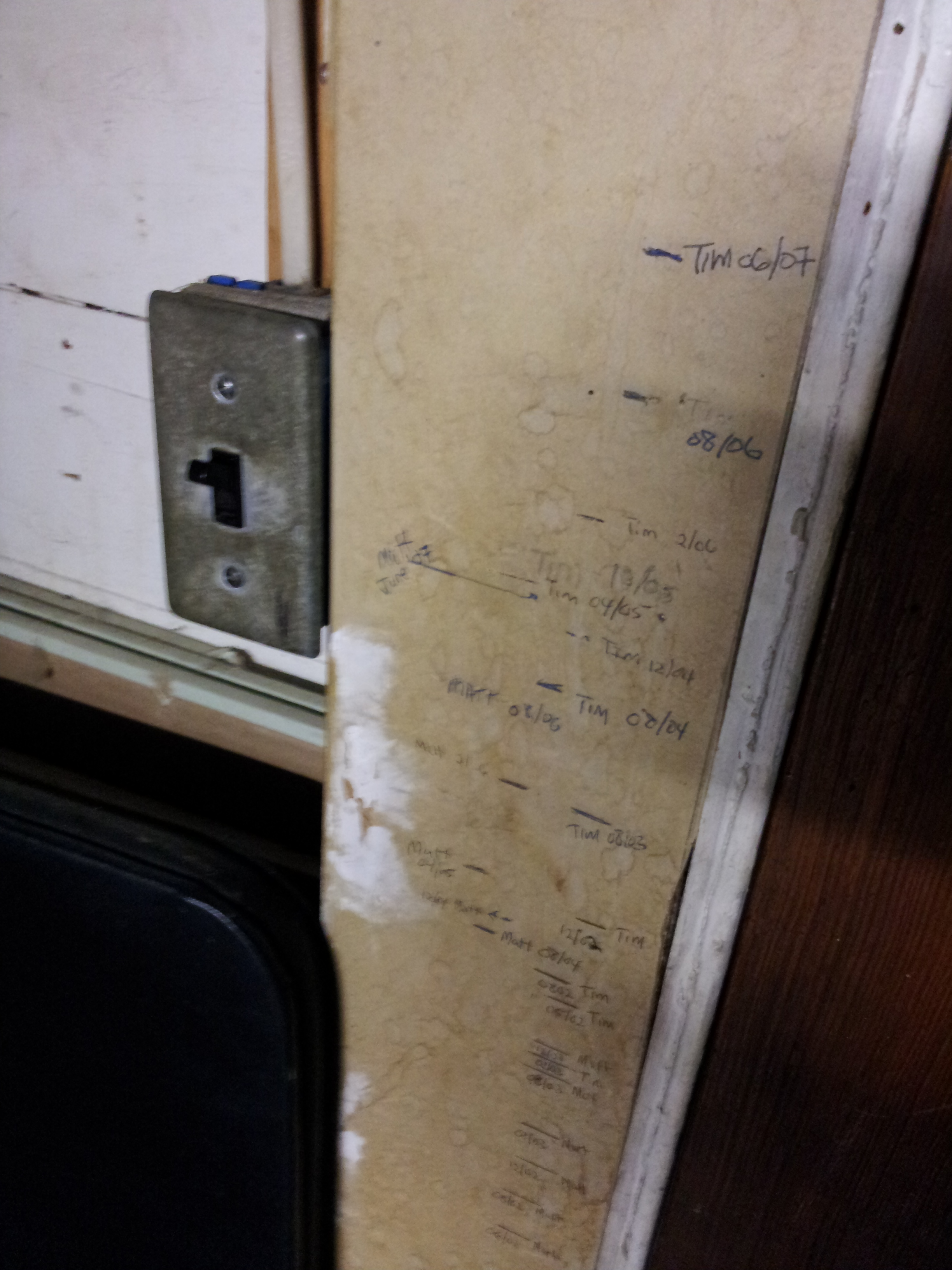
It was eight years ago this weekend that Laura and I closed on our house in Biddeford. One of the first things I did was unpack a scrap piece of lumber with small notations written on it. I held that stick up against a piece of the door frame in the unfinished part of our basement, and I meticulously copied the notations, according to name, height and date.

It was a trick I learned from my great-grandmother, Cleo, more commonly known as Nana. When I was a young boy, I visited Nana every Saturday morning at her second-floor apartment on Pearl Street in Biddeford. Nana spoiled me rotten.

At first, it was visits after Saturday morning Catechism classes at St. Mary’s; and then it became the much-anticipated end of my newspaper route that stretched from Franklin Street in Saco to Pine Street in Biddeford and included all of Gooch Island.

There were invariably pizzas from Mr. T’s and plenty of Boston Creme donuts from Dunkin’ Donuts.  It’s a small miracle that I do not weigh 350 pounds.  Those edible delights were all served to me on a TV tray in the living room so that I didn’t have to miss an action-packed moment of The League of Justice or Sealab 2020. There were no DVRs back then.

But there is no Nana today, and you can have my DVR for just one more of those Saturday mornings. Nana loved me unconditionally, no questions . . . no admission price… I was her son’s grandson, and that lineage came with perks that rival those bestowed upon Great Britain’s royal family.

Of course, I dutifully ran Nana’s Saturday errands…a payment on the account at Doyon’s Pharmacy, picking up a piece of cleaned jewelery at Youland’s or getting a new plunger at McKenney &  Heard. And before I left to head back across the river to my boyhood home, I would stood against the closet door that Nana marked at least each month. With a ruler and a pen she notched that door with my height to measure my growth. It was her archive: evidence of what she achieved and why she worked so hard for all those years.

So, I did the same thing with Tim and Matthew when we were all living in that tiny Old Orchard Beach bungalow. But how could I keep those memories alive when we decided to sell our home? I grabbed a piece of a lumber, a pen and a level. I then carefully marked that scrap of wood so that I could carry it forward into our brave new world.

It is a world that has changed dramatically since 1982. There was no MERC. Those downtown mill buildings were still (although waning) epicenter of manufacturing. People actually drove Ford Pintos with wood panels. Van Halen was a relatively new band, and we listened to that music on cassette tapes. There were no answering machines or blogs.

We remember so that we do not forget. We reminisce because it reminds us of our shared and fragile connections.

There is comfort in ritual; there is innocence in nostalgia, and there is the sudden realization that change is certainly incremental, yet never-ending.

Anything will grow in June, when it’s very easy to forget that the days will soon again become much less long.

A slow turning

Our relationship has always been somewhat strained.

There is an edge, a certain wariness. Something that neither of us talk about.

Sometimes, we just struggle through it. But more often than not we just let it hang in the air, a cloud of mistrust, fear and the evolving realization that we are more alike than either of us can imagine.

Today, he seems different. More confident, relaxed.

Me? Not so much, save for a recent dose of clarity.

Today is his 15th birthday, but it was earlier this week that Matthew became a man; that he became what I always knew he could be.

And  I could not be more proud of him.

It was a warm day, a holiday. There was another lawn that needed to be mowed.

The Rent-A-Teenager program we started just a few days before was flourishing. The phone was ringing off the hook, and both Tim and Matt were adjusting to the sudden influx of responsibility and the world of work.

Tim, my oldest son, was grumpy and tired. He was dragging and stalling.

I did what I do best: I got frustrated. “We committed to this job,” I barked. “When we say we’re going to do something, we do it!”

Tim shrugged. It was a job he committed to, but he was not feeling well and wanted some more time to wake up before leaving.

I had my own struggles. I had planned a window of time to help the kids with their business, but I had lots of other plans and the clock was ticking. There was a barbecue with friends, bills to be paid, laundry . . .

Another 10 minutes went by, and I loaded the mower in the truck. Tim was sullen, angry. “If you won’t do it, I will,” I huffed.

Matthew watched the exchange between me and his brother without commentary. He had the day off. He had his own holiday plans.

As I was backing the truck out of the driveway, he flagged me down. “I’ll do it, Dad,” he said.

We rode to the job site in our typical silence. I was concerned. It was a good-sized lawn, and I assumed most of it would fall on my shoulders.

I was judging Matthew the boy. I did not realize then that I was riding with Matthew the man.

We got to the site, and I gave him the instructions. He listened carefully before helping unload the mower, the trimmer and a push-broom.

To stay on schedule, I started the trimming, but kept a careful eye on Matthew with the lawn mower. I have high expectations. I am demanding.

But Matthew never wavered. He was sweating in the direct sun, but kept the lines straight. His eyes were fixed on the ground before him, carefully watching for rocks. He never stopped. He never paused. He never complained.

When he finished the mowing, he carefully inspected his work before sweeping the walkway without me telling him to do it.

He wanted that lawn to look good, perfect.

We returned home in silence. Two men who just finished a job. A father and a son.

The silence was comfortable, familiar for both of us.

I snuck a glance at him in the passenger seat of my truck. He was smiling. And then it dawned on me: He had become everything I wanted him to be: a hard worker, honest, ethical and polite.

I have known Matthew since he was four years old. God had given me an amazing gift. I just saw a boy become a man, and that is a rare thing to witness.

Matthew saw a job that needed to be done. His family needed his help. Without question, without hesitation, he stepped up and delivered.

Matthew and Tim are brothers, but they are not the same.

My relationship with Tim has always been easier, less awkward . . . more natural.

Tim is instinctively courageous and confident. He can fix anything. He is handsome, tough and cool. The self-appointed defender of the weak who is always ready to push the envelope.

We call him “Fonzie.” He is everything I was not when I was 17. Just ask my classmates.

I secretly admire him, even when he pushes the envelope just a wee bit too far.

Matthew? Think Richie Cunningham. A bit more shy and not as confident. A gifted writer and artist. Someone who wears his heart on his sleeve. A model student, polite, clean-cut and destined to be anything he wants to be.

Matthew is the kid you want your daughter to date. He is funny, exceptionally smart and ready to blow the SATs out of the water.

Tim embraced me as his father almost immediately. It was not the same with Matthew.

Matt clung to the idea that his biological father and Laura would reunite. He had little use for a demanding stepfather who can lecture with the best of them.

Matthew and I clash because we are both perfectionists, dreamers, procrastinators. We are both overly sensitive and a tad needy at times.

When I saw Matthew,  I saw a mirror.

I’m stupid like that. Matthew is not my reflection. He is his own man. Whatever I could teach him has been taught. He is more than ready for whatever lies ahead; great things, I’m sure.

Happy birthday, Matthew! You are an exceptional man, and I am so very proud of you!

First blood

Hell hath no fury like a politician scorned, or so they say….

Enter State Senator Nancy Sullivan, the self-righteous, semi-retired English teacher who desperately wants to keep her state health insurance and can’t accept the terms of Maine’s term limits law.

Sullivan is being forced from the senate because of term limits, so now she wants to go back to Augusta as a state rep in District 137.

There’s just one little thing standing in her way: Biddeford Mayor Alan Casavant, a fellow Democrat who also happens to be the incumbent state representative in District 137.

Despite winning a landslide mayoral election in November, Casavant also wants to serve a fourth and final term in the Maine House of Representatives.

In a rare Primary election attack ad that was published in local newspapers, Sullivan questions Casavant’s commitment to both the mayor’s office and his state rep seat.

I don’t blame Sullivan for going after Casavant’s competing public service roles. Frankly, his dual roles represent one of his biggest political liabilities.

But Sullivan conveniently forgets to mention a few other things in her attack ad, which is labeled: “Being mayor is a full-time job.”

For starters, Sullivan wouldn’t know what a full-time job looks like if one jumped up and bit her in the face. Before heading off to Augusta to begin her political career, Sullivan was a middle-school English teacher in Saco.

Teachers work hard, long hours, but they also get a week of vacation during Christmas, a week of vacation in February, a week of vacation in April, and then 6-7 weeks of summer vacation from mid-June through mid-August.

Going from being a full-time teacher to being a part-time legislator doesn’t require much of a transition, if you get my drift.

Sullivan was more than happy to ignore her obligations as a “full-time” teacher to launch her political career in 1998. To her credit, she used part of her teacher pay to reimburse Saco schools for the “full-time substitute” teacher who had to take over and run her classes.

But she also enjoyed nice perks by racking up retirement funds from both positions.

Her rival is not much different. Casavant also went to Augusta during his lifelong career as a teacher at Biddeford High School. Neither Casavant nor Sullivan has held a private sector job for more than three decades.

So don’t expect Sullivan to make much noise about Casavant being both a teacher and a legislator.

Sullivan has a long history of talking out of both sides of her mouth. It’s a big mouth, so it’s not an especially remarkable feat.

In her ad, Sullivan chastises Casavant for missing three recent “School Board” meetings. Maybe someone should tell Sullivan that Biddeford does not have a school board. We have a school committee. Yup, there is a big difference between a board and subservient committee.

She also criticizes Casavant for not taking the time to more closely examine the city’s budget “in order to lessen the tax burden on citizens.”

I’m not exactly sure why an English teacher would capitalize the word “budget” in the middle of a sentence, but hey….cut her some slack. It’s been a while since Nancy was in a classroom.

There’s also this fact: there is no burden on Biddeford’s taxpayers as a result of the recently proposed budget. Umm, Nancy…this is why they call it a “proposed” budget. It will likely be re-tooled before being voted upon by the city council.

Apparently, Sullivan is very worried about this budget. It’s hard to know. I didn’t see her at Monday night’s budget workshop meeting. Casavant was there, and as I write this, he is at another budget meeting.

Sullivan also conveniently ignores the fact that Casavant has repeatedly said this proposed budget represents too much of a burden. and he will not support it as it is now proposed.

And then there is the fact that one of the biggest increases in the city’s proposed budget represents a shift of funding from the state level to the municipal level for general assistance funding.

Does Sullivan support slashing general assistance funding? Didn’t she criticize Republican Governor Paul LePage for basically the same thing?

Perhaps Sullivan would like to see the proposed increases in Biddeford’s school budget slashed. Which teachers would she like to fire? We coud certainly use her experience and savvy in this arena.

In closing out her ad, Sullivan states: “I have time for YOU!”

This confuses me. Allow me to explain why.

During each of her campaigns for the senate, I have supported Sullivan. Laura and I have donated to her campaign. I have attended her fundraising events, and I have always put her campaign signs on my lawn.

A little more than two years ago, Laura called Nancy to ask a questions and offer some perspective as a state employee about one of Governor John Baldacci’s proposed budget shifts.

Sullivan never returned the call. Laura sent an e-mail. Again, no reply from Sullivan. We also didn’t hear back from our state rep, Paulette Beaudoin.

Frustrated, Laura called Alan Casavant, a state rep in a different district. Casavant called her back the same day.

The funny thing about Sullivan’s ad is that she never mentions anything she has accomplished for the people of Biddeford. Not one thing. Nada. Zip. Zilch. Zero.

Instead, Sullivan did what she does best: full-on attack, tearing down her opponent.

After 14 years of serving Biddeford in Augusta, Sullivan can’t recall one thing she has accomplished for the people of Biddeford? Combine that with the fact that she still hasn’t been able to land a job for her husband; and you are left with a pretty dismal track record.

If you prefer petty, vindictive self-serving politicians, please vote on June 12 to send Nancy Sullivan back to Augusta for another two years…maybe then, she can actually do something for Biddeford.

The Usual Suspects

In just a few weeks, Biddeford voters will face a rather unique set of choices.

For the first time in more than 20 years, all three of the city’s incumbent state representatives are facing challenges from members of their own party for the June 12 Primary election — well . . . up until an hour or so ago.

Although both Alan Casavant and Paulette Beaudoin are hoping to serve a fourth and final term in Districts 137 and 135, respectively; the District 136 race took an unexpected turn today when city councilor Bobby Mills announced he was dropping out of the Democratic Party and will not challenge incumbent Megan Rochelo in the June 12 Primary.

On his campaign Facebook page, Mills announced his sudden departure as a philosophical awakening of sorts….what recovering alcoholics generally refer to as a “moment of clarity.”

Mills says he is “too conservative” for the Democrats and “too liberal” for the Republicans.

Of course, there is also the technical fact that he just bought a home not located in District 136.

So, voila…Mills is now an Independent, just like Angus King, Eliot Cutler and Jesse Ventura.

Funny how a real estate transaction can alter your political priorities.

Fortunately for those of us who live in District 135, we will now have a third choice in November as Mills stakes out the ground between whomever wins the Democratic Primary (Paulette Beaudoin or Joanne Twomey) and Republican Perry Aberle, a former city councilor.

So, who cares? What’s the big deal? The same people who have been running for office for more than a decade are back at it again. Yawn.

Maine voters overwhelming approved the adoption of legislative term limits in 1993, and most political observers point to the scandal involving then Speaker of the House John Martin as the catalyst for the referendum that was approved by 68 percent of Maine’s voters.

But according to a 2004 report by Richard J. Powell of the University of Maine and Rich Jones of the National Conference of State Legislatures, Maine’s term limits law is “relatively weak compared to the other states because the law applies only to consecutive terms.”

Thus, people like Nancy Sullivan can turn around and swap seats instead of returning to the dreaded private sector.

The strategy of toggling between the House and Senate every eight years has worked wonderfully for Martin, even though he was described as the “poster boy” of Maine’s term limits law.

According to the report by Powell and Jones, Maine’s term limits law was enacted after an especially tumultuous turn of political events that included the slim re-election victory of Republican John McKernan and the “ballot-gate” scandal involving John Martin.

Voters were further dismayed by sheer partisanship in Augusta. A protracted budget fight between McKernan and the Democrats who controlled both the House and Senate in 1991 caused a 17-day state shut down.

Those who support term limits say it prevents an entrenched system of government and prohibits the development of professional politicians.

Someone ought to explain that to Martin, the Earl of Eagle Lake, one of the most hated, yet simultaneously respected, members of the Maine Legislature.

Martin was first elected to the Maine Legislature in 1964, the same year I was born. And he got real comfy, real fast in Augusta. For nearly 50 years, Martin has been the proverbial leader of the Legislature.

Those who oppose term limits say it takes almost two years for new lawmakers to learn how to submit legislation, work in their caucus, find the washroom or learn how to stuff a ballot box.

And, of course, we cannot forget about the dreaded lobbyists, most of whom have been wandering the Capitol Hallways since Elvis was alive. Term limit opponents invariably ask the same question: “Do we really want to have lobbyists with more experience than legislators?”

Just remember, everyone hates lobbyists, except their lobbyist.

Whether it’s renewable energy, labor rights, the ACLU, the banking industry or realtors, just about everyone, with the exception of overweight bloggers from Biddeford, is represented in Augusta by a powerful lobbyist.

So what will Biddeford’s Democrats do in June, when they are asked whether to stay the course with the incumbents or choose some not-so-fresh blood?

If past election results mean anything, it’s likely that most Democrats will skip the Election and head to the beach, the movies or stay at home sticking hot needles in their eyes.

Casavant is facing a serious challenge by Sullivan, who is a savvy campaigner, tenacious and hungry for the job.

Although Casavant easily overwhelmed Twomey in last year’s mayoral race, he has a whole new set of challenges, including a looming municipal budget battle and the appearance of divided loyalties.

Can Casavant simultaneously serve as Biddeford’s leader while also representing a portion of Biddeford and Kennebunkport in the Legislature? The odds, for better are worse, are in Sullivan’s favor.

Meanwhile, Paulette Beaudoin, the sweet little old lady who does exactly as told by her caucus, is facing a very serious threat from Joanne Twomey, one of the best campaigners since Huey Long.

Beaudoin might stand a chance if she could figure out how to use a telephone to return calls or how to raise her needed seed money for a Clean Elections campaign. Here again, the incumbent is in trouble and Twomey can expect an easy and overwhelming win.

I have no dog in this fight, but I can assure you this much: when the November general election rolls around, you can expect to see a lot of the same faces you’ve seen for the better part of the last decade.

I am not a believer in term limits. I believe in voters, and I also believe this will be one of the most interesting June elections Biddeford has seen in a very long time.

Just remember, if nothing changes…then nothing changes.

The needle and the damage done . . . again

Team Seaver 2011

For those of you who think I am a world-class prick, what you are about to read should only confirm your suspicions.

It is a recounting of my reaction, more than three years ago, when I was about to learn that my wife, Laura, was diagnosed with MS.

The only way I can even begin to assuage some of that guilt is to do what I do…tell a story, share that story and hope that maybe you will feel compelled to help . . . just a little bit

If the following story moves you, if it makes you angry or if it makes you sad . . . please consider clicking this link.

If my words about that crappy day, full of self-righteous indignation, make you smile or laugh . . . please consider clicking that link.

If my words make you wonder how a world-class prick can end up with such a wonderful wife. . . well, you get it. . . click that link.

Enough of this…here’s the story one more time . . .

December 2008

It is paper-thin and measures only 8 by 3-1/2 inches, but it scares the hell out of me.

It has been sitting on the dashboard of my truck for several days, just there. Always visible. Always reminding me of what I cannot escape.

It is a placard that allows parking in disabled parking spaces. You know the one. The little, gender-neutral stick figure that sits in a wheelchair against a crimson-blue backdrop.

I have been struggling with writing this post for the last several days because I am terrified of both its content and the potential reaction from those who read it.

The reason I have the placard is because Laura was diagnosed with MS in December 2008. Since then, she has experienced fluctuating levels of mobility; and I do my best to ignore it. To brush it off. To think it will eventually go away.

Some days are better than others.

That’s how it goes with MS, people tell me. I try to pretend that Laura is just tired or maybe a bit depressed. Maybe if I work just a bit harder, just a bit more, it will go away. That is a child’s thinking. That has been my thinking.

Make no mistake, Laura is lucky. Her MS is fairly manageable. She is able to go to work each day and leads a more than productive life.

But still, I wonder. Me, the eternal pessimist. This disease is slowly, but deliberately, taking away a little piece of my wife each day, no matter how much I try to deny or ignore it.

I still remember the day she was diagnosed. It was just a few days after Christmas. Laura had been experiencing a strange numbing sensation on her face. She made an appointment with her doctor. He recommended that she see a neurologist. At the time, we both thought it was no big deal.

I was home and knee-deep in ethernet cables when Laura called me on her way back from the doctor’s office.

I didn’t take her to the appointment. My mother-in-law drove her to and from the neurologist’s office.

I regret that decision to stay and work on hooking up my kids’ computer to the internet. But I don’t regret that decision nearly as much as I regret the things I said to Laura when she finally got me on the phone.

“Hey,” she said in a soft-spoken tone which belied the news that should have followed. She wanted to tell me in person, face-to-face.

“What,” I shot back, only half paying attention, much more focused on the twisted mass of blue wires wrapped around my feet.

“I was wondering if you could start a pot of coffee,” she asked.

I was livid. I had already done three loads of laundry, paid the bills and vacuumed the living room. The computer wiring was near the end of my “to-do” list and the thought of one more thing sent me over the edge. Idiot, that I am.

“You want coffee? Make it yourself,” I barked. “Do you know what kind of day I’ve had? Pick up a cup from Dunkin’ Donuts or whatever, but just leave me alone.”

Silence.

“What’s your problem?” I continued. “You’ve been out shopping with your mother, and you want me to make the fucking coffee? Could you be any more lazy?”

“Sorry, ” she said. “I didn’t mean to bother you. I’ll take care of it myself.” And the phone went silent.

She arrived home maybe 20 minutes later. I was still up to my knees in tangled cords. She brought me a cup of coffee and asked if we could talk.

I was still exasperated. “What?”

“They diagnosed me with MS,” she said, trying very hard to hold back the tears.

I let go of those silly cords. We sat down at the dining room table and began our latest adventure.

If you think I was a prick then, I can assure you that I haven’t done much better since.

I avoid conversations about MS. I avoid the annual MS Walk. I don’t want to think about it. I want it to go away.

Every other night is “shot night” at our home. Every other night, Laura injects herself with Betaseron to keep the illness at bay. Every other night, I turn away and find something else to occupy my thinking.

I love my wife. Honestly, I do. And I know she needs my support. Again, some days are better than others.

So today, marks the first day that I used the placard. We took Laura’s mother to Wal-Mart. We parked in one of the disabled spaces. Betty was moving through the store like a speed demon, anxiously making her way toward what would hopefully be her new television. She is 66 years old and she left me in the dust.

Instinctively, I paused, and turned back to check on my wife. I could tell that Laura’s energy level was dropping quickly. “Are you okay,” I asked.

“Yeah, she nodded. “I’m fine.”

I knew it was a lie, and once again…I played along.

Stupid is as stupid does

“They who can give up essential liberty to obtain a little temporary safety deserve neither liberty nor safety.” — Benjamin Franklin

When we become adults we no longer need our parents to make critical decisions in our lives. We are free to fail, free to succeed, and yes…even free to be flat-out stupid.

Adolph Hitler’s pursuit of a ‘more perfect world” included a government campaign against smoking and the individual right to bear arms….among other things.

Freedom, however, does not come without risks and costs, especially when it comes to our rights to wallow in pure stupidity.

But what line should our government draw between an individual’s desire to exercise his or her inalienable right to stupidity and the protection of other citizens from those stupid choices?

The Biddeford City Council is just half an inch away from enacting an ordinance that will prevent residents from using fireworks anywhere in the city.

The council’s decision follows on the heels of a recent reversal in state law that now allows the sale, use and distribution of fireworks. But the new state law also stipulates that individual communities may set their own standards regarding the use, sale and possession of fireworks.

By allowing individual communities to establish their own fireworks ordinances,  a resident of Bangor could –theoretically — have more freedom than a resident of Biddeford.

Some animals, apparently, are more equal than other animals.

Laura being stupid with sparklers, in direct violation of state park policy

My wife, Laura, is a member of the city council’s Policy Committee. She and other members of the committee voted unanimously in favor of the city’s ban on the use of fireworks.

When asked why she voted in favor of the ban, Laura explained that the majority of residents who testified before her committee supported the ban. Furthermore, she said, the local ban was adamantly supported by both the city’s police chief and the fire chief.

It makes sense to me that government officials, such as the police and fire chief, would want to ensure public safety by having greater control over public activities. In a sense, this is the fundamental and  appropriate role of government: to provide for the public’s general welfare.

For example, the city is not infringing upon its residents’ Second Amendment rights by enforcing a policy that limits the use of shotguns in certain parts of the city; nor is the city infringing upon its residents’ First Amendment rights by limiting public comments at city council meetings to five minutes.

Reasonable people can agree that individual rights have some limits. Your freedom of speech does not allow you to scream “Fire!” in a crowded movie theater.

But then again, the road to hell is paved with good intentions, and what do we do about all the stupid people and their stupid choices?

It is a slippery slope with grave consequences that should be weighed carefully.

On July 4 1978,  I violated state law, local ordinances and the core elements of common sense by using a Roman Candle — a type of firework device that launches brilliant shots of exploding matter into a brilliant, although brief, display of color and sound.

I was 14 years old, and I nearly blew off my testicles by holding the tube improperly while sitting on the front stairs of my childhood home.

I lit the fuse and pointed the tube across the street, toward the parking lot of the Armory building on Franklin Street in Saco, then the home of 133rd Engineering Batallion.

Fortunately, there was an adult present who saw that the fuse was pointed toward my crotch.

“Hey, turn it around!” he screamed just before the tiny balls of fire began jettisoning toward my own tiny balls of fire.

Obviously, I survived the incident and learned a valuable lesson about protecting my genitals.

Under today’s standards, however, I would have been prosecuted by the Department of Homeland Security for firing upon a federal facility, and my parents would have been charged with child endangerment.

But it all turned out fine. For better or worse, my testicles remained in tact, and I went on to make many more stupid choices.

Stupidity is the cornerstone of innovation, and it’s a trademark of America and our willingness to take risks, make mistakes and ultimately succeed.

Imagine strolling on a North Carolina beach in the early 1900s and watching as two brothers played with a “flying machine.” How stupid! Those men think humans can fly like the birds!

Go back further in history. How much sense did it make for a bunch of disgruntled farmers to take on the world’s most powerful army in a rebellion against a mighty throne?

And what about the stupidity of Columbus, and his epic failure to find a new route to India?

Acts of stupidity and risky behavior provide us with tremendous value and opportunities. More importantly, our right to be stupid is inextricably linked to our pursuit of happiness.

Therefore we ought to be damned careful as we set out to create a utopian society. After all, Adolph Hitler was one of the world’s most outspoken critics of smoking.

In fact, Hitler went after the smokers long before he set his sights on private gun ownership and the Jews.

Thus, whenever government infringes on our God-given right to be as dumb as a door-knob, it ought to include much deliberation and considerable thought and debate about the unintended consequences of such legislative endeavors.

Defining stupidity is nearly impossible. Beauty, after all,  is in the eye of the beholder.

Do you think the government should tell you what is okay to eat? Do you think the government should dictate who you can marry? Would you prefer that the government provides your health care, your housing and your food? Can you imagine the consequences?

How dependent are you prepared to be? How much of your liberty are you willing to sacrifice for your security?

Fireworks have become a symbol and trademark of our liberty. They define our brilliance, our diversity and our strength as a nation. They remind us of the explosions that had far greater consequences more than 200 years ago.

It would not be hard for the city to set some reasonable guidelines for the use of fireworks. We could establish acceptable hours of use. We could set policies that include where the use of fireworks is permissible, such as a required 20-foot setback from a neighbor’s property.

In America, you have the right to define the course of your life, and that means you have the right to be stupid.

If we don’t stand for stupidity, then what will we stand for?

The Biddeford City Council will hold a second reading on its proposed fireworks ordinance on Tuesday, April 3.

Ready To Serve

GOP presidential hopeful Mitt Romney and Biddeford Mayor Alan Casavant had at least on thing in common on Tuesday.

Both men showed their detractors that they are as tough as nails and more than ready for a political fight.

READY TO SERVE: Michael ready is sworn-in by City Clerk Carmen Morris as the newest member of the Biddeford City Council

Although Casavant’s nomination of Michael Ready for the vacated Ward Seven council seat was approved by an unexpected 7-1 vote, it included more than 30 minutes of sometimes emotional and heated commentary.

The final outcome also caused a member of the city’s planning board to announce her resignation as a protest against what she described as nothing more than “political theater.”

But any lingering doubts about Casavant’s ability to move the council when needed quickly evaporated Tuesday.

Councilor Melissa Bednarowksi also proved she is more than willing to stand as the council’s lone voice of dissension.

At issue were two competing philosophies about who should be appointed to fill the council vacancy that was created last month when David Flood gave up his seat to again pursue a career as a newspaper publisher.

Councilors Melissa Bednarowski, Brad Cote and David Bourque listen to public comments about Mayor Casavant’s nomination of Mike Ready

Bill Sexton was one of three candidates who actively campaigned for the seat in November, but finished in second place behind Flood.

Ready previously served on the council, and Casavant said Ready’s prior experience — especially since the council is facing the prospects of  a daunting budget debate — is what mattered.

Casavant remained steely eyed during the floor debate, signaling confidence in his ability to shore up the votes he needed.

But many of the councilors seemed torn, and at times appeared emotional and wavering with their decision.

“This is a tough situation,” said Councilor David Bourque, looking toward the audience, where both Ready and Sexton were seated with their family members. “It’s a tough spot for us to be in.”

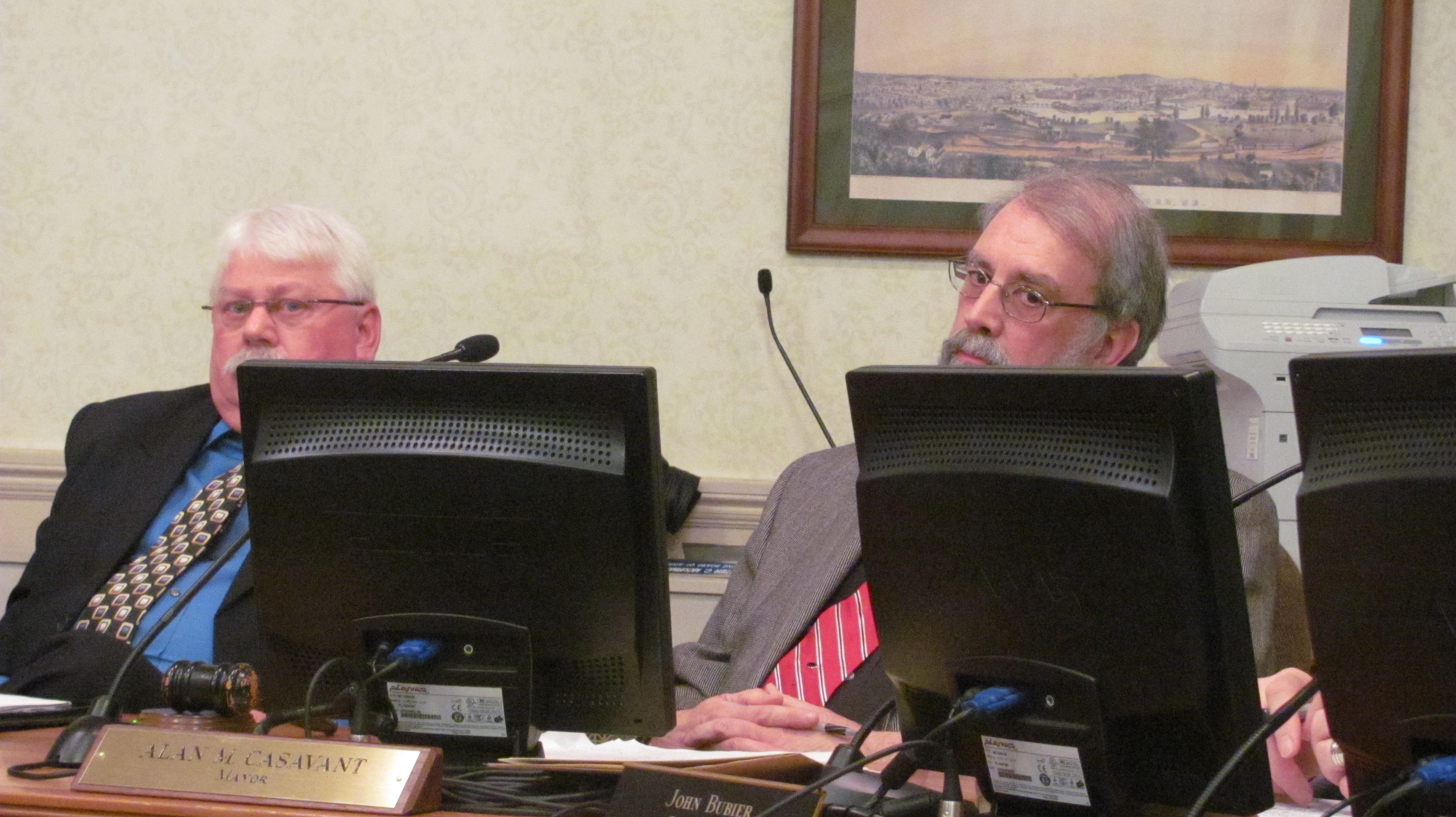
IF LOOKS COULD KILL — Council President Rick Laverierre and Mayor Alan Casavant seemed tense during public comments about the nomination of Mike Ready

Council President Rick Laverierre, however, said the council had a sworn obligation to uphold Casavant’s appointment unless they could offer a compelling reason why Ready should be disqualified from service.

“I, too, find myself in a quandary,” Laverierre explained. “But we need to remember we’re talking about the charter, and the charter is clear about how we should approach this.”

Councilor Roch Angers said he felt physically ill about the dilemma.

“I feel sick to my stomach for both of these men,” Angers said. “It should be the people saying how things go. We should be listening to the input of people from Ward Seven.”

Angers, who helped the mayor during last year’s campaign, then questioned Casavant directly, asking him if he would consider Sexton for nomination.

The mayor did not flinch. “I have a nomination on the table,” he replied curtly.

The tension in the room was palpable.

Councilor Richard Rhames voiced concerns about Ready’s appointment, reminding his fellow councilors that Ready was one of the “MERC 5,” a group of five city councilors who approved a controversial, five-year extension of the city’s contract with the Maine Energy Recovery Company in 2007.

Members of the public were equally divided on the issue. Sexton’s parents and his son all addressed the council, urging them to support Bill Sexton, but also praised Ready.

“Mike [Ready] is a nice man, but Mike didn’t run for the seat,” Sue Sexton told the council.

Sexton said she understood why Ready wants to help the city now, but reminded councilors that her son ran a hard campaign and went door-to-door, looking for votes and listening to residents’ concerns.

Bill Sexton also praised Ready, but had strong words for the mayor.

“The mayor knows nothing about me,” Sexton said. “He never called me. I have been referred to as a puppet, or maybe it’s because [I’m a Republican] or because I supported the casino. I don’t know, but I just want a shot at what I worked so hard for.”

Bill Sexton (right) told reporters he will likely stay involved in city politics and said he was disappointed that the mayor refused to even consider him as a potential nominee.

Sexton closed his remarks by reminding Casavant of his mayoral campaign pledge to be a “positive, professional” mayor.

“I ran my own campaign in a positive, professional way,” Sexton said. “This should be about what’s best for the city. The charter gives you the power to appoint but that does not mean you should just pick your friends.”

Judy Neveaux, a resident who also worked on Casavant’s campaign, reminded the council that Casavant was supported by an overwhelming margin of voters in November.

“The people clearly trust this mayor to do what is right for our city,” she said. “I think it’s important to let the mayor do his job.”

Although the comments were often tense and sometimes pointed, resident Ron Peaker brought the evening to an all-time low by accusing Flood of being “dishonest” about his intentions during the campaign.

Bill Sexton later denounced Peaker’s remarks, calling them “inappropriate and pure speculation.”

Just moments after Ready was sworn in by City Clerk Carmen Morris, Sue Sexton asked the mayor if she could approach the podium. She thanked Ready for his willingness to serve and wished him well.

Sue Sexton told All Along the Watchtower that she would be resigning her seat from the Planning Board as a protest to Casavant’s appointment.

“Despite all the things he said during his campaign, it has become painfully honest that our new mayor is just playing political favorites,” she said.