
Which Hollywood film better describes the city of Biddeford’s ongoing struggle with issues such as “the creative economy,” “cultural diversity” and elitism: Mr. Holland’s Opus or Mad Max: Beyond Thunderdome?
In Thunderdome, a community barely surviving in a post-apocalyptic world is wary of strangers and outsiders. To avoid another global war, all disputes are settled by a bizarre cage match contest in which “two men enter and one man leaves,” a fight to the death.
By contrast, the 1995 film Mr. Holland’s Opus examines the career of a musician who reluctantly becomes a high school music teacher. Mr. Holland becomes passionate about exposing his students to the value of music and arts, but a political reality sets in near the end of the film.
The school board is struggling with its budget. A decision is made to eliminate the arts and music programs in order to preserve the “more important” functions of teaching reading and writing. Mr. Holland tries to fight back. “if you keep cutting arts and music, pretty soon these kids will have nothing to write or read about,” he quips on the day he receives his pink slip.
Take me to the other side
Sarah Beanland is a Massachusetts resident who summers in Biddeford Pool. I met her and her husband last week on Main Street. They had just purchased a couple of paintings.

She was puzzled and dismayed to learn that some community members have reacted negatively to a recent push for the creation of a creative economy in the downtown area. Although she quickly conceded that she did not have the benefit of a local, historical perspective, she was forceful in her opinion about the benefits of a creative economy and how it can elevate any community.
“Arts and education are the great equalizers,” she said. “But we must make sure that everyone has access to those things. Access to both arts and education is the key.”
Renee O’Neil, a lifelong resident, has been a leading downtown advocate for more than two decades. O’Neil championed and led the efforts to restore and renovate City Theater, a historic Opera House on Main Street.
“I don’t get why anyone would feel offended in any way by efforts to build a creative economy here,” she said, conceding that there has been a historical resentment about the perceptions of class warfare in Biddeford.
Renee said a lot of people told her she would never be able to generate enough community interest to successfully renovate City Theater. She proved those detractors wrong, and today the facility serves a broad array of community functions, ranging from theatrical functions to a venue for community meetings and events.
Renee recalls growing up in a working-class family and says community concerns about elitism are becoming a distant part of Biddeford’s past. “There was a time and a place when that all may have been true, but not now,” she said. “I guess I don’t see the social boundaries because I have always crossed them. My dad would talk to everyone. There was never this idea that we weren’t all part of the same community.”
Renee’s husband, Jim agrees. “All this talk about elitism seems strange,” he said. “People were not happy with the fact that nothing much was happening [in downtown,]” he said. “Now something positive is happening, and these very same people are upset. Go figure.”
For many years, Renee and Jim operated a small and popular convenience store near the western border of the city. They said they learned much from that experience, including how initial impressions are often inaccurate and that all people share much more in common than the things that seem to divide them.
“People would come into the store, and when we took the time to know them, we found ourselves connecting on a personal level,” Renee said. “Too many people don’t seem to take the time to listen or consider things beyond their own comfort level.”
The Rubberband Man
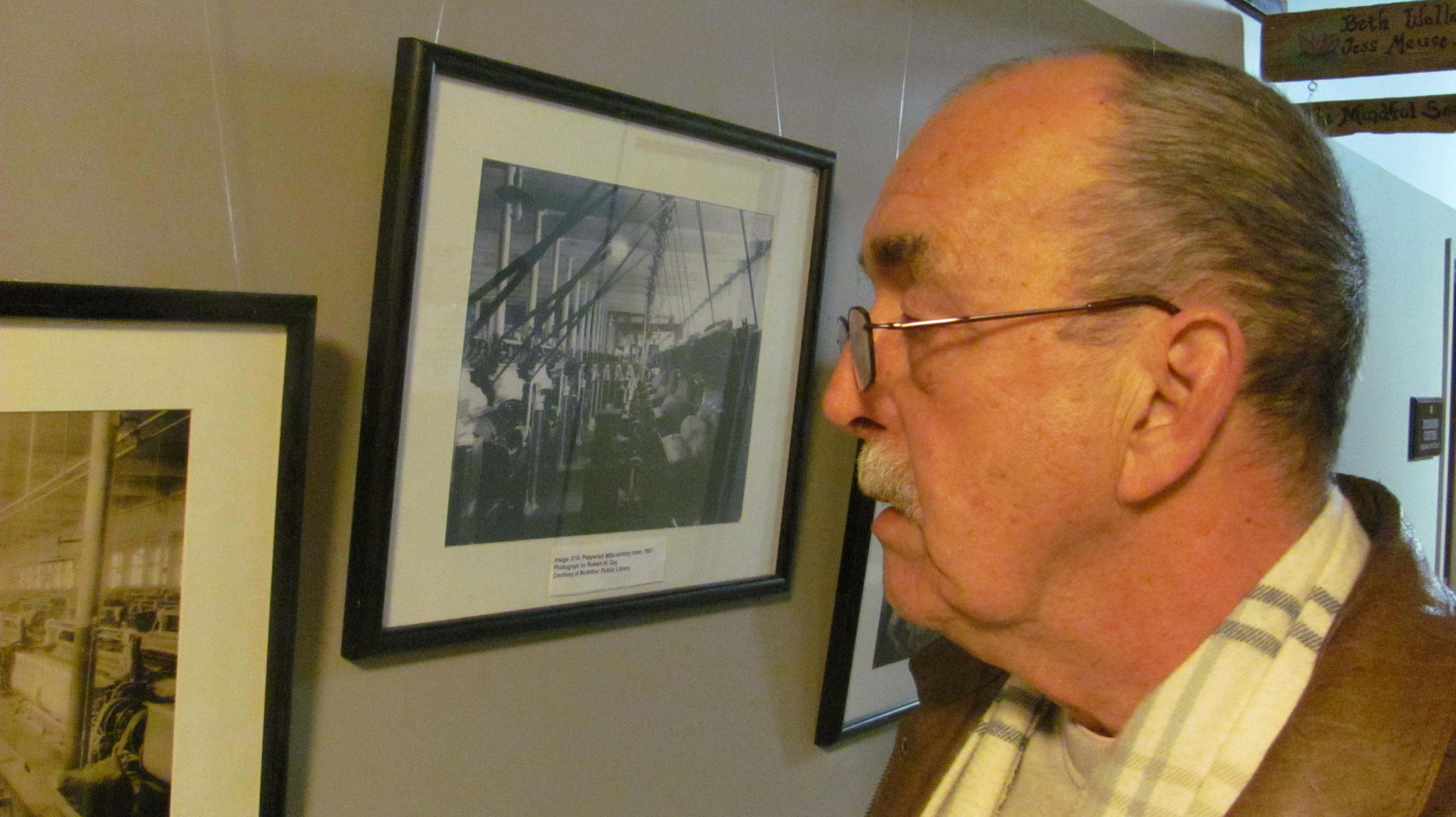
If any one person is revered as the spokesman of Biddeford’s working class population, it is George “Pete” Lamontagne, a former city councilor, mill worker and former president of the labor union that represented the city’s mill workers back when the mills were producing blankets and other textiles.
Today, those same mill buildings that once drove Biddeford’s economy and provided steady employment for generations of immigrants are being renovated and converted into numerous uses, from up-scale housing units to a small business incubator that features dozens of small businesses.
There is even talk of a hotel, a conference center and many other exciting opportunities for a community that has struggled to move beyond its mill town heritage.
As the renovation and reinvigoration of the formerly dormant mill complex continues, a new tension has been created. That renovation process is primarily being led by “people from away,” the folks I describe as Biddeford’s most recent immigrants.
Lamontagne, who I previously interviewed on these pages (Blanket maker turned peace maker; AATW, Jan. 2012) , admits the irony is a “interesting study of human psychology right before our eyes.”
“Oh yes, there is elitism in Biddeford,” Lamontagne said in his usual soft-spoken style. “But it goes both ways and it’s more often about perception than reality.”
Lamontagne serves as a self-appointed emissary between the two sides of this latest clash of personalities and opinions in Biddeford. He was co-curator of a photo exhibit that was displayed at the Engine Gallery on Main Street. That exhibit, The Way We Were, focused on Biddeford’s cultural history.
The mostly black and white images from The Way We Were exhibit were collected from a variety of sources, mostly from individual community members who were eager to share their memories and heritage.
But not everyone appreciated Lamontagne’s efforts to bridge the gap between old and new ideas for Biddeford’s future and its identity.
“A lot of people questioned why I was getting involved,” he recalled. “A lot of people said, ‘Pete, how can someone like you spend so much time with those people.'”
Lamontagne says he understands the mistrust and suspicion raised by some of his peers. He agrees with my assertion that the passionate push for developing a creative economy in downtown Biddeford sometimes seems too aggressive without fully understanding the city’s history.
Together, Lamontagne and I recant a long litany of real elitism and class warfare in Biddeford: Attempts by coastal neighborhoods to secede from the city in the 1990s; a move to ban public use of the beaches at Biddeford Pool and Fortunes Rocks in the 1970s, and of course, the long history of enduring the weight of criticisms from those who live across the river in Saco.
But we also talked about more recent examples, including the tensions and controversy created by the opening of Fatboys Saloon and the 800-pound gorilla issue that created an even deeper divide in the community: a plan in 2011 to open a casino-resort complex on the outskirts of the city.
“No doubt, the casino issue left a bad taste in a lot of mouths,” Lamontagne said. “On one side were supporters, many of whom saw the casino as a way to create much-needed blue-collar jobs and put Biddeford back on the map. On the other side were people who worried about the image of a casino, about how it would impact our quality of place.”
Lamontagne, like most Biddeford voters, supported the idea of opening a casino. But Maine voters rejected the city’s proposal, despite narrowly approving a similar facility in Oxford the year before.
“A lot of people were upset and are still upset about that,” Lamontagne said. “We’ve lost a lot of our traditional jobs, and people are worried. Many of them don’t see how art exhibits and music performances will help us get back to where we were.”
City Councilor Roch Angers agrees with Lamontagne. Angers grew up in a working-class neighborhood on South Street, where his family operated a small grocery store.
“You know what I hate?” Angers said. “The word Biddo. That’s not the name of our community. We have three consonants in the name of our city. Deal with it and show some respect for our heritage.”
Fatboy Slim

Biddeford City Councilor David Bourque found himself at the center of a storming controversy earlier this year.
His plan to open Fatboys Saloon on Main Street erupted into a full-scale public policy nightmare that once again raised concerns about elitism and a lingering sense of class warfare.
When the Heart of Biddeford, a non-profit downtown business organization, raised their concerns during a city council meeting, former Biddeford mayor Joanne Twomey came off the ropes swinging in defense of Bourque and his proposed establishment. Local newspapers seized on the story.
Heart of Biddeford representatives said they only asked the council whether downtown was the appropriate location for a “biker bar” and whether it met the vision of a Downtown Master Plan that was developed two years prior and included input from a broad array of stakeholders. They worried about noise and impacts to nearby downtown residents and plans to build a hotel nearby.
But Twomey wasn’t buying what the Heart of Biddeford was selling. She described the organization and some of its members as “elitists.” She was full of sound and fury, outraged that a working class community would look down their noses at a bar marketed toward working class citizens.
The liquor license was approved and almost four months have passed since. Twomey has taken out nomination papers and apparently is planning another run at the seat she lost two years ago.
Although the dust may have settled in the Fatboys debate, Bourque said he was taken aback by the reaction to his business.
“I don’t get it,” he told me during a telephone interview. “It came out of nowhere. It was like I was guilty until I could prove myself innocent.”
While Heart of Biddeford members said Bourque should have approached them before aggressively promoting the pending opening of Fatboys, Bourque says no one from the Heart of Biddeford approached him to learn about his vision or plans.
“It was an unprecedented attack on my reputation,” Bourque said. “People should know who I am. I have been on the city council for four years, and I’ve been doing business in this city for more than 30 years.”
Bourque was an outspoken supporter of the casino. Many Heart of Biddeford members opposed the idea of a casino. Was this payback, I asked.
“I don’t think so,” Bourque responded. “I think people just jumped to conclusions. I believe in what the Heart of Biddeford is doing. They deserve a lot of kudos for what they are doing and trying to get done in Biddeford.”
Bourque defended the pre-opening promotion of Fatboys, including a controversial Facebook page that displayed young women in tight-fitting clothes and marketing geared toward bikers. “Sure, we wanted to create a buzz,: he said. “It’s alcohol and female bartenders. What’s wrong with that?”
But some say Bourque simply poked a tiger with a stick by being as provocative as possible during the pre-opening promotion. He should not be surprised that the tiger snarled.
Bourque said he has moved beyond the controversy. He also says he is planning to join the Heart of Biddeford and run for another term on the city council. “I was so humbled during that process,” he said. “I heard from so many people who supported me…people I have not seen or heard from in years. It was very encouraging.”
The mayor weighs in

(Sun Chronicle photo)
Before his retirement in 2010, Mayor Alan Casavant spent 35 years teaching American Studies and Psychology at Biddeford High School.
He describes this conversation about elitism, cultural diversity and the creative economy as “fascinating stuff that has always intrigued me.”
“I think we can all be somewhat elitist at times,” he said. “But it’s sort of like racism in that it’s not an easy or comfortable topic for a lot of people.”
Throughout his first term as Biddeford’s mayor, Casavant has consistently pushed for Biddeford to move beyond its own negativity and self-imposed inferiority complex. “Yes, we were a mill town,” he says. “But we are no longer a mill town and we simply must acknowledge that new reality as we all work toward repositioning ourselves for the future.”
Casavant said cultural identity is important, but it should not become a wedge that prevents collaboration between those with different perspectives. “There’s room for everyone in Biddeford,” he says. “We all have a role to play. The question becomes who among us is willing to step up? You can’t just sit back and complain. We all need to look for solutions.”
But Casavant acknowledges that his vision is difficult for some people to embrace. “We are all — to varying degrees — uncomfortable with change, but change is the only constant thing in our lives.”
The mayor understands and empathizes with those who are upset that there is push to transform LaKermesse, the city’s annual Franco American festival, into a celebration of multi-cultural diversity.
Casavant has also heard elitism used as a weapon in other policy debates, including ongoing debate about the city’s municipal airport and accusations that it’s nothing more than “an exclusive country club for rich out-of-towners.”
“I think both sides get too defensive when we attempt to discuss these issues,” Casavant said. “I think we would all be well-served by committing even further to understanding and appreciating different points of view.”
Perception or reality?
Has a sense of cultural elitism taken hold in downtown Biddeford, where a push for creative economy is brushing up against those hoping for more traditional economic development?
Vassie Fowler, a downtown business owner, does not hesitate with her answer. “You betcha.”
In addition to owning and operating Union House Pub and Pizza with her husband Jack, Vassie also runs a catering service that has worked closely with the Heart of Biddeford and the Engine gallery. She was raised by a family of second-generation immigrants from Greece: the Ladakakos family, best known for their outstanding, downtown Italian sandwich shop, George’s Sandwich Shop.
Union House is one of the many small businesses thriving in the renovated North Dam mill building that was redeveloped by Doug Sanford.
Vassie says she is happy that her business can simultaneously be part of Biddeford’s new and old narrative. A pizza pub located in a renovated mill building, a business name that pays homage to the city’s past.
But she also says tension between those pushing for a creative economy and those who want more traditional development is real.
“It feels like you have to be loyal to just one side, and that’s just ridiculous,” she responded in an e-mail. “You can be embraced but then shunned. Like you’re either with us or against us; you’re either part of the clique and follow our rules or you’re not. Give me a break.”
Fowler says there is certainly room for a creative economy in Biddeford, but it should not be the sole focus.
“Biddeford will never improve or grow unless we are honest with who or what we are,” she added. “Flower pots and a fresh coat of paint can not change who we are as a community: the good, the bad and the ugly.”
Previously on this series:
Prologue: Constant Craving — Can quality of place be balanced with quality of life?
Part I: Fool for the city — A new breed of immigrants in Biddeford face a backlash

 LESSONS IN MEDIOCRITY | OUTLAW JOURNALIST
2 thoughts on “Mr. Holland’s Opus”