
The Dangerous Type

Four years ago this week, (the third week of February) I was discharged from Spring Harbor, a psychiatric hospital in Westbrook, Maine.

It was my most recent hospitalization. I have been in and out of psychiatric hospitals for more than 40 years, sometimes on a voluntary basis; other times as an involuntary patient. I have been hospitalized in Arizona, Tennessee, Oregon and Maine. So, I consider myself a little bit of an expert on this subject.

Trust me on this: being a patient on a psychiatric ward sucks. In all fairness, being a patient in any kind of hospital for any reason is no picnic for anyone. Hospitals are typically places we go to when we are ill or injured. Other than child birth, most people do their very best to avoid hospitals.

It is the same for psychiatric patients. I have heard people say or joke that they could use a “vacation” on a psych unit or that “mental people use hospitals to avoid their responsibilities.” These are actual quotations.

I have been on vacations. I have been a patient on a psychiatric unit. Believe me. There is nothing similar between these two things. Nothing.

For more than four decades now I have been taking a wide variety of psychiatric medications. Today, I take five different medications to treat everything from life-sucking depression to anxiety and yes, the consequences of a schizo-affective disorder.

Imagine your spouse telling you that they had to stay in the basement in order to get away from the government? Or imagine what it would be like if your sibling called you, crying and confused because they had gotten lost on the way home from work?

Imagine not being able to remember anything that happened last week or being unable to read more than two pages a day? This is my life off medications. And yup, this is also my life on medications. The meds just make the consequences less frequent and less severe.

Why do I say all this? Am I just looking for sympathy? Shouldn’t I keep this stuff private?

Take me to the river

I have been publicly open about my mental illness for several years now. That, and my pitiful attempts at trying to be a father, are the two things I want to be remembered for. They are the two things in my life, other than Laura, that matter most to me. They are my only real contributions to society, to the world around me.

It doesn’t get any better than this: My sons and I enjoying some time together on the banks of the Saco River.

Of course, like most people, I am generally selective about what I share on social media. I try to portray myself as witty, as some kind of half-assed satirist, a fun-loving guy, someone you would want to be friends with; a hard-working and responsible member of society; a successful husband and father.

Maybe I am those things. Maybe not.

But it seems that publicly sharing my personal struggles with mental illness gives others permission to reach out to me in search of a friendly ear, advice about a family member or their own struggle with some kind of psychiatric illness.

That is so gratifying to me. Beyond words.

I want to break down and destroy the myths and stereotypes that accompany mental illness. Imagine a friend telling you that they have been diagnosed with brain cancer. What would you say? What would you do?

I’m almost positive you would not say something like “stop feeling sorry for yourself,” or “it’s all in your head,” which, ironically is sort of true about brain cancer. Why is mental illness different? Why is it still okay for Hollywood to refer to psychiatrists as “shrinks?”

Those battling cancer are described as brave and courageous. We wear ribbons to show our support. We are quick to offer our empathy, our support, our understanding.

Tell someone that you are hearing voices and the reaction is a lot different. Trust me. Way different.

Honestly, what do you think of when you think about someone with a psychiatric illness? Do you think about someone like the character “Multiple Miggs” in the movie Silence of the Lambs; or do you think of them as your neighbor, co-worker or someone walking their dog past your home?

At the start of this piece, I stated that I have been in and out of psychiatric units for more than four decades. That is true. What is also true is that during the same time period, I have purchased a home, paid taxes, worked hard and was promoted in the private sector, raised two kids, held together a marriage for more than 19 years (and counting). Today I still mow my lawn, pay my bills and spend time with friends and family.

The scary thing? I’m a lot like you and other people you know and trust. The idea of being diagnosed with cancer is terrifying and for good reason. I have lost close friends to that horrible disease. Unfortunately, I have also lost some very good and close friends to mental illness.

So that’s why I’m open about my struggles. That’s why I try to remember to take my meds, even though they sometimes adversely impact my libido, my energy, my sleep and appetite.

Later this week, I am scheduled to have another ECT treatment (Electro-Convulsive Therapy). ECT treatments terrify me. I am afraid that I will not wake up from the anesthesia. Basically, ECT involves having enough electricity beamed into your brain to induce a seizure. So why do I go through with it?

Because, for me and many, many others, it works. It allows me to live. Once a month, I participate in an ECT support ZOOM meeting with other patients. It is so gratifying to see the progress that many of these people have made. To see them smile, laugh and be able to hold a conversation. To hear them say they were reluctant to get ECT until they heard me and others share our own experiences.

That’s what matters. That’s what is important to me.

If you ever want to reach out; if you ever need a friendly ear, please do not hesitate to contact me. If you don’t know me or have my contact info, you can ALWAYS reach out 24/7 365 days a year toll free at 1.888.568.1112 if you are concerned about yourself or somebody else.

Thank you,
Time out

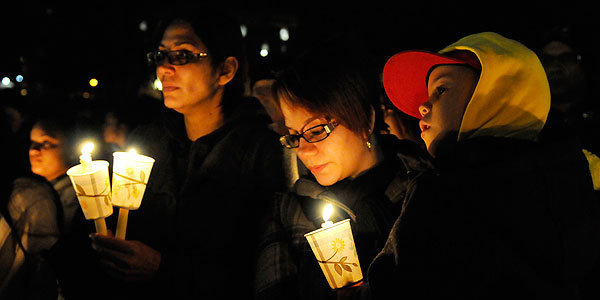
mourningWe are all, it seems, struggling to come to terms with what happened yesterday in Newtown, Connecticut.

As the awful news began to unfold, I urged friends and family members to pause and refrain from using this tragedy to further support political/policy agendas. I was unable, –am still unable — to comprehend what happened. It seems impossible to shoulder the weight of this horrific tragedy.

“Today is not the day to have these conversations,” I wrote on my Facebook page yesterday. “Today is a day to grieve and to support one another.”

Those words strike me as empty, hollow. . .meaningless. Over the last 24 hours, our nation has experienced a range of emotions: rage, grief, shock, fear and despair.

So, how do we move forward? How do we reconcile those feelings, the raw emotions that carry us into another day?

Understandably, many of us are searching for answers, for meaning. We have different opinions, and I submit that those opinions are all vital, all necessary for the larger conversation that we can no longer ignore.

The response to my Facebook post was generally respectful. Some people, however, chided me..saying yesterday, the day before, last year was the time for that conversation. I agree with those well-intentioned Facebook friends of mine. I only wonder if they will now join me in that conversation.

Four days after the Tuscon shootings, I penned an op-ed that was published in the Portland Press Herald. I got lots of supportive feedback and some nice comments for my willingness to speak publicly about my own mental health issues and how those issues affect each and every one of us, but we all moved on to more important things . . . like arguing about Rick Santorum, Wal-Mart and Honey Boo-boo.

On July 23, I wrote another blog post about the peril of ignoring mental health issues and focusing on gun control in response to the movie theater shootings in Aurora, Colorado. But we quickly moved on . . .

As I struggle to find light in this time of darkness, there is only one small measure of comfort: for the first time, I am seeing and hearing numerous people address mental health as one of the core issues for that conversation. More people, it seems, are ready to have “that” conversation.

But it is not the only issue we must be willing to confront. I consider myself an ardent supporter of the Second Amendment, but today I am left with questions for which there seem to be no easy or convenient answers. I loathe knee-jerk reactions, but I am willing to reconsider all of my opinions so that I can join that larger conversation in a meaningful and productive way.

Ironically. as we all began dealing with the tragic fallout from yesterday’s rampage, another new story from half way across the globe was unfolding.

Questions about China’s inadequate mental health system are increasing in the wake of multiple incidents of school children being attacked and killed by knife-wielding, mentally ill people. Over the last few years, numerous school children have been killed and scores more injured by knife-wielding mad men.

That is not an argument against gun control. That is an argument that shows gun control is not the entire solution.

News commentator Bob Costas didn’t hesitate to offer his opinion about gun control less than 24 hours after an NFL player shot and killed his girlfriend before shooting himself in front of his coach. Just one week later, another NFL player was killed because he was riding in a car with a drunken teammate. It’s no surprise that there was no call for tighter alcohol controls.

Railing for gun control may help us feel a bit safer; but if we don’t have that conversation across a larger context then we can expect more of the same . . . senseless violence that shocks and angers, but then slowly fades away into distant memory.

On a final point. How do we ensure better background checks to prevent mentally ill people from purchasing or obtaining firearms?

Should someone like me, someone who struggles with depression and has been hospitalized sacrifice our privacy and have our health care records disclosed? Should family members of mentally ill people lose or sacrifice some of their rights under the Constitution?

I do not know the answers to those questions. But I do know, there is no way to guarantee safety. We live in a dangerous world, and if we are willing to sacrifice liberty for security (and considering the Patriot Act, Department of Homeland Security, and long shoeless TSA lines, we are) we may end up with something we never bargained for.

Balance and perception a.k.a. ‘Shit happens’

An obvious aliment

Over the last few days, I have learned some valuable lessons.

First and foremost, I was reminded this week that I am extraordinarily blessed to have a diverse cadre of superior friends and family members.

I also learned a valuable lesson about ladders, not to mention a very painful experience that drove home the importance of why access to affordable and quality health care is so important for our national security.

But having so much down time has also allowed me to reflect on at least two other subjects: balance and perception.

During this presidential election season we have all heard a bunch of rhetoric about “self-reliance” and about “being in this together.” But which philosophy is correct?

Just like working with a ladder, the most important lesson is too often forgotten: it’s all about balance.

And we lose our balance when our perceptions become too narrowly defined.

A week ago, I broke my left arm in two different places while helping my sons with their landscaping business. The injuries, although significant, will eventually heal.

These last few days have been tough. It’s amazing how much you take for granted the use of two working arms. For example, try zipping up your pants with one arm. Or opening a bottle of pain meds; typing or driving a vehicle with a standard transmission.

Most people understand those limitations. They instantly empathize, and are quick to offer assistance. After all, my injuries are very obvious. My arm is either in a sling or set into a wrap-around corset to keep it in place. I have visible wounds on my legs and my elbow.

Strangers ask what happened with sympathetic voices, and they often share with me their own similar experiences. My friends laugh with me about how the accident happened. It’s okay and acceptable to make jokes about it.

We are comfortable with physical injuries. They do not frighten us. Shit happens.

Anyone who has ever smashed their elbow into a 3-inch-thick slab of stone knows that it is a painful injury. They know why you need to take it easy and sometimes need the use of medication to cope or just sleep through the night.

I say all this because these experiences provided me with a very stark contrast to my much less obvious injuries; the disease that is invisible to the eye, that is masked by perception.

On balance (no pun intended) my mental illness is far more painful than a broken arm. But you can’t see it, and I am reluctant to show it to you.

Imagine a disease that rarely allows you to sleep through an entire night. A disease that constantly impacts your perception of the world around you; a disease that clouds your judgment, alters your reality and makes it almost impossible to get out of bed.

Imagine an intense level of pain that without medication would have you think every hour of every day about ending your life; a disease that inhibits your ability to maintain relationships and function as a productive member of society.

Imagine having a disease that is commonly ridiculed and often dismissed as nothing more than “feeling sorry for yourself.”

I live with the challenges of that disease every day. I fight it with every fiber of my existence, only to know that it will never go away; that there is no cure or remedy.

I refuse to allow my broken arm to alter my life. This last week has been one of the busiest and most challenging weeks of my professional career, and I have risen to each and every challenge.

Am I bragging? Yes, but only to make a point. This is the way the overwhelming majority of people who suffer from a mental illness operate. They struggle through each day. They go to work. They mask their pain. They pay their bills. They follow the law. They take their meds and follow their doctor’s orders.

They wince when they hear the words “sicko, whack job and nut case,” but they swallow and stay silent for fear of being labeled, judged or excluded.

They are just like you. They are your neighbors, your friends and your co-workers. They did not choose to become sick any more than you would choose to fall off a ladder. They are some of the most self-reliant people you will ever meet. They have abundant courage and determination.

We all have limitations. The trick is learning to balance and to expand your range of perception. With those tools, you can fix just about anything.

Pocketful of Kryptonite

Although it was 30 years ago this week, I still remember the day like it was yesterday.

I came home from high school and flipped on the television. The news was on, and that was strange because this was long before the days of CNN, MSNBC or Fox News. Back then, there was no such thing as the internet.

So why was the news on during the afternoon?

The president had been shot.

Only a few months earlier, John Lennon was gunned down in front of his New York City apartment building. We didn’t know it then, but in a few more weeks there would be an assassination attempt on Pope John Paul II.

Violence was everywhere, it seemed.

Welcome to 1981. I am a junior at Rumford High School. My orthodontic braces had just been removed, and I am living with my uncle and aunt in West Peru, Maine while my parents continue a bitter divorce process.

I am going back there tomorrow. I am going back to my old high school, where I painted a mural on the wall of my English teacher’s classroom.

I am also reminded that the more things change, the more they stay the same.

“Those who cannot remember the past are condemned to repeat it,” said 19th Century philosopher George Santayana

When Ronald Reagan was president, U.S. Rep. Gabrielle Giffords was 11 years old, John Lennon was buried, and I was struggling with acne.

John Lennon, Ronald Reagan, Gabrielle Giffords, Pope John Paul II.

And Maine Governor Paul LePage.

Wait! What? Paul LePage?

No, LePage was not shot, but he did receive a death threat from Michael Thomas, a Portland man who allegedly vowed to assassinate him and reportedly suffers from a history of mental instability.

John Lennon, Ronald Reagan, Gabby Giffords, Pope John Paul II and Paul Lepage. Now there’s an interesting group of people, all of whom stir some sort of reaction.

But what about this next group of individuals?

Mark Chapman, John Hinckley, Jared Loughner, Mehmet Ali Ağca and Michael Thomas. They all have at least two things in common.

One: They are all currently in jail.

While some folks may use these tragedies to demand tougher gun laws, or to discuss political motivations, the other common thread shared by our second group of men is almost always sensationalized by both the media and general public .

Each of these men has a mental illness.

(Sidebar: There are several theories, including a Tom Clancy novel, about Ağca, the man who attempted to assassinate the Pope,and his political motivations and reported connections to the KGB, but there is little doubt that he is mentally unstable, especially if you begin perusing transcripts of interviews with him after the shooting in Vatican Square.)

We like to ignore mental illness. It is an uncomfortable topic, but not one that should be dismissed. Otherwise, as demonstrated above, the consequences can be fatal.

These high-profile crimes and the men behind them add to the burden of mental health advocates who fight daily against the stigma associated with mental illness.

In fact, violent acts committed by people with serious mental illness comprise an exceptionally small proportion of the overall violent crime rate in the U.S. They are more likely to be the victims of violence, not its perpetrators, according to the National Association of Social Workers (NASW)

In its March 2011 article, “Budgets Balanced at Expense of Mentally Ill,” the NASW newsletter also mentions a new report by the U.S. Substance Abuse and Mental Health Services Administration that documents a nationwide decline in behavioral health care spending as a share of all health care spending, from 9.3 percent in 1986 to just 7.3 percent, or $135 billion out of $1.85 trillion, in 2005.

Moreover, high-profile incidents such as John Hinckley’s attempted assassination of President Reagan also give apparent permission for the media to stereotype and hype mental illness as one that will likely produce violent crime.

In the days following the 2007 massacre at Virginia Tech, “Nightly newscasts reported “no known motive” and focused on the gunman’s anger, sense of isolation, and preoccupation with violent revenge. No one who read or saw the coverage would learn what a psychotic break looks like, nor that the vast majority of people with mental disorders are not violent. This kind of contextual information is conspicuously missing from major newspapers and TV,” wrote Richard Friedman in “Media and Madness,” an article published in the June 23, 2008 issue of The American Prospect.

Friedman goes on to explain that “Hollywood has benefited from a long-standing and lurid fascination with psychiatric illness,” referencing movies such as Psycho, The Silence of the Lambs, One Flew Over the Cuckoo’s Nest and Fatal Attraction.

According to Friedman, “exaggerated characters like these may help make “average” people feel safer by displacing the threat of violence to a well-defined group.”

As a former journalist and a current communications consultant, I am naturally drawn to issues surrounding journalism and those who are employed by the so-called Fourth Estate.

And as someone who has been battling mental illness all my life, I know a thing or two about the effects of stigma.

And that’s why I’m going back to my old high school. I will be the keynote speaker at a symposium on mental health stigma.

The Carter Center does a succinct job of defining the problems associated with stigma:

“In ancient times the word stigma was defined as ‘A mark burned into the skin of a criminal or slave, a brand.’ This inhumane treatment was metered out to criminals and anyone felt to be a threat to society. Have we really come so far today? Just mention depression or worse Bipolar to most employers, family or friends and the reaction’s generally a negative one.”

Superman and Lois Clark

Maybe you remember the 1978 movie Superman.

The movie may have been cheesy, but the cast was stunning. Some of Hollywood’s most enduring and iconic figures were featured in that film, including Marlon Brando, Gene Hackman, Ned Beatty, Valerie Perrine and Margot Kidder.

The film also launched the career of Christopher Reeve, a handsome, muscular man who was cast in the leading role as the Man of Steel.

While participating in a 1995 equestrian competition in Virginia, Reeve was severely injured and became paralyzed. His injuries elicited support from all over the globe. He spent the rest of his brief life trying to help others with spinal cord injuries and established the Christopher Reeve Foundation.

He was a sympathetic hero. He touched us all. The man of steel could not escape this batch of Kryptonite. He died in October 2004 and millions mourned his passing.

Now, let us examine the fate of Superman’s leading lady, Margot Kidder, a successful actress who was cast as the petulant, cynical and manic reporter, Lois Clark.

A year after Reeve was paralyzed, Kidder was found by police hiding in the bushes in a suburban neighborhood near Los Angeles, California. She was taken into custody for a psychiatric evaluation.

The world was not so nice to Ms. Kidder.

Kidder has a bipolar disorder, so she became fair game for the media, late night comedians and a slew of derisive web site commentary. She was certainly no Superman.

She was human, frail and vulnerable but in a different way than her co-star, and that difference was best amplified by the ridicule that continues to follow her today, some 15 years after her illness became fodder for her former Hollywood colleagues.

Maybe that’s why fellow Superman star Marlon Brando spent so many years keeping his mental illness a secret.

By the time Superman was released in 1978, Brando was already known as one of Hollywood’s most iconic figures. The star of “On the Waterfront” and “The Godfather,” he was a tough guy’s tough guy.

But his mental illness apparently was a bit tougher.

Brando was a deeply troubled man struggling with depression, anger, and loneliness, according to those who knew him and detailed in an article by the National Center on Physical Activity and Disability.

Brando was from a generation of those who didn’t talk about mental illness. A generation that believed depression was little more than self-pity run amok or some other sort of character flaw.

It was that same generation of actors which produced the original Superman, George Reeves.

George Reeves (no relation to Christopher) was an actor best known for his leading role in the 1950s television series, The Adventures of Superman.

Reeves’ untimely death at age 45 was officially ruled as a suicide by police, although there is much speculation about that fact, most notably in the 2006 film Hollywoodland, which stars Ben Affleck as George Reeves.

Whether Reeves committed suicide is irrelevant and will probably remain a mystery for a long time to come.

But we do know how Hollywood would have treated him if he had talked publicly about battling depression.

Just ask Lois Lane.

Testimony in support of LD 364

A copy of the testimony I presented to the Maine Legislature’s Joint Standing Committee on Insurance and Financial Services on March 2, 2011

Re: LD 364, Resolve, Directing Updated Review and Evaluation of Maine’s Mental Health Parity Law

 Good afternoon, ladies and gentlemen of the committee. Thank you for the opportunity to speak to you today about the importance and my support of LD 364.

My name is Randy Seaver, and I am here.

Ladies and Gentlemen, if that statement seems vague, please allow me to explain. From my perspective, it is nothing short of a miracle that I am able to stand before you today and testify about the critical importance of maintaining Maine’s mental health parity legislation.

What do you see when you look at me? Perhaps you see a father, a husband or a communications consultant? Maybe you know me from some of the other state policy work I have been involved with over the last several years. Perhaps you know me as a veteran; or as a former journalist and newspaper editor.

In fact, I am all of those things. But what you may not know is that I am also someone with a mental illness who requires daily medication and ongoing treatment. I am not unique. I am not an anomaly. In fact, I am just like the thousands of other Maine people who suffer from some sort of mental illness.

If you think my numbers are high, please consider that the Centers for Disease Control estimates that 1 of every five Americans suffers from some form of mental illness. Based on the latest Census figures regarding Maine’s population, the math will tell you that there are more than 200,000 people just like me in Maine.

We are your neighbors, your friends, your co-workers and colleagues.

Mental illness is no different in its implications than any other form of disease, such as Diabetes or epilepsy. Would you think of me any differently if I stood before you to talk about insurance coverage for diabetics?

My illness, as long as it is treated properly, is virtually impossible to detect. When addressed through medication and regular clinician visits, my illness does not prevent me from doing things that so many us take for granted: holding a job, maintaining a marriage, volunteering in the community and yes, even paying taxes that support our communities.

But there is another side of that coin because I know all too well the costs associated without access to treatment and medications. Between 1982 and 1998, I was in and out of various hospital settings and unable to hold a job or maintain a relationship.

In fact, if you were to eat just one whoopee pie for every time I was hospitalized during that 16-year time frame, you would die of hypoglycaemic shock before you were halfway there.

When Jared Loughner committed his horrific acts of violence in Tucson, I knew that I had a responsibility to speak up publicly about both the stigma associated with mental illness and the need to ensure that people have fair access to treatments and medications.

You see, Jared Loughner and I are not that much different. The only real difference is that I was able to receive treatment and medication, and that I take responsibility for managing my illness.

Those two things are important, and they are the only reasons why I am here today, and not in prison, a hospital ward or a morgue.

But without access to treatment, how am I able to take responsibility for managing my illness? If I pay the same insurance premium as my neighbor, why should an insurance company view my illness any differently?

Access to medication and ongoing treatment allows me to be a productive member of my community. Without that access, it is likely that I will end up in a hospital. If I’m not working, I’m unable to support myself. I am not paying income taxes or contributing to the economy as a consumer of goods and services. Wouldn’t you agree that an ounce of prevention is worth a pound of cure?

Ladies and Gentlemen, my name is Randy Seaver, and I am here!

I am here to plead with you to maintain and support Maine’s mental health parity law.

Tucson shootings and the costs of stigma

(originally published in the January 11, 2011 Portland Press Herald)

The horrific event that transpired in Tucson on Saturday has inspired more than ample discussion regarding the tone and spirit of our nation’s political discourse.

Despite all the fervent commentary, there is one piece of this puzzle that remains largely glossed over, however.

And this is where it gets a bit personal.

When I was 22, I was living in Tucson and attending college part-time. Just like Jared Loughner, I was removed from school for many of the same reasons.

But I got lucky. I ended up at the Southern Arizona Mental Health Center (SAMHC) and spent the next several weeks there as an inpatient client.

I did not have insurance. I did not have any assets or even a job. My family was in Maine, thousands of miles away. So, my ability to receive life-saving treatment and long-term support services was funded primarily on the backs of Arizona taxpayers.

Nearly a quarter century later, I like to think that investment has, so far, paid significant dividends. But I can assure you, it was a long-term and risky investment.

Make no mistake. Mr. Loughner committed horrific, criminal acts that warrant the full weight of justice. But if society expects and demands justice, we must also recognize that there is a very deep and painful cost associated with scaling down or the elimination of community-based mental health services and treatment options.

According to its web site, SAMHC was officially established in 1962 as a state-owned and operated outpatient mental health facility under the aegis of the Arizona State Hospital.  The campus-style facility, then located at the intersection of Campbell Avenue and 6th Street, was purchased through legislative appropriation.

Nearly 50 years after its founding, SAMHC continues to provide crisis behavioral health services to the entire community, regardless of ability to pay, insurance status or age.

As of this writing, it is unclear whether Loughner attempted to access those services or if he or members of his family made any attempt to deal with his now-obvious illness.

What is clearly known, however, is the commentary our society freely tosses around when describing mental illness.

Unfortunately, the terms “sicko” “whack-job” and “nut case” are apparently acceptable on social media outlets, reader comment pages and even in the so-called mainstream media.

Yet, we wonder with righteous indignation why those affected by mental illness are reluctant to seek services or get help before their illness manifests itself into a deadly outcome.

If I were dealing with testicular cancer, I could expect to be described as a “hero” or as a “survivor.”  I am praised for my courage to acknowledge my illness and for my willingness to fight it tooth and nail with all available resources.

Heck, you might even put a bumper sticker on your car, wear a pink bracelet or post something supportive on your Facebook page.

But what if I tell you I have a diagnosed mental illness; an illness that affects me every day; an insidious, almost-invisible illness for which there is no cure?

I get some nervous head nods or even some encouragement in the form of: “pull yourself up by your bootstraps, try positive thinking, you should appreciate things more.”

Well-intentioned, perhaps, but the stigma and its costs are clear.

Though we have made much progress, I can assure you that we have a long, long way to go.

Only because I was able to access services and am willing to deal every day with my disease am I able to do things now that I once thought impossible: hold a job, enjoy a wonderful marriage, own a home and even hold a driver’s license.

So, some may choose to focus on the debate regarding our nation’s political rhetoric.

But whether we’re talking about John Hinckley, Mark Chapman or the more recent example of Jared Loughner, one thing we should all be able to recognize is that mental illness can be a fatal illness – and if left untreated, its costs are overwhelming.

According to the Centers for Disease Control, one of every five Americans suffers from some form of mental illness.

I hope you agree with me that an ounce of prevention is worth a pound of cure.

Uncle Bert

Originally posted on Dec. 22, 2005 on All Along The Watchtower.

Last week, I thought today would be little more than a day of drinking and celebrating with my co-workers and those I developed relationships with during the last seven years as the Courier’s editor.

But God had different plans.

So, instead I will be going to a funeral.

Uncle Bert is an “in-law” relative. And since Laura and I have been together just a little more than four years, it’s not like I can say we were particularly close. And even Laura, I think, is grieving the uncle she knew from her childhood more than the Uncle Bert who decided to end his sorrow and grief a bit sooner than the rest of us expected.

But his suicide, like all suicides, has left me troubled.

Roughly a year ago today, Uncle Bert smoked a cigarette with me outside my new home. He was always very nice to me. Sure, all of Laura’s relatives were nice to me (some more than others), but Uncle Bert seemed comfortable talking with me; and he wasn’t what you would call a big talker.

He had a thick Downeast accent, gray hair, a wiry frame and a warm smile. We talked about my driveway, which really needs to be repaved. He spent several years as the owner of a paving company, and told me that my driveway was actually in pretty decent shape.

“You have a nice home, Randy,” he told me. “You’re doing a good job with those boys.”

There’s no way to explain how much that comment meant to me. He reminded me of my own late Uncle Leonard, a man who raised me during my teenage years when my mother was overwhelmed and my father was focused on indulging his every biological whim.

I always felt for Uncle Bert; he struck me as lonely, and there was no denying the fact that he never quite accepted the loss of his wife, the woman Laura knew as Aunt Cathy.

Laura and I were both raised as Catholics. And yesterday (or maybe the day before), she asked me if I thought Uncle Bert would go to heaven.

Yes, I told my wife as she brushed away a tear. “The God I believe in would not turn Uncle Bert away. Uncle Bert was a kind, decent and honest man. If he doesn’t go to heaven, then it’s no place I want to be.”

The Church tenets were designed to keep people alive. Although its doctrines are fear-based, the intent, I think, was more practical and based in necessity.

God, I believe, is sad that Uncle Bert is no longer with us. But I believe in a loving and forgiving God, a God who understands and accepts our human follies. Would you turn away your child if he or she made a mistake?

Laura and her cousins have much closer realtionships than I ever had with any of my cousins. They get together frequently every year. So I know Peggy and Liz (two of Bert’s four children) as well as any of my in-laws.

Peggy and Liz are amazing women with families of their own. Their father’s better traits are certainly apparent in the way they raise their own children.

I just hope Uncle Bert knows what a special gift he gave me by openly expressing a vote of confidence in my struggles to be a stepfather.

As someone who spent the better part of a decade struggling with severe depression and at least two serious suicide attempts, I was shaken to learn that Uncle Bert went through with his shuffling of life’s mortal coil.

I just hope God knows what He is doing, and I hope we all learn from the lessons that are so readily available in every day living.

Uncle Bert is gone and will not be here for this Christmas or any other, but I choose to remember that sly grin and gentle demeanor. And I know that all the streets in heaven will be well-paved, at least in the smoking section.