This is where it ends

Former Biddeford Mayor Donna Dion had a favorite saying that she often repeated throughout her political career, including during her unsuccessful bids to become Maine’s governor.

“You can’t have community without unity,” Dion would often say, pointing out that we all have a stake in the game, a moral obligation to work together for the common good.
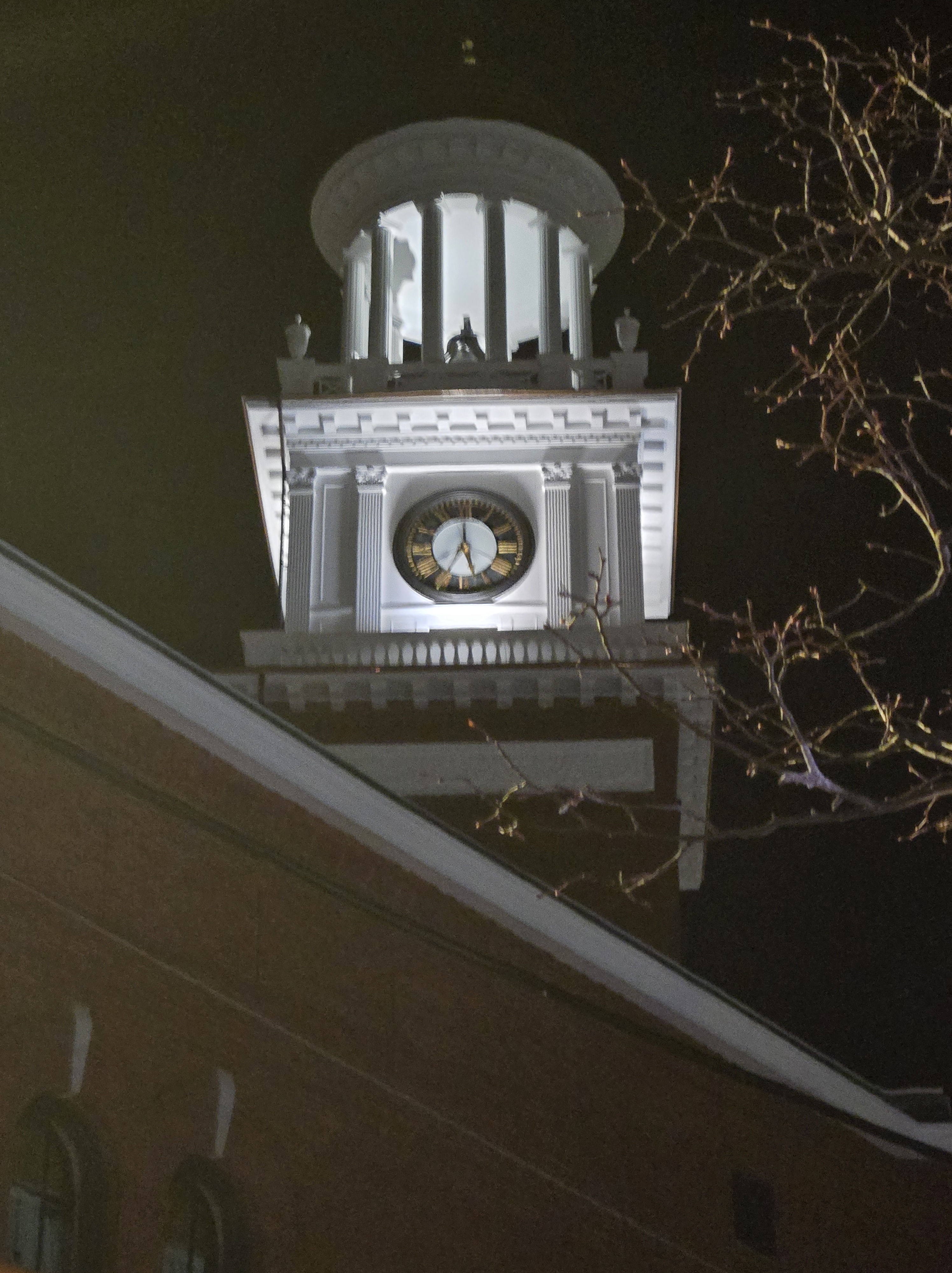
The restored, historic City Hall Clocktower in Biddeford (Seaver photo)

Over this past week, I have come to better understand what Dion meant when she repeated that phrase over and over again. “You can’t have community without unity.”

Three events in Biddeford this week reminded me that we are a community, and that we are stronger when we are united in purpose; when we are connected by common threads —  a sense of community.

In the span of just six days, our community experienced a full range of emotions – from pure holiday joy, to a poignant reminder of our shared past and then –, sadly — the tragic news that we lost a young and much beloved member of our police department.

Sgt. Jacob Wolterbeek was killed in a traffic accident on his way home at the end of his shift on Thursday morning. He was only 41-years old and leaves behind a wife and three young children just days before Christmas.

Let’s back up a bit, and think about last Friday night.

From joy to sorrow

I have the privilege of being one of four administrators on a Community Facebook page dedicated to the Biddeford-Saco region. It’s a volunteer gig that is sometimes frustrating – – watching adults bickering with each other over petty matters — but it is also rewarding to see just how quickly the entire community bands together in a time of need, a time of loss.

It was a cold night, and Laura was away for the weekend. It was also the night when Santa Claus makes an official stop downtown to greet all the good boys and girls.

The Merry and Bright Night event is coordinated by the Heart of Biddeford, a non-profit organization that takes the lead in organizing community events in the downtown area.

I really didn’t want to leave the warmth and comfort of my home, but something made me want to go and check out the festivities.

As soon as I parked my truck on South Street, my mood improved dramatically. It was bitterly cold, but there were several fire pits, where I found dozens of residents teaching their kids how to make S’mores.

There were hundreds of people milling about, almost everyone was smiling. Holiday lights were strung everywhere and holiday music was being played over a loudspeaker.

Hundreds celebrate the kickoff for the holiday season in downtown Biddeford (Seaver photo)

Before Santa Claus arrived to greet the children, before the city’s Christmas tree was lighted – I realized that it took a lot of work to make this happen. It took scores of volunteers – but it also required loads of help from city employees, including public works, the police department and even the fire department.

A lot of people pitched in to help make that night magical for families and dozens of onlookers

It was a great night to be part of our community.

Pride in the name of love

Every community – whether it’s Bedford Falls or Biddeford, Maine – has its own curmudgeons. But even Ebeneezer Scrooge, Henry Potter or the Grinch himself offer us lessons about the power and benefits of community.

A few years ago, Biddeford voters overwhelmingly approved a renovation project at City Hall. The project included life-safety improvements, energy efficiency and the outside appearance of the building and its landmark clock tower.

Yes, a handful of our local curmudgeons took to Facebook to complain about spending taxpayer money to restore and repair the clock tower.

That clock tower is a focal point for our community. It is a symbol of community pride. Something that is apparently lost on the curmudgeons.

Mayor Marty Grohman was offering residents tours up into the tower during the downtown holiday celebration.

Biddeford Mayor Marty Grohman and I strike a pose near the mechanical gears of the clocktower (Daniel Boucher photo)

After climbing nine flights of stairs, our group finally reached our destination. The walls surrounding the clock’s 150-year-old mechanisms seemed to be dripping with history.

The mayor offered each of us the opportunity to leave our name on the walls where dozens of others over the years have left their own names.

It wasn’t that long ago when Biddeford had two clock towers. One was perched atop City Hall, the other atop the then vacant and crumbling Lincoln Mill Building across the street.

A few of us tried to rally the community in an effort to preserve the Lincoln Clocktower, but we failed. That tower was eventually removed and destroyed because of structural concerns.

I think that was a lesson for all of us, a reminder that we have to show effort to preserve our history, which brings me to this week’s second lesson in the power of community.

Take me to the river

The former St. Andre Catholic Church in Biddeford was closed nearly 15 years ago after being an integral part of the community for more than 100 years.

The church remained vacant and somewhat neglected until a team of people decided that the magnificent structure could be brought back to life as a place to provide nurturing, learning and social activities for young people.
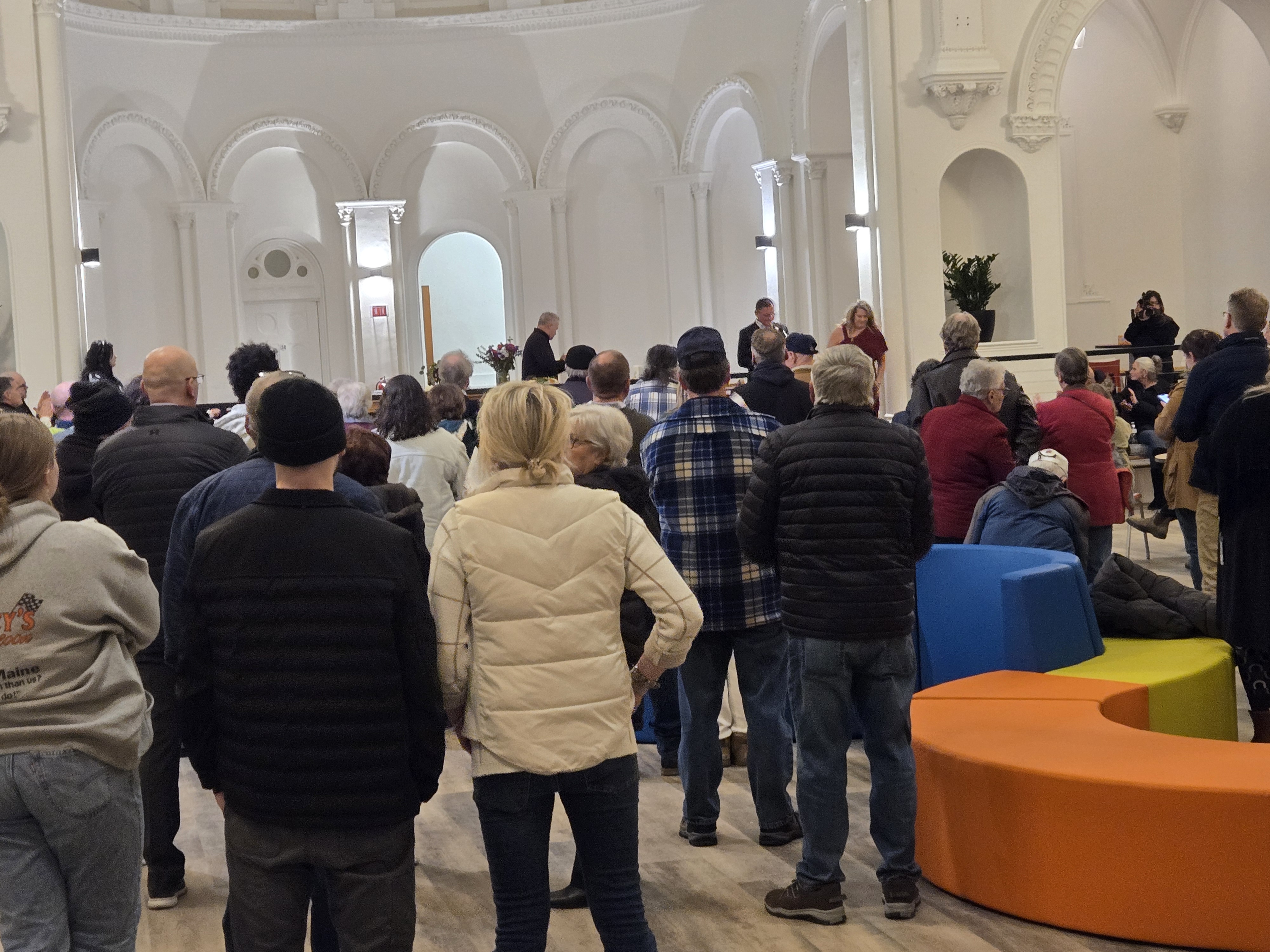
The community celebrates the grand opening of the My Place Teen Center in the former St. Andre Church building (Seaver photo)

On Monday evening the community gathered in the building once again, not as a church – but as admirers of a renovation project that required millions in monetary donations and lots and lots and lots of heavy lifting by volunteers and others, including state and local officials.

Scores of people attended the grand opening of the new My Place Teen Center.

Renee O’Neil of Biddeford was one of those people who attended Monday’s event. O’Neil shared memories of attending church at St. Andre’s when she was a little girl.

“I used to stare at those murals,” she said, pointing to two historic murals near the altar of the former church. “It’s just incredible that they were able to preserve so much history. It really warms my heart to know that this building will continue to be a place for community support.”

Jim Godbout, a well-known community volunteer and the owner of Jim Godbout Plumbing & Heating, once again stepped forward and offered his help as the lead contractor. He was able to rally many others to pitch in to the complex and daunting renovation task.

The transformation of the long-since neglected building was nothing short of amazing.

The St. Andre building served the community for so many years, a vital part of its working-class neighborhood. Today – thanks to a community effort – it will once again serve the community.

“This is a story of resurrection and new life,” Tim Higgins, chair of the My Place Teen Center’s board of directors, told reporter Tammy Wells a York County media specialist. “Lives will not only be changed here, they will be saved here,” Higgins said.

A devastating loss

Unfortunately, a  community that celebrates together also grieves together.

On Thursday morning, we learned that we had lost a much-admired member of our community.

Within moments of sharing the awful news on our community Facebook page, the shock and sorrow spread throughout our community — and beyond.

Sgt. Jacob Wolterbeek receives his Seargeant badge from Police Chief JoAnne Fisk (Photo courtesy of Biddeford Police Department

It became quickly apparent that Sgt. Jacob Wolterbeek had a profound impact on our community. Within two hours more than 400 people reacted to the awful news, expressing sympathy and support for Wolterbeek’s family, friends and co-workers.

But one particular Facebook comment really struck a chord with me. It came from a young man who had met Wolterbeek under not such great circumstances:

“That police officer changed my life,” the young man wrote. “I was into some bad stuff as a teenager. He arrested me. Gave me a talk about the road I was going down and what it would lead to.

“For the next two years — anytime he saw me walking — he’d stop to check in; to make sure I was alright, to ask if I was having trouble; as a boy with no present father.

“For a stranger to do that. It changed my thinking. I went to college and I became a nurse. [He] used to protect us breakers. Always telling us “I see the good you do in the neighborhood”

That, my friends, is community. The good times, the shared connections and the bad times.

Today, I am feeling blessed to be a small part of such an extraordinary community.

Donna Dion was right. We are stronger and better when we realize that unity is a fundamental part of community.

Never miss another update. Subscribe for free today!

A Hard Day’s Night

No one can deny that the city of Biddeford – once derided as “Trash-town U.S.A.”  — has today become an unlikely hip destination for young adults and others who enjoy an eclectic array of craft breweries, a diverse culinary scene and dozens of boutique shops and businesses that offer everything from gourmet cheeses to hand-crafted outdoor gear.

In fact, several national publications that cater to the promotion of unique culinary delights and a creative economy all point to the city of Biddeford as a place to be for young, urban professionals.

A photo from the Heart of Biddeford website

Not surprisingly, the city of Biddeford is today Maine’s youngest city, according to the U.S. Census Bureau.

What a change 23 years make, but that change wasn’t easy — and it does come with some equally undeniable consequences.

More about that in a moment. First, a bit of disclosure.

Over the past few weeks, I have been sorting through hundreds of stories I have written about Biddeford since the mid-1990s as part of the redesign and launch of this website, Lessons in Mediocrity.

From 1998 until 2002, before I met my wife, I lived in downtown Biddeford; on the third-floor above the Happy Dragon Restaurant on Main Street.

I also grew up in the Biddeford-Saco area. My family goes back four generations in this community. My wife, a former Biddeford city councilor, and I have been living at our home on Lamothe Avenue for just over 20 years.

After my time at the Courier, I continued to write/blog about the city, its politics and people. As a policy consultant, I worked on several local campaigns and issues. My kids went to Biddeford schools.

I also served on the Biddeford Airport Commission, the Downtown Development Commission and the Biddeford Zoning Board of Appeals.

Today, I keep my toes in the water by working as a free-lance writer, still writing about Biddeford for Saco Bay News.

You get the point. I have a close connection to Biddeford, a community I love and care about deeply.

Why am I sharing this now?

When we look at the city of Biddeford today, I think many of us tend to forget the challenges the city was facing then, when we literally burned our trash in the middle of downtown.

When I joined the Courier in 1998, my boss and publisher David Flood was already an ardent and outspoken booster for downtown Biddeford.

David – unlike me and several other people – saw big potential in Biddeford’s downtown, despite some overwhelming challenges that included the presence of a downtown trash incinerator and significant socio-economic hurdles.

In fact, David  – who was recently inducted into the Biddeford Hall of Fame — was one of the original founders of the Heart of Biddeford, a non-profit organization established in 2004 with a mission to promote economic development and improve quality of life in the city’s downtown area.

While former mayor Alan Casavant receives a lot of credit for the revitalization and renaissance of downtown Biddeford. It was actually former mayor Wallace Nutting who got the ball rolling, some seven years before Casavant was elected as mayor.

Nutting a retired four-star general and native of Saco, also had a strong vision of what downtown Biddeford could become.

Although Nutting, a former Pentagon official who served as a senior advisor to President Ronald Reagan, was one of the smartest, most distinguished and accomplished people I ever met, I thought he was off his proverbial rocker when he started talking about the city’s beleaguered downtown as a “destination for arts, culture and local shopping.”

But Nutting and Flood were not alone. The former mayor also tapped several other like-minded citizens to join him on his newest crusade. Ed Caron, a Biddeford attorney; Renee (Potvin) O’Neil, the woman who basically spearheaded the renovation of City Theater, and Donna Tippett all volunteered to help.

Nutting, the man who previously led the U.S. effort to extricate Manuel Noreiga out of Panama, had a new mission.

Failure was not an option.

What this core group – and later several other volunteers, business owners and residents – accomplished was nothing short of amazing.

But hindsight is always 20/20. It took years, taxpayer funding and political willpower to transform downtown from a neglected hodgepodge of businesses to one of the most vibrant cities in Maine.

Now back to those unintended consequences.

Biddeford After Dark

In the autumn of 2001, while working for David and Carolyn Flood, I decided to write a five part-series about downtown Biddeford, but with a twist.

My Biddeford After Dark series would explore the city’s then gritty downtown area during the overnight hours.

I would write about the punks who congregated at the 7-11 store near the intersection of Jefferson and Alfred Streets; I would ride along with third-shift Biddeford police officers and I would interview the late-night workers, including the supervisors at the MERC incinerator.

I don’t think David was crazy about my idea. I think he was concerned that my series would only perpetuate negative stereotypes about the city of Biddeford.

But – as was so often the case – David game me a wide berth and lots of latitude in running the newsroom.

At that time, I was living and working in downtown Biddeford. I didn’t write the series for overtime pay or to avoid my daytime responsibilities as the Courier’s editor. I was single. I lived alone. I did it for fun.

An excerpt from that series: “As I walk along Lincoln Street — past a tired wrought-iron fence that is leaning and lurching in places — I can almost hear the ghosts of the past. They call to each other, unloading bales of cotton, smoking cigarettes and wiping the sweat from their brows.”

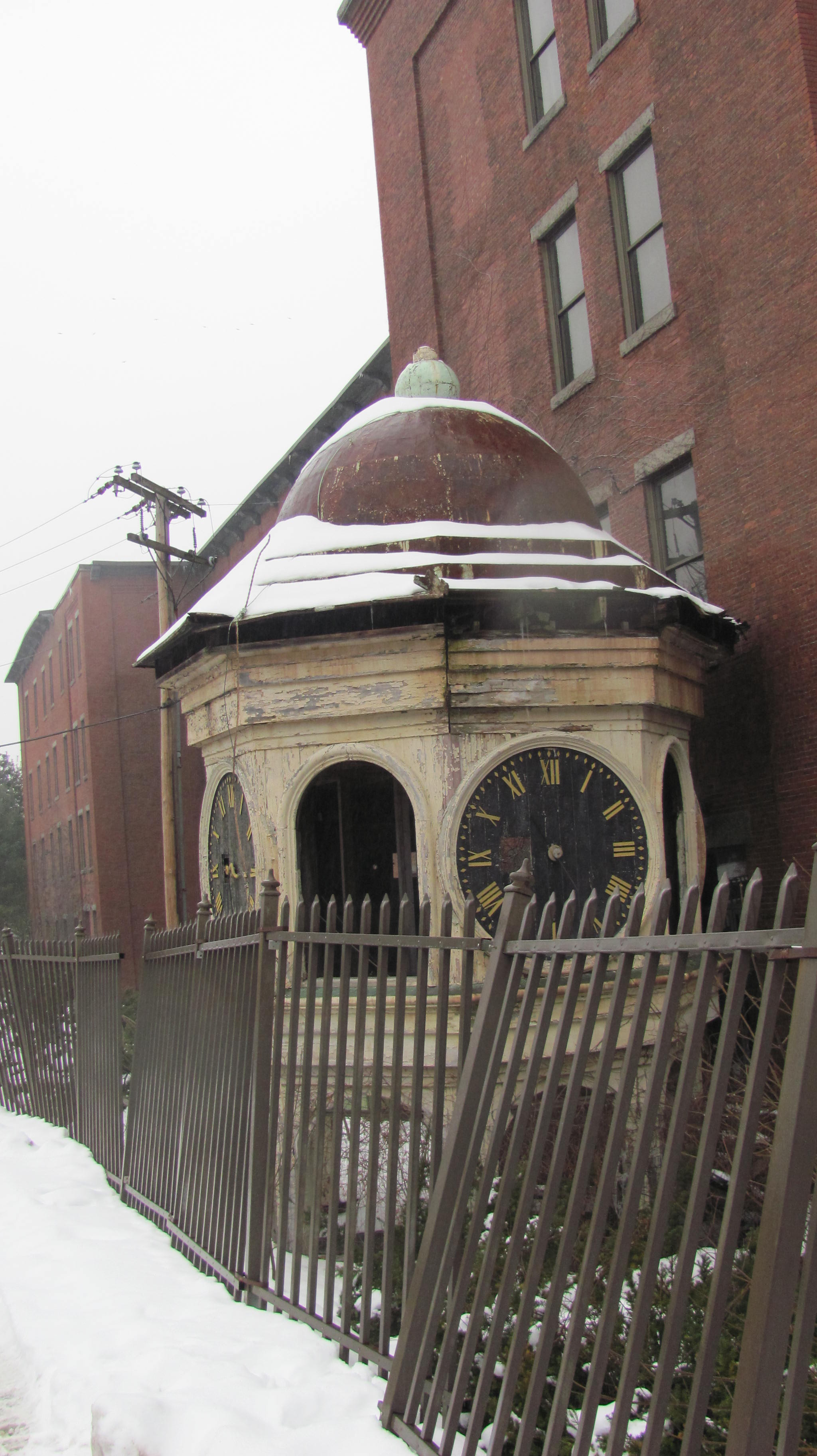
Back then, the former Lincoln Mill clocktower was perched and rotting on the ground in front of the vacant and deteriorating mill building that is today – 23 years later– a luxury hotel with a roof-top swimming pool, a craft distillery and an expansive lobby that has become a favorite gathering place for locals and visitors alike.

Who would have imagined?

But here’s the other thing, the downside of the good news.

A photo I took of the former Lincoln Mill clocktower nearly 25 years ago.

In 2001, it wasn’t hard to find a parking spot in downtown Biddeford. In 2001, you didn’t see any homeless folks sleeping in doorways on Main Street. In 2001, rents – both commercial and residential – were among the lowest in southern Maine.

Why? Well, it’s pretty simple: very few people really wanted to live or shop in downtown Biddeford back then. The stench of burning garbage; shuttered and vacant mill buildings and crumbling infrastructure hardly gave off a welcoming vibe.

Sure, there were some notable exceptions. Legacy businesses such as Reilly’s Bakery and Biddeford Savings Bank were able to weather the storm created by an economic recession and the terrible decision to burn garbage downtown.

But many people had given up on the downtown. Politicians set their sights on easy targets: the development of Wal-Mart and other big-box stores on the outer end of Alfred Road, a proposed racino and continued suburban sprawl on the western side of the city.

As I go through the stories and columns I wrote back then, I am reminded of the tremendous debt we all owe to David Flood, Wallace Nutting, Renee O’Neil and so many others.

We should also never forget the business leaders, civic activists and policy makers who formed Twin Cities Renaissance, the coalition of visionaries from both sides of the Saco River who committed themselves to seeing MERC finally closed.

Sure, Alan Casavant deserves lots of credit for helping us believe in our city again, but he got a lot of help from people who believed in Biddeford even when many of us had given up on the city.

Thank you for your blood, sweat and tears.

In the movie Jaws, Mayor Larry Vaughan says he was just “acting in the town’s best interests” by keeping the beaches open.

In Biddeford, Mayor Wallace Nutting was acting in the town’s best interest by believing in his city and its people.

Make no mistake. Our city still has challenges and hurdles to clear. But if you look at what has been accomplished over the last two decades, Biddeford’s future seems bright.

Originally published in Saco Bay News