
A retired judge, district attorney, state commissioner and former mayor from Biddeford reflects on his career and the changes in his community.
Hollywood movies often rely on stereotypes. Lawyers are frequently depicted as corrupt and self-serving. The district attorneys in those movies are not much better, using their power as glorified crime fighters for political gain. Mayors are routinely portrayed as bumbling, narcissistic egomaniacs; and judges wield their power with a rigid temperament and periodic fits of rage.
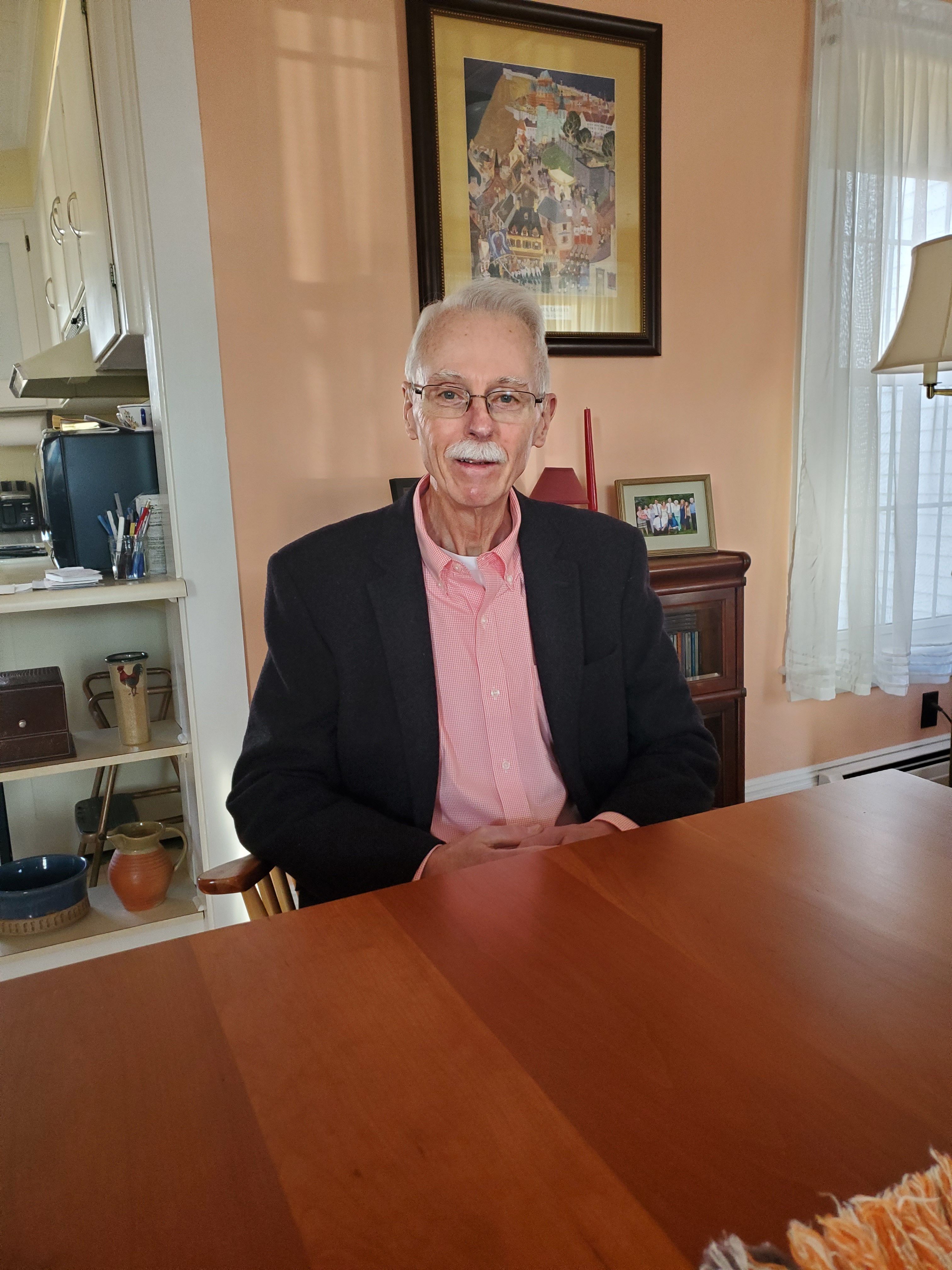
Michael Cantara of Biddeford has served in all four of those roles, but he is the exact opposite of those Hollywood stereotypes. Instead, Cantara is well-known throughout southern Maine as a man of principle, restraint, intellect and compassion.
Among many other awards and accomplishments, Cantara was inducted into the Maine Franco-American Hall of Fame and also inducted into the Biddeford Hall of Fame in 2022.
Cantara, 70, was adopted as an infant from the St. Andre Home in Biddeford by Jean Paul and Laurette Cantara. He and his two sisters were raised in a very modest home on Granite Street Extension. His father worked at the Saco Lowell machine shops. His mother worked at the Pepperell textile mill and later as a waitress at the Nutshell Restaurant in Biddeford.
He attended parochial schools, including St. Andre’s and later St. Louis High School, which closed just before his senior year. Thus, he graduated from Biddeford High School in 1971 before attending Colby College with the idea of becoming a pediatrician.
You planned on becoming a doctor but ended up retiring as a judge. A lot of things must have happened between those two bookends.
“Oh yes, they certainly did.” (Laughs) “I wasn’t exactly a clear career thinker when I went to school. I majored in French with a minor in biology. But my dream of being a pediatrician floundered on the shoals of organic chemistry. (Laughs) So, I reset the dial and decided to become a teacher.
“In my senior year of college, I was nominated for a Fulbright Teaching Scholarship. So, I got this wonderful gift of teaching in a French high school in Normandy, near the small town of Rouen, where Joan of Arc was burned at the stake.
“I taught American culture, history and language at a vocational school. My students were adolescent French boys from the local neighborhood. They were so receptive to the ideas I was teaching because at that time all things American were considered pretty cool.”
You returned to the United States and ended up going to law school.
“I had wanted to teach French on the college level, but was intrigued by political science and chose the mayoral election in Paris as the topic for my doctoral thesis. At that time, there was quite a bit of upheaval on the city’s political landscape.
“There was so much happening in the early 1970s. In general terms, it was a time of upheaval when young people were being encouraged to stand up for what they believed; to be a part of the social change that was happening all over the world.
“I wanted to go back to Maine, and the options for teaching French were practically non-existent, and I was exploring opportunities for public service. So, I enrolled at the University of Maine Law School.”
You were paying close attention to politics on the national, state and even local level, at a time when Maine’s own Senator Edmund Muskie was derailed from his presidential campaign because he allegedly teared up during a press conference.
“Yes, men – – especially back then — were not supposed to cry. I was very inspired by Senator Muskie and his dedication to public service. As you know he was the architect of the Clean Water Act. Without that federal legislation, which was vitally important for Maine, we wouldn’t be talking about the Riverwalk in Biddeford today had it not been for Ed Muskie’s leadership.”
“In fact, Senator Muskie gave the commencement address at my high school graduation, which was held at Thornton Academy because Biddeford did not have enough space.”
You were drawn to the Democrat Party and today remain as a party stalwart.
“I was very much influenced by my parents. Both my mother and father read the paper every day, and they were both Democrats who understood the importance of voting and paying attention to what was happening. Democrats were very pro-union.
“My uncle Henry, however, was anti-union. He worked at S.D Warren and was very much a company man. Regardless, my father was always very calm when talking to my uncle about the importance of labor unions.
“My father would listen patiently and spoke in a measured way, but always remained committed to his beliefs. I learned a lot from my father.”
You hung out your law practice shingle on a Crescent Street office without much money in your hand.
(Laughs) “Actually no money. My law partner Jim Boone and I were able to secure the lease by offering sweat equity. We would paint the building and sand the floors in exchange for the first few months’ rent.”
And then you decided to get into politics.
“What was I thinking? (Laughs) I decided to run for the Legislature in the early 1980s. At that time, I was living on State Street. And the occupant of that House seat in the Legislature was Lucien (Babe) Dutremble.
“I don’t know what possessed me, but I had the crazy idea of challenging Mr. Dutremble – one of the most respected and adored men in the city – in the Democratic primary. And, of course, throughout the campaign he couldn’t have been any kinder to me.
“What was so strange and incredible to me is that I lost only by 16 or 18 votes. I can’t remember exactly, but it was slim enough to invoke the city charter’s requirement for a recount, which was presided over by Luc Angers, the city clerk at the time. They were all paper ballots back then and the recount took place at the police department. The result didn’t change, but I thought that was probably the end on my political career.
“But then a couple years later, I was asked by Mayor [Robert] Farley to serve on the planning board, even though I was previously on the [William] Pombriant ticket who ran against Mr. Farley in the primary. I ended up serving almost four years on the planning board, and so I had a ringside seat to some of the issues affecting Biddeford: Affordable Housing, Land Use and Habitat Protection.
“Not much later, Gene Libby, who was the district attorney, asked me if I would join his office as an assistant district attorney. I enjoyed that work and was covering all three district courts, which were then located in Springvale, Biddeford and Kittery.”
And then you decided to run for mayor.
“Yes, and that was back when local elections were partisan, so there were primaries and a longer campaign season. There was no city manager. The mayor ran the city’s day-to-day operations, much different than it is today.”
Why did you only serve for one term?
“Because the seat for the district attorney was opening up. It was an open seat, and I was looking forward to the challenge.”
Bonnie (Belanger) Pothier told me that you practically hounded her to run for the mayor’s seat to replace you. She jokes that she just finally caved to your pressure.
(Laughs) “I knew that she was going to be a great mayor, and she proved me right. I didn’t always agree with her, but I had tremendous respect for her. She had a lot of uphill battles to fight, but she was a remarkable leader.”
While you were serving as district attorney, Governor John Baldacci appointed you as Maine Public Safety Commissioner for four years, and then during his second term, he nominated you to serve as a district court judge in York County.
“Yes. I was among five people nominated to fill new positions created in order to address significant backlogs of cases and to free up more judges throughout Maine to serve the newly-created business docket.”
You served as a judge for 12 years and retired in 2019. Do you miss it?
“I very much miss the people I worked with. I had the privilege of working with exceptional people; the clerks, the magistrates and the marshals. But the weight of some of the decisions a judge has to make – I don’t miss that particular kind of stress.
“It can be very challenging. You can provide a legal answer to a problem, but you’re not providing a life solution. There’s so much poverty – – financial poverty, health poverty, educational deficits and mental health issues, not to mention chronic unemployment.
“As a judge, you are witness to all of it and sometimes feel so powerless to change any of it.”
You are a true son of Biddeford. What challenges do you see facing the city today?
“I have been a citizen of Biddeford for most of my 70 years. Without question, we must address the issue of homelessness. Yes, it is a financially expensive and complicated issue, but we have an ethical obligation; a moral obligation to do more than just talk about the issue.
“I was taught that we are all children of God. I don’t want to let my brother or sister freeze to death tonight. We are living in 21st Century America, and I don’t think that’s too much to ask.
“It is an issue of dignity, and it is not insurmountable. We just need the political will to make it happen.”
From the humblest of beginnings, you went on to become a teacher, an attorney, a mayor, a district attorney, a state commissioner and then a judge. If they were alive, do you think your parents would believe how much you have been able to accomplish?
“I don’t know, but I do know that I learned life’s most important lessons from my parents, including the importance of service to your community; to volunteer for your school, your church.
“I certainly hope that I lived up to their expectations. I hope that I have lived a good life. I think that’s the most important thing.”

 LESSONS IN MEDIOCRITY | OUTLAW JOURNALIST