Pour Some Sugar on Me

There’s no denying it. This is not your father’s news industry anymore. That’s good news, but it’s also very bad news.

I’m writing this because there were three significant local changes in the news industry that happened in just the last two weeks.

More about that in just a moment.

Traditional, legacy media outlets are no longer the sole guardians of truth and justice, and that fact — like it or not – will impact you — and it might even hurt you.

For centuries, newspapers, (and then later) radio and television news operations kept an immeasurable amount of gravitas in their pants’ pocket, like so many nickels and dimes. The publishers, editors (and oftentimes the reporters) took your trust in them for granted.

Nearly 300 years ago, Edmund Burke, a member of British Parliament, reportedly coined the term “Fourth Estate” to describe the press, pointing out its obligations as a check in government oversight and its responsibility to frame political issues as well as to be an advocate for the general public.

Pretty big responsibility, eh?

The industry that was once the trusted and almost sole gatekeeper of vital public news and information is now scrambling, desperately trying to find a way to remain relevant or at least financially solvent.

So, what are the threats and challenges facing both you as a news consumer and traditional media outlets?

First and foremost, social media platforms are taking over the distribution of news and information. There are no more paperboys and even newsrooms are shifting away from brick-and-mortar structures.

In survey after survey; in poll after poll, one fact becomes abundantly clear. Consumers want their news on their schedule (on demand). Readers also try to skirt paywalls, no longer seeing the value of paid news subscriptions.

Readers today gravitate toward click-bait headlines and “news” websites that match their own political ideology.
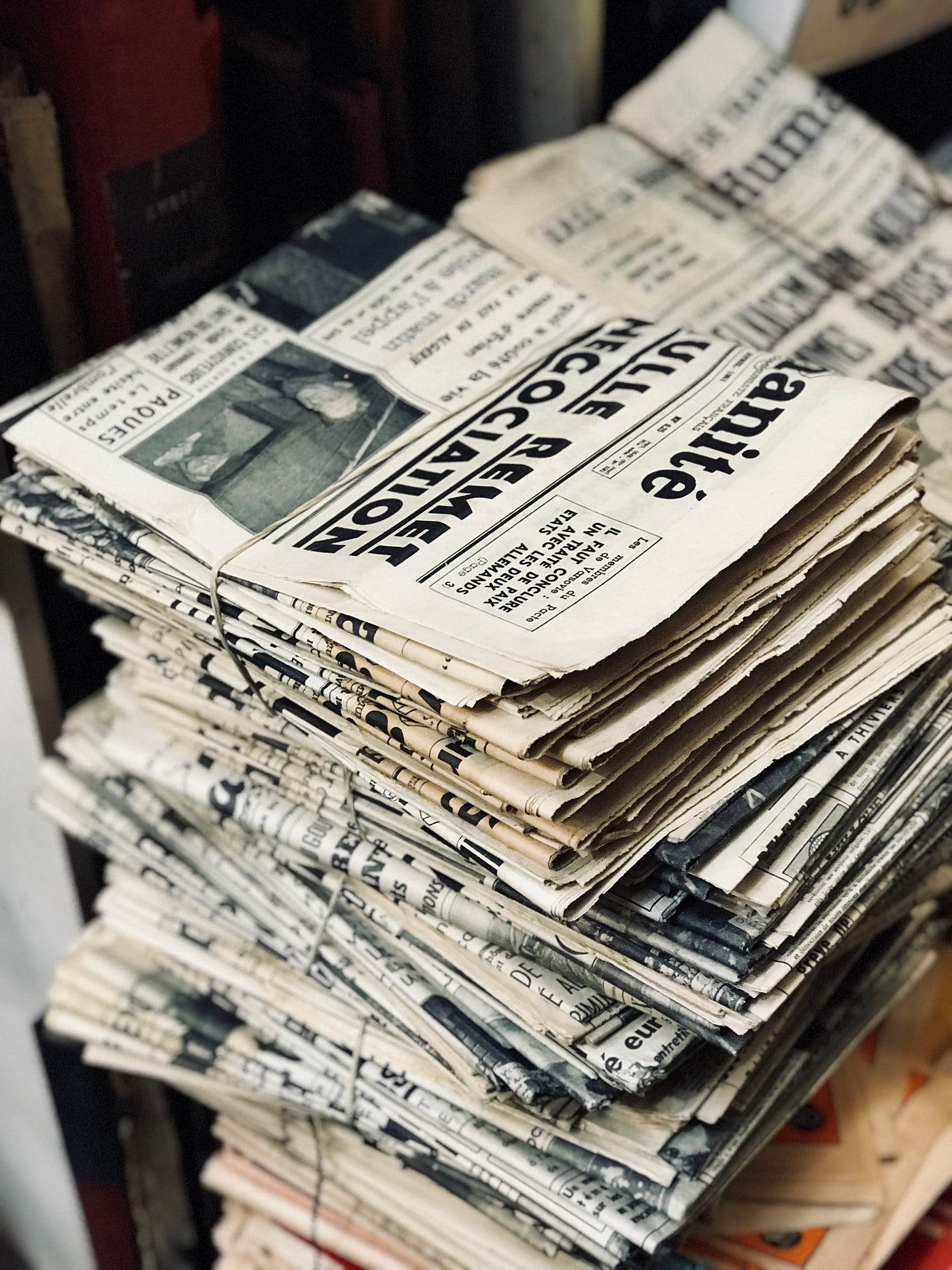
Photo: The Death of the Newspaper Industry | John W. Hayes)

Never-ending competition, a 24-7 news cycle and the disturbing rise of AI (artificial intelligence) all remain as threats to established and not-so-established news outlets.

And to top it off, reader trust in traditional news outlets is plummeting faster than shares of K-Mart stock.

In his Nov. 29, 2022 opinion column, Boston Globe columnist Jeff Jacoby pointed to a recent Gallup report, which revealed that just one out of three Americans claimed to have a “great deal” or a “fair amount” of confidence in the media.

We could talk all day about the national news scene and the spiraling demise of legacy media, but let’s take a deeper look at the news on a local level, right here where it hurts the most.

Today, almost everyone is a journalist – or so they believe. All you need is a keyboard and an internet connection and it’s off to the races.

While I love certain aspects of “citizen journalism” it does sort of invite a Wild, Wild West approach in reporting news.

While I love certain aspects of “citizen journalism” it does sort of invite a Wild, Wild West approach
in reporting news.

These citizens journalists typically do not have editors or the resources of an editorial board. They have no professional training. Ethics and objectivity are now electives, no longer requirements.

In other ways, however, these pesky citizen journalists and their social media followers do keep some much needed pressure on those Fourth Estate guys, the traditional legacy media outlets.

We’re not in Kansas anymore

Speaking of legacy, traditional media, the Bangor Daily News (BDN) – Maine’s preeminent source of political news – decided last week to shut down its editorial board. The paper will no longer have an Op-Ed (Opinion-Editorial) section.

I found that news strange. It struck me as counter-intuitive, especially since so many people are saying that readers are flocking toward opinion and away from objective news reporting.

In a Jan. 24 column, the BDN described the move as “the end of an era.”

Susan Young, the paper’s opinion editor, said the news was “bittersweet.”

“Far too few people read opinion content, so we have to try different things,” Young told me during an online conversation, saying the decision was influenced by the paper’s digital analytics.

The BDN’s decision will also mean the end of rigorous and highly regarded opinion columns from people like Amy Fried on the political left to Matt Gagnon on the political right.

Still closer to home, the publishers of the Biddeford-Saco Courier announced on Wednesday that they will now offer their subscribers a digital weekly update via email.

That “announcement” dropped exactly two weeks after I formally launched the Biddeford Gazette, a free digital newspaper dedicated to covering Biddeford news, opinion and events.

For more than 30 years, the Courier has relied upon free delivery of its print publication at newsstands or tossed into the driveways of private homes.

The Courier was founded and locally owned by David and Carolyn Flood. A few years ago, the paper was then sold to the owners of the Portland Press Herald who also own a number of weekly and daily publications.

Courier reporter Sydney Richelieu announced the “inaugural edition” of “Biddeford-Saco | Now” in an email sent to subscribers. The move, she said, is designed to offer readers another option in finding out what is happening in their community.

I have some unsolicited advice for Sydney and the Courier’s editors, please stop printing press releases and then labeling them with a byline of “Staff Reports.”

Otherwise, I am quite pleased that you guys finally want to step up your game in covering local news.

To be honest, I have a bit of an advantage over the other guys. I’m a Biddeford native and resident, and I have been covering Biddeford for nearly three decades. I have a stockpile of sources and lots of time on my hands.

Just a few days ago, a close friend of mine remarked that other local publications are now starting to pay more attention (deservedly so) to the city of Biddeford, since I launched the Gazette.

That’s actually really good news, especially for the people of Biddeford.

The other guys may not like the fact that I am now in the mix, but they should remember the folks at the Journal Tribune were none too happy when the Courier was launched in 1989; and the folks at the Courier were none too happy that Saco Bay News came along in 2019 and showed off the nimble advantages of being a digital publication.

Increased competition does not help the Courier, Saco Bay News or the Biddeford Gazette, but it does keep a fire lit under our asses; and that is good news for readers.

The people of Biddeford should not have to rely upon just one reporter for the news that matters to them.

Competition keeps reporters motivated, but more importantly – it keeps them in check.

The Biddeford Gazette is not trying to put anyone else out of business. In fact, the opposite is true.

The Biddeford Gazette uses its own social media pages on Facebook, BlueSky and X to round up and share local news stories from other media companies. No one else does that.

You read that right. We take the time to share news from the other guys on our social media pages. And when you click to read those stories, you are not directed to our website, instead all the postings will link automatically to whatever source produced the news, whether it’s Saco Bay News, the Courier or WGME-TV.

Please visit our new Facebook page and follow us to experience a new level of local news coverage.

Whenever or wherever news about Biddeford is published, we will be there to make sure you know about it.

That’s my mission. That’s my passion.

I value your trust.

I will not stop.

Never miss another update! Subscribe for free today!

Stop Making Sense: the birth and resurrection of a monster in Biddeford

Over the just the past few days, two journalists have reached out to me in order to criticize some things I’ve said on social media.

Ted Cohen, a former and respected reporter from the Portland Press Herald, and Ed Pierce, now the editor of the weekly Windham Eagle, both think I need some guidance.

Cohen was sincere and well-meaning with his criticism. We’ve known each other for more than 25 years. He raised some valuable points for me to consider. Pierce, however, was much less than cordial. He really, really does not like me.

In fact, during our back-and-forth exchange – while we were both hurling insults and snarky comments at each other on Facebook — Pierce decided to bring out the big guns and tried to publicly shame me about something I did when I was 12 years old, an incident that was on the front page of the Journal Tribune in 1976. (You can read about that incident here).

Cohen just thinks I am wasting my time and frittering away my resources as an old-school reporter. He thinks I should just “shut-the-fuck up” on social media and go back to being a full-time journalist covering the city of Biddeford. He does not like my blog posts about my struggles with mental illness, a topic he says “nobody really cares about.”

During a camping trip last weekend, I gave a lot of thought to the criticisms raised by both Cohen and Pierce. Again, I admire and respect Cohen. Pierce? Not so much. But I realized both men provided a glimpse into the viewpoints of many other people, especially in the Biddeford-Saco area.

Although I generally get a lot of positive feedback from readers, there are, apparently, a lot of people who are annoyed by what I write. Several people think I suck at journalism. Many others are bent out of shape and hate the fact that I am an administrator of the Biddeford-Saco Community Facebook page.

If you think my ego is hyper-inflated, and if you think that I have too much influence in the city of Biddeford and elsewhere, don’t blame me.

Put the blame where the blame belongs.

Blame David Flood. It’s all his fault.

It was David Flood who set this unfortunate series of events into motion. He created the monster that some of you despise.

David Flood Press Herald photo

Let’s pause and back up a bit for context.

A bad seed is planted

It was October 1998. I was sitting in my parked car (a 1987 rusting Subaru) on Washington Street in Biddeford, not far from the former Wonderbar Restaurant.

My stomach was in knots, and I was just starting my second pack of cigarettes that day. I really wanted this job. I really needed this job.

My life at that time was a giant, hot mess. I was basically broke, living in a studio apartment in Westbrook and had a credit score somewhere near the 300 mark.

I was 34 years old and considered myself a complete failure. No close family connections. Few friends, and not even a bank account.

I was working for another weekly newspaper when I interviewed for the job at the Biddeford-Saco-OOB Courier, a weekly publication that was then owned by David and Carolyn Flood.

The job appealed to me to me for two reasons. First, it seemed more interesting than the job I had covering the towns of Windham and Standish. I had grown up in the Biddeford-Saco area. My family had deep roots in both communities.

Secondly, the Courier position would pay roughly 50 cents an hour more than my current gig. That’s a difference of about $20 per week. When you’re flat broke, an extra $20 per week sounds really good.

I think David was impressed by my enthusiasm and the fact that I had experience. But I think what clinched the deal was that he recognized the value of hiring a reporter who had a basic understanding of the community he would be covering.

We shook hands, and I was set to start in two weeks so that I could give my current employer notice.

That was it. That was the moment when my entire life changed.

If not for David’s decision to hire me, I would not have met Laura who had decided several years ago to run for a seat on the Old Orchard Beach School Board. I would not have had the opportunity to help raise my kids, Tim and Matt.

If not for that job as a reporter covering Biddeford and Saco, it is quite likely that you would have never heard my name. More than 99 percent of the people I interact with on social media only know me because David Flood hired me as a reporter.

If not for David Flood’s decision, I would have never been hired a few years later by Barton & Gingold, one of Maine’s most respected political and public relations consulting firms. I would have never bought a house in Biddeford.

Had David Flood not hired me, it is more than likely that you and I would not know each other. So, if you find me insufferable or just plain annoying, blame David Flood. It’s all his fault.

Jumping in feet first

Just a few days before Halloween 1998, I hit the streets as the newest reporter covering Biddeford and Saco. Other than a couple of family members, I basically knew no one in the area.

The few friends I had at that time all lived near Portland. I grabbed a reporter’s notebook, a pen and an old camera on my quest to find a news story. I walked less than 20-feet when I bumped into a man wearing the costume of a deranged chef. He was holding a rubber chicken and a meat cleaver.

It was a Friday afternoon, and downtown merchants were participating in a Halloween trick-or-treat event. I asked the man with the rubber chicken if I could take his picture for the newspaper.

That man’s name was Brian Keely, the son of Vincent Keely who owned the Wonderbar Restaurant on the other side of Washington Street. Five years later, Brian Keely was the best man at my wedding.

Brian’s father sort of adopted me. Vincent always had a sly grin and had a mannerism that was both charming and subdued. Because the Wonderbar was near City Hall, it was a popular place for city councilors and other politicians to hang out after long, tedious meetings.

I spent a lot of time at the Wonderbar. Vincent Keely pointed me to some great stories. He knew almost everyone. He seemed to like me. Brian and I became good friends.

Back then, there was always a lot of drama at City Hall. The stories were easy to come by, but the competition was stiff. Every meeting was also attended by a reporter from both the Portland Press Herald and the Journal Tribune.

I was trying to establish myself and pushing to make the weekly Courier the paper of record in Biddeford and Saco.

I worked my ass off. We gave the Journal and Press Herald a run for their money. A few months later, David gave me the first of several pay raises. It was February 1999, and I received a notice from Northern Utilities that my heat was going to be turned off.

Without me asking them, David and Carolyn paid my overdue heating bill. They never asked for repayment. You never forget things like that. I was battling with some severe depression back then. David and Carolyn basically saved my life.

It was there and then that I decided I would treat the Courier as if I were its owner. I didn’t work 40 hours a week. I worked, 60, 80 hours a week. Sometimes more. It didn’t matter. The Courier was not my job.

The Courier was my life.

The beginning of the end

Eventually, I became the Courier’s editor. David and Carolyn were kept busy as their company grew by leaps and bounds. They soon added the South Portland Sentry and the Kennebunk Post to their existing publications, which included the Courier and the Scarborough Leader.

It was at about this time that I approached David and asked permission to begin a weekly opinion column, which would focus on statewide politics. He agreed. The name of that column was called All Along The Watchtower.

To this very day, people routinely tell me how much they loved that column, which had morphed into a catch-all of snarky local political commentary.

Doug Sanford offered me an apartment on the third floor above the Happy Dragon restaurant on Main Street in Biddeford. I now lived and worked on Main Street. I was immersed into Biddeford’s culture.

I became a fixture at City Hall and regularly annoyed local politicians including former mayor and city councilor Jim Grattelo, who repeatedly asked David to fire me.

Brian Keely and I started a live call-in television program on the public access channel. The name of the show, of course, was called Along the Watchtower, and it was a live, no-holds barred hour-long program about local politics.

I could keep going and going, but that’s basically it. That’s how it started. The staff at the Journal Tribune didn’t much care for me. Their days were numbered, and they knew it. Reporters at the Press Herald’s Biddeford bureau respected my work ethic but kept their distance.

David promoted me to become managing editor of all his publications.

I left the newspaper business in 2006 to pursue a career in political consulting. A few years later, in 2011, former Biddeford city councilor Alan Casavant asked me to be his campaign manager. He wanted to oust incumbent mayor Joanne Twomey.

We won that campaign by a margin of more than 65 percent. I repeated my role in Casavant’s re-election in 2013; and I helped with his next four campaigns.

Serving as master of ceremonies at Alan Casavant’s inauguration in 2011

In 2001, a woman named Laura Kidman Hayes sent me a curt e-mail, pointing out that I screwed up in my coverage of the pending election in Old Orchard Beach. I responded with a pithy and sarcastic retort.

She lost that election, and we were married less than two years later. The next year, we bought our home in Biddeford. A few years later, she won a seat as an at-large representative on the Biddeford City Council. She easily won reelection for a second term.

I missed writing about Biddeford politics and started this blog. A couple of years ago, I agreed to do some freelance writing for Saco Bay News. I had to step away from writing about Biddeford news a few months ago, however, because of a conflict of interest. I also can no longer write about Saco politics because my stepsister is now that city’s mayor.

So today, I continue to run my own, very small consulting business and write this blog and occasionally write puff pieces and feature stories for Saco Bay News.

A moment of clarity

Let’s get something straight right now. I no longer consider myself to be a professional journalist. I share personal opinions and observations on social media. I am basically a semi-retired consultant. That’s it.

You should also know that I am not very bright as I outlined in a prior blog post from two years ago.

I do enjoy public feedback — the good, the bad and the ugly. You can find samples of that criticism on this site. Maybe your criticisms can someday make that list.

To Mr. Cohen, I say, thanks, but no thanks. I’d rather be a free-wheeling blogger than a full-time journalist.

To Mr. Pierce, I would say . . . dude, you have a serious anger management problem, and you should really get some professional help.

To Jim Grattelo, I would say: remember what Obi-Wan Kenobi said to Darth Vader, if you strike me down, I will only become more powerful.

To the rest of you, thank you so much for taking the time to read my stuff. It means the world to me. To think that you give up even a few minutes of your day to engage with me is almost beyond my comprehension.

Finally, to David and Carolyn Flood, you guys not only saved my life, but you gave it meaning. I know I that I often drove you guys nuts, but please never doubt how grateful I will always be.

Never miss anther installment of Lessons In Mediocrity. Subscribe now for free!

Goodbye Stranger

reporterI want to scream.

In a world chock full of culprits that are partially responsible for everything from the “dumbing down of America” to the nomination of Mitt Romney and the advent of Twitter, it’s become increasingly difficult for me to stomach the banality associated with blaming “the media.”

While media criticism is important and necessary, a lot of people who blame “the media” have no idea what they are talking about.

Instead, blaming “the media” has become a catch-all phrase and a convenient target for those who want to ignore two very much larger problems: laziness and stupidity.

There is no question that media has changed, but I challenge you to define the word in its present-day context.

Sure, we can turn to the dictionary and find this: media: (noun) 1.) plural form of medium; 2.) the main means of mass communication (esp. television, radio, newspapers, and the Internet) regarded collectively.

Media, whether it’s a daily newspaper, the evening television news, a blog or something that a “friend” posts on his Facebook page, is multi-faceted, multi-layered and increasingly accessible to every person on the planet.

That’s not necessarily a good thing.

Blaming the media is sort of like blaming your reflection in the mirror for having that fifth margarita or being late to work. Too often, blaming the media is just a convenient form of mental masturbation that serves no good purpose except helping you sleep better at night.

The good ol’ days?

The opening pages of the book Leaving Readers Behind: The Corporate Age of Newspapering contains this stunning contrast of two very different media mission statements:

This is the Journalist’s Creed written by Walter Williams in 1914:  I believe in the professionalism of journalism. I believe that the public journal is a public trust; that all connected with it are, to the full measure of their responsibility, trustees for the public; that acceptance of lesser service than the public service is a betrayal of this trust.”

And this is the Statement of Strategic Intent issued by Knight Ridder Newspaper Corp. in 1991:  We stand for excellent  service to customers and communities, a fair, respectful and learning environment for all our employees and a strong return for our shareholders. This responsibility is shared by each of us in Knight Ridder, regardless of title or function.”

So it seems easy to be cynical about the so-called “mainstream media” or as Rush Limbaugh describes it: “the drive-by media.”

Oh, how we long for the good days of journalism; the fair and balanced reporting and the loyalty of preserving the public trust. Too bad it’s gone right?

Wrong.

We are surrounded and inundated with loads of good journalism and a diversity of media that is unparalleled and will be surpassed in its diversity in less than 15 minutes.

Before you moan about the demise of media, or the sentimental loss of the warm and fuzzy images of Walter Cronkite and the proverbial grumpy editor such as Ben Bradlee, chew on this: Why haven’t you switched the channel?

Try it, you’ll like it

Better yet, what’s stopping you from being the media? It’s probably the same four things that stop most media endeavors: Money, Time, Resources and Audience.

Sure, go ahead and bitch about advertiser supported media, but how are you going to pay your reporters?  For those of you who will predictably point to examples such as “listener supported” public broadcasting, you may have missed those corporate announcements at the beginning of each segment.

Without corporate and taxpayer subsidies, National Public Radio would be nothing more than a distant memory because the vast and overwhelming majority of its listeners don’t dig very deep into their own pockets.

Yeah, and state-sponsored media is a sure-fire way to ensure credibility and a lack of bias. I mean, really . . . what would could possibly go wrong if we let the government report to us about the government?

I find it annoying that the bulk of those who bitch about the media have spent zero hours in a newsroom nor  ever required to sit through three hours of a planning board meeting while earning slightly more than minimum wage.

Pull back the curtain

Of course, no one loves to talk more about the media than the media. They are a narcissistic lot, full of righteous indignation. I know this because many of my friends and former colleagues still work in the media. God bless them.

These folks are professionals, but they are no different from anyone else and subject to all sorts of the very same pressures you will find in any other profession: gossip, bias, greed, competition and ego.

A few weeks ago, I found myself on the phone with one of the editors at the Portland Press Herald. I was calling on behalf of one of my clients and asking for a favor.

The editor was a bit pissed off about my intrusion, and he didn’t try very hard to mask his annoyance: “Randy, you used to be a journalist, how can you ask me a question like that?”

Surprisingly, he accepted my honest response. “I’m not a journalist anymore, and you know damn well my current occupation requires me to ask the question even though I know you are going to refuse my request.”

That honest exchange led to a compromise we could both live with: he did not budge and I accepted his decision.

Where’s the good media?

As I said before, we are surrounded by some excellent examples of journalism. A couple of weeks ago, I picked up a copy of the Southern Forecaster newspaper. That free, weekly newspaper was chock-full of solid community-based reporting.

There was an in-depth, comprehensive story about growing tensions between the Scarborough Rod & Gun Club and a group of neighbors who chose to build their homes near the club. It was a universal story about the themes of gentrification and it made me think about the tension in my own community between those who use the Biddeford Airport and their residential neighbors.

Another front-page story examined the plight of the South Portland City Council in light of a recent court decision that would allow municipal employees to serve on municipal boards and committees. Again, the same dynamic is an issue in my own community.

The Forecaster group of newspapers is one of the few remaining Maine-owned media outlets, and its staff seems to understand the importance of digging deep and solid reporting. Mo Mehlsak is the editor of the Forecaster. I remember him from his days as the city editor at the Journal Tribune. He is a newspaperman’s newspaper man: tough, intelligent and insightful. I never had the pleasure of working with him, but I have admired his work for nearly 20 years. He is obviously grooming an exceptional staff of reporters.

Speaking of the Journal Tribune, Tammy Wells has been covering York County issues longer than anyone else. She offers her readers a ton of institutional memory and insight.

When it comes to unbiased reporting and a willingness to cover stories in-depth, check out the work of my former colleague, Kate Irish Collins, a reporter for the Saco-based Sun Chronicle, part of Current Publications, another Maine-owned media outlet. No one person can come close  to matching Kate in producing such a volume of news content with consistent accuracy and lack of bias.

My friend Kelley Bouchard at the Portland Press Herald consistently delivers solid reporting and poignant features. She led off her newspaper’s insightful (and painful) examination of Maine’s aging population. The Challenge of Our Age.

On Election Night, every political junkie in Maine turns to the exceptional coverage provided by the Bangor Daily News.

And if you’re looking for a good compilation of Maine news and opinion, check out Bob Mentzinger’s  Writing Maine feed. Mentzinger is a close friend, but he’s also the editor at the Brunswick Times Record, another afternoon daily that strives every day to produce exceptional journalism on a shoe-string budget.

Yes, there is plenty of room for media criticism, and Al Diamon does an exceptional job of keeping Maine’s media outlets on their toes with his sometimes harsh, yet consistently detailed analysis that can be found in his weekly Media Mutt column published at The Bollard.

These are just a few samples that show it’s not hard to find solid journalism in Maine or anywhere else. You just have to look for it.

The next time you feel like bitching about the media, go take a long, hard look in the mirror and ask yourself this: are you part of the solution or part of the problem?