By RANDY SEAVER
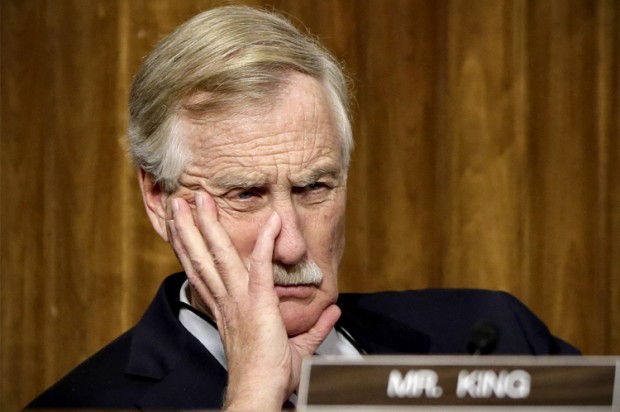
In just a few weeks, someone else will be leading the state of Maine, and Gov. Angus S. King, Jr. seems grateful that his two terms in office are about to end. He has granted this one-on-one interview between two speaking engagements, and although it is relatively early in the morning, the state’s 71st governor looks tired.
King won his first bid for public office in 1994 and was re-elected in 1998 by one of the largest margins of victory in the state’s history. He is one of the only two independent governors in the country, and the second in a state known for its quirky political trends.
According to the state’s website, King, 58, graduated from Dartmouth College in 1966 and the University of Virginia Law School in 1969. He began his career in 1969 as a staff attorney for Pine Tree Legal Assistance in Skowhegan. In 1972, he became chief counsel to the U.S. Senate Subcommittee on Alcoholism and Narcotics in the office of then-Senator William D. Hathaway. In 1975, he returned to Maine to practice law and began his almost 20 year-stint as host of the television show “Maine Watch” on the Maine Public Broadcasting Network. In 1983, he became vice-president and general counsel of Swift River/Hafslund Company, an alternative energy development company based in Portland and Boston.
You have offered to help negotiate a solution to the problems Biddeford and Saco are facing with Maine Energy. Are you optimistic that even a dialogue between all the parties can be successful?
“I’m optimistic that anything can happen if people sit down and talk with one another, and that’s what I’m hoping can happen here. I have met with the mayors, the city councils and members of Twin Cities Renaissance and representatives from the company . . . and there at least seems to be some movement toward some direct discussions. And I don’t understand why that should be difficult. If George Mitchell can facilitate discussions about a peace process in Northern Ireland, then I don’t know why we can’t do it.
“I don’t know if there is a simple solution to this because you have a large plant with a large capital investment in the middle of a community, and basically — the community, or at least a significant part of the community wants it out; they certainly want the impacts minimized. I don’t know if there is an answer, but we’ll never know unless we try to find it.”
Some legislators have criticized you because you went forward with your computer laptop program, despite facing a projected $240 million budget shortfall. It’s obviously an important program for you, but shouldn’t it have waited, considering that the state’s General-Purpose Aid for education was cut?
“It’s not an important program for me. It’s an important program for the state. The cost is relatively minor when considering the overall education budget, and I think that’s a point that has sort of been lost in all of this.
“The cost of the laptop program is about $9 million a year. The total school budget in Maine is about $1.8 billion a year, which means that it’s one half of one percent of the overall school budget. And yet, it [the laptop program] has the potential to fundamentally change our standing and how our state is perceived by the rest of the world.
“It’s really a question of bang for the buck. The educational benefits of this program are so far out of proportion to a one half of one percent expenditure that it would be just . . . . . . short-sighted is too mild a word . . .for what it would mean to stop it; particularly now that it’s actually in place and people can go see how it works.
“Before, I was arguing for it sort of in the abstract. But now, everybody in Maine can walk down to their local seventh grade [classroom] and talk to their teachers and students and see what’s happening in the classrooms, which is absolutely extraordinary. I have received unsolicited letters from seventh-grade teachers saying, ‘We were opposed to it. We didn’t think it was a good idea, and now we think it’s the most important educational initiative in our lifetimes.’”
“It is really huge, and it has the potential to really leapfrog Maine . . . in terms of where we stand in the world. The other thing that’s sort of frustrating is to read about legislators and legislative candidates saying this isn’t a good idea and we ought to kill it. Everybody in the world is watching this project.
“Within the last month, we’ve had a delegation here from Edinborough, Scotland, including two members of their city council, their superintendent of schools and two [school] principals. They flew all the way here to see this project, and there are some legislators I can’t get to walk across the street to see the project. That’s pretty frustrating.
“We had a delegation from France come to look at it last week. This week, we have a delegation, including the premier from New Brunswick, coming to look at it. We have many states that are interested in it And yet, here we are: arguing about whether to continue.
“All I ask is that people actually take a look at what’s happening and then make a judgment, in terms of other educational expenditures. What could you use $9 million for, one half of one percent, that would have this kind of impact? And the answer is . . . I can’t come up with anything. What is one half of one percent? Is that snowplowing or cleaning materials?
“GPA (general purpose aid for education) is now up to $730 million a year. Teacher pensions are costing the state $900 million a year. This is only one percent, less than that, really, of the whole state budget for education.”
You have also been criticized about instituting state employee furlough days. Some have said that such a program costs more money because of necessary overtime expenses and lost productivity.
“Here’s a case where we had a serious budget problem, and . . . I didn’t think that state employees could be immune from the impacts. People in the public were saying to me, ‘lay them off.’ The three furlough days this year saved us from having to lay-off about 150 people permanently. That was the choice that I had.
“I felt it was less disruptive to have everybody have a little pain, then to have some people really be devastated. That was the decision.”
Why are we having budget difficulties?
“In some ways it’s complicated, and in other ways it’s really quite simple. If you read headlines that say, ‘Stock market up, unemployment down, incomes growing,’ we’re going to have all the revenues we want and need. If you read headlines that say, ‘Stock market at a five-year low, unemployment rate up, incomes stagnant,’ the revenues are going to be down. We are inextricably linked to the overall economy.
“Right now, we’re in a situation in which we’ve had the largest drop in the stock market since 1929. We had Sept. 11. We’ve had a recession that really won’t go away; it’s now one of the longest we’ve had in 20 years, since the early 1970s. And all of those things combined mean that the state is going to be getting less revenue.”
What will your advice be to the next governor?
“We have to prepare a budget between now and December and then essentially turn that over to whomever is elected. And then they’ll have about two months or six weeks to put their stamp on it before they submit it in February.
“My advice to my successor is that they should look for savings wherever they can. They’re going to have to look at our tax structure,. . . so much depends on what the economy looks like. We had a forecast last week that said things were basically worse than we thought, and then on Friday we got economic data from the federal government that said things are better than we previously thought.
“I think [the next governor] will have some hard decisions to make.”
What are your plans for after you leave office?
(Smiles) “Oh, that I can tell you. Mary and I have bought a very large R.V. It’s parked in my front yard. In fact, it’s become my front yard. Mary and I and the kids, who are 12 and 9 (Benjamin and Molly), are going to leave the day after I leave office. We’re going to see the country. We’re going to take about 5-1/2 months, and be back in May or June sometime.
“We’ll go to the Grand Canyon, Mount Rushmore, Glacier National Park and all those places I wish I had seen when I was a kid. And I think it’s okay when my successor takes over, not to have me around as he works through some of the issues he’ll be dealing with. I’ll be away.
After that, we’ll come back to Maine. We’ll continue to live in Brunswick. I have, really honestly, I don’t know. . .I’m not trying to be coy. . . I just don’t know, maybe teach or write . . .I’m just not sure.”
Your proudest accomplishment?
“It’s hard to say because only time will tell. I’ll be honest with you, and I haven’t said this before . . . this computer thing may turn out to be huge. I think it’s bigger than I thought. And it really does have the potential to change things. This thing has enormous potential.
“And I think, if I’ve accomplished anything . . . I am very proud of a lot of specific things. . . the computers, learning results, land conservation, job growth; 75,000 new jobs, first in the nation law on dioxin . . .
“Looking back on this era, it may be that the most important contribution I’ve made is toward Maine’s attitude toward itself. I’ve tried very hard to communicate a message of optimism and possibility to Maine people. We can compete, and we don’t have to apologize and feel as if we are unable to stand with the best.
“I think a leader has a lot of responsibilities; I think there’s a psychological, emotional intangible aspect to being a leader. And maybe that’s why I’m so passionate about the casino issue, because it’s so inconsistent with what our state is. We truly live in a great place.”









 LESSONS IN MEDIOCRITY | OUTLAW JOURNALIST