Smokin’ In The Boys’ Room

It’s really not that surprising, and I’m not so sure that I disagree with Maine Governor Janet Mills.

Here’s the set-up: Maine Democrats – who have majority control of both chambers in the State House – are in a tough spot.

Why? Because there is a possible and significant state budget shortfall on the horizon.

To pay for everything their party approved last year, and to keep pace with the additional spending the governor wants — not to mention that Mills’ latest budget proposal is roughly 10 percent higher than the last biennial budget — the Democrats are going to need to find some new revenue.

Stat!

And where is the easiest place to find new tax revenue without inciting street riots from Sanford to Caribou?

You go for the low hanging fruit – a.k.a. the people who don’t have a team of lobbyists and consultants in their back pockets; the people easiest to demonize.

You go for the smokers. Nobody – except other smokers – really likes cigarette smokers. They stink, they tend to be less educated and low-income workers. . . you know? . . . the very same people that Democrats claim to love and care for so dearly.

Although no can really blame Republicans for crowing about this targeting of low wage earners (Why not? It kind of makes Democrats look bad) but there is plenty of hypocrisy here for the Maine GOP, as well.

Sure, sure, sure . . . Mills has also set her sights on some other relatively easy targets for additional revenue.

After all, we can’t expect the smokers to live long enough to become a reliable revenue stream for our ever-increasing state budget. Many of these folks can’t even walk down a grocery aisle without coughing and feeling out of breath.

In addition to an increased cigarette tax, Mills and her gang are also eyeing increased taxes on streaming services such as Netflix and Spotify; as well as a four percent increase on cannabis taxes.

Nobody – except other smokers – really likes cigarette smokers.

That’s okay. The stoners won’t even notice that they are paying more for weed while watching back-to-back reruns of Breaking Bad.

Right on cue, Republicans have stepped forward to skewer the governor for supposedly hurting the very same people she claims to care so much about.

“We’re already one of the highest taxed states in the country so we don’t see a need to increase any taxes,” House minority leader Rep. Billy Bob Faulkingham said, according to a story filed by WMTW-TV.

In that same news story, Mills defended her decision to go after smokers for additional revenue.

“Let me just say Maine has the highest adult smoking rate and the second highest youth smoking rate in New England, Mills told reporters. “We also have the cheapest cigarettes of nearly every state in New England, and we haven’t raised the cigarette excise tax in two decades.”

In her defense, Mills makes some excellent points.

There is no question whatsoever that people who smoke on a regular basis are much more likely to develop serious health problems.

According to the Centers for Disease Control, cigarette smoking cost the United States more than an estimated $600 billion in 2018, including more than $240 billion in health care spending.

They say that no one is more stridently opposed to cigarettes than former smokers. That may be true.

Up until just a few years ago, I smoked more than two packs of unfiltered cigarettes every day. It was a habit I started during basic training in the U.S. Air Force. The guys who smoked got frequent breaks while the rest of us did not.

When I quit smoking in 2016, the owners of 3Ds Variety on Main Street in Biddeford filed for federal relief funds to help offset the loss of revenue. (Relax, that is a joke). At that time, I was spending roughly $20 per day to support a habit that benefitted no one, especially me.

Last year, I did some rough calculating. By quitting smoking, I saved more than $45,000. But by then, some irreversible damage had already been done.

I lost several of my upper and lower teeth near the front of mouth. Remember that kid playing the banjo in the movie Deliverance?

Yeah, well — that kid has more of his teeth than I do. I will have to wear partial dentures every day for the rest of my life or figure out how to consume all my meals through a straw.

I don’t blame the Air Force or the R.J. Reynold’s Tobacco Company for the damage I caused by choosing to smoke.

I am also not holier than thou when it comes to addictive behavior. If I found myself unhoused, with no family, no car and sleeping outside in freezing weather, I’m pretty sure that I would pick up the habit again.

Yup, smokers have a pretty weak lobby in the Legislature. And most people – Democrats and Republicans — will likely support a tax increase on cigarettes.

As the old saying goes, “smoke ‘em if you got ‘em.”

Editor’s Note: If you or someone you know wants free help in quitting smoking, please visit the Maine Quit Link

Never miss another update! Subscribe for free today!
Hello, Goodbye

Dear readers,

Once again, I have some good news and some bad news. Let’s start with the good news.

Roughly 24 hours ago, Laura told me it was time for me to get a bit more serious about the Biddeford Gazette, an online multi-media news source focused on the city of Biddeford.

Instead of trying to run the Gazette as a subpage here — on my personal blog site — I went ahead and purchased a new domain so that the Gazette could stand on its own without all the clutter and distraction of my blog, Lessons in Mediocrity.

Going forward, as time and funding allows, I will be making enhancements to the Biddeford Gazette site to improve its functionality and design.

My goal is to give you an alternative and comprehensive overview of what is happening in the Biddeford area.

Now the bad news.

As I continue working to build the Biddeford Gazette, I am going to need your help. Mainly, I’m hoping you will subscribe (for free) and follow us on social media.

By subscribing, you will get an email update every time a new story is published. Your email address will NOT be shared with anyone else. Go here to subscribe.

I hate to be a pain in the ass, but if you are already a subscriber of my blog, you will need to subscribe separately to the Biddeford Gazette. It’s free and it’s worth it.

Throughout all of this, I will continue my blog on a more personal scale. To learn more about the Biddeford Gazette go here.

As always, thank you so much for reading!

Free Fallin’

I have never been so ashamed to be a resident of Biddeford, Maine as I am tonight.

What I witnessed during this evening’s city council meeting was a complete and utter failure of leadership, morality and principles.

Tonight, the city council and Mayor Marty Grohman found a way to screw over a local businessman who, ironically, was just trying to help the city help our unhoused neighbors.

Tonight, the city sent a signal to every resident, business owner and potential resident: Welcome to Biddeford! We don’t pay our bills!

Gotta hand it to our courageous leaders. They finally found a way to save taxpayers some money. We just won’t pay our bills.

Sure, Biddeford was recently  featured in Good Housekeeping magazine for its Christmas “vibe.” Even a Boston news station plugged the city as a top destination.

Well laddi, laddi da! Isn’t that precious?

Sip your fucking cocoa, marvel at the white lights strung along Main Street, and poop unicorn dust in the Lincoln lobby, but never forget that this is also a city being run by an incompetent, self-absorbed moron.

Why am I pissed?

If you don’t know him, Jim Godbout is the owner of Godbout Plumbing and Heating, one of the most respected local companies in southern Maine.

Jim Godbout/ File Photo

Jim is, perhaps, one of the most decent, kind, generous and hardworking guys you could ever hope to meet. Earlier this year, I listed him as one of the 20 most influential people in the Biddeford-Saco area.

Godbout is always ready to help the community, and he is damn good at rallying other business leaders to pitch in and make seemingly impossible dreams possible.

For example, Godbout led the effort to save and restore Waterhouse Field. As a recognition for his civic leadership there is a street named in his honor next to the field.

Jim has also been leading the renovations at the former St. Andre Church into a community teen center. He is involved in working with students at the Biddeford Regional Center of Technology.

And recently, he again agreed to help the city by providing bare-bones pricing for necessary renovation work at the Seeds of Hope Neighborhood Resource Center.

That renovation project was spearheaded and rushed through by Mayor Marty Grohman and City Manager Jim Bennett.

After all, the city needed some good PR after demolishing a homeless encampment on Water Street near Mechanic’s Park earlier this year.

The city wanted to make sure some homeless advocacy group didn’t sue us for removing homeless folks without providing an option for somewhere better where they could safely spend the night.

The city manager assured the council earlier this year that the cost of upgrading the Seeds of Hope Building would be covered by Community Development Block Grant (CDBG) funds. Yippee! Free money from the federal government, Bennett assured us. Taxpayers will not feel a pinch.

Oopsie! Something went wrong.

Get Ry Cooder to sing my eulogy

Apparently, the renovation work at Seeds of Hope proved to be more intense than what the city thought it would be. There were problems with the roof and even bigger problems with windows that were literally falling out of the building.

No worries, the city and its contractors pushed forward. They did a truly awesome job. The Seeds of Hope is now able to serve more people although the demand for their service is exploding.

Once the work was finished, Godbout, following an agreed upon budget cost, sent an invoice for his crew’s work, a total of about $655,000.

But the city found out that they could not use CDBG funds for the project.

And then there was silence.

A few days ago, on Nov. 4, Godbout sent a note and a copy of his invoice to Vassie Fowler, executive director of the Seeds of Hope.

“Vassie, please forward [this invoice] to the city as they had promised the funding for this project and have not come through with anything. I am carrying a lot for them making them look good having a warming center open in time for bad weather. Thanks, Jim.”

Godbout was unavailable for comment at press time, but here’s another glimpse at what kind of man Godbout is.

Godbout told the city that he would settle for $400,000 and go out to the community and run a fundraising campaign to cover the remaining $255,000 balance.

Let me say that again slowly. Godbout – a man who is getting screwed by the city – said he will settle for about 60 percent what was owed to him and would raise the remaining balance by coordinating a community fundraising drive.

So, taxpayers have to come up with $400,000 and then likely be called upon to donate to a fundraising campaign for the project.

Kids, you can’t make this shit up.

And the council bought it. Hook. Line and Sinker.

Although Council President Liam LaFountain made a motion to pay Godbout the full amount, only Councilor Marc Lessard voted in favor of paying Godbout every penny of what he is owed.

In the end, the council voted unanimously for the less painful option, even knowing that Godbout is paying interest on a loan he used to finance the work.

Godbout will get $400,000. He will have to raise the rest from the community.

Imagine when you get your next tax bill. Just tell the city to fuck off. Tell ‘em you’ll pay 60 percent of their debt and have Mayor Grohman open a lemonade stand to make up the difference.

If you don’t pay your taxes, the city will take your property. But if the city owes you money . . . sorry, Charlie.

What kind of message does this send to the larger world? What contractor will ever want to do work for Biddeford? Will this impact our bond rating?

Sure, come to Biddeford, visit the glorious Lincoln Hotel and fart hot cocoa from your ass. But when it gets right down to it. When our backs are against the wall. When there are no more shell games to play, this is a city that doesn’t pay its bills.

No wonder we just lost another finance director after only seven months on the job.

I have been covering Biddeford City Hall for nearly 30 years. This is an all-time low.

Lessard summed up his frustration with yet another of his famous pithy quotes. “I expected the city manager to be driving the car on this issue. Apparently, that car doesn’t have a steering wheel.”

And where was our illustrious lame-duck city manager? Reportedly he was home, still recovering from shoulder surgery.

I am ashamed to be from Biddeford tonight.

Never Miss Another Installment of Lessons in Mediocrity! Subscribe for free today!

A Hard Day’s Night

No one can deny that the city of Biddeford – once derided as “Trash-town U.S.A.”  — has today become an unlikely hip destination for young adults and others who enjoy an eclectic array of craft breweries, a diverse culinary scene and dozens of boutique shops and businesses that offer everything from gourmet cheeses to hand-crafted outdoor gear.

In fact, several national publications that cater to the promotion of unique culinary delights and a creative economy all point to the city of Biddeford as a place to be for young, urban professionals.

A photo from the Heart of Biddeford website

Not surprisingly, the city of Biddeford is today Maine’s youngest city, according to the U.S. Census Bureau.

What a change 23 years make, but that change wasn’t easy — and it does come with some equally undeniable consequences.

More about that in a moment. First, a bit of disclosure.

Over the past few weeks, I have been sorting through hundreds of stories I have written about Biddeford since the mid-1990s as part of the redesign and launch of this website, Lessons in Mediocrity.

From 1998 until 2002, before I met my wife, I lived in downtown Biddeford; on the third-floor above the Happy Dragon Restaurant on Main Street.

I also grew up in the Biddeford-Saco area. My family goes back four generations in this community. My wife, a former Biddeford city councilor, and I have been living at our home on Lamothe Avenue for just over 20 years.

After my time at the Courier, I continued to write/blog about the city, its politics and people. As a policy consultant, I worked on several local campaigns and issues. My kids went to Biddeford schools.

I also served on the Biddeford Airport Commission, the Downtown Development Commission and the Biddeford Zoning Board of Appeals.

Today, I keep my toes in the water by working as a free-lance writer, still writing about Biddeford for Saco Bay News.

You get the point. I have a close connection to Biddeford, a community I love and care about deeply.

Why am I sharing this now?

When we look at the city of Biddeford today, I think many of us tend to forget the challenges the city was facing then, when we literally burned our trash in the middle of downtown.

When I joined the Courier in 1998, my boss and publisher David Flood was already an ardent and outspoken booster for downtown Biddeford.

David – unlike me and several other people – saw big potential in Biddeford’s downtown, despite some overwhelming challenges that included the presence of a downtown trash incinerator and significant socio-economic hurdles.

In fact, David  – who was recently inducted into the Biddeford Hall of Fame — was one of the original founders of the Heart of Biddeford, a non-profit organization established in 2004 with a mission to promote economic development and improve quality of life in the city’s downtown area.

While former mayor Alan Casavant receives a lot of credit for the revitalization and renaissance of downtown Biddeford. It was actually former mayor Wallace Nutting who got the ball rolling, some seven years before Casavant was elected as mayor.

Nutting a retired four-star general and native of Saco, also had a strong vision of what downtown Biddeford could become.

Although Nutting, a former Pentagon official who served as a senior advisor to President Ronald Reagan, was one of the smartest, most distinguished and accomplished people I ever met, I thought he was off his proverbial rocker when he started talking about the city’s beleaguered downtown as a “destination for arts, culture and local shopping.”

But Nutting and Flood were not alone. The former mayor also tapped several other like-minded citizens to join him on his newest crusade. Ed Caron, a Biddeford attorney; Renee (Potvin) O’Neil, the woman who basically spearheaded the renovation of City Theater, and Donna Tippett all volunteered to help.

Nutting, the man who previously led the U.S. effort to extricate Manuel Noreiga out of Panama, had a new mission.

Failure was not an option.

What this core group – and later several other volunteers, business owners and residents – accomplished was nothing short of amazing.

But hindsight is always 20/20. It took years, taxpayer funding and political willpower to transform downtown from a neglected hodgepodge of businesses to one of the most vibrant cities in Maine.

Now back to those unintended consequences.

Biddeford After Dark

In the autumn of 2001, while working for David and Carolyn Flood, I decided to write a five part-series about downtown Biddeford, but with a twist.

My Biddeford After Dark series would explore the city’s then gritty downtown area during the overnight hours.

I would write about the punks who congregated at the 7-11 store near the intersection of Jefferson and Alfred Streets; I would ride along with third-shift Biddeford police officers and I would interview the late-night workers, including the supervisors at the MERC incinerator.

I don’t think David was crazy about my idea. I think he was concerned that my series would only perpetuate negative stereotypes about the city of Biddeford.

But – as was so often the case – David game me a wide berth and lots of latitude in running the newsroom.

At that time, I was living and working in downtown Biddeford. I didn’t write the series for overtime pay or to avoid my daytime responsibilities as the Courier’s editor. I was single. I lived alone. I did it for fun.

An excerpt from that series: “As I walk along Lincoln Street — past a tired wrought-iron fence that is leaning and lurching in places — I can almost hear the ghosts of the past. They call to each other, unloading bales of cotton, smoking cigarettes and wiping the sweat from their brows.”

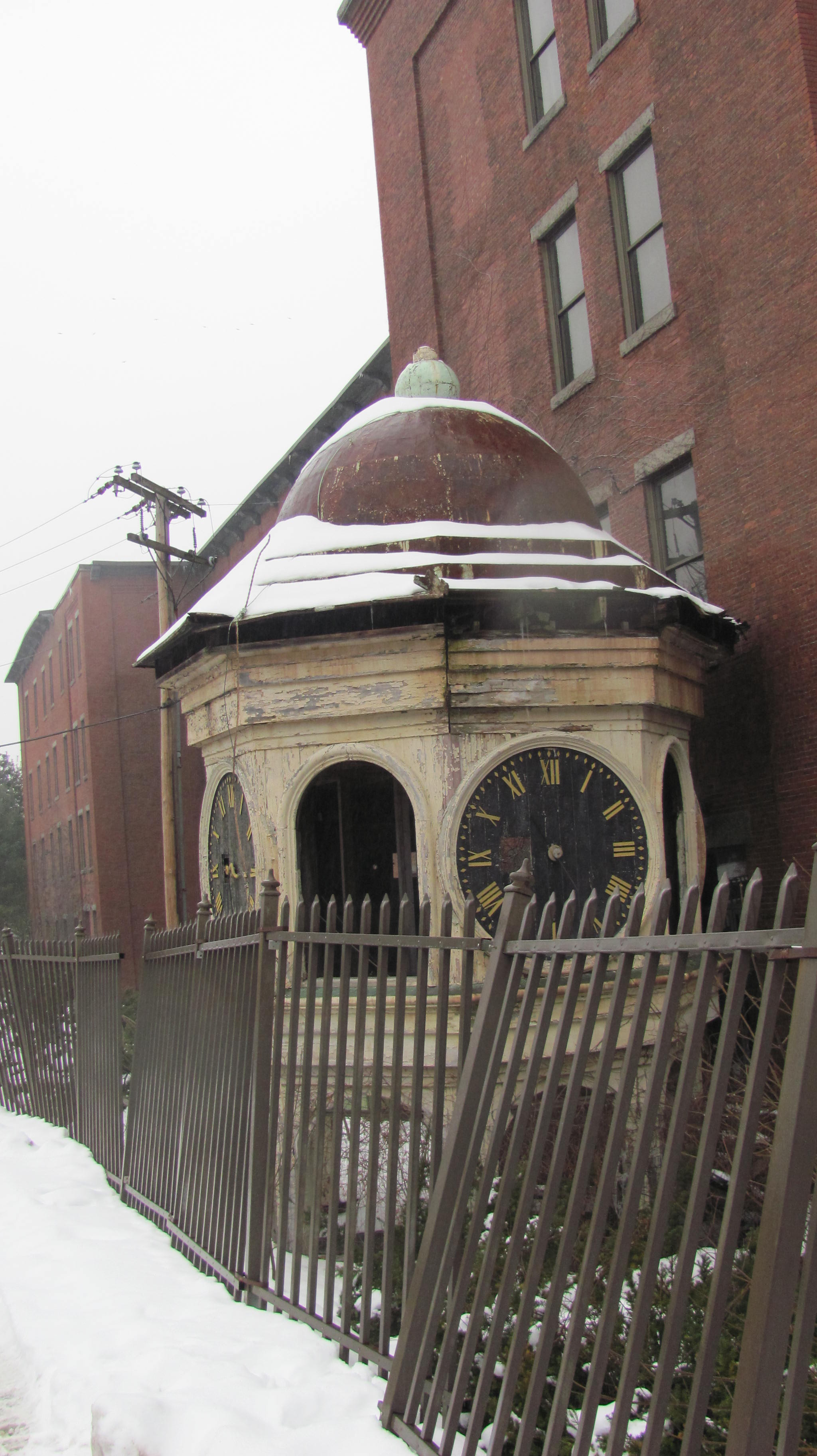
Back then, the former Lincoln Mill clocktower was perched and rotting on the ground in front of the vacant and deteriorating mill building that is today – 23 years later– a luxury hotel with a roof-top swimming pool, a craft distillery and an expansive lobby that has become a favorite gathering place for locals and visitors alike.

Who would have imagined?

But here’s the other thing, the downside of the good news.

A photo I took of the former Lincoln Mill clocktower nearly 25 years ago.

In 2001, it wasn’t hard to find a parking spot in downtown Biddeford. In 2001, you didn’t see any homeless folks sleeping in doorways on Main Street. In 2001, rents – both commercial and residential – were among the lowest in southern Maine.

Why? Well, it’s pretty simple: very few people really wanted to live or shop in downtown Biddeford back then. The stench of burning garbage; shuttered and vacant mill buildings and crumbling infrastructure hardly gave off a welcoming vibe.

Sure, there were some notable exceptions. Legacy businesses such as Reilly’s Bakery and Biddeford Savings Bank were able to weather the storm created by an economic recession and the terrible decision to burn garbage downtown.

But many people had given up on the downtown. Politicians set their sights on easy targets: the development of Wal-Mart and other big-box stores on the outer end of Alfred Road, a proposed racino and continued suburban sprawl on the western side of the city.

As I go through the stories and columns I wrote back then, I am reminded of the tremendous debt we all owe to David Flood, Wallace Nutting, Renee O’Neil and so many others.

We should also never forget the business leaders, civic activists and policy makers who formed Twin Cities Renaissance, the coalition of visionaries from both sides of the Saco River who committed themselves to seeing MERC finally closed.

Sure, Alan Casavant deserves lots of credit for helping us believe in our city again, but he got a lot of help from people who believed in Biddeford even when many of us had given up on the city.

Thank you for your blood, sweat and tears.

In the movie Jaws, Mayor Larry Vaughan says he was just “acting in the town’s best interests” by keeping the beaches open.

In Biddeford, Mayor Wallace Nutting was acting in the town’s best interest by believing in his city and its people.

Make no mistake. Our city still has challenges and hurdles to clear. But if you look at what has been accomplished over the last two decades, Biddeford’s future seems bright.

Originally published in Saco Bay News

Alan Casavant: Interview

If you ask Alan Casavant to describe his time as Biddeford’s mayor, he’ll tell you he used the same basic approach that he used as a high school teacher for more than 35 years.

Casavant, 71, is now completely retired as both a teacher and politician. He served 12 years (six consecutive terms) as the city’s mayor, first elected to that position in 2011. He also served four terms in the Maine Legislature as a state representative and served on the Biddeford City Council for 18 years, first elected in 1975.

Alan Casavant/ Seaver photo

He was born and raised in Biddeford and graduated from Biddeford High School in 1970. Initially, he majored in psychology during his first two years of college at the University of Southern Maine, but during his junior year, he transferred to the University of Maine Orono and decided to study teaching.

As fate would have it, he was assigned to Biddeford High School in order to complete his student teaching requirement. He was then hired as a permanent substitute teacher and then became a full-time social studies teacher at his alma mater.

He also coached the Biddeford High School hockey team, leading the Tigers to a state championship and is remembered by many people as a formidable broom ball player.

Casavant became the city’s second-longest serving mayor. Only Louis “Papa” Lauzier served longer than Casavant, from 1941 to 1955 – a total of 14 years.

You didn’t want to break Mayor Lausier’s record? Just one more term?

(Laughs) “No. I never set out with the idea of serving as long as I did. In fact, I had pretty much decided that I was going to step down two years ago, but I had a friend who convinced me to serve just one more term, and it appealed to me because I felt like there was still some unfinished business to take care of.

“I’m 71 years old, and I had done it for 12 years. I don’t think anyone intended to have any one mayor serve that long, but the real trump card was losing the hearing in my left ear.”

You first ran for city council when you were just 23 years old, which means the bulk of your life has been serving the city of Biddeford as an elected leader. What drew you into local politics?

“I really enjoyed politics. The process and the players intrigued me. The psychology of it (Laughs). I enjoyed being part of the decision-making process, and having input. I used to tell my students – and it’s not to be taken egotistically – but I trusted me making the decisions more than I trusted anybody else. (Laughs)

“I felt, if I was on the outside looking in, I could give my view but that didn’t mean my viewpoint would resonate with the person I was talking to, whereas – actually being there I could listen but I could also be an active, very-active participant. I really enjoyed that.”

How has Biddeford’s political world changed over the last 50 years, going back to when you first ran for the council in the 1970s?

“It’s changed so much. I think people were more in tune with the political process back then; with what was happening at City Hall back in the ‘70s. You had little organizations all over the city, where politics were discussed, such as the Green Lantern Club on Green Street.

“There was more public input because people were more aware of what was going on back then. We had a daily paper covering everything happening in the city. The mayor was a much stronger position, but it was also more familiar. You didn’t have the nastiness, and I say that because I was always in the minority back then. There were three of us on the council in our 20s. It was always the majority against me, Dick Lambert and Billy Zuke. So many of the council votes were 8-3.  It was more friendly. We would all go out together after the meetings for a bull session at Bull’s Café.”

What motivated you to run for mayor against an incumbent (Joanne Twomey) who was widely considered as basically unbeatable?

“The casino proposal that she was supporting concerned me, but it was much more about a philosophical and process difference. During that time period, too many people were watching council meetings as entertainment. The meetings were often bombastic and confrontational.

“I just thought that I could do a better job. I had retired from teaching, so I had the time. I just believed that a lot of people were ready for a change.”

Besides wanting to change the tone of how business was conducted during council meetings, what were your other priorities?

“Well certainly, the issues surrounding the Maine Energy [Recovery Company] plant loomed very large on my screen. I thought that had to be resolved because of what I had learned and come to believe. Not only was it an economic issue and an environmental issue, it was also a psychological issue. It was as if the city had given up on itself. We had become known as “Trash Town, U.S.A.” I knew that had to change.”

Why do you think public participation in local government has declined so much?

“I’m convinced that it’s a lack of knowledge. If you look back at the ‘70s, ‘80s and ‘90s, everybody read the Journal Tribune and/or the Courier. Reporters back then would pursue the stories until the end. When David [Flood] sold the Courier and the Journal closed, there became a vacuum of legitimate news. I also think some people may feel jaded by the process because of the misinformation that abounds on social media like Facebook.”

What do you think was your greatest accomplishment as mayor?

“Recreating pride in Biddeford. It’s nothing really physical. It’s just people in Biddeford actually believe in themselves as a community again. It was as if the community had lost its mojo; the recession, the Maine Energy plant, downtown business closings – – the glass was always half empty.

“People now openly brag about living in Biddeford. I recently saw an ad from a Kennebunk hotel that pointed out they were located only five minutes from Biddeford.”

What was your biggest disappointment during your 12 years as mayor?

[Pauses] “Probably dealing with the housing issue. Trying to figure that out and recognizing that there is no easy answer. There’s no instant answer, especially since it’s a regional, statewide and even national issue.

“We really need a regional approach. There has to be a concerted effort, driven by the state.”

Do you miss being the mayor?

(Laughs) Yes and no. I can’t even watch the meetings right now. I miss the adrenaline rush of being right in the middle of everything. I don’t want to meddle, which is really difficult for me to do. (Laughs) It’s really hard to do something for 12 years and then just stop, suddenly being out of the loop and not knowing exactly what’s going on – – just stopping cold turkey. It’s a little strange.

“There is also relief. When I was mayor, I’d spend almost an hour every morning and every night responding to e-mails. Now I maybe get four e-mails a day.” (Laughs)

As a politician, do you see social media as helpful?

“I call it anti-social media. Most of it is very disparaging and accusatory. It took me about a week or two as mayor to decide that I wasn’t going to read most of it. Otherwise, I’d see things that I didn’t say or do, and it got so frustrating. It’s so often just a rumor mill.”

What do you see as challenges on Biddeford’s horizon?

“Well, obviously the housing issue is going to dominate our conversations for a long time, and we’ll need to tackle that situation; but we also are looking at lots of other major budgetary issues, including staffing. How do we retain and attract professional employees? People want services, but that cost money. You can’t have it all.

“I also worry that our economy is slowing a bit in the downtown. The downtown really defines who we are as a community, and it’s important for our overall economy.”

Your political adversaries blame you for pushing so hard for a municipal parking garage.

“The reality is that we actually need at least two parking garages. The next one needs to be near the corner of Main and Alfred streets. It’s interesting to me that in so many other cities, whether it’s Westbrook or Portland or Auburn, there is virtually no resistance to parking garages.”

You describe your role as mayor as simply an extension of your time as a high school teacher.

“It’s the same skill set and the same techniques. It was about repeating, repeating and repeating information so that the kids could get it; it was about connecting the dots so that they could understand it; and it was also about forming relationships and helping them feel good about themselves.

“It’s never just one person leading the city. You really need a team approach, it’s like a quilt with several different patches. It’s rewarding, sometimes frustrating but if you have the right people around you — if you can build a team with lots of different perspectives — then you can do almost anything.”

Originally published in Saco Bay News

Smoke on the water

Pot%20leaf_40Attitudes regarding marijuana have dramatically changed during the past two decades.

Those in favor of legalizing the drug are finding increasing support from an expanding constituency, including millenials who can now vote and health care providers who say the drug can benefit their patients.

Even retired Supreme Court Justice John Paul Stevens — not a likely Cheech & Chong fan — says it is time for marijuana to be legalized.

In an interview with Scott Simon on National Public Radio, the former justice said: “I really think that that’s another instance of public opinion [that’s] changed. And recognize that the distinction between marijuana and alcoholic beverages is really not much of a distinction.”

Talk about a dramatic shift. In 1987,  after admitting that he once used marijuana, Supreme Court nominee Douglas Ginsburg was forced to back away from the nomination process.

And last year, voters in both Colorado and Washington defied federal law and legalized the use of marijuana as a controlled substance.

But the quest to legalize marijuana in all 50 states face an uphill battle, best evidenced by what has happened in the Maine Legislature.

In November The Legislative Council, a 10-member group of legislative leaders,  split on a proposal that would have sent a statewide referendum question to voters. Because the vote was tied, it failed and cannot be considered again until the next Legislature convenes in 2015.

It was the third time the Legislature has rejected proposals by State Rep. Diane Russell (D-Portland) to legalize marijuana. Russell could not be reached for comment.

But State Rep. Alan Casavant (D-Biddeford) said he is glad the proposal failed.

“I voted against it every time,” Casavant said.

Casavant, who spent more than 35 years teaching high school, said he experienced first hand the impact of marijuana on his students.

“Legalizing it would be nothing more than a continued erosion of our culture,” he said. “I have heard all the arguments for and against, and I can’t support it.”

Casavant also said the issue should not be debated on a state-by state basis. “For it to happen, we really need some guidance from the federal government. It’s a very complicated issue. Where do you draw the line on intoxication, for example?”

Casavant says he is sympathetic to those who need marijuana for medicinal reasons, but says the risks still outweigh the benefits, even when considering that marijuana could provide a bumper crop of new tax revenue.

“As the mayor of a city, as a legislator, I am very aware of how we need new sources of revenue that will not impact people who are already struggling to keep up, but despite those realities, I can’t support this. Not now.”

State Rep. Justin Chenette (D-Saco) said he is “evolving on the issue.” Chenette said he had initial apprehension about the issue when first approached for his support by Russell.

“Being a college student so recently, I have witnessed the rampant use of marijuana on campus,” Chenette said. “I am concerned about how young people will use it, but I also see the other side. I would be in favor of sending the question to referendum, but I have yet to formulate a strong opinion one way or the other. It’s something that warrants more study.”

Ryan Fecteau of Biddeford is hoping to be a member of the next legislature.

Fecteau, 21, says he generally supports the legalization of marijuana but does not want to see it included in the Maine Democratic Party’s platform because it could be wedge issue in a year when Maine Democrats need to be focused on bigger fish, including capturing the Blaine House.

“I think it should be treated the same as alcohol,” Fecteau said, adding that additional revenue from the state sale of marijuana could provide much-needed tax relief for seniors and revenue that could help fund critical programs.

With a little help from my friends

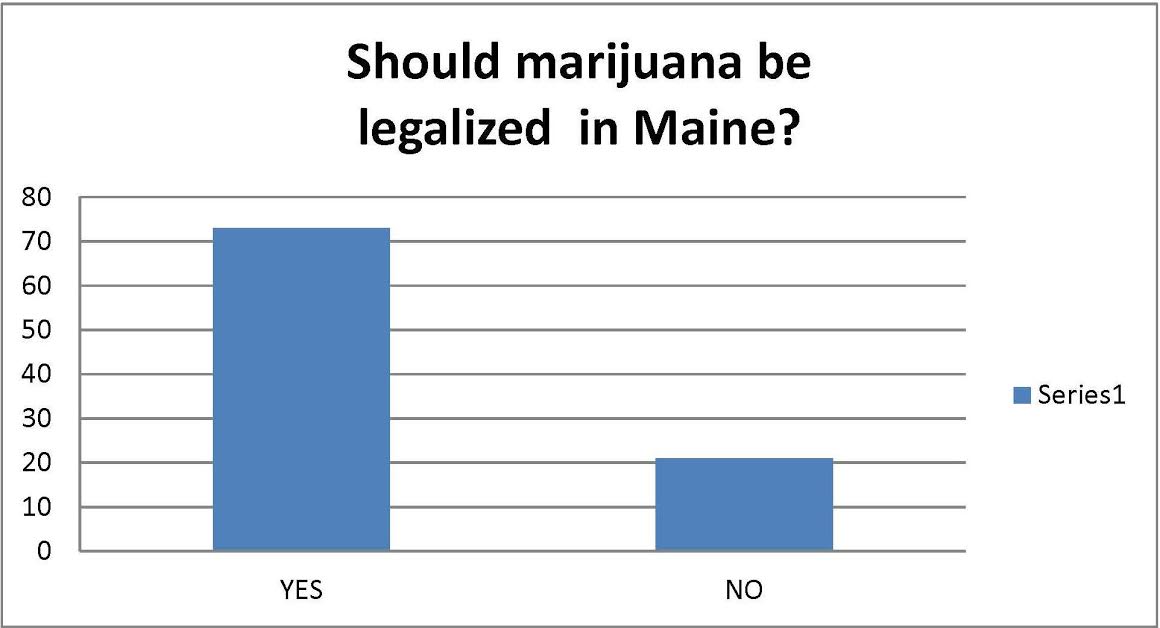
A few days ago, I posted a simple question on my Facebook page about the legalization of marijuana.

That informal survey drew more than 100 responses in 24 hours.

I was surprised by some of the responses. I was also fascinated to see that an almost even split of Republicans and Democrats were on each side of the issue.

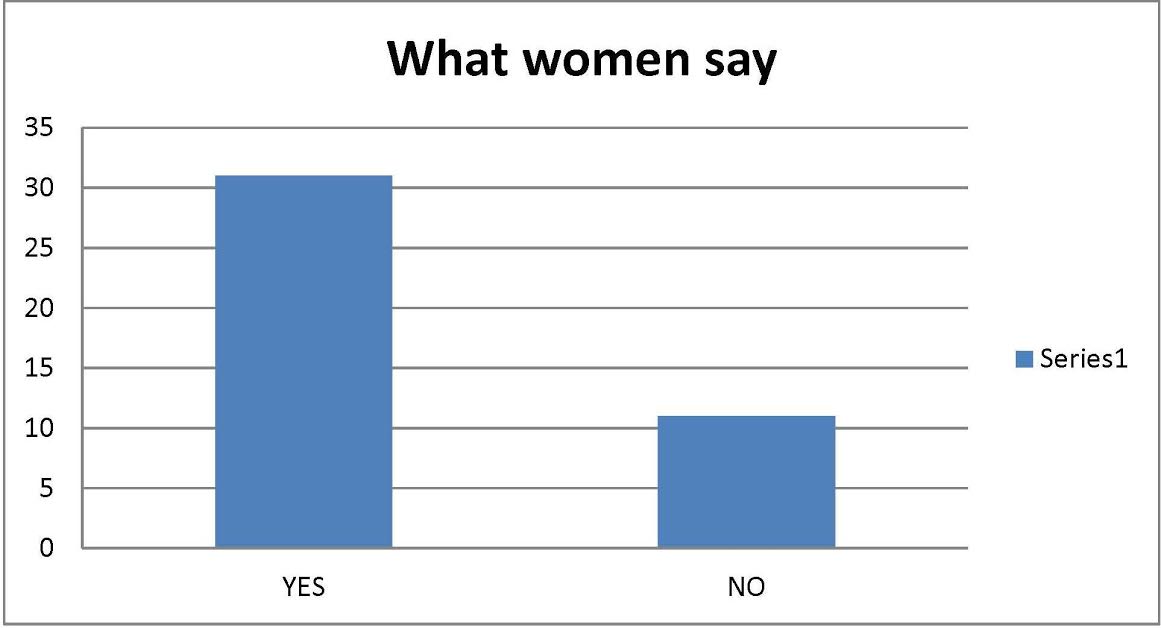
Moreover, both men and women overwhelmingly support legalization (male approval led female approval by only a slight margin).

Women with children were equally split. Among male opponents, more than 75 percent are politically conservative, yet nearly 40 percent of male supporters are conservatives.

Here are a few charts to break it down for you:

weed2


women


men


Social media and Maine’s gubernatorial campaign

camplogo3Despite all the hoopla about the power of social media tools in political campaigns, what metrics can we use to determine if those tools are effective?

While just about anyone can set up a Twitter account or create a Facebook page, social media tools are only as effective as those who are using them.  Although it is widely accepted that social media tools played a big part in President Obama’s 2008 campaign, that type of success is not guaranteed by simply using social media as part of a campaign strategy.

When it comes to Maine’s 2014 gubernatorial race, which of the campaigns is best using social media? More importantly, how do we set aside our individual biases and evaluate the campaigns based solely upon their social media metrics?

At the Brookings Institute’s Center for Technology Innovation, Darrell West offers a mixed review regarding social media and campaign engagement and the awkward transition to actual governance.

Social media are the ultimate in disruptive technology. They change information delivery, business organization, online content, news coverage, and the manner in which individuals process new developments. As shown during the 2008 campaign, these digital tools represented a textbook example of voter mobilization and electoral impact. They were, in the words of Engage Partner Mindy Finn, the “central nervous system” of campaign organizations.

Using social networking outreach tools such as Facebook, MySpace, YouTube, and Twitter, a number of Democratic and Republican candidates raised money, identified supporters, built electoral coalitions, and brought people in closer touch with the electoral process.

You may recall a somewhat silly and lighthearted piece about Maine’s gubernatorial campaigns that I posted a couple of months ago. Then, I jokingly said we should dispense with the standard election process and use social media metrics to determine the winner. I examined each of the campaign’s current metrics.

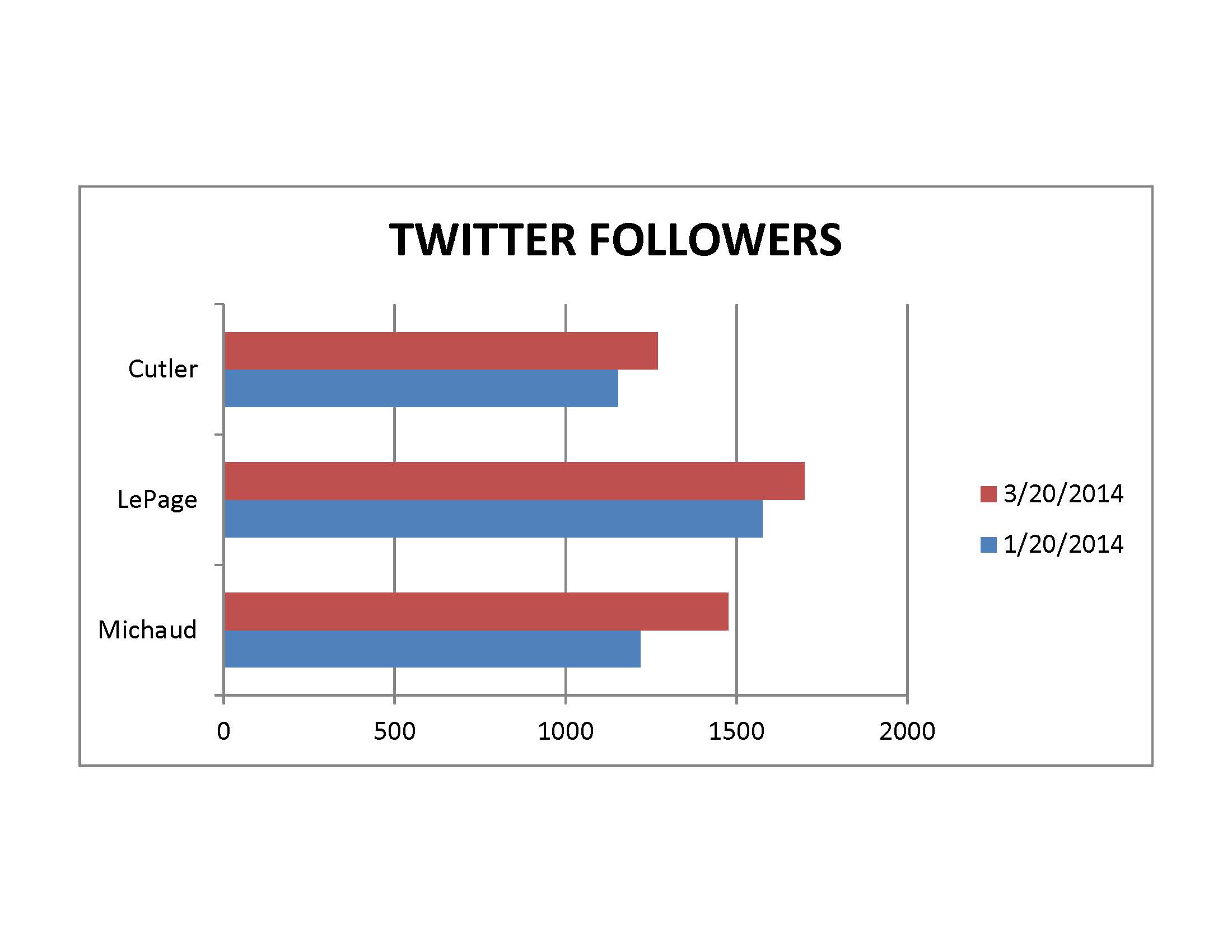
Twitter FollowersToday, I have decided to track those metrics on a regular basis and to blog frequently about those campaigns and their use of social media.

Over the last 60 days, each of the Maine gubernatorial campaigns has been active on various social media platforms. But before we begin, it’s important to note that Democrat Mike Michaud is the latest entrant to this race. Both Governor LePage and Eliot Cutler carried over their respective social media support from the 2010 campaign.

Nonetheless, Michaud has seen the greatest increase in social media traffic, earning a 21 percent increase in the number of Twitter followers @Michaud2014, moving from 1,219 Twitter followers on January 20 to 1,475 followers as of March 20, 2014.

Although Governor LePage (@lepage2014) has the greatest number of Twitter followers (1,698) his metrics have increased only 8 percent during the same time period.

Eliot Cutler (@EliotCutler) saw a 10 percent increase in Twitter followers, from 1, 153 to 1,269 followers during the same period.

Facebook LikesOn Facebook, Cutler still dominates in the total number of Likes for his campaign page (19,824) but saw only a 4 percent increase over the last 60 days, while both Michaud and LePage experienced increases of 10 percent.

LePage’s Facebook page had 18,438 fans on March 20, compared to 16,791 fans on January 20, 2014.

Michaud’s Facebook page had 11,600 fans on March 20, compared to 10,529 fans on January 20, 2014.

When viewed overall, it would appear that Team Cutler has the steepest hill to climb, so far.

Note: Though it’s generally common knowledge, it must be noted that Twitter followers and Facebook fans do not translate directly to the number of supporters for a political candidate. As an example, I follow all three campaigns on Twitter, but will only be voting for one candidate.

Feeling gravity’s pull

jc1
Justin Chenette/ Photo by Matthew Hayes

At first glance, the two men who represent the city of Saco in the Maine Legislature seem worlds apart.

One is 22 years old and openly gay; the other is 62 and married with children.

While Justin Chenette is serving his first term in the Maine House of Representatives, Barry Hobbins is serving his seventh term in the House and previously served five terms in the State Senate.

Over the years, Hobbins has become a steady fixture of pragmatic policy making. He is a successful attorney who knows how and when to pull strings to get things done. He has spent a lifetime building relationships, earning trust and observing the flow of subtle political currents that often shift without warning.

Hobbins is careful, patient and strategic: the hallmarks of a legislator who can deliver when it matters. Like Chenette, Hobbins was only 20 years old when he won a five-way primary race for the Democratic nomination to replace 84-year-old Camille Bedard as Saco’s representative in the House.

“Mr. Bedard gave me some great advice when I was starting out,” Hobbins recalled. “He told me: sit back and learn. He told me to pick my battles.”

Chenette took a different path, however, landing himself in hot water with the state party only hours after he announced that would be running in early 2012.

“I didn’t check in with anybody first,” Chenette said. “They didn’t know who I was or what I was all about. I sort of got scolded.”

Unlike Hobbins’ slow and steady start into Maine’s political machine, Chenette made national headlines earlier this year, when he was sworn into office as the nation’s youngest, openly gay lawmaker.

The issue of gay marriage was again on the ballot for Maine voters, but Chenette says he was not running to make a point about his sexuality. “I didn’t want that distinction,” he said. “I was running because I was frustrated about a lot of issues, so I had to thread the needle carefully.”

Chenette says some people judged him much more harshly about his sexuality rather than his political inexperience and youth. His campaign signs were vandalized with gay slurs. Undaunted, Chenette pressed on, working hard to earn voter respect.

“Some people told me I should get the police involved and do an investigation,” he said. “I didn’t want to do that. “I didn’t want to give people like that any power. They spray-painted my signs with all sorts of ugly things, but most people took the time to get to know me, to understand why I wanted to represent them in Augusta.

Chenette won his June 2012 primary with 78 percent of the vote and went on to defeat Republican Roland Wyman with 60 percent of the vote in November.

Who let the dogs out?

hobbins
Barry Hobbins

Unlike Hobbins, Chenette did not wait to begin picking battles.

He pounced on Democratic and Republican legislative leaders during his first speech on the floor of the Maine House, only days after being sworn into office.

Chenette latched onto problems he saw in Maine’s political machine, specifically the way lawmakers were using Clean Election funds to form PACs that are used to determine who becomes a legislative leader.

“I said that Democratic and Republican leadership was doing little more than participating in legalized bribery,” he said. “I said it was completely wrong to channel this money for special interests.”

If Chenette wanted attention, he got it.

“It didn’t go over very well even in my own party,” he laughed. “I got called into the Speaker’s office and got my ass chewed. That process became a pattern. I was not playing by any set of unspoken rules.”

Chenette said his first term has been “challenging,” yet he refuses to back down or change his firebrand style.

“We’re not sent to Augusta to sit on our hands, and behave like well-trained dogs,” he said. “The people sent us there to do their work, but on Day One, I was disgusted by the fact that we spent so much time talking about how to get re-elected . . . on Day One.”

Not surprisingly, Hobbins admitted that his colleague makes some people uncomfortable.

“Justin certainly has a different style,” Hobbins said. “He is outspoken and very idealistic. He seems in a rush to make his mark.”

But Hobbins also says Maine’s term limits law has changed the dynamic of how the Legislature works.

“When I first got there, you didn’t feel a clock ticking against you,” Hobbins recalled. “Today, it’s different, younger people feel a sense of urgency, as if there isn’t much time to accomplish their goals.”

Hobbins describes Chenette as conscientious, but certainly not pragmatic.

“There is no denying that there is a generational gap,” Hobbins said. “Justin feels strongly about issues and causes, but that does not mean that others do not feel just as strongly, even if they have a different approach.”

Hobbins said he is just as “progressive” in his political philosophy as Chenette.

“I know what it’s like to be young and full of passion,” Hobbins said. “I became the state party chair when I was 28, and I ran for Congress when I was 32.”

Hobbins said the Legislature is no longer dominated by a bunch of stuffy, old white men. “The president of the senate (Justin Alfond) is 36, and the Speaker of the House (Mark Eves) is also 36. Age is not so much of an issue as a difference of approach.”

Hobbins said a shift of legislative demographics is representative of generational shifts in other parts of society.

“Look, I don’t post pictures of myself every day on Facebook or use Twitter, but a lot of people do, and those can be good tools to keep your constituents updated,” he said. “I think it’s a significant compliment to the citizens of Saco that they choose people who have vastly different styles to represent them.”

Republican Joyce Maker represents the city of Calais in the Maine House. She is old enough to be Chenette’s mother, and concedes that she has taken him under her wing.

DSCN2402“I love Justin,” Maker said. “He is a wonderful young man, and he works very hard, but I do think he has some growing up to do.”

Maker describes herself as a moderate. She says she has been able to find a lot of common ground with Chenette, a Democrat who describes himself as further left of center.

“He comes across as strong and opinionated sometimes, but he is also a really good listener,” Maker said. “I think in time, he will catch on and learn the benefits of being a bit more pragmatic.”

Maker says she sees the value of Maine’s Clean Election Law, but agrees with Chenette about the inherent problems of leadership PACs.

“Justin would like to do away with Clean Elections,” she said. “I see some value to the program because it allows more people the opportunity to participate. But despite our differences, we have been able to work through that issue, and I think he is genuinely interested in hearing other points of view.”

Chenette says he is more than happy to work with his colleagues on the other side of the political aisle.

“I love having lunch with Republicans,” he laughed. “It’s always a good opportunity to learn about the people beyond their particular labels. You can find a common connection, and that helps make the process work better.”

Is Chenette becoming more pragmatic?

“I don’t know,” he confessed. “But I know that I will always stay true to values and core beliefs. Barry’s style has a place. We just have different approaches. I think we make a good tag team for Saco.”

Next installment: Justin Chenette: A rising political star?

Smoking in the boys’ room

Portland-Maine-Old-Port
Portland, Maine

I have a friend — let’s call him Todd — who thinks that the city of Portland, Maine is so hip, so cool and oh so wonderful.

Todd fled the pace and grind of Boston in order to raise his family in place that is consistently ranked as one of the country’s most “livable” cities, whatever that means. Today, Todd has become one of Portland’s biggest fans.

I like Todd. He is a smart guy. He has a law degree.  Generally speaking, Todd arrives at his conclusions following a painstaking and multi-layered process of analytical and critical thinking. Todd has jumped into Portland with both feet. He recently bought a home in North Deering. He is a civic volunteer. He is an under-40 professional with a beautiful wife, two small children and a promising life ahead of him.

I admire Todd, but I want to vomit every time he feels compelled to tell me how great it is to live, work and play in Portland.

I know what you’re thinking: Dude, you live in Biddeford. You ought to shut to eff up and call U-Haul before you start dissing Maine’s largest city.

Go ahead and laugh. I can handle it. It’s not exactly an original thought.

Before we proceed any further, let me assure you that I know a thing or two about the city of Portland. I have some street cred when it comes to discussing the city I call pretentious-ville, a city that so transparently and desperately wants to be a mini-Boston.

I’ve lived in a brownstone, I’ve lived in a ghetto

I lived in Portland before it was considered hip; before you thought it was actually possible to bump into Jack Kerouac’s ghost.

I worked in the kitchen at 39 Exchange Street, a restaurant that has since been replaced by a much-needed boutique store in the Old Port. I worked as a janitor at the McDonald’s that was located on the corner of Oak and Congress streets. I made pizzas at The Bag on Free Street. I also had a corner office across the street from Brian Boru.

I lived on “The Hill” (Vesper Street) and the West End (well, sort of the edge . .Walker Street) I lived on the fourth floor of the Trewlawny building and survived on Italian sandwiches from Joe’s Smoke Shop. I remember the State Theater when it showed pornos. Christ, I saw mainstream movies at the Fine Arts Cinema before it decided to give the State a run for its money with John Holmes flicks. I was thrown out of Horsefeathers.

I remember when Dewey’s was located on Fore Street; when DiMillo’s was just a hole in the wall on the other side of Commercial Street. I rented a room on Sherman Street. We used to call that neighborhood “the student slums.” Today, we call it “Parkside.”  I lost my virginity on Alba Street in Deering Center. I got picked up by the police on Canco Road, and I was there when the cranes arrived at the Golden Triangle to begin construction of One City Center.

I ate mushrooms in the basement of a friend’s house on Spring Street and then swore I could see telephone poles melting on Winter Street. I worked third shift at the 7-11 on Congress Street; and passed out in the median of the Franklin Arterial. I shared an apartment with a gay roommate on Park Street. I lived on Peaks Island when the Portland ferry terminal was little more than a dilapidated building. I sold pipe, valves and fittings at W.L. Blake, an industrial supply wholesale distributor that is today the Old Port Sea Grill and up-scale office spaces.

I was evicted from an apartment on Preble Street; and fell madly in love with a girl who attended the Portland School of Art (today: Maine College of Art). I rode the escalators at Porteous, Mitchell and Braun. I ate scrambled eggs while hungover at Ye Olde Pancake Shoppe. I bumped into Sammy Hagar at the Sonesta Hotel, which quickly changed its name back to the Eastland.

I remember when WMGX had a studio on Cumberland Avenue and when Frank Fixaris announced high school sports scores on Channel 13 and Fred Nutter did televised editorials on Channel 6. I remember when you could get a great sandwich at Carbur’s or see the Kopterz play at Cayo’s.

Okay; you get the picture.

So, forgive me if I have a different perspective of Portland, Maine. Forgive me if I don’t buy into all the laddi-da crap about how wonderful and “livable” the city is.  Forgive me for believing that Portland is the most self-absorbed and obnoxious of Maine’s 457 cities and towns. Livable? Tell that to the people living in my old apartment on the third-floor of a Greenleaf Street triple-decker. Take a walk down Valley Street at 2 a.m. on a Thursday and tell me all about “livable.”

Suffragette City

Ironically, voters in the same city where the Temperance movement got its beginnings recently approved a referendum that allows the use of limited amounts of marijuana.

Neal Dow, the father of Prohibition and a former Portland mayor, must be rolling in his grave.

The referendum’s success was a much celebrated event among the city’s uber liberal progressives who spend their days dreaming about being free of “the man” and his corporate control over their lives; while simultaneously devising new ways to control and restrict the lives of their neighbors with a mountain of nanny-state regulations, from outlawing the use of Styrofoam to forbidding soft drinks on school grounds.

Portland — a once proud, prosperous and industrious community that hosted the North Atlantic Fleet during WWII — has today become the capital of hypocrisy and self-absorption.

I have no problem with legalizing the use or possession of marijuana. I am a Libertarian. But I wonder how a city that wants to celebrate individualism and diversity over everything else can keep a straight face when explaining the tobacco smoking ordinance the city council approved earlier this year.

In a March 6, 2013 Portland Press Herald story, Portland Mayor Michael Brennan said the city’s tobacco ordinance was created to address a serious public health issue: second-hand smoke.

“Secondhand smoke is a dangerous toxin,” Brennan told the newspaper. “Whether it’s children on a swing set or joggers circling the Back Cove or someone walking their dog along the Eastern Prom, we need to make sure we are doing everything we can to reduce the exposure to such a serious health hazard.”

Sure, it’s hard to argue with Brennan on this point, but I wonder if he can answer my next question: Why does the ban also apply to electronic cigarettes, which emit only a water-based vapor while delivering nicotine to the user?

I’m a smoker, so I can’t hold my breath waiting for Brennan to answer the question, but it’s really quite simple: Even the appearance of smoking does not fit with the fluff and pompoms of Maine’s most “livable” city.

Hiding behind the pretense of a public health concern (what is the city doing to control automobile fumes that I am forced to inhale while walking through the Old Port?) is little more than a ruse. Smokers are the ugly people, the less-than people. The NASCAR-watchin’, beer drinkin’ types who probably buy their clothes at Wal-Mart. That doesn’t quite match the image, does it?

And if there’s one thing we know about Portland, it’s that image is everything.

So, go ahead, Portland . . . keep patting yourselves on your collective backs.

Me? I’ll take cities and towns like Lewiston, Rumford, Sanford or Biddeford every day of the week.

Smoke ’em, if you got ’em.

Constant Craving

20130715_055332Much has been said about Maine’s quality of place, a subject that hit me like a brick this weekend as I once again travel the roads of rural Maine.

But what is the value of a quality place without a quality life?

GrowSmart Maine describes quality of place as:

“. . . our majestic mountains, unbroken forests, open fields, wild rivers, pristine lakes, widely-celebrated coast, picturesque downtowns, lively arts and culture, authentic historic buildings, and exceptional recreational opportunities. It is our principal advantage in today’s global economic competition. Quality of place will help us keep and attract skilled workers and entrepreneurs to fill Maine’s declining workforce population.”

Sounds good, right?

Sure, right up until you drive along Rte. 4 past Livermore Falls and into the town of Jay on your way to someplace pretty.

The policy wonks, pundits and environmental do-gooders slap themselves on the back with self-congratulation over drinks at the Senator Inn in Augusta after passing some piece of legislation designed to protect Maine’s “quality of place,” but I wonder if they have ever strolled along Water Street, less than a mile away or driven past the dilapidated tenement triple-deckers that line Rte. 8 on the way toward the Civic Center.

Try telling someone in that neighborhood about quality of place.

Better yet, visit the Wal-Mart in Calais, Skowhegan, Newport or Sanford. Tell the single-mom buying generic-labeled cereal about “quality of place.”

Drive past the gutted factories and the ghost towns that were once homes to thriving industries like shoe shops, paper mills and textile manufacturing. Pull over and tell the people who are barely living there about quality of place.

Drive north, east or west from Portland. Get off the main roads and count the number of blue tarps that serve as substitute roofs on ramshackle homes. Pause and tell those people about “quality of place.”

There are no easy answers, but I never see the pundits or the lobbyists shopping for pre-paid cell phones, making an installment payment at Rent-A-Center or drying their clothes at the Laund-O-Matic on a sweltering July afternoon.

These people —the not-so-pretty and the not-so-fortunate ones —- are largely forgotten, discounted and mostly ignored. They routinely buy lottery tickets. Many of them smoke, and they keep their heads above the surface like prison inmates. One fucking day at a time.

It’s easy to judge them. To think we know better about how they should live or how Maine should be managed, but few of us know — really know— that if this is quality of place . . . That if this is as good as it gets…..

What is the value of having an abundance of natural resources if you cannot feed your children? What is the value of open space if you don’t have a car to get there?

How do we achieve the balance between protecting the things we cherish in our backyard without forgetting or discounting the people who live there?

I do not know the answers. Do you?