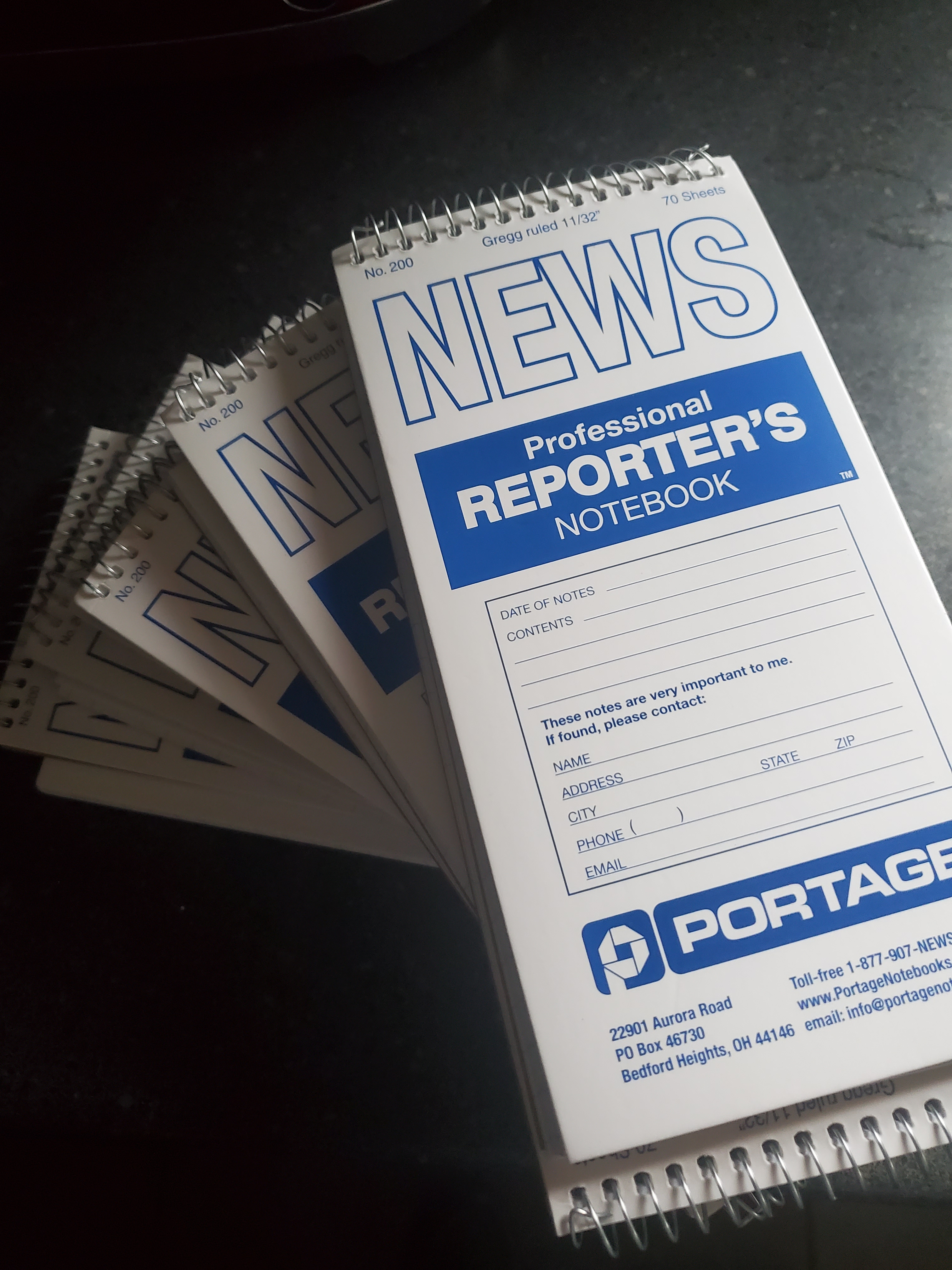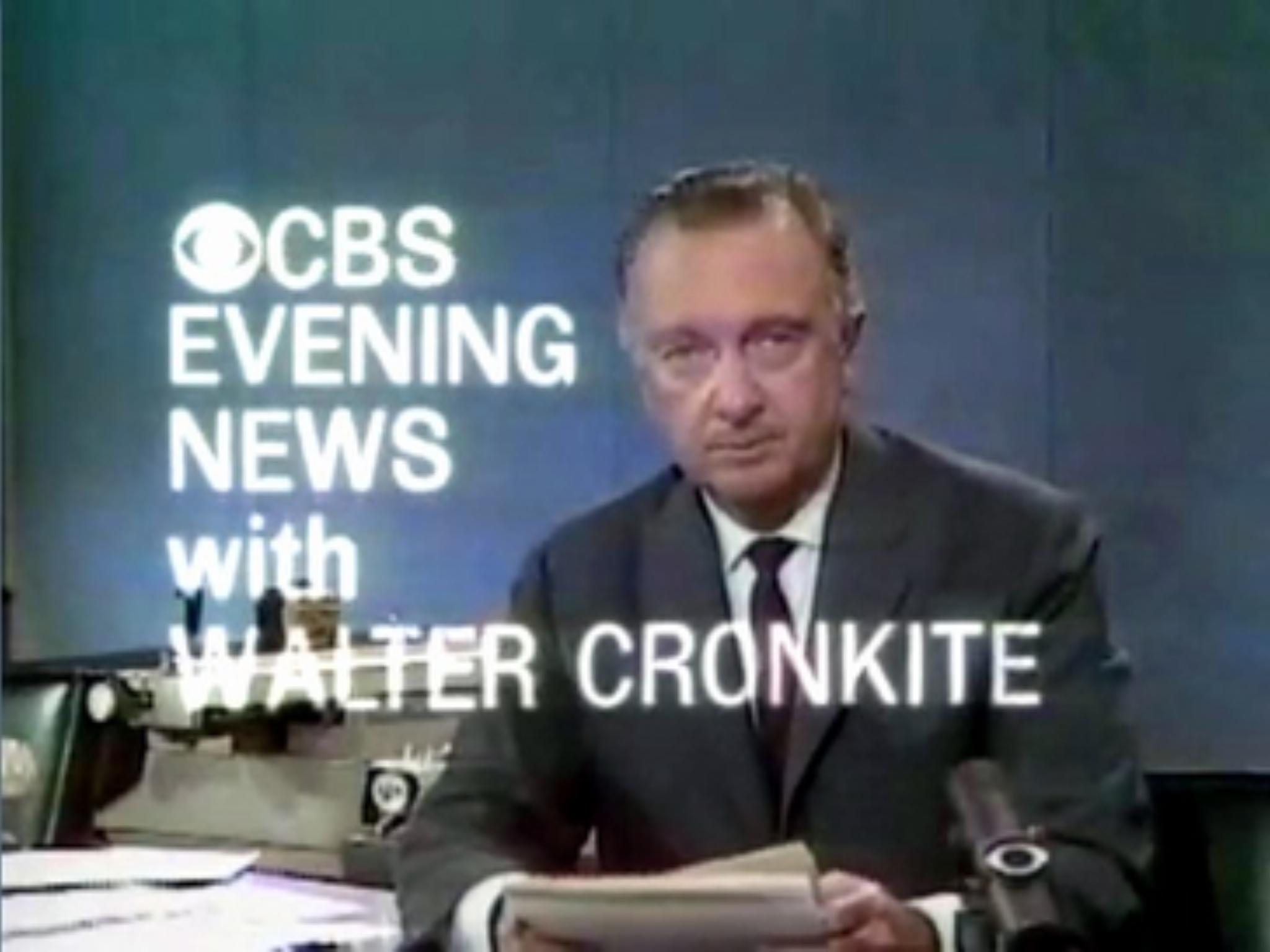
My all-time favorite journalists (The Top 12)

I am a journalist, and I love making lists.

So, it should come as no surprise that I woke up at 3:30 a.m. yesterday with the idea that I should make a Top 12 list of my favorite journalists – people who have inspired me, people I have worked with and even people I have worked for.

It was originally going to be a Top 10 list, but I could think of no-one on this list who should be eliminated as a finalist.

______________________

12.) Marian McCue, The Forecaster
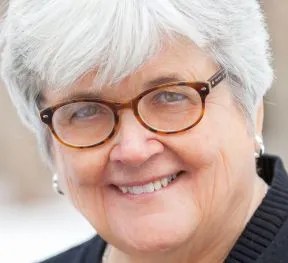
(Portland Press Herald photo)

Marian McCue was inducted into the Maine Press Association (MPA) Hall of Fame in 2019

According to a story published in the Portland Press Herald, McCue purchased the former Falmouth Forecaster in 1990 at a time when it was published every two weeks and mailed to residents.

The MPA reportedly described McCue’s tenacious commitment to journalism as “great foresight and a singular journalistic duty, into what would become arguably ‘the’ community newspaper of record for the greater Portland area.”

I have long admired Marian’s work ethic and her commitment to the very best principles of true community journalism.

____________________

11.) Liz Gotthelf, Saco Bay News

(Saco Bay News photo)

When it comes to community journalism, few do it better than my friend Liz Gotthelf, who launched Saco Bay News – a digital media outlet – in 2020, shortly after the daily Journal Tribune forever closed its doors.

A former Tribune reporter, Liz is dedicated to the community where she lives and works. She built Saco Bay News on nothing more than an idea and a desire to keep covering the communities of Biddeford, Saco and Old Orchard Beach.

Liz is a scrappy journalist with a HUGE heart. Her care and commitment to journalism shines through in everything she writes. Liz was knocked to the ground in August 2024 when her husband died suddenly and unexpectedly. She took just a few days off, and then – despite near overwhelming grief – jumped back in the saddle, covering community news and events. How do you spell integrity?

I am lucky to call Liz a friend, and I was proud to work with her for a little more than two years as one of her contributing writers.

___________________

10.) Chris Busby, The Bollard

(Bangor Daily News photo)

The Portland-based weekly The Bollard is one of my favorite newspapers. Busby is one of those people who has likely forgotten more about journalism than I will ever learn.

More than 20 years ago, Busby began building the Bollard with his own blood, sweat and tears. The paper reeks with journalistic integrity and offers a no-holds-barred approach to covering local and state government. The Bollard is also where I get my regular fix of Al Diamon’s Politics and Other Mistakes column and Liz Peavey’s weekly column.

The really good news? The Bollard is available online and its print version is available for free throughout southern Maine. I pickup the Bollard at the Hannaford grocery store in Biddeford.

______________________

9.) Barbara Walters, ABC News
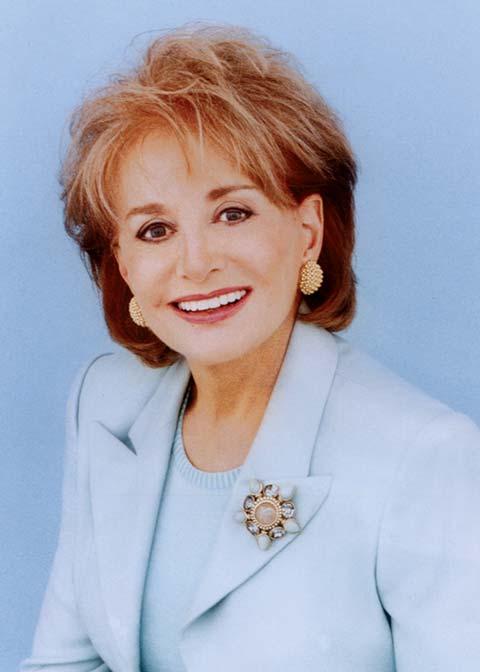
ABC News Photo

Barbara was a true journalism pioneer. She broke the proverbial glass ceiling that held back so many women in the news business, especially in the realm of televised newscasts.

Her legendary career, which started in 1951 at an NBC affiliate station in New York, earned her numerous accolades and awards, often described as one of the most trusted, and dogged reporters of the 20th Century.

Of course, Walters is best known today for her time as a producer and reporter of NBC’s Today Show and then later becoming the first female co-anchor of a network evening news show with Harry Reasoner on the ABC Evening News.

______________________

8.) David Flood, Mainely Newspapers

BCHC Photo

David and Carolyn Flood launched the weekly Biddeford-Saco-OOB Courier in 1989. They immersed themselves in the community and quickly became a fierce and reputable source of competition to their much larger, daily counterparts, the Journal Tribune and the Portland Press Herald.

Their hard work and commitment to community news paid off. The company expanded into a group of weekly newspapers that included the Scarborough Leader, South Portland Sentry and the Kennebunk Post among others.

David’s business model of not charging for subscriptions proved effective. But David cared more about Biddeford than just becoming the paper of record. He was the principal founder of the Heart of Biddeford.

He was always bullish about the city, especially its downtown area. After selling his publications, he was elected to the Biddeford City Council. Two years ago, he was inducted in the Biddeford Cultural and Heritage Center’s Hall of Fame. He also served briefly as president of the Biddeford-Saco Chamber of Commerce.

David hired me as a reporter in 1998. He then later promoted me to become the Courier’s editor and then later I became managing editor of all his publications.

I drove David nuts. I gave him plenty of reasons to fire me, but he didn’t. In fact, he gave me a rather long leash, and I think he valued my intense work ethic and my fierce sense of newspaper competition.

I often joke that the Biddeford Gazette is my baby. If that’s true then David and Carolyn Flood are the Gazette’s grandparents.

__________________

7. Jeff Jacoby, Boston Globe

(Wikipedia photo)

I don’t know a lot about Jeff or his background, but I do love his weekly column, Arguable

It is well-written, often long-winded (a man after my own heart) but always informative, balanced and not afraid of controversy. As an opinion columnist, Jacoby admittedly leans a bit to the political right, which must make him wildly popular with the men and women who work in the Globe’s newsroom.

Don’t get me wrong. Jacoby may lean just a bit to the right, but his analysis is often scorching and always thought-provoking, but always fair and balanced.

I love Jacoby’s column, and that’s reason enough for him to be on this list.

___________________

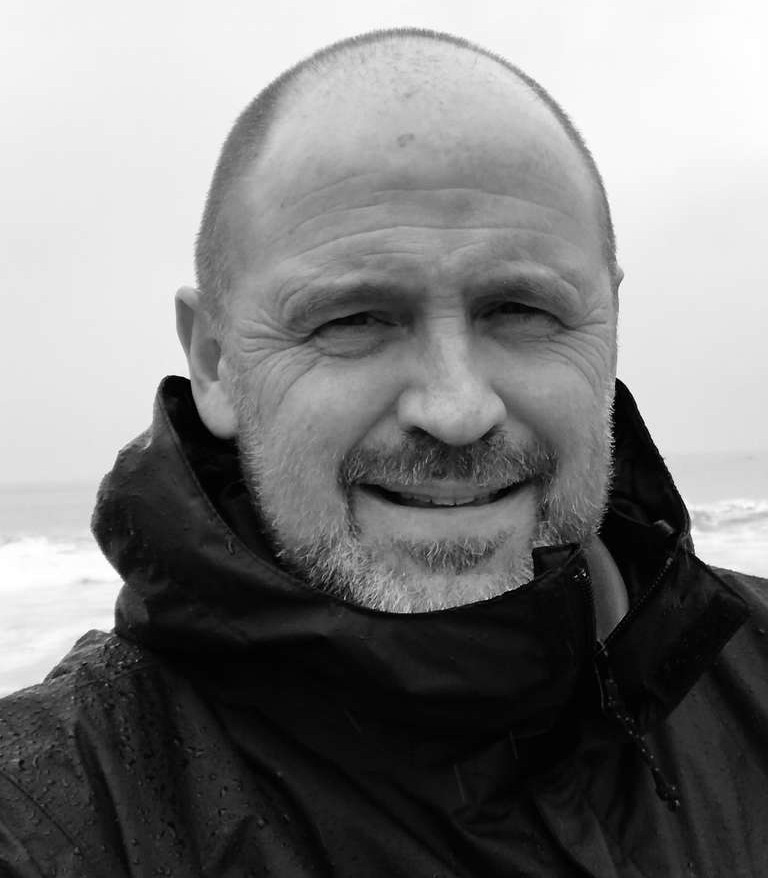
6.) Jack Beaudoin, Journal Tribune
JackBeaudoi.com photo

If you ask people who have lived in Biddeford a long time about who they think was the city’s best reporter, Beaudoin’s name invariably rises to the top.

Jack, a Biddeford native, earned his reputation as an outstanding reporter. He was usually the smartest guy in the room but never acted like it. In fact, he is one of the most self-effacing people I have ever met.

Jack is also the former publisher of the Maine Center for Public Interest Reporting. Today, he lives in Stonington and describes himself as an “ink-stained wretch.”

You can find his work today at jackbeaudoin.com

_____________________

5.) Kelley Bouchard, Portland Press Herald
Facebook photo

I think it was 2001 when Kelley and I first met. She had been assigned to cover Biddeford back when the Press Herald had a bureau office on Main Street in Biddeford.

I am lucky to know Kelley as a friend, despite the fact that we were fierce competitors back in the day, when MERC was still burning garbage downtown and dinosaurs could be seen stumbling down Lincoln Street.

Kelley was tough as nails. She never accepted the proverbial talking point memos. She asked hard questions, but she was fair and thorough. Today, she still holds my feet to the fire, often questioning the motives of some of my political posts on social media. I really miss working alongside Kelley. Those days are some of my favorite memories.

______________________

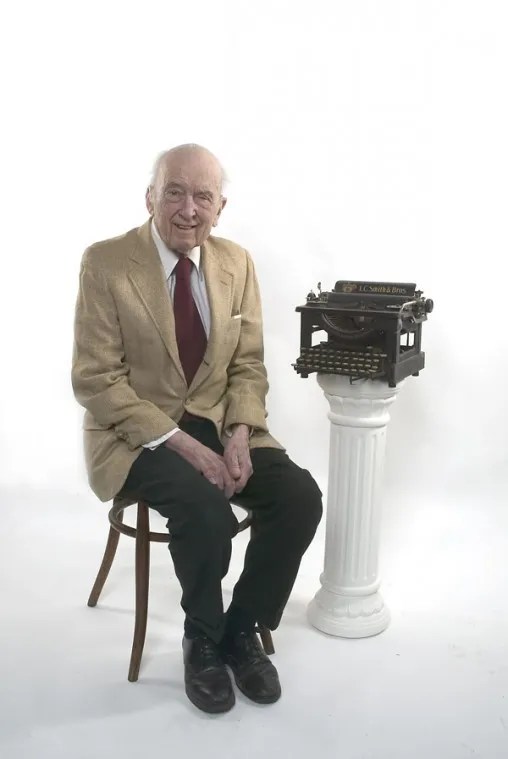
4.) Harry Foote, American Journal
Press Herald photo

If you’re a journalist over the age of 40 in Maine, it is more than likely that you once worked for Harry Foote, the late founder and publisher of the weekly American Journal, then based in Westbrook.

Harry — always grinning but unrelenting in his push for perfection and “real news,” — probably taught more journalists than the Columbia School of Journalism.

I learned so much from Harry. He was a legend and a force to be reckoned with, just ask former mayors and city councilors from Westbrook.

Harry died in 2012 at the age of 96. In 1990, he received the Maine Press Association’s Journalist of the Year award. In 1999, he was inducted into the Maine Press Association’s Hall of Fame.

I really miss Harry, the chaos of his newsroom, his collection of pencils and the apron he would wear around his waist. I’m one of the lucky ones. I got to work for Harry Foote.

____________________

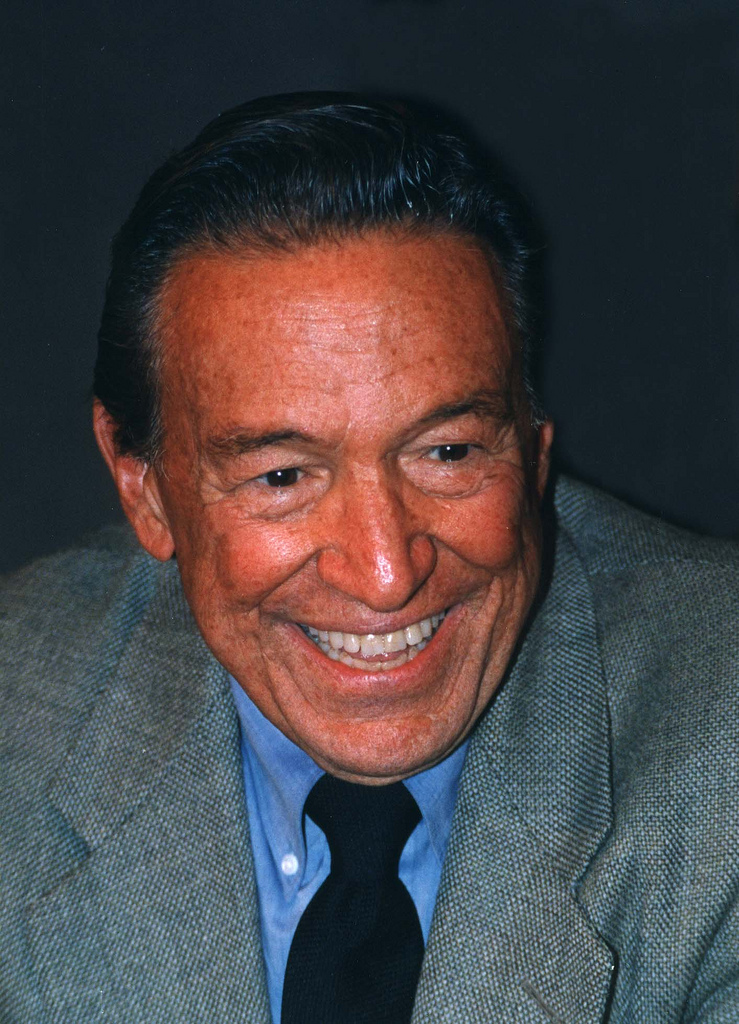
3.) Mike Wallace, CBS News/ 60 Minutes
Wikipedia photo

It is a well-known fact that journalists in the United States are required by law to pay silent homage and tribute to Mike Wallace before writing or producing every news story.

Wallace is considered a deity by so many of his peers in the world of journalism. He was one of the original four members of the magazine-style television news program, 60 Minutes. He was the definition of investigative journalism. He was loathed by President Richard Nixon.

Why is he on this list? Because he is Mike Wallace, and I am legally required to describe him as one of the greatest journalists of all time.

_____________________

2.) Carl Bernstein, Washington Post
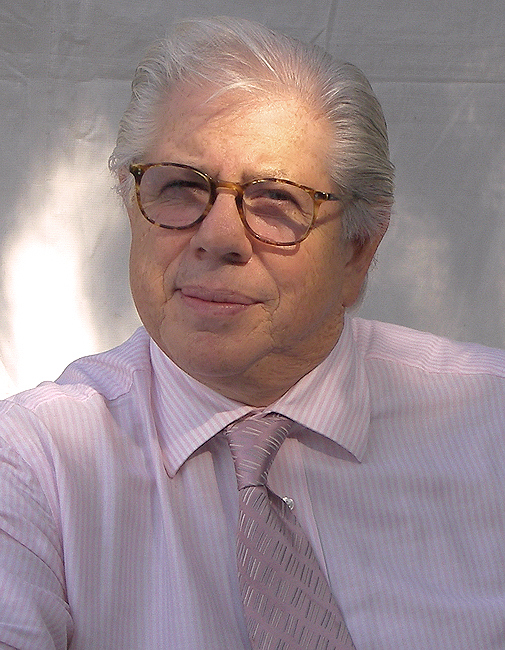
Wikipedia photo

Although never as well-known or revered as his Watergate counterpart — Bob Woodward – Carl is a man after my own heart.

He never graduated from college, but he was a brilliant and remarkable reporter. It is rumored that he lied in order to get hired by the Washington Post when he was still in high school. His peers often described him as a manic and tenacious workaholic.

Many people believe that without Bernstein’s rabid and aggressive style of reporting, the Watergate scandal may have never been brought to light. I was 10 years old when Nixon became the first president to resign from office in August 1974. I was glued to the television coverage. It was then that I knew I wanted to be the next Bob Woodward or Carl Bernstein.

If you enjoy good books, check out Bernstein’s memoir, Chasing History: A Kid In The Newsroom.

Drum roll please . . .

And now —- my all-time favorite journalist:

Hunter S. Thompson, Rolling Stone
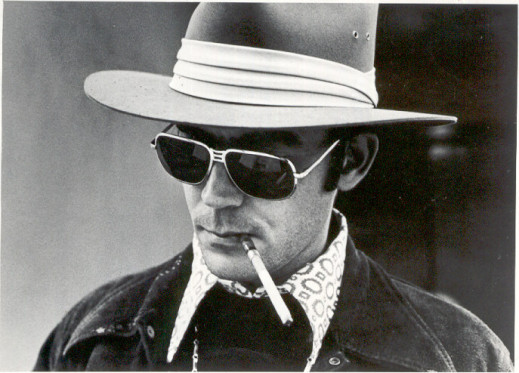
(Photo from Facebook)

Quite simply, the late Hunter S. Thompson is my hero, my idol and all sorts of other things. He is the founder and creator of Gonzo-style journalism.

He broke all the rules of traditional journalism. A heavy drinker and smoker, he also experimented with drugs, including hallucinogens. He was a prominent leader of the counter-cultural movement that swept across America during the late 1960s and the early 1970s.

His landmark book — Fear and Loathing in Las Vegas — was well received and required reading for rebellious teenagers who wanted nothing more than to piss off their parents.

Hunter’s career started back in the days when people like Jack Kerouac and Alan Ginsberg were gaining traction in literary circles, creating what became the Beat Generation and a legion of self-described “beatniks” who desperately wanted to follow in their footsteps.

Thompson was simultaneously brilliant and self-destructive. He didn’t take criticism well, unless it was from someone he respected and also loathed like Truman Capote.

I really believe that I was born 30 years too late, I like to think that maybe Hunter and I would be friends. We both served in the U.S. Air Force.

Perhaps no writer influenced me more than Thompson. I tried to use a Gonzo-style approach when writing my weekly All Along the Watchtower column for the Courier.

If you want another great book recommendation, check out Outlaw Journalist: The Life and Times of Hunter S. Thompson by William McKeen.

And that’s a wrap.

_________________________

My sincere apologies to everyone on this list. I really do respect your work, and I do – unlike Chris Busby – care about how other journalists perceive my work.

I had a lot of fun writing this. I hope you enjoyed reading it.

___________________________

Randy Seaver is a hack journalist living in Biddeford. He is the editor and founder of the Biddeford Gazette, a non-profit digital news publication that focuses on the city of Biddeford.

Randy has been annoying other journalists and editors since 1981 when he did a brief stint as an unpaid student intern at the former Journal Tribune, a daily newspaper based in Biddeford.

He regularly writes about politics, journalism and his own struggles with mental illness at Lessons in Mediocrity | Outlaw Journalist

© 2026 Randy Seaver | All Rights Reserved

Subscribe today and never miss an update! It’s free and worth it!
A Change Will Do You Good

“So I turned myself to face me

But I’ve never caught a glimpse

How the others must see the faker

I’m much too fast to take that test”

— David Bowie, Changes (1971)

Today – almost 44 years later – I still enjoy telling the story about the first time something that I wrote was published.

It was 1981. I was 16 and a high school junior. We were required to do a one-week work-study project, exploring a career field that seemed of interest.

I thought I wanted to be a newspaper reporter. So, I called the Journal Tribune —then this region’s daily newspaper – to make an inquiry. The editor (Eric Reiss) agreed to let me shadow a couple of reporters and work in the newsroom.

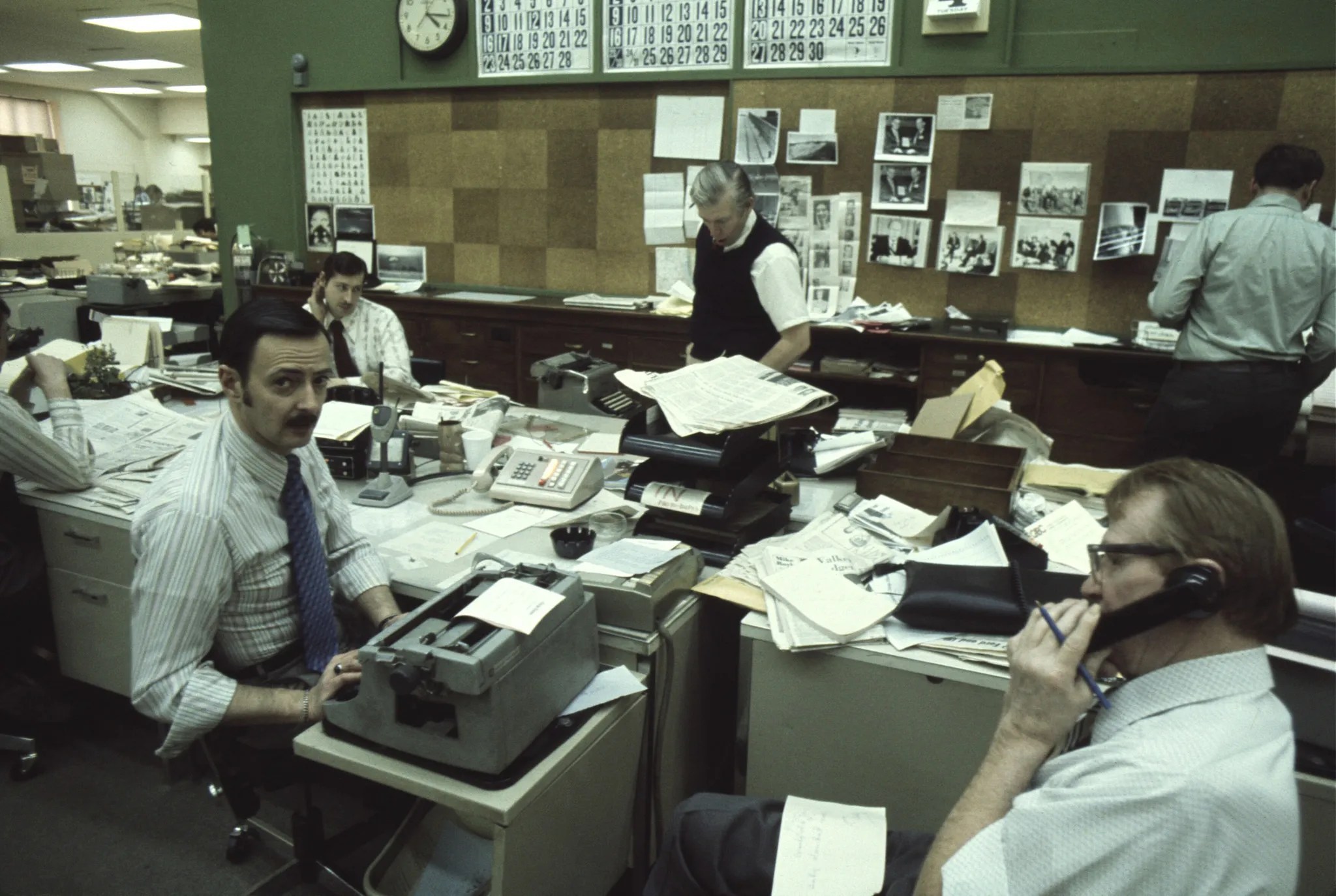
Back then smoking was allowed in newsrooms. So was coffee, profanity, screaming matches and the constant hum from a chorus of IBM Selectric II typewriters.

A typical newsroom in the 1970s (Chicago Tribune)

It was a marvelous time, especially for an enthusiastic high school kid with dreams of grandeur about becoming the next Bob Woodward.

Near the end of the week, I was allowed to occupy an empty desk that was closest to the cranky city editor, Bob Melville – a man who wore his glasses perched low on his nose.

Mr. Melville would later become a well-known real estate agent and was repeatedly elected to serve on the Biddeford School Board after his retirement. In real-life, Bob had a great sense of humor and was well-regarded as a hard-working, respectable man of intellect and integrity.

But for me, a skinny 16-year-old kid with stubborn acne, Mr. Melville was like the Wizard of Oz, and I was a combination of the Cowardly Lion and The Scarecrow. I had neither brains nor courage.

I was just sitting there at that desk, wondering what I should do. Phones were ringing all around me, but I was not allowed to answer them.

Our deadline was looming. If you have ever worked in a newsroom, you know that editors become increasingly grumpy with each passing second closer to deadline.

Melville, clutching his phone, suddenly turned to me, staring at me over the glasses that remain still perched on the end of his nose.

Mr. Melville was like the Wizard of Oz, and I was a combination of the Cowardly Lion and The Scarecrow. I had neither brains nor courage.

“Kid!” he barked. “Line Two.”

I was shocked, excited and terrified. The city editor was giving me a story. Finally! Something I could actually write! I was on my way now!

Oh, the places you will go

Turns out that the guy on ‘Line 2’ was a local funeral director. He was calling to give me a last-minute obituary for that afternoon’s newspaper.

I took copious notes on a legal pad. I do not remember the name of the gentleman I was writing about. I only remember that he belonged to about every social club you could imagine: The Elks, The Eagles, The Lions, Rotary . . . the list seemed endless.

The deceased also had roughly 250,000 nieces, nephews, cousins and grandchildren.

I hung up the phone and loaded a fresh sheet of paper into my typewriter. I had never written an obituary before, but Mr. Melville gave me a stack of some recent obits as a guide.

I put my very best effort into writing that obituary. I pained over each word, doing my best to avoid split infinitives and ending any sentence with a preposition.

Melville kept glancing at me and then the clock on the wall. I could tell he was becoming impatient.

I tore the copy from my typewriter and proudly placed it in a wire basket on Melville’s desk before returning to my chair.

I watched as he began to read my masterpiece. His brow furrowed and his posture stiffened. He grabbed a red pen and was waving it across my piece with an almost gleeful abandon.

After several painstaking seconds of anticipation, he finally turned to me and asked: “Where do you go to high school?”

Actually, that year I was attending Rumford High School, but I blurted out “Thornton Academy.”

“Well, don’t they teach English at Thornton Academy?” he huffed.

I was humiliated but could barely wait until the first run of that day’s paper was completed. I anxiously turned to the obituaries page but found nothing that remotely resembled my masterpiece.

In the end, the only two things I got right was the man’s name and age. Basically, everything else had been rewritten. No matter, I was proud.

My mother was proud, too. She cut out that obituary and posted that poor bastard’s obituary on our refrigerator – I was now part of an elite clan: a newspaper reporter who had published something in a real newspaper.

In the mood

More than four decades later, and I am now a semi-retired newspaper editor and reporter.

A few weeks ago, I launched a new endeavor, The Biddeford Gazette. The Gazette is a free, online news outlet that focuses on Biddeford news and events.

A lot has changed in the newspaper business over the last 40 years. For example, you can no longer smoke in a newsroom, but profanity among your coworkers is still strongly encouraged.

For better or worse, more and more people are turning to social media for their news and information. Thanks to technology, today’s news consumers can now custom tailor their news feed almost in the same way you create a music playlist on Spotify or YouTube.

Some of the changes are good, but many of the changes – especially AI (Artificial Intelligence) – are not so good.

Launching my own media source was never intended to become a source of income. It’s basically a hobby, a tool to help provide some handrails on the road of life.

Yes, I still do a little political consulting and some public relations work for clients throughout New England, but none in the Biddeford or Saco area.

The Biddeford Gazette allows me to report news on my terms, when I want and how I want. I’m not here to compete with any other traditional publication, including Saco Bay News, the Biddeford-Saco Courier or the Portland Press Herald.

Up until last year, my website was called Randy Seaver Consulting and provided an overview of the services I offered as a public relations consultant.

My lingering mental health issues, however, played a part in me stepping away from the full-time, stress-packed world of political consulting.

Then, as I began shifting my professional career, I renamed the site, Lessons in Mediocrity so that I could basically do whatever I want: serious journalism, political satire, fiction, local news and a diary of coping tools against schizophrenia, anxiety and depression.

Well, how did I get here?

Today is the first day of 2025.

I am no longer that skinny kid with pimples too afraid to look a girl in the eye. I am once again going to rebrand this website as the Biddeford Gazette.

Up until today, the Biddeford Gazette was a sub-page on my blog. Rest assured, my personal blog will continue – but now as a subpage to the Gazette.

Since launching the Biddeford Gazette just six weeks ago, I have been able to break some significant news stories and also have a bit of fun at the expense of local politicians. (Someone needs to keep them on their toes)

And I am pleased to announce that beginning January 6, 2025, the Biddeford Gazette will publish local obituaries that are supplied by local funeral homes.

Traditional media outlets charge significant fees to publish an obituary. The Biddeford Gazette will publish them for free with the help of some social media partners in the Biddeford and Saco area.

Imagine that, 44 years later, and I am going right back to where I started, doing my best to honor and remember those who are no longer with us.

This change just feels right.

Happy New Year!

P.S. This website is currently being reconfigured.

Never miss another update! Subscribe to the Biddeford Gazette for free!

Angels and Demons: The best lie I ever told

I think Stephen King would probably agree with me when I say that the very best horror stories are the ones that are based on a true story.

Despite my childhood proclivity for lying, the story you are about to read is, unfortunately, true.

It happened on a very hot day in the summer of 1976, almost 50 years ago. I was 12 years old, and I told a whopper of a lie that ended up on the front page of the daily newspaper.

Let’s pause here for a moment. Please allow me to explain why I am publicly sharing this story for the first time.

Two guys having a hissy fit

Ed Pierce, now the managing editor of the weekly Windham Eagle, got upset with me about something I posted on Facebook regarding Biddeford City Manager James Bennett a few days ago.

Pierce publicly questioned my “journalistic ethics” in posting the story about Bennett. I replied that I am no longer a “professional journalist,” despite the fact that I occasionally write puff pieces for Saco Bay News as a freelancer. My days of covering Biddeford City Hall are behind me.

To make a long story a bit shorter, Ed Pierce and I began trading barbs on social media. We were each very snarky with our slings and arrows.

Fun stuff — two, white middle-aged newspaper guys who both live in Biddeford – going at it like a couple of high school girls arguing about who gets to be prom queen.

Pierce got especially pissed when I brought up an unfortunate incident that happened in 2018 while he was the editor of the now closed Journal Tribune in Biddeford.

Maine media critic Al Diamon — who writes a column in several publications throughout Maine – had a field day with Pierce, who was duped into writing a news story about something that never happened.  [Read Diamon’s blistering column here.]

Pierce was getting angrier by the second until he somehow found an equally damming story about me.

Here’s the difference: While I was going after Pierce for a silly mistake he made as a newspaper editor, he decided to come back at me with an embarrassing story from my childhood, when I was 12 years old.

What’s the frequency, Kenneth?

As I said, it was a hot day in July 1976. I was getting ready to head out on my paper route. Ironically, I delivered the Journal Tribune in my neighborhood in Saco, near the armory on Franklin Street.

I got into an argument with my younger sister. Our fracas woke our father from a mid-day nap. He was enraged. He came flying out of the house and almost literally beat the shit out of me.

I was both angry and hurt, I took off running and stayed away for a few hours. I made it as far as the Five Points Shopping Center in Biddeford before getting hungry and tired.

I started to walk home, but I was still angry. Only a few hundred yards away from my home, I threw away my wristwatch and my belt near Don’s Variety, a small corner store that was located at the corner of Maple and Bradley streets in Saco.

Don’t ask me why I threw away my watch and belt. It’s been almost 50 years. Who knows what I was thinking?

My parents had called the Saco Police Department and reported me missing. It was now evening as I began my way back up Franklin Street to return home. A patrol officer spotted me only a few yards away from my home.

My face and shirt were covered with dried blood. My parents came running over to the now parked police cruiser. The officer asked me what happened. I glanced at my parents and then back at the officer.

I then did something I would regret for many years to come. I lied.

I told the officer that I was attacked by a big, fat bald man wearing a red tee-shirt and blue jeans.

You can probably guess what happened next.

The city of Saco basically went into lockdown. The story swept across the city like a wildfire. A child molester was on the loose in Saco.

At the officer’s advice, my parents brought me to the Webber Hospital in Biddeford. The ER doctor was concerned about damage to my right eye. I was transferred by ambulance and admitted for overnight observation at Maine Medical Center in Portland.

My lie had worked, but not for long.

Extra! Extra! Read all about it!

The next day, the Journal Tribune ran a front-page story about the attack. I was the victim, so they used my name, despite the fact that I was 12.

Then my lie began to unravel.

A friend of my parents told police that she had seen me at Five Points and was concerned because I had blood on my face and clothes.

Now the Biddeford Police Department got involved. Detective Gagne questioned me. I offered up a new story. I said that I was beaten by a group of teenagers near Mayfield Park.

Gagne wasn’t buying what I was selling. My tissue of lies disintegrated.

Finally, after being threatened with juvenile detention, I told the “truth.” I said I “fell down” in my backyard.

Of course, I was once again lying but everybody bought it. Hook, line and sinker. The police, my parents and even the local newspaper.

The very next day, the Journal Tribune ran a front-page story above the fold: “Youth Admits Lie.”

They had to do the story to quell panicked and concerned citizens. They were just doing their job. But again, my name was included in the story. I went from victim to outcast in less than 48 hours.

The owner of Don’s Variety was understandably pissed. He kicked me out of the store a few days later.

The first few weeks of seventh-grade sort of sucked.

All in all, I had told three lies. The first about a fat, bald man. The second, about a gang of kids on May Street, but it was the last one that everyone seemed to believe for nearly five decades. I fell down. Okay. Sure. Whatever.

That last lie held up right until Ed Pierce decided to use that story as leverage in order to publicly embarrass and hurt me.

Near the end of our Facebook exchange, Mr. Pierce made a not-so-subtle reference to wristwatches that could be found at the long-since closed Don’s Variety.

When confronted by me and some others, he quickly deleted his comments.

What Ed Pierce probably doesn’t know is that he actually did me a huge favor. I’ve been carrying that shame around for almost 50 years. It was a relief to finally let go. To finally tell the truth; to finally reconcile something that should have never happened.

The angels wanna wear my red shoes

My father passed away a little more than four years ago. They say you should never speak ill of the dead, and that’s probably good advice.

One of the earliest photos of me and my dad; Circa 1964.

Did my father act like a monster? Yup. Did he physically and emotionally abuse me and my younger sister? Yup. For many years, he routinely referred to me as “queer boy.” My sister struggled with her weight, beginning around age 9. He routinely referred to her as “baby elephant.”

It would be easy and quite convenient to simply label my father as a monster, but to do so would be telling a much bigger lie.

Yes, he was abusive . . . to me, my sister and my mother, but here’s the hard part: He was also a loving and generous father. He sometimes worked three jobs so that my sister and I would want for nothing.

My father worked his ass off to make us middle-class. Clarinet lessons and Boy Scouts for me. Ballet and tap lessons for my sister. Every Christmas was magical. In many ways, we were spoiled kids.

We went on vacations every summer, and Dad helped us with our homework. That was him. Singing and playing guitar in the church choir while my sister and I were altar servers at Most Holy Trinity. He was a talented musician, well-known for his charm and sense of humor.

My father’s professional career was spent teaching students who were in those days mostly ignored.

He was a teacher at the Cerebral Palsy Center in Portland. He had to help some of his students use the bathroom. He patiently helped them eat their lunch. Day in and day out, he was gentle and kind to those kids. But it took a toll.

It seemed like one of his students died almost every month. It gutted him. He cared so much about them. He was a walking, talking, breathing contradiction of terms.

Dad always had a soft spot for the outcasts and the troubled kids. He was a friend, a dedicated mentor with tons of patience.

Two years after I “fell down,” my mother finally filed for divorce. That was not pretty.

My father was a demon, and he was an angel, and that’s about as fair as I can be.

Life is complicated.

I have forgiven my old man; something that became a lot easier to do once I was confronted with how hard it is to be a father.

This is a sad story, but it is true. If you think I’m exaggerating, you can check the police records or the Journal Tribune archives on microfiche at the McArthur Library in Biddeford.

The next time you a hear a child say that he or she got hurt by “falling down,” please remember that they are likely feeding you a load of baloney.

Thank you, Ed Pierce. It feels good to finally have the truth out there. Now how about some fresh sushi and French Fries?

Never miss another installment of Lessons in Mediocrity! Subscribe today for free!

Stop Making Sense: the birth and resurrection of a monster in Biddeford

Over the just the past few days, two journalists have reached out to me in order to criticize some things I’ve said on social media.

Ted Cohen, a former and respected reporter from the Portland Press Herald, and Ed Pierce, now the editor of the weekly Windham Eagle, both think I need some guidance.

Cohen was sincere and well-meaning with his criticism. We’ve known each other for more than 25 years. He raised some valuable points for me to consider. Pierce, however, was much less than cordial. He really, really does not like me.

In fact, during our back-and-forth exchange – while we were both hurling insults and snarky comments at each other on Facebook — Pierce decided to bring out the big guns and tried to publicly shame me about something I did when I was 12 years old, an incident that was on the front page of the Journal Tribune in 1976. (You can read about that incident here).

Cohen just thinks I am wasting my time and frittering away my resources as an old-school reporter. He thinks I should just “shut-the-fuck up” on social media and go back to being a full-time journalist covering the city of Biddeford. He does not like my blog posts about my struggles with mental illness, a topic he says “nobody really cares about.”

During a camping trip last weekend, I gave a lot of thought to the criticisms raised by both Cohen and Pierce. Again, I admire and respect Cohen. Pierce? Not so much. But I realized both men provided a glimpse into the viewpoints of many other people, especially in the Biddeford-Saco area.

Although I generally get a lot of positive feedback from readers, there are some people who are annoyed by what I write. These folks think I suck at journalism. Many others are bent out of shape and hate the fact that I am an administrator of the Biddeford-Saco Community Facebook page.

If you think my ego is hyper-inflated, and if you think that I have too much influence in the city of Biddeford and elsewhere, don’t blame me.

Put the blame where the blame belongs.

Blame David Flood. It’s all his fault.

It was David Flood who set this unfortunate series of events into motion. He created the monster that some of you despise.

David Flood Press Herald photo

Let’s pause and back up a bit for context.

A bad seed is planted

It was October 1998. I was sitting in my parked car (a 1987 rusting Subaru) on Washington Street in Biddeford, not far from the former Wonderbar Restaurant.

My stomach was in knots, and I was just starting my second pack of cigarettes that day. I really wanted this job. I really needed this job.

My life at that time was a giant, hot mess. I was basically broke, living in a studio apartment in Westbrook and had a credit score somewhere near the 300 mark.

I was 34 years old and considered myself a complete failure. No close family connections. Few friends, and not even a bank account.

I was working for another weekly newspaper when I interviewed for the job at the Biddeford-Saco-OOB Courier, a weekly publication that was then owned by David and Carolyn Flood.

The job appealed to me to me for two reasons. First, it seemed more interesting than the job I had covering the towns of Windham and Standish. I had grown up in the Biddeford-Saco area. My family had deep roots in both communities.

Secondly, the Courier position would pay roughly 50 cents an hour more than my current gig. That’s a difference of about $20 per week. When you’re flat broke, an extra $20 per week sounds really good.

I think David was impressed by my enthusiasm and the fact that I had experience. But I think what clinched the deal was that he recognized the value of hiring a reporter who had a basic understanding of the community he would be covering.

We shook hands, and I was set to start in two weeks so that I could give my current employer notice.

That was it. That was the moment when my entire life changed.

If not for David’s decision to hire me, I would not have met Laura who had decided several years ago to run for a seat on the Old Orchard Beach School Board. I would not have had the opportunity to help raise my kids, Tim and Matt.

If not for that job as a reporter covering Biddeford and Saco, it is quite likely that you would have never heard my name. More than 99 percent of the people I interact with on social media only know me because David Flood hired me as a reporter.

If not for David Flood’s decision, I would have never been hired a few years later by Barton & Gingold, one of Maine’s most respected political and public relations consulting firms. I would have never bought a house in Biddeford.

Had David Flood not hired me, it is more than likely that you and I would not know each other. So, if you find me insufferable or just plain annoying, blame David Flood. It’s all his fault.

Jumping in feet first

Just a few days before Halloween 1998, I hit the streets as the newest reporter covering Biddeford and Saco. Other than a couple of family members, I basically knew no one in the area.

The few friends I had at that time all lived near Portland. I grabbed a reporter’s notebook, a pen and an old camera on my quest to find a news story. I walked less than 20-feet when I bumped into a man wearing the costume of a deranged chef. He was holding a rubber chicken and a meat cleaver.

It was a Friday afternoon, and downtown merchants were participating in a Halloween trick-or-treat event. I asked the man with the rubber chicken if I could take his picture for the newspaper.

That man’s name was Brian Keely, the son of Vincent Keely who owned the Wonderbar Restaurant on the other side of Washington Street. Five years later, Brian Keely was the best man at my wedding.

Brian’s father sort of adopted me. Vincent always had a sly grin and had a mannerism that was both charming and subdued. Because the Wonderbar was near City Hall, it was a popular place for city councilors and other politicians to hang out after long, tedious meetings.

I spent a lot of time at the Wonderbar. Vincent Keely pointed me to some great stories. He knew almost everyone. He seemed to like me. Brian and I became good friends.

Back then, there was always a lot of drama at City Hall. The stories were easy to come by, but the competition was stiff. Every meeting was also attended by a reporter from both the Portland Press Herald and the Journal Tribune.

I was trying to establish myself and pushing to make the weekly Courier the paper of record in Biddeford and Saco.

I worked my ass off. We gave the Journal and Press Herald a run for their money. A few months later, David gave me the first of several pay raises. It was February 1999, and I received a notice from Northern Utilities that my heat was going to be turned off.

Without me asking them, David and Carolyn paid my overdue heating bill. They never asked for repayment. You never forget things like that. I was battling with some severe depression back then. David and Carolyn basically saved my life.

It was there and then that I decided I would treat the Courier as if I were its owner. I didn’t work 40 hours a week. I worked, 60, 80 hours a week. Sometimes more. It didn’t matter. The Courier was not my job.

The Courier was my life.

The beginning of the end

Eventually, I became the Courier’s editor. David and Carolyn were kept busy as their company grew by leaps and bounds. They soon added the South Portland Sentry and the Kennebunk Post to their existing publications, which included the Courier and the Scarborough Leader.

It was at about this time that I approached David and asked permission to begin a weekly opinion column, which would focus on statewide politics. He agreed. The name of that column was called All Along The Watchtower.

To this very day, people routinely tell me how much they loved that column, which had morphed into a catch-all of snarky local political commentary.

Doug Sanford offered me an apartment on the third floor above the Happy Dragon restaurant on Main Street in Biddeford. I now lived and worked on Main Street. I was immersed into Biddeford’s culture.

I became a fixture at City Hall and regularly annoyed local politicians including former mayor and city councilor Jim Grattelo, who repeatedly asked David to fire me.

Brian Keely and I started a live call-in television program on the public access channel. The name of the show, of course, was called Along the Watchtower, and it was a live, no-holds barred hour-long program about local politics.

I could keep going and going, but that’s basically it. That’s how it started. The staff at the Journal Tribune didn’t much care for me. Their days were numbered, and they knew it. Reporters at the Press Herald’s Biddeford bureau respected my work ethic but kept their distance.

David promoted me to become managing editor of all his publications.

I left the newspaper business in 2006 to pursue a career in political consulting. A few years later, in 2011, former Biddeford city councilor Alan Casavant asked me to be his campaign manager. He wanted to oust incumbent mayor Joanne Twomey.

We won that campaign by a margin of more than 65 percent. I repeated my role in Casavant’s re-election in 2013; and I helped with his next four campaigns.

Serving as master of ceremonies at Alan Casavant’s inauguration in 2011

In 2001, a woman named Laura Kidman Hayes sent me a curt e-mail, pointing out that I screwed up in my coverage of the pending election in Old Orchard Beach. I responded with a pithy and sarcastic retort.

She lost that election, and we were married less than two years later. The next year, we bought our home in Biddeford. A few years later, she won a seat as an at-large representative on the Biddeford City Council. She easily won reelection for a second term.

I missed writing about Biddeford politics and started this blog. A couple of years ago, I agreed to do some freelance writing for Saco Bay News. I had to step away from writing about Biddeford news a few months ago, however, because of a conflict of interest. I also can no longer write about Saco politics because my stepsister is now that city’s mayor.

So today, I continue to run my own, very small consulting business and write this blog and occasionally write puff pieces and feature stories for Saco Bay News.

A moment of clarity

Let’s get something straight right now. I no longer consider myself to be a professional journalist. I share personal opinions and observations on social media. I am basically a semi-retired consultant. That’s it.

You should also know that I am not very bright as I outlined in a prior blog post from two years ago.

I do enjoy public feedback — the good, the bad and the ugly. You can find samples of that criticism on this site. Maybe your criticisms can someday make that list.

To Mr. Cohen, I say, thanks, but no thanks. I’d rather be a free-wheeling blogger than a full-time journalist.

To Mr. Pierce, I would say . . . dude, you have a serious anger management problem, and you should really get some professional help.

To Jim Grattelo, I would say: remember what Obi-Wan Kenobi said to Darth Vader, if you strike me down, I will only become more powerful.

To the rest of you, thank you so much for taking the time to read my stuff. It means the world to me. To think that you give up even a few minutes of your day to engage with me is almost beyond my comprehension.

Finally, to David and Carolyn Flood, you guys not only saved my life, but you gave it meaning. I know I that I often drove you guys nuts, but please never doubt how grateful I will always be.

Never miss anther installment of Lessons In Mediocrity. Subscribe now for free!

Achtung, Baby

Not too long ago, a very well-known and respected Boston Globe columnist opined that there are some good reasons why a growing number of Americans no longer “trust the media.”

In his Nov. 29, 2022 opinion column, Jeff Jacoby pointed to a recent Gallup report, which revealed that just one out of three Americans claimed to have a “great deal” or a “fair amount” of confidence in the media.

“It has been a long time since most Americans trusted the press to tell them the truth,” Jacoby wrote, adding that “in 1972, when Gallup first began assessing the public’s opinion of the news industry, 68 percent of adults voiced a high degree of confidence in the media’s credibility. In 1976, the year Robert Redford, Dustin Hoffman, and Jason Robards starred in All the President’s Men, public faith in the media’s integrity set a record: 72 percent.”

“Over the last three decades, that faith [in the media] has largely crumbled,” Jacoby wrote, saying “journalists and news organizations have increasingly abandoned the old ideal of unbiased news coverage, as media outlets have come to care more about getting the narrative right than getting the facts right.”

To support his opinion, Jacoby points to some recent news stories and how those stories have been covered by large and well-known media outlets.

I tend to believe that Jacoby is right, at least on a macro level.

(Photo: IMDb)

What is journalism?

The field of journalism has undergone a seismic shift over the last four decades. It’s not uncommon today to hear an older person say something like “I miss Walter Cronkite. He didn’t have an agenda.”

In all fairness, Cronkite was roundly criticized by many voices for being a bit less than completely objective.

I think our expectations of the media have also changed dramatically over the last four decades.  For better or worse, evolving technology – along with a relatively new emphasis on the importance of ratings – has produced a profound impact upon the media landscape.

But what is “the media,” and how do we define the practice of journalism? I think those are some loaded questions, and the answers are both complex and widely varying.

Today, thanks to technology and some societal changes, just about anyone can be a “journalist” or a media outlet. There is no requirement for any kind of training or experience. All you need is a notebook, a camera and an internet connection and presto – –  you are a journalist, or as we say these days, a “social influencer.”

Don’t get me wrong. There are many positive aspects of grass-roots journalism, but it’s also becoming increasingly difficult for news consumers to separate the wheat from the chaff when trying to discern what exactly is legitimate news coverage.

Another problem is that more and more consumers are trying to custom-tailor their news feed, aligning themselves with their own politically-flavored news perspective. If a news outlet produces a story that somehow disrupts the reader’s individual world view then it is automatically dismissed as “fake news” and further proof of media bias.

Almost three years ago, I wrote a similar blog post and interviewed two veteran Maine journalists from both sides of the political spectrum, asking them if the media is biased.

Dennis Bailey spent several years as a reporter working for the Maine Times and Portland Press Herald. He readily acknowledges that his personal politics are more in line with Democrats.

“I’ve never been a believer in objective journalism,” Bailey told me. “A good story is a good story, but it does come with some bias.”

Bailey pointed to certain realities about how a news story is produced. “A reporter often decides what story to follow,” he said. “From there, an editor decides the placement of a story and the headline of that story. These are all subjective decisions.”

On the other side of the political aisle, John Day, who spent several decades as a reporter and then as an editor of the Bangor Daily News, agrees with Bailey about media bias.

“I’m a big fan of diversity,” Day said. “But I was always a contrarian. Fake news has always been around. If all news outlets reported every story the same way, then it would be nothing more than a giant circle jerk.”

New media outlets seem to be popping up almost every-day. Cable-television introduced us to the 24-hour news cycle, and the creation of the internet ushered in the age of instant news coverage. The popularity of social media sites such as Twitter and Facebook only further obfuscate the definition of “the media.”

And we cannot ignore the financial pressures faced by those who produce the news that we read, watch or listen to.

Several months ago, I watched an interview with Christopher Wallace, a former anchor on Fox News Sunday and is now a CNN anchor. Wallace, who has a reputation as a hard-nosed journalist, was talking about how the media has changed over the last several years.

What struck me about that interview is that Wallace laid plenty of blame at the feet of his father, Mike Wallace, who is generally revered as some kind of demi-god by most professional journalists. During the latter part of his career, the elder Wallace was one of the lead anchors of 60 Minutes, a news magazine show that debuted on CBS.

“Before 60 Minutes, the networks generally considered news programming as some sort of public service,” the younger Wallace explained. “Then 60 Minutes happened, and suddenly the networks began to see news programming as a very valuable commodity.”

While the big media corporations continue to intensify their ratings war, many local and small media outlets are struggling to keep their heads above water as they desperately try to keep pace with the continually changing news landscape.

But how does that negatively impact you? Who really cares if another local newspaper closes shop? I’ll get to that in a moment.

The responsibility of the fourth estate

Nearly 300 years ago, Edmund Burke, a member of British Parliament, reportedly coined the term “Fourth Estate” to describe the press, its obligations as a check in government oversight and its responsibility to frame political issues as well as advocacy for the general public.

From Burke’s perspective, the news media played a very important role, at least as important as the other three estates: the clergy, the nobility and the commoners. Today, especially in the United States, the other three estates of government are considered as the executive branch, the legislative branch and the judicial branch.

That’s pretty heady stuff if you stop and think about it. A free and unencumbered press literally has the capacity to bring down even the most powerful of political leaders or organizations. We need the press to be our advocates at the table. We depend on the media to keep government in check.

It’s not just important during something like the Vietnam War (the Pentagon Papers, New York Times) or the Watergate scandal (Washington Post). It also matters in your own community and your day-to-day life.

For example, how exactly is the government spending your tax dollars? Who is paying attention to that new zoning ordinance and how it could impact your home value? What is the city planning to do to your kid’s school? Who is advocating for the less fortunate among us? Who is keeping us aware of the day-to-day threats to our peace and comfort?

Sure, I think it’s great that the city of Biddeford has its own, municipal news organization: The Biddeford Beat. But is that really a good replacement for an independent media source? I mean, really, how do we expect a government agency to provide a comprehensive critique of itself or an overview of its day-to-day activities? In fact, one has to wonder how much tax money is being used to produce local government-controlled news.

There are two main reasons why it is becoming more common to see local government create its own “news” coverage. First, the technology makes it relatively easy to do, especially if it’s just an on-line news source.

But much more troubling is the fact that many local government agencies are simply trying to fill a void left by a rapidly shrinking pool of professional reporters at the local level.

I fondly remember covering Biddeford City Council meetings more than 20 years ago. Back then, the council chambers were – politely speaking – often packed with opinions, rage and contempt. It was mostly civil, but it seemed as if there was always some sort of tension. Certain residents regularly attended every meeting, never hesitating to use their five-minute limit at the podium during the “public comment” period. It was awesome.

Back then, there were at least three reporters at every council meeting: Kelley Bouchard covered Biddeford for the Portland Press Herald. Josh Williamson represented the Journal Tribune, and I was there on behalf of the Biddeford-Saco-OOB Courier.

Each of us would have likely stabbed the others in the neck in order to get the story first. We scrapped it out on the streets, digging for the facts, looking at all the angles and always fiercely competitive. Frankly, it was humbling to work with professionals like Kelley and Josh.

According to the US Census Bureau, the city of Biddeford has a population of roughly 22,000 residents. I think a city of that size, although small, deserves and warrants a full-time reporter or two. Even more so, when considering that Biddeford is the largest city in York County and is a service center for residents from all over southern Maine.

Today, unfortunately, city council meetings in Biddeford are generally quiet, somewhat uneventful and not very well attended. There are no longer three reporters covering every meeting.

The Journal Tribune ceased operations a few years ago, and the Portland Press Herald closed its local bureau on Main Street. The Courier, a locally-owned publication, was sold to the owner of the Portland Press Herald, which basically uses the weekly newspaper to account for its coverage of the Biddeford-Saco area.

Today, Tammy Bostwick Wells, one of the finest and hardest working reporters I’ve ever met, is expected to cover not only Biddeford but also several other communities throughout York County. Tammy, who previously worked for the Journal Tribune and the St. Croix Courier, does an awesome job, but she is realistically limited in what she can cover. After all, she is only one person and there are only so many hours in a day.

That, unfortunately, is the new reality for local media across the United States. Reporters are basically forced to “attend” government meetings via streaming platforms such as Zoom because of time and staffing constraints. We’re lucky that we have people like Tammy who are willing to take on more and more work without an equal increase in monetary compensation for their efforts.

And I would be remiss if I didn’t extoll the virtues of my publisher and her commitment to the communities of Biddeford, Saco and Old Orchard Beach via the operation of Saco Bay News, an online local media source. Liz Gotthelf-Othot is another former Journal Tribune reporter who runs herself ragged every day in her efforts to provide coverage of news that may otherwise go un-noticed.

(Disclaimer: Liz pays me to cover Biddeford news for her online publication)

Yesterday, I posted something on Facebook that lacked appropriate context: “I’d take a dime-bag of outrage over a pound of apathy every day of the week and twice on Sundays.”

We need the media to provide that “outrage” in a meaningful and constructive way. If a news story pisses you off, good! Get involved and help make the change you want to see.

Yup, I do think that big media outlets are somewhat responsible for the erosion of public trust in the media, but I also think we need to challenge ourselves to view news differently than through the lens of our own opinions and our own biases.

I sleep better at night knowing that people like Tammy Bostwick Wells and Liz Gotthelf-Othot are watching my local government. And you may also want to avoid taking the media – especially the local media – for granted.

That’s enough rambling and pontificating for now. Peace.

Never miss another installment of Lessons in Mediocrity! Subscribe now for free!