

Here’s a picture now. Take a good look.
Biddeford Mayor Alan Casavant and I are standing in line outside the Biddeford Ice Area on a Saturday night.
Considering the hundreds of other people waiting in line with us, we both feel very out of place.
We didn’t know what to expect. We had front-row, ringside seats for a series of NEF cage match fights. Of the approximately 2,000 other ticket holders, neither Casavant or I spotted a familiar face. And that takes some doing.
Some two miles away, a non-profit group is hosting a performance dance event in one of the former mill buildings that dominate the core of our city.
I wouldn’t hesitate to bet my next paycheck that attendance at the cage match fights far outpaced the number of people attending the dance performance.
Both Casavant and I were a bit elitist about our initial perception of the fights and the crowd that seemed thirsty for blood. We were outsiders, and well outside of our element.
It was interesting to note, however, that Maine Secretary of State Matt Dunlap, a one-time Democratic candidate for the US Senate, “likes” the NEF page on his Facebook page.
If not for the complimentary tickets, you can be assured that neither Casavant or I would be there.
After more than two hours of watching raw, intense competition, Casavant and I left with a changed opinion about both the event and its participants. There was a mutual respect among the fighters. The violence ended abruptly at the end of each match as the contestants would embrace and indicate their admiration and respect for each other.
It was nothing short of a bizarre experience for me . . . on the eve of once again writing about cultural diversity and elitism.
Pride cometh before the fall
Here’s another picture, and take a good look.
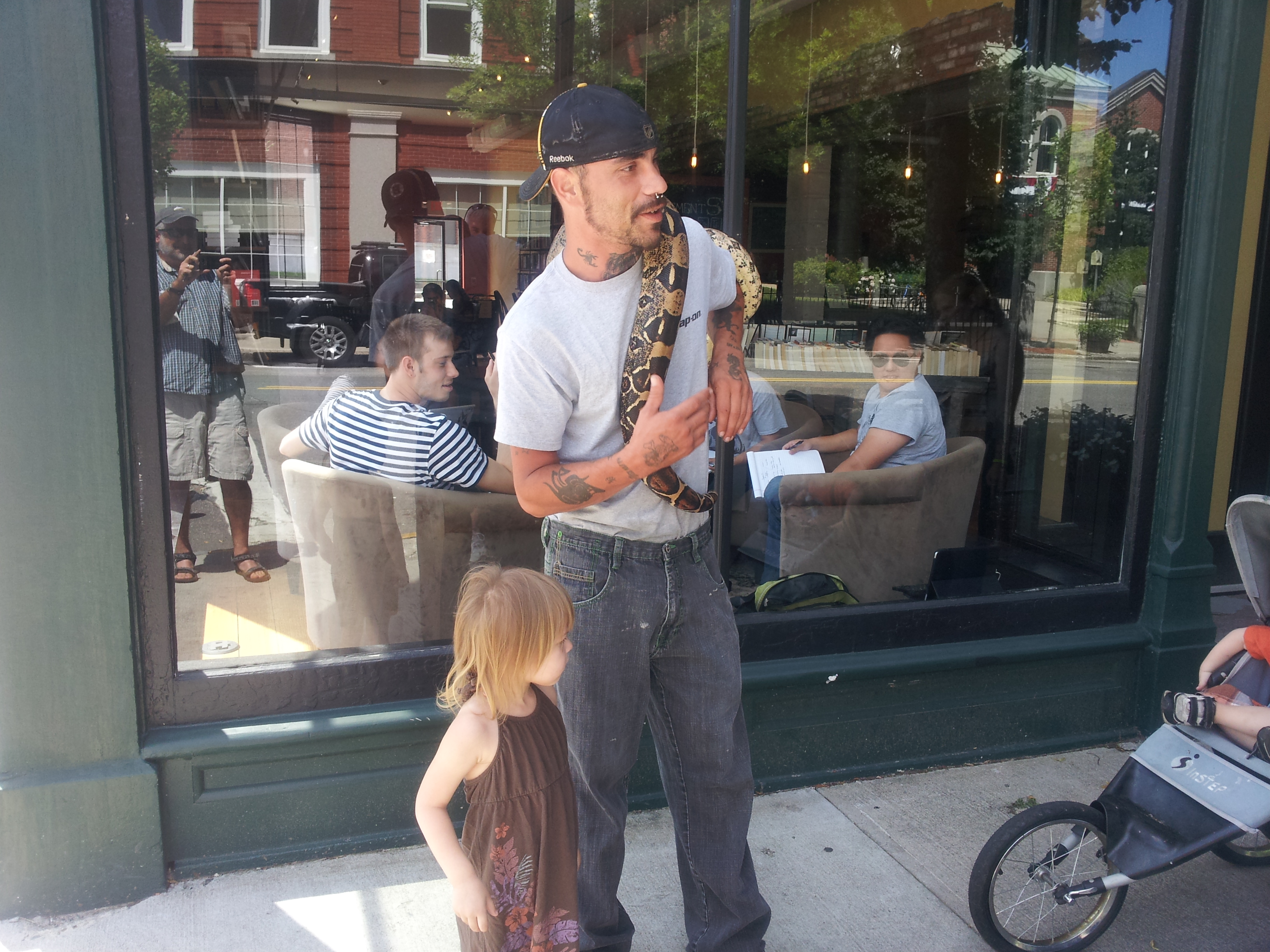
It is a Saturday afternoon on Main Street in downtown Biddeford. I am standing outside Elements Book Store and Cafe, waiting to meet with Tammy Ackerman, and I bump into my friends Jim and Renee O’Neil.
The conversation quickly turns to my previous blog post, Fool for the city
As we talk about Biddeford’s cultural heritage and words like elitism and diversity, we are briefly interrupted by a strange convergence.
A couple that summers in coastal Biddeford Pool come onto the sidewalk, each holding paintings they had just purchased. Renee met the couple just moments before and she introduces me to them as the conversation about Biddeford continues.
Moments later, a man in his late 20s is in our midst. He is wearing a t-shirt, jeans and a baseball cap backward. His tanned, muscular forearms seem to be a canvass of tattoos, but most strikingly he has a very large boa snake draped over his body. He is accompanied by a little girl, maybe four years old. Just behind him, is a woman pushing a baby stroller and puffing on a cigarette.
We are — all of us —- on the other side of a giant window that looks into Elements. The patrons inside look up from their laptops and cappuccino, curious about this new picture on the other side of the glass. Me, Renee and Jim, a couple from Biddeford Pool and this man with a giant, scary snake.
Strangely, it does not seem even the slightest bit unexpected or awkward.
After a few moments, the man moves onward down Main Street with his entourage, and the rest of us continue our conversation.
Renee, a lifelong and well-known resident of the city, adamantly disagrees with my assertion that Biddeford continues to struggle with talk about cliques, elitism and a pervasive sense of class warfare. Her husband, Jim, is concerned that I am not accurately portraying the picture.
The funny thing? They both admitted that they had yet to read the what I had written the week before.
“It seems like you should be holding up a mirror, but instead are using a piece of stained glass,” Jim offers. “Mirrors simply reflect light, but stained glass filters the light to present a certain picture.”
They are both somewhat troubled that I wrote about Tammy Ackerman, a downtown activist, in a blog post that poked at the touchy subject of elitism and cultural diversity.
“Tammy is like Mother Theresa,” Renee quipped. “She’s the last person that anyone should describe as an elitist.”
More about my conversation with Jim and Renee in just a bit . . .
After reading last week’s post, Tammy Ackerman phoned me to share her thoughts and opinions about my half-assed attempt to bite down on an apple most people want to discard or at least ignore:
That people in Biddeford seem especially sensitive about the words elitism, cultural diversity and a push for change that is being driven by relatively newer, non-traditional stakeholders…
People from away.
Subsequently, we spent the better part of 90 minutes talking face-to-face yesterday at Engine, her gallery and multi-use space on Main Street. I very much enjoyed that conversation, and I left the gallery with a lot of conflicting thoughts and opinions.
Last week I wrote about how former Biddeford mayor Joanne Twomey described Ackerman (and others) as elitists at an April 16 City Council meeting during a liquor license application for Fatboys Saloon. I opined last week that Twomey was “maybe, just maybe . . . a little bit right.”
According to Ackerman, the more division we create; the more we use labels, the more we remain stuck. “I guess I bristle when someone calls me an elitist because I come from the same working-class cloth as anyone else,” she said during our first phone conversation on the subject.
But elitism doesn’t have to be solely identified or explained by economic capacity, I countered. A lot of people have talked about cultural or ideological elitism . . . the idea that Biddeford is lacking in culture or diversity makes many other people bristle.
On Saturday, Ackerman said the points I was trying to make were anything but clear.
“I guess I don’t understand what you were trying to say on your blog because I have done nothing to exclude anyone from anything,” she responded. “I don’t say bad things about Biddeford. We’re not creating gated communities here. I am imposing anything on anyone.”
My point, I conceded, was partially lost . . . or at least not very clear last week. When I said that Twomey was “maybe a little bit right” I was speaking more to the pace and the perception of the conversation, not necessarily the facts.
Ackerman and some of Biddeford’s other newer immigrants are incredibly passionate and motivated. Perhaps a little too motivated.
Ackerman’s efforts to heighten and amplify arts and culture in the downtown caught some people off guard. The push, at times, seems aggressive. Ackerman (and others) sometimes fail to understand a dynamic that is embedded in this community: an exaggerated sense of pride that is used to mask a lingering sense of low self-esteem.
Make no mistake. People who live in Falmouth, Cape Elizabeth or Camden are very proud of their communities, but they never talk about their pride. That would be uncouth, ill-mannered.
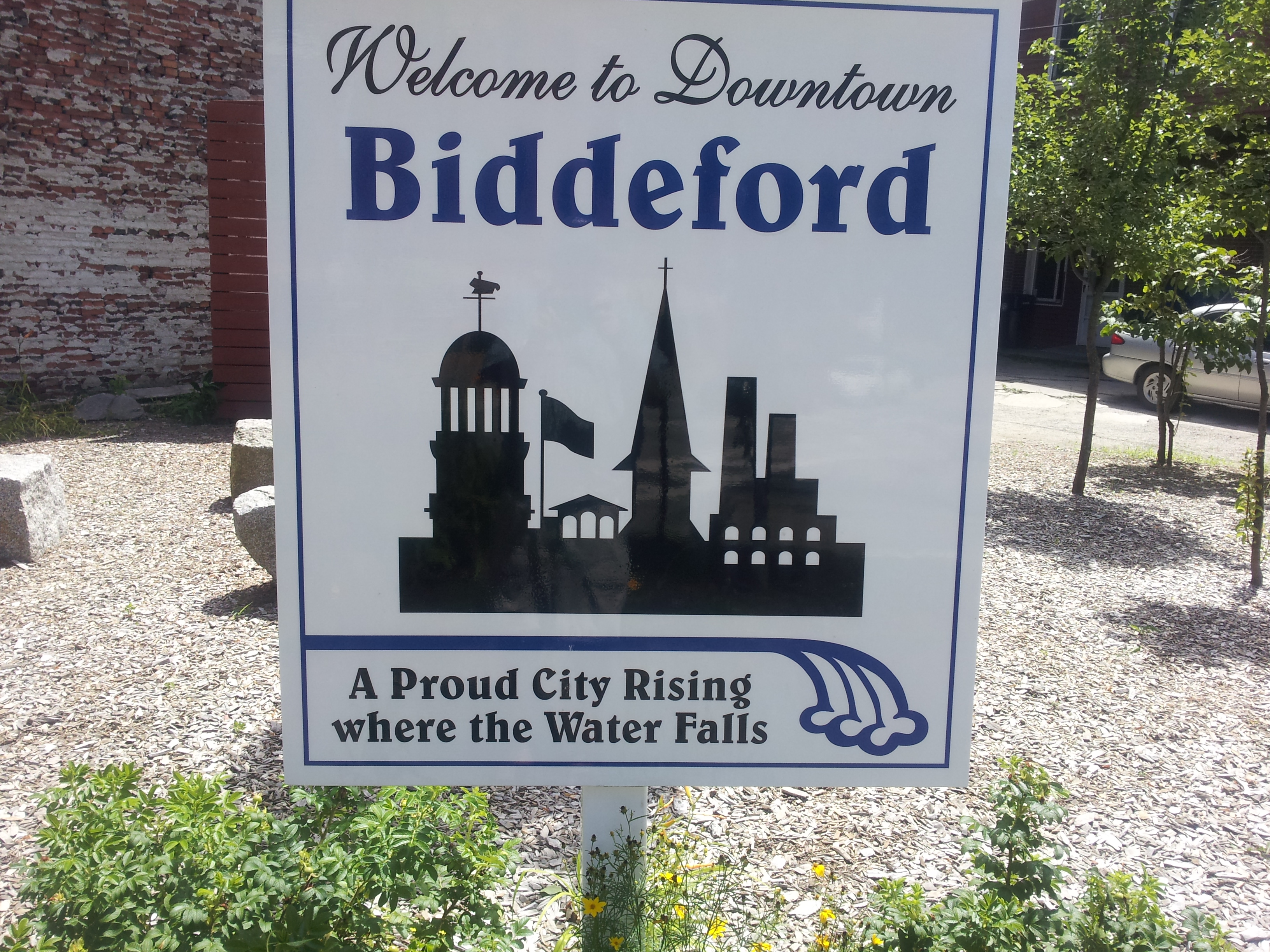
But in communities like Biddeford we wear our pride on our sleeves. A proud city rising where the water falls is our motto. Tiger Pride.
Maybe, just maybe, we’re not quite so proud. Maybe, just maybe, there is still a dynamic of self loathing going on here.
Maybe, just maybe, we are much more consumed with envy than pride.
It ain’t me; I ain’t no senator’s son
Ackerman says that issues such as elitism, the creative economy and quality of place are inherently subjective.
“Quality of life is important,” she said. “Ask one person to describe quality of life and you get one answer. Ask someone else and you get another answer. Ask 10 people, and you get 10 different answers.”
She also says she is perplexed how anyone could define her as an elitist, but she concedes that the term can have both negative and positive connotations, such as the pride associated among an elite group, i.e. the Navy Seals. But she also remains stuck on the apparent misnomer of elitism when it is attached to her efforts to promote a creative economy in Biddeford.
“I’m not a fancy person, so I guess I don’t get the ‘style police’ commentary,” she said. “If style police means I care about how our downtown looks, then maybe I am the style police, but I’m not sure why anyone would be opposed to our downtown looking as good as possible.”
Ackerman spoke at length about her experiences in Biddeford, her struggles and her vision. I plan to write a more detailed piece about that in an upcoming post, but we kept jostling with the tricky concepts of elitism and diversity.
Whether talking about Fatboys Saloon or the pushback to ideas about transforming downtown Biddeford, Ackerman repeatedly pointed to a Downtown Master Plan that was coordinated by the Heart of Biddeford two years ago.
The downtown master plan was a very open and inclusive process that sought input and guidance from any stakeholder who was willing to participate. An over-arching theme of that process resonated clearly: Almost universally, people in Biddeford wanted the downtown to be a ‘family friendly’ destination.
According to Ackerman, taking a position in Biddeford is a daunting proposition for many small business owners and others who worry about some sort of retribution for their viewpoints. “Who wants to go through that? It’s not fun, and it’s certainly not profitable,” she said. “A lot of people are unwilling to get involved.”
Ackerman says she wants Biddeford “to be a good place for everyone” and as inclusive as possible. She says peoples’ behavior often reflects the treatment they get. If all residential landlords took small steps to maintain their properties, it would enhance not only the appearance of the downtown, but also the attitudes of those who live there, which could lead to a greater level of respect and an enhanced sense of community ownership.
But in a follw-up e-mail she sent me, it seemed clear that Ackerman remains frustrated that I urged her and others to be just a bit more mindful of the city’s cultural history and a laundry list of perceived and some very real examples of elitism. She disagreed with my suggestion that maybe we should pause a bit to remember the past before pushing so headstrong into the future.
“I’m still not sure what “dial it back” means,” she wrote, responding to my point that some people are a bit uncomfortable about the pace of the conversation or the sudden (and admittedly positive) changes in our community. “I have the energy to help Biddeford discover what’s good about it now. I may not have this energy in a couple of years! Biddeford’s time is now. Decisions made today will impact the future just like the decision to bring MERC [the controversial, former downtown waste-to-energy incinerator] in impacted 25 or so years of Biddeford’s future.”
As clear as waves on the sea
I was honestly surprised by the reaction to last week’s post. While some people thought I hit the nail on the head, others thought I was far off base. Regardless of the opinions and their sometime surprising sources, I know one thing is beyond dispute. I had tapped something raw, something that makes people queasy.
One friend, another lifelong resident of Biddeford, told me my analysis was spot-on. There is again another battle of elitism happening in Biddeford, he said. “I don’t know how to define it, but it seems pretty obvious to anyone paying attention. It’s like heading to the beach and seeing the waves. I don’t necessarily know where they came from or exactly how they were formed, but I know that they are there.”
City Councilor Roch Angers grew up in downtown Biddeford, and says many of the dividing lines are self created, but often painfully obvious. “It’s been going on for as long as I can remember,” he said. “It’s like an embedded piece of our culture. I think it’s part of our Franco heritage. There has always been a push back against those who appear to be succesful . . . a certain sense of envy. I agree that it’s more perception than fact, but no one can deny that it is there.”
Angers agreed with the historical foundation of my argument: the way immigrants (old and new) are received by their new hometown. A lingering sense of suspicion, a healthy dose of skepticism and a maddening attempt to thwart any attempt at change.
It’s not a new phenomena. It’s been going on for quite a while: The division between the affluent coastal neighborhoods and the inner city, which included two secession movements in the 1990s (Ultimately, the Maine Legislature refused to allow Biddeford Pool to become part of Kennebunkport)
The push to keep the city’s coastal beaches open to public access, championed by Mayor Gilbert Boucher in the early 1970s; the town/gown divide fostered by both sides as it relates to the University of New England’s campus, students and administrators.
The way that it’s still okay and politically correct to make jokes about Francos or a city that comedian Bob Marley describes as “Lewiston by the Sea.”
“I think people like Tammy [Ackerman] and Doug Sanford add a ton of positive energy to this community,” Angers said. “I also think they sometimes seem to be in too much of a rush to do the things we can probably all agree should have been done a long time ago. I think we are on the right track, and we just need to remember some balance.”
But Joanne Fisk, a 1976 graduate of Biddeford High School and another lifelong resident, adamantly disagrees that those historical divides or perceptions still exist.
“That all may have been true 30 years ago or so, but not today,” Fisk says. “I’m not sure what you’re trying to accomplish other than opening a can of worms that we have moved well beyond.”
Fisk also says that Biddeford is not an anomaly, nor are any issues of elitism more pronounced here than in any other community.
“I guess it’s easier to talk about the things that divide us, but I also think we would all be a lot better off if we spent more energy talking about our common ground.”
On the other side of the coin, Mark Robinson, a Fortunes Rocks resident, says he knows what it’s like to be called an elitist, and how the label often doesn’t fit.
A lifelong resident, Robinson said his best teachers were those at Biddeford High School, despite his Dartmouth College degree. He says he learned some of his most important life lessons as a teenager working in a mobile dining cart that catered to late-night downtown mill workers.
“I think the new energy in town is fantastic, and all the new players have my support one hundred percent. I know almost all of them personally, and they’re great,” Robinson said. “That said, I do think once in a while it’s possible to get a little too exuberant about the way things should be.”
In an e-mail, Robinson wrote that he was also troubled earlier this year by the tensions created by the announcement of Fatboys Saloon pending arrival to the downtown business mix.
“I was out of state at the time, but I remember being very upset reading about the brouhaha over what was described as a biker bar,” Robinson responded via e-mail. “I thought that was way over the line. Don’t like a TV show? Hey man, don’t watch it. Don’t like a biker bar? Don’t go there. Hell, it’s even OK to hope the place fails miserably and goes out of business. I don’t have a problem with that at all. But he should have the right to sink or swim on his merits, and he was getting crucified before he even got the place off the ground. Not at all fair, in my book,”
Born to be wild
Delilah Poupore, executive director of the Heart of Biddeford, said she was “taken aback” by my earlier commentary.
“I think that having community conversations about these topics can be very constructive and helpful,” she said. “But when you isolate particular individuals as part of the conversation, you are doing little more than creating more tension and controversy.”
I pushed back. At the same time that Heart of Biddeford took its first ever public policy position about a specific business (Fatboys Saloon), public policy makers in Augusta were weighing public comments related to the closure of the controversial MERC waste-to-energy incinerator that was located in the heart of the city’s downtown.
Delilah and just about everyone else at the Heart of Biddeford agreed that MERC’s presence was a major challenge to the downtown’s ongoing revitalization efforts. In my professional capacity, I represented MERC’s parent company and knew that the Heart of Biddeford and other downtown stakeholders were crucial to our efforts to build public support for the plant’s sale and eventual demolition.
I arranged meetings with both the Heart of Biddeford and the Downtown Development Commission. Both groups allowed me to make brief presentations to their respective members. DDC members were somewhat less supportive, concerned about the significant losses of both property taxes and downtown jobs if MERC closed. Conversely, the Heart of Biddeford crowd warmly embraced my message about how the closure would dramatically improve downtown Biddeford.
But when it came time to make public comments, the Heart of Biddeford declined to make any formal statement. “It’s not our place to make public comments about a specific business,” they explained.
Then, BOOM! Only a few weeks later, the Heart of Biddeford offered public testimony, raising questions about the impact of a “biker bar” into the downtown business-residential mix. I guess they changed their policy. This one time.
And that, I think, is why some people had such a strong reaction. Apparently, a biker bar would be a much bigger problem than burning garbage on an industrial scale in downtown Biddeford.
Something didn’t seem right.
Poupore maintains that her organization’s concerns were meant only to help the city council consider the liquor license application from a “planning/zoning” perspective. But the organization had never before raised any public concerns about any of the other several bars in downtown Biddeford or their annual liquor license applications.
Tammy Ackerman, a former city council candidate and a Heart of Biddeford board member, voluntarily waded into The Fatboys controversy. That spark reignited a lingering flame of resentment among some self-identified stakeholders, who admittedly spend far more time complaining than participating.
Once again, accusations of elitism and class warfare emerged upon Biddeford’s public stage.
Next week: Part III (THUNDERDOME: Residents offer differing perspectives about elitism and cultural diversity in Biddeford).
 LESSONS IN MEDIOCRITY | OUTLAW JOURNALIST