It was like nothing I could ever imagine. It was 5:25 a.m. on the day after Thanksgiving, and I was in a parking lot with more than 1,800 people, waiting in the blackness of a pre-dawn sky for the fluorescent monster to open its mouth and swallow us whole.
Welcome to the jungle—
We got everything you want —
There was an edge of excitement in the air; a certain camaraderie that permeated the long and winding line of bleary eyed men, women and children who were sipping coffee from styrofoam cups and chatting nervously about why they were there.
I couldn’t help myself. I wanted to be disgusted. I wanted to be shocked. I wanted to be sad, but all that would have to wait. So instead, I patted my rear pants pocket, making sure that I had remembered my wallet.
Welcome to the jungle —
If you got the money, honey —
We got your disease—
The rain had yet to begin falling, but the air was cold and damp. The drones, me included, didn’t seem to mind, however. We were on a mission, fueled by adrenaline, caffeine and the hopes of finding what we wanted.
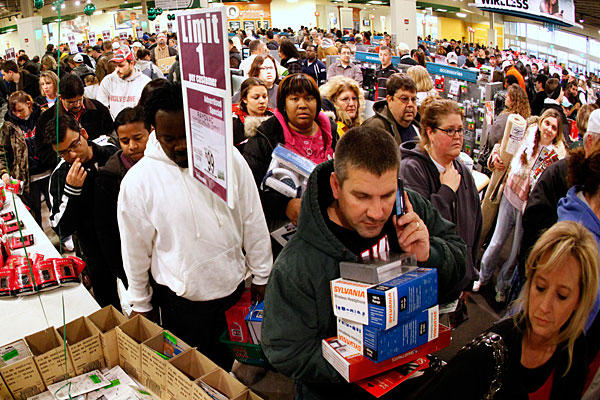
Finally, the magical hour arrived and the line lurched forward. It was6 a.m.and still dark. We shuffled forth like lemmings toward the sea. Deaf, dumb, blind and ready to swipe our plastic cards through an electronic machine so that we could buy more stuff, we inched closer toward the Nirvana of mass consumerism.
As I shuffled closer toward the store, I wondered how many of these people own storage sheds. You know — the place where you keep all the stuff that you can no longer fit in your house.
The shopping carts were snatched up quickly. There were no punches thrown, but some angry glares were traded as the mob raced through the double-glass doors. The elderly greeter seemed overwhelmed. Wearing his trademark blue vest, I imagine that he gave up trying to greet each shopper individually after the first 250 people squeezed through.
By the time I got there, only a handful of shopping carts were left. The greeter resigned himself to simply nodding at the onslaught of shoppers.
It was 6:09 a.m.There were lines of shoppers at more than 28 open cash registers. The greeter seemed ready for a coffee break and the $30 DVD players were nowhere to be found; an entire pallet of the electronic devices, stacked more than seven-feet-high, had been snatched up.
Everywhere I looked, shoppers of all ages were pushing carts with televisions, bicycles and computer systems wedged inside. I tried to interview people and take pictures of the scene.
One woman, who recently lost her job at Biddeford Blankets, was pulling two carts behind her and yelling at her husband to keep up.
I saw another man who has publicly condemned Biddeford’s downtown waste incinerator. He was one of the lucky ones. He got three of those DVD players. “What happens if they break?” I asked.
“At this price, who cares,” he replied, weaving his cart through an obstacle course of dazed shoppers toward the toy aisle.
I started to feel guilty about being there. But later in the day, I talked to a woman who has two young children. She and her husband both work hard, but they are forced to stretch every dollar they earn. Children need heat, electricity, medicine and food just as much as they need the new Gameboy machine under the Christmas tree, she said. “I have to buy it where it’s cheapest,” she added.
“I don’t feel good about it,” she said of buying presents at the big box store. “But that’s just the way it is.”
We waved flags in the weeks and months followingSept. 11, 2001. We talked about national pride. Well, this is it, folks. Welcome to capitalism, where the strongest survive and the little guys become convenient nostalgia. This is who we are. Sometimes, it’s not pretty, but it is real.
I brought home a television that was made inMalaysia. I wondered about who made that television. What kind of a country was I supporting with my unnecessary purchase?
According to several sources, including the World Fact Book, 8.3 percent of people inMalaysia are living below the poverty line. Sound bad?
In the United States, 12.3 percent of our nation is living below the poverty line.
Malaysia spends an estimated 2.03 percent of its gross domestic product for its military. In contrast, we spend roughly 3.2 percent of our GDP on the military. Malaysia is operating in debt with revenues of $2.03 billion and expenditures of $27.2 billion. We live in debt also, producing $1.946 trillion in revenues versus $2.052 trillion in expenditures.
Malaysia is a country that has transformed its economic picture during the last 30 years, becoming a major exporter of electronic items. TheUnited States leads the way in buying Malaysian goods, accounting for more than 22 percent of that country’s exports.
None of this made me feel any better about my purchase. I just wanted to know. The box and the styrofoam packaging were taken off my front lawn a few hours later by a trash truck. And I took a shower before going to work for the day.
Welcome to the jungle, baby.
Originally published in the Dec. 4, 2004 Biddeford-Saco-OOB Courier
 LESSONS IN MEDIOCRITY | OUTLAW JOURNALIST