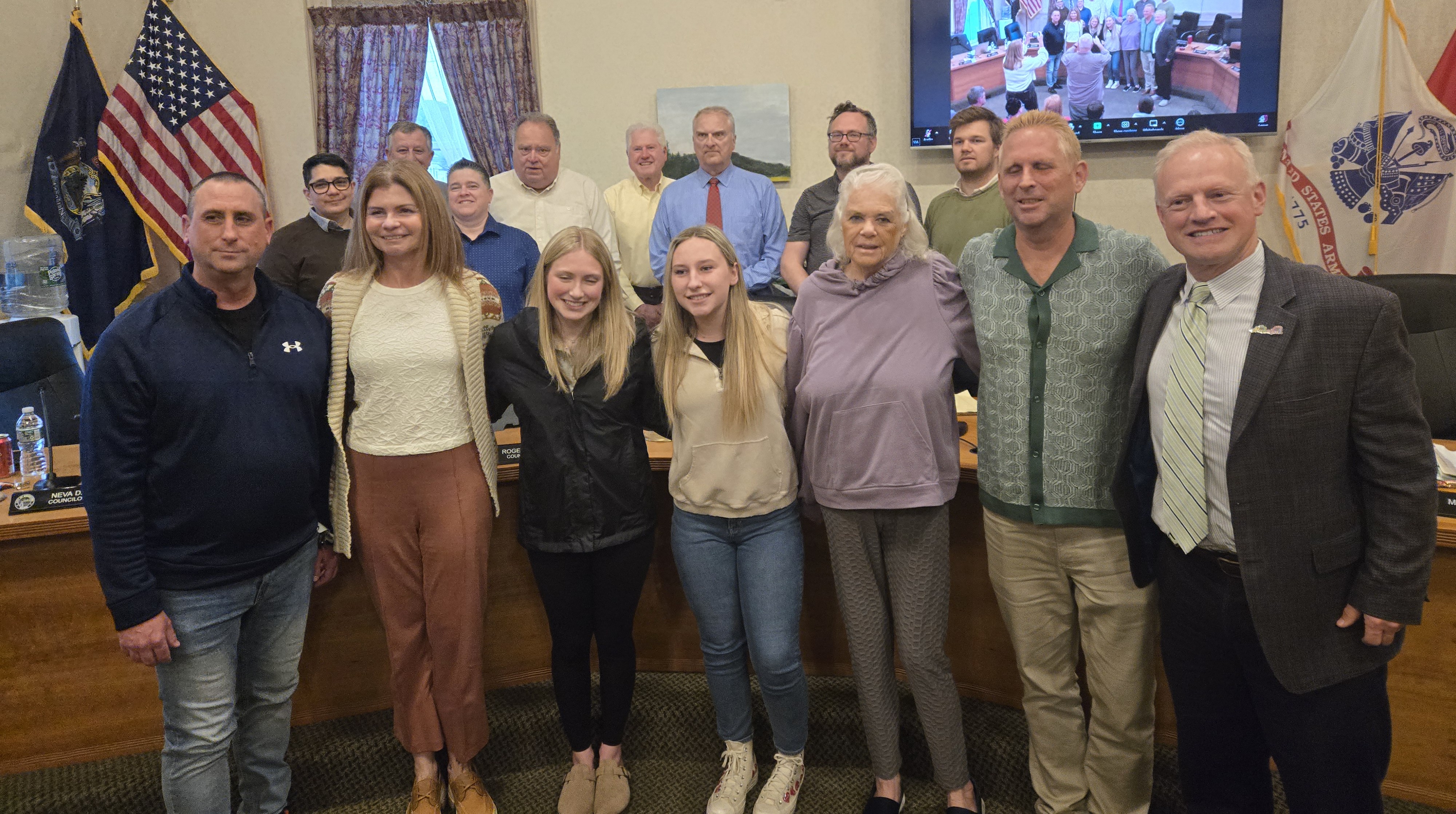
Biddeford Mayor Marty Grohman and members of the city council set aside some time at the beginning of Tuesday’s council meeting to remember and honor one of the city’s most iconic Irish residents.
Patrick “Vincent” Keely, a former city councilor and the owner of the Wonderbar, died on April 8 this year. He was 90.
According to his obituary, Keely was born on August 20, 1934, in Galway, Ireland, to John and Delia (Walsh) Keely. He moved to Boston, Massachusetts in 1960 and later to Biddeford in the early 1970s, according to his son, Brian.
Grohman described Keely as a bridge builder and community leader who had a special talent for bringing people together to resolve their differences. “He also could pour a perfect pint of Guiness,” Grohman fondly recalled, describing the downtown Wonderbar as a popular gathering spot for people of all backgrounds.
Members of Vincent Keely’s family pose with Mayor Marty Grohman (far right) and members of the Biddeford City Council to honor a man who has left a lasting legacy of respect and cordiality (Seaver photo)
Brian Keely told the council that his father “fell in love with Biddeford,” recalling how his father moved his family to Biddeford more than 50 years ago.
“It was a big change from Boston,” the younger Keely recalled. “There was no mass transit and we all kind of wondered why we were here, but we quickly fell in love with this community, too. My father made us see what Biddeford could become.”
My father made us see what Biddeford could become.”
— Brian Keely
Brian Keely told the council that his father knew everyone who came into the Wonderbar by name, and everyone — regardless of their political differences — was treated the same by the smiling man behind the bar.
“We could all learn a lot from my father,” Brian told the council. “About being kind to one another, about treating everyone with respect.”
Brian told the council that his father always envisioned Biddeford as a “gem in the rough.” He would be proud of what the city has become today, the younger Keely said.
Keely was also known for doggedly ensuring the annual raising of the Irish flag at City Hall to celebrate St. Patrick’s Day each year.
Patrick Vincent Keely
Grohman asked the council and members of the public to stand for a moment of silence to honor Keely’s legacy of community service in Biddeford.
Never miss another installment! Subscribe for free today!
What’s going on with the University of New England and its plan to build a new pier on the Saco River?
Why is the university worried about a small time, mediocre reporter and the stories he writes about the proposed pier?
I don’t know how to answer those two questions.
But here’s what I do know: I’m not going away. I’m not giving up. In fact, I’m about to turn up the heat on this particular story.
On the day after last week’s election, I was feeling a bit glum and somewhat overwhelmed, so I decided to take a break and watch one of my favorite films, All the President’s Men.
For those of you who don’t know, the 1976 film was about two intrepid reporters from the Washington Post – Carl Bernstein and Bob Woodward — who ultimately forced the resignation of President Richard Nixon at the height of the Watergate scandal.
Watching the film again, reminded me of just how hard and frustrating it is to be a reporter, whether you’re working for the Washington Post or the Biddeford Gazette.
Throughout history, governments, large corporations and powerful individuals have all sought to control the press; to push their own narrative and maintain secrecy. Sometimes stonewalling a reporter works.
Sometimes it doesn’t.
John Mitchell, President Nixon’s attorney general, threatened Katherine Graham, publisher of the Washington Post, during the Watergate scandal in 1972.
Mitchell warned the reporters, the editor and even the publisher of the Washington Post: “Katie Graham’s gonna get her tit caught in a big fat wringer if that’s published,” Mitchell said.
The Washington Post did not back down, even though many other newspapers were nervous or reluctant to dig deeper into the scandal at that point in time.
Let’s pause here for a moment.
I am not Carl Bernstein. Saco Bay News is not The Washington Post. And my stories are much, much less than microscopic when compared to historic stories such as Watergate or The Pentagon Papers.
I am just a semi-retired, overweight, underachieving, middle-aged, bald man with very few of his original teeth left and no college degree. (In fairness, Carl Bernstein also never earned a college degree).
So, if you stop and think about it, why should anyone at the University of New England give a rat’s ass about anything I write? What are they afraid of?
You better, you better, you bet
Earlier this year, I learned about the University of New England’s plan to construct a new pier on the Saco River.
Just a few weeks later, Biddeford City Manager James Bennett quashed both the city’s harbor master and the assistant harbor master from the regulatory review process.
When I contacted Bennett about his move, he told me it was done in order to prevent “bias.”
I got to work on myfirst story about the proposed pier, which was published by Saco Bay News on May 25th.
As the story continued to unfold, I wrote follow-up stories about the controversy. You can find all three of those stories by clicking on this link.
Just days after my third story was published, a representative from the university reportedly contacted the publisher of Saco Bay News and told her that “it would be best if Randy Seaver no longer wrote stories about the university.”
The University of New England (UNE) won. They got me bounced from the story . . . or did they?
Although you’re not going to see any more stories written by me in Saco Bay News about UNE’s pier, I am actually just beginning my effort to bring public awareness and transparency to this issue.
UNE’s attempt to silence the media has backfired. They can now expect an amplification of coverage on this issue.
You can’t handle the truth!
Reporters are trained to ignore rhetoric and focus on facts. If you read any of my prior reporting about UNE’s proposal, you will see that each article is balanced, fair and focused on facts.
That is the same approach I am taking here. I decided that once and for all, I wanted to see and explore some facts for myself.
A few weeks ago, I was invited to take a boat tour of the Saco River near the proposed location of the university’s pier.
I was not the only one invited to take this tour. Every member of the Biddeford City Council was given the very same opportunity. Every member of the media in southern Maine was also given the same invitation.
So far, I am the only journalist or Biddeford city official who has ventured onto the river to discover for myself what the hard data shows about adequate water depths.
It was an eye-opening experience, to put it mildly.
Below is a short video of what I learned during my tour near the base of the Saco River. I have also created a separate page on this blog siteto gather and publicly share information about this topic.
My advice to the university and the city of Biddeford is this: Brace yourselves. I will not go gently into that good night. I want facts and transparency. This is not the end of my reporting.
It is just the beginning.
Never miss another installment of Lessons in Mediocrity! Subscribe for free today!
If Elmer Fudd had attended Tuesday’s Biddeford City Council meeting, he may have made the following observation about our city councilors:
“Those wascly wabbits seemed especially wambunctious last night.”
Fudd’s assessment matches my own observations.
Watching the councilors in action, I actually began to wonder whether a couple of our council critters had skipped their required rabies vaccinations, especially when they began talking about a favorite City Hall subject: solid waste disposal.
If you missed the meeting, then you also missed a rare opportunity to hear one of the city’s most eloquent and handsome residents address the council about the contentious issues surrounding trash and recycling.
No, Jim Grattelo did not show up last night.
It was me — yours truly — the voice of logic, reason and nicotine addiction from Ward Seven.
At issue is the perennial topic of how to both increase the city’s recycling rate and reduce the amount of trash we send to the Maine Energy Recovery Company, where household waste is recycled into electricity.
Council President Rick Laverierre seemed ready to explode or at least pop a button on his new suit, when he railed against the concept of a pay-per-bag trash collection system.
“This is not a Maine Energy thing,” he said, ignoring the obvious and hoping to avoid taking a public stance on a very controversial issue.
Laverierre strongly supports sending no less than two referendums to the city’s voters.
The first referendum would ask voter permission to even allow the council to discuss or say the words “pay-per-bag,” and the second referendum (a few months later) would ask the voters whether they approve a plan. Seriously.
For the first time in 192 years, I found myself in agreement with Councilors David Flood and Richard Rhames.
The last time the three of us agreed on a topic was in 1820, when we published a joint op-ed in the Boston Globe, making the case for Maine’s secession from the state of Massachusetts.
The opening line of that editorial proves the piece was a collaborative effort:
“For whatever. Massachusetts blows. We need another state where Democrats can control the Legislature.”
Back to last night’s meeting. Rhames, for a brief moment in time, seemed lucid with a firm grasp of the obvious.
Rhames reminded his fellow councilors that they will soon be forced to review the city’s waste disposal contract.
“This council needs to be grappling with this issue,” he said. “This matter is roaring up on us. It is not a simple issue and, unfortunately, we have not yet begun to consider our position.”
But Councilor Michael Swanton expressed doubts about how much the city would save its taxpayers by forcing the Solid Waste Commission to devise a plan that could increase the city’s recycling rate. “I ran the numbers at home,” he said. “And I figured out that I would save about 37 cents per week by recycling more.”
The council, however, did seem to agree on one thing: trash disposal involves a lot of fluctuating numbers, a good pair of rubber gloves and the willingness not to hoard No.2 plastic bottles.
Ultimately, the council voted 8-1 (Laverierre opposed) to kick the can down the road for another few weeks by sending a resolution to the Solid Waste Commission that seeks to increase the city’s recycling rate.
Take the money and run
Earlier in the evening, the council took up the issue of ethics, pondering whether to amend the city’s ordinances to require members of the Planning Board to sign a code of ethics.
It should be noted that members of the city council are not required to sign a code of ethics.
As I have explained to my children, whether you should take a 10-dollar bill from your mother’s purse is NOT an ethical dilemma.
It is a crime.
An ethical dilemma is a situation in which both choices have merit and must be carefully weighed against one’s own values and belief system.
At first blush, it seems more than reasonable to ask city officials to sign a code of ethics. But a closer examination of the proposed language reveals some glaring problems that leap off the pages and then steal money from your mother’s purse.
For example, Councilor David Flood (my neighbor, former employer and BFF) pointed out that by signing the code, planning board members would be required to only do reasonable things that also “appear to be reasonable.” Again, I’m not kidding.
If this same standard were applied to the city council, we would not have a city council.
Upon realization of this quandary, the council pondered their own ethical dilemma and rejected adopting a code of ethics for other people to follow.
Smart move.
In other business, the council put the brakes on a proposed policy that would allow the city to accept private contributions for public infrastructure.
After hearing further words of wisdom from yours truly about the slippery slope of unintended consequences, the council decided to send the proposed policy to the “Policy” Committee for further review and clarification.
If you would like to have Randy Seaver speak to your civic club, organization or rehab group, please send an e-mail to randy@randyseaver.com
Never miss another update! Subscribe for free today!