Promises In The Dark

This is a story about the Saco Transportation Center, also known as the place where green-energy dreams go to die.

Now before some of you have a stroke, I do believe our climate is changing. I also believe humans have an impact on their environment — but sometimes it seems we get just a wee bit silly – running around like Chicken Little, screaming that the sky is falling.

You’ll have to forgive me, but I’m just not a big fan of The Emperor’s New Clothes.

While the pursuit of cleaner energy is certainly a noble cause, it seems that we are too often willing to abandon common sense, and instead blindly follow a mantra that is born from fear, rhetoric and half-truths.

And if you have the temerity to question anything about the green agenda, you are immediately branded as a mouth-breathing “denier” with limited cognitive functioning. You better toe the line.

My biggest problem with the “green energy/zero-carbon” agenda is all the self-righteous virtue signaling that goes hand-in-hand with this issue. So often, the paradigm of “Green Energy” is built upon a solid foundation of hypocrisy.

Now, let’s take a closer look at the Saco Transportation Center. When the facility was formally opened in 2009, press releases were sent out. VIPs were in attendance and local, state and even federal politicians were tripping over themselves in order to pat themselves on the back about how “green” the new facility would be — a virtual “role model for other communities across the country.”

Breathlessly, city leaders in Saco extolled the virtues of the new facility, congratulating themselves for being such good stewards of the environment. The facility was hailed as state-of-the-art, dedicated to be a giant leap forward in the pursuit of a better world, where every boy and girl has a pet unicorn and we all actually enjoy eating kale.

From the press release: “The station is notable for being the first green design train station in the United States, featuring a wind turbine for electricity, geothermal heating and cooling systems, and a roof made from recycled soda bottles.”

But almost as soon as the dust from the grand opening settled, the illusion of green virtue became harder to justify. Saco taxpayers had spent roughly $200,000 for construction of the wind turbine that sat majestically atop the hill of Saco Island.

The magnificent wind turbine, however, did not produce the expected amount of electricity, and it became a “safety concern.” It was quietly removed and taken down a few years later. There was no press release. No senators. No platters of kale and tofu. No pontification from local politicians or environmental lobbyists. The taxpayers took care of the demolition expenses. We can only pray that the turbine was properly recycled.

Undaunted, the politicians, environmental lobbyists and members of the green energy brigade pressed on, and they soon sent out another press release. Oh Happy Day! Biddeford-Saco-OOB Transit (Transit) was going to take ownership of two electric buses. Another ribbon cutting. More speeches. We’re saving the world one bus trip at a time. The local politicians cheered. Abandoned puppies were all adopted and the planet heaved a heavy sigh of relief.

Those new electric busses cost approximately $1.5 million each, nearly three times the cost of a traditional diesel bus.

Don’t worry, the local politicians said. Taxpayers are off the hook . . . the buses were “free,” purchased under a federal grant that was coordinated by U.S. Senator Susan Collins. Ummm, where does federal money come from? Oh yeah, that’s right — from federal taxes, paid by you and me.

Chad Heid, executive director of Transit, told reporters that his organization will be applying for more federal aid so that additional electric buses can be purchased in the future. Heid added that there will be a charging station in Biddeford, and “on-route charging stations at the Saco Transportation Center will be installed later this year.”

Maine Governor Janet Mills and Senator Angus King, Jr. participate in the celebration of new electric busses. (Photo: WGME TV)

Flash forward a couple years later? Still no bus charging stations at the transportation center. In fact, the company that built the “green” electric busses recently filed for bankruptcy protection, according to the Bangor Daily News.

Apparently, green energy doesn’t work out so well for its investors.

Almost immediately after being purchased, the new electric busses presented several challenges for the local transit authority. The new busses nearly drained their batteries after only a few hours of use on cold, Maine mornings.

A bit of disclosure: I was hired by Transit last year on a short-term contract to help collect data about passenger/route efficiencies.  That contract ended last year. Over just a few weeks of riding several of the busses on various routes, I learned a lot about our local bus system and the people who ride the bus. (More about that in a minute).

On one cold February morning, those of us riding on one of the new electric busses had to be rescued by a passenger van, transported back to the Transit maintenance facility on Pomerleau Street and then re-loaded onto a traditional diesel bus. The passengers were not happy campers. I tried not to laugh.

Earlier this year, the University of New England began running a series of promotional television commercials including one in which several students praised the school for its “sustainability” practices and its commitment to the environment. Well, laddi-laddi-da.

Local taxpayers (you and me) help provide a shuttle trolley to go back and forth between downtown and UNE’s Biddeford campus, 14 times a day, seven days per week. The students who bloviate about “environmental stewardship and sustainability” apparently don’t like using mass transit, and instead prefer to drive their cars to have brunch at the Run Of The Mill and other downtown taverns.

That particular bus line (The Silver Line) operates for free. Throughout the day, basically every 15 minutes, that bus (trolley) also runs a loop up Main Street in Biddeford; right onto Lincoln Street, past the parking garage; right onto Elm Street and back to Main Street in Saco. Again, it is free to ride that line. How many people do you suppose take advantage of this service?

Over several days of riding that bus trolley, I saw two people use it. Two. Over a six-hour period. Two people. 30 Trips. Two people. Number of people getting on or off at UNE? Zero. Zilch. Nada.

We want to “save the planet” right up until the point when it’s not very convenient to do so. Where I come from, we call that hypocrisy.

Yes, Transit does serve a certain segment of our local population; mainly people without cars.

Meanwhile, the Maine Turnpike Authority recently withdrew its financial subsidy for the ZOOM Turnpike Express bus. They are focusing instead on spending more money to make the highway better able to handle an increasing number of cars.

Remember, the Saco Transportation Center has a roof made of recycled soda bottles. In the lobby, however, you can find vending machines that offer a wide array of beverages in plastic bottles. Good to know, in case we ever need to repatch, repair or replace the roof.

What about the train? Sure, the Amtrak Downeaster is a fun way to go catch a Bruins game or see the Celtics, but very few people use it as a commuter line. In fact, according to rail officials, overall ridership on the Downeaster is increasing, but the number of work commuters has dropped by more than 30 percent since 2019.

Really, would you ride the train from Saco to Portland for work? You would be dropped on the western outskirts of the city, on Thompson Point Road. Hardly convenient or efficient.

The municipalities of Biddeford, Saco and Old Orchard each contribute $250,000 annually toward the Transit’s operating costs, and I’m glad that my community offers public transportation.

But it pisses me off that the people who squawk loudest about “sustainability” and carbon emissions rarely – if ever – use public transit. And I think maybe we should be a bit more committed to efficiency rather than patting ourselves on the back for being green. Because, honestly, it’s literally not sustainable.

When it comes to meaningless virtue signaling, the city of Saco is giving Portland a good run for its money, but I guess it’s only an island if you look at it from the water.

Originally published in Saco Bay News

Fortunate son

I’ve told this story before, but I think it bears repeating, especially since we are about to celebrate the Fourth of July holiday and because our nation seems increasingly divided as our focus becomes more and more about our own individual concerns and less about the nation as a whole.

It’s also because today is July 2, the 41st anniversary of my Basic Military Training start date in the United States Air Force.

What you are about to read is all true: a little bit of humor, a little bit self-realization but mostly the justification for why I believe every American citizen should undergo basic training.

Continue reading at your own risk. Remember, I am sharing my story. Things may operate much differently today at Lackland Air Force Base than when I was there more than 40 years ago. Secondly, I may get some minor details wrong, but again I’m going back more than four decades.

******

It was a long day of travel, from waving goodbye to my mother and sister at the Portland Jetport, to a connecting flight in Boston, landing at Dallas/Ft. Worth and finally San Antonio. It was July 2, 1982.

I had no fucking clue about what I would soon experience.

I learned two very important lessons within 30 seconds after stepping off the bus at Lackland Air Force Base. First, if you are considering military service, work with your recruiter so that your first day of training doesn’t fall on July 2 in southern Texas.

It was so friggen hot!  The heat hit me like an unforgiving concrete wall. I was also tired. I had been awake since 4 a.m., filled with equal parts anxiety and excitement. By the time we got to Lackland, it was close to midnight, not considering I was now on Central Time.

Lesson Two: Pack Lightly. Seriously, there is no need — despite my mother’s best advice — to bring your own iron to boot camp. You will also not need several changes of clothes, a box of Twinkies or a camera or even a jar of your grandmother’s pickled dandelion greens. Trust me on this.

From the darkness, a voice began screaming at us. “Drop your bags next to your right foot!” Easy. So far, so good. This isn’t so bad.

“Now pick your fucking bags up!,” the voice screamed only two seconds later. Okay, dude. No need to yell. “Put your fucking bags next to your right foot!,” the voice screamed again. Wait. What? Didn’t we already do this? “Pick your bags up, you stinking piles of shit!” Okay, there’s no need to scream, and we can certainly do without the insults. Just make up your mind.

“Put ‘em down! Pick them up! Put them down! Pick them up!” This went on for a few minutes. Most everyone else had a very small bag. Maybe some toiletries and clean pair of underwear. I had like 165 pounds of shit in my bag. (Okay a bit of an exaggeration) But I did, unfortunately, catch the attention of my Technical Instructor (commonly known in other branches as a Drill Instructor).

It was my very first time meeting TSgt. Edward Ramirez face-to-face. It was not a pleasant meeting. “What is your major malfunction?” he screamed at me, only inches from my face even though I was about a foot taller. I didn’t know what to say. That, apparently, really pissed him off and pretty much set the tone for the next six weeks of training.

There we were. Roughly 50 of us rainbows standing there on the hot asphalt next to the bus, with no idea what would happen next.

When you first arrive at Lackland you are referred to as “rainbows” because you are all wearing different colored clothes. You stand out from everyone else because you are different. Rainbows get zero respect from either the instructors or other troops who are further along in their training.

In fact, a popular chant is: “Rainbow, rainbow, don’t be blue – My recruiter screwed me too”

We were marched to the place that would be our home for the next six weeks. It was a relatively modern building, not much different than what you see in the movies. There was a line of cots (no bunk beds) lining both sides of the room. Upon arriving, we were told to “Find a bunk, Now!” Fifty-one guys scrambled to find and stake out one of 50 available cots.

I was lucky.  Found one near the door. Airman Basic Stanton from Iowa was not so lucky, so — much to my chagrin — he stood at attention right next to me. We kept our eyes straight ahead but could hear the approaching clicking of Tsgt. Ramirez’s heels on the tile floor. “Are you two sweethearts gonna sleep together?” he inquired. “Sir, no sir,” I replied, as instructed.

                                                                                *****

Essentially, basic training in the Air Force (at least back then) is pretty much divided into three equal categories. During the first 12 days or so, your instructors do everything possible to break you down into your most basic form. You are no longer an individual. No one is concerned about your individual needs or wants.

On the first full day of training, your head is shaved. No facial hair is allowed. You receive your fatigues, a pair of combat boots, six pair of black wool socks, six white crew-neck t-shirts and six pairs of briefs. You are no longer rainbows. You are now pickles. All green and prickly.

On about the fifth day of training, you receive your name tags that are worn above your left pocket. Just your last name. No one gives a rat’s ass about your first name. Now you are canned pickles. You have a label. The tag above your right pocket reads: USAF. That’s it. No rings. No jewelry. Nothing. You are part of a unit. You are all eat the same food. There is no special treatment. You are an Airman Basic. E-1 on a scale that goes all the way to E-9 for enlisted men.

E-1. You are worth about as much as a pint of frozen cat piss. You get zero respect. You are worthless. You are nothing. You do not think. You follow orders without hesitation. You do not speak unless spoken to. You are worth less than a fart in church. You are not Catholic, Jewish, Protestant, Atheist or Muslim. You are not white, black or Hispanic. Nobody give’s a rat’s ass about your level of education, your parents’ bank statements or where you were raised.

None of it matters. None of it. You are now part of something far more important and meaningful than you. You are part of a unit. If the unit fails, you fail. If the unit succeeds, you succeed. There is no quiet time. You go to bed when told. You get up when told. You get five minutes (no more) every morning to “shit, shower and shave.” Enjoy it. That’s about as relaxing as it gets. At least for the first few days of training. You are responsible for every other man in Flight 016, Squadron 3704. They are responsible for you. There are zero exceptions and you do not ask questions. You follow orders. Period. End of story.

Back then, Basic Military Training in the Air Force lasted roughly six weeks. I say roughly because you must complete 30 days of training in order to graduate. Weekends and holidays do not technically count as days of training, but there is no such thing as a day off during basic training. Every day is a new challenge. Every day is a new opportunity to learn to become better, to exceed expectations.

Now you see why starting Basic Training on July 2 was such a bad move. July 2 (our travel day) was on a Friday. Saturday, July 3 did not count as a day of training. Sunday, which wouldn’t count, regardless — was the Fourth of July and Monday, July 5, was a federal holiday. That’s four days of shit with zero credit. It is tough and demanding. But if you can’t handle the rigors of basic training, what are you going to do if you find yourself in a combat situation?

****

A bunch of canned pickles. I am top row, third from right

Within 10 days or so, things start getting a bit easier. Make no mistake, it’s still rigorous but the culture shock has started to wear off. You begin to form friendships with your fellow trainees. You can perfectly execute an about-face maneuver; you begin to absorb military culture. The routine itself becomes somewhat comforting. You laugh to yourself when you see a new group of rainbows getting off the bus. You begin to look forward to that final week of training when you trade in your fatigues for your dress blues.

The bonding between trainees is inevitable and necessary. It’s basically one for all, and all for one. If someone screws up, they’re going to get shit from the instructors but they’re also going to get shit from their fellow trainees.

At first, it seems stupid to have to fold your underwear in six-inch squares. But as our TI told us, the Air Force is not going to let you work on Inter-Continental Ballistic Missiles (ICBMs) if you can’t figure out how to fold your underwear in a six-inch square. Pretty much makes sense to me.

Basic training is unforgiving. There is only one standard, and you have no choice. No variables. I could tell you lots of funny stories, including how I earned the name of “wet-man” while running the confidence course or about receiving a hand-written note from President Reagan, but none of that really matters today.

In retrospect, what matters is that Basic Training makes you a better person. What I learned during those six short weeks, some 40 years ago, made me a better employee. It makes me a better husband, a better friend and especially a better father.

But there is something much more important than all of that. Basic training made me a better citizen. It made me care about my country, about the world around me; about my fellow man.

In short, that’s why I think every citizen should undergo some form of basic training within a year of their eighteenth birthday. And now for the hard part . . .

******

For nearly 40 years, I have carried the following fact around with me like a chain of Kryptonite hanging on my neck. I did not graduate from basic military training.

Three days before I was scheduled to graduate, I was told to report to the medical office and a very kind Major told me that I was being sent home.

In my mind, I had failed. I was ashamed to my core. I washed out. I couldn’t hack it. I was a fuck-up. Those were the messages I played in mind that moment and almost every other day since then.

But here’s the thing, and both the Major and Tsgt. Ramirez told me: “You are receiving an Honorable Discharge. There is nothing to be ashamed of.”

 I was too busy holding back tears to absorb their words. For nearly two years, I had waited to join the United States Air Force. I bragged about it throughout my senior year at Thornton Academy.

I had come so close. But no cigar. Now, just as most of my peers back home were heading off to college campuses, I was coming home as a failure.

Essentially, there are basically three different types of discharges you can receive once you complete your military career. Dishonorable, which means you were a class-A screw-up or convicted of a felony. General Discharge, sort of a don’t ask, don’t tell situation where the military sends you on your way without any benefits; and Honorable, which means you met the standards of the military, but your service is no longer needed, your enlistment has expired or there is a medical reason that prevents you from serving.

Yes, my discharge was honorable, but I always – until fairly recently – saw it as a failure. Today, a copy of my discharge is framed and hanging in my office. Slowly, I am beginning to reconcile myself with what I always considered as my first epic blunder as an adult.

What happened? Why was I not allowed to graduate with the rest of my flight?

Essentially, about five weeks into my training, I began to sleep-walk at night. I was found wandering the corridors wearing nothing but my underwear. I was told to go back to my bunk, I had no idea how I got out to the hallway. It happened again on the next night, and then once more.

In order to serve in the military, you must first pass a physical exam and a routine mental health questionnaire. If you develop problems during your initial training, the government basically doesn’t want to spend effort or time on your recovery. It makes sense. If you have a habit of sleepwalking, you are essentially a security risk.

So, there it is. I try to give myself credit. You weren’t drafted. You volunteered to serve your country, I try to tell myself. It didn’t work out, . . . or did it?

 If I had to make that choice – about joining the military – knowing what I know now — the decision is easy. I would not hesitate to once again swear an oath to defend the Constitution of the United States against all enemies, foreign and domestic . . .

A little more than 60 years ago, a young and idealistic President John F. Kennedy – a Democrat who would be considered a Republican by today’s standards – implored his fellow citizens to “ask not what your country can do for you—ask what you can do for your country.”

Today, it seems, we spend so much time worrying about being triggered; being offended by a book or movie or even a friggen’ beer can. We want to be constantly and incessantly recognized for our own, individual uniqueness; our own individual wants, desires and beliefs. We have little room for those who have different opinions and perspectives. We endlessly expect more and more from government, but what are we giving?

What are we doing, as individuals, to help our fellow citizens –even those whom we despise? Our nation is becoming a trove of self-serving, overly-sensitive and rather greedy bunch of souls, all glued to the mini-computers in our hands, rarely looking up to see where we’re heading.

How would you answer President Kennedy if he were alive today? What can you — yes you – do for your country?

And there you have it: I think everyone would benefit greatly from six weeks of basic training.

*****

P.S. Thank you so much to the roughly 1.4 million men and women who are today serving and protecting me and my fellow countrymen in the United States; and to the millions more who have served. Roughly 6.4 percent of our population joins the military, according to the U.S. Census Bureau.

(The names of my training instructor and fellow trainees have been changed; they were all remarkable men, and I hope they are doing well)

Pretty Persuasion, Part 3

Before we proceed any further, please allow me to be perfectly clear. Just like millions of other people all over the world, I am outraged and saddened by the events now happening in Ukraine.

But, as this conflict goes on I am also struck by my own hypocrisy, and I’m wondering why so many of us (especially in the United States) are so angry about Russia’s invasion and so sympathetic to the people of Ukraine; yet we are basically silent about similar conflicts that are now raging in several African countries (and other places around the world).

Yes, it’s true. The people of Ukraine are suffering horrible circumstances. Towns and villages are being wiped out. Hundreds of people are dying every day. Refugees have been forced out of their homeland. Innocent people have lost their homes and basically all their possessions.

But here’s the thing. The same exact thing is happening right now in Ethiopia, Central African Republic (CAR), Sudan and many other places, where ongoing civil wars and other conflicts have been raging for years. Children are being killed by warlords. Territories are being occupied by those with military might.

Why are we not getting nightly news updates about those conflicts? Where is CNN’s round-the-clock coverage? Why aren’t people updating their Facebook profile pictures with the flag of Cameroon?

(Photo credit; DW.com)

I have some theories about why we seem to care more about Ukraine than many other nations.

  1. Americans have been indoctrinated for more than 60 years now about the evils of Russia and its threat to the free world. From drills that involve hiding under school desks to free-flowing rhetoric about the evils of communism, we have a long and well-documented history of loathing and fearing Russia.
  • Unlike many of the aforementioned African nations, Ukraine is rich in natural resources that are very important to the United States and other western nations, including recoverable reserves of uranium ores, titanium ore reserves, shale gas reserves, food resources (wheat, corn, etc.) and on and on.
  • We tend to have short attention spans. Although profoundly sad on many levels, news about an actor slapping a comedian temporarily overshadowed the media’s news priority over Ukraine and lots of other things, including how millions of Americans are struggling with record-breaking inflation.
  • Russia’s invasion of Ukraine came as a flashpoint in Eastern European geo-political theater. Meanwhile, war and civil unrest seems to be par for the course in several African nations. It’s been going on for centuries and shows no sign of ending any time in the foreseeable future.
  • It should be noted that Ukraine’s location is a high strategic resource for the western world; hence why Putin is so bugged about Ukraine becoming part of NATO.
  • Finally, the majority of Ukrainian people are white. Just like us. It’s easier to sympathize when the people and the landscape look familiar. We see towering steel and concrete apartment buildings that have been destroyed by Russian rockets. It’s much harder to envision war-torn regions in many African nations before they were involved in war.

As I wrote at the beginning of this post: what is happening in Ukraine today is horrific and gut-wrenchingly sad. Vladimir Putin should be tried and convicted of war crimes. The people of Ukraine did nothing to provoke Russia. They are innocent. It is more than understandable why the free world is outraged by what is happening.

It is good and laudable to send humanitarian resources to Ukraine. It is good to place economic and other sanctions upon Russia.

But let’s not forget that a whole lot of other people are also suffering the same exact nightmare in places you won’t read about on the front page of the Washington Post or other daily papers. Let’s make what is happening in Ukraine awaken the rest of us from our slumber.

For every dollar of relief we donate to Ukraine, let’s match that gift with an equal donation to the people of Ethiopia or any other war-torn shithole around the globe.

Let’s not beat our chests of moral indignation and sympathy only when it’s convenient to do so.

Losing my religion

Warning: This post is about politics, God, a dear friend of mine and a chance encounter with my sixth-grade Social Studies teacher.

I enjoy talking politics with my friends, even with those friends who adamantly disagree with me or have an entirely different perspective than mine.

There are consequences, however. Openly discussing your political beliefs (made so much easier today with social media) can cost you some very special friendships; it can also put a strain on your relationships with family members; it can even cost you your job or social status.

Politics, very much like religion, is not for the faint of heart.  Both topics are generally dominated by people with an absolute and an unquestionable belief that their position is the correct one.

I envy those people. I really do.

A few years ago, a friend gave me a copy of book titled: “I don’t have enough faith to be an atheist.”  I never read the book, and now I can’t even find the copy she gave me. Basically, the book explores the contrasting worlds of atheism and Christianity, tackling subjects such as “does God really exist; and if so how is God defined and what are the consequences for the world.”

It is not light reading, which pretty much explains why I didn’t read it.

From my perspective, it is decidedly much more convenient to reject the notion of God, the idea of sin and the premise that there is something much greater than human construct. It’s much more palatable for me to be a “spiritual” being; a small part of a great universe in which we are all connected, open to definition, without judgment or much consequence for any of our actions.

I feel warm and fuzzy just thinking about it.

I was raised as a Catholic. I didn’t learn much about God or Jesus Christ during my weekly catechism classes, but I aced the lessons in standing, sitting and kneeling on command. I also learned about the Pope, the hazards of a nun with a ruler and the seven sacraments.

The coolest of the seven sacraments, in my opinion, is the Holy Sacrament of Confession. For you non-Catholics out there (repent now before being cast into Hell), the weekly act of confession involves going into a telephone booth sized room and telling a priest about your sins. The priest then absolves you of all your sins and as a consequence instructs you to say five (maybe 10) Hail Mary prayers.

It was like a license to sin. Steal a pack of chewing gum from Zayre’s? Say five Hail Marys. Get into your father’s collection of Playboy magazines? Say five Hail Marys. Kill the neighbor’s cat (on purpose)? Say five Hail Marys.

There is a reason that the concept of “Hail Mary” is synonymous with the idea of a long-shot. Just ask Fredo Corelone about that.

Anyway, growing up Catholic is relatively painless. You don’t have to handle snakes, you just have to digest a small, thin wafer of cardboard every week and believe that it has been transformed into the body of Jesus Christ.

I tried being a good Catholic. I was an altar boy and even toyed with the idea of becoming a priest, but in the end I felt a huge void. There was something missing.

Busload of faith

I make no secrets about my mental illness and my daily battles with depression, paranoia and schizophrenia. I take medications. I see a psychiatrist. I undergo ECT treatments, and I see a therapist. My therapist recently retired and I was assigned to a new one.

He is a man from India. He is funny, smart and friendly. During our very first meeting, he asked me something I never expected: How is your faith?

My head tilted. My body stiffened. My mind raced: huh? What? Does my insurance cover this?

Bottom line? I am very uncomfortable talking about things like faith, religion or God. But there it was and there it now remains. This gnawing feeling that I don’t have faith. That my world view is missing a very big component. My idea of right versus wrong could be completely off mark. Maybe everything I learned while growing up was a lie. Maybe I need to be open to some new ideas, some new beliefs.

Last week, I had the opportunity to have lunch with a very close and longtime friend that I have not seen in a long time. Up until that point, I was doing a pretty good job of feeling sorry for myself: I have been dealing with some dental issues and corresponding levels of pain that impact everything from eating to sleeping. I am anxious about rising fuel costs and wondering how I will heat my home next year. On and on and on.

Then, I took a breath and asked him how things were going in his life. Without going into all the awful details, his life is severely screwed up right now: his health, his finances, the strains on his marriage and so much more. I could not (and still cannot) imagine going through what he is going through. I asked him. ‘How are you getting through this?” He smiled patiently. “I have faith,” he replied.

I was polite and kept my thoughts to myself. “Dude, it doesn’t sound like faith is working out for you.”

But the more I listened, the more I was struck by his calm in a sea of calamity; of his confidence in a world chock full of doubt. We talked about a lot of things. About the difference between wrong and right, about what is happening in the world today and yes, we talked about God.

Back to politics for a moment. In many ways, I was a lucky kid in my formative years. My political leanings came from being raised by my very liberal mother, whose political identity is slightly left of Noam Chomsky; and by my late uncle who would be found politically right of Ronald Reagan.

Today, I happily engage in political discussions with friends and soon to be ex-friends. Sometimes, I argue simply for the sheer joy of arguing. I seek out controversy and then piss gasoline onto its flames.

But you have to be careful. The most common causes of war? Politics and religion. Choose your battles wisely. Keep your options open. Stand for something or fall for anything. Be brave, but be smart.

Finally, I stopped by one of my favorite watering holes after work yesterday. Also seated at the bar were two older men who were heavily engaged in a discussion about politics, the damn media and their opinions about the crisis in Ukraine.

They seemed clueless that anyone was listening to them talk. I kept to myself, nursing a beer and trying to mind my own damn business. And then someone said something about Saco Middle School and then one of the men said something about Thornton Academy.

I couldn’t help myself. “I graduated from Thornton,” I piped up. The men paused and turned to face me. One of them said, “Did you go to Saco Middle School? Suddenly, a light bulb went off. One of those men was Mr. Boothby, ironically my sixth-grade Social Studies teacher. We both laughed. He then recognized me. I asked about his wife, my beloved second-grade teacher. He hung his head just a bit. She passed three years ago, he told me. She had bravely fought a battle with Alzheimer’s. The grief in his voice was palpable.

I don’t know how I would survive if I lost Laura. I don’t know if I could ever forgive God for taking her from me. I don’t know how I could rise and face each new day. I bet it would take more than a bottle of pills, some talk therapy and electronically induced seizures. I can only imagine that it would take a busload of faith.

Sick of Myself

Rights without obligations set the stage for anarchy. Obligations without rights set the stage for tyranny.

The older I get, the more I wonder about the world, humanity and whether we are making progress or simply marching off a cliff while chanting about our rights, about our individual uniqueness and about being offended.

What do we have in common if we are all so goddamn unique? What value do we place on our neighbors and upon all the other people who inhabit our planet? What is the basis for our morality?

Last week, I criticized Biddeford Mayor Alan Casavant and the city council for dreaming up the idea that we need to create a “diversity” committee in the city. Despite my criticisms, they went right ahead and approved the idea to create the committee. Good for them. I still, however, think that it’s a lot of sound and fury about nothing other than political pandering.

But this week, I find myself applauding Casavant and his decision to issue a proclamation that asks residents and visitors to wear a mask when visiting local businesses and public buildings.

It is NOT a mask mandate such as those issued by the mayors and city councils of other Maine communities, including Portland, South Portland and Brunswick.

Casavant’s proclamation also urges all community members to be “patient and understanding of the challenges that are posed by the pandemic.” Casavant then did something really stupid. He posted his proclamation on the city’s Facebook page.

The knee-jerk reaction was swift and unforgiving. While most people indicated that they supported the mayor’s proclamation, there were plenty of other comments criticizing the decision. One commenter wrote “and the hits keep coming from the Democrats” while others said the pandemic is nothing more than a hoax orchestrated by the pharmaceutical industry and Joe Biden’s dog, Major.

If you think wearing a mask while in public places is government tyranny then maybe you should go back to your bunkers, stock up on Hot Pockets and order more ammo from Amazon.

Behold, I send you out as a sheep among the wolves

Last year, one of my Facebook friends called me a “sheep” because I thought getting vaccinated and wearing a mask made a lot of sense during a global pandemic.

My doctor, a board-certified internist, said my decision made good sense. And that’s saying something because that bastard is always on my ass about something: smoking, not exercising, poor diet, excessive sleep, recreational drugs and being overweight.

Last week, an American Airlines plane traveling from Miami to London had to turn back because a passenger in first class refused to wear a face mask. The flight was cancelled and the other passengers had to re-book their flights. 128 people had to go through an unnecessary bout of extreme aggravation because one person refused to wear a mask.

If I had been one of those other passengers, I would have used my face mask to strangle the man or woman who refused to comply with the airline’s requirement about face masks.

For those of you who say that your “rights” are being violated because you’re being asked to wear a mask in public places, let me make something perfectly clear: you don’t have the right to fly on American Airlines. You don’t have the right to shop at Walmart or any other retail store. These are private businesses. They get to set their own rules.

Furthermore, you cannot send your kid to school without a shirt or shoes even on a really hot day. You do have Constitutional rights but you also have a moral obligation to be a decent human being, to be considerate of others  . . . to care about the world outside your own front door.

I have not been to church in a very long time, but I consider myself to be a Christian man. From what I have read and been taught, Jesus extolled the virtues of kindness, generosity and forgiveness. He asked us to consider the needs of our fellow man.

Do the needs of the many outweigh the needs of the few? I honestly don’t know.

Maybe, just maybe, it’s time for all of us to step back and consider not only our rights, but also our obligations. Otherwise, what’s the point?

Originally published in Saco Bay News

Twisting By The Pool

A little more than 35 years ago, I found myself working as a volunteer on the Cheyenne River Indian River Reservation in Eagle Butte, South Dakota.

Life was good. I had a full head of hair, a smoking hot girlfriend and I was doing my part to make the world a better place by promoting social justice, peace and everything else that is super important when you’re 23 and someone else is paying your bills.

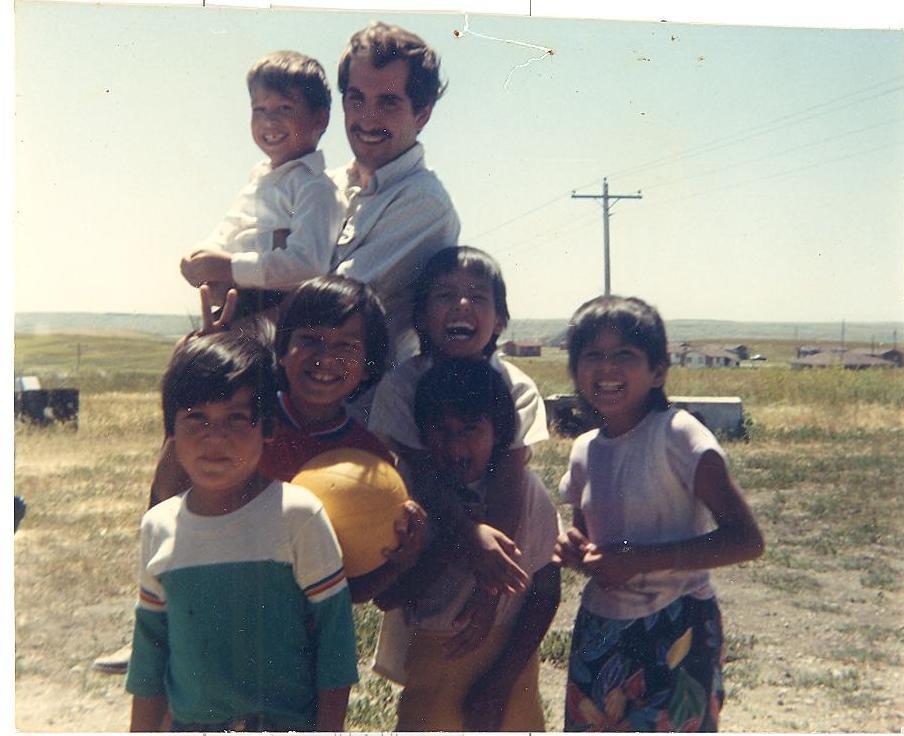
Me and some of my favorite kids on the reservation

One day, on a particularly hot and arid August afternoon, I found myself in a local tavern (imagine that) and I attempted to engage one of the local residents in conversation.

“It must be really hard to be a Native American on the reservation,” I said with all due sincerity and earnestness.

He put down his drink and turned to face me with a quizzical (if not supper annoyed) expression upon his face. “What?” he asked.

So, against my better judgment, I repeated myself. He did not take it well.

He sighed heavily and said, “Please don’t call me that. I am an Indian.” He could see immediately that I was surprised by his response.

“The last thing I need is to have some self-serving white punk attempt to pat himself on the back by patronizing me,” he continued.

His tone told me that this would be an especially short conversation.

“I’m sorry. I didn’t mean to offend you,” I stammered, eyeing the exit.

“That’s my point,” he said. “You somehow think that a bunch of politically correct words are going to make up for the fact that your people stole our land, murdered our children and raped our women.”

 He sighed and returned to his drink. “Look, I know you’re probably a nice kid, and I really do appreciate what you’re trying to do to help my community but I’ve had my fill of white apologies.”

And that was that. There were not a whole lot of people living on the reservation, but strangely I never saw that man again after that day. He did, however, teach me an invaluable lesson: more often than not, words are nothing more than just words.

Life During Wartime

My grandfather, whom some of you may recall as an eccentric English teacher at Biddeford High School in the 1960s, tried to teach me the values of developing critical thinking skills and avoiding populism. I was 12. The world was all about being popular and not thinking too hard about anything.

And so it is that I find myself, more than 40 years later, on this bitterly cold morning — an overweight, bald, middle-aged, underachieving white guy — briefly contemplating whether I should continue this column because I know deep in my bones that it is going to piss some people off. (Look, Grampa! I just ended a sentence with a preposition! Ha!)

Tomorrow, our nation will celebrate Dr. Martin Luther King Day in honor of one of history’s most prolific and courageous leaders who inspired all people to be better versions of themselves while promoting peace, justice and equality by his stunning examples of how to find common-ground with our fellow man.

Ironically, on this same day — here in my hometown of Biddeford, Maine – the city council will be holding a special meeting to decide whether we should create two committees that aim to study and foster the development of goals, policies and practices that are intended to foster the principles of “diversity, inclusion and equality.”

No, I did not stutter. The city is not creating a committee to study these issues. They will be discussing the formation of TWO committees to basically do the same thing. Why do one when you can have two for the same price? (A popular mantra in the world of government).

Here, hold my beer.

Look, don’t get me wrong. I am as a big a fan of diversity, inclusion and equality as the next guy, but really? This is something that warrants the need to create two committees in the city?

For starters, who on Earth, will serve on these committees? It’s not like we have a mass of people beating down the doors of City Hall to serve as volunteers on various city committees. For Christ’ sake, more than half of the city council seats were unopposed in the last election.

Begging my pardon. But this seems to be a classic example of a solution desperately in search of a problem.

If the city council is really concerned about “diversity” and “inclusion” why are they so blind to the plight of downtown residents who do not live in such pretty hip, cool neighborhoods when it comes to snow ban parking rules designed to support a privately operated parking garage?

Is Mayor Casavant going to stand outside of 3D’s Variety on Main Street and ask customers who just purchased a carton of generic cigarettes whether they feel included and well represented by their local government?

What about working-families that are struggling to get by and hoping – against all odds – to be able to someday buy their own, affordable home and then listen to Councilors Marc Lessard and Amy Clearwater bad-mouth and dismiss the notion of a housing development with modular homes? “I think the majority of residents would much prefer to see the creation of stick-built homes.” Lessard reportedly said during a recent meeting about a proposed housing development.

Hmmm, the good people of Cathedral Oaks Drive and Thacher Brook Lane aren’t too crazy about new neighbors with modular homes, huh? How inclusive! How diverse! It’s just that some animals are more equal than other animals, I suppose. Diversity, my ass!

Okay, I think I have made my point. Now, I’m going to head down to Mulligan’s for a beer. If I run into Casavant, Lessard or Clearwater there, I will drop dead on the spot. After all, the place isn’t especially known for its diversity. Strangely, however, the regular patrons are really nice people who are always more than happy to welcome a new face to the crowd. And that, my friends, is the definition of inclusion.

Peace.

Originally published in Saco Bay News

Werewolves of London

It is a well-known fact that participation in the world of politics – whether it is national, statewide or local — is often a rough and tumble affair.

But here in my hometown of Biddeford, politics is a blood sport and its machinations are not for the faint of heart, those with thin skin or fragile egos. You better put on your big-boy pants if you want to play in this arena.

Me and the mayor in 2011

This was a strange election year in our city. Several city council seats were uncontested and the mayoral campaign between incumbent Alan Casavant and his challenger Victoria Foley was relatively quiet — right up until the last few days of the campaign.

So, what happened? Why did just a small handful of Foley’s supporters all of a sudden go rogue on social media and get their knickers in a knot?

Well, it was a couple of things, including a direct mail piece that the Casavant team sent out just a few days before Election Day. The reaction to that mailer from a few renegade Foley supporters was swift and scorching. Heads exploded, small children went missing and locusts began to ravage the city.

Relax. I’m joking.

(Disclosure, I was a member of Casavant’s campaign team.)

Foley, and an overwhelming majority of her supporters, ran a clean, positive and civil campaign. But some new terminology was introduced into the broader spectrum of campaign rhetoric this year: ageism and nativism.

What? Do I now have to feel guilty about being an old native of Biddeford?

The unhinged objection from a small group of Foley’s supporters on Facebook was likely sparked by Casavant’s use of a direct quote that Foley gave to a newspaper reporter several weeks ago. “My opponent says Biddeford is on a great trajectory,” Casavant wrote. “I appreciate her kind words.”

Another objection was the mention of Foley’s age on the Casavant mail piece. Again, that was from a newspaper profile of the candidates. I very much doubt that any member of Foley’s team wanted to storm the Biddeford-Saco Courier’s office because they had the temerity to list her age (38).  For the record, Casavant is 69.

Throughout the campaign, there were many subtle comments made about the need for a more “energetic” candidate in the mayor’s office. I will not reveal the names of those thin-skinned Foley supporters, but I will quote some of their social media comments, which, by the way, were taken down very quickly once the Casavant team replied.

No worries. I have the various screen shots.

PR 101: Nothing is ever truly “erased” once it has been published on a public site.

A Foley supporter, who I will dub as Jane Doe, wrote a screed on Facebook attacking the mayor for invoking his experience and for the fact that he is a lifelong Biddeford native who bleeds black and orange.

“When I saw the first post on the socials for Alan’s re-election campaign weeks ago, I was repulsed by the nativism dog-whistle language, that only someone “from” Biddeford, who has deep roots here, is capable of being Mayor of Biddeford,” Jane Doe wrote. “. . . (and) mentioning Victoria’s age is a clear attempt to label her as “too young” to do the job.”

And John Doe wrote this:  “There is a young, progressive female Democratic (sic) running for mayor of Biddeford, Maine. The current mayor is an old, entrenched, multi-term good ol’ boy Democrat.”

John Doe continues: “As with everything the current mayor does, there’s plenty of wolf-whistle nativism on the (Casavant direct mail piece.). The whole production looks and reads like an Onion joke about old, straight white guys desperately clinging to their fiefdoms…but unable to do more than make fun of the competent women around them.”

What John Doe conveniently forgets is that Alan Casavant appointed Victoria Foley to the city council. Casavant also appointed Councilor Amy Clearwater to the council. I could keep going, but you get the point:  Casavant obviously recognizes the competency of female candidates.

The Casavant team created a campaign website, which included video endorsements from several “natives” but it also included profiles of newer residents who like the way our mayor is leading the city. Maybe that stung. Who knows? But I also know several lifelong residents of Biddeford who supported Foley’s attempt to capture the mayor’s seat.

Biddeford has a long and storied history of welcoming and embracing “immigrants” who flocked here to work in the textile and shoe mills more than 100 years ago. These people, and all the others who followed in their footsteps (Including Victoria Foley) contribute so much to the fabric of a truly diverse community.

In summary, we should all thank Ms. Foley for offering an alternative checkbox on the ballot. She has a lot to offer this community and she has a bright future ahead if she chooses to continue in the city’s political landscape.

Now it’s time for this old white guy to take a nap.

Biddeford After Dark: When writing was fun

“Biddeford After Dark” is a five-part series of articles that I wrote more than 20 years ago while serving as the editor of the Biddeford-Saco-OOB Courier.

According to what I wrote at the time, the purpose of the Biddeford After Dark series was “to explore what was often ignored: what happens in our community after most people have gone to sleep.”

The Lincoln Mill Clock Tower removed from its perch, sits rotting near the side of the road in downtown Biddeford. (Seaver photo, Dec. 2001)

I have fond memories of writing those articles, all of which were written in a first-person, narrative style.

It was October 2001, and I think my publishers, David and Carolyn Flood, thought I was nuts for wanting to work all the extra hours necessary to accomplish my goal. But I wasn’t looking for overtime compensation or a break from my daytime responsibilities.

I just thought it would be fun.

The Biddeford After Dark series stands out today – nearly two decades later – as one of my favorite writing endeavors.

Clicks on these links to travel back to Biddeford in 2001:

Part One: Tough Guys Don’t Dance

A reporter wanders darkened streets, and young punks act tough in the 7-11 parking lot

Part Three: The Naked & The Dead

What’s it like to be working when most people are asleep? What are the implications for downtown Biddeford?

Part Four: The Thin Blue Line

I spend a shift as a ride-along reporter with a third-shift police officer. My observations were much different than what I expected.

Part Five: Takin’ Care of Business

In-depth conversations with the donut makers, factory workers and the guys who operate Biddeford’s downtown waste incinerator; all while most of the city sleeps.

(Note: For the life of me, I cannot find the files for Part Two of this five-part series. I guess the night takes its due without permission).

Fire and rain; a tale of two cities

When I was 15, I was sent to live with my uncle Leonard in West Peru, Maine.

I would joke with people during my sophomore and junior years in high school that I lived in Peru but had to go through Mexico to attend my classes at Rumford High School.

If you have ever been to Rumford or driven past it, you know how bad the downtown paper mill smelled. The stench from that pulp and paper mill would make you gag. It was 10 times worse than the putrid smell generated by the MERC trash-to-energy plant in downtown Biddeford.

Closing MERC sparked an economic renaissance for Biddeford. Home values went up; the downtown area began to flourish with several new businesses; and young people from all over southern Maine decided to move here.

Back to Rumford.

One time, while driving through Mexico (Maine), I asked my uncle how he could tolerate the god-awful smell generated by the mill on the other side of the Androscoggin River. His answer was quick with a serious tone: “That is the smell of money,” he said.

I learned a lot from my uncle. He was the director of student teacher training at the University of Maine in Farmington, but he didn’t suffer fools lightly. He was an avid hunter, fisherman, snowmobiler, boater and camper, just like the tourists who visit western Maine every year.

But he always reminded me that most of the forest land in Maine is privately owned.

In Biddeford, we had the luxury of closing MERC. It proved to be a financial success for our city that is perched along the shores of Maine’s gold coast.

In Rumford, however, closing the pulp and paper mill would be like dropping an economic nuclear bomb on that town and its surrounding communities (Mexico, Dixfield, Peru, Roxbury and Byron). They would all feel the pain.

Each year, for the past 20 years, my family goes camping along the south shore of Rangeley Lake, roughly 90 minutes northwest from Lewiston. It’s a wonderful place to hear the cry of loons while sitting around a camp fire and staring at the brilliant array of stars on cloudless nights.

But some people worry that we may lose those opportunities if the NECEC (New England Clean Energy Connect) project is built.

More than 80 percent of Maine’s sustainable forest lands are privately owned. Large landowners, such as Weyerhauser and Irving have a long history of allowing public access on their privately-owned land.

While driving along Route 17 toward Rangeley, you will see logging trucks headed down the highway toward Rumford, Lincoln, Jay and other mill towns, providing economic stimulus in a region that knows its poverty rate is much more intense than in places like Portland, Freeport, Biddeford and Kennebunkport, where logging trucks are a rare sight.

Hey, kid! Get off my lawn!

Many Mainers consider access on private land as their birthright and they rarely think twice about using that land for their own enjoyment. And some of them – such as the Natural Resources Council of Maine -actively work to block any kind of development, including renewable energy projects (wind, solar and hydro).

That last one leaves me scratching my head. An environmental group lobbying to stop a renewable energy project???

As you continue your drive northwest on Route 17, you will see the Record Hill Wind project lining the ridgeline in Roxbury on your left side. That project features 22 wind turbines. The town of Roxbury was mainly in favor of the project, which not only generates new property taxes but also guarantees public access along that ridgeline for hunting, snowmobiling, hiking and ATV trails.

In a perfect world, we may not need more energy. But before people in southern Maine pontificate their opposition to the NECEC, maybe they should listen to the many voices of people who live and work on that land, including former State Rep. Larry Dunphy (R) of Emden.

In a recent letter to the editor of the Piscataquis Observer, Dunphy doesn’t pull any punches: “I believe that when Mainers learn the truth about the NECEC, they will support it as I do,” Dunphy wrote. “Please do your own research. Don’t base your opinion on the lies being paid for by the same oil and gas companies who profit handsomely from stopping clean energy from coming into Maine.”

The bulk of the NECEC project will run across private land and the remaining corridor will be adjacent to existing transmission corridors. The NECEC will preserve and create new snowmobiling/ATV trails, and other outdoor activities.

The project will also pump millions of dollars in economic activity into Maine’s economy while providing Maine and other New England states with a clean, sustainable source of energy that will meet current and future electricity demands.

It’s a no-brainer. Please join me in supporting the NECEC project.

Originally published on the Saco Bay News web site; July 29, 2021

Video killed the radio star

As we continue our march through the 21st Century, there are still a great many people who are less than pleased about the various advances of technology and about how the so-called charge into a brave new world is affecting their lives and their nostalgic memories.

Henry Thoreau opined that “the mass of men lead lives of quiet desperation.” This is especially true when it comes to the Baby Boomer generation that is constantly trying to catch up with Gen X and Millennials on the technology choo-choo train.

Facebook is full of memes that disparage overweight, poorly dressed or otherwise ‘redneck’ people who shop at Wal-Mart.

Twitter or Facebook will not suspend your account if you share photos of a fat lady using a motorized cart while buying Twinkies and a case of Coca-Cola at Wal-Mart.

Boomers are those who write a check for their purchases at the supermarket. The ones who still pay cash for their Turnpike tolls. I’m not necessarily suggesting that all Boomers are a bunch of troglodytes, but if the shoe fits . . .

In a world where people are increasingly offended or feel marginalized, it is still acceptable to look down upon those who shop at Wal-Mart.

For all of its successes, Wal-Mart faces steep criticism from the pretty people who gladly shop at Target or Whole Foods.

Wal-Mart does not need me to defend it from gross mischaracterizations. (But if someone from their corporate headquarters wants to talk about public relations, please send me an email.)

Now, back to the talk of technology. We carry mini-computers in our back pocket. We have robots to clean the floors in our homes. We use Alexa for everything, ranging from setting the thermostat to maintaining a shopping list. Many people have satellite dishes on their roofs and satellite radio and GPS units in their cars.

In 1985, MTV only showed music videos. My girlfriend at that time said MTV wouldn’t last long because people would get “bored” watching videos. I wonder what she would say today about You-Tube? Today, MTV broadcasts “reality” shows such as “Jersey Shore” and “Sixteen and Pregnant.”

Would you like to join me and invest in opening a new Block-Buster store? Things change. And that’s not always such a bad thing.

Now back to Wal-Mart bashing.

Over the past year or so, dozens of social media memes have popped up, decrying the advance of the self-checkout lane option at Wal-Mart. They argue that this trend is poised to exterminate the need for cashiers. Really?

What other national retailer pays someone to simply greet and welcome you to the store?

Other memes include quips such as “when is Wal-Mart going to send me W2s if they expect me to work there?” Another meme: “if I wanted to self-checkout, I would stay at home and shop at Amazon.”

That last one leaves me scratching my bald head. Amazon is the epitome of technology and consumer trends. If you use Amazon, why are you bitching about Wal-Mart and its self-checkout option?

And why is Wal-Mart singled out for providing a self-check-out option? Hannaford grocery stores have self-checkout lanes. Target stores also have self-checkout options and even Whole Foods (gasp) is experimenting with a self-checkout option for its customers.

I went to Market Basket today. I only had a few items in my cart yet it took 11 minutes for me to get through the traditional checkout lane. Market Basket does not offer a self-checkout option (at least not at its Biddeford store.)

There is an old saying that time is money. If I have just a few items in my cart, I breeze through the self-checkout lane in less than three minutes, saving roughly eight minutes for me to do something else instead of waiting in line to buy a six-pack, a loaf of bread and a box of Twinkies.

To add insult to injury, I get on the Turnpike without stopping to pay a toll, simply by using my EZ pass device. I have to guess that EZ Pass is more profitable for our friends at the Maine Turnpike Authority because these devices decrease the need for human toll booth attendants.

When I was a young child, I remember that my father had a night job pumping gas at the Top Gas station in Saco. He would wash your windshield, check your oil, or inflate your tires upon request.

Today? There are no gas station attendants. Welcome to the jungle. At some point, the machines are going to become self-aware; and we all know what happens then. In the meantime: Thanks for reading! See you next week.

Originally published in Saco Bay News on May 13, 2021