Voter turnout for Maine’s 2014 Primary Elections on June 10 will be absolutely dismal.
Taxpayers across Maine will spend hundreds of thousands of dollars for an absolute non-event; an utter waste of time and resources, all in the name of a Democratic process that doesn’t work without a contest.
In fact, we will be lucky to see voter participation that exceeds the June 1996 state primary, when only 12 percent of eligible voters bothered to cast a ballot.
Think of it this way, it will be like buying a ticket to watch the Boston Red Sox play the Boston Red Sox at Fenway Park.
The winners have already been determined.
Unlike the June 2010 Primary four years ago, the gubernatorial candidates for each political party have already been chosen. If only one Democrat goes to the polls somewhere in Maine, Mike Michaud will clinch his party’s nomination in a landslide.
But in 2010, voters of both parties had lots of choices. There were four candidates seeking the Democratic Party’s nomination, and no fewer than seven candidates seeking the Republican Party’s nomination.
More recently, in 2012, six Republicans and four Democrats fought in the primaries for a chance to fill the shoes of U.S. Senator Olympia Snowe.
This year, Republican Susan Collins has already won her party’s nomination and Shenna Bellows is assured of being the Democratic Party’s sacrificial cow.
But what about the Maine Legislature and the crop of fresh faces ready to head off to Augusta?
Okay, you can stop laughing now.
In fact, you may want to cry because you and all of your neighbors will be funding an entire day of using municipal clerks and voting officials to collect ballots that hardly matter.
Of Maine’s 35 state senate seats, only four will face a primary challenge (three Democratic primaries and one Republican primary)
It’s not much different for the process to fill the 151 chairs in the Maine House of Representatives, where only 19 of the 151 races will see a Primary challenge (8 Democratic primaries and 11 Republican primaries)
In 132 of 151 House Districts in Maine, it doesn’t matter a bit if you go to the polls on June 10. The races for the Blaine House, the U.S. Senate and the Legislature have been pre-determined.
Please do not disturb the slumber of your municipal clerks or voting officials.
Despite all the hoopla about the power of social media tools in political campaigns, what metrics can we use to determine if those tools are effective?
While just about anyone can set up a Twitter account or create a Facebook page, social media tools are only as effective as those who are using them. Although it is widely accepted that social media tools played a big part in President Obama’s 2008 campaign, that type of success is not guaranteed by simply using social media as part of a campaign strategy.
When it comes to Maine’s 2014 gubernatorial race, which of the campaigns is best using social media? More importantly, how do we set aside our individual biases and evaluate the campaigns based solely upon their social media metrics?
At the Brookings Institute’s Center for Technology Innovation, Darrell West offers a mixed review regarding social media and campaign engagement and the awkward transition to actual governance.
Social media are the ultimate in disruptive technology. They change information delivery, business organization, online content, news coverage, and the manner in which individuals process new developments. As shown during the 2008 campaign, these digital tools represented a textbook example of voter mobilization and electoral impact. They were, in the words of Engage Partner Mindy Finn, the “central nervous system” of campaign organizations.
Using social networking outreach tools such as Facebook, MySpace, YouTube, and Twitter, a number of Democratic and Republican candidates raised money, identified supporters, built electoral coalitions, and brought people in closer touch with the electoral process.
You may recall a somewhat silly and lighthearted piece about Maine’s gubernatorial campaigns that I posted a couple of months ago. Then, I jokingly said we should dispense with the standard election process and use social media metrics to determine the winner. I examined each of the campaign’s current metrics.
Today, I have decided to track those metrics on a regular basis and to blog frequently about those campaigns and their use of social media.
Over the last 60 days, each of the Maine gubernatorial campaigns has been active on various social media platforms. But before we begin, it’s important to note that Democrat Mike Michaud is the latest entrant to this race. Both Governor LePage and Eliot Cutler carried over their respective social media support from the 2010 campaign.
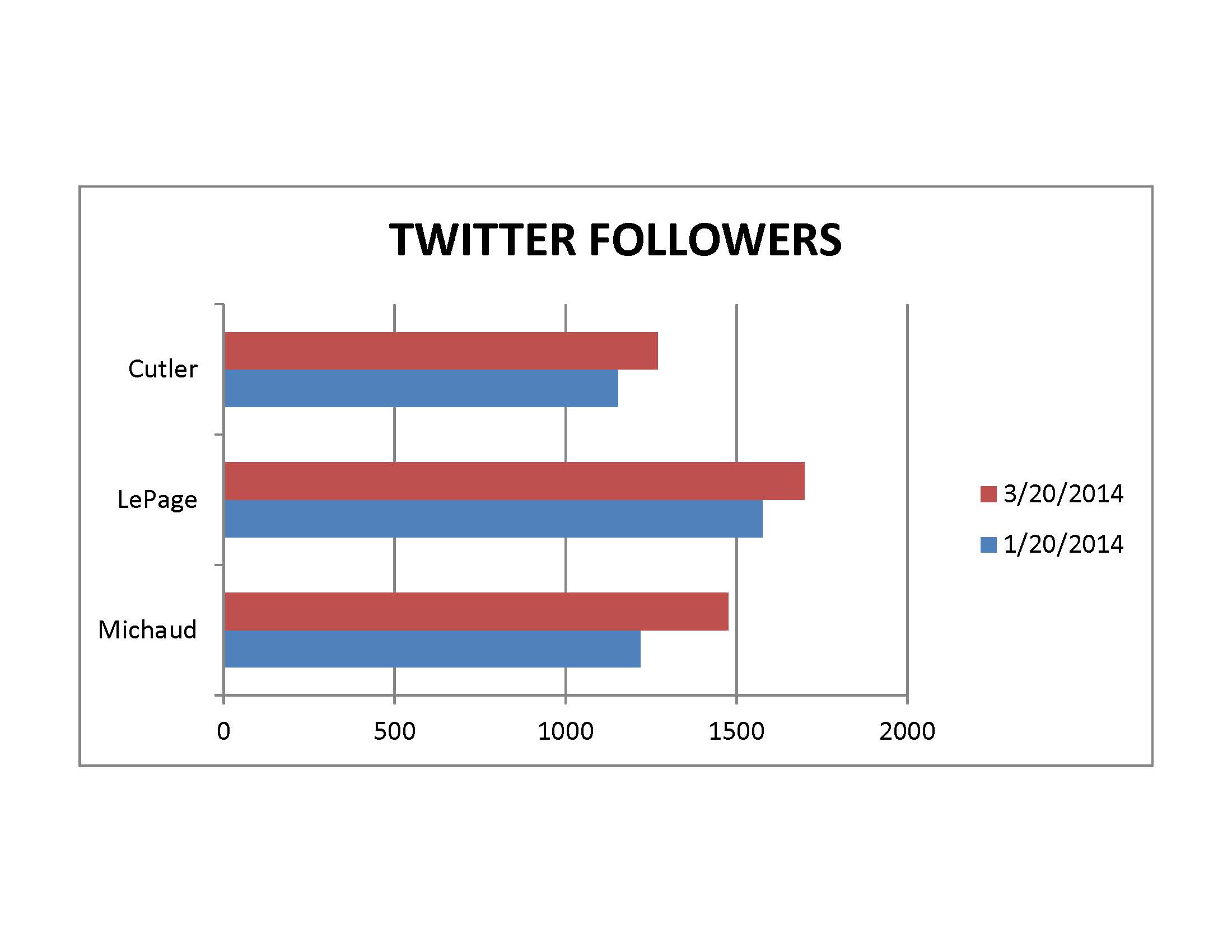
Nonetheless, Michaud has seen the greatest increase in social media traffic, earning a 21 percent increase in the number of Twitter followers @Michaud2014, moving from 1,219 Twitter followers on January 20 to 1,475 followers as of March 20, 2014.
Although Governor LePage (@lepage2014) has the greatest number of Twitter followers (1,698) his metrics have increased only 8 percent during the same time period.
Eliot Cutler (@EliotCutler) saw a 10 percent increase in Twitter followers, from 1, 153 to 1,269 followers during the same period.
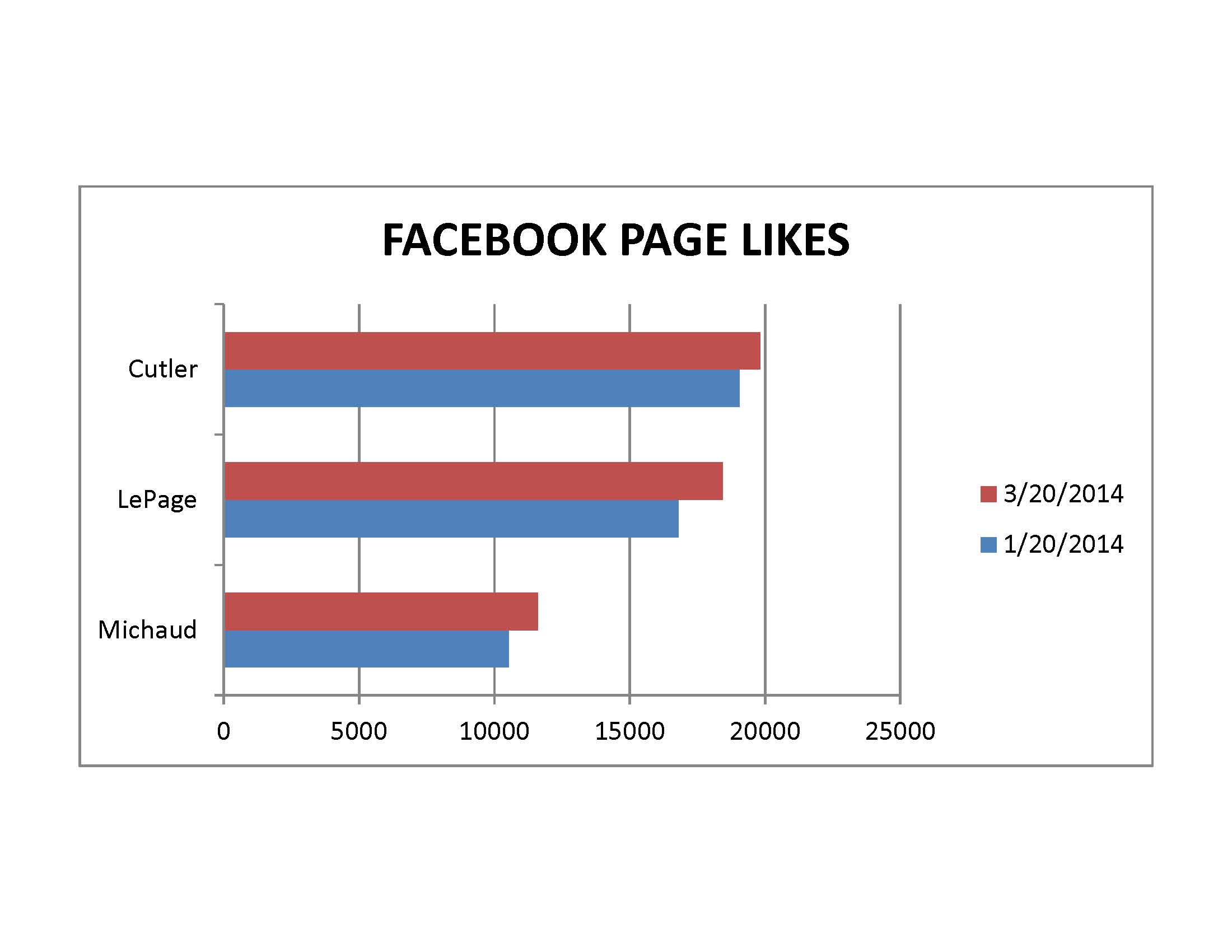
On Facebook, Cutler still dominates in the total number of Likes for his campaign page (19,824) but saw only a 4 percent increase over the last 60 days, while both Michaud and LePage experienced increases of 10 percent.
LePage’s Facebook page had 18,438 fans on March 20, compared to 16,791 fans on January 20, 2014.
Michaud’s Facebook page had 11,600 fans on March 20, compared to 10,529 fans on January 20, 2014.
When viewed overall, it would appear that Team Cutler has the steepest hill to climb, so far.
Note:Though it’s generally common knowledge, it must be noted that Twitter followers and Facebook fans do not translate directly to the number of supporters for a political candidate. As an example, I follow all three campaigns on Twitter, but will only be voting for one candidate.
While most people were picking out green outfits, drinking lots of beer or otherwise wasting time on St. Patrick’s Day, one select group of folks were bracing for potential fame and fortune as hopeful members of the 2015 Maine Legislature.
The deadline for wannabe state representatives and state senators came and went at 5 p.m. on March 17.
Given the impacts of last year’s legislative redistricting and Maine’s term limits law, voters will be faced with a healthy crop of fresh faces.
But you can always count on a few perennial candidates: those who think the next campaign will be the magic campaign, the Wonka Golden ticket that will admit them into the strata of being really important and somewhat relevant. Such is the case in Biddeford, where Perry Aberle — undaunted by two consecutive and somewhat epic campaign failures — has once again tossed his hat into the ring seeking to capture a legislative seat that eluded him two years ago by a hefty margin.
Now that he has tossed his hat into the ring again, hopefully, someone will toss him back a working razor.
Aberle won his last election nearly two decades ago, when he was still in high school and was elected to serve one term on the Biddeford City Council. Since then, his campaign skills have deteriorated.
He ran for the state legislature two years ago and was crushed by incumbent Paulette Beaudoin, the proverbial little old lady who cleaned Aberele’s clock by garnering nearly 64 percent of the vote (2,585-1,471).
A year later, Aberle brushed himself off and decided to challenge Biddeford Mayor Alan Casavant. Despite a much larger pool of voters in a city-wide election for mayor, Aberle’s vote total shrunk by more than half, and he finished a distant third in a three-way race that also included former mayor Joanne Twomey. Casavant easily won re-election with 2,377 votes, compared to 720 for Aberle.
Today, Aberle is again running as a Republican for the Maine House of Representatives in District 12, which includes the central and downtown portions of the city. He will face Biddeford businessman Martin Grohman, a Democrat, in the general election.
Will the the third try be the charm for Aberle? Don’t bank on it, would be my advice.
Over in District 11, which includes western portions of the city, Democrats Ryan Fecteau and David Flood will duke it out for their party’s nomination. The winner of that contest will face political newcomer Debi Davis, a Republican, in the November general election.
In the District 32 State Senate race, Democrat David Dutremble will once again bank on his family’s political legacy and last name recogntion to hold onto his seat for another term. Dutremble will once again be challenged by Arundel businessman James Booth who ran for the seat two years ago as an Independent. This time, Booth is running as a Republican. Anything is possible, but Booth is facing an uphill battle in a district that historically favors Democrats.
This morning, I stumbled across a new Facebook page that is dedicated to the idea of reclaiming the color blue for Republicans.
At first blush, I thought this was one of the silliest things. But then, I started thinking about it.
Why would the GOP want the color blue versus red? Isn’t red the traditional color for Republicans? Not unless you consider “traditional” as the last 15 years.
According to the Republicans Red No More Facebook page, “center-right parties around the world are Blue, and Social Democrat parties are Red, except in the U.S. where 13 years ago the media assigned Red to the Republicans. “
The page creators argue that for more than a century, Republicans were routinely associated with Blue and Democrats with Red.
That color association was changed, they say, by NBC journalist Tim Russert in 2000 when he assigned Red to Republicans on his electoral map.
Since then, they say, the media has adopted this formula, even though it runs counter to American history and worldwide practice.
Are they right? Well, take a look at the map that NBC used to portray the 1980 presidential election results between Ronald Reagan and Jimmy Carter.
Color is a form of non verbal communication. It is not a static energy and its meaning can change from one day to the next with any individual.
For example, a person may choose to wear the red one day and this may indicate they are ready to take action, or they may be passionate about what they are going to be doing that day, or again it may mean that they are feeling angry that day, on either a conscious or subconscious level.
Experts say the color red can cause people to feel rushed, agitated or angry. The color blue, on the other hand is generally associated with serenity. It is also associated with trust, honesty and loyalty.
So, given this information it becomes easy to see why Republicans want to “take back” the color blue.
And what about the rest of the world? Are Social Democratic political parties generally red and center-right parties blue?
That would be true in a wide range of countries, including Finland, Israel and the Czech Republic. In fact, the more you look, the more you will see that conservative or centrist parties are associated with the color blue around the globe.
But I don’t expect the U.S. Democratic Party to go down without a fight in the upcoming color war. After all, the last thing Democrats want is to be associated with the color red (Think Soviet Union, the Red Invasion and all sorts of other negative stereotypes.
Who changed the color? Was it a mainstream media with a liberal bias? Was it an oversight or an intentional switch by the GOP? There’s a lot of conflicting information out there, but one thing is for sure: you can always find some strange stuff on Facebook, which relies on the color blue.
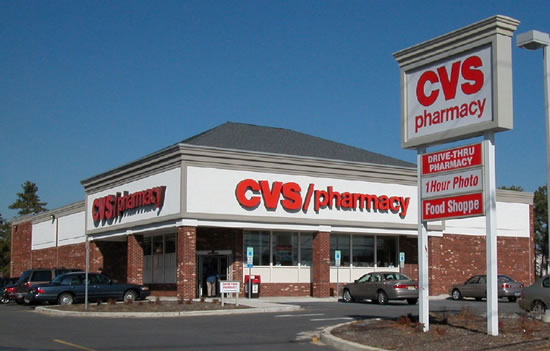
You probably heard that CVS, one of the nation’s largest drugstore chains, made news by announcing it will no longer sell cigarettes.
While a majority of pundits and health advocates were quick to heap praise upon the retail giant for its “bold and principled” move, some lingering questions remain about the decision and its fallout.
Depending on your perspective, one of the following things precipitated Wednesday’s announcement:
A: the CVS board of directors decided that their good conscience should prevail: selling tobacco products is in direct conflict with their company’s core value of promoting healthy lifestyles, and they made a “principled” decision; or
B: the CVS board of directors violated several regulations of the Securities Exchange Commission by willingly turning away an estimated $2 billion in annual revenue generated from the sale of cigarettes at its stores, and was thereby willing to accept a loss in profits for its shareholders because of principles; or
C: the CVS board of directors knew exactly what they were doing, and this was little more than a calculated and strategic move that would 1.) attract new customers; 2.) provide a significant public relations and marketing boost to a company that is constantly battling with fierce competitors; and 3.) most importantly, open up new sources of revenue and cost discounts with the chain’s affiliated vendors and health partners, including health insurance companies.
Which of those scenarios do you think is most plausible?
If you chose A, you are what people in my profession call completely gullible. If you chose B, you should probably get back to promoting your own grassy-knoll theory.
The right answer, of course, is C.
Allow me to explain. There is no defense for smoking cigarettes. It’s a terrible and nasty habit. But CVS is relying upon a questionable talking point here, especially when considering all the other products that are stocked on its shelves.
The last I heard, the United States is dealing with an obesity epidemic that is costing taxpayers and insurance ratepayers billions and billions of dollars each year. Yet, CVS, the self-proclaimed bastion of good health and righteous moral principles, has yet to announce that it will no longer sell soda, potato chips or candy at any of its stores. Why?
Every once in a while, I enjoy a cold beer, a nice glass of wine or a soothing shot of bourbon. Alcohol, however, is a known toxic. Many people are unable to consume alcohol responsibly. Alcohol related deaths are skyrocketing. Alcohol abuse can be found at the root of many social problems, including crimes that range from inxtoxicated driving and domestic violence to robberies and assault. Loss in workplace productivity related to alcohol consumption is staggering. The impacts of alcohol on our nation’s health care system is extraordinary.
Will CVS sell wine or beer at any of its stores?
I am a free-market capitalist. I am tickled pink that CVS made its own decision. The government did not pressure the company. The market did. That’s the way it should work.
But for CVS to single out just one of several products its sells for profit earns them my Hypocrite of the Year Award.
And for health advocates to call this a “move of principle” is a joke because they conveniently (for now) ignore some much larger issues.
Today, it’s the smokers. And eventually, smoking will be eliminated. But then what?
Do you really think it will stop there? Do you really think that they won’t come after your food, your beverages, or any of your choices?
Attempting to create a physically fit, morally upright citizenry has been attempted before. Maybe some day, we will get it right.
This blog is on equal footing with the New York Times.
No, I am not having a Richard Sherman moment. I am simply stating a fact. A fact that should give all of us pause as we contemplate the marvels of technology
What I write on these pages is instantly available to billions of people, anyone connected to the world-wide web. By virtue of nothing more than my registered domain, my silly and perfunctory blog is just as accessible as any other online media source.
The internet, virtually free of government regulation (at least in the United States), is the great equalizer, and it has fundamentally shifted the way we live our lives. Today, we can do things that would have seemed impossible or the stuff of science fiction just 20 years ago.
Medical records can be transmitted at lightning speed, sometimes helping doctors save a life; you can now renew your driver’s license while wearing only boxer shorts at 3 a.m. from the comfort of your own home; 12-year-old boys no longer have to suffer the humiliation of sneaking a peek at a Playboy magazine perched on the top shelf at the local drug store. There are millions of funny cat videos to watch; and you can argue politics with absolute strangers (today they are called Facebook “friends” or “followers”) 24 hours a day.
I think we can all agree that the internet is pretty cool. Thank you, Al Gore!
I write this because of a recent court decision that is considered by some as a victory for free markets and by others as a threat to humanity.
The issue is known as “network neutrality,” a terrifying concept with a very appealing name. Thank you, public relations professionals! (You’re welcome)
Those who favor net neutrality say they want to “save the internet.” Those who oppose net neutrality say they want to “save the internet.”
Enter the District of Columbia U.S. Court of Appeals, which sided with Verizon and other telecom giants over the schizophrenic rulemaking proposed by the FCC.
According to Reuters, the Court rejected federal rules that required Internet providers to treat all web traffic equally, a decision that could allow mobile carriers and other broadband providers to charge content providers for faster access to websites and services.
The Federal Communications Commission’s open Internet rules, also known as net neutrality, required Internet service providers to give consumers equal access to all lawful content without restrictions or tiered charges.
Which side of the net neutrality debate is right?
The sad fact is that both sides are a little bit right, and we can all agree that the internet should continue being cool and delivering porn or funny cat videos at blazing fast speeds, right?
Unfortunately, that’s not really the issue at hand. Let’s pause for a moment and watch a video:
Clash of the Titans
At the center of the net neutrality debate is a sad truth. This is not some humanistic battle on the wild frontier of technology. This is a race to the bank by two sets of very large corporations.
On one side, you have internet service providers like Verizon, Comcast and AT&T. On the other side are huge internet users like Netflix, Google, Amazon, Microsoft and YouTube.
The late Senator Ted Stevens (R-AK) was roundly chastised for describing the internet as a “series of tubes,” but he was not that far off the mark.
The bottom line? It costs money to make the internet work. It requires infrastructure that is in constant need of upgrades and repairs to meet the challenges of an exploding market and skyrocketing volume demands. The world has a big appetite for cat videos and pornography.
Netflix, Amazon and others want to use the internet just like you and me. Equal access for all, they scream.
But does that make sense? Net neutrality opponents argue that the internet is a public domain and should thus have equal access for all users. Let’s think about that.
Can we apply that logic to other public domains? How about the post office? Should it cost as much to mail a post card as it does an air conditioner? Is that discrimination?
Or how about the Turnpike, a quasi-public piece of infrastructure subsidized by tax dollars? Tractor trailer trucks have to pay a bigger toll than someone driving a Prius. And that is fair because the truck creates more wear and tear on the road.
Proponents of net neutrality say that consumers may have to pay more for faster services or special tiered packages. Oh my!
Their rallying cry, as demonstrated by a recent op-ed in the New York Times by Susan Crawford is that the internet could end up being like (gasp) pay TV.
I don’t know about Susan Crawford, but television when I was growing up sucked. We had three channels, and I was my father’s remote control. Television today is much better. I have a huge TV and about a zillion channels that all show the same seven movies over and over. I pay through the teeth for that kick-ass, high-definition, Dolby surround-sound, 60-inch, power sucking thing of beauty, and I can pause live television. Imagine telling that to someone watching Archie Bunker in 1972.
Net neutrality is a solution desperately in search of a problem. Your internet today is better than it was five years ago. I guarantee it will be even better five years from now, . . . unless, the “Save the Internet” crowd opts for a second bite at the apple.
As Maine Goes (AMG), one of Maine’s most popular and controversial political websites, had gone dark after a 16-year run that allowed verified members to post and comment on a wide range of political issues. Admittedly, AMG was a conservative site, but it was well-moderated, and liberal posters would sometimes wade into those waters to offer their perspectives and to push-back on what they perceived to be an echo-chamber of conservative thought.
AMG’s membership, although decidedly right-leaning, was rather diverse: single mothers, retired folks, business owners, students, academics and every-day working people spent hour upon hour debating ideas, posting insights and frequently arguing about a wide range of subject matters.
Journalists would monitor the site, observing political trends and gleaning intelligence from campaign operatives who would lurk on AMG’s pages.
Profanity was forbidden, but the jousting was real. It was not a place for those easily offended. If you couldn’t take the heat, if you didn’t like being challenged, well…you could always just sit back and watch the big dogs get off the porch.
So it was, in the post-AMG abyss, that I decided to try my own social media experiment. Lacking the dedication and commitment that Scott Fish gave to AMG, I instead set up a Facebook group called “Thinking Politics”
It remains a closed, secret group (new members must be invited by existing members to participate). I started the group with fourteen people: six who generally lean left, six others who generally lean right and two people I perceived to be in the middle of the political road. (This was all very subjective and was calculated while drinking generous doses of a favorite Merlot).
The mission statement of the group is rather simple: Thinking Politics is a place for those who enjoy political discourse that includes rigorous debate but not personal attacks. Members are seeking an elevated level of political discourse and pledge to be as committed to hearing as they are to speaking.
I wanted to see how these selected friends would do in a controlled environment. I invited no one else, despite the urge not to offend other friends. I tried to just sit back and watch. That was almost five weeks ago.
Can you hear me?
Today, there are nearly 120 members in the Thinking Politics group. Members pick and start the conversation points or join other ongoing discussions.
At least one person dropped out of the group. She was reportedly frustrated that she could not see comments being made by another member because he had “blocked” her from his own Facebook profile.
The group quickly veered left. Why? Simply put, my left-leaning friends outflanked their counterparts on the right by inviting others of similar thought as reinforcements.
Obviously, this dynamic frustrated my friends on the right. They were feeling outnumbered, outmatched and felt it was a waste of time to participate if they were just going to be outshouted. They retreated a bit.
But here’s where it gets strange. Some of those on the left actually began bemoaning the fact that the page was becoming little more than a “political echo chamber,” chock full of progressive thought with little or no input from the political right.
Just when I thought my experiment had failed, something happened. The conservatives found some heavy-hitters to join their ranks, including State Rep. Jonathan McKane (R-Newcastle) and Beth O’Connor, a former state representative and vice chair of Maine Taxpayers United. Other unapologetic Republicans followed.
So now the page was a bit more balanced, but was it more productive?
It remains to be seen. A majority of the members seem genuinely committed to the process: to stand firmly on ground and debate with civility. But I wanted (hoped) to see something else. I wanted to see if people would begin asking questions. I wanted to see if there was a natural curiosity out there. Would people pause and consider alternative viewpoints? More importantly, would they proactively seek out those other views?
You can guess the answer.
I’m right, you’re wrong
Even in a semi-controlled environment, my friends seemed more focused on being right rather than considering an alternative viewpoint. I get it. That’s how I roll 99 percent of the time.
Last week, I participated in an event that some friends organize every once in a while: a Political Beer Summit. Now, face to face and with the assistance of great beer and delicious pizza, the political debate was just as passionate but it was a lot less heated.
Sitting across the table from one another, the Democrats saw the Republicans as reflections of themselves with the exception of different viewpoint. The Republicans were not afraid that the Democrats were going to stiff them with the check. It was fierce, but friendly. No one changed their mind, but every one was willing to listen.
Why can’t that dynamic happen more often? Why are we so fiercely competitive?
Recently, I stumbled across an article in the Washington Post that explains this increasingly fierce dynamic of political competition.
Nearly every recent election has held out the possibility of a shift in party control of one institution or another, writes Francis Lee in his Monkey Cage blog.
Lee continues: Competition fuels party conflict by raising the political stakes of every policy dispute. When control of national institutions hangs in the balance, no party wants to grant political legitimacy to its opposition by voting for the measures it champions. After all, how can a party wage an effective campaign after supporting or collaborating with its opposition on public policy?
Lee’s analysis of political competition helps explain the dynamics I witnessed in my experiment. Today’s political discourse has taken on the tenor and tone of an all-out war, a battlefield of fighting to the death and an unwillingness to compromise.
Last night I posed a question on my Facebook timeline: Is it possible to debate politics without animosity; is it possible to fight a war without hating your enemy?
Matt Jacobson, a Facebook friend who was one of several Maine people seeking the Republican nomination for governor in 2010, offered a brilliant response: “Too many don’t understand the difference between an opponent and an enemy,” he wrote.
I am fascinated by the psychology of politics, and I earn my living as a policy/political consultant. It still amazes me that so few candidates understand the vital importance of reaching toward the middle for additional supporters. If we want the fence sitters to join our side, how do we get them off the fence and into the game?
I think it’s a worthy question, and I invite your feedback. And if you want to join the Thinking Politics group just send an e-mail to randy@randyseaver.com
By comparison, guys like Gary Hart and Bill Clinton had it easy.
Sex scandal? No big deal. Traffic jam in New Jersey? Now that’s how you infuriate people.
It remains to be seen exactly how the controversy surrounding “bridge-gate” will impact Christie’s dreams of a 2016 presidential bid, but watching the news this morning it appeared that the world was about to slip off its axis. The talking heads were beside themselves, questioning whether Christie’s political clout could endure the scandal.
Within moments of the fateful e-mail surfacing, DNC activists were all over the blogosphere, questioning the New Jersey governor’s credibility and his ability to lead.
“Is this the guy we want in the White House?,” wrote one woman on Facebook, mocking Christie for “not knowing” about every e-mail his staff had sent or received.
Strangely, it was only a few months ago when Democrats were eager to point to Christie as a welcome voice of sanity in the GOP. They praised his bipartisan nature because he was willing (gasp) to meet with President Obama in the aftermath of Hurricane Sandy, only days before the 2012 election.
Republicans, on the other hand, were infuriated, stopping just short of accusing Christie of orchestrating the hurricane disaster as a way to help Obama beat Romney. Sorry, but my cocker spaniel could have helped Obama beat Romney.
Back then, my friends on the left side of the political aisle celebrated Christie. They praised him as a rare Republican. They called him a moderate. They said he was a “common sense leader.”
They used to say the same things about John McCain: a maverick . . . a man of principle. Democrats felt good about being able to heap praise on someone from the other side of the aisle, right up until he won the GOP nomination.
The same dynamic began happening to Christie last year, despite his willingness to parody himself on the Jimmy Fallon Show. Because Hillary is the heir apparent for the Oval Office, and because Christie was holding his own in polling against her, he began to fall out of favor, especially with my friends on the left.
Christie, however, adamantly and repeatedly denies having any interest in the 2016 presidential race. Strangely, he sent a lot of Christmas cards to elected officials in Iowa a few weeks ago. Who knows? Maybe he just likes Iowa.
I don’t know how this crisis will impact Christie’s political future, but I do know this: I was lukewarm about him as a presidential candidate until this afternoon.
Christie did something today that is rare in today’s political world. He took responsibility. He said, “I own this.” He apologized. He held his subordinates responsible. He expressed regret. He answered every question the media threw at him . . . and then some. He talked, and talked and talked . . . and talked.
He did not run away from the problem. He faced it head on. He accepted the responsibility that comes with leadership. “The buck stops with me,” he said.
How refreshing. He didn’t blame his political opponents. He didn’t blame the media. He didn’t blame Congress. He owned the problem and pledged to fix it.
That’s leadership, but don’t hold your breath waiting for the left to give him any praise or even the benefit of the doubt.
Because today was the best day that Hillary Clinton has had in a long, long time.
Like a lot of other people, President Barack Obama has a New Year’s resolution.
This week Obama pledge to return his focus to the subject of “income inequality.”
According to a story in the Washington Post, the president was a bit short on specifics about how he might achieve his long-sought economic goals. Instead, the speech — coming at the end of a difficult and politically damaging year — was designed to help define a populist argument that he and other Democrats can carry into upcoming legislative battles and into next year’s midterm elections.”
While most everyone can agree that a widening gap between the haves and the have-nots presents serious problems for the country, the real battles will come as various factions argue about how to narrow the gap between the poor and rich. You can expect these battles to line up in perfect symmetry between the two major political parties.
This is the year that I will turn 50. This year is also the 50th anniversary of President Lyndon Johnson’s declaration of a “war on poverty.”
This is where it gets tricky for Democrats. Five years into Obama’s presidency, and 50 years after our nation declared a so-called war on poverty, there is ample evidence that the war is failing and President Obama’s economic recovery measures are falling short. The poor are still getting poorer and the rich are getting richer. This is why today’s political battles are about extending unemployment benefits, expanding Medicaid, etc.
An Inconvenient Truth
Republicans will have their own challenges in this debate.
They will be labeled, generalized and demonized as rich, fat cats. No one will talk about John Kerry, the Kennedys or the Roosevelt Family. We will ignore Nancy Pelosi’s wealth. This, as always, will be about politics . . . not about solutions. It will be about Republicans trying to beat Democrats by pointing to failures; and about Democrats blaming Republicans.
It’s just too easy for most Americans to get behind the Robin Hood concept of taking from the rich and giving to the poor without realizing that you are simply relocating wealth by force.
Since both parties have challenges in this mid-term election year, you can expect a lot of talk about the “top 1 percent.” But here is an inconvenient truth that I stumbled across on Twitter:
According to the non-partisan Congressional Budget Office (CBO), the top 1% of wage earners make 14.9 percent of all pre-tax income in the United States, yet pay 24.2 percent of all federal taxes.This is a conversation we must have. We should focus on making poor people richer, not on making rich people poorer.
The best way to achieve that goal is to 1.) Focus on educating the nation’s workforce. 2.) Stabilize family units 3.) Drive down health care costs and stop focusing on expanding insurance (make health care more affordable, efficient)
Since U.S. poverty rates continue to climb, maybe it’s time to admit we’ve lost the war on poverty. Maybe we need a new strategy and a little less politicking. But don’t bank on it.
If you would like to read or download the CBO report, you can find it here
Another Biddeford politician has thrown his hat into the ring to replace State Rep. Paulette Beaudoin in the Maine Legislature.
While some observers were thinking that newcomer Ryan Fecteau has all but clinched the June 2014 Democratic primary for the District 11 seat, it looks like voters could have several choices.
Former Biddeford city councilor and one-time mayoral candidate David Flood announced this week that he also will be running for Beaudoin’s seat, and he’s already received her endorsement.
Flood is best known in the city as the founder and publisher of the Biddeford-Saco-OOB Courier and five other weekly newspapers that he and his wife sold in 2007, only months before he won an at-large seat on the city council. In 2009, Flood lost his bid to oust Mayor Joanne Twomey, but two years later voters returned him to the city council.
Flood and Fecteau both have some advantages and challenges.
Fecteau, 21, is certainly eager and appears to have built a decent foundation for his campaign. In an unprecedented move, he publicly announced his candidacy last year.
Previously, Fecteau served on the city’s Charter Review Commission and as chair of the city’s Democratic Committee. He has already set up a web site, social media pages and did what no other state representative candidate from Biddeford has done before: he coordinated a fundraiser and campaign event for himself in Washington, D.C., where he is a student at Catholic University of America.
Fecteau posted some photos from that Washington D.C. event and sent press releases to local newspapers. The photos show a bright-eyed kid with big dreams, holding a microphone and rallying a group of his peers who would be hard-pressed to find Biddeford on a map, never mind being able to vote for him.
Flood, 58, said he believes his experience as a successful business owner, entrepreneur and father makes him a strong candidate who understands the challenges of a struggling state economy and the real-life, day-to-day issues that impact voters. “This is an important time in our state’s history,” Flood said. “We need someone who knows what it’s like to pay taxes, to meet a payroll, to raise a family and deal with the complexities of life.”
Flood also has Paulette Beaudoin’s endorsement, saying she called him and asked if he would consider running for the seat she now holds.
Flood is the founder of the Heart of Biddeford, a non-profit group that is working to revitalize the city’s downtown area. He also owns commercial properties on Main Street, including a previously empty building that he co-purchased and developed with Biddeford architect Caleb Johnson. Today, 265 Main Street houses Elements Cafe and other tenants, including Engine, a non-profit arts center. Earlier this year, he launched a new magazine, Innovation Maine.
Ryan Fecteau
“I think of myself as a newspaper guy,” Flood said. “Carolyn and I opened the Biddeford-Saco-OOB Courier on July 13, 1989. I had just turned 34, and our two sons were eight and five years old. We know what it’s like to start a business and work as hard as you can to make it work.”
By the time the Floods sold the company, it had increased to six newspapers with 28 full-time and a dozen part-time employees.
“I do not want local governments to have to raise property taxes because the state isn’t doing its job,” Flood said. “This is an exciting time in Biddeford’s history – this is a way I can help.”
But Flood does have some challenges. Only weeks after winning his last election, he abruptly announced that he would be resigning his seat from the city council to return to the newspaper business. “It would have been a huge conflict of interest if I remained on the council,” he explained in 2011. “That opportunity came along right after the election, it’s not something I planned to do while campaigning.”
Flood’s return to the newspaper business was also short-lived, and he said he has no problems talking about that turn of events with voters.
Other Democrats who may be considering the seat include former Biddeford Mayor Joanne Twomey, who lost her primary challenge against Beaudoin two years ago; former city councilor Roch Angers and (because the district’s boundaries have changed) former State Sen. Nancy Sullivan.
Republican Perry Aberle is also considering another run for the seat. Aberle was trounced in his first bid for the seat by Beaudoin in 2012. A year later, in November, Aberle finished a distant third in a three-way race to be Biddeford’s next mayor.
District 11 was formerly known as District 135. Beaudoin held the seat for eight years and is being forced out because of term limits.

 Allow me to make a bold prediction.





 LESSONS IN MEDIOCRITY | OUTLAW JOURNALIST