Queer Eye From The Straight Guy

Originally published in Saco Bay News

It’s that time of year again. Summer is beckoning, and we will soon be celebrating Pride Month, an international observance celebrating members of the LGBTQ+ community during the month of June.

Right on cue, you can expect to see a lot of push-back about Pride Month on social media platforms such as Facebook, X and Instagram. Those lamenting the celebration of Pride Month will sing an all-too-familiar refrain:

“Why are they shoving this stuff down our throats?”

“Why isn’t there a celebration for heterosexual people?”

“I don’t mind gay people, but why do they have to make a big deal about this stuff?”

“It’s immoral and against my religious values.”

Since I am a happily married heterosexual, I thought it might be useful if I attempted to answer those questions from the perspective of someone who doesn’t “fly the rainbow flag.”

What is often overlooked is the fact that Pride Month is a celebration for everyone, even us grumpy, older straight people fit on the rainbow spectrum.

The point of Pride celebrations is the joyous relief that no one – no one – has to live in fear of retaliation or even violence just because of their gender, orientation, skin color, cultural heritage or anything else.

Violence. you say? Really? That’s just an exaggeration to illicit sympathy for social deviants, right? Ummm, . . . here, hold my beer.

Join me now for a trip in the Way-Back time machine. Actually, we’re not going too far back in time.

It is October 6, 1998. We are standing in a sprawling pasture not far from Fort Collins, Colorado. We can see a long wooden fence with blood stains.

This is the spot where college student Matthew Shepard was beaten and tortured by two other men.

Mathhew had been strapped to one of those fence posts. His attackers took their time brutally attacking him, celebrating their uncorked rage and hatred. They beat him relentlessly until he lost consciousness.

Matthew’s attackers left him there alone to die in an open field, his body shattered and still bleeding. Matthew died a few days later in a hospital room.

What was Matthew’s crime? Why did his attackers hate him so much? Why did they feel the need to take his life? What terrible thing had he done to spark so much anger, so much hatred?

Matthew was gay.

That’s it. Matthew was an adult male who loved another man. That’s it. That’s all.

Simply because he loved another man, Matthew’s attackers felt it was their God-given, righteous duty to mete out their own version of justice.

During their trial, one of the attackers told the Court that Matthew had made “sexual advances” toward him. Some people even expressed sympathy toward the two men who killed Matthew Shepard.

Now, with that out of the way, let me now try to answer those four questions.

  1. Why are they shoving this stuff down our throats?

Well, for starters, having a parade and flying a flag is far cry from “shoving something down anyone’s throats.” Gay people have been around just as long as straight people, but have always been in the minority. Always made to feel that thy are “queers” and not worthy. Defective, immoral people: faggots and dykes.

It has been this way for millennia. Homosexuality has been condemned in literature, films, popular music and even religious texts including the Bible and the Quran.

Remember high school? Imagine if one of your classmates brought another boy to the prom? How would that have gone over? Imagine that girl living down the street giving another girl a Valentine’s Day card.

In reality, — until very, very recently — heterosexuality is what is crammed down every kid’s throat from birth onward.

What bothers you so much about seeing a rainbow flag or seeing gay people openly and proudly marching in a parade? Why are you so easily triggered by seeing people now able to express their love and identity? Don’t we all have the right to life, freedom and the pursuit of happiness?

  • Why isn’t there a celebration for straight people?

Seriously? Every other month except June is basically a celebration, honoring heterosexual people. It’s Mr. and Mrs. Claus, not Mr. and Mister Claus, right?

If you’re a straight person, odds are that you have always enjoyed the relative safety, comfort and acceptance of being straight.

You were never asked to live a lie, to hide your true feelings. To remain in a closet out of sight, and out of my mind.

Up until just a few years ago, gay people were expected to stay out of view. They were not allowed to marry the person they loved and cherished. They were not allowed to serve in the military. All that is slowly changing. That is why gay people can now – finally – celebrate the fact that they are gay.

  • I don’t mind gay people, but why do they have to make a big deal about being gay?

For starters, refer to point No. 2. Are you married? Ever been to a wedding? Know someone who is married? Marriage ceremonies are a really big deal and represent a multi-billion-dollar industry.

Why do straight people make such a big deal about their weddings, engagements and anniversaries? It’s all-over social media: Straight people celebrating their kids, sharing pictures of their honeymoons and their dream weddings.

Who we love IS a big deal and cause for celebration, straight, gay or whatever.

  •  It’s immoral and against my religious values.

Many people are quick to say that homosexuality is a sin, an affront to God, the creator. I’d like to know what exactly is wrong with consenting adults loving each other. What bothers you so much about adults being able to live their own, authentic lives?

“Well, it’s prohibited in the Bible,” some folks say.

Yes, it is. In fact, the Bible has some very specific language describing homosexuality as abomination. (Leviticus 18:22 and Leviticus 20:13, not to mention other passages in the New Testament.

The Book of Leviticus offers the following: “Do not lie with a man as one lies with a woman; that is detestable, and “If a man lies with a man as one lies with woman, both of them have done what is detestable. They must be put to death; their blood will be on their own heads.”

I wonder if the two men who attacked and killed Matthew Shepard were thinking, “hey, we’re just following what the Bible says.”

It should be noted that the same book of the Bible also prohibits tattoos, eating bacon, lobster, clams and oysters.

The book of Leviticus also offers helpful advice for the proper rules of selling a slave and advocates the death penalty for adultery.

So, do we follow the Bible or just the selected parts we like?

I can almost hear some people screaming about transgender persons using public restrooms and the “unfairness” of athletic teams that allow biological men to compete on women’s teams.

I don’t have all the answers. But I do have faith. I believe a nation that figured out how to put a man on the moon can probably tackle and solve these controversial issues.

Remember, less than 75 years ago it was still quite fashionable to complain about Blacks using the same water fountains as their white counterparts.

Are some members of the LGBTQ+ community a bit too extreme and in-your-face? Yup. Being gay or trans does not necessarily exempt you from being an asshole or stop you from being obnoxious or rude in public.

But 99.9 percent of the LGBTQ+ community are just like you and me. They just want to heave a sigh of relief and celebrate the fact that they no longer have to remain hidden from view.

As far as I know, celebrating Pride Month is not a compulsory obligation. If Pride celebrations really bother you, don’t go to the parade or flag-raising ceremony.

But maybe ask yourself this: what exactly are you afraid of? Do you view homosexuality as a disease? Are you worried that if your kid reads a book about another kid with two dads, then your kid will decide to become gay. Really?

When, exactly, did you decide that you were straight? Did you get it from a book, a movie or a parade?

If you’re gay, you’re gay. If you’re straight, you’re straight. It’s not any more of a choice than your eye color or your height. It’s how you were born. It’s who you are. It’s not a choice.  You don’t choose to be tall or short; to have blue eyes or brown eyes. You don’t choose where you were born. It’s really okay for us to be different and to be decent toward people different from ourselves.

You always have the choice to just be kind and respectful. If a rainbow offends you, simply turn away. Scroll past.

Relax. July will be here before you know it. And then we can ALL celebrate our freedom by waving flags, marching in parades and lighting fireworks. Remember, we are ALL equal, not just us straight, old, grumpy white guys.

Peace!

Subscribe for free, and never miss another installment of Lessons in Mediocrity

Interview: Michael Cantara

A retired judge, district attorney, state commissioner and former mayor from Biddeford reflects on his career and the changes in his community.

Hollywood movies often rely on stereotypes. Lawyers are frequently depicted as corrupt and self-serving. The district attorneys in those movies are not much better, using their power as glorified crime fighters for political gain. Mayors are routinely portrayed as bumbling, narcissistic egomaniacs; and judges wield their power with a rigid temperament and periodic fits of rage.

Michael Cantara/ Seaver photo

Michael Cantara of Biddeford has served in all four of those roles, but he is the exact opposite of those Hollywood stereotypes. Instead, Cantara is well-known throughout southern Maine as a man of principle, restraint, intellect and compassion.

Among many other awards and accomplishments, Cantara was inducted into the Maine Franco-American Hall of Fame and also inducted into the Biddeford Hall of Fame in 2022.

Cantara, 70, was adopted as an infant from the St. Andre Home in Biddeford by Jean Paul and Laurette Cantara. He and his two sisters were raised in a very modest home on Granite Street Extension. His father worked at the Saco Lowell machine shops. His mother worked at the Pepperell textile mill and later as a waitress at the Nutshell Restaurant in Biddeford.

He attended parochial schools, including St. Andre’s and later St. Louis High School, which closed just before his senior year. Thus, he graduated from Biddeford High School in 1971 before attending Colby College with the idea of becoming a pediatrician.

You planned on becoming a doctor but ended up retiring as a judge. A lot of things must have happened between those two bookends.

“Oh yes, they certainly did.” (Laughs) “I wasn’t exactly a clear career thinker when I went to school. I majored in French with a minor in biology. But my dream of being a pediatrician floundered on the shoals of organic chemistry. (Laughs) So, I reset the dial and decided to become a teacher.

“In my senior year of college, I was nominated for a Fulbright Teaching Scholarship. So, I got this wonderful gift of teaching in a French high school in Normandy, near the small town of Rouen, where Joan of Arc was burned at the stake.

“I taught American culture, history and language at a vocational school. My students were adolescent French boys from the local neighborhood. They were so receptive to the ideas I was teaching because at that time all things American were considered pretty cool.”

You returned to the United States and ended up going to law school.

“I had wanted to teach French on the college level, but was intrigued by political science and chose the mayoral election in Paris as the topic for my doctoral thesis. At that time, there was quite a bit of upheaval on the city’s political landscape.

“There was so much happening in the early 1970s. In general terms, it was a time of upheaval when young people were being encouraged to stand up for what they believed; to be a part of the social change that was happening all over the world.

“I wanted to go back to Maine, and the options for teaching French were practically non-existent, and I was exploring opportunities for public service. So, I enrolled at the University of Maine Law School.”

You were paying close attention to politics on the national, state and even local level, at a time when Maine’s own Senator Edmund Muskie was derailed from his presidential campaign because he allegedly teared up during a press conference.

“Yes, men – – especially back then — were not supposed to cry. I was very inspired by Senator Muskie and his dedication to public service. As you know he was the architect of the Clean Water Act. Without that federal legislation, which was vitally important for Maine, we wouldn’t be talking about the Riverwalk in Biddeford today had it not been for Ed Muskie’s leadership.”

“In fact, Senator Muskie gave the commencement address at my high school graduation, which was held at Thornton Academy because Biddeford did not have enough space.”

You were drawn to the Democrat Party and today remain as a party stalwart.

“I was very much influenced by my parents. Both my mother and father read the paper every day, and they were both Democrats who understood the importance of voting and paying attention to what was happening. Democrats were very pro-union.

“My uncle Henry, however, was anti-union. He worked at S.D Warren and was very much a company man. Regardless, my father was always very calm when talking to my uncle about the importance of labor unions.

“My father would listen patiently and spoke in a measured way, but always remained committed to his beliefs. I learned a lot from my father.”

You hung out your law practice shingle on a Crescent Street office without much money in your hand.

(Laughs) “Actually no money. My law partner Jim Boone and I were able to secure the lease by offering sweat equity. We would paint the building and sand the floors in exchange for the first few months’ rent.”

And then you decided to get into politics.

“What was I thinking? (Laughs) I decided to run for the Legislature in the early 1980s. At that time, I was living on State Street. And the occupant of that House seat in the Legislature was Lucien (Babe) Dutremble.

“I don’t know what possessed me, but I had the crazy idea of challenging Mr. Dutremble – one of the most respected and adored men in the city – in the Democratic primary. And, of course, throughout the campaign he couldn’t have been any kinder to me.

“What was so strange and incredible to me is that I lost only by 16 or 18 votes. I can’t remember exactly, but it was slim enough to invoke the city charter’s requirement for a recount, which was presided over by Luc Angers, the city clerk at the time. They were all paper ballots back then and the recount took place at the police department. The result didn’t change, but I thought that was probably the end on my political career.

“But then a couple years later, I was asked by Mayor [Robert] Farley to serve on the planning board, even though I was previously on the [William] Pombriant ticket who ran against Mr. Farley in the primary. I ended up serving almost four years on the planning board, and so I had a ringside seat to some of the issues affecting Biddeford: Affordable Housing, Land Use and Habitat Protection.

“Not much later, Gene Libby, who was the district attorney, asked me if I would join his office as an assistant district attorney. I enjoyed that work and was covering all three district courts, which were then located in Springvale, Biddeford and Kittery.”

And then you decided to run for mayor.

“Yes, and that was back when local elections were partisan, so there were primaries and a longer campaign season. There was no city manager. The mayor ran the city’s day-to-day operations, much different than it is today.”

Why did you only serve for one term?

“Because the seat for the district attorney was opening up. It was an open seat, and I was looking forward to the challenge.”

Bonnie (Belanger) Pothier told me that you practically hounded her to run for the mayor’s seat to replace you. She jokes that she just finally caved to your pressure.

(Laughs) “I knew that she was going to be a great mayor, and she proved me right. I didn’t always agree with her, but I had tremendous respect for her. She had a lot of uphill battles to fight, but she was a remarkable leader.”

While you were serving as district attorney, Governor John Baldacci appointed you as Maine Public Safety Commissioner for four years, and then during his second term, he nominated you to serve as a district court judge in York County.

“Yes. I was among five people nominated to fill new positions created in order to address significant backlogs of cases and to free up more judges throughout Maine to serve the newly-created business docket.”

You served as a judge for 12 years and retired in 2019. Do you miss it?

“I very much miss the people I worked with. I had the privilege of working with exceptional people; the clerks, the magistrates and the marshals. But the weight of some of the decisions a judge has to make – I don’t miss that particular kind of stress.

“It can be very challenging. You can provide a legal answer to a problem, but you’re not providing a life solution. There’s so much poverty – – financial poverty, health poverty, educational deficits and mental health issues, not to mention chronic unemployment.

“As a judge, you are witness to all of it and sometimes feel so powerless to change any of it.”

You are a true son of Biddeford. What challenges do you see facing the city today?

“I have been a citizen of Biddeford for most of my 70 years. Without question, we must address the issue of homelessness. Yes, it is a financially expensive and complicated issue, but we have an ethical obligation; a moral obligation to do more than just talk about the issue.

“I was taught that we are all children of God. I don’t want to let my brother or sister freeze to death tonight. We are living in 21st Century America, and I don’t think that’s too much to ask.

“It is an issue of dignity, and it is not insurmountable. We just need the political will to make it happen.”

From the humblest of beginnings, you went on to become a teacher, an attorney, a mayor, a district attorney, a state commissioner and then a judge. If they were alive, do you think your parents would believe how much you have been able to accomplish?

“I don’t know, but I do know that I learned life’s most important lessons from my parents, including the importance of service to your community; to volunteer for your school, your church.

“I certainly hope that I lived up to their expectations. I hope that I have lived a good life. I think that’s the most important thing.”

Originally published in Saco Bay News

I Wanna Hold Your Hand

Two rather interesting events happened this week, each painting a troubling picture for loyal, solid Democrats at both the national and local level: Senator Joe Manchin of West Virginia announced he would not seek reelection, and City Councilor Marty Grohman was elected to become Biddeford’s next mayor.

What do Manchin and Grohman have in common?

Bear with me, because I think these two stories serve as a bellwether of a changing political landscape that has long alienated people in the so-called political “middle,” the centrists who are weary of extremists on both the left and the right of the political spectrum.

Mayor-elect Marty Grohman

Currently, Democrats have a razor-thin majority in the United States Senate, including the so-called “Independent” senators Bernie Sanders of Vermont and our own Angus King, both of whom caucus with the Democrats and consistently follow the marching orders of both Chuck Schumer and President Joe Biden.

It’s really nothing short of a miracle that any Democrat could win an election in a state like West Virginia, which is more red than Biddeford City Councilor Marc Lessard’s campaign signs. Manchin’s decision spells very bad news for the Democrats and will no doubt reshape the battle for senate control in 2024.

“Manchin’s moderate positions have at times been a thorn in the side of his increasingly left-leaning party,” according to ABC News political analysts.

So how does this connect to the rather mundane and much less dramatic world of Biddeford politics?

Theoretically, Biddeford’s municipal elections are supposed to be a “non-partisan” affair. Biddeford voters approved a change to the city’s charter in the late 1980s to dump the partisan labels of Democrat and Republican.

But if you really believe our local elections are non-partisan, I’ve got an ocean-front home to sell you in Ohio.

Make no mistake, despite all the pontificating, hand-wringing and lack of primaries, local elections are still very much influenced by each candidate’s political label. Not by his or her merits, but by his or her political allegiance.

Local Democrat leaders like State Rep. Marc Malon will tell you that’s not true.

It should be noted here that on top of his elected office, Malon is also professionally employed by the Maine Democrat Party. He currently serves as Party Affairs Director for the party.

Malon is a good guy. He’s very smart, and he is passionate about his politics. He works hard, and has a unique perspective on Maine’s political landscape. It’s his job to make sure that Democrat candidates get elected in Maine, even in places like Biddeford that are supposedly “non-partisan.”

So why do I keep saying “supposedly?”

Because partisan politics still plays a big role in Biddeford’s political circles and games, despite what the city’s charter says about municipal elections.

That said, state and local Democrat leaders, including Malon, did absolutely nothing wrong. Let me repeat that in order to be perfectly clear: No one on the ballot (nor their supporters) did anything wrong during Biddeford’s most recent election cycle.

So why am I taking the time to write about an election with zero incidents of impropriety by any of the candidates or their supporters? First, I am a local political junkie. Secondly, because I see a major shift starting to happen in both local and national elections.

In a story I wrote for Saco Bay News just a few hours after the results were announced, I listed those who supported and endorsed each of the mayoral candidates: Susan Deschambault and Marty Grohman. I posted that story on my personal Facebook page with a teaser, asserting that the Democrat Party closed ranks on a local level and clearly lined up behind Deschambault over Grohman.

It’s understandable (and quite predictable) that Democrat leaders would line up behind a Democrat over an “independent” or a Republican candidate in a general election, even though party affiliation isn’t supposed to matter in a non-partisan election.

Overall, the city of Biddeford – like many other mill towns — has a long history of leaning to the political left. Today, however, it seems that it’s becoming a matter of how far left a candidate needs to be in order to win elected office in the city.

I have a theory about why notable Democrat leaders were so enthusiastic about supporting Deschambault over Grohman. In a nutshell, it was political pay-back. Allow me to explain.

Both Deschambault and Grohman served on the city council. Both candidates served in the Maine Legislature. They had very similar platforms. In fact, during an October head-to-head debate, the only real difference that was clear to the audience was that Grohman likes to ride a bicycle and Deschambault says she likes to avoid both bicycles and walking.

Just days before the election, Mayor Alan Casavant repeated his support for Marty Grohman to take over the big chair at City Hall. On that same day, the Deschambault campaign ran an advertisement in the Biddeford-Saco Courier, listing local politicians who were endorsing Deschambault.

Deschambault’s list of supporters was impressive: State Sen. Henry Ingwersen, the highest state official serving Biddeford, was on that list. The rest of Biddeford’s delegation, including Malon and Rep. Erin Sheehan, were on that list. Former Speaker of the Maine House of Representatives Ryan Fecteau was on that list.

Previous state representatives Megan Rochelo and Victoria Foley (who lost her own bid for mayor against Casavant two years ago) was on that list. Previous mayors Mike Cantara and Bonita (Belanger) Pothier were on that list. Weeks before, Malon and Fecteau both used their personal Facebook pages to endorse Deschambault.

Pretty impressive, huh? What do they all have in common? They are all active, strident and loyal Democrats. On a local level, these folks are all political heavy-hitters. If you want something done, these are the people who can make it happen.

But it wasn’t just local Democrats who were offering assistance for Deschambault.

According to campaign finance reports, Deschambault’s campaign also got the support of many individuals well outside of Biddeford, including Democrat Party activist and former legislator Justin Alfond and State Senator Joe Baldacci, younger brother of former governor John Baldacci, both of whom wrote checks for Deschambault.

I saw that ad and thought to myself, it’s all over for Grohman. I publicly predicted that Deschambault would win the race. Despite what some people like Alan Casavant say, Biddeford is pretty much a blue community. Or is it?

But then something strange happened. Deschambault lost. Wait. What?

Despite such an impressive list of Democrat supporters and the fact that Biddeford most often votes blue, the party wasn’t powerful enough to knock off Grohman, the more centrist candidate.

Deschambault’s track record in the State Senate was basically flawless. She did whatever the party leaders told her to do. She always voted the way they wanted. She played nice. She toed the party’s line.

Good for her. She’s a Democrat. She voted the party line. Yawn.

During his stint in the Legislature, Grohman sometimes had the temerity to look at issues from a more centrist position. Furthermore, he had the audacity to run as an “independent” candidate against Democrat Chellie Pingree for the First Congressional District race. That was enough, right there.

The Republicans may have the symbol of an elephant, but the Democrats are the ones who “never forget.” Deschambault was being rewarded for her party loyalty, Grohman was being punished for thinking for himself.

Shortly after I posted my story on Facebook, Malon went on the defense.

“As a staffer for the Maine Democratic party and one of the electeds (sic) who endorsed Susan, I am pretty confident offering this analysis: there is little to no impact on the political landscape in Biddeford for state/federal races,” he wrote. “This is based on previous municipal and state/federal results and my analysis of this particular race . . .”

I responded toMalon, “ . . . but there is no denying that party stalwarts lined up solidly behind Deschambault: Baldacci, Alfond, the entire legislative delegation (current and former).”

Malon came back:because they all knew her and liked her. Honestly that’s about the extent of it.”

Again, I like Marc. We have plans to get together for some good whiskey soon. We’re both political animals, but I’m not buying what he’s selling. Because they knew and liked her?? Are you freakin’ kidding me??

They all know Marty Grohman, too. What, exactly, did they not like about him? Because he rides a bicycle to work? Because he is a successful businessman? Because he has blue eyes? Because he volunteers at the skating rink and helps veterans? Spare me.

Biddeford is changing, including its political machinations, and that started more than 20 years ago, when MERC was still burning trash downtown. A Republican, Saco native (Gen. Wallace Nutting), beat two well-known, lifelong residents for the mayor’s seat. Ever since, the Democrats’ iron grip on the city has been slowly eroding.

I agree with musician Sheryl Crow, “a change will do you good.”

My advice to the Democrats? You’re gonna need a bigger boat.

Originally published in Saco Bay News

The Deadbeat Club

I grew up in a working-class family during the early 1970s. Actually, we were probably only one half-step above the poverty line, but both my parents worked very hard to give my sister and me a blissful and happy childhood with all the trappings of middle class America.

Despite the popularity of the rebellious, love-the-one-your-with attitudes of the “hippie” movement at that time, our parents instilled upon us some universal traditions. To be polite. To be respectful. To show decorum.

These days, it feels like those values are rapidly diminishing in the rear-view mirror of nostalgia. Today, it is apparently much more important to be comfortable, no matter how you define your own comfort level. The emphasis now is to feel good rather than to do good.

When we were growing up, we had three sets of clothes: our school clothes, our play clothes and our “Sunday best” clothes. Despite financial strains, my parents always ensured that my sister and I had new school clothes each year.

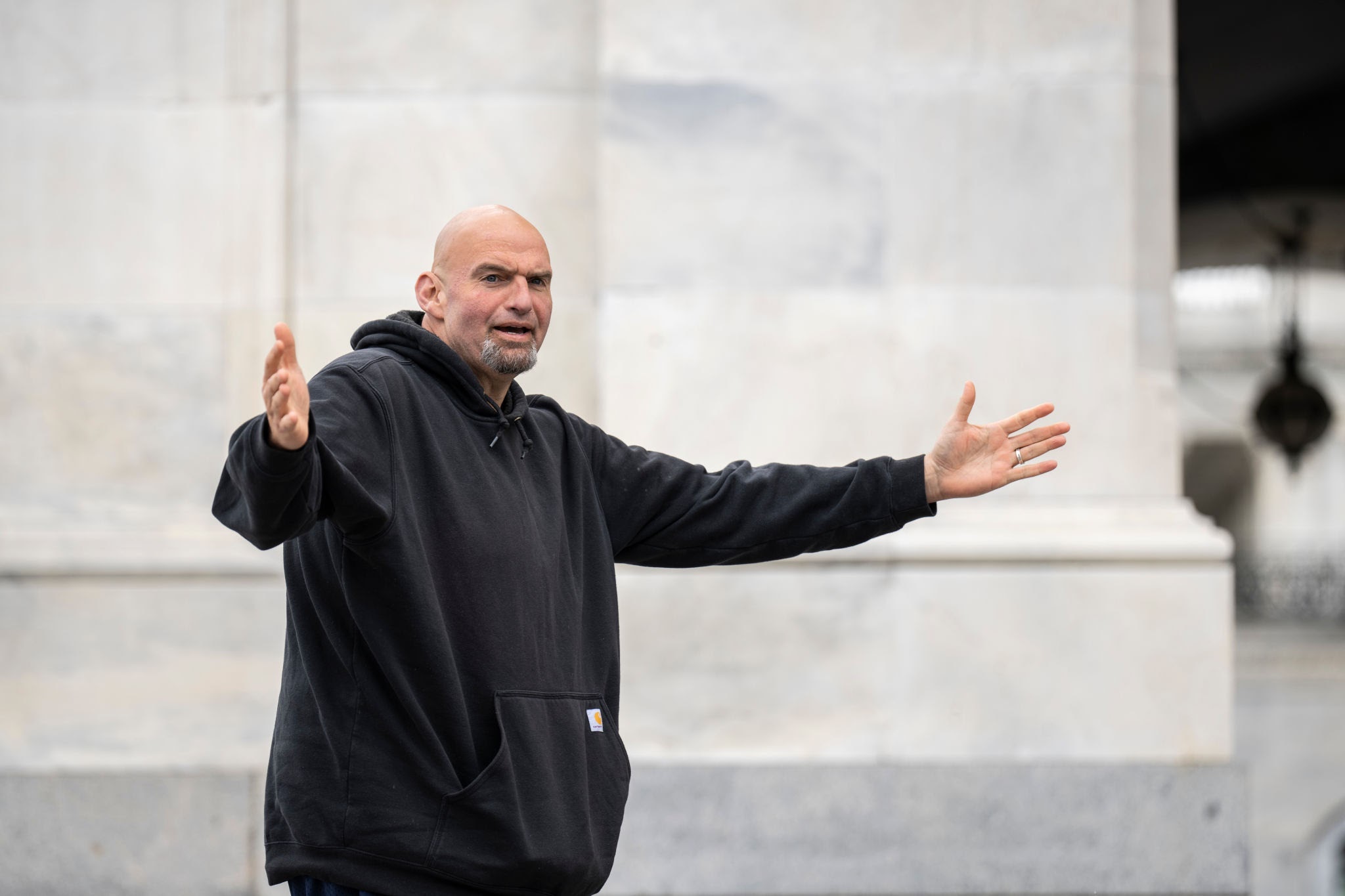
Senator John Fetterman. (Photo by Drew Angerer/Getty Images) Newsweek.

But it was a cardinal rule in our home that required us to change into our play clothes after school, before we went outside to play with our friends. When you’re pinching pennies, you want your clothes to last. And looking good at school was important.

Our Sunday clothes were just that. The more formal attire when attending church, a family function or a rare dinner at a restaurant. My sister would wear a dress. I had pleated slacks, a button-down shirt and a matching jacket. We both wore polished shoes. We made an effort to put our best foot forward.

But in today’s world such compliance of proper attire and respect are rapidly vanishing. Whether it’s in the workplace, our public schools and now — even in the U.S. Senate — being “comfortable” is the new standard. The new goal. It’s all about our feelings and unique needs. Dressing up to show respect is becoming somewhat passe’.

Although members of Congress today seem intent on hurtling toward a possible government shutdown in a hyper-partisan atmosphere, one Democrat senator is causing quite a stir with his fashion ensemble.

Senator John Fetterman, a newly elected representative from Pennsylvania, reportedly prefers wearing baggy shorts and a “hoodie” on the Senate floor and in the halls and offices of Congress. This week, Senate Majority Leader Chuck Schumer quietly threw out the Senate dress code rules. Now there is no dress code for the U.S. Senate.

Obviously, because both Fetterman and Schumer are Democrats, Republican lawmakers are literally flipping out about “a lack of decorum and a lack of respect.”

In fact, Maine’s own Senator Susan Collins has threatened to wear a bikini on the Senate floor. Please, Senator Collins, please don’t do that. Just the imagery alone hurts my brain.

Fetterman, who earlier this year was hospitalized for six weeks because of severe depression, has told journalists and others that he can work just as effectively wearing a hoodie instead of a jacket and tie. He’s probably right. But here’s the kicker: Fetterman is not just some guy roaming around the Capitol building.

He is a United States Senator. How he conducts himself in public is a reflection of America, not his own wardrobe choice. He is a member of one of the most powerful assemblies on the planet. He shouldn’t dress for that job like he’s about to go shopping at Walmart.

Republicans, however, show absolutely no bounds of hypocrisy in their battle cry for decorum and respect in Congress.

For example, earlier this year, U.S. Rep Marjorie Taylor Greene (R-Georgia) committed her own extreme fashion faux pas during the annual State of the Union. Dressed like a coked-out stripper from northern New Jersey, Greene acted like an emotionally-unstable eight-year-old, screaming almost uncontrollably at the President of the United States while he was delivering an address to Congress and the American people.

Republicans were silent about that horrid display of petulance run amok. So, I guess bad behavior is okay as long as you dress up? Really?

If my sister or I had ever acted like that in public, I guarantee our asses would be blistered for weeks. It seems to me that both Democrat and Republican lawmakers could learn a lot from my parents about respect, civility and decorum.

Promises In The Dark

This is a story about the Saco Transportation Center, also known as the place where green-energy dreams go to die.

Now before some of you have a stroke, I do believe our climate is changing. I also believe humans have an impact on their environment — but sometimes it seems we get just a wee bit silly – running around like Chicken Little, screaming that the sky is falling.

You’ll have to forgive me, but I’m just not a big fan of The Emperor’s New Clothes.

While the pursuit of cleaner energy is certainly a noble cause, it seems that we are too often willing to abandon common sense, and instead blindly follow a mantra that is born from fear, rhetoric and half-truths.

And if you have the temerity to question anything about the green agenda, you are immediately branded as a mouth-breathing “denier” with limited cognitive functioning. You better toe the line.

My biggest problem with the “green energy/zero-carbon” agenda is all the self-righteous virtue signaling that goes hand-in-hand with this issue. So often, the paradigm of “Green Energy” is built upon a solid foundation of hypocrisy.

Now, let’s take a closer look at the Saco Transportation Center. When the facility was formally opened in 2009, press releases were sent out. VIPs were in attendance and local, state and even federal politicians were tripping over themselves in order to pat themselves on the back about how “green” the new facility would be — a virtual “role model for other communities across the country.”

Breathlessly, city leaders in Saco extolled the virtues of the new facility, congratulating themselves for being such good stewards of the environment. The facility was hailed as state-of-the-art, dedicated to be a giant leap forward in the pursuit of a better world, where every boy and girl has a pet unicorn and we all actually enjoy eating kale.

From the press release: “The station is notable for being the first green design train station in the United States, featuring a wind turbine for electricity, geothermal heating and cooling systems, and a roof made from recycled soda bottles.”

But almost as soon as the dust from the grand opening settled, the illusion of green virtue became harder to justify. Saco taxpayers had spent roughly $200,000 for construction of the wind turbine that sat majestically atop the hill of Saco Island.

The magnificent wind turbine, however, did not produce the expected amount of electricity, and it became a “safety concern.” It was quietly removed and taken down a few years later. There was no press release. No senators. No platters of kale and tofu. No pontification from local politicians or environmental lobbyists. The taxpayers took care of the demolition expenses. We can only pray that the turbine was properly recycled.

Undaunted, the politicians, environmental lobbyists and members of the green energy brigade pressed on, and they soon sent out another press release. Oh Happy Day! Biddeford-Saco-OOB Transit (Transit) was going to take ownership of two electric buses. Another ribbon cutting. More speeches. We’re saving the world one bus trip at a time. The local politicians cheered. Abandoned puppies were all adopted and the planet heaved a heavy sigh of relief.

Those new electric busses cost approximately $1.5 million each, nearly three times the cost of a traditional diesel bus.

Don’t worry, the local politicians said. Taxpayers are off the hook . . . the buses were “free,” purchased under a federal grant that was coordinated by U.S. Senator Susan Collins. Ummm, where does federal money come from? Oh yeah, that’s right — from federal taxes, paid by you and me.

Chad Heid, executive director of Transit, told reporters that his organization will be applying for more federal aid so that additional electric buses can be purchased in the future. Heid added that there will be a charging station in Biddeford, and “on-route charging stations at the Saco Transportation Center will be installed later this year.”

Maine Governor Janet Mills and Senator Angus King, Jr. participate in the celebration of new electric busses. (Photo: WGME TV)

Flash forward a couple years later? Still no bus charging stations at the transportation center. In fact, the company that built the “green” electric busses recently filed for bankruptcy protection, according to the Bangor Daily News.

Apparently, green energy doesn’t work out so well for its investors.

Almost immediately after being purchased, the new electric busses presented several challenges for the local transit authority. The new busses nearly drained their batteries after only a few hours of use on cold, Maine mornings.

A bit of disclosure: I was hired by Transit last year on a short-term contract to help collect data about passenger/route efficiencies.  That contract ended last year. Over just a few weeks of riding several of the busses on various routes, I learned a lot about our local bus system and the people who ride the bus. (More about that in a minute).

On one cold February morning, those of us riding on one of the new electric busses had to be rescued by a passenger van, transported back to the Transit maintenance facility on Pomerleau Street and then re-loaded onto a traditional diesel bus. The passengers were not happy campers. I tried not to laugh.

Earlier this year, the University of New England began running a series of promotional television commercials including one in which several students praised the school for its “sustainability” practices and its commitment to the environment. Well, laddi-laddi-da.

Local taxpayers (you and me) help provide a shuttle trolley to go back and forth between downtown and UNE’s Biddeford campus, 14 times a day, seven days per week. The students who bloviate about “environmental stewardship and sustainability” apparently don’t like using mass transit, and instead prefer to drive their cars to have brunch at the Run Of The Mill and other downtown taverns.

That particular bus line (The Silver Line) operates for free. Throughout the day, basically every 15 minutes, that bus (trolley) also runs a loop up Main Street in Biddeford; right onto Lincoln Street, past the parking garage; right onto Elm Street and back to Main Street in Saco. Again, it is free to ride that line. How many people do you suppose take advantage of this service?

Over several days of riding that bus trolley, I saw two people use it. Two. Over a six-hour period. Two people. 30 Trips. Two people. Number of people getting on or off at UNE? Zero. Zilch. Nada.

We want to “save the planet” right up until the point when it’s not very convenient to do so. Where I come from, we call that hypocrisy.

Yes, Transit does serve a certain segment of our local population; mainly people without cars.

Meanwhile, the Maine Turnpike Authority recently withdrew its financial subsidy for the ZOOM Turnpike Express bus. They are focusing instead on spending more money to make the highway better able to handle an increasing number of cars.

Remember, the Saco Transportation Center has a roof made of recycled soda bottles. In the lobby, however, you can find vending machines that offer a wide array of beverages in plastic bottles. Good to know, in case we ever need to repatch, repair or replace the roof.

What about the train? Sure, the Amtrak Downeaster is a fun way to go catch a Bruins game or see the Celtics, but very few people use it as a commuter line. In fact, according to rail officials, overall ridership on the Downeaster is increasing, but the number of work commuters has dropped by more than 30 percent since 2019.

Really, would you ride the train from Saco to Portland for work? You would be dropped on the western outskirts of the city, on Thompson Point Road. Hardly convenient or efficient.

The municipalities of Biddeford, Saco and Old Orchard each contribute $250,000 annually toward the Transit’s operating costs, and I’m glad that my community offers public transportation.

But it pisses me off that the people who squawk loudest about “sustainability” and carbon emissions rarely – if ever – use public transit. And I think maybe we should be a bit more committed to efficiency rather than patting ourselves on the back for being green. Because, honestly, it’s literally not sustainable.

When it comes to meaningless virtue signaling, the city of Saco is giving Portland a good run for its money, but I guess it’s only an island if you look at it from the water.

Originally published in Saco Bay News

Things to do in Denver when you’re dead

As I previously stated on Facebook, there are four topics that I now avoid discussing on any social media platforms: Abortion, Climate Change, Guns and LGBTQ+ issues.

The way I see it, it has become virtually impossible to discuss or debate any of these issues without the conversation dissolving into an abyss of bruised egos, hurt feelings and misunderstanding. I am NOT an expert on any of these issues. My opinion carries no more weight than your opinion.

Although I have staked out my positions, I am more than happy to discuss or debate any of the following topics with you in an off-line setting, preferably while drinking some craft beers or delicious coffee. I am always willing to hear alternative viewpoints — always ready to consider new information and perspectives, and ready to change my mind or outlook. Enjoy.

ABORTION:

Personally, I am opposed to abortions in almost all cases except when the mother’s life is in danger. That said, I also believe that I do NOT have the right to tell a woman what to do with her body. Thus, I am somewhat reluctantly pro-choice on this issue.

That said, I think it’s hypocrisy that we have the technology to detect bacteria on Mars and declare it’s a sign of life; and then say that an embryo or especially a fetus is not a living organism. It begins growing and developing from the moment of conception. That’s just science.

CLIMATE CHANGE:

I’ve written this before, and my position has changed very little over the past few years. First, Climate Change is real. Very real. The evidence is all around us and it is impacting, and will continue to impact, human life.

What bugs me about this subject is mostly centered upon the alarmist attitude of otherwise very intelligent people; and the sheer hypocrisy of those who often chant the loudest and want to impact my choices.

I am a huge supporter of renewable energy, including wind, solar and hydro projects. But that does not mean that all renewable energy projects are good. Some projects have an adverse impact on the surrounding environment, but for the most part I like renewable energy because it requires zero assistance from any other nation. It is truly independent energy. In some cases, I also support nuclear power and natural gas projects. [Disclosure: I have worked as a paid consultant on several renewable energy projects in New England]

I believe in being a good steward of our natural resources. I try to minimize my energy consumption. But the alarmists want to make my choices for me, that and the ever-growing bureaucracy of government regulation chaps my ass.

Furthermore, this issue is too often mired in fear and rhetoric, often ignoring science.

This ecosystem (Earth) is 4.53 BILLION years old. Think about that for a minute. We’re making declarations and pushing the panic button while ignoring the simple fact that we have basically NO idea about climate trends BEFORE humans began roaming the planet approximately 500,000 years ago.

Translation? Humans have been on earth for less than .01 percent of the earth’s life. Furthermore, we know (because science tells us) that this ecosystem has undergone numerous, significant and sometimes cataclysmic changes, sometimes wiping out various species, often referred to as “natural selection.” We’ve had Ice Ages, continental and seismic shifts, not to mention eons of volcanic activity that created huge dust plumes and particulate distribution all over the globe.

Bottom line? Our climate has been changing for a very, very, very long time and it will continue to change with or without us. I mean, really. Do you think you can alter the Earth’s ecosystem by driving a Prius? Do you think humans are powerful enough to somehow control or stabilize an ecosystem that has been evolving for 4.53 billion years???

Again, I think we should all strive to be good stewards of our planet and commit ourselves to better public health outcomes while also reducing global conflict by using renewable power, but I also think it’s still okay to drive a pickup truck, use a clothes dryer, microwave oven or a flat-screen television.

GUNS

I consider myself to be a strong supporter of the Second Amendment, but I do not believe that the Second Amendment — nor the First Amendment — is absolute. As a classic example, you certainly have the right to free speech, but you cannot yell ‘fire!” in a crowded movie theater; nor can you publicly threaten to assassinate the president or another person. Your FIRST AMENDMENT rights are not absolute.

The framers, I believe, were all too familiar with a tyrannical government and wanted to ensure that ALL power would rest in the hands of the people, not the state. There is ample historical evidence that the framers were not too keen on having a standing army, but saw the necessity of a citizen militia that could be called upon in times of need.

Thus, the Second Amendment reads: “A well-regulated Militia, being necessary to the security of a free State, the right of the people to keep and bear Arms, shall not be infringed.”

A lot of people conveniently skip over the first part of that sentence and instead focus on the last part regarding the “right of the people to keep and bear arms.” The Second Amendment is important to both our liberty and security as a nation, but it does not give my neighbor the right to own a rocket-propelled grenade launcher or an intercontinental ballistic missile.

We have, what I believe, some common-sense limits. Academics aside, however, this issue has become a flashpoint in American politics. It seems almost impossible to have a civilized conversation about this topic because of an increasing frequency in horrific mass shooting incidents, many of which involve school-aged children as the victims.

I am as horrified and as sick as you are of seeing incidents like these happen. I too want something to change. Now. Right now. However, as hard as it may be, we have to put our emotions in check and work together and across the aisle to solve this problem.

What I find disheartening and a bit peculiar is that so many people focus primarily on the guns. Typically, these are people who don’t own firearms and don’t like firearms. On the other side of the debate, people (typically from the political right) say it’s not at all about the guns. They do a mighty good job of pontificating about mental health services (right up until it’s time to fund mental health services).

From my perspective, both sides of this debate are a little bit wrong and a little bit right. When we hear the news about another drunk-driving related death, we are outraged at the driver, not the vehicle he/she was driving.

Each day, roughly 30 people in the United States die in drunk-driving car crashes, according to the National Highway Traffic Safety Administration (NHTSA). Data from the NHSTA shows that from 2010 to 2019, more than 10,000 people died each year in drunk driving car accidents. How many more?

Too often, when it comes to a mass shooting incident we miss (or perhaps ignore) the larger, more pressing question: Why?

Why does someone (anyone) feel compelled to slaughter a large group of innocent eight-year-olds? Firearms, including semi-automatic rifles and handguns, have been around a long time. But this is a relatively new phenomena in American culture, beginning sometime around the late 1990s.

Why are we so violent? Why is our country so far ahead of all other industrialized nations when it comes to gun violence? I think we ignore the why because it’s much more convenient to focus on the guns.

Bottom line: I think we need serious gun reform legislation to include limits on high-capacity magazines, tighten loopholes on the easy availability of firearms and require mandatory safety training. Even Ronald Reagan, perhaps the most conservative Republican president in the last 100 years, wrote to Congress in the early 1990s, urging them to take meaningful action in limiting high-capacity firearms.

This is not rocket-science. We can achieve meaningful and substantial reforms without taking away your guns. I also believe that an unarmed citizenry is a dangerous thing. History underscores my belief on that matter. [Disclosure: I have a significant mental illness and subsequently choose not to own firearms].

LGBTQ+

First, the good news. It is becoming increasingly easier for people to feel comfortable in their own sexuality, but this topic is yet another flashpoint of vitriolic discussion on social media.

My take? I don’t really see any negative impacts to allowing two men or two women to enter into a state-supported marriage contract. Numerous studies have demonstrated undeniable statistical data that reveals married couples are far less likely to be involved in crime or drug abuse and are far less likely to need government assistance and typically have a more positive impact than their single peers on regional economies. It doesn’t matter if the couple is same-sex or a more traditional heterosexual couple.

Look I don’t understand all the uproar and the wringing of hands about these topics, including gender identity. I am a middle-aged, straight, white guy. I don’t want to publicly discuss what happens in my bedroom, and I don’t care much about what happens in your bedroom, as long as it involves consenting adults. It’s really none of my business.

Yup, I do think there is a part of this issue that has become somewhat trendy. And I don’t like the whole “you’re either for us or against us” mantra. I think there are a lot of gray areas out there, and as a civilized society I think we can work out the kinks. Look, we figured out how to put a man on the moon, I’m relatively comfortable in thinking that we can address same-sex restrooms or trans-gendered athletics. As long as we can all take a deep breath and set emotions aside.

My default position on all LGBTQ issues is basically just be kind, tolerant and accept others who may be different than you are. I don’t need to fly a rainbow flag in order to be decent and kind.

That said, much of the emotional uproar on this particular subject focuses on children. Here’s my take: I think it’s perfectly okay and probably pretty smart to teach children how to respect diversity that they will encounter throughout their lives. Beginning, perhaps, in the fifth-grade, I think it’s okay for students to read books that focus on sexuality and gender.

At about this age, many children begin to have questions about these subjects, and it’s not always easy to have those discussions with their own parents or family members.

I never chose to be straight. My gay friends and relatives never chose to be gay. Either you are or you are not. A textbook or movie isn’t going to change that.

However, I am opposed to having these discussions with children under the age of eight. Any parent or teacher out there will tell you that seven-year-olds will gladly eat paste. Six-year-olds still believe in Santa Claus, the Easter Bunny and the tooth fairy. Their brains are basically mush. They have little to no critical thinking skills.

If a six-year-old announces that he or she wants to marry their best friend, I would hope you don’t go ahead and book a function hall or send out wedding invitations to friends or relatives. For me, it should be the same if your seven-year-old announces that he/she wants to change gender.

You certainly can be supportive of that declaration without embarking on life-changing medical operations. You can address your child by his/her preferred pronouns. I think it’s okay if you allow a child (age 12 or above) to legally change their name. It can easily be changed again. You can be supportive and loving of your child but it does not require you to hit the operating room.

In Maine, I believe the age of consent is 16. Still a bit low, in my opinion. But if 16 is the age of consent, then it should also be the age of individual gender choice. I’m more comfortable with 18, or better yet 21, but we’re not talking about me or my kids.

At 16, your brain has not finished the formatting process that allows for critical thinking. Society says at 16 you are too young to vote. Too young to watch porn. Too young to enter into a legal contract and so on. You can love, support and nurture your children without introducing puberty blockers, hormone treatments or irreversible surgery.

But if you encounter an adult, or even your own child, who says they are gay, non-binary or trans-gendered why not treat them with anything other than respect or kindness?

Gay people and transgendered persons have been around since the beginning of human existence. Now, they are able to feel more comfortable and included in society. Even if your own religious beliefs claim that homosexuality is a sin, you can still choose to be kind. You can always be kind. That is a choice.

And that’s a wrap for the four dreaded topics of social media. Peace to you and yours.

Bonnie Pothier: Interview

Bonita Pothier/ Seaver photo

Bonnie Pothier has been breaking barriers since before breaking barriers was a thing. She was the first woman elected as mayor in Biddeford, but she also had to break a lot of other barriers and overcome many other challenges before then.

Whether as a school teacher, a downtown business owner or even as a member of the local Rotary club, Pothier has always been willing to swim upstream, letting nothing get in her way.

 Born and raised in Biddeford, Pothier’s high school class was the first to graduate from Biddeford High School after St. Louis High School was closed in 1971. Bonita Pothier was the middle child of a large family that included her older sisters Charlene, twins Donna and Mona and two younger brothers John and Chuck. Pothier graduated from the University of Maine Farmington, earning a bachelor’s degree in education.

Today, she is one of five regional representatives for U.S. Senator Angus King, Jr., working in the Biddeford office that serves all of York County, a position she has held since King was first elected as senator in 2012. Recently, she announced that she will be retiring in just a few weeks.

“I have been working every summer since I was 11 years old, babysitting,” she laughed. “I finally decided that I wanted to just relax and enjoy the summer for once.”

Initially, it wasn’t your idea to run for mayor in 1989, was it?

“No, it wasn’t. (Laughs) My husband and I were just having dinner with some friends, including Mayor Mike Cantara. Mike said he would not be seeking another term because he wanted to run for the District Attorney seat. So, we all started talking about who would be a good fit to run for mayor. Mike looked over at me, and said you should run. I almost spilled my drink, and I burst out laughing. I was sure he was kidding. The room got quiet. Even my ex-husband thought it was a good idea. I was not at all convinced.

“Michael (Cantara) stopped by my house every night, working to convince me. At the time, I was the president of the chamber of commerce but I had no real political experience. I had a downtown business and young kids. I kept telling him I was too busy, but he persisted.

“I don’t think the city is ready to have a woman as its mayor,” I told him. “You’re putting your money on the wrong horse. Finally, I gave in. I told him I’ll run but you’re going to be sorry.”

You had a decisive win in the election, but your problems were just starting.

“Oh you bet. (Laughs) There were a lot of people who were very uncomfortable with the concept of a woman in power. Also, I was the first Franco-American to be become president of the chamber, so it wasn’t just my gender that bothered a lot people. When I marched in my first La Kermesse parade as mayor, I brought my children along to march with me.

“Over the next few days, there were lots of angry letters to the editor published in the Journal [Tribune]. People said it wasn’t appropriate for the mayor to be walking in the parade with her children. Others criticized my hairstyle.

“All that aside, being the mayor of Biddeford was one of the best jobs I’ve ever had. It was a fascinating experience.”

But a patriarchal sentiment extended beyond City Hall, right?

“Oh yes, I remember trying to join the Biddeford Rotary Club and [Richard] Dick Martin said there will be women in the Rotary Club over my dead body. That’s when the Saco Bay Rotary Club was formed. Dick and I came to a very good place of mutual respect. We worked closely together on the design of the new elementary school, MERC and the sewer treatment plant. He was an engineer by trade and he was appointed to the council when Tiny Frechette died.”

You were criticized for trying to work in a “man’s world” and how could you know anything about culverts and road repairs.

“It was, I think, a pivotal time for our city. A lot of people simply couldn’t understand why I wanted to do it, that I should just stay home, mind my own business and take care of my children. Back then, there was no city manager and people had a lot of doubts about department heads reporting to a woman.”

Back then, you were dealing with issues surrounding the MERC trash incinerator, needed sewer upgrades and an exodus of downtown merchants as the mills began to close. What do you think of Biddeford today?

“When I look around today, it’s so satisfying to see the vibrancy that is returning to our community. I believe things are always cyclical, but this is what I knew we would eventually become. I’m old enough to remember what it was like to be downtown in the 1960s. Honestly, the sidewalks were full of people shopping or going out to eat. You had a hard time walking from place to place because of the crowds.”

But you also saw the city’s downtown core begin to crumble in the 1980s.

“It was sad to watch so many things disappear. I remember when I wanted to open my business on Main Street in the early 1980s, so many people said I was crazy to be making an investment downtown. It was like we had all but given up on our downtown. The mills were closing and people began shopping at malls.”

Becoming mayor at that time, with a national recession and jobs leaving the area, what things do you consider were hallmarks of your one term as mayor?

“There were a lot of things, but one really just jumps out at me. Back then, there was no development west of the Turnpike intersection. The council had the foresight and vision to contemplate that area as a commercial growth district, and we went ahead and decided to extend the sewer and water lines there. Without that, you would have never seen all the development that has happened there since.”

How did you end up working for Senator King?

“You’re not going to believe this, but again it was nothing I ever contemplated or pursued. I was visiting a friend at the hospital and Senator King was there visiting the same person. I had known him for a long time. We just started chatting. He seemed interested by my experience as a senior manager at Key Bank, my time with the Chamber and other stuff. He actually pitched me the job, telling me you’ll never be bored working for me. Truer words have never been spoken (Laughs).

As a senate staff person, what’s your perspective on our national landscape?

“I feel like the tone of our political discourse has deteriorated. We have relaxed so many norms, so many people no longer practice good manners in public. The language is  . . . well, shocking. There’s so much anger and distrust out there.”

What do you think is driving that anger?

“I think people are afraid, but nobody wants to admit they are afraid. We’ve given ourselves permission to just be constantly angry. It seems more acceptable to be angry than afraid. I think people want to be heard. And that’s what I admire most about Senator King. Despite what some people think, he really listens to people, even when they are being critical of him. He really goes the extra mile.”

The mayor’s seat in Biddeford is opening up this year. Want to run for your old job?

“Are you kidding me? (Laughs). No. Absolutely not. I want to spend more time with my grandchildren and go to the beach.”

What would be your advice to the next mayor?

“What you do can have lasting impressions long after you leave public office. It’s important for all of us, I think, to consider our ethics and to be careful about what message you want to send. Your words matter. I would also tell them to try to bridge the divide that is developing between older and newer residents. I am very concerned about gentrification and the way we are moving forward.

“I think what is happening downtown is fantastic. But we also have to be mindful. While we have many more young people discovering Biddeford and moving here into the old mill buildings, you don’t see families moving into those units. And I don’t think a community can thrive without families.”

Originally published on Saco Bay News

Ryan Fecteau: Spotlight Interview

Originally published in Saco Bay News

Although he majored in political science and eventually became the Speaker of the Maine House of Representatives, Ryan Fecteau’s political journey had a rather innocuous and humble beginning.

Fecteau, 30, said he first became interested in politics when he was appointed as a student representative to the Biddeford School Committee nearly 15 years ago. In 2020, he became the youngest person to be named as Speaker of the House since 1842. He is the first Biddeford representative to hold that post and the first openly gay person to be named Speaker.

“I think I was picked because I was sort of quiet and reserved,” Fecteau laughed, recalling his appointment by former school superintendent Sarah Jane Poli. “I think Sarah Jane thought I would not make waves; unlike [some other students.]”

Fecteau was 16, and a junior at Biddeford High School. He wasn’t even old enough to vote, but he was admittedly intrigued by the political process. Some two years later, he decided to seek a seat on the Biddeford Charter Commission.

“There were certainly a lot of skeptics who wondered about this new kid and what he was trying to prove,” Fecteau said, pointing out that the commission was chaired by one of the city’s most well-known politicians. “I was only 19, and I think some people wondered about my motivations.”

From there, even though he was still a full-time student at Catholic University of America in Washington, D.C., Fecteau decided that he wanted to run for an opening seat in the Maine House of Representatives. “To this day, I have no idea what possessed me to do it,” he said. “But in my gut, I felt a lot of passion, and I really thought that young people should have a voice at the table.”

State Rep. Paulette Beaudoin was actually Fecteau’s next-door neighbor, and she was unable to run for re-election because of term limits. She was 82 years old when Fecteau announced in the summer of 2013 that he would be seeking her seat. He was 21. “Yeah, you could say it was quite a contrast,” he laughed.

Another Democrat also wanted to take over Beaudoin’s seat. Former newspaper publisher and downtown property owner David Flood threw his hat into the ring for the nomination. Fecteau won the nomination, 493-263. He says he won his race the old-fashioned way.

“I knocked on a lot of doors and met with a lot of people,” he recalled. “Because of school, I was doing a lot of early campaigning in January. That’s a big advantage actually because it’s really cold outside and people invite you into their homes.”

We caught up with Fecteau recently to discuss his time in the Legislature and his thoughts about the future of Biddeford and the state of Maine.

If you’re knocking on doors in January, you have to be pretty motivated. Something must have been driving you.

“When I think back, I really believe my main motivation was what I saw happening among my peers. So many young people just didn’t see a future for themselves in Maine. They were basically writing off the state because they didn’t see economic opportunities for themselves here.”

You served the maximum of four consecutive two-year terms in the House. Why didn’t you go for the State Senate seat that opened up at the end of your final term?

“I decided a while back that I really enjoyed the opportunity to serve in the House, but it would also be nice to just stop there.”

What about future political ambitions?

“I really haven’t given it much thought. I don’t know. It’s definitely not on my radar screen right now. I just started a new job. We just a bought a house, so it’s not something I am contemplating. Actually, I think it’s very hard to chart your political future in a state like Maine. We only have two Congressional districts and have a pretty significant and deep bench of candidates.”

What about local politics? We’ve heard your name mentioned as a potential mayoral candidate in Biddeford.

“What? (Laughs) Oh, no, no no. Definitely not. I don’t want to be that close to the fire (Laughs). Actually, I think very highly of municipal leaders who take on the tough tasks — with little pay — to keep our communities up and running. While I don’t have plans to run for mayor or council, I admire those who find a way to serve in any capacity on behalf of the public good.”

Looking back on your time in the House, what would you say were your proudest accomplishments?

“There are so many things. During my second term, I chaired the Labor, Commerce, Research and Economics Committee, and I re-introduced a bill to expand funding for CTE (Career and Technical Education) in high schools around the state. I had sponsored a similar bill in my first term. The last infusion of funds for CTE programs was in 1998, and the costs of those programs was falling onto the shoulders of communities like Biddeford.

“We know that we have to solve challenges in the work force and train our young people to fill critical positions. The bill was defeated again, but I kept at it because I knew it was the right thing to do.  Ultimately, last year, we passed a $20 million bond for funding to 29 CTE centers across the state, including $7 million for the Biddeford Regional Center of Technology.”

Also, we were able to expand dental care coverage for more than 200,000 Maine people. We had strong bi-partisan support for that bill. When you think about it, it’s really an economic development issue.

“When you have someone sitting across from you at a job interview and the applicant has really bad teeth, it’s a stigma issue. I saw it as part of our social contract. Previously, people were using emergency rooms as a last resort to solve terrible, constant pain. Something had to be done.”

You eventually became one of the most important and influential people in Maine politics. But your tenure as Speaker was markedly different.

“It was a very humbling and rewarding experience, but it sure was unique. I was elected in December 2020, and the pandemic had been raging for a little more than six months. There was no way that it was going to be business as usual. To say that it was a significant challenge for all of us is sort of an understatement.

“Although it was a significant challenge to adapt the Legislature to mitigate against the pandemic, the work we accomplished over those two years was transformational.

“We made long overdue investments in Maine people and infrastructure. From broadband expansion to upgrading vocational schools, to fully funding the state’s share of public education to making school meals free for all students, to providing child care workers with a wage boost to investing in the construction of affordable and attainable housing, we overcame unprecedented circumstances and delivered transformational results.”

Are partisan political battles better or worse today than when you first arrived at the House?

“I actually think that it’s better today. During my eight years in Augusta, I experienced a lot of political variables. There is a stark difference in the tone from the governor’s office. My first term, we had a Republican governor and a Republican-controlled state senate.”

What are the biggest issues facing Maine today?

“Affordable housing is definitely the big issue, and that sort of goes hand-in-hand with our state’s work-force challenges. We have this perfect storm of new and younger people moving to Maine. It’s hard to know what’s driving that migration. Is it people who want to live in Vacationland? Or are they just planning to stay a little while? That’s the big question.

“Regardless, we’ve got to build more housing. It’s simple supply and demand. If we want people to fill in the gaps of our work-force shortages, we need affordable housing for them, otherwise they’re not going to stay.”

You’re beginning a new job, appointed by Gov. Janet Mills.

“I was appointed as senior advisor for Community Development and Strategic Initiatives in the Governor’s Office of Policy Innovation and the Future.”

What exactly is that?

(Laughs) “It’s a long title, but basically I will be mostly focused on housing and work-force policy initiatives. It’s sort of a hybrid position. I’ll also be working closely with certain consulates that have ongoing relationships with Maine, such as Canada, France and others to explore economic development opportunities.”

Originally published in Saco Bay News

Beat on the brat

A lot of people have really strong feelings about President Biden’s plan to forgive up to $10,000 in federal student loan debt for individuals earning less than $150,000 a year.

Based on my social media feed, the debate pretty much runs along partisan lines: Democrats support the idea and Republicans vehemently oppose it.

From what I can gather, each side is flooding Facebook, Twitter and Tik-Tok with two very basic themes to support their arguments and position. Democrats are relying upon the virtues of kindness and empathy, castigating Republicans as selfish and mean-spirited. Just because I struggled to pay off my student loans, does not mean I think that other people should struggle to pay off their student loans.

Republicans, on the other hand, are trumpeting the virtues of personal responsibility, arguing that the loan forgiveness simply transfers debt incurred by someone else onto the backs of hardworking taxpayers who are already suffering under record-breaking inflation.

On the surface, I can see the merits of both arguments and it’s easy for me to see why the debate has become so heated and intense, but that debate – from both sides – does very little to address what is a very real problem in this country.

I get it. Republicans are playing the elitist card. Isn’t it lovely that Johnny or Susie was able to go to Harvard or Yale, but how about the hard-working people who went into the trades instead of college? It doesn’t take much to stoke that fire.

There is always a not so hidden layer of resentment just below the surface when discussing college education among the working class.

Democrats are quick to fire back that the world needs engineers, architects, chemists, doctors, nurses and pharmacists; and that the cost of the necessary education has skyrocketed, making it almost unbearable to be saddled with a debt that could take as much as 30 years to repay.

Again, I understand the validity of both of these points, but I don’t see how those arguments – and especially Biden’s plan – really address the fundamental problems: the crippling cost of higher education and the completely bungled student loan process itself.

Before we go any further, a quick bit of disclosure. I have two sons, one did not go to college but is doing very well as an auto-body technician in an employee-owned firm with insurance, a retirement plan, paid vacations and sick time. He is learning new things every day and building his skills.

My younger son chose to attend a private university in North Carolina and majored in fine arts. He is also hard-working, and is employed in the service sector. He will likely benefit from President Biden’s student loan forgiveness plan.

Both of my kids made their own choices. Laura and I obviously advised them, but ultimately they each chose their own path and understood that they are responsible for their own choices.

I made lots and lots of mistakes as a parent (I still do), but I like to think that we raised our kids to be responsible, hard-working and decent young men. It looks to me like those lessons worked . . . so back to the national argument.

Let’s first pause, however, and consider a couple of things:

  1. President Biden’s plan only forgives $10,000 of a student’s “federal loan” debt. This is a fraction of the debt that most college kids rack up in pursuit of their education. People like my youngest son will still have a ton of debt upon finishing college. No complaining, and yes, he is responsible for that debt. not you and me.
  2. We are all Americans and should be at least somewhat concerned about the well-being of our fellow citizens.
  3. In the United States, we have many taxpayer-supported programs that provide short and long-term assistance to all kinds of people across the entire economic spectrum. We routinely provide debt forgiveness to major corporations and every individual is able to file for various versions of bankruptcy as a final resort if they find themselves unable to cope with their debts.
  4. I know what you’re thinking: if someone files for personal bankruptcy, it is their creditors – not the taxpayers – who get screwed. Yes and no. Those creditors turn around and file those losses as tax write offs. So, yeah . . . the taxpayers (you and me) subsidize those losses.
  5. Yup, Biden is playing politics with this issue, making his decision just weeks before the mid-term elections, when Democrats are poised to perhaps lose control of the House and maybe the Senate. Imagine that. A politician playing politics. The nerve of that guy. (Remember, Biden talked a lot about this student loan relief idea while he was on the campaign trail.)
  6. The way federal student loans are structured, the government reaps plenty of interest (profit) from borrowers. Even with the $10k forgiveness, the government will still be making a profit on the repayments.
  7. Let’s also remember that FEDERAL student loan debt cannot be discharged by bankruptcy, like other kinds of debts.

Republicans, in my opinion, should tread a bit carefully on this topic without bloviating about “rugged individualism,” “personal responsibility” and debt repayment.

President Donald Trump’s businesses (casinos and hotels) filed for bankruptcy (more than once). No, he did not file personal bankruptcy, but his businesses sought bankruptcy protection during the days before he was an elected official. The media and other candidates harshly criticized Trump for seeking bankruptcy relief.

Then candidate Trump defended the move by arguing that “businesses often have to file for bankruptcy and that filing for bankruptcy was a financially sound move each time he did it.”

On this point, I agree with Trump. I also believe bankruptcy protection – whether Chapter 11 for a business or Chapter 7 or 13 for a person – should be a last resort and come attached with some consequences, such as determining future credit worthiness.

The meat of the matter

My friend Scott Jalbert wrote a piece about this subject on his Facebook page. It was one of the most cogent pieces I have seen about this issue. Scott and I, for the most part are politically aligned. I would describe us as center-right individuals. It would appear that we both tend to believe that the government that governs least governs best.

 Scott made several points on his post. 1.) That the ease and availability of federal student loans has allowed colleges and universities to jack up their tuition rates to astronomical levels while stockpiling huge endowments. 2.) The federal student loan program, itself, is fraught with bureaucratic gobbly-gook that is both confusing and misleading. 3.) There is a fundamental absence of reasonableness when it comes to lending money for education. (No bank in the world would allow me to borrow $2 million for a summer home on Rangeley Lake) Yet, with the backing and guarantee of the federal government, student loans are dispensed like candy at a street festival.

“I went to college 30+ years ago and since then public college tuition has increased by 200 percent,” Scott wrote on Facebook. “Private college [tuition has risen] by about 140 percent. It went from something that we could pay off by working summer and school-year jobs to a mountain of debt that takes 20 years to pay off.”  https://www.facebook.com/scott.jalbert.3

“Remove the federal government from the college business.” Jalbert continues. “Force colleges to enroll the best and the brightest instead of packing campuses by enrolling everyone to meet quotas and to boost profits. Have students secure loans from private lenders without government intervention. Stop the vilification based on career choice and stop applying the pressure that everyone should go to college. Period.”

An idea for consideration

I am empathetic to the plight of young college students and their families, but I also know many other young people who did not go to college and are also struggling during these tough economic times. Where is their bailout?

If I were president (now there’s a scary thought), I would propose the following: 1.) Immediately freeze interest rates and set to .5 percent for all student loans (private and public). 2.) Establish a commission to review and recommend changes to the student loan process and 3.) . . . well, here’s where it gets interesting.

I would make available up to $10,000 of student loan deferment for those borrowers who are college graduates in exchange for their commitment to pay back those funds through public service.

My plan would require 10 hours per week of public service, which could be through enlistment in the military, the Peace Corps, the Red Cross, AmeriCorps, Habitat for Humanity or many other programs. It could also be as easy as volunteering at a soup kitchen, a homeless shelter or helping remove litter from public roads and highways. This commitment of 10 hours per week would last a minimum of two years.

This way, we all have some skin in the game. I would also offer up to $10,000 to any American who wants to pursue non-traditional educational opportunities, such as apprenticeships.

The reason we establish governments is to make it easier to survive and thrive. Government provides for a common defense, public infrastructure and education. Imagine what the world would like without a government that addresses the needs of all of its citizens.

The money you have in the bank would not have the protection of federal insurance, there would be no ambulance if you begin having chest pains. There would be no public roadways or highways.

We have laws that prohibit price gouging, perhaps it’s time to examine the pricing practices of both public and private colleges and universities. It’s just a thought, nothing more and nothing less.

Subscribe for free now and never miss another installment of Lessons in Mediocrity

Tainted Love; Part Deux

It’s July, and according to the Old Farmer’s Almanac, the “Dog Days of Summer” are finally upon us. This is the time of the year when those of us in the northeast have a pretty good view of the constellation, Sirius – hence the “dog days.”

It is also the “quiet” month. The days are long and warm. It is time for frolicking at the beach, family barbecues and complaining about the tourists from Quebec and Massachusetts. Football has yet to ramp up its next season. The Celtics and Bruins are basically done for a few months; and the political season – my favorite – is just now gearing up for another relentless, knock-down, drag-out, hands-out- for-donations season on your favorite social media platform.

Here in Maine, the 2022 elections will feature what promises to be a sure-fire battle of the ages for the Blaine House as the once-every-four-years-gubernatorial election draws near.

Unlike the last three gubernatorial battles, this year’s match-up appears to be a straight-forward Democrat versus Republican race, pitting Democrat incumbent Janet Mills against Republican Paul LePage who is seeking a return to the Blaine House.

I will be watching this race closely because I am curious about how – or if – the absence of any real “independent” candidates will affect the outcome. But we still have some time before the campaigns really heat up and in only a matter of weeks, campaign signs will be littering every paved road in Maine – and on most of the dirt roads too.

Sure, staffers and volunteers from both campaigns are already working, but on the surface, I’m betting that things will remain relatively quiet until we get into the middle of August and especially in the days just after Labor Day.

Looking back

In previous gubernatorial races, Eliot Cutler, a so-called moderate who really likes children, was a spoiler in both 2014 and 2010, the races which LePage won with relatively narrow victories.

Republican candidate Paul LePage

Cutler is currently awaiting trial on child pornography charges, hence we will not be hearing much from him during this election cycle. That’s good news for Mills and bad news for LePage.

LePage won his first term as governor in 2010, capturing just 37.6 percent of the vote (218,065). Cutler, running as an independent, came in a close second with 35.9 percent (208,270) and Democrat Libby Mitchell garnered only 18.8 percent (109, 387) of the vote.

Cutler was hardly independent. Much like his role model, former governor and now Senator Angus King, Cutler is much, much more a Democrat than Republican. Maybe not a progressive Democrat like Libby Mitchell, but a Democrat for all intents and purposes.

Maine Democrats blame Cutler for handing the 2010 race to LePage. While he may have been able to peel off a few moderate Republican (is there really such a thing?) votes, Cutler was more centrist than Mitchell and thus was able to attract votes from the perennial “undeclared,” fence-straddle voters.

Four years later, LePage won a second term, this time capturing roughly 48.2 percent of the vote; Democrat Mike Michaud got 43.2 percent of the vote; and Cutler finished the three-way race, bringing up the rear with less than nine percent of the vote. The Democrats had learned their lesson, but it still wasn’t enough to beat LePage.

The 2018 gubernatorial race was pretty much a straight-forward match-up between Democrat Janet Mills, a former Attorney General for the state of Maine, and Republican Shawn Moody, a political outsider and successful businessman that founded Moody’s Collision, an-employee-owned company with several locations throughout southern Maine.

Gov. Janet Mills

Because of term limits, LePage was unable to seek a third, consecutive term.

Yes, we don’t want to overlook Terry Hayes, another so-called independent who lost her Democrat primary race to Mills in 2018, but still decided to go for the gold and wound up with a measly six percent of the vote in the November general election.

Mills won a solid victory with slightly more than 50 percent of the vote in 2018. Despite his political inexperience, Moody was still able to grab about 43 percent of the vote.

Looking forward

So here we are, facing the mid-terms and another gubernatorial election. Which candidate has the edge? Which candidate do I think will win?

Frankly, I think it’s going to be a pretty close race.

Before we go any further, let me say that this is just my opinion. I am not working or volunteering for either candidate. I don’t have any special insight or knowledge. Yes, I have a professional background in journalism and public relations, but I am really nothing more than an arm-chair pundit who loves politics.

My opinions and predictions are no more qualified than your opinions and predictions.

So, why do I think it’s going to be a tight race between LePage and Mills? Because I think a lot of issues on the federal level are going to impact the Maine gubernatorial race.

Gun violence, abortion rights and climate change could all play a hand in this year’s election. But this year – more than in any year for a long, long time – the economy is going to be a HUGE factor. As James Carville famously said roughly 30 years ago today, “It’s the economy, stupid!”

The incumbent, whether it is George H.W. Bush or Jimmy Carter, is always judged by the economy. Voters, whether it is right or wrong, primarily tend to vote with their wallets.

The last time, inflation was this bad, Ronald Reagan crushed Jimmy Carter’s re-election bid with just one sentence: “Are you better off today than you were four years ago?”

Many voters, including those in the middle, will hold Mills accountable for our current economic conditions. Just as voters are heading off to the polls, many of them will be feeling the pain of filling their home heating-oil tanks, still struggling with run-away inflation and soaring gas prices.

That said, other issues at the federal level could motivate more people, mostly Democrats and some middle-of-the-road voters, to the polls. Those upset with recent decisions by the U.S. Supreme Court and recent mass shooting incidents may want to make their opinions known at the voting booth. This could be bad news for LePage.

LePage is a strong supporter of gun-owner rights and he appeals to “pro-life” supporters. He generally holds the concept of renewable energy as a waste of both time and money. He is regarded by his base as a fiscal conservative.

From where I sit, it looks like both LePage and Mills will have to focus heavily on their ground game, especially their GOTV (Get-Out-The-Vote) efforts.

Just go back and look at the numbers.

In both of his previous bids, LePage never hit the 50 percent mark — and that was with two left-leaning candidates in each race.

Mills supporters cannot afford any missteps. Yes, she has a strong base but she will need more than that this time.

I suspect that the LePage campaign will work non-stop to hang the poor-economy label on Mills. I can almost guarantee that they will link her to President Biden’s dismal polling numbers. Meanwhile, the Mills campaign will focus on portraying LePage as Maine’s version of Donald Trump, an evil boogeyman who hates women, puppies and pine trees.

So, who do I think will win? Honestly, I don’t know.

I do know, however, that this will be one of the most brutal and intense gubernatorial campaigns that Maine voters have ever seen.

Now, let’s sit back and watch. Your predictions are welcome.