Two stories I found on the pages of the Portland Press Herald today:
[Maine’s] Riverview Psychiatric Center faces the loss of an estimated $20 million in federal funding because the federal government has decided that the hospital in Augusta has not solved staffing and governance problems.” Full story
The mother of a Connecticut woman who was shot to death by police after trying to breach a barrier at the White House said her daughter was suffering from post-partum depression. Mother: Daughter in Capitol chase was depressed
Considering the earth shattering news that Republicans are opposing Democrats, it’s understandably tough to remember things that happened a couple of weeks ago, like the Navy Yard shooting where Aaron Alexis, a former Navy reservist, used a shotgun to begin a massacre that left 12 people dead.
A few weeks before, Alexis called police in Rhode Island, telling them that he was getting messages from his microwave, according to the Associated Press.
“The mass of men lead lives of quiet desperation,” wrote Henry David Thoreau.
But just look what happens when those desperate folks stop being quiet.
It’s easy and sexy to argue about the Affordable Care Act, gun control . . . my guy versus your guy.
But the silence becomes deafening if we dare mention other topics that (not surprisingly) have a direct and immediate impact on all the other stuff we love to debate.
Fewer than 24 hours after the incident in which a depressed woman was shot (justifiably) by Capitol police, that story has already become buried under the weight of Congressional bickering.
And the Aaron Alexis story did not fit into any of the convenient arguments for or against gun control. Don’t expect any tearful Congressional testimony there.
I return you now to the sport of pointing fingers and assigning blame. Enjoy.
Many years ago, when I was still a teenager, my mother gave me one of those funny key chains that featured a picture of a gorilla and the following text: “If you can’t dazzle them with brilliance, baffle them with bullshit.”
That message seems to encapsulate the rather recent drive to create a Utopian society by imposing a vernacular corralled by the concept of “political correctness.”
Of course, my mother was not always so jovial or light-hearted, especially when it comes to politics. In fact, my mom makes most progressives seem like Bush-appointed circuit court judges. She is an avid reader and a regular subscriber to Mother Jones. She was one of the first people in Maine to carry a Working Assets credit card. She read Bury My Heart at Wounded Knee as a bedtime story to me and my sister.
Okay, I’m sort of kidding about that last part, but let’s just say that my mother pretty much defines the word, liberal. May God have mercy on her soul.
It is without question that my political opinions and rantings have caused my poor mother many a sleepless night, wondering exactly where she went wrong.
Here’s where my mom went wrong: She had the temerity to teach her children about critical thinking. She taught us to question authority, and she loves us so much that she allows us to have our own voices, not merely reflections of her own pinko-commie-subversive thought process.
My mother, like most mothers, also had a handful of favorite adages that she never hesitated to repeat;
“The road to hell is paved with good intentions.”
“Sticks and stones may break my bones, but names will never hurt me.” And my favorite:
“Don’t put that in your mouth!”
Brave New World
My mother also encouraged her children to read; and to read voraciously. Although I caused my mother consistent grief, sorrow and disappointment, I generally exceeded her ingrained expectations about reading. I recall a lengthy conversation we had over Kentucky Fried Chicken about George Orwell’s Animal Farm, a study of the good intentions and the eventual pitfalls associated with the Bolsheviks and the Russian Revolution in 1917.
All of this brings me to my point (finally) and an admission that this post was written as a lengthy response to my eldest niece, Bre Kidman, a law student and Loyola graduate. (Also a card-carrying pinko, feminazi who apparently lives in a world where every little girl receives a pink pony on their eighth birthday.)
Actually, Breanne is one of the smartest people I have stumbled across during my near half-century of wandering this planet. She’s also a gifted writer and has a sharp wit. In essence, I am intimidated about tackling her logic. Bre had a visceral reaction to one of my earlier blog posts: Talking in Your Sleep That post highlighted my contempt and loathing of the politically correct model. You can read the exchange that took place over the next three days by clicking on the comments link at the bottom of that page.
While I find “political correctness” to be a dangerous hybrid of processes envisioned years ago by George Orwell and Aldous Huxley, Breanne bases her rection on the false premise that being “politically correct” and being “polite” are essentially the same.
PC is just another way to be polite?
Breanne and I agree that people should strive to be polite, respectful and courteous. These are laudable goals and foster an ability to absorb differing perspectives and enrich our lives.
Surprisingly, especially considering that Breanne is such a strong “pro-choice” advocate, she fails to acknowledge that political correctness is too often imposed; while being polite is basically voluntary. Although I will concede that a failure to be polite has its consequences, those consequences are typically more severe when one fails to adhere to the dictates of our “newspeak.”
Breanne challenged me to provide tangible examples of when a political correctness failure has “bitten someone in the ass.” (My words, not hers)
Roll up your sleeves, Bre. It’s about to get tense. I will start with the words of a black woman. Note: I did not describe her as an African-American, but please hold your criticism until you finish reading her thoughts on the subject of political correctness and its unintended consequences
Carnell wrote her piece in response to the uproar caused by the hiring of a white editor by the publishers of Essence Magazine, a publication specifically marketed toward black women.
An excerpt: The real cause of cognitive dissonance here is the political correctness which has returned to devour the very little angel faced darlings it was designed to protect. Political correctness was initiated in an effort to soften language and expressions which could be interpreted as offensive to disadvantaged communities.
So instead of ‘black’ or ‘colored’, those of African descent were assigned the glossier, new and improved, Negro 2.0 category of African-American, and so on. A new school of words were employed to shave the jagged edges of the language which had been blamed for causing much of the emotional angst observed in the black community.”
Excerpt: I wonder, do the TV talking heads understand the true definition of the labels they hurl at public figures: “racist,” “sexist,” “bigoted,” or worse — based on nothing more than a comment taken out of context, someone’s clumsy attempt at humor, or a photo or image that’s the artistic expression of a creative person?
How many of us understand these definitions when we call someone a racist or sexist jerk? Jerk, perhaps… but racist or sexist? Perhaps… perhaps not. Do we really understand the seriousness of those labels? Or, are we simply indulging in destructive name-calling based on political correctness?
Damn, I love Google! Let’s keep going for just one more because who doesn’t love a Top-10 list? For example: this list from Jay Carlson and our friends at the ListServe blog ( 10 Ridiculous Cases of Political Correctness,) is chock full of juicy tidbits, such as an office worker who filed a complaint and was deeply offended about the words “master” and “slave” to describe computer files.
You get my point, and I am confident that you can use Google without my biased guidance. But before you blather on about mind-numbing topics like political correctness, please at least acknowledge that its consequences are real, if only to force us into uniform conformity, like cattle headed for the slaughter.
Final note: If you think there are no consequences for living in a world that has gone overboard with a zealous push for political correctness, you may want to have a chat with four former lacrosse players from Duke University or the now-disbarred District Attorney who rushed to prosecute them under the pressure of political correctness.
Be polite, and try to keep your feelings in check because they are not facts and they belong only to you.
Her essay in today’s Bangor Daily News is perhaps one of the clearest and most concise pieces that dares to tackle the soft and fuzzy slush associated with “politically correct” speech.
An excerpt:
Politically correct linguistic gymnastics is part of our everyday conversation. As panderers promote victimhood, multiculturalism and identity politics we’ve had to become excruciatingly careful how words trip off the tongue. It’s exhausting. After all, a little slip-up, and bam — you could find yourself on the unpleasant receiving end of a sermon, a scolding or even a lawsuit.
Part of me is tempted to let that statement flutter alone in the social media stratosphere without context. I am curious about the the reaction, but I am not anxious to begin looking for a new job, new clients, new friends and a new wife.
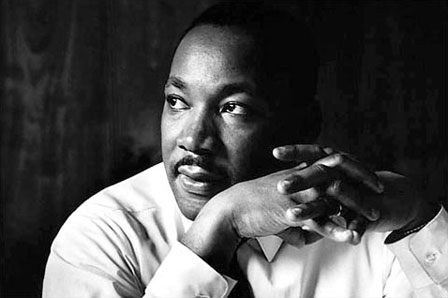
The Rev. Dr. Martin Luther King, Jr. Seattle Times photo
Of course, I’m talking here about degrees of racism. But isn’t that the way it usually goes with us garden-variety racists?
Originally, I was going to write this post after speaking with an African-American “acquaintance” of mine, a woman I have long admired from a safe and comfortable distance. We have tentatively scheduled a cup of coffee — or maybe a pint of beer sometime in the next few days, when her schedule settles down.
I know of this woman only through third parties. Recently, we have become “connected” on a few social media platforms. I find her writing haunting and jarring.
So why did I deviate from my original plan?
1.) I am intimidated by this woman; and
2.) This week is so timely for this discussion, this musing of mine. For one, this week we celebrated the 50th anniversary of the stirring and famous speech by the Rev. Dr. Martin Luther King, Jr. We also have all the fallout from Gov. LePage’s latest verbal snafu; but more importantly . . .
3.) I am afraid that I would be less than honest if I met her before writing this. Meaning: I would try to be more careful, bend to my “white-man guilt” by being overly empathetic and trying desperately not to offend. In summary, I would probably open the flood gates of bullshit.
Others take a shot at redemption in their later years. They either soften or gradually see the light; or — more appropriately — begin smelling the rot of their own garbage. Strom Thurmond comes to mind, here.
I fall asleep at night comforted that I am not David Duke, David Marsters or even Strom Thurmond. I am more like Governor LePage, and more like most people I know.
I am a tiny bit racist. So I get to skate with the hip, the self-aware and the all-so-cool white folks who either ignore their racism or make excuses for it.
It is not excusable.
Physician, heal thyself
I had this race epiphany a few days ago while reading a media report about Governor LePage and his attempt to “clarify” and explain allegations made by anonymous members of his own party. Essentially, LePage denied ever saying that President Obama doesn’t like white people.
The governor’s defense centered upon his assertion that President Obama has repeatedly missed opportunities to heal our nation’s racial tensions, fumbling or ignoring golden opportunities to bring white and black people closer together.
For just one bat-shit crazy second, that explanation almost made sense to me. It was then that I could no longer deny that I was a racist.
Now, before I bring down the full weight and wrath of those ultimately loyal to LePage, allow me to back up.
The governor was a little bit right in his criticism of President Obama on this front. But here’s the problem, LePage almost three years ago abdicated the moral high ground when it comes to easing racial tensions.
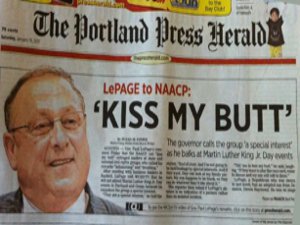
Most of us remember that cold day in January 2011 when local and national media went into overdrive regarding LePage’s alleged racism. He didn’t just decline an invitation to attend the annual Martin Luther King Day breakfast in Portland. Instead, he proudly (with what would become his trademark bluster) told reporters that “the NAACP can kiss my butt.”
If LePage is worried about missed opportunities to heal racial divides, he’s got a damn funny way of showing it.
Consider what he could have said. “I’m not sure why you folks in the media are making such a big deal about this. I simply declined an invitation because my schedule is full, but lets all remember that I consistently attended local MLK breakfast events in Waterville during my tenure as mayor. I also have taken a young African-American man into my home and helped raise him as a member of my own family. I strongly resent any implication that I am a racist. Let’s get busy talking about the important issues we are facing in Maine government.”
Nope, LePage could not resist coming on strong, full of sound, fury and arrogance. He began a path of allowing his pride to trump his greed.
How do we move forward?
I do not think our governor is a more successful version of David Duke, but I do think he has missed plenty of opportunities to talk in a meaningful way about an issue that is still very relevant in today’s world — even 50 years after the delivery of the I Have A Dreamspeech.
So, I am also a little bit racist, but I am also a little bit greedy, a little bit of a misogynist and a little too quick with anger.
Unless I am willing to look at these things, to painstaking examine my own heart, I have no authority to opine on these issues. We must be willing to confront the things we don’t like . . . even those things that lurk in the darkness of our own souls. Otherwise, the garbage festers and it can grow and infect other parts of our being.
As I said before, these things are not excusable but there are reasons for their development in even the best of people. Part of it is our cultural and genetic pre-disposition to assimilate within the familiar.
In this way, I suspect strongly that I am not alone; that the majority of folks I know are just a tiny, tiny bit racist. We can work on it if we can be honest about it. If we start with the man in the mirror.
White-man guilt
In the aftermath of the Civil War, the United States embarked upon a period of “Reconstruction.” Today, we would call in FEMA and lease some trailers.
The concept of giving former slaves 40 acres and a mule as reparation for their slavery was short-lived. Much of that land was eventually returned to its antebellum owners. From time-to-time, some guilt-ridden white folks and a lot of still angry black folks talk about the concept of ‘reparations” as the only way to heal the racial divide. Affirmative-Action programs were apparently a lot easier to digest.
Only weeks before being sworn-in, President Jimmy Carter granted an interview to Playboy magazine. It was the November 1976 issue. I know this because I was 12 years old and was an avid reader of my father’s hidden stacks of Playboy magazines.
Patty McGuire was that month’s centerfold. She was later named Playmate of the Year in 1977. She liked CB radios. I desperately wanted a CB radio back then. I saw Patti, and I knew it was a match made in heaven . . . but I digress.
Carter was trying to heal the cynicism of a post-Watergate nation by being painfully honest. In that issue of Playboy, he confessed to “having lust in my heart.”
Unfortunately, Carter had a lot of other tasks at his feet, many of which did not work out so well. But confessing lust in a Playboy interview is sort of like criticizing missed opportunities for racial healing after telling the Maine chapter of the NAACP to kiss your butt.
“Those who cannot remember the past are condemned to repeat it.” George Santayana
A Facebook friend reminded me that it was 122 years ago today, on December 28,1890, that more than 300, unarmed native Americans were slaughtered in South Dakota by U.S. Forces. The dead included women and children, and this travesty is recanted in horrific detail through the pages of Bury My Heart at Wounded Knee.
Colonel James Forsyth was later charged with The Killing of Innocents, but was exonerated and promoted. 22 of the soldiers that day were awarded the Congressional Medal of Honor. Do you remember being taught that lesson in public school? Probably not. It’s a piece of American history we like to forget.
“I can still see the butchered women and children lying heaped and scattered all along the crooked gulch as plain as when I saw them with eyes young. I can see that something else died there in the bloody mud, and was buried in the blizzard. My people’s dream died there. It was a beautiful dream… the nation’s hoop is broken and scattered. There is no center any longer, and the sacred tree is dead.” -Black Elk (1863-1950); Oglala Holy man.
The Lakota and other tribes were labeled as terrorists in Washington, DC, long before we created the Patriot Act to keep ourselves “safe” from terrorists.
As we once again debate how to keep American citizens safe, many people dismiss the quaint notion of government tyranny. Tyranny happens in other places, not here…not now…they say.
Generally, these believers in government authority and the government’s sole discretion in keeping us safe are white folk who rarely consider the downsides of an unbalanced distribution of force and power. These believers in government sanctity forget about the rather recent atrocities in Dafur, Serbia, Libya or Nazi Germany.
I spent the summer of 1987 working on the Cheyenne River Reservation in Eagle Butte, South Dakota. Back then, I thought wanted to be a priest.
I was 23 and full of my self as most 23-year-old men are. I strived to be sensitive, to be politically correct. The wise Lakota who surrounded me would gently smile when I used the words, “Native American.”
I tried my best to be empathetic, compassionate. I desperately wanted people to know that I was enlightened and not a typical white man; someone who could listen without judgment or prejudice.
One of the men on the reservation set me straight. “If you think you can assuage the sins of your past with a couple of words, you are sorely mistaken.”
He stepped outside to have a cigarette. We never crossed paths again.
So here are two pictures. One is from 122 years ago; the other is from 1987.
Take a good look, and you tell me… have we learned anything from history?
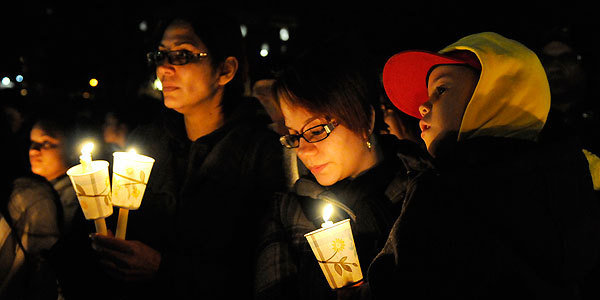
We are all, it seems, struggling to come to terms with what happened yesterday in Newtown, Connecticut.
As the awful news began to unfold, I urged friends and family members to pause and refrain from using this tragedy to further support political/policy agendas. I was unable, –am still unable — to comprehend what happened. It seems impossible to shoulder the weight of this horrific tragedy.
“Today is not the day to have these conversations,” I wrote on my Facebook page yesterday. “Today is a day to grieve and to support one another.”
Those words strike me as empty, hollow. . .meaningless. Over the last 24 hours, our nation has experienced a range of emotions: rage, grief, shock, fear and despair.
So, how do we move forward? How do we reconcile those feelings, the raw emotions that carry us into another day?
Understandably, many of us are searching for answers, for meaning. We have different opinions, and I submit that those opinions are all vital, all necessary for the larger conversation that we can no longer ignore.
The response to my Facebook post was generally respectful. Some people, however, chided me..saying yesterday, the day before, last year was the time for that conversation. I agree with those well-intentioned Facebook friends of mine. I only wonder if they will now join me in that conversation.
Four days after the Tuscon shootings, I penned an op-ed that was published in the Portland Press Herald. I got lots of supportive feedback and some nice comments for my willingness to speak publicly about my own mental health issues and how those issues affect each and every one of us, but we all moved on to more important things . . . like arguing about Rick Santorum, Wal-Mart and Honey Boo-boo.
As I struggle to find light in this time of darkness, there is only one small measure of comfort: for the first time, I am seeing and hearing numerous people address mental health as one of the core issues for that conversation. More people, it seems, are ready to have “that”conversation.
But it is not the only issue we must be willing to confront. I consider myself an ardent supporter of the Second Amendment, but today I am left with questions for which there seem to be no easy or convenient answers. I loathe knee-jerk reactions, but I am willing to reconsider all of my opinions so that I can join that larger conversation in a meaningful and productive way.
Ironically. as we all began dealing with the tragic fallout from yesterday’s rampage, another new story from half way across the globe was unfolding.
Questions about China’s inadequate mental health system are increasing in the wake of multiple incidents of school children being attacked and killed by knife-wielding, mentally ill people. Over the last few years, numerous school children have been killed and scores more injured by knife-wielding mad men.
That is not an argument against gun control. That is an argument that shows gun control is not the entire solution.
News commentator Bob Costas didn’t hesitate to offer his opinion about gun control less than 24 hours after an NFL player shot and killed his girlfriend before shooting himself in front of his coach. Just one week later, another NFL player was killed because he was riding in a car with a drunken teammate. It’s no surprise that there was no call for tighter alcohol controls.
Railing for gun control may help us feel a bit safer; but if we don’t have that conversation across a larger context then we can expect more of the same . . . senseless violence that shocks and angers, but then slowly fades away into distant memory.
On a final point. How do we ensure better background checks to prevent mentally ill people from purchasing or obtaining firearms?
Should someone like me, someone who struggles with depression and has been hospitalized sacrifice our privacy and have our health care records disclosed? Should family members of mentally ill people lose or sacrifice some of their rights under the Constitution?
I do not know the answers to those questions. But I do know, there is no way to guarantee safety. We live in a dangerous world, and if we are willing to sacrifice liberty for security (and considering the Patriot Act, Department of Homeland Security, and long shoeless TSA lines, we are) we may end up with something we never bargained for.
At the risk of provoking law enforcement officers, irate taxpayers, members of Maine’s Legislature and people who suffer with a mental illness, I want to congratulate Tux Turkel and a his team at the Portland Press Herald/Maine Sunday Telegram for an exceptional article in this morning’s paper.
At the crux of the story is the number of fatal shootings in Maine that are connected to police calls that involve someone who is mentally ill.
Before we proceed further, it’s important to note that the vast and overwhelming majority of people who suffer from a mental illness never have an interaction with law enforcement agencies.
Secondly, despite the myths, stigma, Hollywood hype and media bias, the overwhelming majority of mentally ill people are not violent.
In fact, violent acts committed by people with serious mental illness comprise an exceptionally small proportion of the overall violent crime rate in the U.S. They are more likely to be the victims of violence, not its perpetrators, according to the National Association of Social Workers (NASW)
In its March 2011 article, “Budgets Balanced at Expense of Mentally Ill,” the NASW newsletter also mentions a new report by the U.S. Substance Abuse and Mental Health Services Administration that documents a nationwide decline in behavioral health care spending as a share of all health care spending, from 9.3 percent in 1986 to just 7.3 percent, or $135 billion out of $1.85 trillion, in 2005.
Mental illness is an uncomfortable subject, one which many people would like to ignore and sweep below the rug. But we ignore it at our peril.
Asking law enforcement officers to effectively deal with ill people is sort of like expecting school janitors to provide high school tutoring services.
In our current situation, there is a natural tendency to blame the survivor. If someone has a knife and they begin moving toward you in a threatening manner, don’t you have the right to defend yourself?
Or do we blame the person holding the knife, a person with a mental illness who is unable to comprehend reality when it matters most?
Try to imagine what it’s like to be the cop who is forced to deal with that situation, to live the rest of his or her life with the knowledge that he/she ended another person’s life.
According to the newspaper: Since 2000, police in Maine have fired their guns at 71 people, hitting 57 of them. Thirty-three of those people died. A review of these 57 shootings by the Portland Press Herald/Maine Sunday Telegram found that at least 24 of them, or 42 percent, involved people with mental health problems. Seven of the shootings were alcohol-related. Two involved drugs.
Of the 33 people who were killed, at least 19, or 58 percent, had mental health problems.
In the days following the 2007 massacre at Virginia Tech, “Nightly newscasts reported “no known motive” and focused on the gunman’s anger, sense of isolation, and preoccupation with violent revenge. No one who read or saw the coverage would learn what a psychotic break looks like, nor that the vast majority of people with mental disorders are not violent. This kind of contextual information is conspicuously missing from major newspapers and TV,” wrote Richard Friedman in “Media and Madness,” an article published in the June 23, 2008 issue of The American Prospect.
Friedman goes on to explain that “Hollywood has benefited from a long-standing and lurid fascination with psychiatric illness,” referencing movies such as Psycho, The Silence of the Lambs, One Flew Over the Cuckoo’s Nest and Fatal Attraction.
According to Friedman, “exaggerated characters like these may help make “average” people feel safer by displacing the threat of violence to a well-defined group.”
So, should we blame lawmakers or Hollywood movies for rather weak funding and policies to assist law enforcement officers in addressing the complications of dealing with mentally ill individuals?
Or maybe, should we all take a good, long look in the mirror? In an age of economic recession, we must wrangle with legislative spending priorities.
But consider how expensive and grossly inefficient our current system is when it comes to dealing with potentially violent people who suffer from a mental illness.
In November 1993, I was living at my sister’s home near Augusta. Two days earlier, I purchased a used Lorcin .380 semi-automatic handgun with the intention of committing suicide. Fortunately, the gun misfired and jammed. Within moments, it seemed, my sister’s home was surrounded by a cadre of police officers, armed to the teeth. Who could blame them?
I was eventually transported to the Jackson Brook Institute (today Spring Harbor Hospital), where I was involuntarily committed for several days.
Compare that situation to one in 1986, when I was living in Tucson, Arizona. Pima County had a mental health rapid response team that included trained mental health workers. These teams served as the lead for responding to crisis situations. They could effectively assess the situation and call police only when necessary. They were equipped to provide the police with tools, intelligence and situational analysis that kept the officers safe.
Those types of programs cost money, but they also save taxpayers money over the long-term. More importantly, the approach in Tucson is far more likely to yield results in which no one dies. But how do you calculate the financial worth of preventing a fatal shooting?
There is a disturbing new trend in the U.S. military, and it’s killing our troops with increasing frequency.
No, we’re not talking about roadside bombs or militant terrorists. We’re talking about something that is much more frightening: suicide.
The U.S. military’s highest court is wrestling this week with whether it makes sense to punish service members who attempt suicide.
According to an article in USA Today, the military’s Court of Appeals appears perplexed about whether it makes sense to prosecute soldiers who make an attempt to end their own lives. The uncomfortable subject matter reared its ugly head during an appeal filed by attorneys for a Marine private who was court-martialed after slitting his own wrists.
From the article: Underpinning the case is the question of why the military criminalizes attempted suicide when it does not treat successful suicide as a crime.
“If (the marine) had succeeded, like 3,000 service members have in the past decade, he would have been treated like his service was honorable, his family would have received a letter of condolence from the president and his death would have been considered in the line of duty. Because he failed, he was prosecuted,” noted Navy Lt. Michael Hanzel, the military lawyer representing [the appellant].
Suicides among active-duty troops have soared in recent years, from less than 200 in 2005 to 309 in 2009, and a spike this year has put 2012 on track to set a new record high.
As someone who struggles daily with a mental illness, this story caught my attention for a number of reasons, including my own dismal military performance.
I received an honorable discharge from the United States Air Force, but it’s hard for me to think of anything “honorable” about it. Like me, this young Marine was never in a combat situation, making it all the more difficult for most people to understand — nevermind legitimize — his claim of post-traumatic stress disorder.
According to the article: “Mental health experts say criminalizing attempted suicide will undermine the Pentagon’s efforts to prevent troops from taking their own lives. Those laws might make troops reluctant to come forward, seek help and be candid with mental health counselors if they fear potential prosecution.”
So, we are left with a situation that clearly mirrors the foundations of Joseph Heller’s classic novel, Catch-22.
Essentially, the Catch 22 argument is one that predicates an outcome upon a contradictory set of rules. For example, if you are sane enough to seek discharge from the military because of a mental impairment, then you are not mentally impaired. You can only be mentally impaired if you are in complete denial that you are mentally impaired. Thus, you cannot say that you are mentally impaired and must remain in the military.
It’s actually understandable why the military is wrestling with this case. It’s damn hard to know the difference if someone is simply using the guise of a mental impairment to escape the otherwise uncomfortable bounds of their own consequences. I say this as someone who has made a serious suicide attempt.
I mean the kind of suicide attempt when you don’t write a note. You don’t make a call. There is no drama. There is just cold, dark, insufferable pain that you desperately want to end.
It happens. It’s not convenient or a light subject but it cannot be ignored without consequence.
Today, I am doing everything possible to avoid ever being in that situation again. But how much harder would that be if I knew I could be criminally prosecuted for my admission?
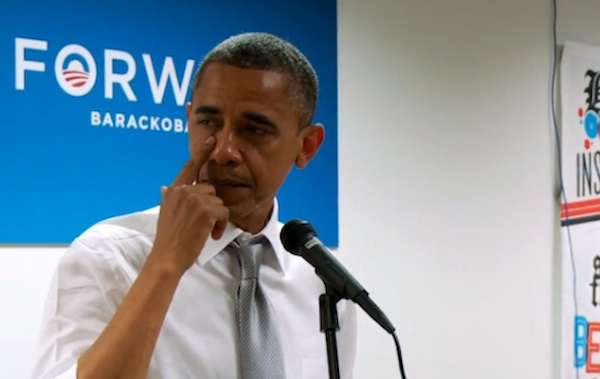
A couple of days ago, an exhausted and emotional President Obama visited privately with some of his campaign workers and reportedly got pretty choked up. At one point, the president’s tears began to flow.
For some reason, the White House decided to release this rare footage, despite the fact that it was recorded at an event the media was not allowed to attend.
Now let’s compare this to the public reaction from just two years ago, when Republican House Speaker John Boehner cried while being interviewed on 60 Minutes about his new role as Speaker of the House…..well, you remember, right?
Here’s what Bill Maher had to say:
“Did you see the new speaker of the House John Boeher cry? He cries a lot. Mr. Boehner you’ve got to stop crying. For one, your tan is going to run. And what’s he going to do if he loses next time? Put on a Bjork record and cut himself?”
Over the last few days, media pundits and amateur pundits on Facebook have been telling us that it is time for cooperation. It is time for the GOP to brush off its brutal losses and begin working with the Democrats. To steal a phrase, It’s time to put people before politics.
But it’s damn hard to accept the media’s blatant hypocrisy. Furthermore, why is it so bad for a man… a strong man, or any man for that matter– to cry? Is it a sign of weakness?
Both Obama and Boehner were captured in honest moments of raw emotional expression. The ability to appropriately express your emotion…whether it’s grief, joy or some hidden pain is generally a sign of good mental health. Do we really want our nation’s leaders bottling up their emotions?
Now, here’s a test. Watch this video and see if it makes you cry….even just a little. I dare ya.
My friends and family know that I cannot watch this scene without crying like a baby. If I were a Democrat, I suppose that would be an endearing quality. But if I am a Republican, I best prepare for some intense criticism.
It will be a lot easier for our nation to heal, if we can just move beyond some of the hypocrisy.
The letter I wrote to President Barack Obama on November 7, 2012:
Dear Mr. President:
First and foremost, please allow me to extend my most sincere congratulations on your hard-fought victory for a second term as our nation’s president.
Before I proceed further, I think it is appropriate that I disclose I did not vote for you, either in 2008 or yesterday. That said, I respect your office and believe you are a decent man who is committed to moving our nation forward to a better future.
I am writing you tonight to share a few thoughts and some unsolicited advice, knowing full well that it is highly unlikely you will read this note.
In essence, Mr. President, I believe you now have a rare opportunity with a second term. You have been unshackled from the constraints of re-election concerns, and I am hoping you will at least consider some of my points.
Although I applaud your efforts to tackle the complexities of our nation’s health care system, I have deep reservations about the individual mandate portion of the Patient Protection and Affordable Care Act. I encourage you to consider pushing for the so-called “public option” as an enhancement to your signature piece of legislation.
Why would a Republican urge you to consider a public option? Because I believe that we must continue looking at innovative ways to contain skyrocketing costs and improve quality of care. As it stands, I see this legislation as a giant gift to the same industry that created the “health insurance” nightmare. A public option would, at least, provide us with the comfort that our government mandates health coverage but not payment to a myopic, for-profit industry.
Yes, I understand the limitations of public policy development, and I can appreciate the value of sincere compromise. But I believe a public option would require private insurance companies to remain competitive instead of giving them a giant gift of additional revenue sources.
Secondly, I would like to see you tackle the immigration issue with the same clarity and conviction you displayed two years ago in your fight to repair our nation’s health care system. I would favor a system that rewards hard-working people who wish to become citizens of our great nation without tolerating those who intentionally attempt to elude the system.
Certainly, we have the technology and means to streamline the naturalization process, and we should be encouraging and welcoming more people to participate in our system of government rather than focusing so much of our time and financial resources in pursuit of a punitive process that yields so few benefits.
Finally, I hope that you and your administration will focus more of your efforts on our sluggish economy and our crushing national debt. We all know that too many Americans are in deep despair and facing serious and significant financial hardships. I urge you to be mindful of these implications as you consider each and every policy initiative that comes across
your desk.
A few months before I was born, President Kennedy urged his fellow citizens to ask themselves what they could do for their country, not what their country could do for them.
I want you to know, Mr. President, that I stand ready to accept that challenge; to further commit myself to working with my neighbors and all fellow citizens for the betterment of our nation. I reject the idea of living in fear and constant anxiety about an uncertain future. I stand ready and able to help you and every other American who is willing to work on behalf of our country.
Although I will continue to criticize some of your ideas and policies, please rest assured that I will also stand shoulder-to-shoulder with you at all other times.
I sincerely hope that you are able to receive my words as they are intended, and I hope that this correspondence finds you, the First Lady and your two beautiful daughters safe and content.






 LESSONS IN MEDIOCRITY | OUTLAW JOURNALIST