 My wife, Governor Paul Lepage, Bill Nemitz, a charity auction and the in-patient psychiatric unit at Maine Medical Center.
How did these random things become connected last week, causing a bit of a stir on my Facebook page last night?
Let’s start at the top.
Last week, just days before the election, Governor Paul LePage joked that Portland Press Herald columnist Bill Nemitz should be placed on a “suicide watch,” speculating that he was going to win his re-election bid and his nemesis might jump off the Penobscot Narrows Bridge as a result.
Boom! Instant controversy. Once again, the governor found himself in familiar territory with his foot in his mouth.
The governor’s critics (Democrats) went wild, talking about how insensitive the governor is to issues regarding mental illness.
Reportedly, some people who have lost loved ones to suicide were also angry and upset about the remarks.
Other folks (Republicans) said the governor was joking and the comment was no big deal, pointing out that many in society make lighthearted jokes on similar topics.
Stop and think if you have ever said “I’m going crazy.” “That is a crazy idea.” “That guy is a nut job.” Have you ever laughed when hearing a joke about hearing voices? Late night talk show hosts had plenty of fodder more than a decade ago when actress Margot Kidder was found partially clothed, hiding in the bushes of an LA suburb.
The subject of mental illness makes us nervous. We laugh about it as a relief valve for our own anxiety and fear. But can you take it too far?
Who’s saying what
My wife has multiple sclerosis. It is a progressive illness with no cure. She often makes jokes about her illness, speculating about when she will need a wheelchair and telling me we will need to completely renovate our home to accommodate her decreasing mobility. She laughs about these very real topics, appearing on the surface light-hearted.
Her jokes about MS really bother me. They trigger a rush of feelings and incredible anxiety. I know that her jokes are just part of her coping methods, but still I cringe when she talks about putting “bling” on her cane.
When Laura jokes about her MS, I try to give her a pass because she has MS, not me. It is her coping strategy.
It’s sort of like the “N” word. An African-American man can use that word in public without recrimination and make jokes about its connotation and meaning.
If I did the same thing, I could possibly lose my job, certainly many friends.
Society draws a line. If you got it, you can talk about it. Otherwise, keep your trap shut.
Unless it’s Hollywood or the media , and then all bets are off, especially when it comes to mental illness.
In the days following the 2007 massacre at Virginia Tech, “Nightly newscasts reported “no known motive” and focused on the gunman’s anger, sense of isolation, and preoccupation with violent revenge. No one who read or saw the coverage would learn what a psychotic break looks like, nor that the vast majority of people with mental disorders are not violent. This kind of contextual information is conspicuously missing from major newspapers and TV,” wrote Richard Friedman in “Media and Madness,” an article published in the June 23, 2008 issue of The American Prospect.
Friedman goes on to explain that “Hollywood has benefited from a long-standing and lurid fascination with psychiatric illness,” referencing movies such as Psycho, The Silence of the Lambs, One Flew Over the Cuckoo’s Nest and Fatal Attraction.
According to Friedman, “exaggerated characters like these may help make “average” people feel safer by displacing the threat of violence to a well-defined group.”
Since the 2011 Tucson shootings, I have been an out-of-the-closet consumer of mental health services. I have testified before the legislature, published an op-ed in the Portland Press Herald, spoken at community forums.
My mission is to show, in a tangible way, that mental illness is generally not scary and more often than not impacts everyday people: your friends, your co-workers, your neighbors and even your social media contacts.
My life-long struggle with mental illness is not particularly funny, but I do make jokes about it. Have you ever tried to eat a chicken cutlet with a spork? (They don’t give you silverware on the psychiatric unit. )
Did you know that nine out of 10 psychiatric units have aquariums? Fish, apparently, relieve anxiety and stress.
I make these jokes and others when speaking publicly because humor helps break down communication barriers.
I got in trouble
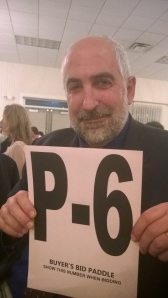 On Friday evening, Laura and I attended the Biddeford-Saco Chamber’s annual holiday auction and dinner. By pure coincidence, my bidding paddle was labeled P-6, the abbreviation of Maine Medical Center’s in-patient psychiatric unit (located on the sixth floor of the Pavilion wing.) I held up the photo and had Laura take a shot of me and my label.
I posted that picture on Facebook.
Some people thought it was funny. Other people did not, questioning why I could joke about mental illness but Gov. LePage could not.
The tricky thing about humor is its intent.
For the record, I chuckled when LePage said Nemitz should be placed on a suicide watch. The two men have been battling for four years, and frankly, I’m not sure who hates who more.
But either way, I think humor is okay, so long as its intent is somewhat calculated and not malicious in nature.
As someone with severe and chronic mental health issues, it’s not up to me or anyone else to tell you what you can joke about. All I ask is that you think about the consequences and lighten up just a tiny bit.
———————————
If you enjoy what you just read, please keep in mind that this is a reader-supported blog, and I want to keep ads at a minimum. If you are so inclined, please consider a small donation to help maintain this site. You can donate by clicking on this link. Thank you!






 LESSONS IN MEDIOCRITY