There’s one aspect of this year’s Maine gubernatorial race that has received little attention: where will dispassionate Republicans land on Election Day?
Four years ago, in what was largely a three-way race, Republican Paul LePage became Maine’s governor by securing approximately 38 percent of the vote.
Since then, much has been said about plurality, the merits of run-off elections and the so-called Cutler effect.
But little has changed in how Maine will choose its next governor, and today LePage is again on the ballot with two opponents.
More importantly, we don’t have Independent Shawn Moody (9 percent) to kick around this time.
Moody was always a long-shot, a late entrant, dark-horse candidate with broad appeal. At least a third of his support likely came from Republicans who were less than impressed with LePage’s style and tone.
From my perch, it’s hard to see how LePage has done anything to build his base, to draw in moderates; and I wonder where will those folks go. Will they hold their noses and vote for LePage? Will they hold their noses and vote for Cutler? Will they clamp down on their noses and vote for Democrat Mike Michaud; or will they leave their noses alone and just stay home on Election Day?
Many Democrats blame Cutler for LePage’s election in 2010. They say he split their party’s voting block and could do it again this time.
So far, Cutler is only a shadow of the threat he was in 2010; but even then his support came late in the game. Say what you will, but Cutler’s numbers will likely rise over the next few weeks as LePage and Michaud busy themselves with tearing each other down.
Recent polls have shown LePage and Michaud in a very tight race. So, I want to know where the Moody voters from 2010 will go; all nine percent of them.
Nine percent may not seem like a big number, but LePage simply cannot rest on his base of 35 percent. This time, the Democrats are working harder and smarter than they did in 2010. They are more unified and reaching for the middle.
LePage has an opportunity to draw in some of those moderate voters in the middle, but so far there’s been no evidence that he’s willing to court their vote.
So far, Eliot Cutler is the only candidate working really hard for the middle, the place where a growing number of voters call home. I doubt it will be enough for him to win, but I am positive that it would be enough for LePage to lose.
Independent gubernatorial candidate Eliot Cutler is in trouble.
At least according to the latest All Along the Watchtower survey (and every other poll conducted over the last few months)
Whatever star power the independent from Cape Elizabeth had during the 2010 gubernatorial campaign has all but vanished.
Of the three major candidates, Cutler was the only one to see his support fade (a 40 percent drop) between my two surveys conducted on March 14 and July 24 of this year
Meanwhile, incumbent Republican Paul LePage saw a 19 percent jump in support between the survey period, but Democrat Mike Michaud maintained strong and commanding leads in both surveys, handily winning each with 48 percent in March; and 49.5 percent in July.
As I said previously, this was NOT a scientific poll. It was not restricted to Maine voters, and there are no cross-tabs to analyze. An eight-year-old girl from Toronto could have voted in this survey, so no one should get too wound up about the results . . . except for Eliot Cutler.
Before I proceed, it should also be noted that my latest survey (launched on July 24) had far fewer participants than the earlier survey I conducted in March.
In my March 14 survey, there were 2,411 participants. By contrast, only 122 people participated in my latest survey.
I am not sure how to explain the dramatic drop in participation. It could be that we are in the middle of summer. It could be that people are growing weary of politics and are waiting until Labor Day to get fired up. It could be apathy. It could be a lot of things, but Cutler’s team could have shared this survey widely among their supporters. They could have easily had a small win. 75 votes for Cutler would have resulted in a blog post that “Cutler wins survey.”
What would be the value of a minor league blog announcing a Cutler win?
Well, it would be something that Cutler could point to as semi-tangible evidence of his campaign’s viability. It would likely help him more than saying he was asked by the Democrats to be their party’s nominee.
Instead, the results here are just more bad news for a campaign that has yet to have a sun-shiney day during the 2014 cycle.
It’s also further evidence that the Democrats don’t need to worry too much about Cutler, and it’s a bit of bad news for the LePage team that desperately wants Cutler to cut into the Democratic base.
That eight-year-old girl from Toronto probably had no idea about how much power she and her friends could have wielded in the 2014 campaign for the Blaine House.
There are advantages to being independent, but there are also some big disadvantages.
If you don’t believe me, just ask Ted O’Meara, campaign manager for gubernatorial hopeful Eliot Cutler.
In an e-mail to Cutler’s supporters this week, O’Meara praised his team’s hard work and their ability to collect more than 5,000 signatures to ensure that Cutler will be on the November ballot.
But O’Meara also took a swipe at Maine’s political parties, pointing out that campaign rules discourage independent candidates from seeking office.
“Our work was made more challenging by the fact that Independents like Eliot have to collect 4,000 signatures, while the party candidates only have to collect 2,000,” O’Meara wrote. “It’s just the reverse when it comes to fundraising; Eliot can collect only half as much per contributor as the party candidates.
“That’s right: twice the signatures, half the money. Guess who wrote the rules?”
O’Meara goes on to say that “self-serving election laws are the only thing the parties can agree on these days.”
It should be noted that O’Meara was more than happy to be a member of a major political party in the not-too-distant past.
In fact, O’Meara was once the chair of the Maine Republican Party and served as a staffer for both Senator William Cohen and Senator Olympia Snowe.
But his point about party control of Maine politics is valid.
In fact, members of both major parties ought to seriously ponder why an ever-increasing number of Americans are registered as unenrolled voters.
Being “independent” is gaining traction all across the nation, and that spells big problems for the big parties, especially when it comes to fundraising from a smaller pool of voters.
Although the party faithful generally point out that their candidates must endure the expense of grueling primaries, that’s just not the case this year.
Both Democrat Mike Michuad and Republican Paul LePage are unopposed for their respective party’s nomination.
Regardless of whether you support Cutler, we should level the playing field for all candidates. Let’s be independent together!
With less than six months to go before the November election, all three of Maine’s gubernatorial candidates seem to be picking up the pace of their campaigns.
In traditional Maine politics, this sort of ramping up usually comes toward the end of summer, just ahead of a Labor Day surge that leads to an October sprint for the finish.
The early nature of this ramp up is likely tied to the results generated by two recent statewide polls, both of which show Democrat Mike Michaud and Republican Paul LePage in a statistical dead heat. Both polls also show Independent candidate Eliot Cutler in a distant third place.
The numbers from polling conducted by Rasmussen and Pan Atlantic SMS Group had to be disappointing news for Cutler and his team.
Video killed the radio star
Apparently, despite the dismal poll numbers, there is still some concern that Cutler could repeat the 2010 election results, by once again drawing from Democratic voters and giving LePage a second term with a plurality victory.
Cutler, with nothing much to lose, recently unleashed a campaign video to explain why he is NOT splitting the vote.
The video was captured during one of his campaign events in response to a question from a very young voter.
Releasing the video was a very smart move, and it was a very dumb move.
It’s a smart move because Cutler uses video to portray confidence, leadership.
It’s a dumb move because it makes his campaign appear on the defensive some six months before the election.
Regardless of how you feel about Cutler, his campaign or the video, one thing is clear: video is an effective communication tool, especially when it comes to social media. Blogs are read, but videos go viral.
A study conducted in the United Kingdom last year showed what most of us know intuitively, yet what so many of us fail to recognize: A picture is worth a thousand words, but a short video is worth a thousand pictures.
But here in Maine politics, the gubernatorial campaigns have yet to do very much in the way of integrating videos in their social media efforts.
As of this writing, the above video from Cutler (posted two days ago) has received 115 views. That does not sound good, right? Well, wait til you hear from the competition.
Mike Michaud’s campaign last released a video four weeks ago and it has received 63 views.
Apparently, all three campaigns could use some work on producing pithy, yet compelling videos.
Another look at the numbers
On a final note, all three campaigns experienced a rather shallow 2 percent increase on their respective Facebook pages, but Michaud’s team scored an 11 percent increase in Twitter followers( 1,7111) during the past month, compared to 3 percent for LePage (1,754) and four percent for Cutler (1.377).
A little help from my friends
And just for the fun of it, I decided to see where my Facebook friends land when it comes to liking the campaigns.
I have 801 Facebook friends (though several do not live in Maine). Of those, 93 of my friends “like” Mike Michaud; 97 “like” Paul LePage; and 154 “like” Eliot Cutler.
Attitudes regarding marijuana have dramatically changed during the past two decades.
Those in favor of legalizing the drug are finding increasing support from an expanding constituency, including millenials who can now vote and health care providers who say the drug can benefit their patients.
Even retired Supreme Court Justice John Paul Stevens — not a likely Cheech & Chong fan — says it is time for marijuana to be legalized.
In an interview with Scott Simon on National Public Radio, the former justice said: “I really think that that’s another instance of public opinion [that’s] changed. And recognize that the distinction between marijuana and alcoholic beverages is really not much of a distinction.”
Talk about a dramatic shift. In 1987, after admitting that he once used marijuana, Supreme Court nominee Douglas Ginsburg was forced to back away from the nomination process.
And last year, voters in both Colorado and Washington defied federal law and legalized the use of marijuana as a controlled substance.
But the quest to legalize marijuana in all 50 states face an uphill battle, best evidenced by what has happened in the Maine Legislature.
In November The Legislative Council, a 10-member group of legislative leaders, split on a proposal that would have sent a statewide referendum question to voters. Because the vote was tied, it failed and cannot be considered again until the next Legislature convenes in 2015.
It was the third time the Legislature has rejected proposals by State Rep. Diane Russell (D-Portland) to legalize marijuana. Russell could not be reached for comment.
But State Rep. Alan Casavant (D-Biddeford) said he is glad the proposal failed.
“I voted against it every time,” Casavant said.
Casavant, who spent more than 35 years teaching high school, said he experienced first hand the impact of marijuana on his students.
“Legalizing it would be nothing more than a continued erosion of our culture,” he said. “I have heard all the arguments for and against, and I can’t support it.”
Casavant also said the issue should not be debated on a state-by state basis. “For it to happen, we really need some guidance from the federal government. It’s a very complicated issue. Where do you draw the line on intoxication, for example?”
Casavant says he is sympathetic to those who need marijuana for medicinal reasons, but says the risks still outweigh the benefits, even when considering that marijuana could provide a bumper crop of new tax revenue.
“As the mayor of a city, as a legislator, I am very aware of how we need new sources of revenue that will not impact people who are already struggling to keep up, but despite those realities, I can’t support this. Not now.”
State Rep. Justin Chenette (D-Saco) said he is “evolving on the issue.” Chenette said he had initial apprehension about the issue when first approached for his support by Russell.
“Being a college student so recently, I have witnessed the rampant use of marijuana on campus,” Chenette said. “I am concerned about how young people will use it, but I also see the other side. I would be in favor of sending the question to referendum, but I have yet to formulate a strong opinion one way or the other. It’s something that warrants more study.”
Ryan Fecteau of Biddeford is hoping to be a member of the next legislature.
Fecteau, 21, says he generally supports the legalization of marijuana but does not want to see it included in the Maine Democratic Party’s platform because it could be wedge issue in a year when Maine Democrats need to be focused on bigger fish, including capturing the Blaine House.
“I think it should be treated the same as alcohol,” Fecteau said, adding that additional revenue from the state sale of marijuana could provide much-needed tax relief for seniors and revenue that could help fund critical programs.
With a little help from my friends
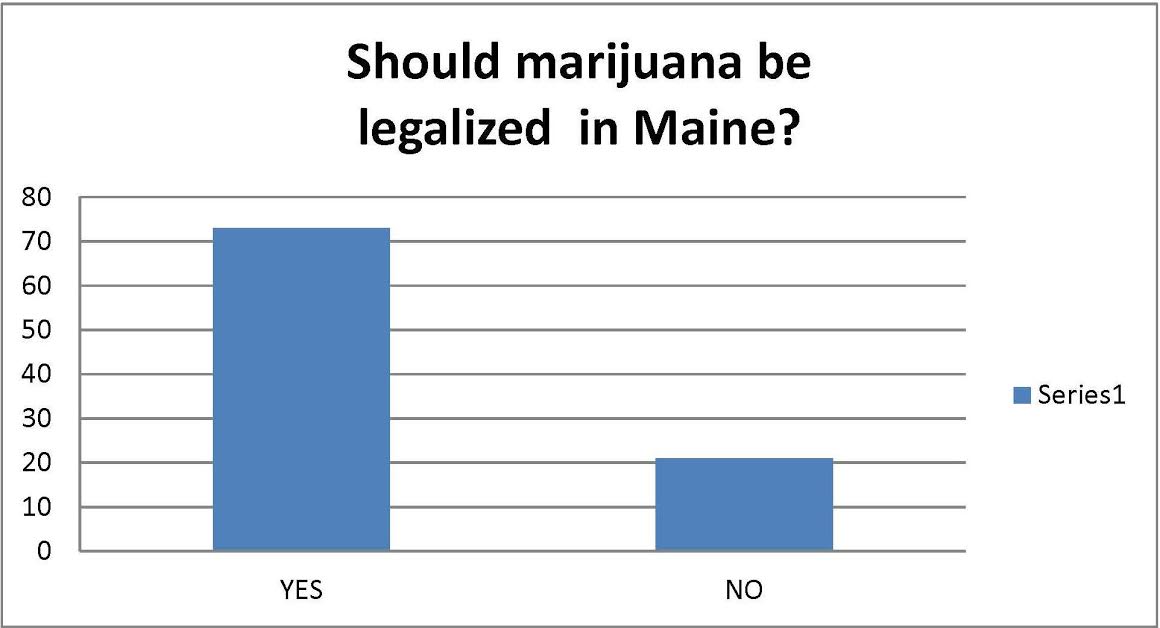
A few days ago, I posted a simple question on my Facebook page about the legalization of marijuana.
That informal survey drew more than 100 responses in 24 hours.
I was surprised by some of the responses. I was also fascinated to see that an almost even split of Republicans and Democrats were on each side of the issue.
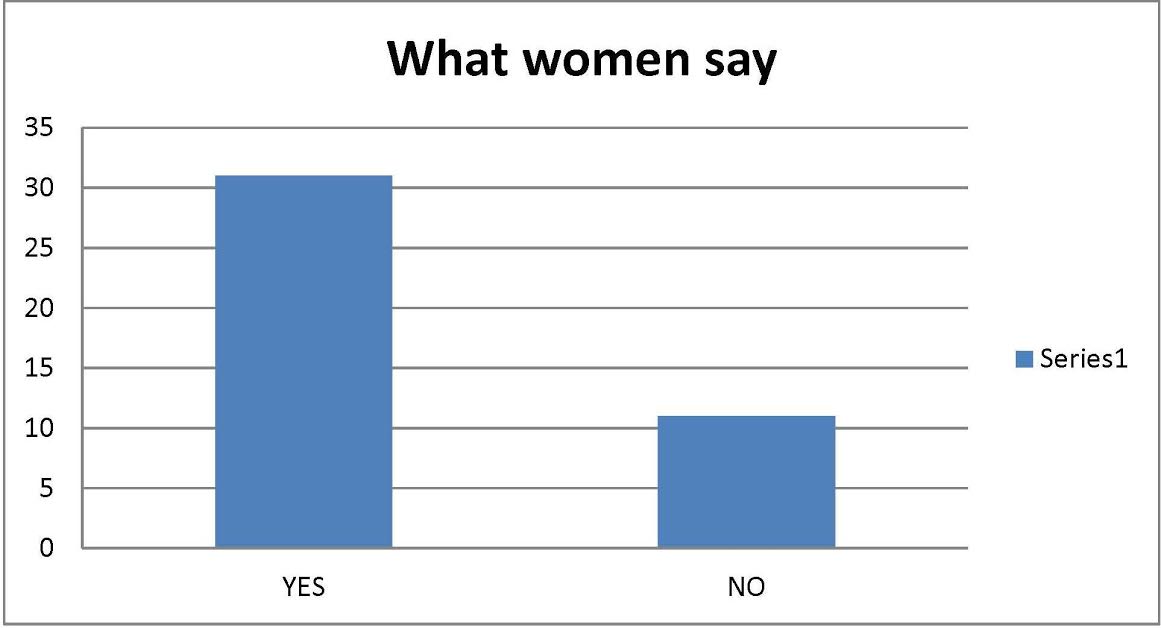
Moreover, both men and women overwhelmingly support legalization (male approval led female approval by only a slight margin).
Women with children were equally split. Among male opponents, more than 75 percent are politically conservative, yet nearly 40 percent of male supporters are conservatives.
1.) The post urges us to “please search for the LePage 2014 website on your computer.”
Oh, I’m not supposed to search under the table or between the seat cushions?
How about this? How about posting a link to your site? You can do that on Facebook.
Instead, the governor’s social media gurus are worried about unintended “filters” that could accompany an embedded link. So, instead they strongly suggest that you use your computer, hunt down the link and then donate.
In fact, donating must be important because they ask you to donate twice in the same paragraph, which almost looks like one giant sentence, considering the absence of punctuation.
2.) The campaign’s post is horrendously long.
Facebook is not Twitter, which requires abbreviated posts. That said, you should not use Facebook to “cut and paste” an entire speech.
A better strategy would be to hook your social media audience into your website. Use social media to tease your message and direct readers back to your website.
3.) If you must go long, give your post some space.
If you insist on your using Facebook like a blog, at least be considerate and allow readers a visual experience that doesn’t look like a bucket of spilled nails.
Insert a line space between paragraphs. Remember, if you want more people reading your posts, make your posts easier to read.
So here’s a primer for Governor LePage and his re-election team:
Voter turnout for Maine’s 2014 Primary Elections on June 10 will be absolutely dismal.
Taxpayers across Maine will spend hundreds of thousands of dollars for an absolute non-event; an utter waste of time and resources, all in the name of a Democratic process that doesn’t work without a contest.
In fact, we will be lucky to see voter participation that exceeds the June 1996 state primary, when only 12 percent of eligible voters bothered to cast a ballot.
Think of it this way, it will be like buying a ticket to watch the Boston Red Sox play the Boston Red Sox at Fenway Park.
The winners have already been determined.
Unlike the June 2010 Primary four years ago, the gubernatorial candidates for each political party have already been chosen. If only one Democrat goes to the polls somewhere in Maine, Mike Michaud will clinch his party’s nomination in a landslide.
But in 2010, voters of both parties had lots of choices. There were four candidates seeking the Democratic Party’s nomination, and no fewer than seven candidates seeking the Republican Party’s nomination.
More recently, in 2012, six Republicans and four Democrats fought in the primaries for a chance to fill the shoes of U.S. Senator Olympia Snowe.
This year, Republican Susan Collins has already won her party’s nomination and Shenna Bellows is assured of being the Democratic Party’s sacrificial cow.
But what about the Maine Legislature and the crop of fresh faces ready to head off to Augusta?
Okay, you can stop laughing now.
In fact, you may want to cry because you and all of your neighbors will be funding an entire day of using municipal clerks and voting officials to collect ballots that hardly matter.
Of Maine’s 35 state senate seats, only four will face a primary challenge (three Democratic primaries and one Republican primary)
It’s not much different for the process to fill the 151 chairs in the Maine House of Representatives, where only 19 of the 151 races will see a Primary challenge (8 Democratic primaries and 11 Republican primaries)
In 132 of 151 House Districts in Maine, it doesn’t matter a bit if you go to the polls on June 10. The races for the Blaine House, the U.S. Senate and the Legislature have been pre-determined.
Please do not disturb the slumber of your municipal clerks or voting officials.
Despite all the hoopla about the power of social media tools in political campaigns, what metrics can we use to determine if those tools are effective?
While just about anyone can set up a Twitter account or create a Facebook page, social media tools are only as effective as those who are using them. Although it is widely accepted that social media tools played a big part in President Obama’s 2008 campaign, that type of success is not guaranteed by simply using social media as part of a campaign strategy.
When it comes to Maine’s 2014 gubernatorial race, which of the campaigns is best using social media? More importantly, how do we set aside our individual biases and evaluate the campaigns based solely upon their social media metrics?
At the Brookings Institute’s Center for Technology Innovation, Darrell West offers a mixed review regarding social media and campaign engagement and the awkward transition to actual governance.
Social media are the ultimate in disruptive technology. They change information delivery, business organization, online content, news coverage, and the manner in which individuals process new developments. As shown during the 2008 campaign, these digital tools represented a textbook example of voter mobilization and electoral impact. They were, in the words of Engage Partner Mindy Finn, the “central nervous system” of campaign organizations.
Using social networking outreach tools such as Facebook, MySpace, YouTube, and Twitter, a number of Democratic and Republican candidates raised money, identified supporters, built electoral coalitions, and brought people in closer touch with the electoral process.
You may recall a somewhat silly and lighthearted piece about Maine’s gubernatorial campaigns that I posted a couple of months ago. Then, I jokingly said we should dispense with the standard election process and use social media metrics to determine the winner. I examined each of the campaign’s current metrics.
Today, I have decided to track those metrics on a regular basis and to blog frequently about those campaigns and their use of social media.
Over the last 60 days, each of the Maine gubernatorial campaigns has been active on various social media platforms. But before we begin, it’s important to note that Democrat Mike Michaud is the latest entrant to this race. Both Governor LePage and Eliot Cutler carried over their respective social media support from the 2010 campaign.
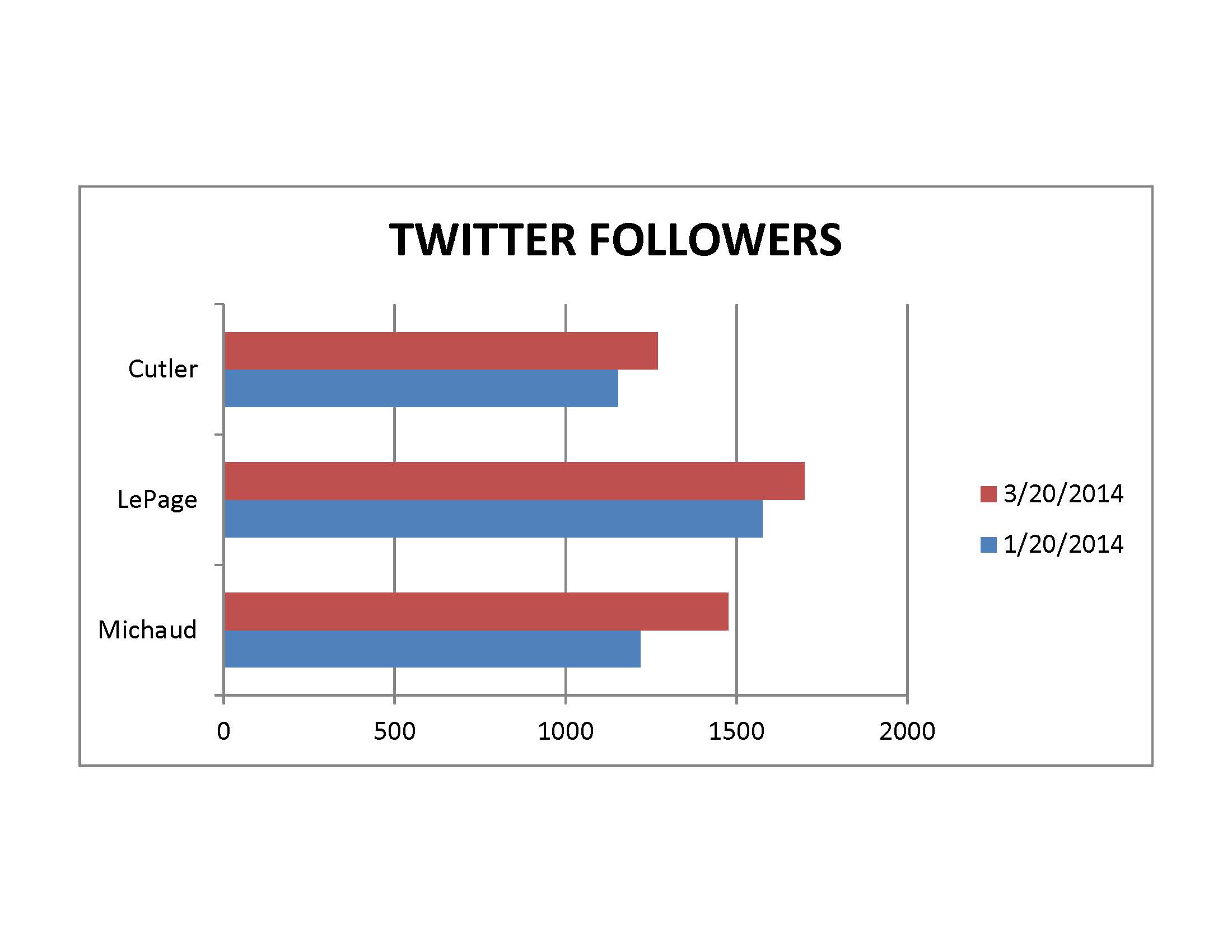
Nonetheless, Michaud has seen the greatest increase in social media traffic, earning a 21 percent increase in the number of Twitter followers @Michaud2014, moving from 1,219 Twitter followers on January 20 to 1,475 followers as of March 20, 2014.
Although Governor LePage (@lepage2014) has the greatest number of Twitter followers (1,698) his metrics have increased only 8 percent during the same time period.
Eliot Cutler (@EliotCutler) saw a 10 percent increase in Twitter followers, from 1, 153 to 1,269 followers during the same period.
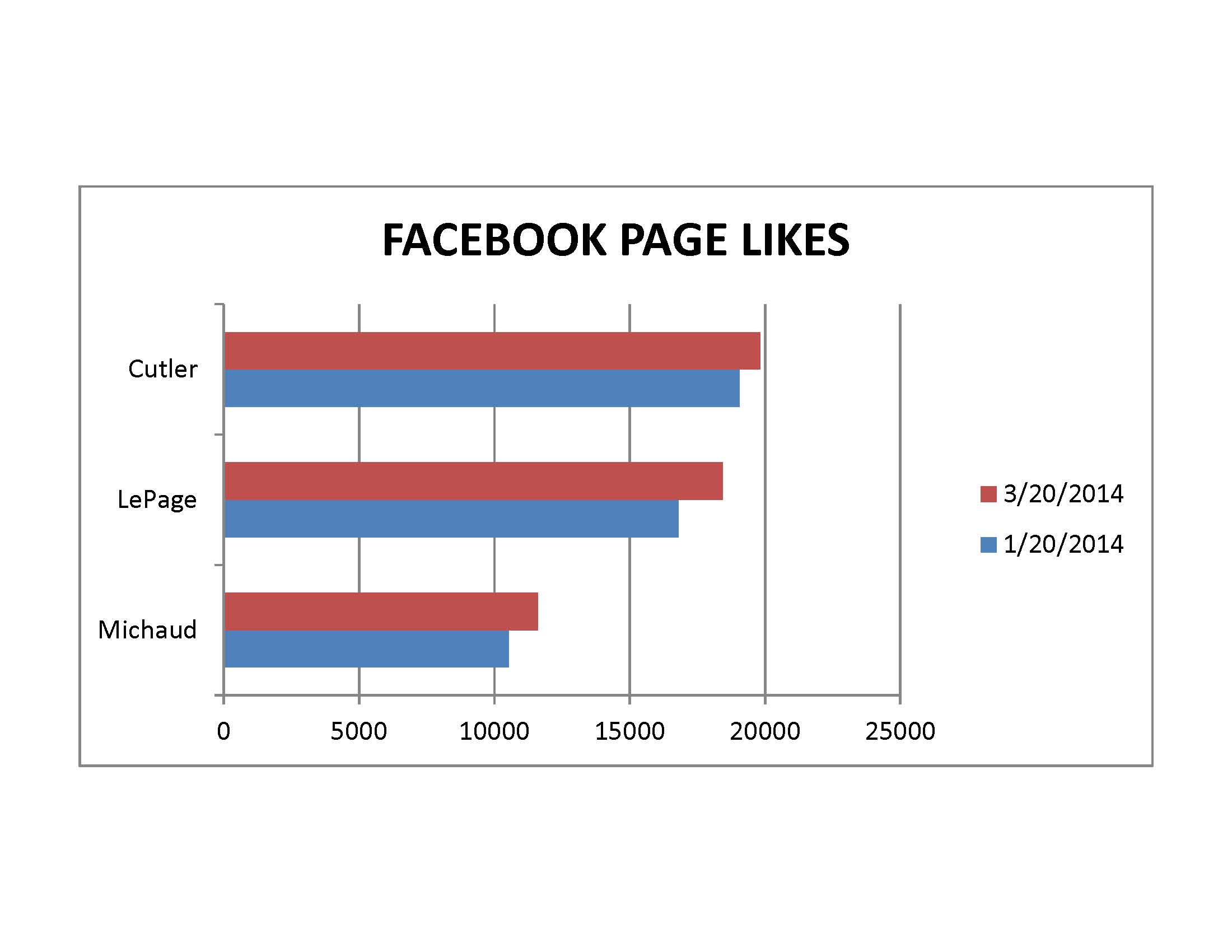
On Facebook, Cutler still dominates in the total number of Likes for his campaign page (19,824) but saw only a 4 percent increase over the last 60 days, while both Michaud and LePage experienced increases of 10 percent.
LePage’s Facebook page had 18,438 fans on March 20, compared to 16,791 fans on January 20, 2014.
Michaud’s Facebook page had 11,600 fans on March 20, compared to 10,529 fans on January 20, 2014.
When viewed overall, it would appear that Team Cutler has the steepest hill to climb, so far.
Note:Though it’s generally common knowledge, it must be noted that Twitter followers and Facebook fans do not translate directly to the number of supporters for a political candidate. As an example, I follow all three campaigns on Twitter, but will only be voting for one candidate.
While most people were picking out green outfits, drinking lots of beer or otherwise wasting time on St. Patrick’s Day, one select group of folks were bracing for potential fame and fortune as hopeful members of the 2015 Maine Legislature.
The deadline for wannabe state representatives and state senators came and went at 5 p.m. on March 17.
Given the impacts of last year’s legislative redistricting and Maine’s term limits law, voters will be faced with a healthy crop of fresh faces.
But you can always count on a few perennial candidates: those who think the next campaign will be the magic campaign, the Wonka Golden ticket that will admit them into the strata of being really important and somewhat relevant. Such is the case in Biddeford, where Perry Aberle — undaunted by two consecutive and somewhat epic campaign failures — has once again tossed his hat into the ring seeking to capture a legislative seat that eluded him two years ago by a hefty margin.
Now that he has tossed his hat into the ring again, hopefully, someone will toss him back a working razor.
Aberle won his last election nearly two decades ago, when he was still in high school and was elected to serve one term on the Biddeford City Council. Since then, his campaign skills have deteriorated.
He ran for the state legislature two years ago and was crushed by incumbent Paulette Beaudoin, the proverbial little old lady who cleaned Aberele’s clock by garnering nearly 64 percent of the vote (2,585-1,471).
A year later, Aberle brushed himself off and decided to challenge Biddeford Mayor Alan Casavant. Despite a much larger pool of voters in a city-wide election for mayor, Aberle’s vote total shrunk by more than half, and he finished a distant third in a three-way race that also included former mayor Joanne Twomey. Casavant easily won re-election with 2,377 votes, compared to 720 for Aberle.
Today, Aberle is again running as a Republican for the Maine House of Representatives in District 12, which includes the central and downtown portions of the city. He will face Biddeford businessman Martin Grohman, a Democrat, in the general election.
Will the the third try be the charm for Aberle? Don’t bank on it, would be my advice.
Over in District 11, which includes western portions of the city, Democrats Ryan Fecteau and David Flood will duke it out for their party’s nomination. The winner of that contest will face political newcomer Debi Davis, a Republican, in the November general election.
In the District 32 State Senate race, Democrat David Dutremble will once again bank on his family’s political legacy and last name recogntion to hold onto his seat for another term. Dutremble will once again be challenged by Arundel businessman James Booth who ran for the seat two years ago as an Independent. This time, Booth is running as a Republican. Anything is possible, but Booth is facing an uphill battle in a district that historically favors Democrats.
As Maine Goes (AMG), one of Maine’s most popular and controversial political websites, had gone dark after a 16-year run that allowed verified members to post and comment on a wide range of political issues. Admittedly, AMG was a conservative site, but it was well-moderated, and liberal posters would sometimes wade into those waters to offer their perspectives and to push-back on what they perceived to be an echo-chamber of conservative thought.
AMG’s membership, although decidedly right-leaning, was rather diverse: single mothers, retired folks, business owners, students, academics and every-day working people spent hour upon hour debating ideas, posting insights and frequently arguing about a wide range of subject matters.
Journalists would monitor the site, observing political trends and gleaning intelligence from campaign operatives who would lurk on AMG’s pages.
Profanity was forbidden, but the jousting was real. It was not a place for those easily offended. If you couldn’t take the heat, if you didn’t like being challenged, well…you could always just sit back and watch the big dogs get off the porch.
So it was, in the post-AMG abyss, that I decided to try my own social media experiment. Lacking the dedication and commitment that Scott Fish gave to AMG, I instead set up a Facebook group called “Thinking Politics”
It remains a closed, secret group (new members must be invited by existing members to participate). I started the group with fourteen people: six who generally lean left, six others who generally lean right and two people I perceived to be in the middle of the political road. (This was all very subjective and was calculated while drinking generous doses of a favorite Merlot).
The mission statement of the group is rather simple: Thinking Politics is a place for those who enjoy political discourse that includes rigorous debate but not personal attacks. Members are seeking an elevated level of political discourse and pledge to be as committed to hearing as they are to speaking.
I wanted to see how these selected friends would do in a controlled environment. I invited no one else, despite the urge not to offend other friends. I tried to just sit back and watch. That was almost five weeks ago.
Can you hear me?
Today, there are nearly 120 members in the Thinking Politics group. Members pick and start the conversation points or join other ongoing discussions.
At least one person dropped out of the group. She was reportedly frustrated that she could not see comments being made by another member because he had “blocked” her from his own Facebook profile.
The group quickly veered left. Why? Simply put, my left-leaning friends outflanked their counterparts on the right by inviting others of similar thought as reinforcements.
Obviously, this dynamic frustrated my friends on the right. They were feeling outnumbered, outmatched and felt it was a waste of time to participate if they were just going to be outshouted. They retreated a bit.
But here’s where it gets strange. Some of those on the left actually began bemoaning the fact that the page was becoming little more than a “political echo chamber,” chock full of progressive thought with little or no input from the political right.
Just when I thought my experiment had failed, something happened. The conservatives found some heavy-hitters to join their ranks, including State Rep. Jonathan McKane (R-Newcastle) and Beth O’Connor, a former state representative and vice chair of Maine Taxpayers United. Other unapologetic Republicans followed.
So now the page was a bit more balanced, but was it more productive?
It remains to be seen. A majority of the members seem genuinely committed to the process: to stand firmly on ground and debate with civility. But I wanted (hoped) to see something else. I wanted to see if people would begin asking questions. I wanted to see if there was a natural curiosity out there. Would people pause and consider alternative viewpoints? More importantly, would they proactively seek out those other views?
You can guess the answer.
I’m right, you’re wrong
Even in a semi-controlled environment, my friends seemed more focused on being right rather than considering an alternative viewpoint. I get it. That’s how I roll 99 percent of the time.
Last week, I participated in an event that some friends organize every once in a while: a Political Beer Summit. Now, face to face and with the assistance of great beer and delicious pizza, the political debate was just as passionate but it was a lot less heated.
Sitting across the table from one another, the Democrats saw the Republicans as reflections of themselves with the exception of different viewpoint. The Republicans were not afraid that the Democrats were going to stiff them with the check. It was fierce, but friendly. No one changed their mind, but every one was willing to listen.
Why can’t that dynamic happen more often? Why are we so fiercely competitive?
Recently, I stumbled across an article in the Washington Post that explains this increasingly fierce dynamic of political competition.
Nearly every recent election has held out the possibility of a shift in party control of one institution or another, writes Francis Lee in his Monkey Cage blog.
Lee continues: Competition fuels party conflict by raising the political stakes of every policy dispute. When control of national institutions hangs in the balance, no party wants to grant political legitimacy to its opposition by voting for the measures it champions. After all, how can a party wage an effective campaign after supporting or collaborating with its opposition on public policy?
Lee’s analysis of political competition helps explain the dynamics I witnessed in my experiment. Today’s political discourse has taken on the tenor and tone of an all-out war, a battlefield of fighting to the death and an unwillingness to compromise.
Last night I posed a question on my Facebook timeline: Is it possible to debate politics without animosity; is it possible to fight a war without hating your enemy?
Matt Jacobson, a Facebook friend who was one of several Maine people seeking the Republican nomination for governor in 2010, offered a brilliant response: “Too many don’t understand the difference between an opponent and an enemy,” he wrote.
I am fascinated by the psychology of politics, and I earn my living as a policy/political consultant. It still amazes me that so few candidates understand the vital importance of reaching toward the middle for additional supporters. If we want the fence sitters to join our side, how do we get them off the fence and into the game?
I think it’s a worthy question, and I invite your feedback. And if you want to join the Thinking Politics group just send an e-mail to randy@randyseaver.com











 LESSONS IN MEDIOCRITY | OUTLAW JOURNALIST