
Dr. Ali Ahmida

Just a few months after the Sept. 11 terrorist attacks, Ahmida discusses what it’s like to be a Muslim and an American.

Dr. Ali Ahmida sees himself as a bridge builder. As the chair of the Department of Political Science at the University of New England, Ahmida weaves a globalized, multi-cultural view into his classes, asking his students to see the similarities, rather than the differences in people of different cultures.
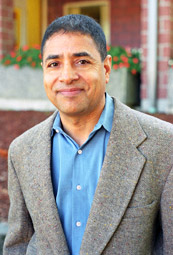
“I consider myself a bridge builder,” Ahmida said. “I am a Muslim and an American, I am both, and I look for the similarities in people. I think it’s unfortunate that we are taught to first see the differences because there are so many things that bind us together.”

The founder of UNE’s political science department, Ahmida was honored this year as the 17th recipient of the Kenneally Cup, an annual award given to one of the school’s faculty or staff members for distinguished academic service.

Ahmida is proud of the silver-plated award that sits on a shelf in his small office on the third floor of Marcil Hall. “Look at it,” he points. “It looks like the Stanley Cup.” But the award is only a small part of his success, Ahmida says. In large part, he credits UNE for having the vision to strengthen its humanities programs and for allowing its faculty the flexibility necessary to be innovative in their teaching approaches.

“UNE has a nice, civil atmosphere,” says Ahmida, relaxing in front of a window that overlooks an easterly portion of the school’s Biddeford Campus near the lower end of the SacoRiver. “You don’t find the elitism here that you do at other schools. We have great potential, and we’re not hampered by an overbearing bureaucracy. UNE trusted my knowledge to build a program. ”

Ahmida teaches several undergraduate courses at the university, ranging from Globalization: Origins, Cultures and Politics to European Fascism and Egypt through the Eyes of Mahfouz.

 In all of his classes, Ahmida says, students can expect to work hard and have their traditional viewpoints challenged.

 An opportunity to learn

Raised in a small town in southern Libya, Ahmida was a voracious reader and an outstanding scholar. Shortly after graduating from high school, he earned a scholarship to study at CairoUniversity in Egypt.

“That was quite an experience,” he laughed. “It’s like taking a kid from Saco and sending him to New York City.” Although his time in Cairo was troubled; he was labeled a student activist and blacklisted by the government, he was able to earn a bachelor’s degree and a small scholarship to further his education in the United States.

Ahmida says his time in Cairo allowed him to overcome his “parochialized view of the world” and exposed to him to many new veins of thought and culture.

“I read many American novels,” he said. “I watched American movies and listened to American music, but it wasn’t an easy choice to leave. My family was still in Libya, but I was becoming a problem for them. It wasn’t an easy decision. They talk here about Catholic guilt and Jewish guilt, but believe me — Muslim guilt is much worse.”

Upon arriving in the United States, Ahmida began his graduate work at the University of Washington in Seattle. “I told my father that God needed to fix the roof here,” he laughs. “Because it was always leaking.”

Part of a community

Today, Ahmida and his wife, Beth Flora, a former Olympic figure skater, are raising their children in Saco, where he says the community has become an integral part of his life.

“This community has been very good to us,” Ahmida says. “It was tough in the beginning because I felt as if we were starting from scratch. It’s true what they say; it takes New Englanders a while to open up, but once they do the process is over and you’re accepted.”

Until it was destroyed by fire last month, Ahmida was a regular at the Lily Moon Café in Pepperell Square. “I feel very much a part of this community,” he said.

But on Sept. 11, 2001, Ali Ahmida’s sense of security and acceptance in his adopted hometown seemed to shatter, if only briefly. While many Muslims around the country were taunted, beaten and ostracized in the days and weeks following the terrorist attacks on New York and Washington, D.C, Ahmida’s life seemed to stay on track.

Only a few days after the attacks, Ahmida found himself grocery shopping at Hannaford in Saco — and he’ll never forget the face he saw staring back at him.

“It never happened to me in Maine before,” Ahmida explained. “Sure, people have gazed at me, but I always chalked that up to curiosity. They were probably trying to figure out my nationality . . . is he Muslim? An Indian? An African? But this one man was looking at me in a very nasty way. It really bothered me, and I was unable to finish my shopping because I was so shaken.”

Ahmida, who is constantly traveling these days to lecture in Rome, Canada and Africa, said he fully supports stepped-up security efforts at U.S. airports and other anti-terrorist measures.

“The terrorists were nothing but ignorant bigots,” Ahmida said. “They couldn’t control their hatred or find a point of dialogue to discuss their grievances. For the vast and overwhelming majority of Muslims, that was a day when their religion was hijacked from them.”

In his classes, Ahmida teaches his students about humanity’s common threads: the struggles of class, the pressures of family life and about the internal battles with one’s own ego. “My courses are not conventional,” he said. “I want to push my students forward into a new way of thinking. To be exposed to a larger world view.”

As part of that mission, Ahmida established UNE’s Core Connections program that has attracted dozens of notable guest speakers, such as feminist Betty Friedan, to the school’s Biddeford campus.

“It’s all about expanding our learning horizons,” Ahmida says. “I am building the bridges. It’s up to my students to cross them.”

Singer/songwriter Anni Clark

Anni Clark is nearly fanatic when it comes to routine car maintenance. She changes the oil every 3,000 miles and always remembers to rotate her tires. She relies upon the talents and integrity of just one mechanic — a small shop located in Springvale, and she can tell you exactly how many miles are on the odometer of her Subaru Forester.

It’s just another example of how Clark is not your typical artist. She’s organized, confident and ambitious. In one breath, she quickly rattles off the chores necessary to be a full-time musician — promotions, bookings, contract reviews, organizing travel plans — the list goes on and on.

And in the next breath, the right side of her brain seems to take over as she discusses her music and how it is created and why she never gives out her cell phone number.

A native of Yarmouth, Clark now lives in Old Orchard Beach. She doesn’t like to talk about her age, but she’s been performing in front of audiences since the early 1980s. Today, she is preparing to leave for a two-week tour in Florida. She’ll come home for about a week and then head off for another tour in Texas, promoting her newest CD, Big Water.

It would be wrong to lump Clark into the straight folk music category. In a review of her fourth album, A Light for Liza, the Boston Globe wrote, “Clark has created a deeply personal, acoustic folk and jazz-tinged sound.”

While Clark’s music has all the emotional depth and complexity of much better-known singer-songwriters, such as Bonnie Rait, Joan Baez or Rikki Lee Jones — she can just as quickly turn on a dime, suddenly providing whimsical insight into familiar themes without warning.

Clark was named Female Artist of the Year and Folk Artist of the Year in Jam Music Magazine’s 2003 Readers’ Pix Awards.

You describe living in Maine as a personal tug of war.

“Winters are tough in New England. I love living here, being near my family. It’s really not tough to live here, it’s just tough to work here.

“The weather controls a lot of what happens. It’s hard to run a business when you can’t count on a steady revenue stream. Any show can be pulled at any time because of Mother Nature. If it snows that day, you can lose your butt. But between June and Labor Day, I love performing in New England.”

Who are your primary influences?

“I describe my music as original folk, pop and blues. So there are the obvious influences: Bonnie Raitt, Joni Mitchell and Rikki Lee Jones. I was an English major in college, and that’s where I got turned on to Joni Mitchell. She was setting the same words to music that I was writing in my journals.

“That’s when I started thinking about the process of putting words to music, about how the words and music flow together.

“I love their vocal flexibility, you know? Bonnie can be so smooth, but she’s got some gravel in her voice, there’s a raspy edge to it. I like that.”

How do you go about writing songs?

“That’s a really good question. For me, it’s not a planned process. I know some people who say, ‘Okay, on Tuesday, I’m going to sit down and write for two hours.’ There are some people who are very structured about it, not me.

“I’m inspired by what’s happening around me or what’s not happening around me. When something trips my trigger, I try to jot it down. I get great ideas while driving in my car, but I’m a good driver. (Laughs)

“I always carry around one of those little, voice-activated tape recorders and I leave it turned on while I’m driving. When I’m in my car, no one can interrupt me. I have a cell phone, but I leave it turned off. I have it so I can call people, but I never give out the number.”

Artists are typically unorganized. You seem to be one of the few exceptions.

 (Laughs) “I know, but I’ve always been that way. A lot of the people I book with will tell me that they’re amazed by how organized I am. This is my full-time job, so I have to treat it that way. I take care of the bookings, lining up promotions, reviewing contracts and putting together press kits for the media.

“Most musicians aren’t like that, but I don’t want to perpetuate the myth.”

Describe the typical audience at an Anni Clark show.

“It really depends on the venue. Sometimes there are small kids and there can be people in their 80s and 90s. Hopefully, there’s something in there for everyone.”

And how would you describe your shows?

“The way I see it, you need to have something that touches everyone. I don’t have to put on a stage persona when I’m performing. I’m still 15, at heart. For me, the best performance is when I’m not the only one performing.

“There’s an obvious synergy with the audience that just takes place. They are as much a part of the show as I am.”

How have your performances changed during the last two decades?

“I cut my teeth doing bar gigs in the ‘80s, but I got a reputation for doing more intimate shows. I love it. I understand that kind of venue and feel connected in those places — coffeehouses and college campuses.”

You’re a big fan of Maine’s new law that bans smoking in bars and taverns.

“Oh, I totally love it. I wish all the states would do it. It’s so much easier to perform in a non-smoking venue. The smoke really takes a toll on my voice. It’s very rare that I find myself in an environment where smoking is allowed these days.”

How do you like living in Old Orchard Beach?

“It’s very convenient and close to the turnpike. I’m close to my family in Yarmouth, and it’s easy to get into Portland, where there’s always so much going on.

“I also like living so close to the beach. I love getting up early and going for walks on the beach. It’s a nice place to live because you can have the best of both worlds.”

General Wallace Nutting: Interview

In two years, General Wallace Nutting will be able to do what no other Biddeford mayor has done.

By way of tradition, the mayor’s portrait will be hung next to the photographs of all the former mayors in City Hall.

But no other Biddeford mayor’s picture also hangs in Saco’s City Hall.

Born and raised in Saco, Nutting was honored two years ago by Saco Mayor Bill Johnson as an “outstanding and distinguished citizen” because of his extensive military career and accomplishments.

Gen. Wallace Nutting. U.S. Department of Defense Photo

Nutting retired from the United States Army as a four-star general, Commander of U.S. Southern Command and a senior advisor to President Ronald Reagan.

Among his many accomplishments, he coordinated and led U.S. efforts to extract Manuel Noreiga from Panama in 1990.

There was no way then for the retired, four-star general to know that he would someday be leading the neighboring city of Biddeford.

Nutting, 75, was in many ways an unlikely candidate in Biddeford’s traditional political structure. A Republican who lives in Biddeford Pool, Nutting was considered by many people as an “outsider,” when he tossed his hat into the mayoral ring, less than three months before the election.

But Nutting proved his detractors wrong on Election Day. Once the votes had been tallied, Nutting beat-out his two more well-known Democratic opponents with 41 percent of the vote, earning the top spot in six of the city’s seven voting wards and leaving City Council President Marc Lessard, an early favorite, in last place.

It was a much different result than Nutting’s first bid for political office in 1994, when he ran for the State Senate. He lost the Republican primary to John Hathaway of Kennebunk, who later went on to win the seat.

One political observer said Nutting’s mayoral win was the result of a “perfect political storm,” in which several key issues converged into a mass of voter resentment about politics as usual.

Last year, Nutting was an outspoken critic of a proposal that would have allowed the city council to negotiate for the placement of a casino gambling resort. His two opponents supported the measure, but voters overwhelmingly rejected it by more than a 2-1 margin.

The council was also hammered because of a recent property tax revaluation and for problems associated with a middle school construction referendum, not to mention their controversial decision last year to shut down the city’s public access television studio.

And while Lessard sparred with Daniel Boucher, a member of the school committee, on several of those issues, Nutting seemed to rise above the fray and focused his campaign message upon basic issues of opening up communications and restoring respect to City Hall.

The mayor doesn’t have a lot of political power in Biddeford. Will that be difficult for you?

“Listening to people has always been a part of who I am, and it’s my basic strategy in most every situation. Human beings and organizations work best when they openly communicate. I’m a patient listener, and I find that leadership through persuasion is most effective.”

Last week, you found yourself for the first time on the other side of the council desk. What was it like?

“Let me tell you, it was a very humbling experience. The voters spoke very clearly during the election. Trying to accomplish their will should prove to be a daunting task.”

But in a letter to the editor last week, Richard Rhames pointed out that only one of the 37 candidates in Biddeford received a majority of the votes.

“Mr. Rhames plays a very important role in this town, and I respect that. He is correct with his math, but you also have to look at the number of candidates. So, no — I wouldn’t call it a mandate, but if you look how they voted for the mayor and nine councilors, it becomes pretty clear that people wanted change.”

You have criticized the council’s decision regarding the local public access television station. Are there any big changes on the horizon for that issue?

“The big fear that I hear being voice now is all about pornography being shown on the channel. There are guidelines for other television stations, so I don’t see why we can’t impose some of those same guidelines to protect the public without being overbearing.

“Other than that, there ought to be a free and open discussion of ideas and viewpoints. We live in a nation that honors free speech. Let me just say that I will not be offended if someone opts to criticize me on television or otherwise. If there is a political criticism, so be it.

But as Councilor Raymond Cote says, the mayor proposes and the council disposes.

(Smiles) “Personally, I believe that there can be five votes to move the issue forward. It’s a challenge to lead through persuasion. Sure, I have issued orders in the past, but I know that I can’t issue orders here.

“[Generals] Marshall and Bradley are my heroes. They both accomplished a lot through persuasion.”

You’re the first Republican in nearly 40 years to win the mayor’s seat in Biddeford.

“Being a Republican or a Democrat really doesn’t make much difference. Republicans and Democrats both pick up trash and shovel snow the same way.”

Have you spoken with Gen. Wesley Clark since the election?

“I can’t remember the last time I saw him. Why? Do you think I should give him some campaign advice? (Laughs).

Growing up in Saco, did you ever think you would be the mayor of Biddeford?

“You know, I’m a local boy, too. I went sledding in Clifford Park and jumped into the river with the kids from Biddeford, and flew model airplanes off the runway at the Biddeford Airport.”

You say Biddeford doesn’t get enough credit.

“I think Biddeford is a great place. Some good things have happened here, but we don’t get credit for it and that bothers me.”

What do you attribute to your win?

“People have told me that they feel as if I speak with sincerity, truth . . . I articulated my message positively. You have to radiate integrity. You don’t lead soldiers into battle in a half-assed manner.”

What are your immediate goals?

“My thinking in this regard has not changed since the campaign. Our first priority must be education.

“From there, the job of the council is to wrestle with current problems, but to also lay the foundation for a better future — and that future is through education.

“I believe that this community can become a prototype for the rest of the state when it comes to Gov. Baldacci’s call for regionalized cooperation and cost sharing. A lot of people are still concerned about taxes, and I’m one of them.

“The structure of government that has served us well for the last 200 years is no longer affordable. If I had my way, I would like to see this area become a model for what the governor is proposing. It can be done without losing the identity of our city or our football team.

“Through healthy economic development, we should be able to take our proper place as the principal city of York County.”

 Is your wife going to take an active role in your administration?

“Jane has been my best friend for 62 years, and we just celebrated 53 years of marriage. It’s not clear yet what role she will play. She wasn’t too happy when I told her that I wanted to run. But she became an excellent campaigner.

“She stood with me in the cold on Election Day, and she has always been a positive factor in my life, so in that way she has already played a major role.”