Jon Stewart – a comedian and talk show host who was once a darling of the far left and progressive Democrats – found himself in some hot water this week when he made his triumphant return to the Daily Show on the Comedy Central network.
Jon Stewart/Photo: Scott Kowalchy, CBS
Stewart previously hosted the late-night “Daily Show” from 1999 to 2015. The show is generally considered satire, but Stewart was well-known for leaning hard left when it came to discussing politics.
Beyond being a comedian, actor, director and producer, Stewart is also a very decent human being who has consistently used his celebrity status to advocate for veterans in need of health care; and for first-responders who are still suffering from the Sept. 11 terrorist attacks in 2001.
Reportedly, viewership of the Daily Show has been somewhat sluggish since Stewart left the network nearly 10 years ago to pursue other projects, namely a streaming show on Apple + TV, The Problem with Jon Stewart.
So how did this funny, sharp-witted philanthropist — who never hesitates to rail against Donald Trump and the Republican Party — piss off almost every member of the Democratic Party on his first night back on the Daily Show stage?
Well, basically, someone didn’t give him the memo before the cameras began rolling on Monday. Stewart, a predictable defender of Democrats, failed to toe the party line.
Stewart (gasp) had the temerity to publicly criticize President Joe Biden, the presumptive Democratic Party nominee for the 2024 presidential election.
Wait! What?
Here, hold my beer, and I’ll explain.
Stewart decided to not use his very big stage to blindly support the man who he likely will be voting for in November. Instead, Stewart’s monologue focused on what a crappy choice we all have to make in November, Republicans and Democrats.
According to Newsweek, thousands of progressive Democrats spilled their iced-mocha cappuccinos on their laps when Stewart “equally” mocked Biden and Trump for issues related to their age, questioning whether either one of them was fit to serve as our commander-in-chief.
Progressives generally preach all day long about tolerance and diversity, right up until the point when the don’t like the subject matter. Then?
Well then, they are not so tolerant or diverse.
Reportedly, reaction to Stewart’s monologue raised a chorus of voices all over social media. Thousands of viewers pledged to never watch the Daily Show again. Social media platforms, including Facebook, X, Instagram and Tik-Tok, reveal that viewers went ballistic with their comments about Stewart and their disdain for so-called balanced commentary.
Here’s one of the thousands of comments that can be found on social media, according to Newsweek:
“FASCIST!! We’re seriously going to 2016 both sides this s*** again?! WTF is wrong with you?! JFC!! #TheDailyShow is a fascist-enabling s*** show!!”
Fascist? Seriously? Where did this person go to school? Today, apparently, the only thing you need to do in order to be labeled as a “Fascist” is to tell jokes about presidential candidates.
Are history books not available online?
I guess now Stewart can join with Bill Maher – another successful white comedian in his 60s who relishes poking fun at people on both sides of our nation’s political divide.
Maher – who hosts his own show on HBO – is another card-carrying Democrat who drew the ire of his political friends by refusing to be politically correct on his television show, Real Time with Bill Maher.
Maher is hilarious when he goes after politicians, policy makers and pundits of all stripes on his show.
Apparently, it will still be safe for progressive Democrats to watch the Comedy Channel, Tuesday through Friday.
Stewart will be working just part-time, only hosting the Daily Show on Monday nights. Talk about ‘Must-See-TV” I’ll be watching.
Does that make me a fascist?
[Thanks to loyal reader Jeffrey Tippett for pointing out that there is no such thing as the “Democrat” Party. Such references should properly be listed as the “Democratic” Party . . . you know, the party of Democrats.The error has been corrected, We, here at Lessons In Mediocrity, rely on our readers to keep us on our toes.]
No one can deny that the city of Biddeford – once derided as “Trash-town U.S.A.” — has today become an unlikely hip destination for young adults and others who enjoy an eclectic array of craft breweries, a diverse culinary scene and dozens of boutique shops and businesses that offer everything from gourmet cheeses to hand-crafted outdoor gear.
In fact, several national publications that cater to the promotion of unique culinary delights and a creative economy all point to the city of Biddeford as a place to be for young, urban professionals.
Not surprisingly, the city of Biddeford is today Maine’s youngest city, according to the U.S. Census Bureau.
What a change 23 years make, but that change wasn’t easy — and it does come with some equally undeniable consequences.
More about that in a moment. First, a bit of disclosure.
Over the past few weeks, I have been sorting through hundreds of stories I have written about Biddeford since the mid-1990s as part of the redesign and launch of this website, Lessons in Mediocrity.
From 1998 until 2002, before I met my wife, I lived in downtown Biddeford; on the third-floor above the Happy Dragon Restaurant on Main Street.
I also grew up in the Biddeford-Saco area. My family goes back four generations in this community. My wife, a former Biddeford city councilor, and I have been living at our home on Lamothe Avenue for just over 20 years.
After my time at the Courier, I continued to write/blog about the city, its politics and people. As a policy consultant, I worked on several local campaigns and issues. My kids went to Biddeford schools.
I also served on the Biddeford Airport Commission, the Downtown Development Commission and the Biddeford Zoning Board of Appeals.
Today, I keep my toes in the water by working as a free-lance writer, still writing about Biddeford for Saco Bay News.
You get the point. I have a close connection to Biddeford, a community I love and care about deeply.
Why am I sharing this now?
When we look at the city of Biddeford today, I think many of us tend to forget the challenges the city was facing then, when we literally burned our trash in the middle of downtown.
When I joined the Courier in 1998, my boss and publisher David Flood was already an ardent and outspoken booster for downtown Biddeford.
David – unlike me and several other people – saw big potential in Biddeford’s downtown, despite some overwhelming challenges that included the presence of a downtown trash incinerator and significant socio-economic hurdles.
In fact, David – who was recently inducted into the Biddeford Hall of Fame — was one of the original founders of the Heart of Biddeford, a non-profit organization established in 2004 with a mission to promote economic development and improve quality of life in the city’s downtown area.
While former mayor Alan Casavant receives a lot of credit for the revitalization and renaissance of downtown Biddeford. It was actually former mayor Wallace Nutting who got the ball rolling, some seven years before Casavant was elected as mayor.
Nutting a retired four-star general and native of Saco, also had a strong vision of what downtown Biddeford could become.
Although Nutting, a former Pentagon official who served as a senior advisor to President Ronald Reagan, was one of the smartest, most distinguished and accomplished people I ever met, I thought he was off his proverbial rocker when he started talking about the city’s beleaguered downtown as a “destination for arts, culture and local shopping.”
But Nutting and Flood were not alone. The former mayor also tapped several other like-minded citizens to join him on his newest crusade. Ed Caron, a Biddeford attorney; Renee (Potvin) O’Neil, the woman who basically spearheaded the renovation of City Theater, and Donna Tippett all volunteered to help.
Nutting, the man who previously led the U.S. effort to extricate Manuel Noreiga out of Panama, had a new mission.
Failure was not an option.
What this core group – and later several other volunteers, business owners and residents – accomplished was nothing short of amazing.
But hindsight is always 20/20. It took years, taxpayer funding and political willpower to transform downtown from a neglected hodgepodge of businesses to one of the most vibrant cities in Maine.
Now back to those unintended consequences.
Biddeford After Dark
In the autumn of 2001, while working for David and Carolyn Flood, I decided to write a five part-series about downtown Biddeford, but with a twist.
My Biddeford After Dark series would explore the city’s then gritty downtown area during the overnight hours.
I would write about the punks who congregated at the 7-11 store near the intersection of Jefferson and Alfred Streets; I would ride along with third-shift Biddeford police officers and I would interview the late-night workers, including the supervisors at the MERC incinerator.
I don’t think David was crazy about my idea. I think he was concerned that my series would only perpetuate negative stereotypes about the city of Biddeford.
But – as was so often the case – David game me a wide berth and lots of latitude in running the newsroom.
At that time, I was living and working in downtown Biddeford. I didn’t write the series for overtime pay or to avoid my daytime responsibilities as the Courier’s editor. I was single. I lived alone. I did it for fun.
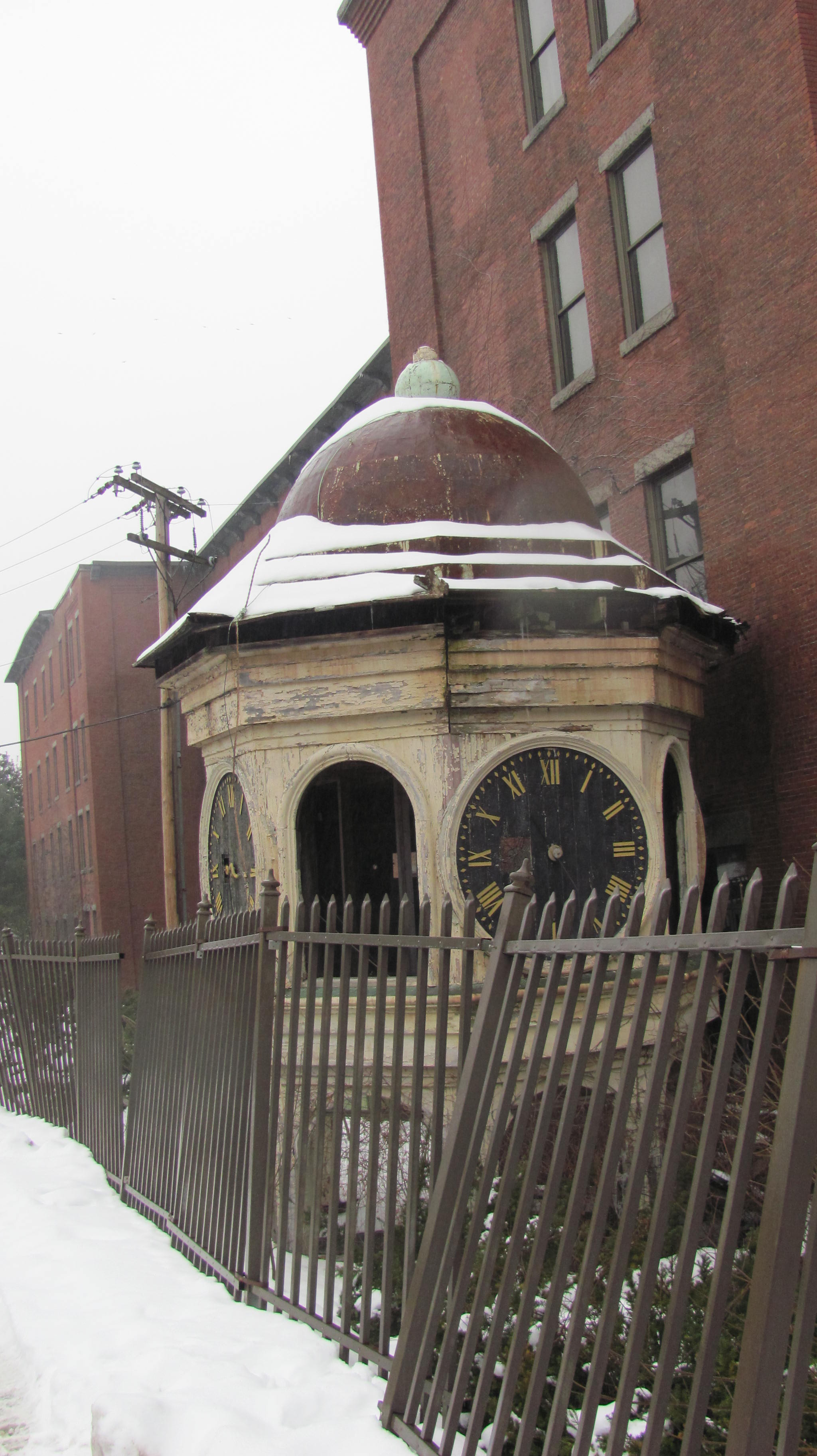
An excerpt from that series: “As I walk along Lincoln Street — past a tired wrought-iron fence that is leaning and lurching in places — I can almost hear the ghosts of the past. They call to each other, unloading bales of cotton, smoking cigarettes and wiping the sweat from their brows.”
Back then, the former Lincoln Mill clocktower was perched and rotting on the ground in front of the vacant and deteriorating mill building that is today – 23 years later– a luxury hotel with a roof-top swimming pool, a craft distillery and an expansive lobby that has become a favorite gathering place for locals and visitors alike.
Who would have imagined?
But here’s the other thing, the downside of the good news.
A photo I took of the former Lincoln Mill clocktower nearly 25 years ago.
In 2001, it wasn’t hard to find a parking spot in downtown Biddeford. In 2001, you didn’t see any homeless folks sleeping in doorways on Main Street. In 2001, rents – both commercial and residential – were among the lowest in southern Maine.
Why? Well, it’s pretty simple: very few people really wanted to live or shop in downtown Biddeford back then. The stench of burning garbage; shuttered and vacant mill buildings and crumbling infrastructure hardly gave off a welcoming vibe.
Sure, there were some notable exceptions. Legacy businesses such as Reilly’s Bakery and Biddeford Savings Bank were able to weather the storm created by an economic recession and the terrible decision to burn garbage downtown.
But many people had given up on the downtown. Politicians set their sights on easy targets: the development of Wal-Mart and other big-box stores on the outer end of Alfred Road, a proposed racino and continued suburban sprawl on the western side of the city.
As I go through the stories and columns I wrote back then, I am reminded of the tremendous debt we all owe to David Flood, Wallace Nutting, Renee O’Neil and so many others.
We should also never forget the business leaders, civic activists and policy makers who formed Twin Cities Renaissance, the coalition of visionaries from both sides of the Saco River who committed themselves to seeing MERC finally closed.
Sure, Alan Casavant deserves lots of credit for helping us believe in our city again, but he got a lot of help from people who believed in Biddeford even when many of us had given up on the city.
Thank you for your blood, sweat and tears.
In the movie Jaws, Mayor Larry Vaughan says he was just “acting in the town’s best interests” by keeping the beaches open.
In Biddeford, Mayor Wallace Nutting was acting in the town’s best interest by believing in his city and its people.
Make no mistake. Our city still has challenges and hurdles to clear. But if you look at what has been accomplished over the last two decades, Biddeford’s future seems bright.
Some people see racism around almost every corner.
I am not one of those people, but . . .
Two days ago, the city of Saco and its neighboring communities were shaken by a violent crime that resulted in four suspects shooting at each other from their cars while traveling on Elm Street.
At the first press conference, Saco Police Chief Jack Clements described the suspects as “four Hispanic males”
One of the suspects involved in Friday’s shooting. Photo: Saco Police Department
It didn’t take long for bigotry, half-assed assumptions and hatred to begin spreading all over social media.
While I can certainly understand why many people expressed fear and concern, I cannot believe how much hatred is brewing in my own community.
Several people used the incident to underscore their disdain for President Joe Biden and his immigration policies.
Within two hours of the incident, Facebook was being flooded with racist rhetoric, such as: “See? This what happens when you have open borders.”
Or this: “Saco used to be a nice, peaceful town until these people came here and ruined things.”
The woman (a self-described Saco native) who posted that last comment conveniently forgets that Friday also marked the 25-year anniversary of Ashley Ouellette’s murder. Ashley, a 15-year-old Thornton Academy student, was found in the middle of the road by a passing motorist.
I remember covering that story. I don’t recall anyone blaming President Clinton. Of course, that terrible crime took place long before Facebook was invented.
If a Hispanic male commits a crime in southern Maine, he must be an “illegal immigrant.” He must be “one of those people.” Really???
These suspects have yet to be identified. How do we know where they were born? Maybe they were born at Boston General hospital. Maybe they were born at Maine Medical Center. Who knows?
Many people just assume if a Hispanic person is involved in a crime, he or she must be an “illegal immigrant.”
I hate to break the news to you: It’s entirely possible that these four men are United States citizens just like you and me.
I can’t prove that, but you can’t prove they are “illegal immigrants,” either.
Maine is vastly a rural state, in fact the most forested state in the country. Our violent crime rates are much lower than many other places.
For those of us who grew up here, things like the murder of Ashley Ouellette or Friday’s shooting incident are jarring – not at all common.
Imagine how people in Lewiston, Maine felt a few months ago when a mass shooting took the lives of 18 innocent victims.
The city of Lewiston is also home to a growing population of Somalian refugees who came to America seeking a better life. They are people “from away.”
The funny thing? The Lewiston shooter was a white guy. A United States citizen. A military veteran.
In fact, the overwhelming majority of mass shootings (7 or more random victims) are committed by young white men.
See? Members of the Abenaki tribe nailed it 300 years ago, when they said this place has gone to hell since these people from away came here.
The vast and overwhelming majority of Saco residents are some of the most decent, kind, generous and intelligent people you could ever hope to meet.
But sadly, the idyllic community of Saco is just like every other place: home to a few ignorant and insecure souls.
The Saco Police Department has lifted a temporary “shelter-in-place” order that was issued early Friday morning following a reported shooting that happened near the corner of Main and Elm streets in Saco.
As of 8 p.m., Friday, the suspects who were involved in the shooting have not yet been apprehended.
In a statement issued late Friday evening, police described the situation as an ongoing “active investigation.” Police are asking members of the public to remain vigilant and report any suspicious activity to the Saco Police Department.
Eyewitness photos from Saco Police Department
What happened earlier today?
According to a statement from the Saco Police Department, officers responded to reports of gunshots in downtown Saco just before noon on February 9.
Witnesses told police that the shooting took place between two vehicles, a red Dodge Charger and a gray Honda HRV, near the intersection of Elm and Temple streets.
Police say the vehicles then moved toward the intersection of North and Elm streets, where a collision occurred. The Honda HRV, which was involved in the shooting, crashed into another vehicle in the intersection. The force of the crash pushed the vehicles into an Old Orchard Beach school bus stopped at the intersection.
No students on the bus reported being injured in the crash, according to police.
Following the collision, four men described as Hispanic males fled the scene on foot. Evidence at the scene indicates that at least one person, wearing all dark clothing, who fled from the crash scene, had been shot in the right arm, police said.
A firearm was observed in the back seat of the Honda HRV. This vehicle has been towed and secured in the furtherance of the investigation.
During a press conference earlier today, Police Chief Jack Clements told reporters that the gun in the vehicle was a “semi-automatic” handgun.
Police, including mutual aid from local and regional agencies, tactical units, K9 units, and drone operators, are continuing to search and clear areas where potential sightings of the suspects were reported.
The red Dodge Charger was found outside the city of Saco later in the evening and is being towed and secured as the investigation continues.
As of press time, it remains unclear about where exactly the vehicle was found.
As a precaution, all Saco schools, including Thornton Academy and Thornton Academy Middle School, were locked down due to proximity to the incidents.
Students were later released under police supervision.
During the earlier press conference, Clements told reporters he does not believe that there is any connection between this incident and a previous shooting several weeks ago on Temple Street in Saco.
The Friday incident triggered a massive law enforcement response, including members of the Maine State Police tactical squad, the U.S. Marshall’s Office and neighboring law enforcement agencies, including the Biddeford Police Department, the Old Orchard Beach Police Department, the Kennebunk Police Department, the Wells Police Department, the Scarborough Police Department, the York County Sherrif’s Department and the Cumberland County Sherrif’s Department.
Police are asking anyone with information regarding the suspects, the shooting, or the vehicle accidents to please contact the Saco Police Department at SacoPD@sacomaine.org or by calling 207-284- 4535.
Saco Bay News will continue to monitor and update this story as more information becomes available.
Do you hate Taylor Swift or do you love Taylor Swift?
According to the internet, there really isn’t much middle ground when it comes to the woman who was recently crowned as TIME magazine’s Person of the Year.
No one, not even her most ardent detractors, can argue against the fact that Swift has become a cultural phenomenon; and her overwhelming success cannot be denied.
Taylor Swift attends a Kansas City Chiefs game (Photo Jason Hama, People Magazine/Getty Images
Taylor Swift, 34, has shattered long-held records in the music industry. Her influence among people under 30 is staggering.
Consider this. Both Billboard and Rolling Stone magazines have described her as one of the greatest singer/songwriters of all-time. She has sold more than 200 million albums; and she is the highest-grossing female touring act ever.
According to the New York Times, Taylor Swift has more number-one albums than any woman in history.
A Political Trigger
According to a wide-variety of sources, Taylor Swift encourages young people to register and vote.
For reasons I cannot explain, this seems to anger many Republicans. Apparently, many far-right stalwarts get nervous and rather upset about young people voting.
Among her most vocal critics, there does seem to be a not-so-subtle layer of misogyny and self-loathing.
In fact, many people have claimed that “Taylor Swift is ruining the NFL (National Football Leage)” because of her romantic relationship with Travis Kelce, a tight end with the Kansas City Chiefs.
In a few days, the Chiefs will return to the Superbowl to take on the San Francisco 49’ers. (More about that in a moment)
Lots of people find themselves annoyed whenever Taylor Swift attends games to support her boyfriend. Again, what is it about two young people being in love that winds people up?
Is the relationship between Swift and Kelce ruining the NFL? Hardly.
Did anyone think that Marilyn Monroe ruined baseball when she began publicly dating Joe DiMaggio, the legendary center-fielder for the New York Yankees?
Does Kelce play better or worse when Taylor attends one of his games? We’ll get there in a minute.
A role model for young women?
Taylor Swift’s fan base – though predominately under the age of 35 – also extends to many older folks who say they like her music; they like her reputation as a philanthropist; and they view her as a strong feminist.
In fact, many of my friends have said, they see Taylor Swift as a role model for their own daughters and other young women.
On this point, I’m not so sure. But, again, this is the phenomena of Taylor Swift. There are many, many strong, generous and very accomplished women in the world. What makes Taylor Swift so special?
For example, Dolly Parton is also a very accomplished musician and actor. She is also a strong, self-made woman who grew up in extreme poverty and went on to become hugely successful in the entertainment business.
Parton is from a different generation, however. While Swift grew up in a wealthy family, Parton had to overcome much larger obstacles on her way to success, fame and fortune.
If you think it’s tough being a woman today, try being a woman in the 1950s.
I think Swift is the voice of her generation, and my wife reminded me that when Dolly Parton was struggling as a songwriter/musician, there was no internet. No Tik-Tok videos. No Apple streaming.
I think it’s quite admirable that Taylor Swift is a well-known philanthropist. Even better, I like the fact that she doesn’t feel compelled to issue a press release every time she opens her checkbook.
More impressive: unlike so many other celebrities, she reportedly treats her staff well. Though I am not a fan of her music, her songs do exude a common thread of strength and self-confidence.
These are all great traits; and thus, great lessons for young women and girls.
But let’s not kid ourselves. Taylor Swift uses her sexuality as a reliable base for her performances. I don’t mean to sound like a prude, but Swift encapsulates that still predominant image and goal of girls being thin, attractive and shaking your booty.
Though we have made some progress on this issue, so many young women today are still struggling with body-shaming issues; the proverbial Barbie-Doll body type.
Would Taylor Swift be as successful if she put on 90 pounds? I don’t know. Should she be a role model for young women? I guess, there’s a lot more to like than there is not to like.
Me and Taylor Swift
I am a grumpy, old, white guy . . . a rather under-represented demographic when it comes to liking Taylor Swift.
A few weeks ago, I made the mistake of publicly stating my distaste for Taylor Swift. I wrote that I was perplexed by the fact that academic institutions – including Harvard University – were teaching courses relating to Taylor Swift.
The reaction was swift (no pun intended) and visceral. I was told that I must be uncomfortable with my own sexuality; that I was yet another insecure man who harbors a misogynistic view of the world.
Look, folks, I admire and respect many women. I have never met Taylor Swift. I do not own any of her music, nor have I ever attended one of her concerts.
How can you possibly “hate” someone you have never loved? Is it not okay to say that I’m not a big fan; or that I could not possibly care less about Taylor Swift?
Despite what some of my friends said, I really like and love the music of several female singers, most notably Liz Phair and bands such as Veruca Salt, The Breeders and The Linda Lindas.
Strong women rockin’ the house
Liz Phair is an accomplished indie-alternative singer/songwriter. She has never come close to Taylor Swift’s popularity but she has been an outspoke advocate for female performers in the music industry.
Many of Phair’s songs drip with anger and resentment. She is an in-your-face performer who is an undeniably independent and strong woman.
If I had a daughter, I would want her to listen to Liz Phair. Or maybe, the Linda Lindas would be more appealing to younger women. In fact, the drummer of that band is only 13 years old.
The Linda Lindas are young women, all under the age of 20. They are predominantly Asian and their music is sharp, poignant and relevant, taking on issues such as racism and misogyny.
In my opinion, Taylor Swift pales in comparison to Liz Phair, the Linda Lindas or Veruca Salt. But that’s just me.
Taylor Swift and The Superbowl
Will Taylor Swift be a distraction at this year’s Superbowl game? Will her presence affect the performance of her boyfriend, Travis Kelce? Let’s close out this blog post by considering some stats about Swift and Kelce.
With Taylor Swift in attendance, the he Kansas City Chiefs’ record is 9-3 (3-0 in playoffs). Without Taylor Swift in attendance, the Chiefs’ record is 4-2.
With Taylor Swift in the audience, Kelce’s stats: 80 catches, 946 yards (78.8 yards per game), five touchdowns.
Without Taylor Swift in the audience, Kelce’s performance dims somewhat with 36 catches, 300 yards (50 yards per game) and three touchdowns.
The only people who should be upset about Taylor Swift attending this year’s Superbowl are the San Francisco 49’ers.
Let’s close out with a couple videos: The first from Liz Phair and then one from the Linda Lindas.
Over the last few days, I have become increasingly convinced that I could possibly die sometime later this year, so please just bear with me for a moment.
Over the last few days, I have spent roughly 17 hours per day in front of my computer. That’s just too much, for anyone.
It wasn’t for work, and it wasn’t for fun.
Instead, I was being driven by thoughts of my upcoming 60th birthday. I was also being driven by the sad fact that I have lost two friends and one family member in just the last 90 days.
One of those people was just 40 when God called her home. The others were in their early 60s.
One day you’re here and the next day you’re not.
I have been thinking a lot about my own death. After all, it’s inevitable, right? Often, you don’t get much warning about your expiration date.
So, I decided I had to get busy.
I am a writer . . . by vocation and also because I am a glutton for punishment and self-loathing. Over the last 40 years, I have written a lot of stuff. A lot of stuff. Tons of stuff.
There are dusty copies of unpublished manuscripts in my office. I routinely tell myself that I will soon take another stab at finishing one of my novels. I look at what I have written and invariably have the same reaction.
Pathetic.
As a young child, I enjoyed writing stories about things like vampires and natural disasters. I had several teachers encouraged me to continue writing. Folks like Peter Flaherty, Peter Scontras and Richard Mullins.
On the other end of the spectrum, I received some valuable criticism, most notably by Bob Melville, the city editor of the Journal Tribune in 1981.
I was an unpaid student intern for a work-study project, and the very first thing I was about to have published was some poor bastard’s obituary.
I took copious notes from the funeral home director and banged it out on my IBM Selectric II typewriter.
Mr. Melville took one look at what I had written and uttered the following words: “What’s the matter, kid? Do they not teach English at Thornton Academy? I strongly suggest you find a different line of work.”
Several years later, when Melville was retired and serving on the Biddeford School Committee, I reminded him of that exchange. He had forgotten the incident, took a sip of his beer and said, ‘You’re welcome. All writers need a good kick in the ass so they can try harder.”
A lifetime of writing
Since the early 1990s, I have worked as a general assignment reporter, as a newspaper columnist and an editor. I also worked briefly as a collaborative research reporter for the Northwest Atlantic Marine Alliance.
I have written and published in-depth policy reports, including a 19-part series that focused on the former Maine Energy Recovery Company (MERC) and more recently a three-part series regarding the issues of homelessness in my community.
Folks in the Biddeford-Saco area know me primarily as the guy who wrote the All Along The Watchtower column in the Biddeford-Saco-OOB Courier between 1999 and 2006.
That satirical column was intended to keep local politicians on their toes and as a way for me to vent my frustration on topics ranging from climate change and gun control to abortion and the absurdity of what happens daily in Washington D.C.
I’ve also been honored with the opportunity to write interviews about several interesting people, including a former senior advisor to Ronald Reagan, a well-know folk singer and the first openly gay Speaker of the Maine House of Representatives.
Some of my favorite writing endeavors include essays such as The Lincoln Tour, a rambling missive I wrote about a hilarious three-week, cross-country adventure with my best friend in 1986.
Most of you already know that I periodically struggle with mental illness that includes bouts of severe depression, extreme anxiety and even psychotic behaviors from paranoia to schizophrenia. Thus, I am perhaps most proud of my regular blog posts regarding mental illness and the stigma that so often surrounds that subject.
Okay, you get the point. I’ve written a lot of stuff. And I’m still writing almost every day.
But what happens when I die? Where will all that stuff go? Will it just be forgotten? My legacy and passion erased?
I am a communications consultant, but I know next to nothing about creating or maintaining a website. That said, I have spent more than 50 hours this week trying to improve the site that I use for both business and fun.
A few years ago, when I first became self-employed, I scrubbed the site and removed all the personal stuff, all the stories about cage fights and city hall, chain-smoking and wandering the streets of downtown Biddeford midnight.
Today, I am essentially retired and very selective about taking on any new clients. So, because I am a cheap bastard, I decided to split the one site between business and pleasure.
It’s nothing fancy. In fact, it’s a rather dull site. But I have made an effort to improve navigation and simplify things.
I wanted one, small place on the world-wide web, where I could archive a lifetime of writing; a place that will hopefully survive for a while long after I have shuffled off my mortal coil.
Here’s a fucking pen
One final story. In 1989, I was working as an industrial tool salesman and lived just outside of Annapolis, Maryland. I was 25, single and didn’t know many people. I often spent Sunday afternoons sitting at a bar, drinking Guiness near the harbor.
It was a quiet place. I often brought a book to read to help pass the time. One afternoon, a disheveled older gentleman walked into the bar and sat down next to me. We began chatting, and he asked me a question. “You don’t seem like a tool salesman. What do you really want to be?”
I was eager with my response. “I want to be a writer.”
He scoffed, reached into his jacket and produced a cheap pen that he slammed down on the bar. “Here’s a pen, go be a fucking writer.”
And with that, he wandered back outside, and I never saw him again. I held onto that pen for many years afterward.
In closing, my ‘improved’ website offers no fancy, slick graphics; very few video clips. Some photos; but mainly just a lot of written content: satire, humor, fiction, policy analysis, local politics . . . all of it one place. Organized, archived and presented with simplicity.
If you ask Alan Casavant to describe his time as Biddeford’s mayor, he’ll tell you he used the same basic approach that he used as a high school teacher for more than 35 years.
Casavant, 71, is now completely retired as both a teacher and politician. He served 12 years (six consecutive terms) as the city’s mayor, first elected to that position in 2011. He also served four terms in the Maine Legislature as a state representative and served on the Biddeford City Council for 18 years, first elected in 1975.
Alan Casavant/ Seaver photo
He was born and raised in Biddeford and graduated from Biddeford High School in 1970. Initially, he majored in psychology during his first two years of college at the University of Southern Maine, but during his junior year, he transferred to the University of Maine Orono and decided to study teaching.
As fate would have it, he was assigned to Biddeford High School in order to complete his student teaching requirement. He was then hired as a permanent substitute teacher and then became a full-time social studies teacher at his alma mater.
He also coached the Biddeford High School hockey team, leading the Tigers to a state championship and is remembered by many people as a formidable broom ball player.
Casavant became the city’s second-longest serving mayor. Only Louis “Papa” Lauzier served longer than Casavant, from 1941 to 1955 – a total of 14 years.
You didn’t want to break Mayor Lausier’s record? Just one more term?
(Laughs) “No. I never set out with the idea of serving as long as I did. In fact, I had pretty much decided that I was going to step down two years ago, but I had a friend who convinced me to serve just one more term, and it appealed to me because I felt like there was still some unfinished business to take care of.
“I’m 71 years old, and I had done it for 12 years. I don’t think anyone intended to have any one mayor serve that long, but the real trump card was losing the hearing in my left ear.”
You first ran for city council when you were just 23 years old, which means the bulk of your life has been serving the city of Biddeford as an elected leader. What drew you into local politics?
“I really enjoyed politics. The process and the players intrigued me. The psychology of it (Laughs). I enjoyed being part of the decision-making process, and having input. I used to tell my students – and it’s not to be taken egotistically – but I trusted me making the decisions more than I trusted anybody else. (Laughs)
“I felt, if I was on the outside looking in, I could give my view but that didn’t mean my viewpoint would resonate with the person I was talking to, whereas – actually being there I could listen but I could also be an active, very-active participant. I really enjoyed that.”
How has Biddeford’s political world changed over the last 50 years, going back to when you first ran for the council in the 1970s?
“It’s changed so much. I think people were more in tune with the political process back then; with what was happening at City Hall back in the ‘70s. You had little organizations all over the city, where politics were discussed, such as the Green Lantern Club on Green Street.
“There was more public input because people were more aware of what was going on back then. We had a daily paper covering everything happening in the city. The mayor was a much stronger position, but it was also more familiar. You didn’t have the nastiness, and I say that because I was always in the minority back then. There were three of us on the council in our 20s. It was always the majority against me, Dick Lambert and Billy Zuke. So many of the council votes were 8-3. It was more friendly. We would all go out together after the meetings for a bull session at Bull’s Café.”
What motivated you to run for mayor against an incumbent (Joanne Twomey) who was widely considered as basically unbeatable?
“The casino proposal that she was supporting concerned me, but it was much more about a philosophical and process difference. During that time period, too many people were watching council meetings as entertainment. The meetings were often bombastic and confrontational.
“I just thought that I could do a better job. I had retired from teaching, so I had the time. I just believed that a lot of people were ready for a change.”
Besides wanting to change the tone of how business was conducted during council meetings, what were your other priorities?
“Well certainly, the issues surrounding the Maine Energy [Recovery Company] plant loomed very large on my screen. I thought that had to be resolved because of what I had learned and come to believe. Not only was it an economic issue and an environmental issue, it was also a psychological issue. It was as if the city had given up on itself. We had become known as “Trash Town, U.S.A.” I knew that had to change.”
Why do you think public participation in local government has declined so much?
“I’m convinced that it’s a lack of knowledge. If you look back at the ‘70s, ‘80s and ‘90s, everybody read the Journal Tribune and/or the Courier. Reporters back then would pursue the stories until the end. When David [Flood] sold the Courier and the Journal closed, there became a vacuum of legitimate news. I also think some people may feel jaded by the process because of the misinformation that abounds on social media like Facebook.”
What do you think was your greatest accomplishment as mayor?
“Recreating pride in Biddeford. It’s nothing really physical. It’s just people in Biddeford actually believe in themselves as a community again. It was as if the community had lost its mojo; the recession, the Maine Energy plant, downtown business closings – – the glass was always half empty.
“People now openly brag about living in Biddeford. I recently saw an ad from a Kennebunk hotel that pointed out they were located only five minutes from Biddeford.”
What was your biggest disappointment during your 12 years as mayor?
[Pauses] “Probably dealing with the housing issue. Trying to figure that out and recognizing that there is no easy answer. There’s no instant answer, especially since it’s a regional, statewide and even national issue.
“We really need a regional approach. There has to be a concerted effort, driven by the state.”
Do you miss being the mayor?
(Laughs) Yes and no. I can’t even watch the meetings right now. I miss the adrenaline rush of being right in the middle of everything. I don’t want to meddle, which is really difficult for me to do. (Laughs) It’s really hard to do something for 12 years and then just stop, suddenly being out of the loop and not knowing exactly what’s going on – – just stopping cold turkey. It’s a little strange.
“There is also relief. When I was mayor, I’d spend almost an hour every morning and every night responding to e-mails. Now I maybe get four e-mails a day.” (Laughs)
As a politician, do you see social media as helpful?
“I call it anti-social media. Most of it is very disparaging and accusatory. It took me about a week or two as mayor to decide that I wasn’t going to read most of it. Otherwise, I’d see things that I didn’t say or do, and it got so frustrating. It’s so often just a rumor mill.”
What do you see as challenges on Biddeford’s horizon?
“Well, obviously the housing issue is going to dominate our conversations for a long time, and we’ll need to tackle that situation; but we also are looking at lots of other major budgetary issues, including staffing. How do we retain and attract professional employees? People want services, but that cost money. You can’t have it all.
“I also worry that our economy is slowing a bit in the downtown. The downtown really defines who we are as a community, and it’s important for our overall economy.”
Your political adversaries blame you for pushing so hard for a municipal parking garage.
“The reality is that we actually need at least two parking garages. The next one needs to be near the corner of Main and Alfred streets. It’s interesting to me that in so many other cities, whether it’s Westbrook or Portland or Auburn, there is virtually no resistance to parking garages.”
You describe your role as mayor as simply an extension of your time as a high school teacher.
“It’s the same skill set and the same techniques. It was about repeating, repeating and repeating information so that the kids could get it; it was about connecting the dots so that they could understand it; and it was also about forming relationships and helping them feel good about themselves.
“It’s never just one person leading the city. You really need a team approach, it’s like a quilt with several different patches. It’s rewarding, sometimes frustrating but if you have the right people around you — if you can build a team with lots of different perspectives — then you can do almost anything.”
The ‘Jolly Old Elf’ offers some sage advice about unconditional love, magic and the true meaning of Christmas
He’s known by many names. Some call him Father Christmas; others call him St. Nicholas or Kris Kringle. But here in North America, he is best known as Santa Claus.
Just two days before the Christmas holiday this year, Santa made time to sit down for an exclusive interview with Saco Bay News. He declined to give his age. In fact, he artfully dodged many of the questions our readers have asked.
Santa and Mrs. Claus pose for a photo during a recent trip to Saco.
Although well known for his “jolly” disposition, Santa was a tad grumpy during our interview. It’s understandable. He’s facing a lot of pressure this time of year. Billions of boys and girls all over the world are waiting anxiously for his visit and his annual delivery of toys and treats.
We decided to let our Saco Bay News readers come up with the questions for this interview.
The legend of Santa Claus transcends cultural bounds and goes back hundreds and hundreds of years. Kelley B. wants to know what you view as major changes to your mission, specifically your annual stop at the Island of Misfit toys that started in 1964?
“Well, let’s get real. In my view, that was a very recent change, and I really owe a debt of gratitude to Rudolph The Red-Nosed Reindeer for tipping me off about that place. Honestly, we are all misfits – every one of us, even me. We are all different. None of us is perfect. We are not defined by our flaws. We are defined by our capacity to love one another.”
Mark J. wants to know if Hermey the Elf is still practicing dentistry.
“Oh sure. His practice is thriving. In fact, he just opened another franchise location here at the North Pole. He’s always up my butt about the importance of flossing; as if I need another thing to worry about. (Laughs).
Celeste T. wants to know why she didn’t get an Easy Bake oven when she was a little girl.
“I get that question a lot.”
About Easy Bake ovens?
“No, silly. Lots of people wake up disappointed by something on Christmas morning. I remember when Celeste asked for that toy oven. It sort of broke my heart to see her disappointed that morning. But that was a tough year for Easy Bake ovens. There was a huge demand, and unfortunately my elves just could not keep pace.
“But you know what? Today, Celeste has a wonderful oven that she uses to cook her meals and to make treats for her family and friends.
“Many people all around the world do not have an oven. In fact, many people don’t even have a home. I’m just super pleased that Celeste is still willing to be nice to other people, even though she didn’t get exactly what she wanted on one particular Christmas morning.”
Deborah P. wants to know what kind of cookies are your favorite. She also wants to know whether she should leave carrots or sugar out for the reindeer.
“Well, she’s a very thoughtful young lady. I like all kinds of cookies. Dude, look at me. I didn’t get to be this size by licking icicles. There’s no such thing as a bad cookie, in my humble opinion.
“As for the reindeer, they prefer carrots. Carrots are rich in both calcium and Vitamin K. They promote good bone density and help with your vision, something that is very important if you’re flying all over the world at night.”
Suzanne C. wants to know more about Mrs. Claus and whether she helps you?
“There is no way I could do what I do without lots of love, help and support. Mrs. Claus and I have been married a long time. A very long time. I mean like centuries . . . you get my gist?
“Like most wives, Mrs. Claus is always willing to give advice. Over the years, I have learned that it’s best to listen to your partner. Sometimes, the most loving thing you can do is to listen when they or anyone else is speaking to you.”
Jeff R. wants to know your favorite Christmas movie.
“I like all of them, but let’s get real. Die Hard is not a Christmas movie. I suppose, my favorite Christmas movie is “It’s A Wonderful Life.” That movie really underscores the true meaning of this holiday.
“Mrs. Claus likes all those Hallmark Christmas movies. Let’s just say I’m quite grateful that we have two televisions and a Netflix subscription.”
Larry M. wants to know how you leave presents at homes without a chimney or fireplace.
“It’s magic.”
Magic? What do you mean magic ?
“Listen, Jimmy Olsen. There’s a lot you don’t know about magic. Magic is real as the nose on your face. Magic is simply the proper combination of love, faith and hope.
“Imagine a world without magic. A world where every single thing has to be analyzed, studied and proven? What a sad world that would be. Childhood is often described as ‘magical’ because children are willing to believe in things they don’t necessarily understand.
“Whenever you get on a plane or whenever you get in your car, you have faith. At least enough faith that you are going to arrive at your destination. You don’t have to understand aeronautics or how an engine works. You just need faith and a bit of hope. Magic is all around us if we focus on love. If we open our hearts and our eyes, each of us can see unlimited potential in each other and in ourselves.”
So, I suppose you’re going to say that magic makes the reindeer able to fly or that you can visit every country in the world in just one night?
“Absolutely. Magic is a wonderful gift. Every time you smile at a stranger, you are spreading love. Every time you pet a dog or hold the door for an elderly person, you are acting out your love. Everyone – – and I mean every one of us – has the power to love. Love does not require anything. It costs nothing but is the most valuable thing in the world.”
Some people say you’re not real.
“Those people are right, but they are also wrong. I am as real as you want me to be. I don’t care if you’re four years old or 40, you can believe in me if you choose. Again, love is a choice. That’s the whole meaning of presents, a practice of showing love. You can’t buy love at the store; it lies within each of us.
“Look; I gotta run. The elves are working overtime, and I need to get ready for a very, very busy night.”
But I have so many more questions. Who are you? And why do you do this?
“Who am I? Take a look in the mirror, sonny. I am you; if you choose to be me. I am your neighbor. I am your co-worker, your classmate, your friend and your enemy.
“I am the guy you are argue with on Facebook. I am your grandfather, your favorite aunt. I am a man, and I am a woman. I am very young and very old. I am simply the personification of love. That’s why I exist.
“Why do I do this? Because I can. Because I choose to love. Because this day – no matter what you call it – no matter your religion, culture or education – – it’s all about hope. About the possibility of a new start, about the potential of unconditional love. Today is a call for us to love one another.
“Now, if you will excuse me, I need to put some fresh batteries in Rudolph’s nose. Ho, ho, ho . . . I’m almost ready to go.”
Editor’s Note: On behalf of all of us at Saco Bay News, we hope you have a safe, warm and happy holiday season!
A retired judge, district attorney, state commissioner and former mayor from Biddeford reflects on his career and the changes in his community.
Hollywood movies often rely on stereotypes. Lawyers are frequently depicted as corrupt and self-serving. The district attorneys in those movies are not much better, using their power as glorified crime fighters for political gain. Mayors are routinely portrayed as bumbling, narcissistic egomaniacs; and judges wield their power with a rigid temperament and periodic fits of rage.
Michael Cantara/ Seaver photo
Michael Cantara of Biddeford has served in all four of those roles, but he is the exact opposite of those Hollywood stereotypes. Instead, Cantara is well-known throughout southern Maine as a man of principle, restraint, intellect and compassion.
Among many other awards and accomplishments, Cantara was inducted into the Maine Franco-American Hall of Fame and also inducted into the Biddeford Hall of Fame in 2022.
Cantara, 70, was adopted as an infant from the St. Andre Home in Biddeford by Jean Paul and Laurette Cantara. He and his two sisters were raised in a very modest home on Granite Street Extension. His father worked at the Saco Lowell machine shops. His mother worked at the Pepperell textile mill and later as a waitress at the Nutshell Restaurant in Biddeford.
He attended parochial schools, including St. Andre’s and later St. Louis High School, which closed just before his senior year. Thus, he graduated from Biddeford High School in 1971 before attending Colby College with the idea of becoming a pediatrician.
You planned on becoming a doctor but ended up retiring as a judge. A lot of things must have happened between those two bookends.
“Oh yes, they certainly did.” (Laughs) “I wasn’t exactly a clear career thinker when I went to school. I majored in French with a minor in biology. But my dream of being a pediatrician floundered on the shoals of organic chemistry. (Laughs) So, I reset the dial and decided to become a teacher.
“In my senior year of college, I was nominated for a Fulbright Teaching Scholarship. So, I got this wonderful gift of teaching in a French high school in Normandy, near the small town of Rouen, where Joan of Arc was burned at the stake.
“I taught American culture, history and language at a vocational school. My students were adolescent French boys from the local neighborhood. They were so receptive to the ideas I was teaching because at that time all things American were considered pretty cool.”
You returned to the United States and ended up going to law school.
“I had wanted to teach French on the college level, but was intrigued by political science and chose the mayoral election in Paris as the topic for my doctoral thesis. At that time, there was quite a bit of upheaval on the city’s political landscape.
“There was so much happening in the early 1970s. In general terms, it was a time of upheaval when young people were being encouraged to stand up for what they believed; to be a part of the social change that was happening all over the world.
“I wanted to go back to Maine, and the options for teaching French were practically non-existent, and I was exploring opportunities for public service. So, I enrolled at the University of Maine Law School.”
You were paying close attention to politics on the national, state and even local level, at a time when Maine’s own Senator Edmund Muskie was derailed from his presidential campaign because he allegedly teared up during a press conference.
“Yes, men – – especially back then — were not supposed to cry. I was very inspired by Senator Muskie and his dedication to public service. As you know he was the architect of the Clean Water Act. Without that federal legislation, which was vitally important for Maine, we wouldn’t be talking about the Riverwalk in Biddeford today had it not been for Ed Muskie’s leadership.”
“In fact, Senator Muskie gave the commencement address at my high school graduation, which was held at Thornton Academy because Biddeford did not have enough space.”
You were drawn to the Democrat Party and today remain as a party stalwart.
“I was very much influenced by my parents. Both my mother and father read the paper every day, and they were both Democrats who understood the importance of voting and paying attention to what was happening. Democrats were very pro-union.
“My uncle Henry, however, was anti-union. He worked at S.D Warren and was very much a company man. Regardless, my father was always very calm when talking to my uncle about the importance of labor unions.
“My father would listen patiently and spoke in a measured way, but always remained committed to his beliefs. I learned a lot from my father.”
You hung out your law practice shingle on a Crescent Street office without much money in your hand.
(Laughs) “Actually no money. My law partner Jim Boone and I were able to secure the lease by offering sweat equity. We would paint the building and sand the floors in exchange for the first few months’ rent.”
And then you decided to get into politics.
“What was I thinking? (Laughs) I decided to run for the Legislature in the early 1980s. At that time, I was living on State Street. And the occupant of that House seat in the Legislature was Lucien (Babe) Dutremble.
“I don’t know what possessed me, but I had the crazy idea of challenging Mr. Dutremble – one of the most respected and adored men in the city – in the Democratic primary. And, of course, throughout the campaign he couldn’t have been any kinder to me.
“What was so strange and incredible to me is that I lost only by 16 or 18 votes. I can’t remember exactly, but it was slim enough to invoke the city charter’s requirement for a recount, which was presided over by Luc Angers, the city clerk at the time. They were all paper ballots back then and the recount took place at the police department. The result didn’t change, but I thought that was probably the end on my political career.
“But then a couple years later, I was asked by Mayor [Robert] Farley to serve on the planning board, even though I was previously on the [William] Pombriant ticket who ran against Mr. Farley in the primary. I ended up serving almost four years on the planning board, and so I had a ringside seat to some of the issues affecting Biddeford: Affordable Housing, Land Use and Habitat Protection.
“Not much later, Gene Libby, who was the district attorney, asked me if I would join his office as an assistant district attorney. I enjoyed that work and was covering all three district courts, which were then located in Springvale, Biddeford and Kittery.”
And then you decided to run for mayor.
“Yes, and that was back when local elections were partisan, so there were primaries and a longer campaign season. There was no city manager. The mayor ran the city’s day-to-day operations, much different than it is today.”
Why did you only serve for one term?
“Because the seat for the district attorney was opening up. It was an open seat, and I was looking forward to the challenge.”
Bonnie (Belanger) Pothier told me that you practically hounded her to run for the mayor’s seat to replace you. She jokes that she just finally caved to your pressure.
(Laughs) “I knew that she was going to be a great mayor, and she proved me right. I didn’t always agree with her, but I had tremendous respect for her. She had a lot of uphill battles to fight, but she was a remarkable leader.”
While you were serving as district attorney, Governor John Baldacci appointed you as Maine Public Safety Commissioner for four years, and then during his second term, he nominated you to serve as a district court judge in York County.
“Yes. I was among five people nominated to fill new positions created in order to address significant backlogs of cases and to free up more judges throughout Maine to serve the newly-created business docket.”
You served as a judge for 12 years and retired in 2019. Do you miss it?
“I very much miss the people I worked with. I had the privilege of working with exceptional people; the clerks, the magistrates and the marshals. But the weight of some of the decisions a judge has to make – I don’t miss that particular kind of stress.
“It can be very challenging. You can provide a legal answer to a problem, but you’re not providing a life solution. There’s so much poverty – – financial poverty, health poverty, educational deficits and mental health issues, not to mention chronic unemployment.
“As a judge, you are witness to all of it and sometimes feel so powerless to change any of it.”
You are a true son of Biddeford. What challenges do you see facing the city today?
“I have been a citizen of Biddeford for most of my 70 years. Without question, we must address the issue of homelessness. Yes, it is a financially expensive and complicated issue, but we have an ethical obligation; a moral obligation to do more than just talk about the issue.
“I was taught that we are all children of God. I don’t want to let my brother or sister freeze to death tonight. We are living in 21st Century America, and I don’t think that’s too much to ask.
“It is an issue of dignity, and it is not insurmountable. We just need the political will to make it happen.”
From the humblest of beginnings, you went on to become a teacher, an attorney, a mayor, a district attorney, a state commissioner and then a judge. If they were alive, do you think your parents would believe how much you have been able to accomplish?
“I don’t know, but I do know that I learned life’s most important lessons from my parents, including the importance of service to your community; to volunteer for your school, your church.
“I certainly hope that I lived up to their expectations. I hope that I have lived a good life. I think that’s the most important thing.”
Two rather interesting events happened this week, each painting a troubling picture for loyal, solid Democrats at both the national and local level: Senator Joe Manchin of West Virginia announced he would not seek reelection, and City Councilor Marty Grohman was elected to become Biddeford’s next mayor.
What do Manchin and Grohman have in common?
Bear with me, because I think these two stories serve as a bellwether of a changing political landscape that has long alienated people in the so-called political “middle,” the centrists who are weary of extremists on both the left and the right of the political spectrum.
Mayor-elect Marty Grohman
Currently, Democrats have a razor-thin majority in the United States Senate, including the so-called “Independent” senators Bernie Sanders of Vermont and our own Angus King, both of whom caucus with the Democrats and consistently follow the marching orders of both Chuck Schumer and President Joe Biden.
It’s really nothing short of a miracle that any Democrat could win an election in a state like West Virginia, which is more red than Biddeford City Councilor Marc Lessard’s campaign signs. Manchin’s decision spells very bad news for the Democrats and will no doubt reshape the battle for senate control in 2024.
“Manchin’s moderate positions have at times been a thorn in the side of his increasingly left-leaning party,” according to ABC News political analysts.
So how does this connect to the rather mundane and much less dramatic world of Biddeford politics?
Theoretically, Biddeford’s municipal elections are supposed to be a “non-partisan” affair. Biddeford voters approved a change to the city’s charter in the late 1980s to dump the partisan labels of Democrat and Republican.
But if you really believe our local elections are non-partisan, I’ve got an ocean-front home to sell you in Ohio.
Make no mistake, despite all the pontificating, hand-wringing and lack of primaries, local elections are still very much influenced by each candidate’s political label. Not by his or her merits, but by his or her political allegiance.
Local Democrat leaders like State Rep. Marc Malon will tell you that’s not true.
It should be noted here that on top of his elected office, Malon is also professionally employed by the Maine Democrat Party. He currently serves as Party Affairs Director for the party.
Malon is a good guy. He’s very smart, and he is passionate about his politics. He works hard, and has a unique perspective on Maine’s political landscape. It’s his job to make sure that Democrat candidates get elected in Maine, even in places like Biddeford that are supposedly “non-partisan.”
So why do I keep saying “supposedly?”
Because partisan politics still plays a big role in Biddeford’s political circles and games, despite what the city’s charter says about municipal elections.
That said, state and local Democrat leaders, including Malon, did absolutely nothing wrong. Let me repeat that in order to be perfectly clear: No one on the ballot (nor their supporters) did anything wrong during Biddeford’s most recent election cycle.
So why am I taking the time to write about an election with zero incidents of impropriety by any of the candidates or their supporters? First, I am a local political junkie. Secondly, because I see a major shift starting to happen in both local and national elections.
In a story I wrote for Saco Bay News just a few hours after the results were announced, I listed those who supported and endorsed each of the mayoral candidates: Susan Deschambault and Marty Grohman. I posted that story on my personal Facebook page with a teaser, asserting that the Democrat Party closed ranks on a local level and clearly lined up behind Deschambault over Grohman.
It’s understandable (and quite predictable) that Democrat leaders would line up behind a Democrat over an “independent” or a Republican candidate in a general election, even though party affiliation isn’t supposed to matter in a non-partisan election.
Overall, the city of Biddeford – like many other mill towns — has a long history of leaning to the political left. Today, however, it seems that it’s becoming a matter of how far left a candidate needs to be in order to win elected office in the city.
I have a theory about why notable Democrat leaders were so enthusiastic about supporting Deschambault over Grohman. In a nutshell, it was political pay-back. Allow me to explain.
Both Deschambault and Grohman served on the city council. Both candidates served in the Maine Legislature. They had very similar platforms. In fact, during an October head-to-head debate, the only real difference that was clear to the audience was that Grohman likes to ride a bicycle and Deschambault says she likes to avoid both bicycles and walking.
Just days before the election, Mayor Alan Casavant repeated his support for Marty Grohman to take over the big chair at City Hall. On that same day, the Deschambault campaign ran an advertisement in the Biddeford-Saco Courier, listing local politicians who were endorsing Deschambault.
Deschambault’s list of supporters was impressive: State Sen. Henry Ingwersen, the highest state official serving Biddeford, was on that list. The rest of Biddeford’s delegation, including Malon and Rep. Erin Sheehan, were on that list. Former Speaker of the Maine House of Representatives Ryan Fecteau was on that list.
Previous state representatives Megan Rochelo and Victoria Foley (who lost her own bid for mayor against Casavant two years ago) was on that list. Previous mayors Mike Cantara and Bonita (Belanger) Pothier were on that list. Weeks before, Malon and Fecteau both used their personal Facebook pages to endorse Deschambault.
Pretty impressive, huh? What do they all have in common? They are all active, strident and loyal Democrats. On a local level, these folks are all political heavy-hitters. If you want something done, these are the people who can make it happen.
But it wasn’t just local Democrats who were offering assistance for Deschambault.
According to campaign finance reports, Deschambault’s campaign also got the support of many individuals well outside of Biddeford, including Democrat Party activist and former legislator Justin Alfond and State Senator Joe Baldacci, younger brother of former governor John Baldacci, both of whom wrote checks for Deschambault.
I saw that ad and thought to myself, it’s all over for Grohman. I publicly predicted that Deschambault would win the race. Despite what some people like Alan Casavant say, Biddeford is pretty much a blue community. Or is it?
But then something strange happened. Deschambault lost. Wait. What?
Despite such an impressive list of Democrat supporters and the fact that Biddeford most often votes blue, the party wasn’t powerful enough to knock off Grohman, the more centrist candidate.
Deschambault’s track record in the State Senate was basically flawless. She did whatever the party leaders told her to do. She always voted the way they wanted. She played nice. She toed the party’s line.
Good for her. She’s a Democrat. She voted the party line. Yawn.
During his stint in the Legislature, Grohman sometimes had the temerity to look at issues from a more centrist position. Furthermore, he had the audacity to run as an “independent” candidate against Democrat Chellie Pingree for the First Congressional District race. That was enough, right there.
The Republicans may have the symbol of an elephant, but the Democrats are the ones who “never forget.” Deschambault was being rewarded for her party loyalty, Grohman was being punished for thinking for himself.
Shortly after I posted my story on Facebook, Malon went on the defense.
“As a staffer for the Maine Democratic party and one of the electeds (sic) who endorsed Susan, I am pretty confident offering this analysis: there is little to no impact on the political landscape in Biddeford for state/federal races,” he wrote. “This is based on previous municipal and state/federal results and my analysis of this particular race . . .”
I responded toMalon, “ . . . but there is no denying that party stalwarts lined up solidly behind Deschambault: Baldacci, Alfond, the entire legislative delegation (current and former).”
Malon came back: “because they all knew her and liked her. Honestly that’s about the extent of it.”
Again, I like Marc. We have plans to get together for some good whiskey soon. We’re both political animals, but I’m not buying what he’s selling. Because they knew and liked her?? Are you freakin’ kidding me??
They all know Marty Grohman, too. What, exactly, did they not like about him? Because he rides a bicycle to work? Because he is a successful businessman? Because he has blue eyes? Because he volunteers at the skating rink and helps veterans? Spare me.
Biddeford is changing, including its political machinations, and that started more than 20 years ago, when MERC was still burning trash downtown. A Republican, Saco native (Gen. Wallace Nutting), beat two well-known, lifelong residents for the mayor’s seat. Ever since, the Democrats’ iron grip on the city has been slowly eroding.
I agree with musician Sheryl Crow, “a change will do you good.”
My advice to the Democrats? You’re gonna need a bigger boat.





 LESSONS IN MEDIOCRITY | OUTLAW JOURNALIST