Members of Maine’s Democratic Party are breathing a collective sigh of relief today after learning that Biddeford City Councilor Bobby Mills has returned to the fold as a solid Democrat.
For those of you playing at home, yesterday Mills announced that he was leaving the Democratic Party and his Primary challenge against incumbent Democrat State Rep. Megan Rochelo for the District 136 seat.
On his campaign Facebook page, Mills lamented that he is “too conservative for the Democrats and too liberal for the Republicans,” thus he was filing as an independent candidate — in the neighboring District 135.
That announcement followed on the heels of Mills’ decision to buy a new home.
But today Mills learned that his new home is, in fact, still part of District 136. So, of course, he is back to being a full-blooded Democrat, no different than FDR, Ted Kennedy or Joe Brennan….solid donkey all the way.
Apparently, a 2003 error at the Biddeford City Clerk’s office caused Mills and several others to believe a portion of Green Street (where his new home is located) was actually part of District 135, where former state representative and mayor Joanne Twomey is planning a Primary challenge against incumbent Paulette Beaudoin.
It’s been a tough couple of years for Maine’s Democrats. In 2010, their party lost control of both the Maine House and Senate. Libby Mitchell, the Democratic nominee for the Blaine House, got smoked by Independent Eliot Cutler, who got smoked by Republican Paul LePage.
Then, when Republican Senator Olympia Snowe surprised everyone with the news that she would not seek re-election, a few Democrats poked their heads out of their caves and briefly considered a run…right up until Independent and former governor Angus King announced he was running and most of the Democrats went back into hiding.
It’s a rebuilding year for Maine’s Democrats, but at least they did not lose Bobby Mills.
“It would have been catastrophic for us,” said one party insider who asked to remain anonymous. “Bobby is a real party stalwart. Losing him would have been the nail in the coffin for us. I mean, really…our morale is so low…the only candidates we can throw at the Senate race are Cynthia Dill, Matt Dunlap and John Hinck. It’s not like we have a deep bench.”
The source declined to comment on growing speculation that Mills could be drafted by the Democratic Party to make a run for either Snowe’s senate seat or possibly challenge President Barack Obama in the primary.
“He (Mills) is a solid guy,” the source said. “When push comes to shove, we know we can count on him when the going gets tough.”
In just a few weeks, Biddeford voters will face a rather unique set of choices.
For the first time in more than 20 years, all three of the city’s incumbent state representatives are facing challenges from members of their own party for the June 12 Primary election — well . . . up until an hour or so ago.
Although both Alan Casavant and Paulette Beaudoin are hoping to serve a fourth and final term in Districts 137 and 135, respectively; the District 136 race took an unexpected turn today when city councilor Bobby Mills announced he was dropping out of the Democratic Party and will not challenge incumbent Megan Rochelo in the June 12 Primary.
On his campaign Facebook page, Mills announced his sudden departure as a philosophical awakening of sorts….what recovering alcoholics generally refer to as a “moment of clarity.”
Mills says he is “too conservative” for the Democrats and “too liberal” for the Republicans.
Of course, there is also the technical fact that he just bought a home not located in District 136.
So, voila…Mills is now an Independent, just like Angus King, Eliot Cutler and Jesse Ventura.
Funny how a real estate transaction can alter your political priorities.
Fortunately for those of us who live in District 135, we will now have a third choice in November as Mills stakes out the ground between whomever wins the Democratic Primary (Paulette Beaudoin or Joanne Twomey) and Republican Perry Aberle, a former city councilor.
So, who cares? What’s the big deal? The same people who have been running for office for more than a decade are back at it again. Yawn.
Maine voters overwhelming approved the adoption of legislative term limits in 1993, and most political observers point to the scandal involving then Speaker of the House John Martin as the catalyst for the referendum that was approved by 68 percent of Maine’s voters.
Thus, people like Nancy Sullivan can turn around and swap seats instead of returning to the dreaded private sector.
The strategy of toggling between the House and Senate every eight years has worked wonderfully for Martin, even though he was described as the “poster boy” of Maine’s term limits law.
According to the report by Powell and Jones, Maine’s term limits law was enacted after an especially tumultuous turn of political events that included the slim re-election victory of Republican John McKernan and the “ballot-gate” scandal involving John Martin.
Voters were further dismayed by sheer partisanship in Augusta. A protracted budget fight between McKernan and the Democrats who controlled both the House and Senate in 1991 caused a 17-day state shut down.
Those who support term limits say it prevents an entrenched system of government and prohibits the development of professional politicians.
Someone ought to explain that to Martin, the Earl of Eagle Lake, one of the most hated, yet simultaneously respected, members of the Maine Legislature.
Martin was first elected to the Maine Legislature in 1964, the same year I was born. And he got real comfy, real fast in Augusta. For nearly 50 years, Martin has been the proverbial leader of the Legislature.
Those who oppose term limits say it takes almost two years for new lawmakers to learn how to submit legislation, work in their caucus, find the washroom or learn how to stuff a ballot box.
And, of course, we cannot forget about the dreaded lobbyists, most of whom have been wandering the Capitol Hallways since Elvis was alive. Term limit opponents invariably ask the same question: “Do we really want to have lobbyists with more experience than legislators?”
Just remember, everyone hates lobbyists, except their lobbyist.
Whether it’s renewable energy, labor rights, the ACLU, the banking industry or realtors, just about everyone, with the exception of overweight bloggers from Biddeford, is represented in Augusta by a powerful lobbyist.
So what will Biddeford’s Democrats do in June, when they are asked whether to stay the course with the incumbents or choose some not-so-fresh blood?
If past election results mean anything, it’s likely that most Democrats will skip the Election and head to the beach, the movies or stay at home sticking hot needles in their eyes.
Casavant is facing a serious challenge by Sullivan, who is a savvy campaigner, tenacious and hungry for the job.
Although Casavant easily overwhelmed Twomey in last year’s mayoral race, he has a whole new set of challenges, including a looming municipal budget battle and the appearance of divided loyalties.
Can Casavant simultaneously serve as Biddeford’s leader while also representing a portion of Biddeford and Kennebunkport in the Legislature? The odds, for better are worse, are in Sullivan’s favor.
Meanwhile, Paulette Beaudoin, the sweet little old lady who does exactly as told by her caucus, is facing a very serious threat from Joanne Twomey, one of the best campaigners since Huey Long.
Beaudoin might stand a chance if she could figure out how to use a telephone to return calls or how to raise her needed seed money for a Clean Elections campaign. Here again, the incumbent is in trouble and Twomey can expect an easy and overwhelming win.
I have no dog in this fight, but I can assure you this much: when the November general election rolls around, you can expect to see a lot of the same faces you’ve seen for the better part of the last decade.
I am not a believer in term limits. I believe in voters, and I also believe this will be one of the most interesting June elections Biddeford has seen in a very long time.
Just remember, if nothing changes…then nothing changes.
“They who can give up essential liberty to obtain a little temporary safety deserve neither liberty nor safety.” — Benjamin Franklin
When we become adults we no longer need our parents to make critical decisions in our lives. We are free to fail, free to succeed, and yes…even free to be flat-out stupid.
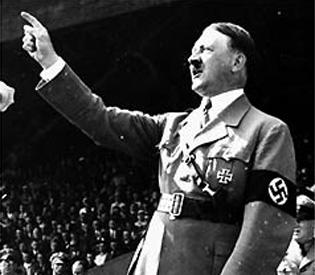
Adolph Hitler’s pursuit of a ‘more perfect world” included a government campaign against smoking and the individual right to bear arms….among other things.
Freedom, however, does not come without risks and costs, especially when it comes to our rights to wallow in pure stupidity.
But what line should our government draw between an individual’s desire to exercise his or her inalienable right to stupidity and the protection of other citizens from those stupid choices?
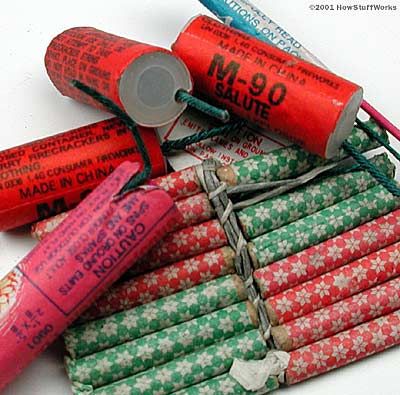
The Biddeford City Council is just half an inch away from enacting an ordinance that will prevent residents from using fireworks anywhere in the city.
The council’s decision follows on the heels of a recent reversal in state law that now allows the sale, use and distribution of fireworks. But the new state law also stipulates that individual communities may set their own standards regarding the use, sale and possession of fireworks.
By allowing individual communities to establish their own fireworks ordinances, a resident of Bangor could –theoretically — have more freedom than a resident of Biddeford.
Some animals, apparently, are more equal than other animals.
Laura being stupid with sparklers, in direct violation of state park policy
My wife, Laura, is a member of the city council’s Policy Committee. She and other members of the committee voted unanimously in favor of the city’s ban on the use of fireworks.
When asked why she voted in favor of the ban, Laura explained that the majority of residents who testified before her committee supported the ban. Furthermore, she said, the local ban was adamantly supported by both the city’s police chief and the fire chief.
It makes sense to me that government officials, such as the police and fire chief, would want to ensure public safety by having greater control over public activities. In a sense, this is the fundamental and appropriate role of government: to provide for the public’s general welfare.
For example, the city is not infringing upon its residents’ Second Amendment rights by enforcing a policy that limits the use of shotguns in certain parts of the city; nor is the city infringing upon its residents’ First Amendment rights by limiting public comments at city council meetings to five minutes.
Reasonable people can agree that individual rights have some limits. Your freedom of speech does not allow you to scream “Fire!” in a crowded movie theater.
But then again, the road to hell is paved with good intentions, and what do we do about all the stupid people and their stupid choices?
It is a slippery slope with grave consequences that should be weighed carefully.
On July 4 1978, I violated state law, local ordinances and the core elements of common sense by using a Roman Candle — a type of firework device that launches brilliant shots of exploding matter into a brilliant, although brief, display of color and sound.
I was 14 years old, and I nearly blew off my testicles by holding the tube improperly while sitting on the front stairs of my childhood home.
I lit the fuse and pointed the tube across the street, toward the parking lot of the Armory building on Franklin Street in Saco, then the home of 133rd Engineering Batallion.
Fortunately, there was an adult present who saw that the fuse was pointed toward my crotch.
“Hey, turn it around!” he screamed just before the tiny balls of fire began jettisoning toward my own tiny balls of fire.
Obviously, I survived the incident and learned a valuable lesson about protecting my genitals.
Under today’s standards, however, I would have been prosecuted by the Department of Homeland Security for firing upon a federal facility, and my parents would have been charged with child endangerment.
But it all turned out fine. For better or worse, my testicles remained in tact, and I went on to make many more stupid choices.
Stupidity is the cornerstone of innovation, and it’s a trademark of America and our willingness to take risks, make mistakes and ultimately succeed.
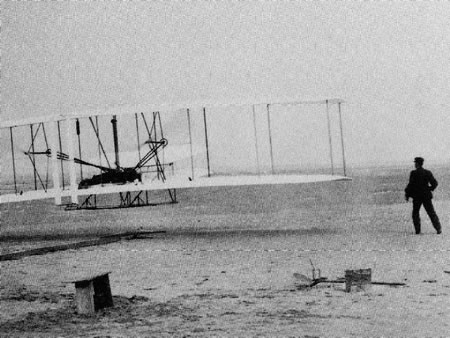
Imagine strolling on a North Carolina beach in the early 1900s and watching as two brothers played with a “flying machine.” How stupid! Those men think humans can fly like the birds!
Go back further in history. How much sense did it make for a bunch of disgruntled farmers to take on the world’s most powerful army in a rebellion against a mighty throne?
And what about the stupidity of Columbus, and his epic failure to find a new route to India?
Acts of stupidity and risky behavior provide us with tremendous value and opportunities. More importantly, our right to be stupid is inextricably linked to our pursuit of happiness.
Therefore we ought to be damned careful as we set out to create a utopian society. After all, Adolph Hitler was one of the world’s most outspoken critics of smoking.
In fact, Hitler went after the smokers long before he set his sights on private gun ownership and the Jews.
Thus, whenever government infringes on our God-given right to be as dumb as a door-knob, it ought to include much deliberation and considerable thought and debate about the unintended consequences of such legislative endeavors.
Defining stupidity is nearly impossible. Beauty, after all, is in the eye of the beholder.
Do you think the government should tell you what is okay to eat? Do you think the government should dictate who you can marry? Would you prefer that the government provides your health care, your housing and your food? Can you imagine the consequences?
How dependent are you prepared to be? How much of your liberty are you willing to sacrifice for your security?
Fireworks have become a symbol and trademark of our liberty. They define our brilliance, our diversity and our strength as a nation. They remind us of the explosions that had far greater consequences more than 200 years ago.
It would not be hard for the city to set some reasonable guidelines for the use of fireworks. We could establish acceptable hours of use. We could set policies that include where the use of fireworks is permissible, such as a required 20-foot setback from a neighbor’s property.
In America, you have the right to define the course of your life, and that means you have the right to be stupid.
If we don’t stand for stupidity, then what will we stand for?
The Biddeford City Council will hold a second reading on its proposed fireworks ordinance on Tuesday, April 3.
GOP presidential hopeful Mitt Romney and Biddeford Mayor Alan Casavant had at least on thing in common on Tuesday.
Both men showed their detractors that they are as tough as nails and more than ready for a political fight.
READY TO SERVE: Michael ready is sworn-in by City Clerk Carmen Morris as the newest member of the Biddeford City Council
Although Casavant’s nomination of Michael Ready for the vacated Ward Seven council seat was approved by an unexpected 7-1 vote, it included more than 30 minutes of sometimes emotional and heated commentary.
The final outcome also caused a member of the city’s planning board to announce her resignation as a protest against what she described as nothing more than “political theater.”
But any lingering doubts about Casavant’s ability to move the council when needed quickly evaporated Tuesday.
Councilor Melissa Bednarowksi also proved she is more than willing to stand as the council’s lone voice of dissension.
At issue were two competing philosophies about who should be appointed to fill the council vacancy that was created last month when David Flood gave up his seat to again pursue a career as a newspaper publisher.
Councilors Melissa Bednarowski, Brad Cote and David Bourque listen to public comments about Mayor Casavant’s nomination of Mike Ready
Bill Sexton was one of three candidates who actively campaigned for the seat in November, but finished in second place behind Flood.
Ready previously served on the council, and Casavant said Ready’s prior experience — especially since the council is facing the prospects of a daunting budget debate — is what mattered.
Casavant remained steely eyed during the floor debate, signaling confidence in his ability to shore up the votes he needed.
But many of the councilors seemed torn, and at times appeared emotional and wavering with their decision.
“This is a tough situation,” said Councilor David Bourque, looking toward the audience, where both Ready and Sexton were seated with their family members. “It’s a tough spot for us to be in.”
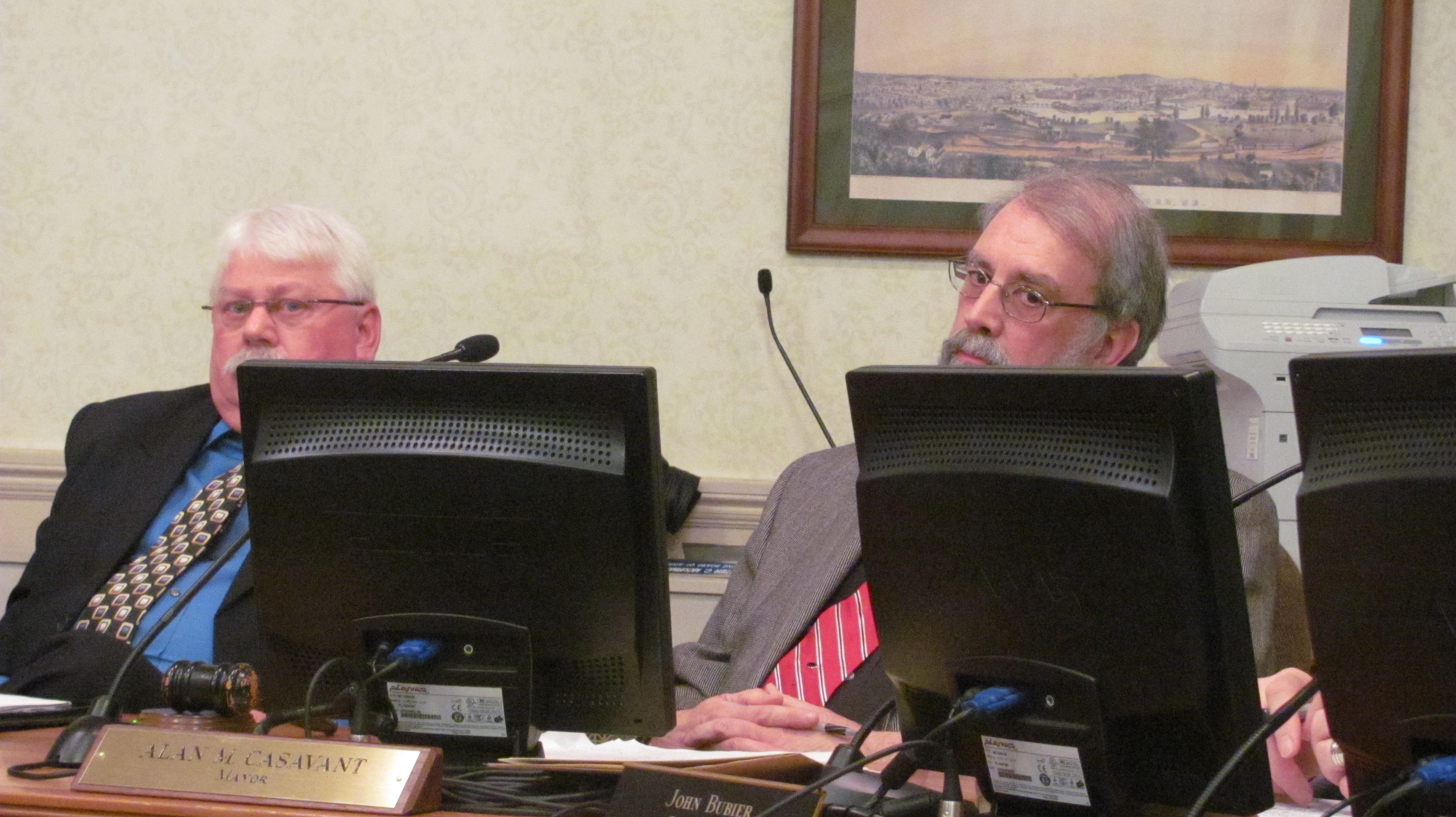
IF LOOKS COULD KILL — Council President Rick Laverierre and Mayor Alan Casavant seemed tense during public comments about the nomination of Mike Ready
Council President Rick Laverierre, however, said the council had a sworn obligation to uphold Casavant’s appointment unless they could offer a compelling reason why Ready should be disqualified from service.
“I, too, find myself in a quandary,” Laverierre explained. “But we need to remember we’re talking about the charter, and the charter is clear about how we should approach this.”
Councilor Roch Angers said he felt physically ill about the dilemma.
“I feel sick to my stomach for both of these men,” Angers said. “It should be the people saying how things go. We should be listening to the input of people from Ward Seven.”
Angers, who helped the mayor during last year’s campaign, then questioned Casavant directly, asking him if he would consider Sexton for nomination.
The mayor did not flinch. “I have a nomination on the table,” he replied curtly.
The tension in the room was palpable.
Councilor Richard Rhames voiced concerns about Ready’s appointment, reminding his fellow councilors that Ready was one of the “MERC 5,” a group of five city councilors who approved a controversial, five-year extension of the city’s contract with the Maine Energy Recovery Company in 2007.
Members of the public were equally divided on the issue. Sexton’s parents and his son all addressed the council, urging them to support Bill Sexton, but also praised Ready.
“Mike [Ready] is a nice man, but Mike didn’t run for the seat,” Sue Sexton told the council.
Sexton said she understood why Ready wants to help the city now, but reminded councilors that her son ran a hard campaign and went door-to-door, looking for votes and listening to residents’ concerns.
Bill Sexton also praised Ready, but had strong words for the mayor.
“The mayor knows nothing about me,” Sexton said. “He never called me. I have been referred to as a puppet, or maybe it’s because [I’m a Republican] or because I supported the casino. I don’t know, but I just want a shot at what I worked so hard for.”
Bill Sexton (right) told reporters he will likely stay involved in city politics and said he was disappointed that the mayor refused to even consider him as a potential nominee.
Sexton closed his remarks by reminding Casavant of his mayoral campaign pledge to be a “positive, professional” mayor.
“I ran my own campaign in a positive, professional way,” Sexton said. “This should be about what’s best for the city. The charter gives you the power to appoint but that does not mean you should just pick your friends.”
Judy Neveaux, a resident who also worked on Casavant’s campaign, reminded the council that Casavant was supported by an overwhelming margin of voters in November.
“The people clearly trust this mayor to do what is right for our city,” she said. “I think it’s important to let the mayor do his job.”
Although the comments were often tense and sometimes pointed, resident Ron Peaker brought the evening to an all-time low by accusing Flood of being “dishonest” about his intentions during the campaign.
Bill Sexton later denounced Peaker’s remarks, calling them “inappropriate and pure speculation.”
Just moments after Ready was sworn in by City Clerk Carmen Morris, Sue Sexton asked the mayor if she could approach the podium. She thanked Ready for his willingness to serve and wished him well.
Sue Sexton told All Along the Watchtower that she would be resigning her seat from the Planning Board as a protest to Casavant’s appointment.
“Despite all the things he said during his campaign, it has become painfully honest that our new mayor is just playing political favorites,” she said.
Former mayor, state representative and city councilor Joanne Twomey announced Sunday that she would seek a return to the Maine House of Representatives.
At the Biddeford Democratic caucus, Twomey told a sparse group of fellow Democrats that Dist. 135 needs a “real” Democrat to stand up to Republicans in Augusta.
Twomey also said that she encouraged Rep. Paulette Beaudoin to seek the Dist. 135 seat four years ago, but decided that Beaudoin was either unwilling or unable to stand up to Republicans and should be replaced.
Joanne Twomey: A “real” Democrat?
Funny thing is: Twomey was not worried about Beaudoin’s performance until she lost her re-election bid for the mayor’s seat. Now Twomey needs a job. Now she is ready to fight Republicans and Democrats and anyone else who gets between her and her need for health insurance at taxpayer expense.
A video from the Biddeford-Saco Courier:
Joanne likes to talk about her “no-compromise/principled” position.
But does that hold water?
1,) The woman who once bemoaned the idea of a casino in Biddeford — testifying before the Biddeford City Council in 2003 by saying — “In my Christmas village, there is no casino,” suddenly flipped when she got herself into a budget pinch, and she quickly became a cheerleader for a proposed casino. Principled? Really?
2.) The woman who built her political career on the backs of criticizing the owners of the MERC facility was giving them hugs in front of news cameras just two weeks before the 2009 mayoral election.
Just a few weeks later, after winning re-election as mayor, Twomey once again reversed her position. Principled? Really?
3.) On Sunday, during Biddeford’s Democratic caucus, Twomey said she encouraged State Rep. Paulette Beaudoin to run for the legislative seat that Twomey held until term limits forced her out in 2006. Now, Twomey says the people of District 135 need a “real” Democrat.
For such a principled person who professes to believe in the people, Twomey does not hesitate to play political hardball, but her victim routine is wearing thin.
It’s probably why Biddeford voters threw her out of office by an overwhelming margin in November. You can only fool people for so long.
But there’s also another reason Twomey lost by a 62-38 margin: She did very little campaigning.
Maybe she was overly confident. Maybe she was tired. Maybe she thought the city’s strong support for a proposed racino would ensure her easy re-election.
Twomey is a political quaqmire. On the one hand, she is a savvy politician. On the other, she is ruled by her emotions.
But this time, it looks like she is in this campaign to win. She’s accepting help from Ryan Fecteau, an eager beaver youngster with a solid grasp of 21st Century campaign techniques.
Twomey will likely do well in the Democratic primary against Beaudoin, a post-70-year-old woman who isn’t much of a campaigner and has never been challenged by her own party.
Former Biddeford City Councilor Perry Aberle, a man who describes himself as a “friend of Joanne,” is considering running as a Republican in District 135. If Twomey wins the Democratic Primary on June 12, Aberle will have his work cut out for him.
As I predicted on November 8, 2011, Joanne Twomey is far from done in Biddeford politics.
Biddeford Mayor Alan Casavant is expected March 6 to announce his nomination for the Ward Seven city council seat that was vacated last week by Councilor David Flood’s resignation.
Newly elected mayor Alan Casavant (right) celebrates with his campaign manager on Election night
Because of a serious flaw in the city’s charter, the voters do not get a say, even though Flood served fewer than 90 days of his term. That needs to be fixed.
I live in Ward Seven, and have spent the better part of the day talking with city councilors and the mayor about the candidate whom I think should replace Flood.
According to the city clerk’s office, 893 voters in Ward Seven cast ballots in the November 2011 election. Of those 893 voters, Flood received 390 votes (roughly 40 percent of the votes cast).
Bill Sexton finished second in the three-way race, earning 270 votes. Sixty six voters left their ballot blank when it came time to choose a Ward Seven councilor; there were four write-ins and Patricia Whitehurst received 160 votes.
For disclosure, I voted for Flood.
When Casavant ran for mayor, he campaigned on a promise to be “positive and professional.” He campaigned on the idea of restoring civility; of rejecting political cronyism; of engaging the entire community, not just those who agreed with him.”
Those were the reasons why I and so many others worked so hard to help get him elected.
We wanted a change.
But did we get change?
Word on the street is that Casavant is planning to nominate former city councilor Mike Ready.
I like Mike Ready. Mike served this city well, both as a city councilor and long-time member of the School Committee. Mike is principled, smart and hardworking.
In short, Mike Ready is a outsanding nominee, but he’s not the right nominee.
If Mike Ready had run for the seat last year, it’s quite possible that I would have supported him over David Flood.
But Mike did not campaign. He did not get signatures to be on the ballot. He did not knock on doors. He did not put up campaign signs or participate in debates.
Bill Sexton did. Bill Sexton wanted the job then, and he wants the job now.
Sexton supported a proposed racino. Casavant may also see Sexton as someone who may have supported Twomey for re-election during the mayoral campaign.
But those items never came up during a break at today’s Democratic Caucus, when Casavant told me that the council has too many inexperienced members. “We’ve got a tough budget ahead of us,” he explained. “We have a lot of complex issues facing us during the next few months. I need people who can hit the ground running, people with experience.”
That rationale may sound good on paper, but it doesn’t pass the straight-face test.
Maine Senate candidate, former city councilor and current school committee member Jim Emerson served as treasurer on Casavan’t campaign team.
Emerson launched his political career with zero experience after being nominated by Mayor Wallace Nutting to fill a vacancy created by the resignation of Phil Dumont in 2006.
Emerson served with distinction and honor. The city did not fall apart. Emerson later campaigned for and won the seat on his own merits.
Mayor Donna Dion appointed Roger Hurtubise to replace Roch Angers on the city council in 2003. Hurtubise figured things out pretty quickly.
It is clearly Casavant’s prerogative to nominate anyone he chooses. More importantly, it’s the council’s prerogative whether to accept or reject that nomination.
Casavant chose last year to run his campaign without a slate of like-minded city councilors. I respected and admired that decision, even though it seems politically naive.
But there’s no reason why Casavant should attempt to stack the council deck after the fact.
The right thing for Casavant; more importantly the right thing for the city, is to try to respect the will and intent of the voters.
By appointing Sexton, Casavant would be sending a strong signal that his campaign themes were at least a bit more than slogans.
If you can’t find Biddeford Mayor Alan Casavant on Facebook, maybe you should have donated more to his campaign.
Actually, Casavant “took down” his “Biddeford Mayor Alan Casavant” page after learning that it violated city policy.
“After I learned that, I wanted to set a good example,” Casavant said. “So I immediately took it down.”
According to Casavant, the city is expected to review its computer policy in the next few days. The standing policy prohibits city officials and city employees from having websites or Facebook pages to discuss, promote or opine about city business.”
Casavant and other city officials and employees may, however, have their own personal page but it cannot be construed as an “official” page either by reference or inference.
For the seven people in the United States who are not friends with Alan Casavant on his personal Facebook, maybe you should send a friend request instead of making assumptions that you were banned.
Typically, when newspapers go to war they are actually engaging in fierce competition.
That competition benefits both advertisers and readers.
In 2001, folks in the Biddeford-Saco area likely had no idea how lucky they were.
For a community with a population of less than 40,000, the region was being served by two daily newspapers and two weekly publications.
The Portland Press Herald had a full complement of reporters, photographers and editors stationed at their bureau on Main Street.
The Journal Tribune was still winning Maine Press Association awards and was the breeding ground for many of Maine’s best and most well-known reporters and editors, including Jack Beaudoin, Dennis Bailey, Lee Burnett, Bob Saunders, Gail Lemley and Mo Mehlsak.
David Flood, meanwhile, was busy building a small empire of weekly publications that stretched across York and Cumberland counties. The Biddeford-Saco-OOB Courier was the company’s flagship publication.
A short while later, Current Publishing was formed and began distributing the Sun Chronicle, a weekly newspaper based in Saco.
Reporters, such as Kelley Bouchard of the Press Herald; and Josh Williamson of the Journal Tribune, were scrapping for stories with yours truly.
Good times, baby! Real good times…for the journalists, and especially for the communities they were covering.
Flood was one of the original downtown cheerleaders. He immersed himself in the community. He was fiercely competitive. Still is.
I served as editor for all of Flood’s weekly publications, and published All Along the Watchtower in the Courier. I was fiercely competitive. Still am.
But the shifting economic landscape dealt a serious blow to the region’s media outlets.
The advent of internet journalism was just kicking into high gear. Remember, in 2001 Facebook meant your got your nose crushed in a big encyclopedia.
Twitter was something that city councilors did whenever former mayor Jim Grattelo walked into a room; and a “blog” was a stain comprised of 1/3 snot, 1/3 ketchup and 1/3 ink on your new shirt.
Today, those newspapers are barely more than shadows of their former selves.
The Journal Tribune was once again sold, this time to a Pennsylvania-based media conglomerate. The staff changed dramatically. Most of the institutional knowledge was sent packing in efforts to trim the bottom line.
Reporters were expected to do more with less, a trend that was happening all over the country and shows no signs of slowing.
Meanwhile, the Portland Press Herald was having its own financial problems. The paper was later sold (and more recently sold again). The Biddeford bureau was closed. Reporters from the state’s largest daily no longer attended council meetings in City Hall.
I left the Courier in 2005. Eric Wicklund, a veteran reporter at the Journal Tribune, was hired to replace me. That was the first sign that things were getting bad. A daily reporter was taking a job at a weekly.
Wicklund lasted a few months. Several editors came and went at the Courier.
In 2007, Flood sold his weekly newspapers to the same company that purchased the Journal Tribune and the Brunswick Times Record. He then started a political career.
David Flood
The Courier continued to shrink. Its new owners are not involved in the community. Reporters cover City Hall meetings from their homes, watching the meetings on television.
The Journal Tribune is running stories from Biddeford City Council meetings as much as six days later on their front-page. Why hurry? Who’s gonna scoop them?
Flash forward five years, and Flood is getting back into the game, stirring controversy by stepping down from the city council to restart his newspaper career.
On Thursday, the American Journal, one of the newspapers owned by Current Publishing, reported that Flood was tapped to be the publisher of its York County sister newspapers.
For the record, back in the old days (before Twitter, LinkedIn and Facebook) I worked at the American Journal with Kate Irish Collins, who is now a senior reporter at the Chronicle and about to become one of Flood’s newest employees) Yes, it is a small, incestuous pool . . . this local journalism thing.
Flood, who also still owns the building that houses the Courier and its sister publications, told the Courier’s owners last week they would need to find a new home.
Apparently, Flood plans to move his newest publications into the building that he owns across the street from City Hall: the place where he built the Courier into a strong weekly paper will now be the place where he works to diminish the Courier.
This news did not go over well with the Courier’s employees, many of whom are former Journal Tribune employees.
It turns out that the Courier staff will soon be housed in the Journal Tribune’s Alfred Street headquarters, where they will ostensibly be one happy family, competing against a common enemy: David Flood.
Political implications
Meanwhile, Flood’s sudden resignation from the City Council has sparked other controversy, most notably from the chair of the Downtown Development Commission (DDC), Brian Keely.
Flood won his seat in November and now, less than 90 days later, will be leaving, forcing Mayor Alan Casavant to appoint a new councilor.
Flood is expected to formally announce his resignation at Tuesday’s city council meeting, but Keely is publicly questioning Flood’s motives.
Now here’s where it gets tricky:
Keely’s wife, Molly Lovell Keely, is the editor of the Courier, one of those people who will soon be looking for boxes, packing tape and a U-Haul.
Keely’s father, Vincent, ran and lost a bid for one of the city council’s at-large spots in November.
Another member of the DDC is Grady Sexton. Grady’s son, Bill Sexton, ran and lost against Flood for the Ward 7 Council seat, finishing second in a three-way race that included Patricia Whitehurst.
On the DDC’s Facebook page, Keely, chair of the DDC, wrote: “… I don’t have any problem with Flood doing what he loves. I do have a big issue with the fact he ran for city office, knowing full well, he would take this new job and would have to resign as councilor. I believe he made fools of the people who supported him…”
Keely also compares Flood to Kim Khardashian, and then opines that Flood is simply trying to prop his ego after losing a 2009 mayoral bid to Joanne Twomey.
I could go into all the political maneuverings, pointing out that those who supported the idea of a racino and a third-term for Twomey are politically at odds with Mayor Alan Casavant and David Flood.
I could opine that Casavant ought to appoint someone from that political camp to fill Flood’s vacancy…. say Bill Sexton or someone else who lives in Ward Seven….but I want to watch a bit more….
They say that all politics are local; and I say local politics are some of the best politics.
Throw in a newspaper war, and well, … it just doesn’t get much better for a guy who blogs about local politics and media.
Somebody start the popcorn. It’s going to be a hell of a show….
And maybe, just maybe, the newspaper business will come back to life….it’s just too bad it took a war.
It is Sunday morning, and I still cannot shake the groaning internal dialogue and the shivers that seized my spine less than 48 hours ago.
Maybe it was the photos: those black and white testaments to days of old, when men were men and felt invincible despite all evidence to the contrary.
Maybe it was the fruit punch or the company I was keeping on Friday night.
But whatever the reason, and regardless of the catalyst that triggered it, the ghosts were there and in full-force.
My mind drifted as I walked down Main Street in Biddeford under a cover of darkness sliced by a full-winter moon.
And it did not take long for the taunting to begin.
At first, it was just a collection of whispers; hard to distinguish above the din of passing cars and the music throbbing from an outdoor speaker at the Wonderbar Restaurant.
I tried to ignore the ghosts and their playful taunts, focusing my eyes on the young couple having dinner at a window table in Bebe’s Burritos, nodding to the young men who passed me on their way to the Oak and Axe.
But with each step along the sidewalk, the whispering became more defined and harder to ignore.
I kept my head down low, and took a long drag from my cigarette. I was on my way to meet Laura for dinner. I had neither the time nor the inclination to engage in this foolishness.
But the ghosts would not let go.
“It is a good night,” I heard one of them say. “Our city is back, there is life here.”
“Yas, baby,” another ghost responded between sips of Canadian Club whiskey from his hip flask. “We will not be forgotten or ignored by these punks.”
I pulled up my collar and steadied my course toward my waiting wife and the Chinese restaurant.
I could hear the sound of brawls from the Water Street tenement buildings, where tired mill workers were drinking warm Schmidt beers on a cold February night.
In a forgotten, smoke-filled, back room — in a building that no longer stands — Renald and Gilbert were arguing about Dempsey and playing their card game.
The stench of coal from the gasification plant was stifling. The second shift textile workers were counting the hours, and a line was gathering outside the Lightning Club, where young bucks combed their hair full of grease, and the school girls from St. Andre’s giggled with delight.
Further down the street, Sal Mineo’s name was illuminated on a marquee. The short-order cook from the Puritan — taking a quick cigarette break in an Alfred Street alleyway — nodded at me, before fading into the bricks of today’s reality.
I paused there for a moment — at the intersection of Alfred and Main Street, maybe a quarter-mile from the banks of the Saco River — feeling strangely content, despite my disquieting thoughts.
The ghosts — as many as 12 of them — kept walking, laughing as they continued down the street.
Only a few minutes prior I made an observation to others who also attended the opening of “The Way We Were” photo exhibit at the upper end of Main Street.
“When our economy worsens, our communities seem to become stronger,” I hypothesized. “Just like when the immigrants first came here in search of prosperity in the land of the free and the brave, we celebrate with one another and share common resources when not distracted by the lustre of individual gains.
“We know that we are okay, because we celebrate and commiserate with our neighbors, our friends and our peers.
“We are stronger, when we are together. We are better.”
Now, standing in the foyer of that Chinese restaurant, I could feel the warmth of the city streets.
And I could not help but think of my old friend Bob Dodge, a man I miss almost every day. A man who loved this city, the way a groom loves his bride on their wedding day.
It’s been three years since I’ve had the pleasure of seeing Bob’s infectious smile.
But I knew that Bob Dodge would be smiling tonight on the eve of La Fete d’ Hiver.
This kid who grew up in a Quimby Street triple-decker, left an unmistakable mark on his beloved hometown.
Who could be better to lead this community’s economic and community development efforts than a local boy inspired by the Kennedy brothers and motivated by sheer passion and will?
I looked down the street, watching those laughing, joyful ghosts as they faded over the diminishing hill just beyond my view. “Hey, Bob,” I whispered . . . wondering if he was there.
Maybe it was my imagination. Maybe it was wishful thinking.
But I swear, he paused and turned back from his group, waving to me in the darkness.
“It’s okay, Randy” he shouted back. “Go have dinner, relax. Me and the boys will be back.”
And with that . . . the ghosts disappeared, fading into the mid-February darkness, and I was left only with the lingering words of French poet Arthur Rimbaud:
“Qu’il vienne, qu’l vienne! Les temps dont s’eprenne.”
You know, . . .the humble Tom Clancy character who routinely saved the world from a cadre of evil forces while also writing a thesis about the importance of granola in the post-Soviet socio-economic structure.
Ryan Gavin
But what about the other guys named Ryan? The ones who were born in 1992 and grew up in Biddeford?
One of them made a short-lived bid to be Biddeford’s mayor, and the other one is wreaking havoc with the city charter.
Both Ryan Gavin and Ryan Fecteau are all of 20 years old, and, make no mistake: they are politically ambitious.
Nearly a year ago, Ryan Gavin, fresh off the heels of learning how to shave and graduating from high school, decided he was the most qualified person to become Biddeford’s next mayor.
After all, Gavin had all sorts of experience built up after serving two terms as an un-elected student representative on the Biddeford School Committee and a valid driver’s license.
Sadly, he was more qualified than many others who tried to become the city’s mayor. Karl Reed’s 2009 campaign comes to mind.
Ryan Gavin put on his best Sunday suit and a pair of sunglasses to make his public announcement from the back stairs of City Hall on a weekend afternoon.
Sadly, the media actually covered this event that included 11 people listening to a kid who looked an awful lot like John Belushi’s character from the Blues Brothers.
Jake was on a mission from God. Ryan was on a mission to save Biddeford from the clutches of Darth Vader, more commonly known ’round here as former mayor Joanne Twomey.
Gavin was smart enough to remove his sunglasses halfway through his press conference.
He was also smart enough to quickly figure out he had a snowball’s chance in hell of ever getting elected in a city brimming with old people who vote like clock-work.
Ryan Gavin eventually became an important part of Alan Casavant’s mayoral campaign team.
Let’s pause for just a moment and give out a shout-out to Ryan Gavin’s parents.
If I could be half the parent that Ryan’s parents were, I would be thrilled and could die feeling as if I accomplished something decent in my lifetime.
Ryan was an exceptional student at BHS. He is, today, an exceptional student at UMO.
He is polite, smart, articulate and — unlike many of his peers — he not only cares about what is going on in the world around him, he’s also willing to step up and fight for it.
Ryan Fecteau
All of which brings us to our next point: Ryan Fecteau, a 2010 graduate of Biddeford High School who also served as a student representative on the School Committee.
In November, Fecteau began what will probably be a long and notable political career by actually winning an election.
Fecteau was one of five people elected to serve as a commissioner on the city’s charter review commission, a previously described group of dorks who want to sit around and debate whether the city’s bylaws should include more semicolons.
There were seven slots available and only five candidates on the ballot, so it’s not like Fecteau proved himself to be a tactical genius.
But you still have to respect a kid who is willing to tinker with the city’s charter when most young men his age are doing more important things like getting laid or drinking beer.
But not everyone in Biddeford is happy about Ryan Fecteau’s grand plans for Biddeford.
In fact, during last weekend’s downtown winter festival, I heard some people complain that Fecteau is actually living in Washington DC and is unable to attend the charter meetings in person. I wish I had figured out how to do that.
His critics also said he was trying to ram through “a lot of stupid ideas.”
So, I picked up the phone and called him, half-expecting to get his receptionist who would politely tell me that Congressman Fecteau was in a meeting with the Secretary of Commerce but appreciates my concerns and will have a form letter sent to me.
Actually, Fecteau is a sophomore at Catholic University of America, and it should come as no surprise that he is studying political science.
Fecteau said he saw an opportunity to get more involved in Biddeford politics, and he seized it.
“It’s a rare opportunity, even though we had a charter commission five years ago, who knows when I would have another chance to do this work,” he said.
When asked his opinion about the city’s police and fire commissions (two of the charter’s more controversial items), Fecteau said he would like to see the two combined, if not eliminated.
So far, so good. The city of Biddeford has more commissions and committees than the state of New York.
Fecteau also says he will only miss one more of the commission’s seven monthly meetings.
“The telephone is not a new invention,” he patiently explained to this over-40 geezer.
Asked to explain one of his recent Facebook posts in which he described Joanne Twomey as “a real Democrat” when compared to State Rep. Paulette Beaudoin, also a Democrat who may be challenged for her seat by Twomey in the June 12 primary, Fecteau chose his words carefully.
“I don’t agree with Joanne on everything,” he said. “Paulette is my neighbor, and we’ve had many, many conversations. The Democratic Party has a plank for a reason. I just think Joanne would be a better advocate for many of the party’s core issues.”
Again, so far…so good, but then we started talking about one of his new ideas.
Fecteau would like to see voting day moved to Saturdays instead of Tuesdays. He thinks such a move will increase voter turnout, completely forgetting that such a move would require Biddeford voters to go to the polls twice in one week: once for state and national elections, and then again for local elections.
“Yeah, I guess that’s an idea that needs more work,” he conceded.
I also told him Saturday voting would infringe upon the voting rights of normal college sophomores who spend the bulk of their weekends drinking beer and getting laid.
But for all you old farts who think these young punks ought to learn how to tie their shoes before running around and changing our government, you ought to take another sip of your Geritol and consider this:
There was a young punk from Bangor who got elected to his city council at the age of 23 before becoming one of the youngest state senators in the Maine Legislature. That little twirp named Johnny went on to serve in the U.S. Congress before becoming Maine’s 73rd governor.
On the other side of the political aisle, another young punk from Bangor became the youngest person to ever get elected to the Maine Legislature. Tarren Bragdon, former CEO of the Maine Heritage Policy Center, has had a big impact on Maine politics and public policy.
And no one should forget the impacts of two of our nation’s youngest presidents, Republican Teddy Roosevelt (42) and Democrat John F. Kennedy (43). Of course, Roosevelt was not elected at 42 because he was sworn-in after President McKinley was assassinated, but still . . . the U.S. Constitution says you can be president when you’re 35; a senator once you hit 30 or a member of the House at age 25.
Congressman Fecteau?… it’s not as implausible as you may think.












 LESSONS IN MEDIOCRITY