The Effect of Herring on Lobsters

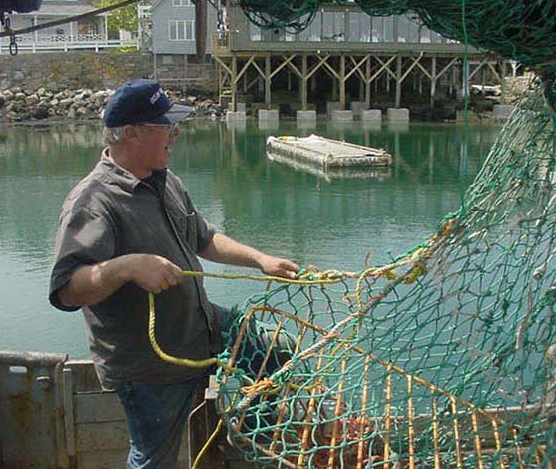
It’s estimated that more than 73,000 metric tons of herring are dumped each year along the coast of Maine for lobster bait, but how does the use of herring bait affect the lobsters that are being harvested in the Gulf of Maine?

That is the question Dr. Phil Yund and other scientists are hoping to answer this year as part of their collaborative research project entitled “Are we using herring to farm lobsters?  Effect of herring bait on lobster growth, and fate of discarded bait in benthic communities.”

The project was funded last year by a $111,972 grant from the Northeast Consortium, and its objectives are simple and straightforward.

Yund, along with Jon Grabowski and Erika Clesceri of the Gulf of Maine Research Institute, will use their research to determine the proportion of lobster diet and tissue derived from bait; assess the impact of a bait-augmented diet on lobster growth and population density; quantify the initial fate of discarded herring bait in the benthic community, and conduct an economic assessment of lobster production versus herring cost.

The project is scheduled to get underway in May and it should be finished in November, according to Yund. The study will focus on two specific areas, comparing data collected from the area surrounding Monehegan Island in Maine and the waters near Grand Manan Island in New Brunswick.

“Basically, we want to find out what’s really happening with all of the herring we dump as bait,” Yund said. “For instance, what other species are eating it, besides the lobsters?”

According to Yund, approximately 25,000 metric tons of lobster is harvested each year. The scientists are now wondering whether those lobsters are being affected, in terms of size and location, by the use of herring bait.

“What [lobsters] feed on during the summer is what makes them grow,” Yund said, explaining why the project will be conducted during the summer months.

In order to make their project work, the scientists needed the help of some lobstermen who know the geographic study area. Carl Wilson of the Maine Department of Marine Resources served as a liaison for the project and enlisted the help of some local lobstermen, including Matt Webber (F/V Griffin) from Monehegan Island.

 A need to participate

Webber, 25, is relatively young, but says he has a lot invested in the lobstering industry. Thus, he says, it made sense to participate in a collaborative research project that could have long-term impacts upon his livelihood.

“I work in a six-month fishery (Dec.- May),” Webber said. “Because of the closures, I end up with a lot of time on my hands At least this way, I’m able to be out on my boat, but I’ll also get to be a part of the process and I think that’s a good thing.”

Although Webber said he is interested in the research aspect of the project, he also expressed concerns about increased regulations, including trap limits and net change requirements.

“I think the more you know about a species, the better you can actually forecast what may take place in the future,” he said. “I’m young, and I want to be doing this for the rest of my life.”

Like many other fishermen who participate in collaborative research projects, Webber said he is expecting to face some challenges and minor difficulties by agreeing to work on the project.

“Sure, I’ll incur some costs. . . like increasing my insurance and picking up some extra survival gear, but I would still say it’s worth it,” he said. “This is my life and I want to be a part of it.”

The project’s goals

According to the project’s summary, recent lobster landings have been higher than traditionally thought to be sustainable. The thousands of tons of herring that are dumped into coastal waters each year are believed to be contributing to this production, and likely are having additional consequences for the near-shore benthic environment.

Three complementary methods will be used to assess the relative contribution of herring to lobster diet and growth in areas with and without bait.

Lobster gut contents will be examined to assess dietary impact. Secondly, nitrogen stable isotope ratios will be used to compare longer term effects of herring bait on lobster biomass production. Finally, single-season growth rates will be compared to determine whether the presence of herring bait increases short-term growth. By addressing these issues, this project will begin to assess how different fisheries are interconnected by fishing practices of lobster production versus herring cost.

Fishing for Answers

[Rockport, Mass.]  Bill Lee happily mutters to himself as he cleans the deck of his boat. Like hundreds of other fishermen throughout New England, Lee has been hit hard by recent changes in federal ground fishing rules, but unlike many of his colleagues he has found an innovative way to soften the blow.

As he works to remove debris from the renovations he recently made to the wheelhouse of his 43-foot trawler (F/V Ocean Reporter), Lee says U.S. District Court Judge Gladys Kessler most likely had no idea about how her April 26 decision would affect the fishing industry. 

But on this otherwise perfect day — with clear skies and calm seas — Lee’s biggest complaint is about the lack of available parking spaces on Rockport’s main pier.

“Tourist season hasn’t even started, and it’s already hard to find a spot down here,” he smiles, shrugging his shoulders and carrying a barrel of trash along the dock. “A lot of these guys don’t have anything to do, so they all hang out over at that café [Flav’s] all day.”

Even before Kessler decided to vacate her order and lighten some of her restrictions late last month, Lee was keeping himself steadily optimistic by participating in a process known as collaborative research.

So instead of rigging his nets for flounder or cod, Lee is installing an underwater camera frame in the net at the stern of his vessel. It’s just another way the 54-year-old fisherman has learned to adapt, and that — he says — is what keeps him going.

“I’ve always been a big believer in the collaborative process,” Lee says. “If you think about it, that’s the way it should be.”

In the past few years, Lee has earned an enviable reputation in collaborative research circles.

“If you ask me, Bill epitomizes the beauty of cooperative research,” said Dr. Earl Meredith of the National Marine Fisheries Science Center in Gloucester. Meredith, a marine biologist, is a member of the New England Fisheries Management Council’s Research Steering Committee.

“Bill is one of those guys who you always love to talk with,” Meredith continued. “He’s always pumped up about an ongoing project or a new idea. He approaches the process with a lot of enthusiasm.”

For his part, Lee says the enthusiasm is just part of a natural evolution that starts when you participate in the collaborative process. He is nonchalant, now focusing his attention on a series of video wires in the wheelhouse of his boat.

There’s something unique about the video gear that Lee uses: it’s all been built in his basement. For example, one of the camera frames he built includes an automobile tire. That way, Lee explains, the underwater camera mounted inside the tire is left undamaged as its housing bounces harmlessly in the net.

Despite the mass of video cables and connectors, Lee is organized about the process of his underwater videotaping. Each camera is designated as either color or black and white, depending on the color of the flange that is mounted to the camera frame. Generally, Lee uses three cameras but he can operate as many as eight.

“Personally, I think this is the way to go,” he says, checking each of the wire connections as we prepare to leave the dock. “When you catch the fish on videotape, you’re not killing them in order to understand their behavior.”

Of principles and practicality —

Bill Lee describes himself as a fisherman, not as a scientist. At the same time, he has converted one entire room of his Rockport home into a well-equipped video production facility. And his basement, although similar to many other do-it-yourselfers’ basements — featuring a drill press and an entire wall of hanging tools — also houses a vast array of high-tech video cable and underwater camera building equipment.

But Lee didn’t start his collaborative research career by producing underwater home videos. Instead, it was a chance encounter with an independent marine biologist that got Lee involved in collaborative research.

Dr. Allan Michael first met Bill Lee some 13 years ago, when the city of Gloucester put out bids for water quality samples. According to Michael, there wasn’t an instant chemistry between the two men — each of whom was accustomed to working independently.

“Bill is certainly full of energy,” Michael says. “Talk about catching a tiger by the tail. I’m just a quiet scientist, but Bill is always on the go, ready to tackle a dozen things all at once. I guess you could say that I’m the steadying influence in our partnership.”

The partnership and acceptance of each other’s differences has served both men well. By working together — a quiet scientist and an ambitious fisherman — Lee and Michael have been able to share their resources on a number of collaborative research projects.

Last year, Lee and Michael were awarded a $35,000 grant from the Northeast Consortium for a project in which they set out to test the effectiveness of a Nordmore-style grate by using underwater videotaping. The grate is placed in the cod end of a trawl net in order to reduce bycatch of non-targeted fish species.

While a typical Nordmore-style grate features vertical bars that are spaced approximately one inch apart, Lee’s grate featured horizontal bars that are spaced three inches apart. The modifications, he says, are based upon fish behavior — behavior that he was able to videotape in a video he produced for the Northeast Consortium.

In the video, which Lee narrates, flounders are shown swimming with a tendency to swim downward, while cod — much stronger swimmers — escape the specially designed net by swimming upward.

Despite the effectiveness of Lee’s underwater video equipment, he keeps a close eye on the cost of the equipment, working to build things that any other fisherman could do easily and without a lot of money.

“You see the radius on this camera frame?” Lee asks as he moves toward the stern of his boat. “That’s the same radius as a standard 5-gallon pail. Show me a fisherman who doesn’t have a 5-gallon pail on his boat. Things don’t need to be expensive in order to be effective”

As an example, Lee’s scientific partner talks about a time early in their relationship when Lee demonstrated his most practical side.

“I was once looking at purchasing a piece of equipment that cost roughly $12,000,” Michael said. “I showed it to Bill, and he built it for me for about $20. He’s very innovative and incredibly motivated.”

In fact, Lee built the 43-foot F/V Ocean Reporter from the keel onward in 1986. “I knew what I wanted and I just decided to build it myself,” he says with a shrug. He learned welding while serving in the U.S. Navy Seabees during the Vietnam War, but he admits that he has always liked to “tinker with things to figure out how they work.”

Lee’s curiosity and ingenuity is displayed in the video he produced for the Northeast Consortium. As he narrates through the video images, he meticulously describes every detail of the research project, showing the gear that was used and how the cameras and lighting equipment were placed into the water.

“A lot of it has to be done by trial and error,” he says. “You just have to keep trying different things.” In the first few minutes of the tape, Lee tells his viewers that attempts to use color film underwater was complicated by underwater plant species that provided too much camouflage for the fish he hoped to capture on tape. He also details the problems he and Michael encountered when they attempted to use reflective lights during the filming process.

Lee is also not a big believer in proprietary information when it comes to doing collaborative research. Instead, he says the information from his research should be shared with as many people as possible.

“Everything we’re doing out there is being funded by the federal government,” he says. “That’s why I believe in being accountable for everything. There should be no secrets.”

For all of his seriousness about collaborative research, Lee also has a well-developed sense of humor, which is best demonstrated by his strong Yankee heritage and his passion of videotape production. For instance, at the end of his baited underwater video, Lee narrates a story about Billy “The Bully” Lobster. During the short segment, shot entirely on location underwater in Ipswich Bay, viewers are treated to images of a lobster that tends to “bully” some nearby crabs.

The crabs exact their revenge by tricking Billy and luring him into a nearby lobster trap by telling him “There’s plenty of food over there.”

Lee’s colleagues and friends describe him as friendly, outgoing and a modern-day Renaissance man; someone who can tackle a myriad of complicated tasks with relative ease and enthusiasm.

“He has to be one of the most dynamic and fascinating guys I know,” Meredith said.

In 1996, Lee was given a Public Service Commendation from the U.S. Coast Guard for his role in the rescue of Harbor Pilot Capt. Bill Chambers of Gloucester, who had fallen from a ladder and into the ocean in the pre-dawn hours of Jan. 21, 1996. Lee was commended for his quick thinking and response while working as the operator of the pilot boat that was dispatched to retrieve Capt. Chambers from the Danish M/V Fresca.

“You do the things you need to do when you need to do them,” Lee says of the incident.

Today, Lee is excited about some upcoming projects he is planning. In just a few weeks, a marine biologist from New Zealand will be visiting the Gloucester area to discuss conducting a research project similar to the one Lee and Michael recently completed for the Northeast Consortium.

“I think it’s pretty exciting that someone from New Zealand can recognize the benefits of what we’re trying to do right here in New England,” Lee said.

Additionally, Lee has placed an advertisement in local trade publications, seeking the assistance of other New England fishermen. He wants to work more on studying fish behavior and designing bycatch reduction techniques that rely primarily on videotape rather than traditional net studies.

“Why kill the fish in order to figure out how not to kill the fish?” he asks.

“Sometimes I think I’m just a dumb fisherman,” Lee says. “But if someone like me can do this kind of stuff, there’s no reason that other guys can’t get involved, too.”

A Day That Never Ends

Jesus, it has now been more than 40 years, but it seems like just yesterday.

August 10, 1983: a date I will never forget and a date that has shaped my life more than any other since my birth.

It was a Wednesday and it was hot. Hot and incredibly humid. Dog Day Afternoon hot.

I was 19 years old and about to experience something I would never forget.

It really has been a long and strange trip, with lots of bumps in the road

I was also an in-patient on the psychiatric unit of the Maine Medical Center in Portland. Less than 24 hours earlier my mother visited me and explained that I could not come home once I was discharged. My behavior, she explained, was unacceptable. My illness was manifesting itself in fits of uncontrolled rage, belligerent behavior and sheer arrogance.

This was my second hospitalization in less than one year. I was floundering and out of control. I remember being angry during that meeting with my mother, my doctor and a social worker. But my anger was much more about fear than anything else.

Where would I go? How would I survive?

I did not have a job. I had only the clothes on my back and 55 cents in my pocket. I not only know it was exactly 55 cents, I also know that it was one quarter and three dimes. I awoke the next morning and stared out the window of my hospital room. From the sixth floor, it looked as if the city of Portland was snarling at me, ready to swallow me whole.

You may find yourself in another part of the world. . .

I was discharged at about 11 a.m. and began my walk down Congress Street, past the fire department, the statue of Longfellow and the porno theaters that have since disappeared.

By the time I hit the intersection of Oak Street, I was drenched in sweat. I stopped at the McDonald’s restaurant and asked to speak with the manager.

I was told the manager was busy. They were gearing up for a lunch rush. I asked when I could come back just before a man tapped me on the shoulder. “What do you need?” he asked.

I will never forget that man. His name was George Lydick. He lived in Falmouth, and he owned three McDonald’s restaurants in the area. He invited me to sit down and grabbed an employment application.

I can’t remember if I filled out the application. I do remember that he gave me a Big Mac and a chocolate shake. He asked if I could start immediately because he needed a third-shift utility worker, a janitor who would clean the bathrooms, change the oil in the fryolators, empty the garbage, break down and sanitize the shake machine and mop the floors.

He was willing to take a gamble on me, but only when the restaurant was closed and there were no customers around. I had told him that I was just discharged from P-6, after all.

I had a job. I would earn $4.25 an hour, and George agreed to comp me two meals a day until I got my first paycheck. I shook his hand. Thanked him profusely and left in search of place to live.

Roughly 30 minutes later, I found myself with dozens of other people in the basement level of Portland City Hall. My name was called, and I met with a caseworker. I showed her my discharge papers and told her I just got a job at McDonald’s but had no place to live. The shame of being there was crushing.

The city, she explained, had limited resources, but if I could find an apartment that would take city vouchers, they could pay my rent until I got my first paycheck. They could not, however, help with any security deposits. She also gave me $17 worth of emergency food stamps and sent me on my way, looking for an apartment with a list of potential places and an eligibility form that the landlord would have to complete.

I struck pay-dirt on my first try, the emphasis on dirt. The apartment was a one-room efficiency on the fourth floor of a building that smelled of cat urine and featured peeling paint, torn carpeting in the hallways and lots of loud music. The rent was $50 a week. It included all utilities.

The room was tiny and had two windows, both of which could not be opened because of the swelling wood and lack of maintenance. The view featured the brick wall of an adjacent building. There was a stained mattress, a two-burner cook top and a micro fridge.

You may find yourself living in a shotgun shack.

It was 2:30 p.m. I had been on my own for a little more than three hours. I had a job and a place to live.

I was terrified and would begin my new job in less than eight hours.

Despite my accomplishments, I did make a very big mistake that day. I decided to use the toilet in my new apartment. It did not occur to me until it was much too late that I did not have toilet paper, a shower curtain, soap or even a towel.

My theory is if that ever happens to you, it only happens once. In the 40 years since, I’ve never had less than 28 rolls of toilet paper in my home at any given time.

I struck pay-dirt on my first try,
the emphasis on dirt.

I remember being stunned that I had to actually pay for things like towels, salt, soap and toilet paper. Those things should be free, I reasoned.

Welcome to being an adult.

My mother and a friend of hers visited me three days later. They brought with them several bags of groceries: cans of tuna fish and soup, fresh vegetables, peanut butter, bread and cereal.

Flash forward 40 years later. I am sitting at my desk this morning, finishing up some work and thinking about where I might have lunch. Maybe I’ll take a drive to the beach instead of updating my blog. I am overlooking my gardens, and I am impressed with my lawn and its lack of brown spots. All my windows can be opened, and we have three air conditioners and stainless-steel appliances in our kitchen.

I am looking forward to our next camping trip in a couple of weeks. We will be towing our 22-foot camper to the shores of Moosehead Lake. That 2020 camper is much nicer than that efficiency apartment on Oak Street could ever hope to be.

You may find yourself with a beautiful wife and a beautiful house . . .

My, God. . . how did I get here?

I say all this because the taxpayers (you) made an investment in me. Four decades ago, you gave me $117 in rent and groceries. For the next two years, you subsidized my medications and loaned me money to go to college.

Was it a wise investment? I like to think so, especially when I look at how much I pay in taxes; the money I donate to charity and the lessons I try to pass on to my two stepsons.

Yes, I have stumbled many times since. I have been hospitalized for psychiatric care (both voluntary and involuntary) more than 20 times. The last time was in 2018, and I began regular ECT (Electro-Convulsive Therapy) treatments. Over the last 40 years, there have been lots of mistakes, many lessons learned.

Sure, it doesn’t always work out this way. And who knows, maybe I will crash and burn tomorrow, but sometimes the investment in those who are living on the edges of society works out nicely.

Regardless, I will never forget that day.

It was my worst day, and it was my best day.

The Lincoln Tour

[This is based on a true story, some of the names have been changed, for obvious reasons]

To truly appreciate the origin of this story, and why we actually thought we would be guests on the David Letterman Show, it is important to understand exactly how drunk we were on that late September evening.

We are talking about some serious alcohol, boys and girls.

Jackson and I pose with Abe on the south rim of the Grand Canyon

We were hammered. We were plowed.  We were shitfaced, stone-cold, blathering, barely-could-walk drunk.

It was 1986, and I had just discovered the literary genius of Hunter S. Thompson.  I was a quarter century behind, so I had some serious catching up to do.

Jackson wasn’t in much better shape. We weaved our way along Spring Street in Portland through the pre-dawn darkness, headed toward our rat-hole apartment on the lunatic edge of the West End.

If memory serves, we giggled as we staggered along, kicking trash cans in the days long before recycling bins.

It had been a long day. Jackson and I were roommates, and we worked at the same Old Port restaurant. He was a flamboyant homosexual, so naturally he was a waiter.

I was a down-on-my-luck college drop-out, so naturally, I worked in the kitchen. The odds of either of us sleeping with a woman anytime in the near future were beyond comprehension.

“Shit!” Jackson blurted quite suddenly, pausing on the sidewalk and looking like he was about to do something really stupid.

I found my balance and attempted a turn so I could face him. “What?” I asked, thinking I might vomit at any given moment.

“We missed Letterman,” he said, his jaw slackening as the color rushed from his already pale face. “Dammit, I hate when that happens.”

“It’s okay,” I replied. “I’ve seen enough stupid pet tricks to last a lifetime.”

Jackson was seriously annoyed, and he stared forlornly at his feet. I turned back toward my wayward march home but something caught my eye and made me freeze in my tracks.

It was draped over an aluminum trash can, and its grotesque beauty was highlighted by a flickering street lamp. It was a black velvet painting of Abraham Lincoln, perhaps the tackiest thing I had come across in my 22 years on planet Earth.

“Look at this,” I said, pointing at my discovery.

Jackson’s face brightened. He temporarily forgot all about David Letterman, at least for the next 48 seconds or so. “It’s perfect, he said, rushing over to examine the canvass more closely. “It’s perfect for the dining room!”

Did I mention Jackson was a flamboyant homosexual?

We immediately seized our new treasure and continued our trek toward Neal Street, laughing about all the things we could do with this discarded and stained piece of magic debris.

We contemplated a very early breakfast at the Denny’s on outer Congress Street, but we barely had the energy or aptitude to make it to our apartment. And driving was certainly out of the question.

So instead, Jackson brewed a pot of coffee as I sat on the couch, staring into the black velvet eyes of America’s sixteenth president.

If you ask Jackson, he will swear it was his idea. But it’s my story, and I prefer to remember that it was an alcohol-induced epiphany of my own making.

He was still puttering in our tiny kitchen when I shared my idea. “We should take pictures of this thing all over town,” I hollered toward the kitchen.

Jackson walked into the living room with the pot of coffee. “No, we should take it on a cross-country trip and submit the photos to David Letterman,” he said.

Maybe it was the Seagram’s talking. Maybe it was because I could not imagine my life getting much worse, but whatever the reason, my imagination raced. “Yeah,” I said, sitting forward on the couch. “We’ll visit really lame tourist traps all over the country and ask people we meet to pose with Abe.”

We were still too wasted to consider the consequences of our conversation.

“We’ll call it the Lincoln Tour,” Jackson pronounced.

I said what any other penniless, 22-year-old man would say. “Let’s do it!”

The Adventure Begins

Neither of us had any money, but unlike me — Jackson had convinced Key Bank to give him a credit card some three months before. He had also just made his final payment on a 1980 Mercury Zephyr station wagon. The car was fire-truck red with a chrome roof rack.

A group of friends joined us on the Eastern Prom in Portland to celebrate the beginning of our journey.

We had crappy jobs and shared a crappy apartment. He didn’t have a boyfriend, and I didn’t have a girlfriend. The way we saw it, there was nothing to lose.

We loaded the Zephyr with our prized possessions before quitting our respective jobs. It was Sunday afternoon, and we called a few friends to meet us for brunch. We could not wait to tell them about our plans.

There was only one glitch. We would have to sedate Jackson’s 13-year-old cat, Moses. Otherwise, we didn’t know how we could get the cat to his sister’s house in Gloucester, Mass.

We didn’t need maps. We figured it would be easy enough to get to L.A. by just following road signs. We each borrowed some money from friends. It went without saying that those loans would never be repaid. We sold or abandoned whatever possessions that could not fit into the car.

It was now almost 5 p.m., and the sun was already fading as our collective hangovers switched into high gear.

On Day One, we barely made it to Gloucester. Moses did not enjoy the ride. He escaped from his box and scratched everything in sight, including my limbs and neck.

Undaunted, we soldiered on, and dropped our first postcard to David Letterman on Monday morning at the Gloucester Post Office.

Back then, Letterman was still with NBC, so our plan was simple: we would build mystery and excitement by sending periodic teasers to 30 Rockefeller Plaza. Each postcard or dining room placemat would read: Look for the Lincoln Tour: Coming to a town near you very soon!

We had only 2,918 miles to go, and we were excited to begin our traveling documentary. We bought six cartridges of film for my Kodak Instamatic camera, a giant bag of Fritos and new sunglasses for Jackson.

We talked excitedly about what we would say as guests on the David Letterman Show and set our sights on Philadelphia for the first real day of driving.

The Journey

I could share all sorts of details about those first few days, but this is supposed to be a short story. So, I will skip details about the big fight we had in Manassas, Virginia, when I missed the exit three times. Nor will I discuss the 12 days we spent with Jackson’s friend, Fat Sam, in Knoxville, Tennessee, or details about another fight while camping along the south rim of the Grand Canyon.

Fittingly, a photo taken in front of the Lincoln Memorial. I had a super crush for the girl on the left.

Jackson was upset that I did buy into his theory of how eating salsa would help keep you warm when it’s very cold outside.

Instead, suffice it to say that we took lots and lots of photos.  In each picture, Abe Lincoln was prominently featured. We conned people into posing for the pictures by telling them that we were crew members from the Letterman Show.

A Kentucky tourist who was vacationing with his family in Gettysburg grew a bit suspicious about our story. “How do I know you’re really with the Letterman show? “ he inquired, squinting at me like a Border Patrol agent in Nogales, Arizona.

“It’s okay, honey,” his chubby wife replied, pointing at our car. “They have Maine license plates. It must be for real.”

Jackson and I were both stunned by the collective gullibility of the American people. Their intense desire to perhaps have their photo selected for a national television show immediately vanquished any doubts about our credibility or the purpose of our mission.

We photographed tourists at the Lincoln Memorial, the Natural Bridge in Virginia and at Dollywood in Pigeon Forge, Tennessee. We took photos of the young and the old, the rich and the poor.

Abe checks in with some very nice ladies at the “Meteor Crater” in New Mexico

We got a picture of a Maryland State Trooper holding the black velvet portrait of Lincoln; there was a cute waitress at the Lincoln Diner in Gettysburg that I still cannot forget.

A lady in Oklahoma wanted to know why I was using such a shitty camera.

I didn’t flinch. “It needs to look authentic,” I explained. “These are supposed to look like any other typical family vacation pictures. It’s what Dave wants.”

Her boyfriend was not convinced. “Why don’t you have a release form or something?” he asked.

I let my annoyance show. “Look,” I barked. “You wanna be on the fucking show or not?”

He shrugged and grabbed Abe, waiting for me to frame the shot.

And that’s how it went for the next 15 days.

Jackson did most of the driving since I didn’t have a valid driver’s license.  We asked everyone we met to send a note to the Letterman show, telling them about seeing the Lincoln Tour. Most everyone eagerly agreed. A few of them even offered to personally call the NBC studios in New York.

We took more photos. A homeless man in Santa Fe; a group of college kids in Albuquerque and an art dealer in Little Rock.

We never made it to L.A. We ran out of money in Tucson, Arizona. I got a job bussing tables at the Red Robin restaurant at the Tucson Mall. Jackson got a job as a waiter at a much nicer restaurant.

Of course, we called NBC to see when they would like to meet with us. We got bounced to an intern in the assistant producer’s office. “We’re the guys from the Lincoln Tour,” Jackson announced as I watched him pace with the telephone.

Me and Abe by the side of the road in Arizona.

The intern seemed less than pleased. “What the hell is the Lincoln Tour? Our mail room has been flooded with stuff about the Lincoln Tour.”

Jackson patiently explained our saga. The intern promised to call us back.

That was 1986.

I’m still waiting for that phone call from David Letterman.

PLAUSIBLE DENIABILITY

A powerful, Boston-based law firm runs a secret operation to recruit highly-functioning psychiatric patients for clandestine work, including political assassinations.

PROLOGUE

CHAPTER ONE

CHAPTER TWO

Plausible Deniability: Chapter One

It was late afternoon on August 10, 1865 when Cornell Weston and Hugh Jeffries greeted one another on the sidewalk near the entrance of the Eagle Nest Publican House on Boylston Street, just a stone’s throw from the southwest corner of Boston Common and less than one mile from the city’s burgeoning financial district. The city’s cobblestone streets were drenched with humidity and the sun was hanging low in the sky.

Carpenters working on the final phases of Boston’s City Hall on School Street were beginning their long trek home, through the Common toward Dorchester or somewhere else in South Boston. Many of the sweat-stained workers wandered into the Eagle Nest for a well-deserved pint after a long day of labor. Although horse carriages lined both sides of Boylston, the workers could rarely afford the fares after consuming several pints of bitter.

Weston and Jefferies were regulars at the working-class pub, and they spent many long hours at their favorite corner table near the back of the tavern. Here, they debated politics, interpreted philosophy and romanticized about the prospects of their career paths as newly minted members of the Commonwealth Bar. For them, mingling with the commoners added to their sense of superiority among their fellow man.

“After you,” Jeffries told Weston, holding back the oak door of the pub’s entrance, and tipping his felt Bowler hat to his colleague.

“Delighted by your grace,” Weston replied with a sly grin and returning the gesture.

“Always the consummate gentleman,” Jeffries said as he followed his friend inside the tavern.

Cornell Weston was 25 years old. He was lanky with wavy brown hair and deep-set eyes. A native of Portsmouth, New Hampshire, Weston’s family had amassed a small fortune in the export business that loaded seafaring vessels with textile goods while also investing in shipbuilding endeavors. Cornell was the first member of his family to attend post-graduate school. His father, an accountant, was determined that his son would attend both Boston Latin and Harvard.

Cornell was hired after graduation by Fidelity Reserve, one of the nation’s largest import-export companies. Fidelity operated offices in four states, including Virginia, Pennsylvania, Massachusetts and New York. Cornell was a brash and opinionated man who was less than satisfied with his current position as deputy general counsel at Fidelity Reserve. He believed himself to be ready for the bench or some other more noble cause. He feared that his legal talents were being fettered away as he spent his days revising and reviewing shipping and manifest contracts.

The bright spot in his career was this: Frazier Randolph, general counsel at Fidelity Reserve, was a portly man, 52 years of age and generally in poor health with an incessant cough. When Randolph died, which Cornell assumed would be any day now, Cornell’s pay would triple and he would have the title of General Counsel.

Hugh Jeffries was much shorter than his best friend, and his girth suggested that he rarely waved away fine cheeses or breads. His curly blond hair and piercing blue eyes belied the true man that he was, giving him an outwardly impish appearance.

Unlike Weston, Jeffries came from old money, and he still lived with his parents at their Central Square mansion in Cambridge. Upon graduation, Jeffries immediately accepted a position at Stewart, Kindley & Smythe, one of Boston’s most prestigious law firms. He worked in the firm’s Real Estate & Trust Bureau, and he fully expected to become a partner in less than two years’ time.

Being one of the most popular publican houses in Back Bay, the long wooden tables at the Eagles Nest were being quickly filled by thirsty men, seeking some small measure of relief on such a hot and humid day.

For the most part, Weston and Jeffries ignored the other men in the tavern. They spent several minutes chatting about current events, their respective careers and Laura Whittermore, the woman Weston had fancied for more than three months. Despite his intense feelings for Miss Whittemore, and her seemingly in-kind inclinations, Weston had uttered no more than four phrases to her, usually in passing on the way home to his Dartmouth Street apartment.

The two men were now near halfway through their second round when Jeffries could sense that Weston was troubled, watching in puzzlement as his best friend remained silent, staring forlornly toward the window overlooking the busy street.

“Why so glum? Has Miss Whittemore become engaged?” Jeffries laughed.

Weston barely acknowledged the question, toying gently with the stein in front of him. After a moment of pause, he turned from his stare out the window and looked directly into his friend’s eyes.

“Do you ever feel as if we our idling our time away?” he asked.

Jeffries was taken aback. “Heavens, man. Our lives are before us, the streets paved with marble for our bare feet. It’s been a little more than a year since graduation. What possible regrets could you have now?”

“This is hardly what I envisioned,” Weston said, ignoring the growing throng of customers and returning his gaze toward the window.

“Well, what do you envision then?” Jeffries asked with a mixture of curiosity and dread, almost afraid of the answer and its implications for his own dreams.

“I envision us to be captains of industry, masters of our destiny,” said Weston, a bit more clearly, as he finally took a swig of his ale.

“Well, we are certainly on our way,” Jeffries replied, somewhat heartened that his friend was regaining his normal composure and bluster.

“At a damn snail’s pace,” Weston almost barked. If not for the size of the crowd and the din of happy drinkers, Weston’s tone and tenure may have caused a curious glance. Instead, his remarks were lost deep within the conversations of other boisterous men.

“Am I to assume that you have a proposal to adjust our fates?” Jeffries asked with a grin. “Some grand scheme, perhaps?”

Weston’s eyes narrowed, and he leaned over the table, setting his elbows firmly in place as he stared again at his friend. “How many times over the course of these last few months have we discussed the death of our president?” Weston asked.

Jeffries shrugged. “I dare say countless times,” he responded.

“And where would the Union be today if Booth’s master plan had manifested itself more completely?”

“We can only thank the Lord that the Union was preserved,” Jeffries said, wishing the conversation would take a more pleasant tone; perhaps arguing about Adams’ defense of the British troops during the Boston Massacre or opining about the works of Ralph Waldo Emerson. After all, they were Harvard men, required to engage in deep thought and question, but certainly not to ponder the demise of the nation.

“Are you then content to be a clerk?” Weston snapped.

Now it was Jeffries who could feel his face redden. “I am hardly a clerk, sir! Need I remind you that I am poised to become a partner in one of the nation’s most prestigious law firms in less than two years hence?”

“Would you bank your parents’ money on that?” Weston asked, leaning back in his chair, satisfied that he had the full attention of his friend.

Jeffries took another swig of ale, motioning the barmaid to bring another round, though he could feel his fists clenching. He turned sideways to his friend, while raising his arm to the barmaid. “You’ve never held my family’s good fortune against me before. Why now?”

“I ask it only as a rhetorical question, my friend,” Weston said before draining his stein. “I am simply asking you to think about the possibilities – about the future.”

Jeffries was puzzled, and he paused while the barmaid filled their steins. “The future?”

“Yes, my good friend. The future. It is on precipitous ground.”

“Nonsense,” Jeffries replied. “The rebellion was crushed. The war is over. The men gathered in this tavern are nearly complete in building a new City Hall. Within a manner of weeks, the Massachusetts Institute of Technology will be opening its doors on the other side of the Charles, only blocks from where I live. The Pacific Railroad is nearly complete and will connect our two coastlines. America’s future has never been brighter.”

“But our president was taken; and who is to say that another rebellion is no just around the corner?”

“Perhaps it is the ale that impairs my judgment,” Jeffries replied. “But I dare say you are taking the pessimist’s view of our current state of affairs.”

“My good friend, it is not the ale, nor the rantings of a madman,” Weston said, fully animated now. “We are Harvard men. We have a God-given obligation to our fellow man. We must see the opportunities before us even before they have clarity. We must seize on these opportunities.”

“I confess that I am complexed,” said Jeffries. “On the one hand, you speak of doom and gloom. In the very next breath, you are speaking of opportunities to be seized. Perhaps you could enlighten me as to the basis of your logic.”

“It’s really quite elementary,” Weston exclaimed, throwing up his arms for dramatic effect. “There are countless firms, individuals and organizations around the globe, most of them rattled by the war and its associated discontent; its air of unpredictability. We can help those clients hedge against the potential of another upheaval in these United States.”

“And, my friend, how do we do this?” Jeffries asked, waving his forefinger at his own chest and toward Weston.

Weston slapped his hands on the table so hard that the two steins of beer shook. “We start our own law firm. A firm dedicated to the principles of preserving the Union forever more. You and I shall be partners.”

Jeffries chortled. “Partners? In our own firm?”

“Yes,” Weston said without flinching. We become partners. We pool our resources and chart our own destiny. Imagine not having to pore over wills and trusts? After all, within two years hence, you may as well be drafting your own will and testament because Stewart, Kindley & Smythe will be surely the death of you.”

“I would require time to contemplate such a proposal,” Jeffries said, unable to face his friend and staring down at the table.

Weston ignored the obvious doubt in his friend’s tone. “Splendid,” he said. “We shall meet here again on Friday. I will bring along someone I have to come to respect at Fidelity. His name is Donald Kendall. He’s British, an Oxford man who studied at the London School of Economics. We will need a third man, someone with international expertise because we cannot limit our future to the borders of our own nation.”

“Very well,” Jeffries replied. “Bring this Kendall fellow, and I promise to give your proposal serious consideration.”

“Splendid,” Weston said, standing from the table and reaching over to shake his friend’s hand.

Jeffries paused. “We’re not shaking on a deal.”

“Of course not,” Weston beamed. “We are simply setting the stage for a future conversation; one which I assure you will forever change the world.”

_______________

 The small corner table was barely able to accommodate the three men and their steins. Donald Kendall silently wondered why Weston and Jeffries would frequent such a roughhouse. He glanced at the stairs behind the table, wondering where those steps led. To what devices were those second floor rooms used?

Mr. Kendall desperately wanted to wash his hands.

Weston, however, was brimming with excitement. “Lads, we are looking down the barrel of a golden opportunity,” he said taking a long swallow of ale to punctuate his words.

“I might agree with the looking down the barrel part of your sentence,” Jeffries said, trading nervous glances with Kendall and feeling more and more ill at ease.

“My dear, chap,” Kendall said. “I am only here this eve because you promised me two free pints.”

Weston ignored both men. “It will be an equal partnership,” he proclaimed. We need each to invest no more than $500. I already have an office flat picked out on Tremont Street, a prestigious address for a prestigious firm.”

“Do I still get my two free pints?” Kendall smirked.

But Jeffries was close to being livid with his friend. “You are already choosing office space and have yet to hear our consent,” Jeffries said, refusing to hide his incredulity.

“Our purpose is more noble and grand than our own selfish interests,” Weston replied, darting his eyes back and forth at the two men. “The way I see things, Mr. Kendall, is that you will promptly return to London to open our offices there. Hire two or three associates and offer them handsome salaries. We will then have offices in Boston and London – an international firm — and our clients will soon be flocking for our services rendered.”

Jeffries and Kendall traded glances, both men filled with doubt and hardy moved by Weston’s enthusiasm.

“You would have me leave the colonies, after being here less than a year?” Kendall asked. “And you want me to resign a job of means based on nothing more than a handshake in a brothel?”

Weston flinched in his seat. “Two points, Mr. Kendall. Firstly, these are no longer colonies. Britain lost the war.”

“Great Britain,” Kendall interrupted.

“Yes, yes,” Weston said, annoyed and shaking his head in frustration. “And secondly – perhaps most importantly – The Eagle Nest is a fine establishment and beyond your poorly conceived ideas about its purpose.”

The minutes turned to hours and it was now well past midnight. Weston knew that both Jeffries and Kendall shared his insatiable ambition, if not for money then for prestige. Weston’s calculation paid off as other two men allowed their imaginations to roam over several pints of bitter ale. Within an hour more, Kendall and Jeffries were weakened. Their ambition, coupled with Weston’s fiery rhetoric, finally subdued all their protests.

Thus, the foundation of Boston’s newest law firm was laid. Each of the men would deliver to their respective employers a thirty-day notice of employment termination. All three knew that they would be dismissed immediately. After much haggling and ample discussion, they drafted a copy of their new firm’s Intent & Purpose:

To serve the nation and the people of the United States, and to all those who have interests therein, whether they be foreign or domestic, in a manner that demands the highest standards of integrity, trust and discretion. And above all else: an unparalleled measure of loyalty amongst ourselves to – through force of law — quell insurrection and to dislodge tyrants in all their forms.

Both Weston and Kendall were required to secure individual lines of credit, along with loans of $200 apiece from their respective families.

Jeffries, however, had his own means through an inheritance he received from his late grandfather.

Over the next fifteen years and with the recruitment of several Harvard classmates, the firm of Jeffries, Weston & Kendall flourished. They had established offices in Boston, Philadelphia, Washington DC, London and Paris.

Their practice areas focused on political consulting, risk analysis and financial management.

Although the firm started small — recruiting local candidates for the Boston City Council, the Massachusetts Assembly and other local races — they became trusted advisors to members of Congress in 12 states, including six members of the U.S. Senate. On the international front, Donald Kendall provided advice and counsel to firms that were planning investments in the states, including imports and exports and advising the British Parliament about tariff policies and the expected reaction in the States.

The firm soon found itself investing its clients’ resources in private security firms and providing insurance for sailing vessels and railroads. But the centerpiece of Jeffries, Weston & Kendall was solidly rooted in their ability to provide political stability with carefully, handpicked candidates who would provide the firm’s clients with a certain measure of predictability.

The ambition of the firm’s partners was insatiable, and there was no predicting their limitations.

But on a rainy evening in early July 1881, the firm was about to face its first real test of power and influence.

President James Garfield was assassinated by Charles J. Guiteau, a drifter with a troubled past and a history of erratic behavior.

Hugh Jeffries offered to attend the trial. He was nervous about the political implications. A second assassination of a United States president did not bode well for the firm or its partners. Clearly, the financial markets would be rattled. Was the United States stable enough to attract greater investment from around the world?

The trial began on November 14 in Washington, D.C, and Jeffries had arranged for himself a prominent seat in the court galley and a room only three blocks from the courthouse. During each day of the trial, Jeffries took copious notes and then dutifully mailed them each evening to his partner in Boston.

But Jeffries’ had an epiphany of sorts a little more than two weeks into the trial.

It was an especially cold night in Washington, and Jeffries dined with some other attorneys at the end of the day. He tried to put on a show of confidence as he sipped Cognac and smoked cigars, but inwardly he was reeling.

By the time, he returned to the inn, his stomach was in knots. The embers burning in the fireplace of his suite gave the ample room a soft glow. Jeffries reached to the nightstand for another swig of his Irish whiskey in an attempt to calm his racing mind and remove the chill of the night air.

He pulled another woolen blanket over himself, speculating which way the trial would go. If Guiteau escaped the force of law by reason of insanity, then the work he and his partners had executed would be foiled. The young nation would again be viewed as unstable and unable to control its population.

That outcome, of course, was troubling, meaning that any wretch with a pistol could throw the nation into chaos and disrupt the normal course of events, including multitudes of commerce.

Sleep seemed impossible, and Hugh Jeffries was as restless as he could ever remember. But there was another gnawing thought upon his brain as he lay awake on that damp evening in late November. At first, the idea lacked clarity but did not take long to cement itself, and he seized upon it with force.

If it were true that any wretch – especially one so malleable – could disrupt the nation and its associated activities of commerce, who was the real tyrant? Who deserved to die? Depending on one’s perspective, there were two sides of this particular coin.

Perhaps, Jeffries thought, this trial was much more an opportunity than a setback for Jeffries, Weston & Kendall. With the slightest bit of manipulation, the central question of this trial could well become who was the tyrant: Garfield or Guiteau? The answer would seem obvious to most men, but Hugh Jeffries was not most men. His firm was prospering beyond all expectations and yet his ambition continued to consume him.

Could someone daring and bold enough hold such a coin and give equal consideration to both sides?

If Garfield was a threat to the nation, then should there not be a more expedient way of removing him from office rather than the drawn-out process of impeachment. But who would decide? Who would judge the tyrant?

If Jeffries, Weston and Kendall was proficient in placing men of high caliber into positions of power and influence, should it not retain the means to remove those same men if it became necessary? Perhaps not with a pistol, especially since Jeffries abhorred violence, but there were many other methods of dealing with tyrants.

Jeffries was able to rationalize his epiphany with one simple sentence. Stability and the greater good of the nation must be preserved, and it is incumbent upon men of good will to ensure that the government would not undo the greater good for which it was created.

Now, Jeffries could hardly wait for his return to Boston so that he could confer his ideas with Weston. Such thoughts, he reasoned, should never be committed to parchment. He would abandon the trial and leave for Boston on the morning train.

What Jeffries could not imagine that night was how his single coin theory would forever change the course of human events, and make his growing law firm one of the most powerful and influential in the world.

He drifted off to a deep sleep with a smile on his face, thinking not of his bride or young children but rather the delight in meeting again with his partner and best friend, Cornell Weston.

There was much to discuss and contemplate. And the dreams came quickly.

c. 2017/Randy Seaver

Plausible Deniability: Prologue

When John Wilkes Booth shot and killed President Abraham Lincoln on April 14, 1865, he did so with clarity, determination and purpose. Booth was clear about his motives. He was dedicated to the cause and willing to accept the consequences of his actions. More importantly, he was of sound mind and body.

In the more than 150 years since Lincoln’s assassination, few assassinations or assassination attempts have been executed with such planning, precision and purpose.

While Booth was hoping to execute a coup d’état for the Confederacy, other assassinations and assassination attempts seem – through a historical lens – much more random and significantly more bizarre. A common theme emerged over the course of time: assassinations or assassination attempts against a United States president are often blamed on the assailant’s mental defect rather than his or her political motivations.

In 1881, defense lawyers for Charles Guiteau, the man who fatally shot President James Garfield, unsuccessfully argued that their client was clinically insane.

In fact, Guiteau’s trial was one of the first high-profile cases in the United States where the insanity defense was considered. Guiteau vehemently insisted that while he had been legally insane at the time of the shooting, he was not really medically insane, causing infighting between him and his court-appointed attorneys.

During the trial, Dr. Edward Charles Spitzka, a leading alienist — the term then used for psychiatrists because the insane were thought to be “alien” to their peers — testified that it was clear “Guiteau is not only now insane, but that he was never anything else.” [Charles Rosenberg, 1968. The Trial of the Assassin Guiteau: Psychiatry and the Law in the Gilded Age. Chicago: University of Chicago Press.]

The prosecution vehemently dismissed the insanity defense, and Guiteau was found guilty and executed.

Two decades later, Leon Czlgosz, a 25-year-old anarchist, shot and fatally wounded President William McKinley in a crowded setting on the grounds of the Pan-American Exposition in Buffalo.

After firing his gun twice at point blank range, Czolgosz was immediately attacked and disarmed by the large crowd that surrounded the president. He was indicted on first-degree murder, and though he reportedly spoke freely with his guards, he refused to speak with his court-appointed lawyers or with the psychiatrist who was ordered to evaluate his mental competence.

As a result, his attorneys argued at the trial that Czolgosz could not be found guilty for the murder of the president because he was insane at the time of the shooting.

The jury was sympathetic to the defense’s case that Czolgosz was insane because “no sane man would have shot and killed the president in such a public and blatant manner in which he knew he would be caught.” But the insanity defense ultimately failed and Czolgosz was later executed in the electric chair.

And then there is the case of Lee Harvey Oswald, an obviously troubled man who allegedly served as the sole assassin of President John F. Kennedy.

When he was 13 years old, Oswald was briefly placed at the Youth House in New York City because of truancy issues and the fact that his mother was having an increasingly harder time controlling her son’s violent outbursts. Lee then, as he was later in life, was described as an anti-social loner. In his psychiatric assessment of Oswald, Dr. Renatus Hartogs found no profound mental defect in the 13-year-old Oswald, but diagnosed him as suffering from a “personality pattern disturbance with schizoid features and passive – aggressive tendencies.”

After his attempted defection to Moscow failed, Lee made a superficial suicide attempt by slicing his wrists. He was held in a Russian psychiatric institution and later allowed to remain in the USSR.

By all accounts, Oswald was a loner in search of belonging and meaning and often bragged about working as a spy for the Central Intelligence Agency. If anyone could be easily discredited, Lee Harvey Oswald fit that pattern perfectly.

In 1974, Samuel Byck hijacked a commercial airliner at Baltimore Washington Airport with the intent of having it flown into the White House and killing President Richard Nixon. Two years earlier, Byck began to suffer from severe bouts of depression after his wife divorced him and after experiencing many job failures. Due to his depression, he admitted himself to a psychiatric ward where he stayed for two months. He was shot by police before the plane ever left the ground.

A year later, Lynette “Squeaky” Fromme, an ardent follower of Charles Manson and member of the “Manson Family,” attempted to assassinate President Gerald Ford in Sacramento, California. She pointed an unloaded Colt .45 caliber pistol at the president. Earlier that year, she unsuccessfully tried to contact Led Zeppelin guitarist Jimmy Page. She told the band’s manager that she wanted to warn the musician about “bad energy.”

In 1979, Raymond Lee Harvey, an unemployed American drifter, was arrested by the Secret Service after being found carrying a starter pistol with blank rounds, ten minutes before President Jimmy Carter was to give a speech at the Civic Center Mall in Los Angeles on May 5.

Although Harvey had a history of mental illness, police were forced to investigate his claim that he was part of a four-man operation to assassinate the president.

On March 30, 1981, John Hinckley stood outside the Hilton Washington Hotel and fired several shots from a small-caliber handgun at President Ronald Reagan and members of his entourage as they were leaving the hotel.

Hinckley was immediately subdued and arrested at the scene. Later, he claimed to have wanted to kill the president to impress actress Jodie Foster. He was deemed mentally ill and was confined to a psychiatric institution.

On September 12, 1994, Frank Eugene Corder flew a stolen single-engine Cessna airplane onto the White House lawn and crashed into a tree in attempt to kill President Clinton. A truck driver from Maryland, Corder reportedly had alcohol problems. He was killed in the crash.

A few weeks later, on October 29, 1994, Francisco Duran fired at least 29 shots with a semi-automatic rifle at the White House from a fence overlooking the north lawn, thinking that President Clinton was standing outside. Nearby tourists tackled Duran before he could injure anyone. Found with a suicide note in his pocket, Duran was sentenced to 40 years in prison.

Oscar Ramiro Ortega-Hernandez, a man who believed he was Jesus and that President Barack Obama was the Antichrist, hit the White House with several rounds fired from a semi-automatic rifle in 2011.

Random, or the foundation of deniability?

Dr. Ali Ahmida

Just a few months after the Sept. 11 terrorist attacks, Ahmida discusses what it’s like to be a Muslim and an American.

Dr. Ali Ahmida sees himself as a bridge builder. As the chair of the Department of Political Science at the University of New England, Ahmida weaves a globalized, multi-cultural view into his classes, asking his students to see the similarities, rather than the differences in people of different cultures.

“I consider myself a bridge builder,” Ahmida said. “I am a Muslim and an American, I am both, and I look for the similarities in people. I think it’s unfortunate that we are taught to first see the differences because there are so many things that bind us together.”

The founder of UNE’s political science department, Ahmida was honored this year as the 17th recipient of the Kenneally Cup, an annual award given to one of the school’s faculty or staff members for distinguished academic service.

Ahmida is proud of the silver-plated award that sits on a shelf in his small office on the third floor of Marcil Hall. “Look at it,” he points. “It looks like the Stanley Cup.” But the award is only a small part of his success, Ahmida says. In large part, he credits UNE for having the vision to strengthen its humanities programs and for allowing its faculty the flexibility necessary to be innovative in their teaching approaches.

“UNE has a nice, civil atmosphere,” says Ahmida, relaxing in front of a window that overlooks an easterly portion of the school’s Biddeford Campus near the lower end of the SacoRiver. “You don’t find the elitism here that you do at other schools. We have great potential, and we’re not hampered by an overbearing bureaucracy. UNE trusted my knowledge to build a program. ”

Ahmida teaches several undergraduate courses at the university, ranging from Globalization: Origins, Cultures and Politics to European Fascism and Egypt through the Eyes of Mahfouz.

 In all of his classes, Ahmida says, students can expect to work hard and have their traditional viewpoints challenged.

 An opportunity to learn

Raised in a small town in southern Libya, Ahmida was a voracious reader and an outstanding scholar. Shortly after graduating from high school, he earned a scholarship to study at CairoUniversity in Egypt.

“That was quite an experience,” he laughed. “It’s like taking a kid from Saco and sending him to New York City.” Although his time in Cairo was troubled; he was labeled a student activist and blacklisted by the government, he was able to earn a bachelor’s degree and a small scholarship to further his education in the United States.

Ahmida says his time in Cairo allowed him to overcome his “parochialized view of the world” and exposed to him to many new veins of thought and culture.

“I read many American novels,” he said. “I watched American movies and listened to American music, but it wasn’t an easy choice to leave. My family was still in Libya, but I was becoming a problem for them. It wasn’t an easy decision. They talk here about Catholic guilt and Jewish guilt, but believe me — Muslim guilt is much worse.”

Upon arriving in the United States, Ahmida began his graduate work at the University of Washington in Seattle. “I told my father that God needed to fix the roof here,” he laughs. “Because it was always leaking.”

Part of a community

Today, Ahmida and his wife, Beth Flora, a former Olympic figure skater, are raising their children in Saco, where he says the community has become an integral part of his life.

“This community has been very good to us,” Ahmida says. “It was tough in the beginning because I felt as if we were starting from scratch. It’s true what they say; it takes New Englanders a while to open up, but once they do the process is over and you’re accepted.”

Until it was destroyed by fire last month, Ahmida was a regular at the Lily Moon Café in Pepperell Square. “I feel very much a part of this community,” he said.

But on Sept. 11, 2001, Ali Ahmida’s sense of security and acceptance in his adopted hometown seemed to shatter, if only briefly. While many Muslims around the country were taunted, beaten and ostracized in the days and weeks following the terrorist attacks on New York and Washington, D.C, Ahmida’s life seemed to stay on track.

Only a few days after the attacks, Ahmida found himself grocery shopping at Hannaford in Saco — and he’ll never forget the face he saw staring back at him.

“It never happened to me in Maine before,” Ahmida explained. “Sure, people have gazed at me, but I always chalked that up to curiosity. They were probably trying to figure out my nationality . . . is he Muslim? An Indian? An African? But this one man was looking at me in a very nasty way. It really bothered me, and I was unable to finish my shopping because I was so shaken.”

Ahmida, who is constantly traveling these days to lecture in Rome, Canada and Africa, said he fully supports stepped-up security efforts at U.S. airports and other anti-terrorist measures.

“The terrorists were nothing but ignorant bigots,” Ahmida said. “They couldn’t control their hatred or find a point of dialogue to discuss their grievances. For the vast and overwhelming majority of Muslims, that was a day when their religion was hijacked from them.”

In his classes, Ahmida teaches his students about humanity’s common threads: the struggles of class, the pressures of family life and about the internal battles with one’s own ego. “My courses are not conventional,” he said. “I want to push my students forward into a new way of thinking. To be exposed to a larger world view.”

As part of that mission, Ahmida established UNE’s Core Connections program that has attracted dozens of notable guest speakers, such as feminist Betty Friedan, to the school’s Biddeford campus.

“It’s all about expanding our learning horizons,” Ahmida says. “I am building the bridges. It’s up to my students to cross them.”

Takin’ Care of Business

This is the final installment of the five-part Biddeford After Dark Series I wrote for the Biddeford Saco Courier in October 2001. This installment focuses on third-shift workers in downtown Biddeford.

The city’s streets are unearthly quiet during the pre-dawn darkness. Save for the steady stream of cars on the turnpike, and the occasional customer at Dunkin’ Donuts — there is little activity taking place at 3:40 a.m. on Sunday.

I traverse crooked and uneven sidewalks, noticing the patch jobs and the crumbling pieces of concrete. And I wonder who walked these streets before. Not before the sun set today, but before the sun set more than 100 years ago.

How much different was Biddeford after dark back then? What happened during the night when the city was a bustling hub of commerce in post-Civil War southern Maine?

As I walk along Lincoln Street — past a tired wrought-iron fence that is leaning and lurching in places — I can almost hear the ghosts of the past. They call to each other, unloading bales of cotton, smoking cigarettes and wiping the sweat from their brows.

I can almost see the women lined along the mill’s wooden floors, carefully inspecting the weaving process on the giant iron looms that were manufactured by the Saco-Lowell shops. There is the sound of steam and the rhythms of belt-driven engines roaring along the banks of the Saco River. The smell of gas lamps and late autumn winds flutters and hovers over the city.

During the daytime of that yesteryear, I see children playing on the cannon that faces City Hall from across the street. I think of old politicians and of the back-door deals they struck. The river may have provided the power, but the energy came from the workers. The men unloading hides at the tannery. Driving carriages and loading trains; they kept the city moving and the bankers happy.

But the night, quiet as it may seem, is not only the playground of reminiscent spirits and tortured souls. The night also belongs to the living. The living who work. The men and women who work to keep living.

Welcome back to Biddeford After Dark.

Time to make the donuts —

Joe Duran arrives to work each day at approximately 3:30 p.m. He punches a time card and then ties an apron around his back. The knot is pulled tight.

For Duran, 37, it’s time to make the donuts, and he settles into a familiar rhythm, knowing that he has to mix enough dough in order to make more than 2,800 donuts.

Joe is a baker for Dunkin’ Donuts and tonight — throughout the next eight or nine hours — he will make enough donuts to satisfy the morning rush of bleary-eyed customers at each of his company’s two Biddeford locations.

“I’d rather work days,” Duran admits quickly, pausing from his routine for a short break, his hands covered with flour. “I have a wife and three kids. I think I could have a better life if I worked when most other people are working.”

Being a night baker at Dunkin’ Donuts is not Duran’s only job, however. Tonight, shortly after midnight, Duran will make his way to his Saco home and sleep for only a few hours. The alarm clock will ring, and Duran will rise, shower and head back to work. This time, for his day job — as a mover. Sometimes, in fact, Duran works at his day job right up to the time when he needs to arrive at his night job.

“This can be a pretty stressful job,” he says, leaning against a screen door in the back of the restaurant. “But I’ve been doing it for a while, and I can get done what I need to do pretty quickly. I’m faster than a lot of the other guys.”

Some donuts are easier to prepare than others, Duran explains. For example, the blueberry donuts get done pretty easily. There is no creme filling. It’s simply a matter of mixing the dough, cutting the donuts, proofing the product in a vertical steam proofer, which helps the yeast to rise and then taking the donuts to the fryers. A few minutes of cooling, and those donuts are finished.

Now, it’s time for the next batch.

“Usually, there’s two of us here,” Duran explains. “A baker and a finisher. Tonight, I’m the baker.”

From inside the restaurant’s lobby, I watch Duran work behind a sheet of Plexiglas. He leans over the trays, moving to a rhythm only he knows — one that has been developed over a period of more than two years.

“We don’t leave until the job gets done,” he smiles. “The donuts have to be ready or a lot of people are going to be very unhappy.”

After spending so much time with the donuts, Duran says he doesn’t often indulge in his own work. “It’s like any other job, you know? When I get done moving other people’s stuff all day, the last thing I want to do is go home and move my own furniture.”

According to Duran, Friday and Saturday nights are the busiest shifts for the bakers at Dunkin’ Donuts. “People like their donuts and coffee on the weekends,” he grins. His shift runs Tuesday through Saturday. “What can you do for fun on a Sunday night?” he adds. “Everyone else is at home, getting ready to go to work in the morning.”

Although Duran earns more than his daytime counterparts, that is about the only good thing he can say about working nights. “Sometimes, I get grumpy,” he says. “But I basically can get six or seven hours of sleep each night. I just wish I had more time with my family.”

Taking care of business—

Beyond the politics and the controversy, there is still work to do and the workers at the Maine Energy Recovery Company (MERC) are on the job seven days a week, 24 hours a day, making sure that their waste-incineration plant is running as efficiently as possible.

The work shifts at Maine Energy involve a rotating 24-hour schedule. Two weeks of working 12-hours at night, and then two weeks of working 12 hours during the day.

Sometimes, the workers forget which is which because they work inside of a building without windows.

Eric Lagerstrom is the control room operator. He sits in a swivel chair, surrounded by a plethora of closed-circuit monitors and computer terminals. The room is lit by stark fluorescent lights, and Eric offers me a Swiss roll and a cup of coffee: “Hey, we have to have our perks at night, you know.”

Including the shift supervisor, the plant is run during the 6 p.m. to 6 a.m. shift by nine people, significantly fewer than the dozens who work during the day shift. The difference between the shifts is remarkable. There are no administrators or cleaners working at night.

“Things are generally quieter at night,” Lagerstrom says. “But the basic process remains the same. We process trash, we then burn it and generate electricity with steam.”

This is Lagerstom’s long week. He will work Tuesday and Wednesday and then Saturday and Sunday for a total of 48 hours this week. Next week, he will work on Monday, Thursday and Friday evenings. At the end of a 28-day cycle, he will switch back over to the day shift.

So, how does he adjust to changing sleep patterns?

“I don’t find it difficult,” he says. “I’m one of those people who can sleep during the day. For those who can’t, I don’t recommend working this job.”

Lagerstrom says working nights requires a good support system, such as an understanding spouse and an environment that can remain reasonably quiet when the sun is shining.

“You have to remain sensible,” Lagerstrom says. “Whatever system works for you, stick to it. Don’t try to burn the candle at both ends.”

As Lagerstrom and I chat, I glance over at the rows of monitors. The black and white screens depict an image of a fiery hell, where conveyors feed monstrous and insatiable boilers. There are dozens of switches, gauges and dials.

The control room, in fact, resembles the cockpit of something like the USS Starship Enterprise. Any moment now, I half expect Captain James T. Kirk to walk inside, asking Spock for a readout about some unknown planet.

My daydream (or rather nightdream) is interrupted. Jeff walks into the control room, removing his hard hat and taking a seat nearby. He is in his mid-40s and he looks tired. His blue coveralls are dirty and his hands are calloused.

Are things more relaxed at night? After all, the boss is at home and sleeping. So, can employees goof off a bit? Can they get away with things they could not during the day shift?

“I think most people can be more productive at night,” Lagerstrom counters. “I think with all of the daytime distractions missing, most people can be more productive.”

Jeff nods his head in agreement, sipping from a cup of coffee.

But still, the night takes its toll.

Even as I talk with these workers, the winter solstice is drawing closer — that time when the earth is further away from the sun than at any other time. During this time of year, it becomes especially difficult for this crew of workers, who both arrive and leave their workplace under the cover of darkened skies.

“I know people who have gone through divorces because of working at night,” Jeff says. “Your relationship has to be solid if you are going to work different shifts. It’s easy to become depressed or lose energy. There’s good camaraderie here, and that helps a lot.”

The darkness before dawn

So, this is the conclusion of Biddeford After Dark; a closer and more intimate look at the nighttime activities of the city. A southbound train rattles over the Elm Street trestle. A hunched-over woman is pushing an abandoned shopping cart that is stuffed with plastic bags along Pine Street.

Paul Easton, replete with his “Buchannan For President” signs and banners, is searching the dumpsters for returnable bottles. Joe Duran is making donuts. Eric Lagerstrom is watching the trash burn. Peter Schimek is patrolling the city’s streets. Karen Stewart is sweeping the tiled floors at the 7-Eleven store.

The parties are over, and a truck lumbers along Jefferson Street, waiting to pick up its next load of trash. The waves are crashing at Fortunes Rocks, but the beach is empty. A toll booth worker offers a friendly smile and change for a $5 bill. Rick and Jo Bernier are just arriving to work at the Palace Diner.

The coffee begins to drip, and the eggs are stacked and waiting. Slowly, but surely, the city rises from its slumber, wiping the proverbial seeds of sleep from its eyes.

A new day has dawned, and the city faces this morning like it has faced the others before this particular sunrise. The city is ready, and the first glimpse of sunlight appears over Wood Island.

Bring on the daylight. For me, it’s time to go to bed.

Thank you for reading Biddeford After Dark. I’ve learned a lot, and I hope you enjoyed a different perspective of our community.

The Thin Blue Line

This is the fourth installment of the Biddeford After Dark series that wrote for the Biddeford-Saco Courier in October 2001. This installment focuses on my ride-along with a third-shift police officer.

While the city sleeps, lost in its innocent slumber, the bad element is most likely to stir. Those who prefer the cover of darkness for their activities rise from their slumber and prowl, looking for a fight, drugs or a camera left behind in a parked vehicle.

It is the time of day when people are most likely to get behind the wheel after having a few drinks. It is a time when tempers flare, and when a jealous rage is most likely to escalate. The moon lingers over the city, and the night whispers are more audible without the hustle and bustle of daytime activities.

But while the city’s leaders sleep, another group takes over. They are the watchers of the night, the defenders of the law; and the guardians of what the rest of us so often take for granted.

Welcome back to Biddeford after Dark, and our report on the proverbial boys in blue: the men and women of the Biddeford Police Department.

Bad boys, bad boys —

As I sit in Peter Schimek’s patrol car, parked in the police department’s parking lot on Alfred Street, I watch in silence as Schimek checks his equipment. Then a song begins to echo in my head.

“Bad boys, bad boys — whatcha ya gonna do? Watcha ya gonna do, when they come for you?”

It’s a few minutes before 11 o’clock, and the downtown bars are packed. There is a kinetic energy on the streets tonight; a restless feeling that throbs only to the rhythms of the early autumn winds.

Like many other young boys, I once dreamed of being a police officer. The thrills and the excitement. The guns, a badge and the image of being the defender of truth, justice and the American Way — whatever that means.

The night’s opportunities are not lost on Schimek or his colleagues. They know that the streets are restless. And they know that they are short-staffed tonight. It’s not a good combination.

Schimek has been a patrol officer in Biddeford for more than three years, previously working as an officer in Old Orchard Beach.

Schimek, 35, is not exactly what I expected from a third-shift patrol officer. He is soft-spoken, almost a bit philosophical about his job and what he sees each night while making his rounds. He talks candidly about the city, his job and the personalities that are drawn to the call of the moon.

Absolutely serious when he needs to be, Schimek is also easy-going and relaxed, revealing a deft sense of humor and a non-cynical view about the people he encounters while working between 11 p.m. and 7 a.m.

Et porquois pas?

“You see all sorts of things during third shift,” Schimek says. “You see it all, and hear it all. Just bragging rights for anything: ‘those are my chips.’ ‘I’m stronger than you.’ ‘You spilled my beer.’ ‘This is my place to stand.’ ‘I don’t like you because you hang out with those kids.’”

Tonight, Schimek and I are covering traffic patrol, looking for burned-out headlights, speeders and drunk-drivers. There isn’t much traffic on the street, but Schimek knows that the night is still young.

It’s not long, however, before we get our first call. A bartender at Le Club Voltigeur, on Elm Street, (et porquois pas?) has called for an escort. Allegedly, according to the bartender, one of the club’s officers has had too much to drink and is now insinuating threats. Our car is the second unit to respond to the scene.

As soon as we pull into the parking lot, the bartender approaches our car. Nearby, a group of five or six men stand together, hands in pockets, trying to look inconspicuous.

“We get a lot more alcohol related calls during this shift,” Schimek explains. “Generally, a lot of people have been drinking since the early afternoon. It can make for difficult situations. Otherwise decent people lose some of their judgment and sensibilities. You have to be careful.”

The bartender goes to her car, unscathed — and Schimek talks with the group gathered in the parking lot. His mannerisms are professional, but he keeps his tone friendly, if not direct. He advises the men to head home, also warning them not to drive. The men nod their heads, trying to look casual and Schimek returns to the cruiser.

“Part of crime deterrence is to drive around,” Schimek says. “You’re going up and down streets, and the criminal doesn’t know when the officer is going to come by. You never have a set pattern. You do everything sporadically, just making your presence known.

So much for hanging out at the donut shop, but Schimek does know every establishment where food is sold late at night. “Hey, we have to eat at some point, you know.”

A fisherman’s nightmare —

Schimek and I are riding near Chick’s Hill on outer Rte. 111 in Biddeford. As we approach the Andrew’s Road, Schimek decides to turn back toward the city. Just as we make our way east, Schimek notices a commercial van that is traveling 15 mph over the posted speed limit. We turn around, and Schimek turns on the blue flashing lights. The van pulls to the side of the road quickly.

Schimek calls in the van’s license plate, and then cautiously approaches the now parked vehicle. I wait, wondering what the outcome of this stop will be.

“The two most dangerous situations for a police officer are domestic [violence] calls and motor vehicle stops,” Schimek explains before leaving the cruiser. “You never know what’s going to happen in those situations.”

After returning to the cruiser, Schimek calls in the driver’s license number. Bad news. Although the 34-year-old driver has a relatively clean driving record, he does have an outstanding arrest warrant. In 1988, this married father of two — returning home on this evening from a hard day of work — apparently made the mistake of fishing with a lure in a fly-fishing only area somewhere near Dover-Foxcroft.

Schimek shakes his head. “I have no choice,” he says. “We have to bring him in to the station and process him on the outstanding warrant.”

Thus, this man, who would have otherwise been sent on his way home with a stern warning to watch his speed, now has to be handcuffed, make bail arrangements and leave his vehicle on the side of the road to be towed.

A busted fisherman. Busted for a minor infraction that happened more than 12 years ago — more than 100 miles away, while enjoying a simple day of fishing.

Schimek is less than pleased with the situation, but he has little choice in the matter. Despite being short-staffed this evening, and the constant crackling of the police radio, Schimek and I will now be tied up at the station until the man either makes bail ($90) or is transported to the York County Jail.

Cash and carry

To my surprise, our prisoner is not that upset about the situation. Sitting in the back seat of the cruiser, behind a metal cage, his wrists chained together behind his back, he is astonishingly good-natured.

“Who would have thought?” he says, as Schimek talks with another officer who has been called in for back-up, so that the van can be moved and towed. “I forgot all about that. I thought it was a forgotten thing. I didn’t even know that I wasn’t supposed to be using lures in that area.”

On the way back to the station, our prisoner trades jokes and a casual attitude with Schimek, who has all but apologized for the inconvenience.

Meanwhile, the radio continues to alert us about other things happening in the city. A 15-year-old boy, standing on the South Street overpass, is spotted by an alert and passing state trooper. The boy may be suicidal, and another unit is dispatched to the scene.

A house party on Summer Street is causing some neighbors to complain. Schimek, however, is out of service and now assigned to little more than being a baby-sitter.

Back at the station, the prisoner is searched again, this time even more thoroughly. We find no contraband or weapons, and Schimek opens a locker, grabbing a plastic baggie. The man now must empty his pockets and verify his valuables. He must also remove his shoes. From there, in the station’s garage, our prisoner is escorted into the station. He is finger-printed and photographed, and then taken to one of several empty holding cells.

Schimek, anxious to return to the streets, seems increasingly frustrated. The prisoner calls a friend who agrees to post bail. Now, we all wait for the on-call bail commissioner. Some 20 more minutes go by.

Finally, the prisoner is able to talk with the bail commissioner. The bail is paid in cash. The police, apparently, do not take American Express — or Visa, for that matter. It’s cash or carry when you need to get out of jail. That’s the law.

Back on the streets —

It’s close to 1 a.m., and the natives, as they say, are definitely restless. Schimek parks his cruiser in the corner of the 7-11 parking lot. From this vantage point, we can see the steady stream of munchie-hungry customers pour forth from the downtown taverns.

Schimek recognizes many of the faces in the crowd, and he smiles when some tough guys walk past the cruiser, muttering derogatory remarks about the police.

“Not everyone appreciates our presence,” Schimek explains. “Third shift has less calls for service, but we typically have more arrests. I have arrested some of these people before.

“Quite often, people you’ve dealt with earlier in the night, you can see them a few hours later, walking home around 6 a.m.”

The moon is nearly full tonight, and Schimek has his own personal theories about why police and medical calls seem to increase during a full moon.

“During bad weather, calls also increase,” he explains. “My own personal theory is that when there is a low-pressure system, people’s brains swell because there is less pressure upon the body. It’s the only explanation I can think of.”

It’s not long before we have to respond to anther call. Two juveniles have stolen a flag from a residence. The perpetrators are apprehended quickly. Three units converge on the suspects in a quiet and poorly-lit neighborhood near Mason Street. The flag has been recovered, and the young men are arrested on probation violations and then charged with theft.

Another officer handles that arrest, and Schimek drives to the victim’s house to return the stolen flag. He chats briefly with the middle-aged couple, who offer thanks for returning their flag.

Another call, and we’re off again. Now, a deaf woman has accused an acquaintance of stealing things from her front porch.

The woman’s home is cluttered, and this call seems to involve a love triangle that has gone terribly astray. Apparently, the alleged victim was storing some of her boyfriend’s items at her home. The man’s other girlfriend, however, took it upon herself to gather up some of her beloved’s most cherished belongings, all of which are stacked in rotting cardboard boxes.

The man, who is the object of dueling affections, has bigger problems than locating his shaving kit, however. He is apparently spending the next several weeks in a New York City jail cell, awaiting trial on drug trafficking calls.

We’re back on the road in less than 15 minutes, but even as Schimek prepares to drop me off near my office on Main Street, something else suspicious catches his eye.

A white, pickup truck is pulled over to the side of Lincoln Street with its rear right turn signal still flashing. The driver is intoxicated and enjoying a midnight slumber. But not for long. The keys are in the ignition. The truck is in gear, and Schimek reaches for his handcuffs as he awakens the snoozing motorist.

The man seems baffled about what is happening. Before he knows it, he is cuffed and stuffed. The streets are safe again. At least for now.

This is Biddeford after Dark. Sleep well.