The kids are alright

v1I remember it like it happened yesterday, but actually it took place a little more than two years ago.

I was standing in my back yard, practically screaming into my cell phone and more than annoyed with the obnoxious punk on the other end of the line.

I’ll get more into the substance of that conversation in just a bit, but here’s the kicker: the young man I was arguing with was incredibly mature and polite, best evidenced by how he responded to my venting anger about his arrogance.

“Mr. Seaver, I simply disagree with you,” he said more than once during that 15-minute call.  He called me “Mr. Seaver,” a sign of respect offered by a much younger person. It was both jarring and nostalgic.

My parents insisted that we always refer to adults (even their close friends who frequently visited our home) as Mr. So and So or Mrs. Smith . . .

It’s been almost 40 years since I was in the fifth grade, but I still call my fifth-grade teacher Mr. Flaherty, despite the fact that he is a Facebook friend. I know many of my peers do the same. It’s how we were raised. You know, back in the good ol’ days.

The good ol’ days weren’t always so good

Lately, I have heard what appears to be an increasing amount of complaints about Generation Y, those born between 1982 and the early 2000’s.

Of course, the criticism reached a crescendo recently in reaction to the performance by Miley Cyrus at this year’s MTV awards show.

A few days later, a good friend shared a link on his Facebook page about Generation Y, pointing to a familiar narrative about what is supposedly the most self-absorbed, narcissistic and generally lazy generation of all time.

It occurs to me that sociology experts said a lot of the same things about the generations that preceded those Generation Y twerps, Gen X and the so-called Baby Boomers (those born in the years following World War II).

In fact, no one seems to enjoy writing about and analyzing the societal impacts of Baby Boomers quite so much as other Baby Boomers.

For disclosure, I was born at the tail end of the Baby Boomer generation; and I often wonder about the real differences between Baby Boomers, Gen X, Generation Y or even the group that Tom Brokaw so famously dubbed “The Greatest Generation.”

With all due respect to Mr. Brokaw and to those amazing people he wrote about, I think we too often view history through rose-colored glasses.

Tomorrow’s not as bad as it seems

Kids today could not survive in the world I grew up in. Kids today are so disrespectful. Parents no longer teach manners. Kids today are so lazy, self-absorbed, belligerent, spoiled, blah, blah, blah . . .

Sure, I have caught myself yelling at a teenager to “turn down that awful music!” And every time I see a boy with his blue jeans hanging on the bottom of his ass, I have to work really hard not to slap him up side the head.

Within five or ten years, there is absolutely no doubt that I will be screaming: “Hey, kid! Get off my lawn!”

But are kids today really worse than they were in the 1980s, the 1960s, the ’50s, during the Depression . . .?

It seem as if many of us are more than happy to be armchair sociologists. We extract an abundance of anecdotal evidence over time, recognize a trend and react with a combination of resentment, anger, nostalgia and a sense that the world is going to hell in a handbasket.

What we see scares the living shit out of us. These kids are about to inherit the reins. Some day, they will be running this country. We need to do something, and quick.

Not necessarily.

Exception to the rule?

Remember that young punk I was talking to a couple of years ago?  His name is Ryan Gavin, and he came to my house on Sunday to interview me for a radio show he produces in Bangor.

RGA little more than two years ago this young punk took out nomination papers to be the mayor of Biddeford. Other than serving as an appointed student representative on the school board, this punk had zero political experience. He never owned a company or worked to support a family. He was a college student who had yet to finish his educational career. How friggin’ arrogant can one person be? How could he possibly think he was ready to lead an entire city or oversee development of a mult-million dollar budget?

But I was annoyed because I was supporting another candidate. I knew the perils of what could happen in a three-way race. I wanted a two-way race: my guy versus the incumbent, a clear, easy and obvious choice for every voter, regardless of their affiliation. A third candidate, I reasoned, would only muddy the waters. This arrogant punk was about to rain on my parade.

Other volunteers on Alan Casavant’s campaign thought I was overreacting. They did not see this young punk as a threat. I knew they were wrong. Ryan Gavin was no ordinary kid. Eventually, he dropped out of the race and joined our team, heading up the campaign’s social media efforts.

When he came to my house, he was prepared for the interview. He had done his research. He asked tough questions, and caught me off guard more than once. Just the two of us in that room. One of us was a pro, but it was not me.

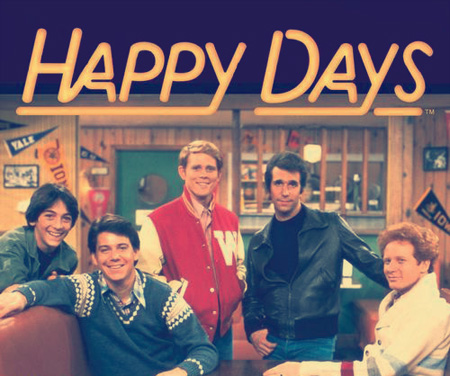
So here’s my own anecdotal observation. There are just as many Richie Cunninghams in the world today as there were in the 1950s. There are also just as many Fonzies, and Fonzie was actually (beneath the surface) a pretty good kid.

Ryan Gavin is much more Richie Cunningham than Fonzie. He was a stand-out student at Biddeford High School. He made older people feel comfortable. He is articulate, polite and wears his jeans on his hips. My wife served with him on the school board and often remarked about how we was always the most prepared, the most earnest of school board members.

In January 2009, Ryan founded WildbrookMedia, and now serves as its executive director, overseeing the creative process for some of the most recognizable content on the air and on social media in Maine.  In 2008, Ryan attended the American Legion’s Dirigo Boys State program, and joined the staff in 2009, currently serving as Media Coordinator. Ryan ran for Mayor of Biddeford in 2011, before endorsing Mayor Alan Casavant in the general election. He  represented Maine at the 47th Annual United States Senate Youth Program, and is a member of the United States Senate Youth Alumni Association.

In summary, this young punk offers a lot of hope for the future, and so do the majority of his peers. It’s just that we spend a lot more time talking about people like Miley Cyrus instead of people like Ryan Gavin.

Sure, this is just one piece of anecdotal evidence, but you don’t have to look very far to figure out that the only thing us old farts have to fear is fear itself.

Goodbye Stranger

reporterI want to scream.

In a world chock full of culprits that are partially responsible for everything from the “dumbing down of America” to the nomination of Mitt Romney and the advent of Twitter, it’s become increasingly difficult for me to stomach the banality associated with blaming “the media.”

While media criticism is important and necessary, a lot of people who blame “the media” have no idea what they are talking about.

Instead, blaming “the media” has become a catch-all phrase and a convenient target for those who want to ignore two very much larger problems: laziness and stupidity.

There is no question that media has changed, but I challenge you to define the word in its present-day context.

Sure, we can turn to the dictionary and find this: media: (noun) 1.) plural form of medium; 2.) the main means of mass communication (esp. television, radio, newspapers, and the Internet) regarded collectively.

Media, whether it’s a daily newspaper, the evening television news, a blog or something that a “friend” posts on his Facebook page, is multi-faceted, multi-layered and increasingly accessible to every person on the planet.

That’s not necessarily a good thing.

Blaming the media is sort of like blaming your reflection in the mirror for having that fifth margarita or being late to work. Too often, blaming the media is just a convenient form of mental masturbation that serves no good purpose except helping you sleep better at night.

The good ol’ days?

The opening pages of the book Leaving Readers Behind: The Corporate Age of Newspapering contains this stunning contrast of two very different media mission statements:

This is the Journalist’s Creed written by Walter Williams in 1914:  I believe in the professionalism of journalism. I believe that the public journal is a public trust; that all connected with it are, to the full measure of their responsibility, trustees for the public; that acceptance of lesser service than the public service is a betrayal of this trust.”

And this is the Statement of Strategic Intent issued by Knight Ridder Newspaper Corp. in 1991:  We stand for excellent  service to customers and communities, a fair, respectful and learning environment for all our employees and a strong return for our shareholders. This responsibility is shared by each of us in Knight Ridder, regardless of title or function.”

So it seems easy to be cynical about the so-called “mainstream media” or as Rush Limbaugh describes it: “the drive-by media.”

Oh, how we long for the good days of journalism; the fair and balanced reporting and the loyalty of preserving the public trust. Too bad it’s gone right?

Wrong.

We are surrounded and inundated with loads of good journalism and a diversity of media that is unparalleled and will be surpassed in its diversity in less than 15 minutes.

Before you moan about the demise of media, or the sentimental loss of the warm and fuzzy images of Walter Cronkite and the proverbial grumpy editor such as Ben Bradlee, chew on this: Why haven’t you switched the channel?

Try it, you’ll like it

Better yet, what’s stopping you from being the media? It’s probably the same four things that stop most media endeavors: Money, Time, Resources and Audience.

Sure, go ahead and bitch about advertiser supported media, but how are you going to pay your reporters?  For those of you who will predictably point to examples such as “listener supported” public broadcasting, you may have missed those corporate announcements at the beginning of each segment.

Without corporate and taxpayer subsidies, National Public Radio would be nothing more than a distant memory because the vast and overwhelming majority of its listeners don’t dig very deep into their own pockets.

Yeah, and state-sponsored media is a sure-fire way to ensure credibility and a lack of bias. I mean, really . . . what would could possibly go wrong if we let the government report to us about the government?

I find it annoying that the bulk of those who bitch about the media have spent zero hours in a newsroom nor  ever required to sit through three hours of a planning board meeting while earning slightly more than minimum wage.

Pull back the curtain

Of course, no one loves to talk more about the media than the media. They are a narcissistic lot, full of righteous indignation. I know this because many of my friends and former colleagues still work in the media. God bless them.

These folks are professionals, but they are no different from anyone else and subject to all sorts of the very same pressures you will find in any other profession: gossip, bias, greed, competition and ego.

A few weeks ago, I found myself on the phone with one of the editors at the Portland Press Herald. I was calling on behalf of one of my clients and asking for a favor.

The editor was a bit pissed off about my intrusion, and he didn’t try very hard to mask his annoyance: “Randy, you used to be a journalist, how can you ask me a question like that?”

Surprisingly, he accepted my honest response. “I’m not a journalist anymore, and you know damn well my current occupation requires me to ask the question even though I know you are going to refuse my request.”

That honest exchange led to a compromise we could both live with: he did not budge and I accepted his decision.

Where’s the good media?

As I said before, we are surrounded by some excellent examples of journalism. A couple of weeks ago, I picked up a copy of the Southern Forecaster newspaper. That free, weekly newspaper was chock-full of solid community-based reporting.

There was an in-depth, comprehensive story about growing tensions between the Scarborough Rod & Gun Club and a group of neighbors who chose to build their homes near the club. It was a universal story about the themes of gentrification and it made me think about the tension in my own community between those who use the Biddeford Airport and their residential neighbors.

Another front-page story examined the plight of the South Portland City Council in light of a recent court decision that would allow municipal employees to serve on municipal boards and committees. Again, the same dynamic is an issue in my own community.

The Forecaster group of newspapers is one of the few remaining Maine-owned media outlets, and its staff seems to understand the importance of digging deep and solid reporting. Mo Mehlsak is the editor of the Forecaster. I remember him from his days as the city editor at the Journal Tribune. He is a newspaperman’s newspaper man: tough, intelligent and insightful. I never had the pleasure of working with him, but I have admired his work for nearly 20 years. He is obviously grooming an exceptional staff of reporters.

Speaking of the Journal Tribune, Tammy Wells has been covering York County issues longer than anyone else. She offers her readers a ton of institutional memory and insight.

When it comes to unbiased reporting and a willingness to cover stories in-depth, check out the work of my former colleague, Kate Irish Collins, a reporter for the Saco-based Sun Chronicle, part of Current Publications, another Maine-owned media outlet. No one person can come close  to matching Kate in producing such a volume of news content with consistent accuracy and lack of bias.

My friend Kelley Bouchard at the Portland Press Herald consistently delivers solid reporting and poignant features. She led off her newspaper’s insightful (and painful) examination of Maine’s aging population. The Challenge of Our Age.

On Election Night, every political junkie in Maine turns to the exceptional coverage provided by the Bangor Daily News.

And if you’re looking for a good compilation of Maine news and opinion, check out Bob Mentzinger’s  Writing Maine feed. Mentzinger is a close friend, but he’s also the editor at the Brunswick Times Record, another afternoon daily that strives every day to produce exceptional journalism on a shoe-string budget.

Yes, there is plenty of room for media criticism, and Al Diamon does an exceptional job of keeping Maine’s media outlets on their toes with his sometimes harsh, yet consistently detailed analysis that can be found in his weekly Media Mutt column published at The Bollard.

These are just a few samples that show it’s not hard to find solid journalism in Maine or anywhere else. You just have to look for it.

The next time you feel like bitching about the media, go take a long, hard look in the mirror and ask yourself this: are you part of the solution or part of the problem?

Puttin’ on the Ritz

I don’t always agree with Oralndo Delogu, but when I do – – – I shout it from the rooftop.

Delogu is an emeritus professor of law at the University of Maine School of Law and a well-known policy wonk. He is also a frequent contributor to the Forecaster group of weekly newspapers in southern Maine.

With the increasingly controversial Affordable Health Care law looming on the near horizon, Delogu’s most recent column moneyraises a point that has been buried beneath the mounds of political rhetoric and stunning complexity of the new law.

In a nutshell, how do we make health care more “affordable” without addressing the skyrocketing cost of healthcare — even in the non-profit sector?

The first half of Delogu’s column focuses upon the fading memories of the Occupy Wall Street movement and all of its garbled rage toward corporate profits. But the second half focuses like a laser on the growing income disparity found in one of Maine’s largest non-profit health care providers. Delogu shares data he uncovered by Mainebiz about Maine Medical Center.

The state’s largest hospital, which is also Maine’s fourth largest employer, recently announced that it would be cutting more than 200 jobs. The hospital blames the usual suspects: uncompensated care, lower insurance payouts, etc.

But Delogu sniffs something else in the air.

According to Mainebiz, Maine Medical Center is the second largest nonprofit corporate entity in the state, with more than $1 billion in assets.

But here’s where it gets interesting:  Of the 27 highest paid health-care professionals in the state, 25 were associated with a “non-profit” hospital and seven of them are or were employed by Maine Med.

Delogu writes: “Based on 2010 salary data, the average annual salary of these seven physicians or executives was just under $1 million . . . one might ask how many hundreds of employees (at these 13 Maine non-profit hospitals) have annual salaries between $636,000 and say, $300,000?

Although there is plenty of evidence to suggest some outrageous behavior in the private-sector world of corporate America, it’s refreshing to see some analysis that is willing to examine other pieces of the puzzle.

Bravo, professor! Bravo!

Get back

Someone once famously said, the only apparent constant is the consistent and unyielding persistence of change.

In political campaigns, the word “change” has long been a favored rhetorical tool for those seeking to oust an incumbent. On the other hand, if those challengers are succesful, they quickly drop the battle cry for “change.”

The New Page mill in Rumford.  (Bangor Daily News photo)
The New Page mill in Rumford. (Bangor Daily News photo)

Change is rarely quantified during political campaigns. Consider: If your house burns down, that will be a change, but not necessarily a change you would choose.

Unfortunately, none of are us are immune to change or able to control its impact.

But it’s important to remember that we can respond to change without panic. We can embrace change and accept it. We can and should always prepare for the next change that waits around the proverbial corner.

I chose this topic as the result of an article I read in yesterday’s Wall Street Journal. That story, about 1,100 lost paper mill jobs in Alabama, jarred me and re-ignited a lingering sense of anxiety I carry around with me about Maine’s fragile economy.

The thrust of the story involved the diminishing need for paper in an increasingly digital age.

I spent the sophomore and junior years of my high school career as a student at Rumford High. Still, more than 30 years later, I always enjoy telling people from away that I lived in Peru and traveled daily on a school bus through Mexico to simply attend classes.

It did not take long for me to understand what it was like to live in Rumford, a community that is literally dependent on the financial health of yet another paper milll perched along the shore of the Androscoggin River.

Every year, while driving my family toward our summer excursion to Rangeley Lake, my kids and wife will complain about the smell of the mill as we drive through the neighboring town of Mexico. “That’s the smell of money,” I remind them.

When I was a kid, the mill was the preferred future for many of my classmates. Those were good-paying union jobs with excellent benefits. If you get into the mill, you would be all set. You could earn a good living, raise a family and buy a decent home.

Those days are changing.

It’s no different in my hometown of Biddeford, another Maine community hit hard by the influence of global markets and a decline in what were once traditional manufacturing opportunities.

Historically, Maine’s economy has been driven by the 3 Fs – – – Forestry, Fishing and Farming. All three of those once strong economic engines are facing serious challenges  – – from unstable and rising energy costs and tightening environmental regulations to global competition and advances in technology.

Fortunately, many of Maine’s paper mills are learning to adapt to a world that consumes less paper as the result of rapid advances in digital technology. But that adaptation seems slow and certainly painful.

 Maine is the second leading paper-making state by volume, producing more paper than any state other than Wisconsin, according to the Maine Pulp and Paper Association. Maine’s paper production has consistently increased since 1990, and in recent years Maine has produced more paper than ever before, according to the association’s web site.

But the challenges cannot be ignored or dismissed. My job regularly takes me into rural communities throughout Maine. Too many of our communities are mere shadows of what they once were.

just last week I spoke to a school principal in northern Maine who told me her school district has a 74.3 percent rate of students who qualify for free or reduced hot lunches. In the same breath she proudly tells me that her school district also has one of Maine’s highest graduation rates and that her school district was the first in Maine to raise money for Hurricane Sandy victims.

Just amazing.

There are many other good stories out there, An increasing number of commercial fishermen throughout the Gulf of Maine are becoming partners in collaborative research projects and using new technology to adapt.

But still, I worry. I worry that my fellow voters will not support our state’s technical schools. I worry that too many of us blindly follow change or react to it within a narrow vacuum of our own experience.

I know what it’s like to live in a community that shudders with fear and anxiety when rumors of No. 2 machine shutting down begin to circulate around town.

Can technology and education overcome the painful consequences of change? Yes, but only if we can accept and prepare for change.

Still, it hurts to think about those 1,100 people in Alabama, just like it hurts to drive through portions of Washington County.

Make no mistake: change is something you can believe in.

Shout it, shout it, shout it out loud

Every voice matters. Even the voices that have a hard time crafting their message.

As my hometown of Biddeford braces for another political season, one of our city’s mayoral candidates has opted to take his message to cyberspace by starting a blog. The blog seems intended as a platform to champion the plight of the under-served and to highlight this candidate’s economic development plan: a push to “legalize weed.”

If nothing else, Karl Reed, Jr. has a unique strategy for ousting the incumbent:

He’s running a write-in campaign, otherwise known as a sure-fire way to place fourth in a three-way race.

Okay, so once you get past the horrid sentence structure, the author’s inability to spell or the grammar that would cause a third-grade English teacher to set herself on fire,  Reed’s intent should not be ignored by those who serve their community. See: Game Over, The Rent is too high.OLYMPUS DIGITAL CAMERA

In his initial post, Reed paints a sympathetic tale of those who are often ignored at the monthly Rotary Club breakfast meeting or the Chamber of Commerce “after hours” event.

He is speaking from the heart, a place more politicians should visit. He is a self-appointed champion of those without a voice, those who are too often discounted . . . those whom many of us ignore blissfully.

Karl worries that our public education system too often fails the kids on the edge of society. He worries that the people he encounters every day on the street may no longer be able to cope under the weight of a dismal economy and a lack of jobs.

These are important messages, an amateur-hour version of the Occupy Wall Street theme: full of sound and fury, completely aimless and an unyielding rage against “the man.”

It’s too easy to ignore it unless you have lived it.

Despite my sympathy and appreciation of his perspective, his rage and angst give me serious pause. Thus, I have no problem confessing that I will sleep better tonight, knowing his name will not be on the ballot in November.

Lie to me. I’m not that strong

My wife had to buy a cane yesterday.

It’s taken almost five years to get to this point – – and try as I might — I can no longer ignore the impact that MS is taking on her body, her spirit.

Worse yet, there is not a goddamn thing I can do to stop it or even slow its progress.

Against this disease, I am useless.

Laura 9Despite the lies that the boys and I tell ourselves, despite all the distractions: the self-inflicted chaos, the thousand other natural shocks that flesh is heir to, the disease has a one-up on us tough guys.

Every day, in just the smallest, almost invisible of ways, I lose a tiny sliver of the woman I adore; and she loses little pieces of a still vibrant and blessed life during a steady creep toward loss of mobility.

By now you think I would have developed better coping skills, that I would be better equipped to face the reality. You would be wrong.

I am still a prick, thinking too often is selfish terms like right now. Not much better than the way I reacted when I learned of her diagnosis.

I talk about it because it warrants conversation. Because I have to publicly own my shitty performance in dealing with my wife’s MS.

Laura is stronger, smarter and far more courageous than me. She once jumped out an airplane. She is more spontaneous, easier to get along with: daring, loving, funny and kind.

Some days are better than others. Yesterday was a good day: Yeah, she bought the cane but we also laughed during a wonderful dinner with friends in Portland.

We all have our crosses to bear. I just wish sometimes I could ignore it a little while longer.

To learn more about MS and how you can help fight the disease, check this.

Too big to fail?

I never expected it to happen so quickly.

Almost every day I am deep in the trenches of public opinion, helping a wide variety of clients navigate the perilous waters of brand reputation management, crisis communications and message development designed to garner strong public support.

But last night it got a bit personal, and I tried a social media experiment.

urlI had an issue with my mobile phone provider, AT&T, one of the nation’s largest corporations. I spent more than an hour on the phone with their customer service representatives, haggling over a bill that was grossly out of balance. You can find the details here.

The company failed on several fronts. First, they did not live up to the promises they made during prior calls about the same issue. Secondly, perhaps more importantly, they let me off the phone without asking me if I was satisfied.

I waited 24 hours and then launched an all-out social media battle with the company. I dragged their competitors into the fray. I hounded their Facebook page and chased them on Twitter. But it all ended rather abruptly.

I never had the chance to execute the second phase of my PR battle because they smartly surrendered and resolved the issue to my satisfaction.

I am just one person, but I used my social media connections to leverage my message. The results were clear. It took fewer than 24 hours for them to surrender to my one-man war on the blogosphere.

This was all preventable. AT&T spent far more than the $1,000 they claimed I owed. They also suffered as others jumped on my bandwagon, further diminishing the company’s brand and reputation.

There are lessons here.

1.) No company is too big to fail.

2.) Do not underestimate the power of social media.

3.) Your brand and reputation are your most important assets and must be guarded.

AT&T ought to take a lesson from companies like AVIS, which authorizes its front-counter rental agents to do whatever it takes to resolve customer complaints; or LL Bean, a company that built a reputation for the quality of its products by honoring their replacement for any reason whatsoever. Or, GWI, a locally owned Biddeford-based ISP and telecommunications provider that always goes the extra mile to make customer satisfaction a top priority.

Fletcher Kittredge of Biddeford started GWI with vision and commitment, but he also had to endure many, many battles with larger telecomm giants. Fletcher proved that you can compete with anyone by focusing on the quality or your product and developing strong relationships with your customers.

AT&T, by comparison, is a multi-billion dollar corporation. Why is it so hard for such a large company to understand or appreciate the value of customer satisfaction and loyalty?

AT&T: Dirty deeds, done dirt cheap

My nightmare started less than 24 hours ago.

Spend just a few moments on the blogosphere and you will find a lot of stories just like mine.

On Google, Facebook and Twitter, these dark tales of woe, deceit and theft abound.

But my story is a tad different.  And this, my friends, is the first warning shot across the bow of a corporate giant aircraft carrier that likely will pay little attention.

attI am talking about AT&T, one of the nation’s largest and most well-known corporations.

AT&T (NYSE:T) is a Fortune 500 company and of the 30 stocks that make up the Dow Jones Industrial Average. Their reported consolidated revenue for the 2011 reporting period was $126.7 billion. Randall L. Stephenson is the chairman and CEO of AT&T.

So now you know what I’m up against, but don’t count me out just yet.

Allow me to back up and offer some context.

I have been a loyal AT&T customer for more than 7 years. I have a Family Plan that is also used by my wife and two teenage step-sons. I have a data bundle, unlimited text and 1,500 minutes of monthly talk time. My average monthly bill runs approximately $200 every month.

I have upgraded my phones over the last few years. I have never said an unkind word about AT&T in the public realm, despite their rather dismal coverage and the fact that my cell phone is essentially useless in my own home. But I am hooked into everlasting contracts, and until now it seemed like a giant pain in the ass to leave.

But then this happened:

Last evening, I received an automated call from AT&T, suggesting that I should consider a new plan. Curious, I went to view my account online and almost had a massive coronary. According to AT&T, I owe them $1,016.21.

Go here to find out how it happened and how AT&T repeatedly failed in even the most basic of customer service tasks.

I spoke with at least two representatives, including a young man named Rico, a “customer satisfaction specialists,” who didn’t seem to know the first thing about customers or service.  In summary, AT&T refused to budge.

Somehow, I was able to get Rico to set down his scripted talking points and listen to me for just a few seconds. And this is what I said.

 I don’t know who you are. I don’t know what you want. If you are looking for me to pay this bill, I can tell you I don’t have money. But what I do have are a very particular set of skills; skills I have acquired over a very long career. Skills that make me a nightmare for people like you. If you adjust this bill now, that’ll be the end of it. I will not look for you, I will not pursue you. But if you don’t, I will look for you, I will find you, and I will kill your company’s reputation.

For good measure, I threw in some other key phrases like Maine Public Utilities Commission, Maine Office of the Public Advocate and Joint Standing Committee on Energy, Utilities and Technology.

I am going to haunt AT&T’s Facebook page and chase them on Twitter. I am going to call their customer service line every day, multiple times a day. I am going to shout my story from the rooftops, call every member of the Legislature, file formal complaints and talk to my friends in the media.

I am going to buy AT&T stock so that I can participate in shareholder conference calls and stay updated on their corporate affairs. I am going to e-mail Randall Stephenson daily, sometimes two or three times a day. I am going to create a Facebook page and make sure that Verizon, Sprint and T-Mobile know about it.

Strangely, there are several fun URL domains available, i.e. attsukz.com; attblows.com, etc.

ATT-Logo-NJTechReviewsBut in the end, AT&T has me over a barrel. They can impact my credit report if I don’t pay on time. They have me locked in a contract.

But I am motivated, and unlike the foolishness and aimlessness of the Occupy fiasco, I have a clear objective: AT&T is going to spend at least 10 times more than what they are charging me for international calls that I never made.

Companies like AT&T spend millions every year to attract customers in a competitive market. They spend millions more on lobbyists and on PR professionals like me.

Go ahead and laugh, who could blame you? But consider this: social media helped bring down the Egyptian president. Lech Walesa, a Polish Factory worker, brought the Soviet Union to its knees in a matter of weeks. David beat Goliath and elephants are terrified of mice.

I invite you to join me in my crusade. I am going to have fun, and you can follow my progress with regular updates here.

Meanwhile, I will wrap it up here with a wonderful quote from Margaret Mead: “Never doubt that a small group of thoughtful, committed, citizens can change the world. Indeed, it is the only thing that ever has.”

Hey, AT&T: can you hear me now? You guys may want to rethink possible.

AT&T customers are welcome to join the fight. Tell me your story here

40 Acres and a Mule

I am a racist.

Part of me is tempted to let that statement flutter alone in the social media stratosphere without context. I am curious about the the reaction, but I am not anxious to begin looking for a new job, new clients, new friends and a new wife.

Seattle Times photo
The Rev. Dr. Martin Luther King, Jr.    Seattle Times photo

Of course, I’m talking here about degrees of racism. But isn’t that the way it usually goes with us garden-variety racists?

Originally, I was going to write this post after speaking with an African-American “acquaintance” of mine, a woman I have long admired from a safe and comfortable distance. We have tentatively scheduled a cup of coffee — or maybe a pint of beer sometime in the next few days, when her schedule settles down.

I know of this woman only through third parties. Recently, we have become “connected” on a few social media platforms. I find her writing haunting and jarring.

So why did I deviate from my original plan?

1.) I am intimidated by this woman; and

2.) This week is so timely for this discussion, this musing of mine.  For one, this week we celebrated the 50th anniversary of the stirring and famous speech by the Rev. Dr. Martin Luther King, Jr.  We also have all the fallout from Gov. LePage’s latest verbal snafu; but more importantly . . .

3.) I am afraid that I would be less than honest if I met her before writing this. Meaning: I would try to be more careful, bend to my “white-man guilt” by being overly empathetic and trying desperately not to offend. In summary, I would probably open the flood gates of bullshit.

A garden-variety racist

Some racists go all in with their prejudice. David Duke comes to mind, and so did the recent antics of a cranky and seriously disturbed retired cop in Sabattus, Maine.

Others take a shot at redemption in their later years. They either soften or gradually see the light; or — more appropriately  — begin smelling the rot of their own garbage. Strom Thurmond comes to mind, here.

I fall asleep at night comforted that I am not David Duke, David Marsters or even Strom Thurmond. I am more like Governor LePage, and more like most people I know.

I am a tiny bit racist. So I get to skate with the hip, the self-aware and the all-so-cool white folks who either ignore their racism or make excuses for it.

It is not excusable.

Physician, heal thyself

I had this race epiphany a few days ago while reading a media report about Governor LePage and his attempt to “clarify” and explain allegations made by anonymous members of his own party. Essentially, LePage denied ever saying that President Obama doesn’t like white people.

The governor’s defense centered upon his assertion that President Obama has repeatedly missed opportunities to heal our nation’s racial tensions, fumbling or ignoring golden opportunities to bring white and black people closer together.

For just one bat-shit crazy second, that explanation almost made sense to me. It was then that I could no longer deny that I was a racist.

Now, before I bring down the full weight and wrath of those ultimately loyal to LePage, allow me to back up.

Maine%20Governor%20Paul%20LePage(1)The governor was a little bit right in his criticism of President Obama on this front. But here’s the problem, LePage almost three years ago abdicated the moral high ground when it comes to easing racial tensions.

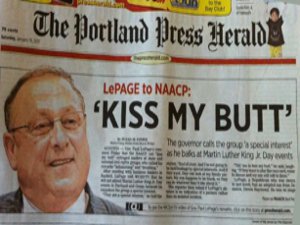
Most of us remember that cold day in January 2011 when local and national media went into overdrive regarding LePage’s alleged racism. He didn’t just decline an invitation to attend the annual Martin Luther King Day breakfast in Portland. Instead, he proudly (with what would become his trademark bluster) told reporters that “the NAACP can kiss my butt.”

If LePage is worried about missed opportunities to heal racial divides, he’s got a damn funny way of showing it.

Consider what he could have said. “I’m not sure why you folks in the media are making such a big deal about this. I simply declined an invitation because my schedule is full, but lets all remember that I consistently attended local MLK breakfast events in Waterville during my tenure as mayor. I also have taken a young African-American man into my home and helped raise him as a member of my own family. I strongly resent any implication that I am a racist. Let’s get busy talking about the important issues we are facing in Maine government.”

Nope, LePage could not resist coming on strong, full of sound, fury and arrogance. He began a path of allowing his pride to trump his greed.

How do we move forward?

I do not think our governor is a more successful version of David Duke, but I do think he has missed plenty of opportunities to talk in a meaningful way about an issue that is still very relevant in today’s world — even 50 years after the delivery of the I Have A Dream speech.

So, I am also a little bit racist, but I am also a little bit greedy, a little bit of a misogynist and a little too quick with anger.

Unless I am willing to look at these things, to painstaking examine my own heart, I have no authority to opine on these issues. We must be willing to confront the things we don’t like . . . even those things that lurk in the darkness of our own souls. Otherwise, the garbage festers and it can grow and infect other parts of our being.

As I said before, these things are not excusable but there are reasons for their development in even the best of people. Part of it is our cultural and genetic pre-disposition to assimilate within the familiar.

In this way, I suspect strongly that I am not alone; that the majority of folks I know are just a tiny, tiny bit racist. We can work on it if we can be honest about it. If we start with the man in the mirror.

White-man guilt

In the aftermath of the Civil War, the United States embarked upon a period of “Reconstruction.” Today, we would call in FEMA and lease some trailers.

The concept of giving former slaves 40 acres and a mule as reparation for their slavery was short-lived. Much of that land was eventually returned to its antebellum owners. From time-to-time, some guilt-ridden white folks and a lot of still angry black folks talk about the concept of ‘reparations” as the only way to heal the racial divide. Affirmative-Action programs were apparently a lot easier to digest.

Only weeks before being sworn-in, President Jimmy Carter granted an interview to Playboy magazine. It was the November 1976 issue. I know this because I was 12 years old and was an avid reader of my father’s hidden stacks of Playboy magazines.

Patty McGuire was that month’s centerfold. She was later named Playmate of the Year in 1977. She liked CB radios. I desperately wanted a CB radio back then. I saw Patti, and I knew it was a match made in heaven . . . but I digress.

Carter was trying to heal the cynicism of a post-Watergate nation by being painfully honest. In that issue of Playboy, he confessed to “having lust in my heart.”

Unfortunately, Carter had a lot of other tasks at his feet, many of which did not work out so well. But confessing lust in a Playboy interview is sort of like criticizing missed opportunities for racial healing after telling the Maine chapter of the NAACP to kiss your butt.

The message gets lost.

Automatic for the People

Note: Please see edits below.

Maine Democrats are celebrating tonight, but I think they have a serious problem.

Let me back up.

State Sen. (Elect) Eloise Vitelli

Politics is fascinating.

Don’t puke just yet, at least not until you consider that observing politics offers the best of everything: intense drama, fierce competition and hilarious moments of human folly, all wrapped in a package of somber significance driven by human pathology.

It’s like a sporting event, a comedy show, and a night at the Met, all wrapped into a neat little package of 30-second installments.

Okay, so go ahead and puke now if you must. But for the rest of you consider this scenario.

It’s the middle of an all-too-short summer in Maine, where a state senator lands a sweet federal gig and must vacate his seat halfway through his two-year term.

He is a solid Democrat, a progressive, even…respected in his party (a former majority leader in the senate) and handily supported each election cycle by his constituents.

His district (State Senate District 19) is a reliable haven for his party: Mid Coast Maine, the home turf of Senator Angus King, Bowdoin College… not a hotbed of right-leaning conservatism, by any stretch.  Not really true, see edits below.

The Dems want to keep this seat. They still feel the sting of 2010 when they lost the Blaine House and both houses of the Legislature. Another gubernatorial campaign is already underway, and the Dems are absolutely committed to dumping Republican Paul LePage, who has repeatedly embarrassed his own party with ill-advised remarks and a stunning inability to control his temper and message.

Now, back to this sleepy senate district.

Two smart, savvy women lace up their gloves, representing their respective parties. A Green candidate also gets into the race.

Republican Paula Benoit

More than $150,000 is spent on the campaigns during just a few weeks. It will likely top $200,000 when all the final campaign reports are turned over for public inspection next month.

It is, according to several political observers — including former State Senator Ethan Strimling — a record-breaking race for campaign funding in a state senate race.

The result?

A turnout of slightly more than 30 percent of the district’s registered voters, and a narrow victory for the Dems. Eloise Vitelli beats Republican Paula Benoit, who previously held the seat from 2006-2008.

Of the 8960 votes cast, the Democrats hold onto their seat by a margin of slightly more than 3  percent, 282 votes.

The Democrats are cheering and drinking bubbly tonight. They deserve the celebration. They worked hard.

But I think they will have a big hangover tomorrow morning.

How do you spend more than $100,000 and win by a little more than 3 percent when the Republican governor is trailing in the polls and you are running a campaign on your home turf?

Conventional wisdom says that the Maine GOP is in trouble and eating their own. Maybe.

But it seems pretty clear that Maine Dems have plenty to worry about between now and next November.

******

Edited to include Benoit’s prior election to the Dist. 19 seat in 2006.

Editor’s note: There is a peril to blog posting when you are a political junkie jacked up on Twitter, caffeine and cigarettes. Some glaring mistakes need to be corrected: 1.) Bowdoin College is not within Senate District 19. In fact, the town of Brunswick is not in Senate District 19, so you can also scratch my reference to Senator Angus King. I was consumed with the Brunswick Times Record’s endorsement of Benoit, thus thinking about Brunswick, instead of focusing on silly things like facts. Not smart.

District 19 may not be a Democratic stronghold, but it’s not a Tea Party demographic either. Like much of Maine, it is shifting and best described as purple instead of red or blue (Props to Gina Hamilton at the New Maine Times for that analysis). Republican Art Mayo who served in the seat from 2002 to 2006 switched parties and became a Democrat in 2004. Gina is much better at facts. Dan Demeritt (@DemerittDan) also pointed out that I did not include the tallies for the Green candidate in the race. Daniel Stromgren garnered 357 votes (4 percent), and Demeritt opines that of every four votes for a Green, one stays home, one goes GOP and two go Dem. So, you tell me: was Stromgren a factor?

In the end, I stand by my original analysis, despite my rush to publish and all of its associated pitfalls. Why?

1.) In 2012 (just last year) Goodall crushed his GOP opponent, Jeffrey Pierce (64-36 percent). Two years earlier, he trounced Republican David Kaler, 52-45 percent.

2.) Republican Gov. LePage is trailing in polls and getting widespread media attention for his gaffes, helping the Dems.

3.) The Dems had the seat and spent more than 100 grand to keep it. They got a 3 percent return for their money and a 30 percent turnout. What “message” are they sending to Gov. LePage? Do they really feel good about that? Really? They are not on easy street. Case closed.