
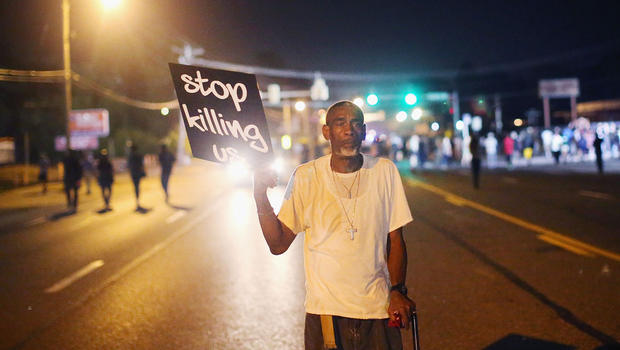
I am at a distinct disadvantage writing these words.
I am white. I am also the husband of a former police officer, thus I am somewhat biased.
But I will proceed regardless; because all the news, all the commentary, and all the passionate debate about what happened in Ferguson, Missouri has sparked my memory, jarred my thinking — all the way back to my junior year in high school when I wrote an essay about the Boston Massacre.
The similarities are striking.
History has a funny way of repeating itself; and as George Santayana said, ” Those who cannot remember the past are doomed to repeat it.”
The Boston Massacre happened on March 5, 1770.
Five colonists were killed by British soldiers, who were serving as law enforcement officers to uphold the rule of law (including unpopular taxes) and other provisions of the Townshend Acts
On that fateful evening, Hugh White, a British private soldier, (Police officer Darren Wilson) stood on guard duty outside the Custom House on King Street. A young man, Edward Garrick, insulted another member of the British Guard, Capt. John Goldfinch, saying that Goldfinch had not paid a bill.
Private White injected himself into the debate and told Garrick that he should be more respectful of British officers. White, in fact, left his post, challenged the boy, and struck him on the side of the head with his musket. This attracted a crowd.
Tensions were already high between the British and the colonists. The boy’s insult and White’s reaction touched off a powder keg of resentment.
Within minutes, more than 50 colonists pressed around White, throwing objects at him and challenging him to fire his weapon.
The crowd grew in size and the British dispatched more troops to quell the colonists, who were throwing rocks and snowballs at the officers. And then muskets were fired. Five colonists were killed and six more were injured.
The first man killed was Crispus Attucks, an African man, who was labeled later as an instigator.
In the days and weeks that followed, there was a propaganda battle between the two sides. Everyone had an opinion.
Of the eight officers arrested, six were acquitted and two were charged with manslaughter because they fired directly into the crowd.
The attorney representing the British convinced the jury that the officers were in fear of their lives and acting in self-defense.
And who was that attorney?
John Adams, the man who would go on to become the second president of the United States, took the case because he wanted to ensure a fair trial, despite his patriot leanings.
Adams received threats and daily harassment. He feared for his life and for the safety of his family. Many colonists regarded him a traitor for representing the British.
At trial, witness statements were contradictory, and Adams seized upon those contradictions to paint an utter scene of chaos for the jurors, despite the fact that his clients were wholly unpopular.
But Adams also played the race card. Adams called the crowd “a motley rabble of saucy boys, ‘negros’ and ‘molattoes, ‘Irish teagues’ and outlandish jack tars.”
Popularity did not matter to Adams. He knew the stakes were too high to cave into the pressure of political expediency.
What John Adams said during his closing statement at trial should cause us all to pause before offering our own amateur speculation about the intent, competence or procedure of the Grand Jury in Ferguson, Missouri:
Facts are stubborn things; and whatever may be our wishes, our inclinations, or the dictates of our passion, they cannot alter the state of facts and evidence.
Flash forward to today and yet another young man is dead, and a community is ripped apart.
We will probably never know what happened on that fateful night in August. Most of us (God willing) will never know the pain of losing a child, or the haunting nightmares of a police officer who felt out of options.
But what we do know for certain is this: that the rioting, which followed the non-indictment was not at all justified, but completely understandable. That there is still a rage and level of mistrust in many of our communities and it is there because of undeniable history.
We also know for certain that more than 100 police officers have been killed in the line of duty this year.
So let’s stop speculating and debate the things we know.
Let’s talk about how we move forward; because as history shows us, things can come apart very quickly.

 LESSONS IN MEDIOCRITY | OUTLAW JOURNALIST
I think some (by no means all) people who go into law enforcement are looking for a way to express their racist or simply bully-boy tendencies without consequence. There was and is no need to shoot an unarmed teen who is running away and “not following commands”, even if he bruised the officer’s face and more importantly, ego.
LikeLike
http://www.motherjones.com/politics/2014/08/police-shootings-michael-brown-ferguson-black-men
LikeLike
If a young man does not know how to keep in control in a volatile situation, he should not be a police officer. That is all. They are paid to stay calm.
I am not familiar enough with US history to compare the two events that you lay out very well.
However, there was no racial/ethnic aspect to what happened in the colonial era between the Brits and THE AMERICAN BRITS.
You would have done better I think to delve into English-Irish history for a comparison because that might have been a little more contextually sound.
It was a matter of politics in the situation you describe, not “race”.
Police brutality is not about politics. And Michael Brown did not approach the officer.
It is not the same.
And it is dangerous to reduce the racialized aspect of the situation to the comparison above. It bleaches what is going on into…nothing much…when IT IS BIG DARN DEAL.
I don’t care what country in the world we are dealing with or what the race of the people are, men who feel fear in the face of possible violence JUST CANNOT BE POLICE.
It has become beyond stupid. All these cops keep saying the same thing. “I got scared, I thought there was an immediate threat” just does not work when THEY KEEP ON MAKING THE SAME EXCUSE.
A guy got shot down south cause some random white fellow thought his rap music was too loud.
So, you are an excellent writer and you have attempted to make a good point. Just make sure that the racial/ethnic aspect is paramount.
If you want to help people to understand what has become a serious embarrassment in the eyes of the world, you have to tell the TRUTH.
RACISM IS A SERIOUS PROBLEM IN AMERICA.
The world is watching and nobody is impressed.
LikeLiked by 1 person
Thank you for your insightful comments. I neglected to mention that the first man killed in the Boston Massacre was Crispus Attucks, an African slave. John Adams, in defense of the soldiers, asserted during trial that the soldiers were under attack by an unruly mob including “negroes and half-breeds.”
LikeLike