Bury my heart

“Those who cannot remember the past are condemned to repeat it.” George Santayana
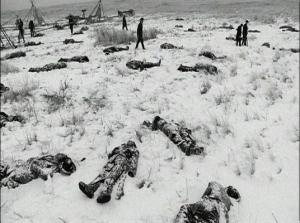
407838_583866058296151_931822225_nA Facebook friend reminded me that it was 122 years ago today, on December 28,1890, that more than 300, unarmed  native Americans were slaughtered in South Dakota by U.S. Forces. The dead included women and children, and this travesty is recanted in horrific detail through the pages of  Bury My Heart at Wounded Knee.
Colonel James Forsyth was later charged with The Killing of Innocents, but was exonerated and promoted. 22 of the soldiers that day were awarded the Congressional Medal of Honor. Do you remember being taught that lesson in public school? Probably not. It’s a piece of American history we like to forget.
 “I can still see the butchered women and children lying heaped and scattered all along the crooked gulch as plain as when I saw them with eyes young. I can see that something else died there in the bloody mud, and was buried in the blizzard. My people’s dream died there. It was a beautiful dream… the nation’s hoop is broken and scattered. There is no center any longer, and the sacred tree is dead.” -Black Elk (1863-1950); Oglala Holy man.
The Lakota and other tribes were labeled as terrorists in Washington, DC, long before we created the Patriot Act to keep ourselves “safe” from terrorists.
As we once again debate how to keep American citizens safe, many people dismiss the quaint notion of government tyranny. Tyranny happens in other places, not here…not now…they say.
Generally, these believers in government authority and the government’s sole discretion in keeping us safe are white folk who rarely consider the downsides of an unbalanced distribution of force and power. These believers in government sanctity forget about the rather recent atrocities in Dafur, Serbia, Libya or Nazi Germany.
I spent the summer of 1987 working on the Cheyenne River Reservation in Eagle Butte, South Dakota. Back then, I thought  wanted to be a priest.
I was 23 and full of my self as most 23-year-old men are. I strived to be sensitive, to be politically correct. The wise Lakota who surrounded me would gently smile when I used the words, “Native American.”
kids
I tried my best to be empathetic, compassionate. I desperately wanted people to know that I was enlightened and not a typical white man; someone who could listen without judgment or prejudice.
One of the men on the reservation set me straight. “If you think you can assuage the sins of your past with a couple of words, you are sorely mistaken.”
He stepped outside to have a cigarette. We never crossed paths again.
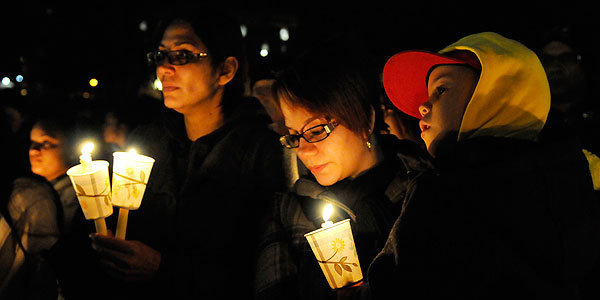
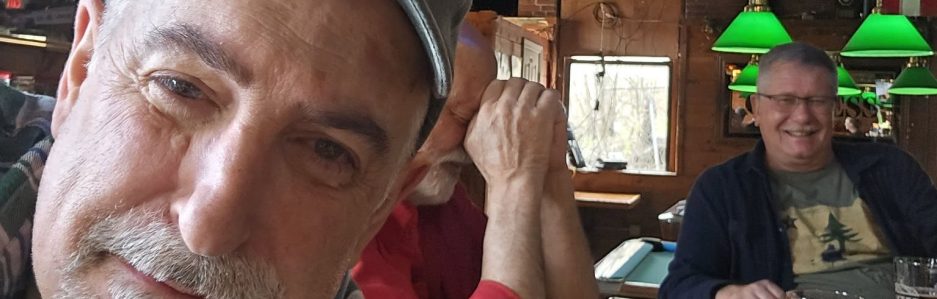
So here are two pictures. One is from 122 years ago; the other is from 1987.
Take a good look, and you tell me… have we learned anything from history?

Thank you!

IMG_2686As our nation and people around the globe continue to grieve the loss of young lives, I offer a bit of good news and a ton of gratitude…

Through the generosity of this blog’s readers, several hundred dollars was raised this year (assuming all pledges are donated) to Santa’s Cause, a non-profit organization in York County that operates with no overhead or administrative expenses.

Santa’s Cause focuses on children who are in state custody or temporary foster homes, ensuring that each of these children will receive a gift during this season of giving. I am proud of all of you who donated…no amount was too small.

I decided to auction what I describe as the last package of Twinkies in Maine. Though dozens of people donated in varying amounts, the single-largest donation came from Grady and Suzanne Sexton, the owner’s of Grady’s Television and a couple that I am proud to call my friends.

Congratulations, Grady and Sue! I will personally deliver your Twinkies tomorrow morning! (I’m sure they are still yummy)

As you wrap up your last-minute Christmas shopping, you may want to consider a donation to Santa’s Cause. Visit their website here and donate online. A pink sweater, a curling iron, some new underwear. Those are the items on these wish lists.

Or you could stop by the Biddeford Wal-Mart on Friday, between noon and three and throw some money into the Salvation Army bucket for a chance to watch me ring bells in the cold. Either way, you will be taking action to make a child’s life brighter, and what could be better than that?

P.S. A special thanks to my friends at the Bangor Daily News, the Portland Daily Sun and Maine Public Broadcasting for the added publicity and public awareness!

Just Ask Superman

superman

Why do some people refuse to address their own or a loved-one’s mental health issues?

Well, do you remember the 1978 movie Superman? Do you remember what happened to its leading stars?

Superman was a cheesy adaptation of the famous comic book hero and television show, but its cast was stunning.

Some of Hollywood’s most enduring and iconic figures were featured in that film, including Marlon Brando, Gene Hackman, Ned Beatty, Valerie Perrine and Margot Kidder.

The film also launched the career of Christopher Reeve, a handsome, muscular man who was cast in the leading role as the Man of Steel.

While participating in a 1995 equestrian competition in Virginia, Reeve was severely injured and became paralyzed. His injuries elicited support from all over the globe. He spent the rest of his brief life trying to help others with spinal cord injuries and established the Christopher Reeve Foundation.

He was a sympathetic hero. He touched us all. The man of steel could not escape this batch of Kryptonite. He died in October 2004 and millions mourned his passing.

Now, let us examine the fate of Superman’s leading lady, Margot Kidder, a successful actress who was cast as the petulant, cynical and manic reporter, Lois Lane.

A year after Reeve was paralyzed, Kidder was found by police hiding in the bushes in a suburban neighborhood near Los Angeles, California. She was taken into custody for a psychiatric evaluation.

The world was not so nice to Ms. Kidder.

Kidder has a bipolar disorder, so she became fair game for the media, late night comedians and a slew of derisive web site commentary. She was certainly no Superman.

She was human, frail and vulnerable but in a different way than her co-star, and that difference was best amplified by the ridicule that continues to follow her today, some 15 years after her illness became fodder for her former Hollywood colleagues.

Maybe that’s why fellow Superman star Marlon Brando spent so many years keeping his mental illness a secret.

By the time Superman was released in 1978, Brando was already known as one of Hollywood’s most iconic figures. The star of “On the Waterfront” and “The Godfather,” he was a tough guy’s tough guy.

But his mental illness apparently was a bit tougher.

Brando was a deeply troubled man struggling with depression, anger, and loneliness, according to those who knew him and detailed in an article by the National Center on Physical Activity and Disability.

Brando was from a generation of those who didn’t talk about mental illness. A generation that believed depression was little more than self-pity run amok or some other sort of character flaw.

It was that same generation of actors which produced the original Superman, George Reeves.

George Reeves (no relation to Christopher) was an actor best known for his leading role in the 1950s television series, The Adventures of Superman.

Reeves’ untimely death at age 45 was officially ruled as a suicide by police, although there is much speculation about that fact, most notably in the 2006 film Hollywoodland, which stars Ben Affleck as George Reeves.

Whether Reeves committed suicide is irrelevant and will probably remain a mystery for a long time to come.

But we do know how Hollywood would have treated him if he had talked publicly about battling depression.

Just ask Lois Lane.

Time out

mourningWe are all, it seems, struggling to come to terms with what happened yesterday in Newtown, Connecticut.

As the awful news began to unfold, I urged friends and family members to pause and refrain from using this tragedy to further support political/policy agendas. I was unable, –am still unable — to comprehend what happened. It seems impossible to shoulder the weight of this horrific tragedy.

“Today is not the day to have these conversations,” I wrote on my Facebook page yesterday. “Today is a day to grieve and to support one another.”

Those words strike me as empty, hollow. . .meaningless. Over the last 24 hours, our nation has experienced a range of emotions: rage, grief, shock, fear and despair.

So, how do we move forward? How do we reconcile those feelings, the raw emotions that carry us into another day?

Understandably, many of us are searching for answers, for meaning. We have different opinions, and I submit that those opinions are all vital, all necessary for the larger conversation that we can no longer ignore.

The response to my Facebook post was generally respectful. Some people, however, chided me..saying yesterday, the day before, last year was the time for that conversation. I agree with those well-intentioned Facebook friends of mine. I only wonder if they will now join me in that conversation.

Four days after the Tuscon shootings, I penned an op-ed that was published in the Portland Press Herald. I got lots of supportive feedback and some nice comments for my willingness to speak publicly about my own mental health issues and how those issues affect each and every one of us, but we all moved on to more important things . . . like arguing about Rick Santorum, Wal-Mart and Honey Boo-boo.

On July 23, I wrote another blog post about the peril of ignoring mental health issues and focusing on gun control in response to the movie theater shootings in Aurora, Colorado. But we quickly moved on . . .

As I struggle to find light in this time of darkness, there is only one small measure of comfort: for the first time, I am seeing and hearing numerous people address mental health as one of the core issues for that conversation. More people, it seems, are ready to have “that” conversation.

But it is not the only issue we must be willing to confront. I consider myself an ardent supporter of the Second Amendment, but today I am left with questions for which there seem to be no easy or convenient answers. I loathe knee-jerk reactions, but I am willing to reconsider all of my opinions so that I can join that larger conversation in a meaningful and productive way.

Ironically. as we all began dealing with the tragic fallout from yesterday’s rampage, another new story from half way across the globe was unfolding.

Questions about China’s inadequate mental health system are increasing in the wake of multiple incidents of school children being attacked and killed by knife-wielding, mentally ill people. Over the last few years, numerous school children have been killed and scores more injured by knife-wielding mad men.

That is not an argument against gun control. That is an argument that shows gun control is not the entire solution.

News commentator Bob Costas didn’t hesitate to offer his opinion about gun control less than 24 hours after an NFL player shot and killed his girlfriend before shooting himself in front of his coach. Just one week later, another NFL player was killed because he was riding in a car with a drunken teammate. It’s no surprise that there was no call for tighter alcohol controls.

Railing for gun control may help us feel a bit safer; but if we don’t have that conversation across a larger context then we can expect more of the same . . . senseless violence that shocks and angers, but then slowly fades away into distant memory.

On a final point. How do we ensure better background checks to prevent mentally ill people from purchasing or obtaining firearms?

Should someone like me, someone who struggles with depression and has been hospitalized sacrifice our privacy and have our health care records disclosed? Should family members of mentally ill people lose or sacrifice some of their rights under the Constitution?

I do not know the answers to those questions. But I do know, there is no way to guarantee safety. We live in a dangerous world, and if we are willing to sacrifice liberty for security (and considering the Patriot Act, Department of Homeland Security, and long shoeless TSA lines, we are) we may end up with something we never bargained for.

Killing me softly

gun-k92At the risk of provoking law enforcement officers, irate taxpayers, members of Maine’s Legislature and people who suffer with a mental illness, I want to congratulate Tux Turkel and a his team at the Portland Press Herald/Maine Sunday Telegram for an exceptional article in this morning’s paper.

At the crux of the story is the number of fatal shootings in Maine that are connected to police calls that involve someone who is mentally ill.

Before we proceed further, it’s important to note that the vast and overwhelming majority of people who suffer from a mental illness never have an interaction with law enforcement agencies.

Secondly, despite the myths, stigma, Hollywood hype and media bias, the overwhelming majority of mentally ill people are not violent.

In fact, violent acts committed by people with serious mental illness comprise an exceptionally small proportion of the overall violent crime rate in the U.S. They are more likely to be the victims of violence, not its perpetrators, according to the National Association of Social Workers (NASW)

In its March 2011 article, “Budgets Balanced at Expense of Mentally Ill,” the NASW newsletter also mentions a new report by the U.S. Substance Abuse and Mental Health Services Administration that documents a nationwide decline in behavioral health care spending as a share of all health care spending, from 9.3 percent in 1986 to just 7.3 percent, or $135 billion out of $1.85 trillion, in 2005.

(See: Pocketful of Kryptonite; All Along the Watchtower, April 2011)

Mental illness is an uncomfortable subject, one which many people would like to ignore and sweep below the rug. But we ignore it at our peril.

Asking law enforcement officers to effectively deal with ill people is sort of like expecting school janitors to provide high school tutoring services.

In our current situation, there is a natural tendency to blame the survivor. If someone has a knife and they begin moving toward you in  a threatening manner, don’t you have the right to defend yourself?

Or do we blame the person holding the knife, a person with a mental illness who is unable to comprehend reality when it matters most?

Try to imagine what it’s like to be the cop who is forced to deal with that situation, to live the rest of his or her life with the knowledge that he/she ended another person’s life.

According to the newspaper: Since 2000, police in Maine have fired their guns at 71 people, hitting 57 of them. Thirty-three of those people died. A review of these 57 shootings by the Portland Press Herald/Maine Sunday Telegram found that at least 24 of them, or 42 percent, involved people with mental health problems. Seven of the shootings were alcohol-related. Two involved drugs.

Of the 33 people who were killed, at least 19, or 58 percent, had mental health problems.

In the days following the 2007 massacre at Virginia Tech, “Nightly newscasts reported “no known motive” and focused on the gunman’s anger, sense of isolation, and preoccupation with violent revenge. No one who read or saw the coverage would learn what a psychotic break looks like, nor that the vast majority of people with mental disorders are not violent. This kind of contextual information is conspicuously missing from major newspapers and TV,” wrote Richard Friedman in “Media and Madness,” an article published in the June 23, 2008 issue of The American Prospect.

Friedman goes on to explain that “Hollywood has benefited from a long-standing and lurid fascination with psychiatric illness,” referencing movies such as Psycho, The Silence of the Lambs, One Flew Over the Cuckoo’s Nest and Fatal Attraction.

According to Friedman, “exaggerated characters like these may help make “average” people feel safer by displacing the threat of violence to a well-defined group.”

So, should we blame lawmakers or Hollywood movies for rather weak funding and policies to assist law enforcement officers in  addressing the complications of dealing with mentally ill individuals?

Or maybe, should we all take a good, long look in the mirror? In an age of economic recession, we must wrangle with legislative spending priorities.

But consider how expensive and grossly inefficient our current system is when it comes to dealing with potentially violent people who suffer from a mental illness.

In November 1993, I was living at my sister’s home near Augusta. Two days earlier, I purchased a used Lorcin .380 semi-automatic handgun with the intention of committing suicide. Fortunately, the gun misfired and jammed. Within moments, it seemed, my sister’s home was surrounded by a cadre of police officers, armed to the teeth. Who could blame them?

I was eventually transported to the Jackson Brook Institute (today Spring Harbor Hospital), where I was involuntarily committed for several days.

Compare that situation to one in 1986, when I was living in Tucson, Arizona. Pima County had a mental health rapid response team that included trained mental health workers. These teams served as the lead for responding to crisis situations. They could effectively assess the situation and call police only when necessary. They were equipped to provide the police with tools, intelligence and situational analysis that kept the officers safe.

Those types of programs cost money, but they also save taxpayers money over the long-term. More importantly, the approach in Tucson is far more likely to yield results in which no one dies. But how do you calculate the financial worth of preventing a fatal shooting?