
Catch 22

There is a disturbing new trend in the U.S. military, and it’s killing our troops with increasing frequency.

No, we’re not talking about roadside bombs or militant terrorists. We’re talking about something that is much more frightening: suicide.

The U.S. military’s highest court is wrestling this week with whether it makes sense to punish service members who attempt suicide.

According to an article in USA Today, the military’s Court of Appeals appears perplexed about whether it makes sense to prosecute soldiers who make an attempt to end their own lives. The uncomfortable subject matter reared its ugly head during an appeal filed by attorneys for a Marine private who was court-martialed after slitting his own wrists.

From the article: Underpinning the case is the question of why the military criminalizes attempted suicide when it does not treat successful suicide as a crime.

“If (the marine) had succeeded, like 3,000 service members have in the past decade, he would have been treated like his service was honorable, his family would have received a letter of condolence from the president and his death would have been considered in the line of duty. Because he failed, he was prosecuted,” noted Navy Lt. Michael Hanzel, the military lawyer representing [the appellant].

Suicides among active-duty troops have soared in recent years, from less than 200 in 2005 to 309 in 2009, and a spike this year has put 2012 on track to set a new record high.

As someone who struggles daily with a mental illness, this story caught my attention for a number of reasons, including my own dismal military performance.

I received an honorable discharge from the United States Air Force, but it’s hard for me to think of anything “honorable” about it. Like me, this young Marine was never in a combat situation, making it all the more difficult for most people to understand — nevermind legitimize — his claim of post-traumatic stress disorder.

According to the article: “Mental health experts say criminalizing attempted suicide will undermine the Pentagon’s efforts to prevent troops from taking their own lives. Those laws might make troops reluctant to come forward, seek help and be candid with mental health counselors if they fear potential prosecution.”

So, we are left with a situation that clearly mirrors the foundations of Joseph Heller’s classic novel, Catch-22.

Essentially, the Catch 22 argument is one that predicates an outcome upon a contradictory set of rules. For example, if you are sane enough to seek discharge from the military because of a mental impairment, then you are not mentally impaired. You can only be mentally impaired if you are in complete denial that you are mentally impaired. Thus, you cannot say that you are mentally impaired and must remain in the military.

It’s actually understandable why the military is wrestling with this case. It’s damn hard to know the difference if someone is simply using the guise of a mental impairment to escape the otherwise uncomfortable bounds of their own consequences. I say this as someone who has made a serious suicide attempt.

I mean the kind of suicide attempt when you don’t write a note. You don’t make a call. There is no drama. There is just cold, dark, insufferable pain that you desperately want to end.

It happens. It’s not convenient or a light subject but it cannot be ignored without consequence.

Today, I am doing everything possible to avoid ever being in that situation again. But how much harder would that be if I knew I could be criminally prosecuted for my admission?

If you are so inclined, you can click on this link to sign an online  petition to urge the military to stop prosecuting U.S. service members who attempt suicide.

As always, thank you for reading.
Attitude of Gratitude

This 90-second video captures the essence of the many things I am thankful for as we prepare to celebrate Thanksgiving.

Happy Thanksgiving!

The Crying Game

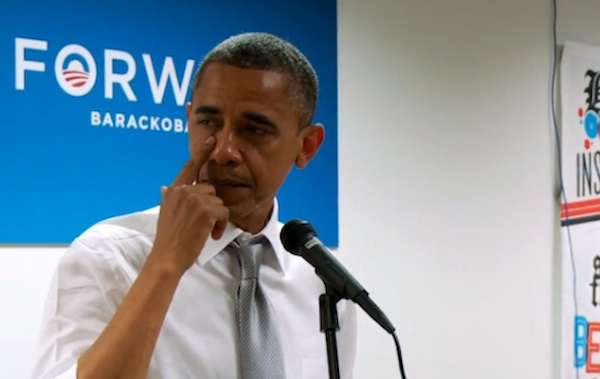
A couple of days ago, an exhausted and emotional President Obama visited privately with some of his campaign workers and reportedly got pretty choked up. At one point, the president’s tears began to flow.

For some reason, the White House decided to release this rare footage, despite the fact that it was recorded at an event the media was not allowed to attend.

The reaction? Pundits across the globe praised the president’s candor, his show of genuine appreciation. In fact, President Obama’s crying video has gone viral, attracting more than 1.7 million hits on the campaign’s You Tube channel.

Now let’s compare this to the public reaction from just two years ago, when Republican House Speaker John Boehner cried while being interviewed on 60 Minutes about his new role as Speaker of the House…..well, you remember, right?

Here’s what Bill Maher had to say:

“Did you see the new speaker of the House John Boeher cry? He cries a lot. Mr. Boehner you’ve got to stop crying. For one, your tan is going to run. And what’s he going to do if he loses next time? Put on a Bjork record and cut himself?”

Over the last few days, media pundits and amateur pundits on Facebook have been telling us that it is time for cooperation. It is time for the GOP to brush off its brutal losses and begin working with the Democrats. To steal a phrase, It’s time to put people before politics.

For my part, I am trying. I really am. Check the letter I wrote to President Obama on the day after the election.

But it’s damn hard to accept the media’s blatant hypocrisy. Furthermore, why is it so bad for a man… a strong man, or any man for that matter– to cry? Is it a sign of weakness?

Both Obama and Boehner were captured in honest moments of raw emotional expression. The ability to appropriately express your emotion…whether it’s grief, joy or some hidden pain is generally a sign of good mental health. Do we really want our nation’s leaders bottling up their emotions?

Now, here’s a test. Watch this video and see if it makes you cry….even just a little. I dare ya.

My friends and family know that I cannot watch this scene without crying like a baby. If I were a Democrat, I suppose that would be an endearing quality. But if I am a Republican, I best prepare for some intense criticism.

It will be a lot easier for our nation to heal, if we can just move beyond some of the hypocrisy.

Dear Mr. President

The letter I wrote to President Barack Obama on November 7, 2012:

Dear Mr. President:

First and foremost, please allow me to extend my most sincere congratulations on your hard-fought victory for a second term as our nation’s president.

Before I proceed further, I think it is appropriate that I disclose I did not vote for you, either in 2008 or yesterday. That said, I respect your office and believe you are a decent man who is committed to moving our nation forward to a better future.

I am writing you tonight to share a few thoughts and some unsolicited advice, knowing full well that it is highly unlikely you will read this note.

In essence, Mr. President, I believe you now have a rare opportunity with a second term. You have been unshackled from the constraints of re-election concerns, and I am hoping you will at least consider some of my points.

Although I applaud your efforts to tackle the complexities of our nation’s health care system, I have deep reservations about the individual mandate portion of the Patient Protection and Affordable Care Act.  I encourage you to consider pushing for the so-called “public option” as an enhancement to your signature piece of legislation.

Why would a Republican urge you to consider a public option? Because I believe that we must continue looking at innovative ways to contain skyrocketing costs and improve quality of care. As it stands, I see this legislation as a giant gift to the same industry that created the “health insurance” nightmare. A public option would, at least, provide us with the comfort that our government mandates health coverage but not payment to a myopic, for-profit industry.

Yes, I understand the limitations of public policy development, and I can appreciate the value of sincere compromise. But I believe a public option would require private insurance companies to remain competitive instead of giving them a giant gift of additional revenue sources.

Secondly, I would like to see you tackle the immigration issue with the same clarity and conviction you displayed two years ago in your fight to repair our nation’s health care system. I would favor a system that rewards hard-working people who wish to become citizens of our great nation without tolerating those who intentionally attempt to elude the system.

Certainly, we have the technology and means to streamline the naturalization process, and we should be encouraging and welcoming more people to participate in our system of government rather than focusing so much of our time and financial resources in pursuit of a punitive process that yields so few benefits.

Finally, I hope that you and your administration will focus more of your efforts on our sluggish economy and our crushing national debt. We all know that too many Americans are in deep despair and facing serious and significant financial hardships. I urge you to be mindful of these implications as you consider each and every policy initiative that comes across
your desk.

A few months before I was born, President Kennedy urged his fellow citizens to ask themselves what they could do for their country, not what their country could do for them.

I want you to know, Mr. President, that I stand ready to accept that challenge; to further commit myself to working with my neighbors and all fellow citizens for the betterment of our nation.  I reject the idea of living in fear and constant anxiety about an uncertain future. I stand ready and able to help you and every other American who is willing to work on behalf of our country.

Although I will continue to criticize some of your ideas and policies, please rest assured that I will also stand shoulder-to-shoulder with you at all other times.

I sincerely hope that you are able to receive my words as they are intended, and I hope that this correspondence finds you, the First Lady and your two beautiful daughters safe and content.

Respectfully,

I get knocked down, but I get up again

Here’s a post-2012 Election tip for my friends in Biddeford:

Don’t bet against Mayor Alan Casavant.

Casavant

Sure, I know…Casavant narrowly lost his bid for a fourth and final term in the Maine House of Representatives for the District 137 seat on Tuesday night.

While Republican Bill Guay certainly deserves a lot of credit for his win, it’s far too early for Casavant’s detractors to begin celebrating and waiting for his eventual ouster from the mayor’s office next year.

Why?

Because Casavant’s numbers actually showed improvement.

First, let’s remember that Casavant won his first bid for the mayor’s office in a landslide last year, capturing more than 62 percent of the vote against a well-known incumbent.

Let’s also remember that Casavant was the anti-casino candidate in a city that overwhelmingly wanted a casino, which was being championed by Casavant’s opponent.

Let’s also not forget that Casavant won three consecutive terms to the Maine House., nor forget that he trounced his House seat challenger in the June 12 Democratic Primary.

Before we get to the numbers here, it should also be noted that the city’s voters overwhelmingly rejected three proposed municipal bond projects and that the city’s taxpayers just got hit a few months ago with a heavy tax increase.

Guay

Logic would suggest that Casavant should be political toast. Under his watch, Biddeford taxpayers took a big hit.

Furthermore, House District 137 is actually composed of Biddeford’s coastal neighborhoods and the town of Kennebunkport, a Republican community if there ever was one.

Last year, when he made his first run for mayor, Casavant decimated his opponent in Ward One by earning 727 votes.

One year later, in his next bid for office, Casavant received 871 votes in Ward One, a better than 20% improvement.

In fact, when just considering the city of Biddeford, Casavant beat his opponent, 1667-1,030….nothing to sneeze at, folks.

Casavant’s detractors were overjoyed when they learned of his narrow defeat on Tuesday night. City Councilor Melissa Bednarowski clapped her hands like a little girl who just got a pony for Christmas, and fellow Democrat State Senator Nancy Sullivan — who is soon to be termed out of office and was defeated by Casavant in the June 2012 Democratic primary — chortled at her table in the Wonderbar restaurant on Election night.

Is Casavant’s loss to Bill Guay on Tuesday a sign of things to come? I asked Sullivan. “I think so,” she replied.

“Would you run against him as mayor next year?” I asked.

“I don’t know,” Sullivan replied, leaning forward from her table. “As they say, I don’t have any plans, but I’m not ruling anything out.”

It should be noted that Sullivan is certainly not happy with me, especially since I called her out earlier this year for a rather nasty attack ad she ran against Casavant during the primary.

“I remember,” she told me, her eyes narrowing on my jugular…”and I will get even.”

Wow, I thought. Here’s a woman I once described as petty and vindictive, saying she will “get even” with someone who had the temerity to criticize her.

People before politics? Hardly. Personalities above all else? You betcha.

Sullivan

Sullivan, a lifelong Democrat, would rather see a Republican win than a fellow Democrat who beat her in the primary. understandable, I suppose…sort of like former Mayor Joanne Twomey, another vindictive and particularly nasty politician from Biddeford.

In February, just months after being humiliated by Casavant in her bid for a third mayoral term, Twomey was at the city’s Democratic Caucus meeting, telling members of her party how she was the real Democrat. And here I thought she was just trying to make a political comeback by challenging fellow Democrat Paulette Beaudoin for the District 135 House seat. Democrats ultimately  stuck with Beaudoin.

And Twomey? She put up a lawn sign for Beaudoin’s Republican opponent. Hmmm…real Democrats vote for Republicans. I get it.

I wish Mr. Guay the best of luck. By all accounts, he is a decent, well-respected, hard-working man. He seems like a natural fit for a citizen Legislature.

My only advice for Mr. Guay? Watch out for some of those Biddeford Democrats! They can be vicious.

Then again, they may be some of your strongest allies.

Play that funky music, white boy!

The city of Biddeford is a lot of things; among them it is a college town that is home to the University of New England, a liberal arts college nestled along the banks of the Saco River.

In numerous conversations this evening with city election clerks and poll workers, I heard repeated stories about record voter turnout and incredible same-day voter registration statistics among UNE students.

It’s nice to see our nation’s young people get involved in politics, I only wish they actually cared a bit more about the community that serves as their temporary home.

Why do I say this? Why am I so callous?

Well, maybe it’s because I think college students, especially, ought to be a bit more “educated” on issues of national, state and local importance. Our nation’s college students represent our future. They are the up and coming leaders of tomorrow, but apparently can’t be bothered to invest a small measure of time in their host community.

How do I know this? Just look at the 2012 Election Results.

Even with a perfunctory review of the numbers, it becomes quickly apparent that the students cared about only two issues: the presidential election and a statewide referendum question regarding marriage equality.

UNE is located in Biddeford’s Ward One, the predominantly coastal and more affluent section of the city.

In Ward One, 1,445 voters cast ballots regarding Marriage Equality, not including 59 blank ballots.

In Ward One, 1,496 voters cast ballots to choose the next president, not including 8 blanks.

But what happened when these voters were asked about who should be their state representative in the Maine Legislature?

Hmmm…. there were 97 blank ballots

How about the Maine Senate? 173 blanks

How about Local Bond Questions regarding road pavements? 228 blanks

How about the local school budget? 138 blanks.

Ok, so maybe most voters don’t drill down that far…but let’s compare the number of blanks on those election issues against some other neighborhoods in the same city, like my neighborhood…

State Senate: 72 blanks (a difference of 99 fewer blank votes compared to Ward One)

Paving Bond: 143 blanks (a difference of 85 fewer blank votes)

Local School Budget: 69 blanks (a difference of 99 fewer blank votes)

Across the board, Ward One had a higher number of blank ballots than any of the city’s other six voting wards (both in actual numbers and as a percent of totals)

For better or worse, Biddeford Mayor Alan Casavant is also serving as a representative in the Maine House of Representatives. He is a Democrat. He lost by a margin of just 8 votes to his Republican challenger. Wow…what if just a few more students had cast a vote in that race???

Many of the students, including a young woman from the neighboring town of Kennebunk, used only their UNE student ID as a means of proving residency in Biddeford. But they did have to swear an oath to certify that they had not voted anywhere else.

Out of curiosity, how is it that college students who can wait in line 36 hours for the latest I-Phone or score coveted Dave Matthews concert tickets months before a scheduled concert not be able to register for voting until the actual day of the election?

Nah, it couldn’t be they want to wait until the last possible minute in order to avoid scrutiny. They really do care what’s happening in the world. They just forgot that Election Day was creeping up on them.

Maybe we should require you to register to vote when you buy an I-Phone or some concert tickets. Wouldn’t that be convenient? Then they would not have to rent so many passenger vans to vote. Then they would not have to put such a strain on our strapped city resources. Then, maybe these educated kids might be able to fill out the entire ballot.

You may call me a dreamer, but I’m not the only one.